Archive for Featured

Padres Keep Building and Borrowing, Add Craig Kimbrel

Right at the deadline, A.J. Preller managed to squeeze in one more major transaction before the dawn of the regular season. We can say that, now, the Padres’ 2014-2015 offseason is complete; we can say that, now, the Padres’ 2014-2015 offseason also includes Craig Kimbrel. He will, presumably, be available to the team for Opening Day. It’s a little different from the usual roster additions made around this time.

The whole of the deal:

Padres get

  • Craig Kimbrel
  • Melvin Upton

Braves get

For the Braves, it’s a totally understandable and justifiable move — not only do they get to shed the rest of the Upton contract, but Kimbrel meant relatively little to them as an elite-level closer on a basement-level team. The cost savings here are significant, and they can shortly be put toward assets that might be of greater help in the window in which the Braves plan to be good again. Also, Wisler! Wisler could be of help in said window.

For the Padres, it fits with a lot of the rest of the offseason. Kimbrel isn’t exactly a one-year player, since he could be under contract through 2018, but the team’s paying a high price again, borrowing from future talent and future flexibility to make the 2015 roster stronger. That goal has been met — without question, the Padres have taken another step forward. Now we all just get to find out whether this collection of talent can come together and push for something beyond a 162nd game.

Read the rest of this entry »


Evaluating the Prospects: Kansas City Royals

Evaluating the Prospects: Rangers, Rockies, D’Backs, Twins, Astros, Cubs, Reds, Phillies, Rays, Mets, Padres, Marlins, Nationals, Red Sox, White Sox, Orioles, Yankees, Braves, Athletics, Angels, Dodgers, Blue Jays, Tigers, Cardinals, Brewers, Indians, Mariners, Pirates, Royals & Giants

Top 200 Prospects Content Index

Scouting Explained: Introduction, Hitting Pt 1 Pt 2 Pt 3 Pt 4 Pt 5 Pt 6

Draft Rankings: 2015, 2016 & 2017

International Coverage: 2015 July 2nd Parts One, Two & Three, 2016 July 2nd

The Royals have done very well with their recent high picks, snagging prospects 2, 7, 8, 11 and 16 in the top three rounds of last summer’s draft, prospects 1 and 6 in the first round in 2013, and prospects 4, 23 and 27 with their first three picks in 2012. To have 10 of 12 picks in the top three rounds over a three-year period appear on the list is and have 7 of those be 45 FV of higher prospects is an accomplishment. Even though all those prospects won’t return significant big league value, retaining some trade value is important and draft picks often flop quickly, so GM Dayton Moore has to appreciate having trade chips accruing this quickly.

Raul Mondesi was a real find for the international group, as he wasn’t the consensus prospect his bonus suggest when he signed. Miguel Almonte and Jorge Bonifaco are great international finds for lower bonuses and there’s depth to the international prospects in the system. While some of this amateur procurement is due to a larger amateur budget in some years, there have been more stringent league-wide controls in recent years and the Royals have continued to produce at an above average rate.

This is a big year for many bats in the system, with Orlando Calixte, Cheslor Cuthbert, Hunter Dozier, Jorge Bonifacio, Christian Colon, Raul Mondesi and Bubba Starling all having big ceiling and need to improve at turning their tools into production to keep their prospect status/trade value. The performance of these hitters in 2015 will likely decide if the system will be seen as better or worse at this time next year; they’re in the middle third of teams at this point.

Read the rest of this entry »


FanGraphs 2015 Staff Predictions

Before the season’s soft opening on Sunday night and grand opening on Monday, we are compelled to to offer you our staff predictions. We attempted to pull in as many of our authors as possible from across our family of blogs, because the only thing better than predictions is predictions by a ton of people!

We’re usually not so good at this sort of thing. Or, more to the point, we’re not any better at it than anyone else. But we enjoy doing it, because it marks the start of a new season. Last season was no different. Boston and Oakland were pegged as division winners, and Tampa Bay was pegged as a Wild Card. Prince Fielder and Jason Kipnis got MVP nods, and Xander Bogaerts got plenty of Rookie of the Year love. Only Boston as a division winner really sticks out as hilarious, but all of these missed the mark by a great deal. Nevertheless, we press on! We also conducted a more in-depth staff survey, and we’ll dig into that on Monday morning.

American League Postseason Teams
East: Boston (20), Baltimore (7), Toronto (7), New York (2), Tampa Bay (2)
Central: Cleveland (24), Detroit (14), Chicago (0), Kansas City (0), Minnesota (0)
West: Los Angeles (22), Seattle (14), Oakland (2), Houston (0), Texas (0)
Wild Card: Seattle (12), Toronto (10), Detroit (9), Chicago (6), Oakland (4), New York (1), Tampa Bay (1), Boston (14), Cleveland (11), Los Angeles (7)

The AL East is wide open enough that every team got a vote, something that didn’t happen in either the 2013 or 2014 editions of our staff predictions, in any division. Outside of that, the divisions are fairly unininteresting aside from the two votes for Oakland. Note that the three consensus division winners are listed at the end of the Wild Card votes, since it would be confusing if they won multiple things.

Even though you’re good enough at math to add up totals from division and wild card winners, let’s total up and check out who the overall postseason favorites are.

Read the rest of this entry »


Division Preview: NL East

We’ve moved our from the west — both NL and the AL — and covered both the NL and AL Wests the last two days. Today, we’ll do both eastern divisions, starting with the National League.

The Projected Standings

Team Wins Losses Division Wild Card World Series
Nationals 94 68 86% 8% 17%
Mets 81 81 7% 23% 1%
Marlins 81 81 6% 20% 1%
Braves 73 89 1% 3% 0%
Phillies 66 96 0% 0% 0%

The easiest division in baseball to handicap. The favorites just have to avoid implosion to punch their ticket to the postseason, with only two teams even pretending to put up a fight, and neither one looking quite ready for the postseason yet. The fight for second place could be a Wild Card battle, but more likely, there is only one playoff team here, and it’s probably going to be the one we’d all expect.

Read the rest of this entry »


2015 Positional Power Rankings: Relief Pitchers (#1-15)

What do we have here? For an explanation of this series, please read this introductory post. As noted in that introduction, the data below is a hybrid projection of the ZIPS and Steamer systems, with playing time determined through depth charts created by our team of authors. The rankings are based on aggregate projected WAR for each team at a given position.

Yes, we know WAR is imperfect and there is more to player value than is wrapped up in that single projection, but for the purposes of talking about a team’s strengths and weaknesses, it is a useful tool. Also, the author writing this post did not move your team down ten spots in order to make you angry. We don’t hate your team. I promise.

2015-positional-power-rankings-relievers

Look, I understand full well this is probably the least-anticipated part of the series. This is a look at only half of the teams, and it’s looking just at relievers, who pale in perceived importance relative to starters. Also contributing to this is the idea that relievers, and therefore bullpens, are almost hopelessly capricious and unpredictable. I’ll grant you that to a certain extent, but it’s also exaggerated — we have a decent idea of reliever and bullpen talent. Relievers don’t get injured a million times more often than starters. The biggest thing is that, because of the limited single-season reliever sample sizes, there’s just room for more variation around true talent. But that doesn’t mean we can’t have good forecasts. This is a worthwhile endeavor, and sometimes a strong or weak bullpen can make all the difference to a team’s postseason chances. Come with me on a journey! It is a journey with numbers and words, where we discuss the best of the projected bullpens.

Read the rest of this entry »


Evaluating the Prospects: Pittsburgh Pirates

Evaluating the Prospects: Rangers, Rockies, D’Backs, Twins, Astros, Cubs, Reds, Phillies, Rays, Mets, Padres, Marlins, Nationals, Red Sox, White Sox, Orioles, Yankees, Braves, Athletics, Angels, Dodgers, Blue Jays, Tigers, Cardinals, Brewers, Indians, Mariners & Pirates

Top 200 Prospects Content Index

Scouting Explained: Introduction, Hitting Pt 1 Pt 2 Pt 3 Pt 4 Pt 5 Pt 6

Amateur Coverage: 2015 Draft Rankings, 2015 July 2 Top Prospects

With 31 players listed, the Pirates system is one of the deeper ones in the game, though a number of the guys listed below already have or will get big league looks next year. That’s obviously better than having the depth be at the low levels since the point of a system is to produce big league players, it just means the list may be less deep a year or two from now.

The Pirates do a nice job in Latin America, with the current regime led by Rene Gayo signing Starling Marte, Gregory Polanco, Dilson Herrera, Alen Hanson and Harold Ramirez, of the 45 FV or better types.  The Pirates spent big in the draft in the years leading up to the bonus pools, but have a lower bar to clear on draft expectations with the big league team’s recent success and the bonus pool system limiting the outlay for domestic prospects.

The last five 1st rounders Pittsburgh has signed (Cole Tucker, Austin Meadows, Reese McGuire, Gerrit Cole and Jameson Taillon) all have returned positively so far and the big league team’s success is proving to block some MLB-ready prospects, so the organization is in a healthy place after decades in the wilderness.

Read the rest of this entry »


2015 Positional Power Rankings: Relief Pitchers (#16-30)

What do we have here? For an explanation of this series, please read this introductory post. As noted in that introduction, the data below is a hybrid projection of the ZIPS and Steamer systems, with playing time determined through depth charts created by our team of authors. The rankings are based on aggregate projected WAR for each team at a given position.

Yes, we know WAR is imperfect and there is more to player value than is wrapped up in that single projection, but for the purposes of talking about a team’s strengths and weaknesses, it is a useful tool. Also, the author writing this post did not move your team down ten spots in order to make you angry. We don’t hate your team. I promise.

The rankings of power being conducted by this site have almost concluded. Today, we turn our attention to relief pitchers. We begin by turning our attention, specifically, to this graph:

RP Graph, Teams 16 to 30

Included here are the bullpens which feature the 16th to 30th most power in the major leagues. Jeff Sullivan will consider Nos. 1-15 later in the morning. Or, he probably will, at least. One oughtn’t get in the habit of assuming that everything will work out nicely. As Werner Herzog has almost certainly said at some point, disaster is inevitable.

Now, relief pitchers!

Read the rest of this entry »


2015 Positional Power Rankings: Starting Rotations (#1-15)

What do we have here? For an explanation of this series, please read this introductory post. As noted in that introduction, the data below is a hybrid projection of the ZIPS and Steamer systems, with playing time determined through depth charts created by our team of authors. The rankings are based on aggregate projected WAR for each team at a given position.

Yes, we know WAR is imperfect and there is more to player value than is wrapped up in that single projection, but for the purposes of talking about a team’s strengths and weaknesses, it is a useful tool. Also, the author writing this post did not move your team down ten spots in order to make you angry. We don’t hate your team. I promise.

2015-positional-power-rankings-SP

Read the rest of this entry »


2015 Positional Power Rankings: Starting Rotations (#16-30)

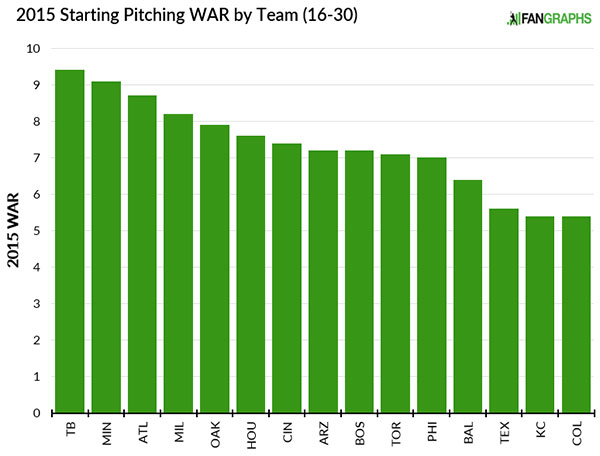
What do we have here? For an explanation of this series, please read this introductory post. As noted in that introduction, the data below is a hybrid projection of the ZIPS and Steamer systems, with playing time determined through depth charts created by our team of authors. The rankings are based on aggregate projected WAR for each team at a given position.

Yes, we know WAR is imperfect and there is more to player value than is wrapped up in that single projection, but for the purposes of talking about a team’s strengths and weaknesses, it is a useful tool. Also, the author writing this post did not move your team down ten spots in order to make you angry. We don’t hate your team. I promise.

2015_fangraphs_startingpitchers_war_projection_16-30

As we get into the back half of the starting rotations, that chart would look a whole lot better for the teams on the right side if you chose to willfully ignore that there’s 15 teams better than them not even shown here. This is where the pitching’s going to get a little dark. I’m tempted to just go with “it doesn’t matter, they’re all going to get hurt anyway and one day we’ll all be dead,” but that seems a little too bleak. Still, it’s sort of how you feel relying on any pitcher these days. Right? No? Just me? Okay, fine. Read the rest of this entry »


Division Preview: AL West

Yesterday, we kicked off our look at each division by going through the NL West. Today, we’ll do the AL version from the land of pitcher’s parks.

The Projected Standings

Team Wins Losses Division Wild Card World Series
Mariners 88 74 45% 25% 9%
Angels 87 75 36% 27% 8%
Athletics 83 79 14% 21% 3%
Astros 78 84 5% 9% 1%
Rangers 73 89 1% 2% 0%

There are two pretty strong contenders at the top, two somewhat interesting teams hanging around the middle, and a likely also-ran. The top of the AL West is unlikely to be as strong this year as it was a year ago, but the low-end of the division should be somewhat better, and the race is open enough to remain interesting all year long. Let’s take a look at the teams.

Read the rest of this entry »