Archive for History

Did WAR Ruin the MVP Conversation?

Brad Penner-USA TODAY Sports

On Wednesday, I wrote about one of my favorite topics: The impact of sabermetrics on the practice and analysis of baseball. Specifically, in this case: How MVP voters behave in the post-Fire Joe Morgan era. And for those of you who got to the end of that 2,000-word post and did not feel sated, there’s good news! This was not the question I actually set out to answer when I started kicking the topic around.

Welcome to Part 2.

The very name of the MVP award invites voters to consider the value of a certain player’s contributions. For nearly 100 years, that was a tricky proposition. How do you weigh differences in position, in playing style, park factors, hitting versus pitching versus fielding versus baserunning? It’s enough to boggle the mind. Read the rest of this entry »


Did Sabermetrics Ruin the MVP Conversation?

Kirby Lee-Imagn Images

Next Thursday night, we’re going to find out who won the biggest individual honors in baseball: the Most Valuable Player awards for both the American and National Leagues, as determined by the august and esteemed voters of the Baseball Writers’ Association of America. (Cue trumpet fanfare.)

MVP awards memorialize great individual performances and bestow immense historical significance upon the players who earn them. This is the kind of thing Hall of Fame cases are built on. So you’d think the entire baseball-watching public would be glued to MLB Network or refreshing the BBWAA website on Thursday evening. But… maybe not. Aaron Judge and Shohei Ohtani are almost certain to win, and I guess it’s worth checking social media after dinner just to make sure.

There’s surprisingly little drama over awards these days; postseason betting odds on the MVP races were a little hard to come by, as most bookies have taken the issue off the board. But consider this as a measure of public sentiment: In early October, BetMGM had Judge as a 1-to-50 favorite in the AL, and Ohtani as a 1-to-100 favorite in the NL. Despite a spirited contrarian push by the pro-Fancisco Lindor camp late in the season, it’s all over but the shouting. Read the rest of this entry »


For Chris Sale, Could 200 Wins Be the New 300?

Brett Davis-USA TODAY Sports

Chris Sale is a serious Cy Young contender. This was once a fairly common combination of words to put together, but after five years of injuries and/or ineffectiveness, it seems like a very weird thing to say today. That’s where we are, though, with Sale striking out 82 batters against 10 walks over his 11 starts and 67 2/3 innings. He leads all NL starters in FIP (2.48), walks per nine innings (1.33), and strikeout-to-walk ratio (8.20); he ranks fourth in strikeouts per nine (10.91), sixth in pitcher WAR (1.9), and 12th in ERA (3.06), though both his excellent FIP and xERA (2.73, third in NL) suggest his actual mark could improve as the season goes on. And for subscribers to the old school, he’s posted an 8-1 record for the Braves, a top contender who lost their ace for the season. Indeed, Atlanta’s offseason gamble to trade for Sale is paying off well so far, and his resurgence have been paramount in preventing the Braves from falling even farther behind the Phillies in the NL East standings.

But what hasn’t been revived yet is any talk about Sale’s chances of making a run at Cooperstown immortality in another decade or so. That’s not surprising, given he lost a good chunk of his mid-career years and stands at only 128 wins and 1,848 1/3 innings — volume that wouldn’t get it done for even the most dominant of starters on a per-inning basis. We’ve long accepted that 300-game winners were going to be increasingly unlikely, but what if 200 becomes the new standard? If Sale truly has reemerged from five years in the injury wasteland, suddenly his Hall of Fame case looks at least plausible.

The 300-win standard never actually was a standard for Hall of Fame voting until relatively recently. Barely a quarter of Hall of Fame pitchers are 300-game winners and a quarter of them (six of 24) exclusively played in the 19th century, when baseball was as much a carnival show as professional sport. From 1917 to 1965, nearly a half-century that included baseball’s peak in the context of American culture, there were never more than three future 300-win pitchers active at any point. In most of those years, baseball had only one or two active pitchers who would eventually hit that threshold, typically a combination of Lefty Grove, Early Wynn, and Warren Spahn. It’s not as if this was an era in baseball history that lacked for Hall of Fame pitchers; slightly more than half of AL/NL Hall of Famers had the majority of their careers within that span of years.

To get a clearer picture, I took all starting pitchers (at least 50% of games as starters) and tracked how many per year got at least 10% support on the BBWAA’s Hall of Fame ballot. It’s not completely an apples-to-apples comparison because the rules have changed at times, but it’s not apples-to-grenades either, as the BBWAA rules have been more stable than the various Veterans Committee schemes.

The stinginess trend toward pitchers is clear. Without a lot of 300-win pitchers to vote on, voters didn’t simply shrug and decide that no pitchers were good enough; they were quite happy to vote for lots of pitchers who failed to get 300 wins, or even 250. From 1936 to 1975, the 10-election rolling average of pitchers with fewer than 200 wins to reach that 10% threshold was 2.5. A pitcher with fewer than 200 wins hasn’t received 10% of the vote since Don Newcombe in 1980. This is despite early voters having the deepest pools of players to vote for; even as Hall of Fame voting started in 1936 and players hung on ballots for 15 years instead of the current 10-year window, voters found room for these pitchers with less impressive win totals.

The 90s cluster of pitching greats are either in the Hall of Fame or off the ballot, so unless voting patterns become more like they were before the 1970s, we may have a real lack of pitchers inducted into the Hall of Fame in the coming years. That process has already started, with only 17 different pitchers ever getting 10% of the vote in 21st-century balloting. There are three active pitchers with 200 wins: Justin Verlander, Max Scherzer, and Clayton Kershaw. There’s also Zack Greinke, who at age 40 has probably thrown his last big league inning, even though he has not yet officially retired and remains unsigned. It seems very likely that all four will get into the Hall of Fame. But then what? Pitcher usage has changed considerably since that quartet debuted. Right now, there are only 11 other active pitchers with 100 (!) career wins, and none between 150 and 200.

Active Pitchers with 100 Career Wins
Player W Debut
1 Justin Verlander 260 2005
2 Max Scherzer 214 2008
3 Clayton Kershaw 210 2008
4 Gerrit Cole 145 2013
5 Johnny Cueto 144 2008
6 Lance Lynn 138 2011
7 Charlie Morton 133 2008
8 Chris Sale 128 2010
9 Carlos Carrasco 109 2009
10 Kyle Gibson 108 2013
11 Wade Miley 108 2011
12 Yu Darvish 107 2012
13 Sonny Gray 105 2013
14 Dallas Keuchel 103 2012

Aside from the previously mentioned quartet, only Sale and Gerrit Cole have ever really come up in future Hall of Fame conversations, though Yu Darvish has an interesting-but-tricky case if voters give consideration to his seven years pitching in Japan. For the first time in ZiPS history, ZiPS doesn’t project a single pitcher who hasn’t already eclipsed 200 wins to have at least a 50% shot of reaching the milestone. Considering this, Sale has an fascinating path to the Hall of Fame. For the most part, the writers still aren’t voting for pitchers without lofty win totals, but it has become clear that the fixation on pitcher wins has decreased in Cy Young voting. This could provide an interesting preview of where Hall of Fame voting is going to be over the next 5-10 years, because year-end voters don’t have the same 10-year requirement for BBWAA membership that Hall of Fame voting does. As a result, you tend to get a younger demographic participating in year-end awards voting, and at least some of those writers will be gaining their Hall of Fame vote between now and when Sale hits the ballot. Additionally, some of the most veteran writers aren’t as active in the year-end voting, as some of them are in a state of semi or full retirement but have maintained their Hall vote. In a contrast the younger writers, some of these senior BBWAA members will lose their vote over the next 5-10 years. Call it the Baseball Writing Circle of Life.

Considering this, let’s crank up ZiPS (Hey, you had to know I was going to do this at some point!) and look at Sale’s up-to-date projections. As discussed at the top of this post, Sale has been excellent in 2024 and, just as importantly, he’s been healthy.

ZiPS Projection – Chris Sale
Year W L ERA G GS IP H ER HR BB SO ERA+ WAR
2025 14 7 3.48 31 31 168.0 152 65 22 40 203 125 3.7
2026 12 7 3.78 28 28 147.7 142 62 21 38 171 115 2.8
2027 10 7 4.14 25 25 130.3 135 60 20 36 144 105 2.0
2028 8 7 4.58 22 22 110.0 121 56 19 34 117 95 1.2
2029 6 6 5.11 18 18 86.3 102 49 17 31 88 85 0.5

Even with ZiPS projecting Sale to be only healthy-ish rather than to have a late-career renaissance like Verlander, that’s another 50 wins and 10 WAR, and with the rest of 2024 added in, 58 wins and 12 WAR. That would bring his total career projection to 186 wins and 62 WAR. Excluding the quartet of Verlander, Scherzer, Kershaw, and Greinke, that’d place Sale second among active pitchers in both wins and WAR, behind only Cole. As far 200 wins go, ZiPS projects Sale to have a 45% chance to reach that milestone, and if 200 becomes the new 300, then he’s got a 45% shot at making it to Cooperstown. Obviously, it’s not that simple, but Sale might not need to get to 200 wins to get elected. When voters look at Sale’s Hall of Fame case, they’ll consider his utter dominance during his best seasons — an eight-season peak from 2012-19 — and, should his health hold up at least to the level that ZiPS projects, he’ll likely go down as one of the very best pitchers during the two-decade era from 2010-2030. That would probably be enough to get him over the hump even if he falls short of 200. This chart tells the story.

Top Pitchers by WAR, 2012-2019
Name W L IP K/9 BB/9 HR/9 ERA WAR
Max Scherzer 134 54 1673.0 11.3 2.2 1.0 2.93 48.5
Clayton Kershaw 122 46 1558.1 9.9 1.7 0.7 2.24 47.3
Chris Sale 105 70 1535.1 11.1 2.0 1.0 3.05 42.8
Justin Verlander 118 72 1666.2 9.7 2.4 1.0 3.16 40.6
Corey Kluber 98 58 1337.1 9.8 1.9 0.9 3.14 34.6
Zack Greinke 129 50 1592.1 8.4 1.9 0.9 2.98 33.2
Stephen Strasburg 106 54 1346.2 10.6 2.4 0.9 3.21 33.2
Jacob deGrom 66 49 1101.2 10.3 2.2 0.8 2.62 31.5
David Price 109 54 1454.1 9.0 2.0 0.9 3.28 31.2
Gerrit Cole 94 52 1195.0 10.1 2.4 0.9 3.22 28.8
Jose Quintana 83 77 1485.0 7.9 2.5 0.9 3.72 28.2
Cole Hamels 89 67 1533.1 8.6 2.8 1.0 3.44 27.9
Jon Lester 114 74 1580.0 8.3 2.6 1.0 3.58 27.7
Madison Bumgarner 99 73 1520.1 8.9 2.1 1.0 3.14 25.4
Gio González 92 67 1366.0 8.7 3.5 0.7 3.58 25.3
Lance Lynn 97 67 1308.0 8.8 3.4 0.8 3.60 23.2
Jake Arrieta 90 61 1249.2 8.4 2.9 0.9 3.51 23.2
Adam Wainwright 96 60 1229.1 7.7 2.4 0.8 3.68 22.6
Félix Hernández 84 69 1341.1 8.5 2.6 1.0 3.60 22.5
Carlos Carrasco 75 54 982.2 10.0 2.1 1.0 3.60 22.2

It’s not as if Sale’s career is missing those non-statistical highlights. While his postseason performances have been short of cromulence, he does have a World Series ring, six All-Star selections so far, and is already 27th all-time in Cy Young career shares.

Will Sale actually end up in the Hall of Fame? We’ll have to wait until he finishes writing the last handful of chapters, which is sometimes a difficult task. But I think the final story may be better than many people think.


When Throwers Have to Run

Bill Streicher-USA TODAY Sports

In the ninth inning of Monday night’s game against the Phillies, Rockies catcher Elias Díaz doubled off Jeff Hoffman with two outs, nobody on, and the game tied 1-1. That put Rockies manager Bud Black in a bit of a pickle. With a runner on second, a single would score the go-ahead run, and Colorado’s best hitter — Nolan Jones — was at the plate. If a single were ever going to come, it would come now.

Rather, a single would score a normal runner from second. Unfortunately, Díaz is slow. He’s in the first percentile for sprint speed. He’s so slow, when he puts a pork shoulder in the crockpot it’s done cooking by the time he comes back from the pantry with the barbecue sauce.

If Black wanted to get that run in from second with a single, he had one of two options. First, call a cab. Second, call for a pinch-runner. Read the rest of this entry »


Say Goodbye to Hollywood: A Tribute to Cole Hamels

Ed Szczepanski-USA TODAY Sports

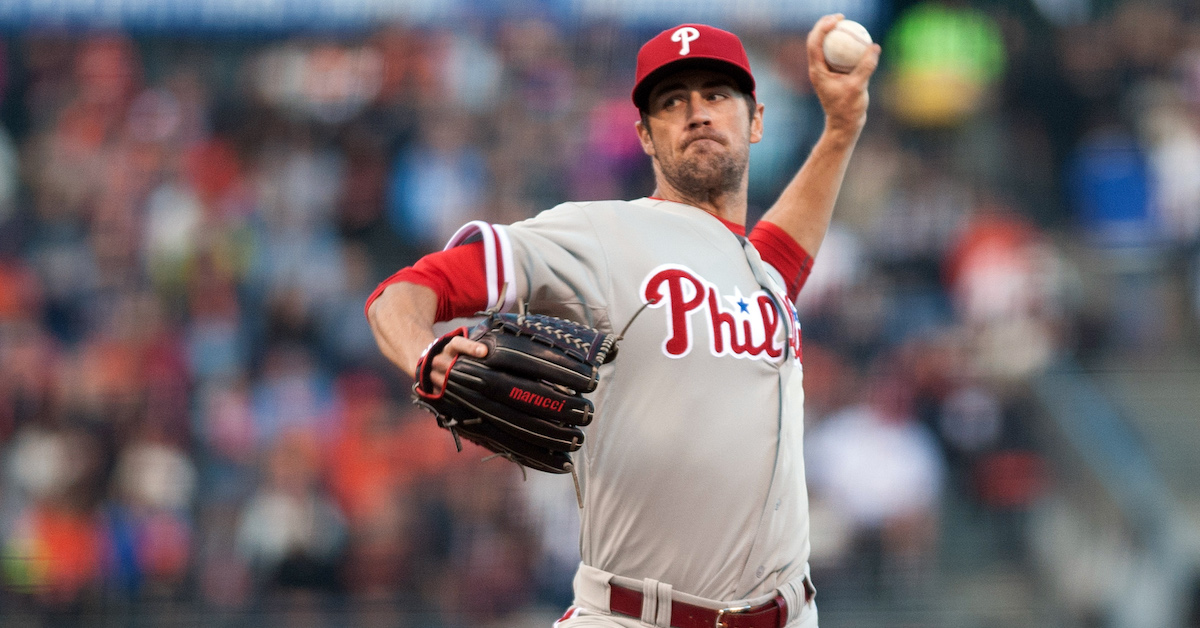
Cole Hamels retired from baseball on Friday, causing significant consternation to people who read that headline and thought they’d been transported back in time to the winter of 2019. (Buy a house now, while you still can, and be sure to stock up on hand sanitizer.)

It’s been four years since Hamels pitched effectively in the major leagues; before the 2020 season, he signed a one-year deal with the Atlanta Braves, and was limited to just 3 1/3 innings by injuries to his triceps and shoulder. Two further comeback attempts, with the Dodgers and his hometown Padres, came to nothing. Hamels never quite recovered from a 2021 surgery to repair a torn rotator cuff, and was still unable to throw without pain when he decided, at age 39, that he’d finally had enough.

Hamels, the 2008 NLCS and World Series MVP, will probably appear on just one Hall of Fame ballot. But few players’ reputations suffered more by comparison to their immediate surroundings than Hamels’ did; he was one or two breaks from giving a speech in Cooperstown someday, even if nobody realized it at the time. Read the rest of this entry »


Save Our Precious Endangered Triple

Michael Chow/The Republic / USA TODAY NETWORK

By and large, the new rule set for this season has led to more exciting baseball. Stolen bases are more common than they’ve been at any point this century. The average time of game is down more than half an hour from its peak in 2021, and lower than it’s been in almost 40 years. There’s less dead time between pitches and fewer annoying delays.

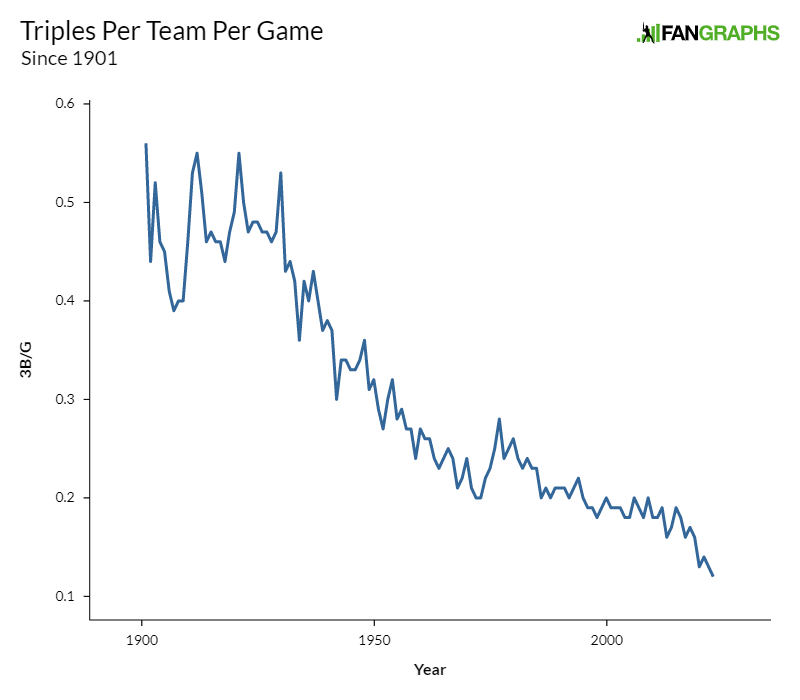
But as much as these rules represent a considered effort to goose the entertainment value of the sport, there wasn’t a mechanism to preserve baseball’s most exciting play: the triple. So concurrent with a rise in stolen bases, we’re down to 0.12 triples per team per game. According to the historical data on Baseball Reference, that’s an all-time low:

Read the rest of this entry »


A Journey Through the History of MLB Mascots

It all began with Mr. Met.

The orb-headed, future enemy of Noah Syndergaard, was the first modern mascot of a major league team to appear live in-game, rather than merely as a drawing or on printed marketing materials. Other teams, like the Brooklyn Dodgers, had employed entertainers who became unofficial mascots for their clubs, but Mr. Met represents the first case of an intentionally designed character becoming an in-person mascot. Mr. Met first debuted in print in 1963; he was heavily featured in the team’s preseason marketing and was portrayed on scorecards and in programs throughout the year. In 1964, he made his first live appearance. He remained a consistent part of the team’s iconography until 1979, when he was removed from use; the character remained on the bench until 1994.

What Mr. Met represented was a modern-era shift for baseball. Fans had traditionally been a more raucous crowd that consisted primarily of adults, and teams at the time were making an effort to appeal more to families. The presence of large, cartoonish characters made ballparks feel like a more welcoming environment for those attending with small children. Mr. Met, who was quickly joined by Mrs. Met, ushered in a new experience, and over the following decades, almost every major league team followed suit, adding their own mascots to entertain game-day fans.

We can give Mr. Met credit for being the first official live mascot of a major league team, but another character set the tone for some of the most popular mascots to follow: the San Diego Chicken. The Chicken is an interesting example of a team representative because the San Diego Padres did not set out to find or create an entertainer for their games. The Chicken, played by Ted Giannoulas, originally did events for KGB-FM Radio. Upon having some success distributing Easter eggs to children, Giannoulas pitched his services to the Padres. At the time, he just wanted a way to get into games for free, but after his 1977 debut, he went on to portray the character for almost 50 years, albeit with a few breaks over the decades. For instance, in 1979, he was fired from the radio station and had to fight for the right to wear the chicken suit, and there were a few other planned absences as well. But those gaps aside, the Chicken was quite popular, even making its way to television, where, alongside Johnny Bench and Tommy Lasorda, it served as the co-host of a popular children’s series called “The Baseball Bunch,” a program aimed at introducing baseball and its players to a younger audience.

The Chicken popularized a certain type of mascot. You can see aspects of it in almost all of the other mascots in the majors. Its big, child-friendly, stuffed animal look became the template from which the next generation of mascots were drawn. That aesthetic is probably best exhibited in the Phillie Phanatic, who debuted in 1978 and is likely the best-known and most recognizable mascot currently in the game.

There’s a simple reason these more child-friendly designs gained popularity — they worked. Some teams had made much earlier attempts at mascots, but they were frankly more horrifying than they were appealing, proving to be disquieting to both adults and children. The Chicago Cubs made efforts as far back as 1908, when they introduced a nameless bear mascot that might remind modern observers more of the finale of Midsommar than a rollicking good time at the ballpark. Unlike Mr. Met, the bear wasn’t a mascot in the traditional sense. The team had no intention of him appearing for the entire season. Indeed, he actually only came to amuse the crowd for a single game. (The polar bear costume was on loan from a local production of “The Top o’ th’ World.”)

The Cubs did win the World Series the season that the terror bear made an appearance, so perhaps they should have kept it around a bit longer. Instead, the team switched to live bear cubs for a time, including the best-known of the group, a cub named Joa (named for Cubs co-owner J. Ogden Armour). Again, we can’t consider these mascots in the same way we think of them now, as they didn’t perform and generally caused more harm than good. Ultimately, though, it wasn’t the moral failing of keeping a live animal on display that forced the Cubs to change their policy on the actual cubs, but rather that the pint-sized bears kept biting people, including the players. Sadly, the cubs who were not sold to the Lincoln Park Zoo met slightly grimmer ends. (The team’s current mascot, Clark, canonically escaped the zoo after hearing enthusiastic hollering coming from Wrigley Field and deciding he desperately needed to see a game in person. Mascot biographies are a wild ride.)

Between the introduction of Mr. Met in the 1960s and the mid-80s establishment of “The Baseball Bunch,” almost every major league club got a mascot of its own. While official mascots have changed somewhat over the decades, they’re still a mainstay for most teams. At present, there are only three major league teams with no official mascot: the Los Angeles Angels, the Los Angeles Dodgers, and the New York Yankees. Given that the two Los Angeles-based teams are so close to Disneyland, it’s somewhat surprising that they haven’t embraced a costume-clad ambassador of their own, but they remain firmly mascotless. The Angels do have a rally monkey, but it’s not an official mascot as much as a part of the club’s iconography. Before they moved to Los Angeles, the Dodgers briefly had a mascot named Weary Willie, who we’ll return to a bit later. The Yankees, however, might have one of the best examples of a failed mascot of any major league team.

In 1979, without any advanced warning to fans or even a proper introduction, the Yankees unveiled Dandy. Unlike the Cubs’ first crack at a mascot, Dandy was actually pretty adorable. He had more in common with the round-bodied characters we see now, with a big belly and fur that resembled the iconic Yankee pinstripes. Dandy sported a long, red handlebar mustache, and carried a comically oversized bat. But the mascot’s initial welcome was anything but warm. According to Rick Ford, who wore the Dandy costume that first day, “Nobody had any idea what I was or what I was doing there. They just looked at me like, ‘What the hell is this thing?’”

Dandy had the right pedigree to be a beloved team icon. He was created by Bonnie Erickson and Wayde Harrison, the same masterminds behind the incredibly popular Phanatic, and had the same kind of goofy charm to his appearance. But he never resonated with Yankees fans. No one knew the character’s name and he was never given an official welcome. Erickson later confessed that the duo hadn’t really been given much direction in terms of what the Yankees actually wanted out of a mascot. “We knew they were interested in increasing family attendance, and they thought this was the way to do it. They left the design up to me.” In addition to not giving Erickson and Harrison much guidance in the design process, the Yankees didn’t offer much help to Ford in terms of how to be a mascot. “Nobody at the Yankees gave me any direction. I was just making it up as I went along,” he admitted.

Dandy’s poor conception and botched introduction might have spelled doom on their own, but it was likely the untimely death of Thurman Munson later in 1979 that ultimately brought an end to the mascot. While Erickson was not familiar with the Yankees catcher, there’s no way to dispute that Dandy, with his distinctive mustache, bore a striking resemblance to the beloved player. Following Munson’s passing, Dandy became an even more unwelcome presence. While Ford continued to don the costume for another two seasons, the character was quietly retired by the team by 1981. The Yankees have not attempted a mascot since, and there are few in the current front office who will acknowledge they ever had one.

The Yankees aren’t the only team that would like to bury the memory of a mascot. Earlier, I mentioned Brooklyn Dodgers mascot Weary Willie, who was actually something of an icon during his heyday. Willie, as portrayed by Emmett Kelly, was a sad-faced clown who was meant to be a representation of a Depression-era hobo. He rose to fame during his tenure with Ringling Brothers Circus, but took the 1956 season off from the circus to clown for the Dodgers. While Mr. Met represents the earliest iteration of modern mascots (at least as recognized by MLB), Willie helped set the tone for how mascots engage with a crowd and keep things exciting amidst lulls in the game action. Willie was not considered a mascot by the team but rather in-game entertainment. While we think of those things going hand-in-hand now, it’s a slight distinction that keeps Mr. Met’s status as the first of his kind intact.

During the 1950s, when the Dodgers were still based in Brooklyn and bore the nickname of “dem bums,” it made sense to have a hobo character as a comical foil to entertain fans mid-game. Kelly, who often also joined the team for spring training, moved with them to Los Angeles, but ultimately left after the 1962 season, feeling that the Dodgers new home was simply “too big for one clown.” It’s likely best that Kelly’s tenure ended on his own terms, as it’s hard to imagine that such a character would have been appropriate on-field fodder for much longer.

It’s the Atlanta Braves, though, that might have the worst former mascot in modern baseball history. The team, which still comes under fire for its name, as well as the oft-discussed “Tomahawk Chop” performed by the crowd, once leaned even further into racial stereotypes in the form of their mascot. Today’s fans might be most familiar with Blooper, the club’s current mascot that was introduced in 2018, and those around in the 1970s and early 80s might recall the Bleacher Creature, who roamed the stands from 1977-81. But it’s the memory of Chief Noc-A-Homa that the organization would likely prefer to forget. Chief Noc-A-Homa pre-dated and also outlasted the Bleacher Creature, staying with the team from 1966-85. Notably, the Chief character, who had a tepee set up in the left-field seats, was not in a suit or oversized costume, but was played by a real person dressed as a Native American chief. Chief Noc-A-Homa was primarily portrayed by an actual Native American, with Levi Walker playing the part for over a decade. In 1983, the Braves also briefly added Princess Win-A-Lotta to the rotation, but she only lasted for one season.

Noc-A-Homa didn’t stir up much controversy at the time in the local Atlanta media, though he was mentioned in Russell Means’ 1972 lawsuit against the Cleveland Indians as being equally as problematic as Chief Wahoo. Walker went on the radio during the lawsuit to defend himself as well as the Cleveland organization, and ultimately the Noc-A-Homa character remained in place. After the 1985 season, Walker made it clear that the $60 per game he was making to play the mascot wasn’t enough, and rather than increasing his pay, the club decided to part ways with him, citing missed appearances. (Walker also admitted that he had asked out several female fans while on the job, one of whom turned out to be the daughter of a Braves executive.) The team did not recast the role, and in spite of fans who had grown superstitious about Chief Noc-A-Homa’s presence and a grassroots campaign in 1991 to bring him back during the Braves’ postseason push, the mascot hasn’t returned. With the benefit of hindsight, though, it’s clear why the Braves didn’t want to bring Walker back in 1991 (or at any time since) and why the team hasn’t used the “Screaming Indian” logo since it last appeared on a batting practice cap in 2012, though much like the Chief Wahoo design, MLB retains the right to use the logo. Many professional sports teams are finally responding to pressure from Indigenous groups to change outdated and racist team names, and those that do so seem to want to create distance between their current policies and the choices they made in the past. The Braves have a long way to go in this regard. They have not indicated any long-term plans to adopt a new name, and despite outside pressure, they have not eliminated the “Tomahawk Chop.” The team still dims the lights during opposing pitching changes, which prompts fans to light up their cell phones and participate in the longstanding, and troubling, tradition.

As some mascots have fallen out use, their broader role has continued to evolve over the years. We now find ourselves in a time where professional sports mascots can mean more to a team than just in-game amusement for the kids in attendance. The New York Times recently reported on how the branding for the Rocket City Trash Pandas helped generate $4 million in sales of merchandise featuring team mascot Sproket. Considering that even the most valuable minor league teams earn about $15 million a season in total revenue, earning $4 million in merchandise sales shows the incredible power of having a good mascot.

The value of mascots to clubs may be shifting as time progresses, and we’re seeing some teams achieve moments of pop culture relevance via their performers and branding. The Trash Pandas might not have the same reach outside of their sport as the Philadelphia Fliers do with Gritty, their giant orange monster who has transcended hockey to be his own entity, but the popularity of Sproket helped make the Trash Pandas a success before they’d won a single game. Mascots may primarily be used to appeal to children and get crowds amped up during games, but they can also impact a club’s bottom line.

There have been stumbles along the way, with teams learning from the growing pains of their off-putting or downright scary creations. Sometimes those missteps have led to teams abandoning mascots altogether, as the Yankees have done. Other teams have moved on from mascots with overtly racist overtones, replacing them with characters more in line with the style of the San Diego Chicken, as the Braves have done with Blooper. Mascots can be a charming part of the fan experience, but like all other aspects of baseball history, they are not without their failings, and it’s important to recognize the bad along with the good. And while mascots may be meant to appeal mostly to children, they also bring out the kid in all of us.


The Canadian Roots of Modern Baseball

I am an absolute sucker for baseball history. Hours upon hours have been lost to deep dives into the SABR Bio Project or the spiraling wormhole that is Wikipedia. It’s amazing what little nuggets of strange-but-true ephemera you can unearth as you sink into over a hundred years of baseball. If you’ve watched Ken Burns: Baseball, you’ll know that even 10 episodes is not enough time to cover the breadth of what the sport is and what it has achieved.

Because the game’s history is so rich and expansive, there’s a habit, as with all history, to pick and choose the aspects of the historical record that best fit with the present tone. We may have even been convinced it started with Abner Doubleday, as popular myth has long-contended. But as it turns out not even Doubleday himself ever made any such claim, and in digging into the roots of where baseball really began, I found that the answer might fall much further north than previously believed, with a game in Ontario, Canada, that may just be the first game of baseball ever played in North America.

If you look at the origins of baseball, it is generally believed that the first game took place in Cooperstown, New York, in 1839. An account from Abner Graves was the source for this claim, but there are a lot of issues when you approach it with any real historical method. For one, Abner Doubleday never visited Cooperstown and definitely did not do so in 1839, when he was attending West Point. Add to this that Abner Graves was only five years old in 1839, and that in his later years he was confined to a ward for the criminally insane after murdering his wife, and you might begin to understand why we perhaps should not take his version of history at face value.

As I researched Canadian baseball’s history for another piece, I came across a mention of a story about a game very similar to baseball, played in Beachville, Ontario. In an 1886 letter, Dr. Adam Enoch Ford recounted attending an event that “closely resembled our present national game” a full year before Doubleday was credited with inventing it. The game in question took place on June 4, 1838, and as you’ll see from the excerpts that follow, it may not be exactly baseball as we know it, but it’s definitely more like it than a game that never actually happened in Cooperstown in 1839. Read the rest of this entry »


A Conversation With 1960s Slugger Jim Gentile, Part Two

This is Part Two of an interview with Jim Gentile, who played for five teams, primarily the Baltimore Orioles, from 1957-1966. Part One can be found here.

——

David Laurila: You mentioned Boog Powell earlier. What can you tell me about him?

Jim Gentile: “You could tell when he was 18 years old that he had all the makings. I knew he was going to be a first baseman after I watched him, because he had great hands. They put him in left field when he came up with us — that would have been ’62 — and he did a real good job.

“I didn’t have a very good year in 1963, so I kind of knew they were going to make a trade. They signed Hank Bauer to be the manager. All of us that were living in Baltimore — Jackie Brandt, Milt Pappas, and myself — went down to the ballpark and met with Hank. He gave us a big talk. I was asked, ‘You gonna be ready for this year?’ I said, ‘Yeah.’ That night I get a phone call. I pick it up and [GM Lee] MacPhail says. ‘Jim, thank you for the great years you had with us. I just traded you to Kansas City. I think you’ll enjoy it.’”

Laurila: Were you surprised?

Gentile: “I was surprised I went to Kansas City — they usually made their deals with the Yankees — but I was lucky to meet a guy who became a dear friend of mine, Rocky Colavito. [Charlie] Finley said that he traded for the two of us because he wanted power. Well, it’s good to have power, but you’ve got to have pitching, too. A whole lot of clubs have proven that over the years. We weren’t very good. Anyway, I played there in ’64, and part of ’65. Last part of May, I was tied with Mickey Mantle for home runs, with 10, and Finley calls and tells me that I was sold to the Astros for $150,000, and two players [to be named later].” Read the rest of this entry »


A Conversation With 1960s Slugger Jim Gentile, Part One

Jim Gentile’s big-league career was filled with peaks and valleys. Short in duration — seven full seasons preceded by two cups of coffee — it was bookended by a lack of opportunity. In between, Gentile was a beast with the bat. From 1960-1964, the slugging first baseman logged a 139 wRC+ and made three All-Star teams. His 1961 campaign was Brobdingnagian. Playing for the Baltimore Orioles, “Diamond Jim” slashed .302/.423/.646 with 46 home runs and 141 RBIs — the last of those numbers being noteworthy for more reasons that one. Five decades later, it made his bank account just a little bit bigger.

Gentile — now 86 years young — reminisced about his bygone career over the phone earlier this summer.

———

David Laurila: You were signed out of (a San Francisco) high school by the Brooklyn Dodgers in 1952. What was that experience like for you?

Jim Gentile: “Well, we didn’t have a draft. Once you graduated, you hoped your phone rang. I knew I was going to get signed, it was just a matter of with who. I talked to the Yankees, the Red Sox, the Phillies, and then the Dodgers scout came over last. We had dinner with him at the house, and we liked their offer. I signed for a bonus of $30,000 with a Double-A contract. Once I got a big-league contract, I got $7,500 more.

“This was in June of ’52 and they said, ‘Let’s wait until ’53; then you can go out to spring training.’ So I was home, and around August they called and said that one of the pitchers in Santa Barbara — that was the California State League, Class C — had gotten hurt. Would I like to go down there and see what professional baseball was like?

“I walked into the clubhouse, and [manager] George Scherger met me. We talked, then he handed me a baseball and said, ‘You’re pitching tonight.’ [San Jose] had just signed two guys for $80,000, and Marty Keough for $125,000. They were all my age, but starting out in Class C. I pitched against them. I had a no-hitter for seven innings, then they beat me in the eighth inning, The score was 3-2.”

Laurila: So your first professional game went pretty well…

Gentile: “Yes, but after that it was ‘Get the married men off the infield,’ because they started hitting me all over the place. I won two and lost six. The two I won, I won with my own home runs, so when ’53 came around they asked if I wanted to pitch or play first. I said, ‘I really like to hit, so let’s try first base.’ They put me at first, and that’s where I stayed. Read the rest of this entry »