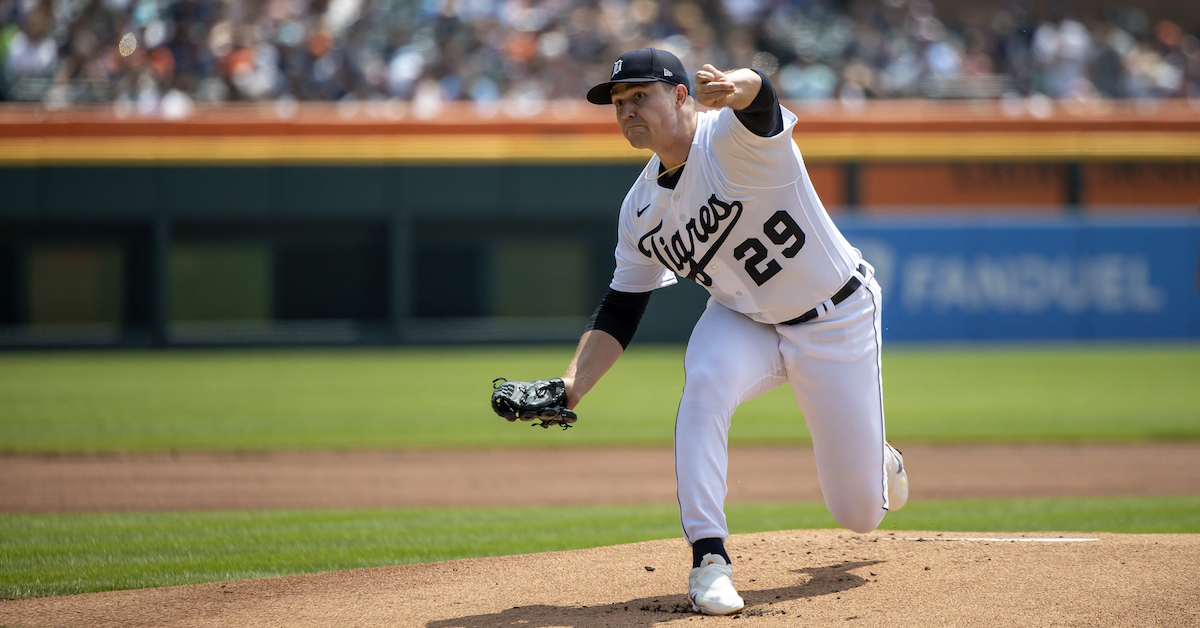
Keaton Winn is a rare big league pitcher, and not just because he’s the only one who grew up in Ollie, Iowa, with a population of 201 in the 2020 census. The 26-year-old San Francisco Giants right-hander’s primary pitch is a splitter, and by a significant margin. Through seven starts this season, Winn’s usage breakdown is 42.2% splitters, 23.3% four-seamers, 20.4% sinkers, and 14.1% sliders. No starter in baseball has thrown a higher percentage of splits this season.
With one notable exception, his atypical approach has yielded good results. Winn failed to get out of the first inning when he faced the Phillies in his most recent start, on May 4, but even with that turbulent outing — five runs in 2/3 frames — he has a respectable 4.41 ERA and a 3.97 FIP. In each of the three starts that preceded the debacle, he went six innings and allowed just one run. His next start is scheduled for this afternoon against the Rockies in Colorado, at 3:10 p.m. ET.
Winn’s mix was even more splitter heavy a year ago. He made his MLB debut last June and proceeded to throw his signature offering an eye-opening 55.1% of the time in 42 1/3 innings. It’s understandable that he would prioritize the pitch — last month, our prospect writers Eric Longenhagen and Travis Ice called Winn’s splitter “devastating… one of the nastier ones in pro ball” — even if such an approach is unprecedented among starters. San Francisco’s fifth-round pick in the 2017 draft out of Iowa Western Community College is anything but ordinary in the way he attacks hitters.
Winn discussed his splitter when the Giants played the Red Sox at Fenway Park earlier this month.
———
David Laurila: Let’s start with your full repertoire. What was it at the time you signed your first professional contract, and what is it now?
Keaton Winn: “When I signed it was four-seam, curveball, slider, and I maybe threw like five sinkers. No changeup. Now it is four-seamer, sinker, splitter, slider.”
Laurila: You obviously throw a ton of splitters. Given how much you rely on it, would it be fair to say that you’re probably not in the big leagues right now had you never developed a splitter?
Winn: “Yeah. That’s definitely crossed my mind before. I mean, I think I ultimately could have competed to get a role, but having the splitter made it so much easier.”
When I interviewed Marco Gonzales in spring training 2018, the now 32-year-old Pittsburgh Pirates southpaw was with the Seattle Mariners and about to establish himself as a solid big league starter. We discussed his return to health — he’d undergone Tommy John surgery two years prior — as well as his repertoire. We also touched on his approach on the mound, a subject we’d earlier addressed in a 2014 conversation when he was a St. Louis Cardinals pitching prospect. At the time, Gonzales was your prototypical crafty lefty, and he’s remained just that throughout his career.
The former Mariners’ player rep for the MLBPA has a lot of opinions on the game he’s played professionally since 2013, when the Cardinals drafted him 19th overall out of Gonzaga University. Not surprisingly, the increase in arm injuries is of particular interest, as is the pitch clock.
Gonzales, who has since landed on the 15-day injured list with a left forearm muscle strain, sat down to discuss those topics at Pittsburgh’s PNC Park earlier this month.
———
David Laurila: We talked back in 2018 when you were with the Mariners. Are you the same pitcher now that you were then?
Marco Gonzales: “No. You’re never the same pitcher you were, even if you think you are. You might have a similar identity — you always have an identity as a player — but you change physically, emotionally, mentally. Your maturity on the mound changes. Your thought process changes, and in turn, that changes what you can do on the mound.
“The pitches I throw haven’t added or subtracted, but how I think about them, how they move, and how I’ve used them has changed a lot. Year to year, week to week, there are changes. That’s part of baseball. For whatever reason, sometimes a pitch doesn’t come out the same way it usually does and you have to use it differently, or maybe manipulate it more.” Read the rest of this entry »
Kyle Hendricks has long been lauded as a cerebral pitcher, and for good reason. Nicknamed “The Professor,” the 34-year-old Chicago Cubs right-hander not only has an economics degree from Dartmouth College, he relies far more on guile than gas. The antithesis of your prototypical power arm, Hendricks subsists with a heater that sits in the second percentile for velocity. Moreover, he’s no spin monster in terms of breaking stuff. As he’ll readily admit, his four-pitch arsenal is sans a plus breaking ball.
His 2024 season is off to a slow start. Over five turbulent outings, Hendricks has surrendered 37 hits, including a league-worst eight round-trippers, seven walks and 28 runs across just 21 innings. Adjustments are in order, but that’s nothing new for the righty. An ability to adjust accordingly has gone a long way toward his career ledger, which coming into this year included an 84 ERA- and a 3.80 FIP, as well as stingy walk and home run rates. When push comes to shove, Hendricks has proven more than capable of outsmarting big league hitters.
Hendricks discussed his evolution as a pitcher and his overall M.O. on the mound during spring training.
———
David Laurila: How have analytics impacted your evolution as a pitcher?
Kyle Hendricks: “Analytics have changed a lot throughout my career, and I’ve had to learn a lot about them. I still don’t know a whole lot, to be honest with you. We have such a good support group behind me on the pitching side, and I rely heavily on them. I’ll go through all my work, throw my bullpens, etcetera, and they’re breaking down all the data, what everything looks like. So, the most it’s probably helped me with is consistency — consistency of pitch shapes, and action on my pitches.
“From there, I’ve always been a guy searching for a better curveball and how to spin a ball better. It definitely can help, just looking at the shape of my curveball, the spin overall, the spin efficiency. Things like that. Those have helped me put a good visual to what I’m searching for in a breaking ball.”
Spencer Arrighetti had just thrown a pair of impressive innings when I talked to him following a spring training start in Lakeland, Florida at the end of February. I admittedly didn’t know a ton about the 24-year-old at the time. I was aware that the Houston Astros had named him their 2023 Minor League Pitcher of the Year, and that he’d been taken in the sixth round of the 2021 draft out of the University of Louisiana at Lafayette, but that was mostly it. The only other thing I knew about Arrighetti — this from my perch in the press box — is that he throws a sweeper.
What I learned about the 6-foot-1, 205-pound righty from our postgame conversation is that he is anything but old school with how he approaches his craft. Analytics is Arrighetti’s second language, and when it comes to talking pitching, they are pretty much his first language. Now on the doorstep of the big leagues — he tossed 4 1/3 scoreless innings with the Triple-A Sugar Land Space Cowboys this past Friday — Arrighetti is a bona fide pitching nerd.
———
David Laurila: Are you into pitching analytics?
Spencer Arrighetti: “Absolutely. I was taught the data by the Astros, and they obviously know their stuff really well. I love the model that we have. I’ve definitely fallen in love with that aspect, so while the game itself is still more important, I fully acknowledge that we have the ability to train analytically now. We can use data to get better.”
Laurila: What have you learned about yourself since coming to pro ball?
Arrighetti: “I’d summarize it by saying that vertical approach angle is kind of indicative of how a pitch will perform. Fastballs are especially vertical-approach-angle dependent on where you should throw them. I’ve learned about that. I’ve also made an effort to improve vertical approach on my fastball, as well as improve spin axis and spin rates on my other pitches.
“There is also the usage data. I’ve found a really good way to utilize my pitch mix efficiently and effectively. Obviously, we’re always trying to fine tune that — the more you climb the ladder, the more it matters — and at this stage it’s especially important for me to have a concept of what’s going to be good against big league hitters.”
Laurila: Can a pitcher meaningfully improve approach angle, or is more a matter of optimizing what you have?
Arrighetti: “It’s a nice mix of both. You get special athletes who do special things, and there are certain things about a guy you won’t want to change, like his delivery. At the same time, you can absolutely chase it. I think I had a pretty decent vertical approach in college, and after being made aware of it, I made more of an effort to get behind and under the ball.
“We look at hop, and it matters a lot, but I don’t have good hop. My four-seam performs like it has hop, but it actually doesn’t have it. I throw it from… I like to call it ‘throwing it from the basement’ as opposed to throwing from above your head. That’s where you find the vertical approach that is more down to up. So, I think that you can make an effort to refine it. Obviously, you’re not going to take a guy that throws 100 [mph] with a steep vertical approach and tell him, ‘Hey, let’s try to flatten it out a little bit.’ You’re going to tell him, ‘Hey, throw 100. You’re fine.”
Laurila: Hand positioning at release plays into what you’re looking to do…
Arrighetti: “Absolutely. Edgertronic is pretty popular within the data room. You can see exactly where the ball is coming out of your hand, which gives you an idea of the timing of it. You adjust your wrist position based on that; you find that point on the ball where you want to be letting it go.”
Laurila: Have you altered any of your grips as a result?
Arrighetti: “I don’t throw a single pitch the same way that I threw it in college; I actually don’t throw many pitches the same way that I threw them in Low-A. We’ve been really good about finding grips and cues that complement my arm and the way I want to throw the ball. Because of that, I’ve been able to develop an arsenal that I’m really confident in. So yeah, I’ve made a lot of drastic changes — even this offseason. I made a big adjustment with my changeup grip. Grips are great until they’re not, and cues are also great until they’re not. When it’s time to adjust, you adjust. Sometimes the adjustment is big, and that’s OK.”
Laurila: Are any of your grips unique?
Arrighetti: “I would say that they are iterations of other pitches that guys throw really well. In general, the more that analytics have come along, the more we have a good idea of which grip will do what to the ball, and from what slot, horizontal approach, and vertical approach. So, not necessarily unique, but tailored to me.”
Laurila: Do you chase certain movement profiles?
Arrighetti: “Absolutely. I think everybody does.”
Laurila: Some guys claim they don’t…
Arrighetti: “The guys that claim they don’t are most likely guys who don’t love the data. Which is fine. There are big crowds of both. There are guys who think it has no place, and there are guys who think it rules everything. For the most part, I think guys generally fall somewhere in the middle. Personally, I’m probably right in the middle, even with my reverence for the work done in research and development.
“Data is a great tool if you’re open to using it. For the guys that don’t need it, that’s awesome. If you naturally have great shapes, that’s awesome. But I’ve found it very useful to use TrackMan and Edgertronic to fine tune the pitches I’m throwing. Everybody wants more hop on their fastball. Everybody wants more sweep on their sweeper. Everybody wants to throw really nasty stuff. So yeah, I would say I’ve been chasing movement profiles for a little while.”
Laurila: You threw some good sweepers today. Is that your best pitch?
Arrighetti: “I would say it’s my most confident pitch with a right-handed hitter in the box. And there is more to it than how much it moves. The point in space where the ball starts to move matters, as does having the ability to disguise your pitches. But while those things are important, for me, when it’s bigger it’s better. I typically look mostly at the actual amount of movement. Velocity as well, because I’m pretty good at spinning the ball. When I throw at a high spin rate, at high velo, I’m going to get big movement. That’s usually what I’m looking for.”
Laurila: What are the metrics on your sweeper?
Arrighetti: ““I get anywhere from 16 to 26 inches of sweep. I’ve actually gotten reps at 28, and while TrackMan is a little faulty sometimes with its setup, I like to believe that I’m capable of making it move that much. Today it was probably around 18 to 20. You also have to be able to adjust your lines with how much it’s moving. If I’m trying to throw it at a righty’s hip, I want 16, 18, 20. If I’m trying to throw it behind them, bigger than that. It will be closer to 78-79 [mph] when it’s big, and usually 80-82 when it’s smaller.”
Laurila: How do you go about adding or subtracting movement?
Arrighetti: “It’s very intent and leverage-based for me. If I find good leverage with the middle finger, which to me is… I don’t know if you’ve watched Matt Brash throw his, but he’s got one of the best sweepers in baseball. He tries to leverage the ball in his hand with a slight bias towards the side. I’ve found that doing that has helped me a lot. If I can find a seam, have that leverage, and feel the leverage at release, it’s going to be really good.”
Laurila: Do you feel that you comp to Brash?
Arrighetti: “No. If I were to comp myself on that pitch, I’m probably closer to Joe Ryan’s. In terms of sweepers that I love to watch and would like to model mine after, a guy in our org who does really great is Cristian Javier. His is the invisiball sometimes. It’s moving 20 inches with a little bit of induced vertical break at about 80 [mph].”
Laurila: How has your repertoire (four-seamer, sweeper, cutter, curveball, changeup) evolved since you signed?
Arrighetti: “I threw a pretty average four-seam, a really slow loopy curveball, a pretty fringe changeup, and a rifle slider. Really, the only one that’s similar now would be the rifle-spin pitch I throw, which I like to call a cutter.
“My changeup grip has probably changed the most. When I was in college it was a pretty standard circle that didn’t really complement the way I throw. I’m not very good at pronating, so I’ve shifted to more of a low-spin split changeup. I’ve seen a lot of progress with that, because I can keep the supinated wrist and pull through the ball a little bit harder from the top. I don’t really have to worry about turning it over much.”
Laurila: You mentioned spinning the ball well. Is that primarily with your breaking stuff?
Arrighetti: “I spin the fastball well, too. I’ve been up to 2,400 rpm, which is good post-sticky stuff crackdown. When guys were using stick, the really good ones were 2,800, 2,900, 3,000, which is unbelievable. I can spin a breaking ball 3,000, but I’ve never come close with a four-seam. My arm action is pretty whippy, which is usually good for spin rates.”
Laurila: Which of your breaking balls gets the most spin?
Arrighetti: “My curveball, which is more seam efficient than my sweeper. My sweeper is actually very not seam efficient. I’m trying to basically throw a two-seam the other way, if you will. Seam-shifted wake is a hot topic right now. It’s kind of hard to explain, but essentially, I don’t need spin efficiency or spin rate on the slider — but it helps it makes the ball appear white, which is useful.”
Laurila: Any final thoughts?
Arrighetti: “I’ve heard some guys throw around the term fake hop. That’s what we like to call induced vertical break hop. We kind of touched on this earlier. Looking at the TrackMan, my four-seam doesn’t have a lot of hop, but you have to look at the release height and the angle you’re throwing from. For a long time, I didn’t think my four-seam was anything special, and the Astros have made it really clear to me that it’s going to be a great weapon at the upper levels. That’s held true so far. Sometimes the data is a little tricky. You have to look at other numbers that maybe don’t jump off the page.”
Logan Webb was my pick for NL Cy Young last season, and while the prediction didn’t come to fruition, the San Francisco Giants right-hander did come close to capturing the honor — this despite an 11-13 record. (We’ve come a long way, haven’t we?) He finished second in the voting to Blake Snell, who is now his rotation mate, and while Webb’s major league-leading 216 innings certainly captured the attention of the electorate, many of his other numbers stood out as well. He ranked fourth among qualified National League pitchers in both ERA (3.25) and FIP (3.16), and his 1.29 walks per nine innings was second to none. Moreover, his 62.1% groundball rate was the highest in either league.
He hardly came out of nowhere. Webb was already good, as his stats over the past three seasons attest. Since the beginning of the 2021 campaign, he has a 3.07 ERA and a 3.00 FIP, and his signature sinker-changeup combination has been responsible for a 59.9% groundball rate. A comparably humble 23.1% strikeout rate over that span (21.4% last year) notwithstanding, the 27-year-old worm-killing workhorse is one of the best pitchers in the game.
Webb sat down to talk pitching at San Francisco’s spring training facility earlier this month. He’ll be on the mound later today when the Giants open the regular season in San Diego.
———
David Laurila: How have you evolved as a pitcher since coming to pro ball?
Logan Webb: “I’ve changed probably four different times. I was a sinker guy when I first started. Then I had Tommy John, and when I came back, so did the velo — it was back to the reason why I was drafted.”
Nolan Schanuel got to the big leagues in a hurry, and he wasted little time proving himself once he arrived. Called up less than six weeks after being drafted 11th overall last summer by the Los Angeles Angels out of Florida Atlantic University, the left-handed swinging first baseman hit safely in each of his first 10 games. Moreover, he reached base in all 29 games he appeared in and finished with a .402 OBP. Indicative of his calling cards — plus plate discipline and quality bat-to-ball skills — he drew 20 walks and fanned just 19 times in 132 plate appearances.
The one knock on his game is he doesn’t hit for much power. Schanuel homered just twice after reaching pro ball — once each in Double-A and the majors — and while that profile isn’t expected to change markedly, he did leave the yard 19 times in his final collegiate season. At 6-foot-4, 220 pounds, he also possesses the frame to become more of a long-ball threat as he further acclimates to big-league pitching. Just 22 years old (as of last month), he has plenty of time left to grow his game.
Schanuel talked hitting at the Angels’ Arizona spring training complex earlier this month.
———
David Laurila: It’s not uncommon for modern day players to identify as hitting nerds. In your opinion, what constitutes a hitting nerd?
Nolan Schanuel: “There are so many ways you can put it. I think it’s somebody that studies not only their own swing, but also other people’s swings, seeing what works for them. Growing up, I looked into dozens of swings. Barry Bonds, Ichiro [Suzuki] — seeing what works for them and kind of trying to put it into mine. So, I would say that being a hitting nerd is studying other people and kind of inserting some of what they do into themselves.”
Laurila: You just named two hitters with very different swings. Were you ever trying to emulate either of them?
Schanuel: “I wouldn’t say emulate. I would say that I tried to pick out pieces of what they did really well. I didn’t really know my swing when I was first doing this, so putting things into it kind of made it what it is today.”
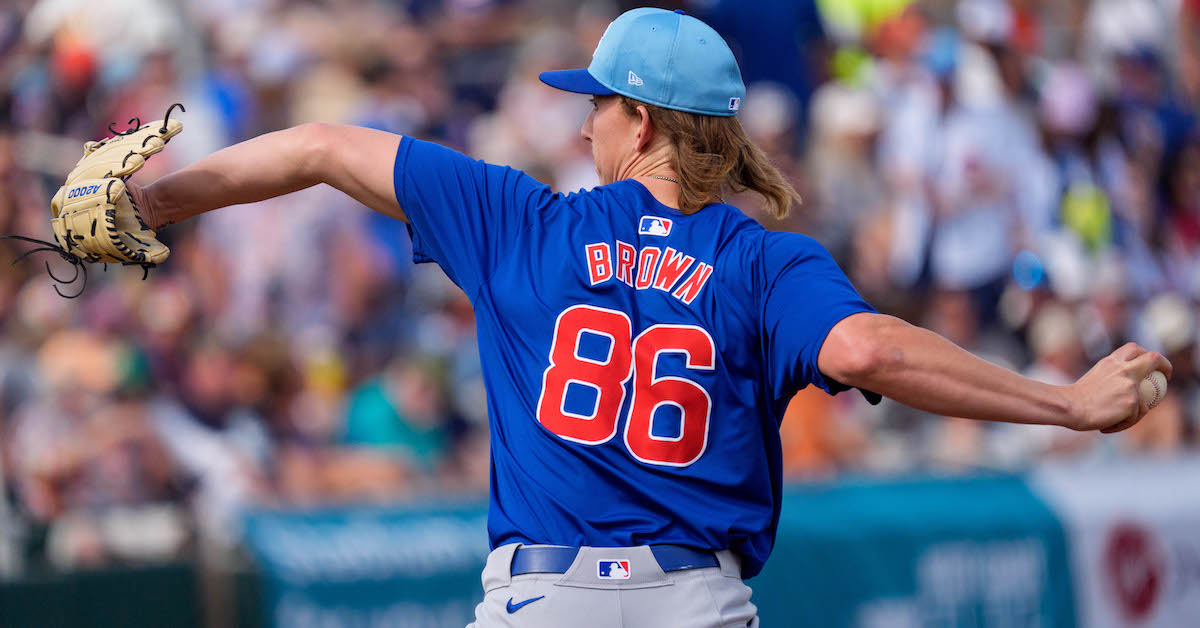
When Eric Longenhagen and Tess Taruskin blurbed Ben Brown in last month’s Names To Know: 100 More Relevant Prospects feature, they noted his “monster mid-90s fastball/breaking ball combo.” Power is the defining characteristic of Brown’s arsenal. The 24-year-old righty ranks among the top pitching prospects in the Chicago Cubs organization, and following an impressive in spring training, he is expected to make his big league debut in the forthcoming campaign.
Brown began coming into his own in 2022 — the year he was acquired by the Cubs from the Philadelphia Phillies in exchange for David Robertson — and he made further strides last year. Across 92.2 innings between Double-A Tennessee and Triple-A Iowa, the 6-foot-6 righty logged a 12.6 strikeout rate while holding opposing hitters to a .215 batting average. His command faltered at times — a health-related speed bump was a contributing factor — but the power remained a constant.
Brown discussed his repertoire and approach at the Cubs’ spring training facility in Mesa, Arizona last week.
———
David Laurila: You consider yourself a pitching nerd. How did that come about?
Ben Brown: “I’ve been one my entire life. I was coached really well growing up, but I also loved to watch YouTube videos of guys throwing. Roy Halladay. Josh Beckett. I was a big Red Sox fan, so I watched Beckett, Jon Lester, Daniel Bard, [Jonathan] Papelbon. I picked up a lot from that.
“I also spent some time at Driveline after I had Tommy John surgery [in 2019], and got introduced to that whole community in Seattle. I can be the hardest critic on myself, because I know what looks good, as well as the numbers you aspire for analytically. I feel like I’m pretty well versed on all that. And I’ve definitely had a lot of really good discussions with pitching coordinators and whatnot about analytics since getting traded over to the Cubs.”
Tarik Skubal is slated to take the mound for the Detroit Tigers on Opening Day when the season begins three weeks from Thursday. Four years into his big league career, the 27-year-old southpaw is emerging as one of the top left-handed starters in baseball. After missing the first three months of last season recovering from flexor tendon surgery, he was one of the best pitchers in baseball upon making his season debut, on July 4. Skubal fashioned a 2.80 ERA, a 2.00 FIP, and a 32.9% strikeout rate — as well as a stingy 4.5% walk rate and a .199 BAA — in 15 starts comprising 80 1/3 innings. His 3.3 WAR from July through the end of the season led all pitchers in that span. And there is reason to believe that he is still getting better, as he adds fastball velocity — he’s hit 99 mph this spring, up from his average of 95.8 mph last season — and fine tunes his five-pitch arsenal.
Skubal sat down to talk pitching at the Tigers’ spring training facility in Lakeland, Florida last week.
———
David Laurila: Looking at your numbers, I saw that your ground ball rate (51.6% last year) keeps getting higher and higher, and your walk rate keeps getting lower and lower. How have you made those things happen?
Tarik Skubal: “I think it all kind of just stems from confidence and the complete arsenal. When you can throw five pitches over the plate, in the zone, and just go right after guys, you tend to get more uncomfortable at-bats. If you can throw different pitches in different counts, hitters have to be a little bit defensive and aren’t getting their A swings off as often. That’s kind of my approach, and I think it impacts the results I’m getting.”
Zack Wheeler has arguably been the best pitcher in baseball over the past four seasons. Since joining the Philadelphia Phillies prior to the truncated 2020 campaign, the 33-year-old right-hander has made 101 starts and boasts a 3.06 ERA, a 2.90 FIP, and a 26.7% strikeout rate. Moreover, his 19.3 WAR over that span is tops among his contemporaries.
A thirst to continually get better has helped bring Wheeler to the pinnacle of his profession. Never entirely satisfied with the depth and quality of his arsenal, he’s always looking for a new edge, whether it’s an additional weapon or an upgrade to one already in his toolbox. Just last year he added a sweeper, and opposing hitters can expect to see yet another option when he takes the mound in 2024.
Wheeler discussed his growth as a pitcher, as well as his goals going forward, last week at the Phillies’ spring training complex in Clearwater.
———
David Laurila: How have you evolved as a pitcher over the years?
Zack Wheeler: “I’ve developed more pitches since I got drafted. Everything has gotten crisper. After my TJ [in 2015], I was able to gain some command, which I didn’t have before. So pairing the repertoire with command took me to that next level. Really, a lot of it has just been repetition and learning, and from there putting it all together.” Read the rest of this entry »
To understand why Baltimore Orioles shortstop Jackson Holliday is the no. 1 prospect on our Top 100 list, look no further than Eric Longenhagen and Tess Taruskin’s writeup of the 20-year-old phenom. They describe Holliday, the first overall pick in the 2022 draft, as “a sweet-swinging shortstop with above-average feel for contact and burgeoning power,” and close their evaluation by predicting that he “is very likely to become a 5-WAR shortstop who does everything well.” He has been spending time at second base this spring, because the O’s already have last year’s no. 1 overall prospect Gunnar Henderson at shortstop, but either way, stardom is seemingly in Holliday’s future.
That the promising youngster is the son of former big league slugger Matt Holliday is well known. It is also a primary factor in his advanced approach to hitting, as well as his overall understanding of his craft. Last season, which he began in Low-A and ended in Triple-A, the lefty-hitting Holliday produced a .323/.442/.499 slash line and 159 wRC+ across four levels of the minor leagues.
Holliday sat down to talk hitting over the weekend prior to a Grapefruit League game in Sarasota.
———
David Laurila: How do you approach hitting?
Jackson Holliday: “As far as guessing pitches… that’s not something I’m great at. But I really enjoy learning about swings — different guys’ swings — how they work, and little things that can help, like cues. My dad has been around baseball for so long, and is such a hitting guy, and I got that from him. But yeah, my approach is pretty simple. I try to stay in the middle of field, stay on my backside, and hit the heater.”
Laurila: Are you basically hunting fastballs and adjusting from there?
Holliday: “Yeah. I sit fastball. I don’t sit offspeed unless there is a real outlier. That’s something I learned from my dad. He would sit heater and try to hit it to the middle of the field. If you’re in a good spot to hit a fastball to the middle of the field you can adjust to the offspeed pitch a lot better than you can sitting offspeed and trying to hit a heater.”
Laurila: How hard is it to be diligent with that? There are going to be times where your subconscious brain tells you, “He’s not going to throw a fastball here.” Read the rest of this entry »