Archive for Q&As

Cubs Prospect Luke Little Is a Large Southpaw With Low-Slot Sweep

Luke Little
Matt Marton-USA TODAY Sports

Luke Little was an afterthought when our 2023 Chicago Cubs Top Prospects list came out in early July. Pitching for Double-A Tennessee at the time, the now–23-year-old southpaw garnered no more than an honorable mention on a list that ran 52 players deep. His stock has since risen markedly. By season’s end, he had earned a big league cup of coffee and thrown 6.2 scoreless innings over seven appearances. Featuring a high-octane heater and a sweeper delivered from a low arm slot, he fanned a dozen batters and allowed just five hits.

His numbers across three levels of the minor leagues were every bit as impressive. Over 36 appearances, all but four as a reliever, the 2020 fourth-round pick out of San Jacinto College had 105 strikeouts and surrendered 40 hits in 63.2 innings. He’s an imposing figure on the mound: The Charlotte, North Carolina native stands 6-foot-8 and weighs 270 pounds.

Little discussed his repertoire and delivery prior to a late-September game at Wrigley Field.

———

David Laurila: Who are you on the mound? For instance, do you identify as a power pitcher?

Luke Little: “I like to think I’m a power pitcher. Obviously, I throw hard. At the same time, I like to think that I have good offspeed pitches. I’ve been really comfortable with my slider, and I’ve also got a good feel for my splitter now, although I haven’t thrown it too much.”

Laurila: How hard are you throwing?

Little: “Last night [September 19 against the Pirates], I sat 97 [mph] with my fastball, and my slider was 81–82. I was up to 99 with my fastball at the beginning of the year, [which is] the hardest I’ve ever thrown, when I was a starter [with High-A South Bend].” Read the rest of this entry »


After Struggling Early, Nick Pivetta Rebounded for a Successful Season

Tommy Gilligan-USA TODAY Sports

Nick Pivetta had an intriguing and largely successful season. A starter to begin the year, the veteran right-hander was shifted to Boston’s bullpen in mid-May, only to return to the rotation a few months later and finish strong. Save for a smattering of rocky outings — mostly in the early going — he was actually solid throughout. All told, the 30-year-old Victoria, British Columbia native logged a 4.04 ERA and a 3.98 FIP over 142-and-two-thirds innings, the second-highest innings mark on the club.

He was often overpowering. Opposing hitters had a .207 BA and a .221 xBA versus his array of offerings, while his 31.2% strikeout rate ranked in the 93rd percentile among big league hurlers per Baseball Savant. An in-season addition to the Red Sox righty’s repertoire was especially effective: Pivetta posted a 44.4% whiff rate and allowed just a .114 BA and a .127 xBA on his sweeper.

Pivetta, who ended up making 16 starts and 22 relief appearances on the season, discussed his 2023 performance on the final week of September.

———

David Laurila: How would you assess your season as a whole?

Nick Pivetta: “I’d say it was good. I mean, I think I’ve handled the situation well. I’ve gone out and given my best effort — I’ve competed and put everything on the line for the organization — and that’s all I really focus on. I’m always making sure that I’m doing the best I can for the team.” Read the rest of this entry »

Spinning To Win, Chad Dallas Is Looking Toward Toronto

John E. Sokolowski-USA TODAY Sports

Chad Dallas emerged as one of the top under-the-radar pitching prospects in the Toronto Blue Jays organization this season. Tossing a system leading 123-and-third innings between High-A Vancouver and Double-A New Hampshire — 18 of his 23 starts came at the higher of the two levels — the 23-year-old right-hander went 9-3 with a 3.65 ERA and a 4.08 FIP. Featuring a spin-to-win five-pitch mix, he fanned 144 batters (also the most in the system) and allowed just 98 hits.

Dallas, Toronto’s fourth round pick in 2021 out of the University of Tennessee, discussed his breaker-heavy arsenal and approach when the New Hampshire Fisher Cats visited Portland, Maine earlier this summer.

———

David Laurila: What is your repertoire and M.O. on the mound?

Chad Dallas: “I throw a four-seam, a slider, a curveball, an occasional changeup, and I recently added a cutter. I spin the ball a lot. I don’t attack a whole bunch of people with the fastball. I like to attack with my offspeed, sort of a pitch backwards kind of deal. Some teams know that, so there are also games where they start sitting soft and I mostly attack them with the heater and the cutter. Either way, I’m out there trying to throw as many strikes as possible.” Read the rest of this entry »


Clarke Schmidt Addresses His Cutter and the Slider/Sweeper Conundrum

Jay Biggerstaff-USA TODAY Sports

Clarke Schmidt had mixed results in his first season as a big league starter. The 27-year-old New York Yankees right-hander took the mound 33 times (including once as a reliever) and won nine of 18 decisions while logging a 4.64 ERA and a 4.42 FIP. Working primarily in five- and six-inning stints — 21 of his outings were between 5.0 and 6.2 innings — he allowed 169 hits and fanned 149 batters over 159 frames.

A new pitch played prominently in what is now a well-balanced repertoire. Schmidt added a cutter this year, and while it wasn’t his best offering results-wise — that honor goes to his curveball — it was his most used. All told, his usage breakdown was 28.1% cutters, 27.4% slider/sweepers, 23.9% sinkers, 19.1% curveballs, and 1.5% changeups.

Thirteen months ago, I sat down with Schmidt to discuss his sweeping slider, a pitch that was referred to in the subsequently published piece as a “baby whirly.” This past September, I circled back to hear about his cutter — and I had something else in mind as well. With the definition of “sweeper” increasingly becoming a matter of debate, I wanted to know how he currently labels the most horizontal of his offerings.

———

David Laurila: What is the story behind your cutter?

Clarke Schmidt: “The reason they wanted me to add the cutter was lefties. The idea was that I could throw a fastball to lefties and be able to induce either A) weak contact or B) a swing-and-miss. That was the real reason, and then once I started throwing it we realized that my arm action was built even more for a cutter than they thought. The metrics on my cutter are really good. Analytically it became one of my best pitches, which is why they were like, ‘Why don’t we up the usage of this?’ Read the rest of this entry »


Phil Maton Revisits Spin (and Comes to Terms With Cut)

Phil Maton
Kevin Jairaj-USA TODAY Sports

Phil Maton can spin a baseball. His four-seamer averaged 2,563 rpm this season, and his signature curveball was an even-more-rotational 3,154. These weren’t new developments. The 30-year-old Houston Astros reliever has long been known for that attribute, with a July 2017 interview with the then-San Diego Padres rookie having served as its first detailed mention here at FanGraphs.

He’s also had a career-best year. In 68 regular-season appearances out of the Houston bullpen, Maton augmented his 4–3 record and one save with a 3.00 ERA, a 3.74 FIP, 74 strikeouts, and just 49 hits allowed in 66 innings. Moreover, October has once again been his friend. Thanks to a pair of scoreless outings in the ALDS, the righty boasts a 1.04 ERA over 16 career playoff appearances.

Maton revisited the importance of spin and discussed a meaningful change to the movement profile of his fastball when the Astros visited Fenway Park at the end of August.

———

David Laurila: Your spin rate was the primary topic when we first spoke six years ago. Now pure spin isn’t considered nearly as important. Do you agree?

Phil Maton: “I think that’s right. Over the years, organizations have figured out that it doesn’t tell the whole picture. There are guys with big breaking balls and hoppy heaters who don’t spin the ball particularly well. That’s where things like spin efficiencies come into play. We’ve identified guys where it’s the entry angle. There are so many different factors in what creates ‘a good pitch.’ Back in 2017, when the spin-rate phase was going on, everyone thought that was the answer. It’s much more complex than that.” Read the rest of this entry »


Tom McNamara Looks Back at the Seattle Mariners’ 2012 Draft

Mike Zunino
Ron Chenoy-USA TODAY Sports

Tom McNamara remembers the 2012 draft well. Now a Special Assistant to the General Manager with the Kansas City Royals, McNamara was then the Director of Amateur Scouting for a Seattle Mariners team that landed Mike Zunino with the third overall pick, this after the Houston Astros had tabbed Carlos Correa and the Minnesota Twins followed by taking Byron Buxton. Other first-round notables that year included Kevin Gausman to the Baltimore Orioles at four, Max Fried to the San Diego Padres at seven, and Corey Seager to the Los Angeles Dodgers at 18.

As is the case with every MLB draft, woulda-coulda-shoulda is in no short supply when you look back with 20/20 hindsight. Eight of the first 30 picks that year have never reached the majors, and a dozen more have yet to accumulate 10 WAR. It’s safe to say that numerous teams would go in a different direction if given an opportunity to do it all over again.

How might have things unfolded differently for the Mariners in 2012? McNamara shared some of his thoughts on that subject during a visit to Fenway Park in September.

———

David Laurila: Let’s start with a player you drafted but didn’t sign. You took Mike Yastrzemski in the 30th round out of Vanderbilt.

Tom McNamara: “Our area scout in the Northeast really liked him in high school. He got to know him, so we knew Mike’s makeup. I also knew how much the head coach at Vandy, Tim Corbin, liked him both as a player and a person. Mike didn’t put up loud numbers there in his junior season, but I remember going to our GM, Jack Zduriencik, and telling him there was a player still on the board I’d love to give a nice bonus to. We ended up offering Mike $300,000. I remember flying across the country and meeting him in Boston. It was Mike, his mom. his agent, his grandfather…”

Laurila: His grandfather being pretty notable.

McNamara: “Yeah. He was a pretty good player. I was always a big fan of Mike’s grandfather, even though I was from New York. And I think Mike was actually a little surprised with the offer we made him. He’s a great kid. He told me that he needed a day to think about it.

“I could tell that his grandfather kind of liked the fact that it was Seattle, that it was away from the Northeast. That’s understandable. When you’re Carl Yastrzemski’s grandson, there is a lot of pressure there. But Mike told me he had promised his family that he would finish school on time before he signed, and it’s pretty tough to put up a fight when a kid says that. There were definitely no hard feelings with him not signing with us. Looking back, the mistake we made was not drafting him the following year. We should have, because we knew him and we liked him as a player. Baltimore took him, I believe. The rest is history.” Read the rest of this entry »


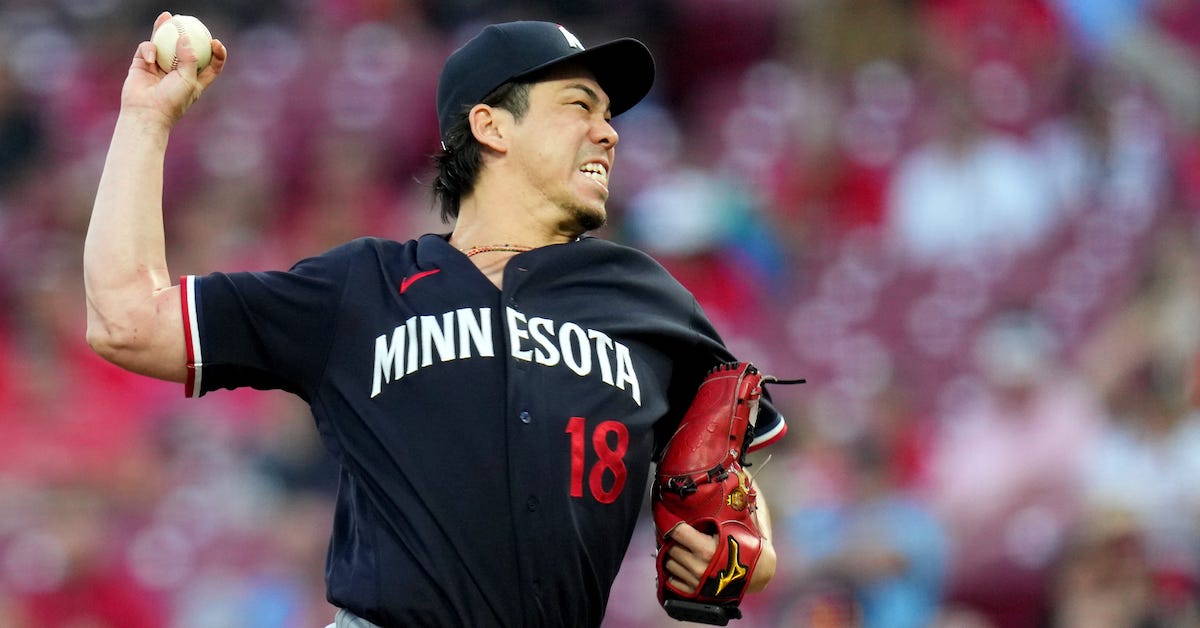
Kenta Maeda on Evolving as a Pitcher

Kareem Elgazzar/The Enquirer/USA TODAY NETWORK

Kenta Maeda has had a stellar career on two continents. Now in his seventh big league season — three with the Minnesota Twins preceded by four with the Los Angeles Dodgers — the 35-year-old erstwhile Hiroshima Carp has a 2.95 ERA and a 162-115 won-lost record between NPB and MLB. He’s been as good as ever in September. The Osaka native has been credited with a win in each of his last three decisions while allowing just four runs over 17-and-two-thirds innings. When he next takes the mound it will be with a 4.28 ERA and a 3.96 FIP on the year.

Maeda discussed his evolution as a pitcher, and offered some thoughts on NPB, when the postseason-bound Twins visited Cleveland earlier this month. Daichi Sekizaki served as an interpreter for the interview.

———

David Laurila: How much have you changed as a pitcher since coming over from Japan?

Kenta Maeda: “The first couple of years I was pretty much just myself; I was the same pitcher that I was in Japan. After pitching here for several years, I know what the different hitters’ weaknesses are and when they are getting on to me. I ironed some things out and made adjustments to become better, to become the pitcher that I am today.” Read the rest of this entry »


Justin Steele (and Tommy Hottovy) on Justin Steele

Justin Steele
Kevin Sousa-USA TODAY Sports

Justin Steele has an uncommon pitch profile and an uncomplicated approach to his craft. He also has an outside chance of capturing this year’s NL Cy Young award. With two starts remaining (one if the Cubs clinch a Wild Card berth prior to Sunday’s regular-season finale), the 28-year-old southpaw is 16–5 with a 3.00 ERA and a 2.99 FIP over 168 innings. He’s not only been Chicago’s best pitcher, but he’s also been one of the best in the Senior Circuit.

Steele’s emergence as a frontline starter was portended by last year’s performance. While his won-lost record was an anything-but-eye-catching 4–7, his 3.18 ERA and his 3.20 FIP weren’t notably higher than this year’s marks. Moreover, his strikeout and ground-ball rates were actually better, as were his xFIP and HR/9. His BABIP was nearly identical. The only meaningful difference, on paper, was his walk rate, which at 3.78 was essentially double this season’s 1.88.

Prior to his last outing — a game in which he was BABIP’d to death by six consecutive fourth-inning singles — I approached Steele in Wrigley Field’s home clubhouse to get his thoughts on what has been an outstanding season. The following day, I asked Cubs pitching coach Tommy Hottovy about the pitch characteristics that make Steele a Cy Young contender.

———

David Laurila: Won-lost record and walk rate aside, a lot of your numbers aren’t all that different from last year’s. Are you more or less the same pitcher?

Justin Steele: “I would say that I’m better. The pitches are the same, I’m the same pitcher as far as that goes, but I’ve been more consistent this year. I’m not walking as many guys. I’m being competitive throughout the count, I’ve cut down on non-competitive pitches big time. So yeah, a lot more consistent.”

Laurila: Were you happy with last year?

Steele: “I think so. I was definitely happy with how I finished up [a 0.99 ERA over his last seven starts]. I felt like the entire season I was improving. That’s something that’s really important to me, always improving from start to start.”

Laurila: What’s behind this year’s improved consistency?

Steele: “I think it’s just more reps, getting more and more comfortable out there each time I take the ball. It’s like anything in life: you do it more and you get more comfortable doing it. You also get better at it.” Read the rest of this entry »


Austin Hays Follows the Numbers (and Trusts the Process)

Austin Hays
Troy Taormina-USA TODAY Sports

Austin Hays knows his numbers. More importantly, he understands the process behind his production. He’s also having a career-best year: the 28-year-old outfielder has a 117 wRC+ to go with 36 doubles, 16 home runs, and a .283/.330/.462 slash line as a rock-solid contributor for a postseason-bound Baltimore Orioles team with the most wins in the American League. Overshadowed by young stars like Gunnar Henderson and Adley Rutschman, he is nonetheless an important piece of the puzzle.

The personable Port Orange, Florida product hasn’t revamped his approach this season, but he has tweaked it in search of more thump. Hays explained how when the Orioles visited Fenway Park earlier this month.

———

David Laurila: When I brought it up yesterday, you told me you were aware that many of your 2023 counting stats are almost identical to what they were at the end of last year. What percentage of guys in this clubhouse would you say keep up with their numbers?

Austin Hays: “I think it’s probably about half and half. There are guys who like to follow where they’re at, follow what they’re doing, and there are others who just like to look at the end of the season. I find numbers interesting, so I like to look at my own, and other people’s numbers as well. It’s something I’ve always been interested in.”

Laurila: You’re in the process of passing some personal milestones. Which of your numbers do you care the most about?

Hays: “Doubles is a big one for me, because that seems to be the thing that helps me out the most with my power numbers. I don’t hit a ton of home runs, so the more doubles I can hit, the higher my slug and my OPS can be. You can get doubles in so many different ways, too. It’s kind of a hustle stat in a way. If you can accumulate five to 10 hustle doubles by going hard out of the box throughout the season, they’ll start to add up, That’s thing I’m probably trying to boost up the most.” Read the rest of this entry »


J.P. France Embraces His Inner Underdog

Kevin Jairaj-USA TODAY Sports

J.P. France is a late-bloomer proving the skeptics wrong. Selected in the 14th round of the 2018 draft by the Houston Astros, the right-hander not only made his big league debut in April at age 28, he’s performed admirably since doing so. In 22 starts plus one relief appearance, France is 11-5 with a 3.84 ERA over 131-and-a-third innings. Moreover, he’s put up those numbers with a skill set that’s unusual in today’s game. His fastball ranks in the 34th percentile for velocity, his groundball rate is in the 51st percentile, and his 17.% strikeout rate is among the lowest for qualified pitchers.

France, who graduated from Tulane University with a degree in Homeland Security before finishing up his college career at Mississippi State University, sat down to discuss his unique profile, and the underdog attitude that comes with it, when the Astros visited Fenway Park at the end of August.

———

David Laurila: You went from a later-round pick to the starting rotation on a contending team. How did that happen?

J.P France: “First, it’s been a grind. I think the COVID year was probably the best thing that’s ever happened to me. It gave my arm basically a full year of rest, and it also gave me time to truly focus on mechanics: how to clean up my motion, how to simplify it. I think that would have happened eventually, but I don’t think it would have happened as quickly. I was able to literally just focus on what was I feeling, and what I was fixing, as opposed to having to go out there and compete and possibly be working on something else at the same time. Read the rest of this entry »