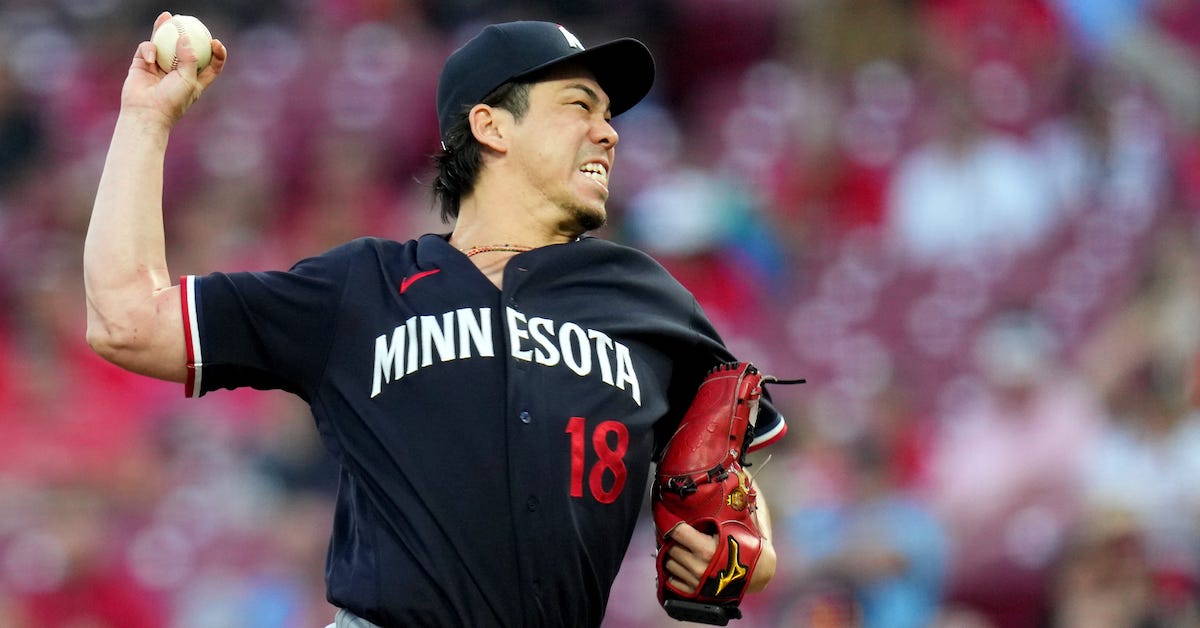
Kenta Maeda has had a stellar career on two continents. Now in his seventh big league season — three with the Minnesota Twins preceded by four with the Los Angeles Dodgers — the 35-year-old erstwhile Hiroshima Carp has a 2.95 ERA and a 162-115 won-lost record between NPB and MLB. He’s been as good as ever in September. The Osaka native has been credited with a win in each of his last three decisions while allowing just four runs over 17-and-two-thirds innings. When he next takes the mound it will be with a 4.28 ERA and a 3.96 FIP on the year.
Maeda discussed his evolution as a pitcher, and offered some thoughts on NPB, when the postseason-bound Twins visited Cleveland earlier this month. Daichi Sekizaki served as an interpreter for the interview.
———
David Laurila: How much have you changed as a pitcher since coming over from Japan?
Kenta Maeda: “The first couple of years I was pretty much just myself; I was the same pitcher that I was in Japan. After pitching here for several years, I know what the different hitters’ weaknesses are and when they are getting on to me. I ironed some things out and made adjustments to become better, to become the pitcher that I am today.” Read the rest of this entry »
Justin Steele has an uncommon pitch profile and an uncomplicated approach to his craft. He also has an outside chance of capturing this year’s NL Cy Young award. With two starts remaining (one if the Cubs clinch a Wild Card berth prior to Sunday’s regular-season finale), the 28-year-old southpaw is 16–5 with a 3.00 ERA and a 2.99 FIP over 168 innings. He’s not only been Chicago’s best pitcher, but he’s also been one of the best in the Senior Circuit.
Steele’s emergence as a frontline starter was portended by last year’s performance. While his won-lost record was an anything-but-eye-catching 4–7, his 3.18 ERA and his 3.20 FIP weren’t notably higher than this year’s marks. Moreover, his strikeout and ground-ball rates were actually better, as were his xFIP and HR/9. His BABIP was nearly identical. The only meaningful difference, on paper, was his walk rate, which at 3.78 was essentially double this season’s 1.88.
Prior to his last outing — a game in which he was BABIP’d to death by six consecutive fourth-inning singles — I approached Steele in Wrigley Field’s home clubhouse to get his thoughts on what has been an outstanding season. The following day, I asked Cubs pitching coach Tommy Hottovy about the pitch characteristics that make Steele a Cy Young contender.
———
David Laurila: Won-lost record and walk rate aside, a lot of your numbers aren’t all that different from last year’s. Are you more or less the same pitcher?
Justin Steele: “I would say that I’m better. The pitches are the same, I’m the same pitcher as far as that goes, but I’ve been more consistent this year. I’m not walking as many guys. I’m being competitive throughout the count, I’ve cut down on non-competitive pitches big time. So yeah, a lot more consistent.”
Laurila: Were you happy with last year?
Steele: “I think so. I was definitely happy with how I finished up [a 0.99 ERA over his last seven starts]. I felt like the entire season I was improving. That’s something that’s really important to me, always improving from start to start.”
Laurila: What’s behind this year’s improved consistency?
Steele: “I think it’s just more reps, getting more and more comfortable out there each time I take the ball. It’s like anything in life: you do it more and you get more comfortable doing it. You also get better at it.” Read the rest of this entry »
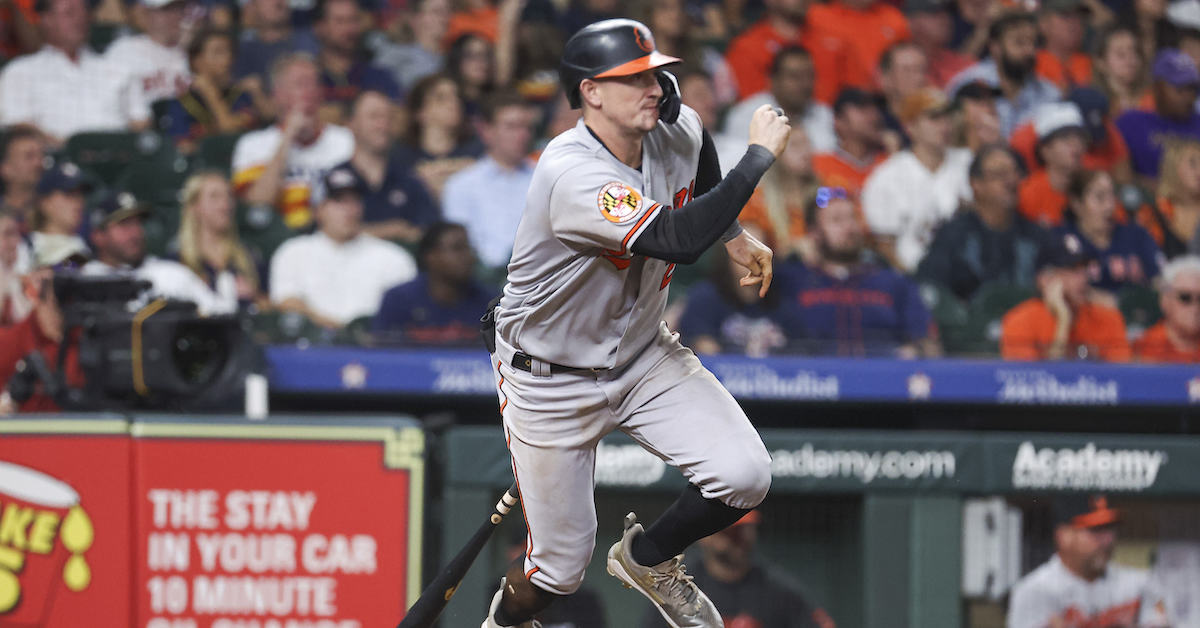
Austin Hays knows his numbers. More importantly, he understands the process behind his production. He’s also having a career-best year: the 28-year-old outfielder has a 117 wRC+ to go with 36 doubles, 16 home runs, and a .283/.330/.462 slash line as a rock-solid contributor for a postseason-bound Baltimore Orioles team with the most wins in the American League. Overshadowed by young stars like Gunnar Henderson and Adley Rutschman, he is nonetheless an important piece of the puzzle.
The personable Port Orange, Florida product hasn’t revamped his approach this season, but he has tweaked it in search of more thump. Hays explained how when the Orioles visited Fenway Park earlier this month.
———
David Laurila: When I brought it up yesterday, you told me you were aware that many of your 2023 counting stats are almost identical to what they were at the end of last year. What percentage of guys in this clubhouse would you say keep up with their numbers?
Austin Hays: “I think it’s probably about half and half. There are guys who like to follow where they’re at, follow what they’re doing, and there are others who just like to look at the end of the season. I find numbers interesting, so I like to look at my own, and other people’s numbers as well. It’s something I’ve always been interested in.”
Laurila: You’re in the process of passing some personal milestones. Which of your numbers do you care the most about?
Hays: “Doubles is a big one for me, because that seems to be the thing that helps me out the most with my power numbers. I don’t hit a ton of home runs, so the more doubles I can hit, the higher my slug and my OPS can be. You can get doubles in so many different ways, too. It’s kind of a hustle stat in a way. If you can accumulate five to 10 hustle doubles by going hard out of the box throughout the season, they’ll start to add up, That’s thing I’m probably trying to boost up the most.” Read the rest of this entry »
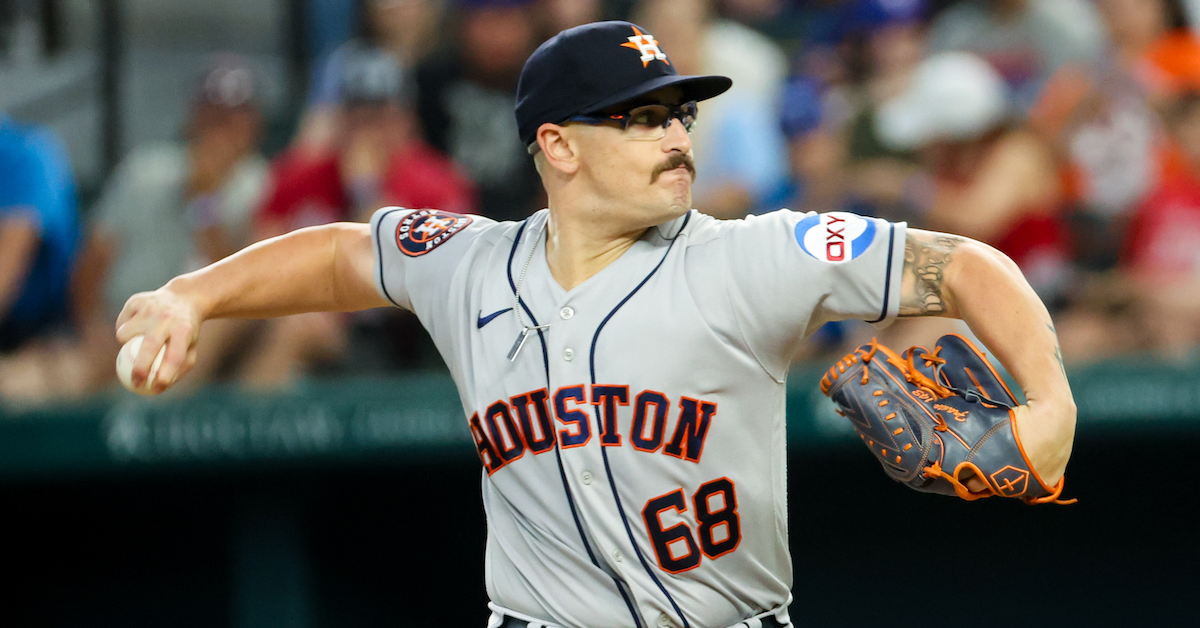
J.P. France is a late-bloomer proving the skeptics wrong. Selected in the 14th round of the 2018 draft by the Houston Astros, the right-hander not only made his big league debut in April at age 28, he’s performed admirably since doing so. In 22 starts plus one relief appearance, France is 11-5 with a 3.84 ERA over 131-and-a-third innings. Moreover, he’s put up those numbers with a skill set that’s unusual in today’s game. His fastball ranks in the 34th percentile for velocity, his groundball rate is in the 51st percentile, and his 17.% strikeout rate is among the lowest for qualified pitchers.
France, who graduated from Tulane University with a degree in Homeland Security before finishing up his college career at Mississippi State University, sat down to discuss his unique profile, and the underdog attitude that comes with it, when the Astros visited Fenway Park at the end of August.
———
David Laurila: You went from a later-round pick to the starting rotation on a contending team. How did that happen?
J.P France: “First, it’s been a grind. I think the COVID year was probably the best thing that’s ever happened to me. It gave my arm basically a full year of rest, and it also gave me time to truly focus on mechanics: how to clean up my motion, how to simplify it. I think that would have happened eventually, but I don’t think it would have happened as quickly. I was able to literally just focus on what was I feeling, and what I was fixing, as opposed to having to go out there and compete and possibly be working on something else at the same time. Read the rest of this entry »
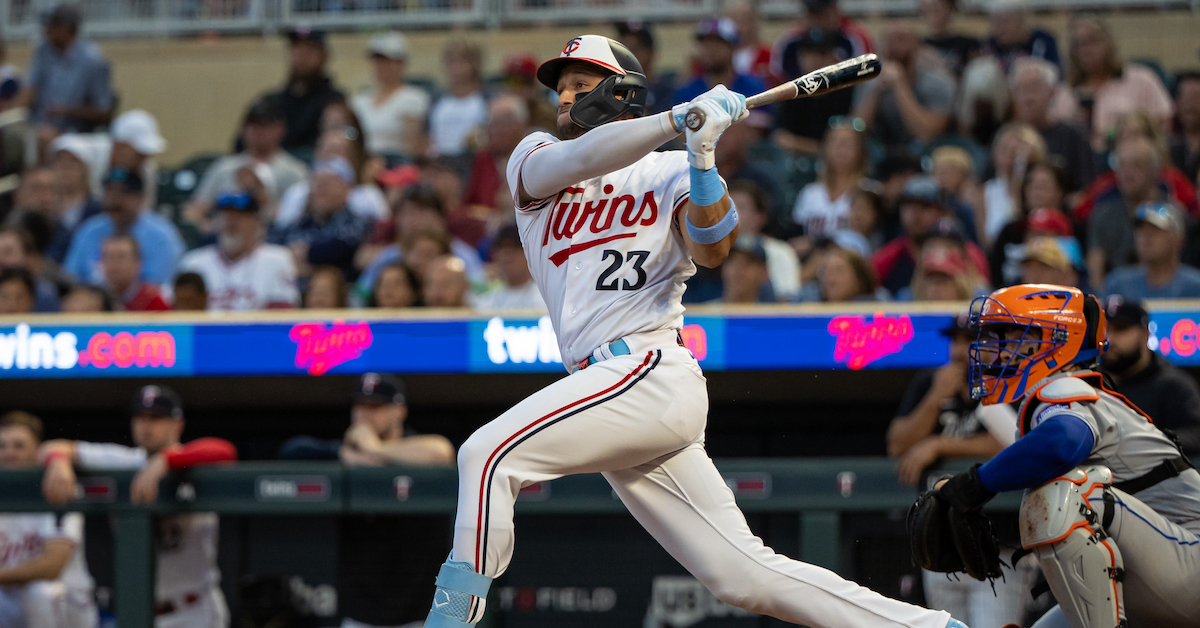
Last Wednesday, in a piece titled “Royce Lewis Has Arrived in Grand Fashion,” Jay Jaffe noted that the Minnesota Twins third baseman had “clubbed his third grand slam in an eight-game span” in the team’s contest against the Cleveland Guardians that Monday. My colleague added that, per the Elias Sports Bureau and MLB.com’s Sarah Langs, Lewis joined Lou Gehrig, Jim Northrup, and Larry Parrish as the only player in MLB history to “bunch three such hits so closely.”
Lewis has done more than hit grannies. Since making his big league debut last season, the first overall pick in the 2017 draft has slashed a healthy .310/.355/.541 with 14 home runs and a 147 wRC+ over 245 plate appearances. Staying on the field had been an issue. As our lead prospect analyst Eric Longenhagen wrote in June, “Lewis’ career has been marred by persistent injury.” But as Longenhagen noted, “He is back and ready to make an immediate impact on Minnesota’s playoff push.”
I was in Cleveland for last week’s Guardians-Twins series, and thus was present for Lewis’ 3-for-4, six-RBI, grand slam performance. Prior to the game, I sat down with the red-hot rookie to talk hitting. Read the rest of this entry »
Bobby Miller was pitching in High-A when I first interviewed him for FanGraphs in June 2021. Drafted 29th overall the previous summer by the Los Angeles Dodgers out of the University of Louisville, the right-hander possessed both a high-octane heater and a lofty ceiling. Since making his MLB debut this past May, he’s met those expectations, going 9–3 with a 3.80 ERA and a 3.67 FIP over 17 starts. The 24-year-old is also coming off of his most impressive outing. Facing the powerhouse Atlanta Braves on September 3, he allowed just three hits and one run in a career-high seven innings.
Miller discussed his continuing evolution as a pitcher and his efforts to find consistency with his slider when the Dodgers visited Fenway Park in late August.
———
David Laurila: We talked two years ago when you were pitching for the Great Lakes Loons. What has changed and what has stayed the same since that time?
Bobby Miller: “A lot of stuff is the same. At the end of the day, it’s still the same game. But the competition is obviously a lot higher. The hitters are lot more disciplined and experienced. Most of them have seen the game’s best arms, so when you’re out there, you’ve got to know that they’ve faced guys just as good or better than you are.
“Game-planning comes in a lot more at this level. I feel like game-planning is super important to learn in the minor leagues, studying hitters and all that, and I wish I’d have learned more before I came up here. While I had somewhat of an idea, I still have a lot of room to improve on that. I think that’s the biggest thing for me: how much time I spend looking at the upcoming lineups I’m going to face.”
Laurila: Basically, what hitters’ hot and cold zones are, and what they hit and don’t hit in certain counts.
Miller: “Yeah. What to avoid in certain counts. When they’re aggressive and when they’re not aggressive. How aggressive they are with runners in scoring position. At some point, I could get better at learning the baserunners, too. But at the end of the day, the most important thing is getting the batter out of the box. It’s about getting outs for your team.” Read the rest of this entry »
Bobby Witt Jr. is more than just the best player on a bad team; he’s potentially on his way to becoming a superstar. Playing in his second big league season, the Kansas City Royals shortstop has 28 home runs and 39 stolen bases to go with 5.0 WAR. Projected by Eric Longenhagen as “the face of this franchise’s resurgence” during last year’s rookie campaign, he debuted at age 21 and didn’t turn 23 until this past June. And he’s been one of baseball’s best hitters in the second half, posting a .399 wOBA and 152 wRC+ since the All-Star break.
Selected second overall in the 2019 draft behind Adley Rutschman, the Colleyville, Texas native approaches his craft with a keep-it-simple attitude, at the same time continuing to hone a swing that’s always come natural to him. It’s hard to argue with success.
Witt discussed his evolution as a hitter when the Royals visited Fenway Park in August.
———
David Laurila: I’ve asked a number of guys whether hitting is more of an art or more of a science. How do you view it?
Bobby Witt Jr: “I think it’s more of an art, because of the swing. So many people have different types of swings. I feel like you form your swing at a young age, and you pretty much critique it off of that. That’s how I look at it.”
Laurila: There is obviously a lot of data in today’s game. I’m sure you’ve studied your swing.
Witt Jr: “Yes, but I’m not really big into the data. I’m more of a visual learner. I see things that I like to do, whether it’s watching guys on TV, or… like, growing up, I would try to emulate guys’ swings. That was kind of how I made my swing.”
Laurila: Whose swing did you try to emulate?
Witt Jr: “Pretty much whoever I was really liking at the time. I grew up a big Red Sox fan and was always kind of smaller growing up, so Dustin Pedroia was one. I had the narrow stance with the big leg kick. I also liked watching Prince Fielder a little bit and transitioned into a toe tap. So just watching guys and seeing what they’re doing on the field, seeing what their approach was. From a young age, I was trying to emulate that to myself.” Read the rest of this entry »
Hunter Brown had yet to pitch above High-A when he was first featured here at FanGraphs in April 2021. Two years removed from being drafted in the fifth round out of Wayne State University, expectations surrounding the Detroit-area native were high coming into that season, as he was ranked as the no. 2 prospect (50 FV) in the Houston Astros system. He’s since lived up to those expectations. Brown not only made his big league debut last September, he went on to log three scoreless appearances in the postseason, including one in which he blanked the Seattle Mariners in the 12th and 13th innings of an epic 1-0 Astros win that took 18 frames to complete. This season he’s been a mainstay in the Houston rotation. Over 25 starts, the hard-throwing right-hander is 10-9 with a 4.47 ERA, a 3.71 FIP, and 152 strikeouts in 133 innings.
Brown discussed a recent change to his delivery, and the current quality of his curveball, on Monday, one day before celebrating his 25th birthday.
———
David Laurila: We talked pitching two years ago. Outside of being in the big leagues, what has changed since that time?
Hunter Brown: “My stuff and my pitch shapes are similar, but I actually made a bit of a change in my last outing. There’s a difference in my windup, and in the stretch, where my hands are coming set. And my shoulders are already lined up out of the windup. It’s just a little rocker step kind of deal. That’s something we’ve been talking about for a while. We’re trying to clean up some inconsistencies that came with my previous [delivery]. It worked against the Tigers [on August 26], and hopefully it will continue to work.” Read the rest of this entry »
Max Scherzer was 26 years old and pitching for the Tigers when I first interviewed him. Thirteen seasons and three Cy Young awards later, he’s taking the mound for the Rangers, the sixth team he’s played for in what has been an illustrious career. Scherzer’s accolades include eight All-Star berths, and just this week, he moved into 11th place on MLB’s all-time strikeout list. Already at 72.0 WAR, he has a Hall of Fame plaque in his future.
In our initial interview, which ran on today’s date back in 2010, Scherzer described himself as “a power pitcher” and “a very mathematic guy” who appreciated, but didn’t overly rely on, analytics available at that time. How does the veteran right-hander approach his craft all these years later, and how has he evolved along the way? I caught up with him to address those questions shortly before he was dealt from the Mets to the Rangers at the August trade deadline.
———
David Laurila: We talked pitching in 2010. How differently do think about your craft 13 years later?
Max Scherzer: “Way different, but the game is also way different. In 2010, it was much more based on what the human eye can see, what’s going on in the field, and listening to the pro scouts. We were understanding some of the numbers back then, but nowhere near what it has blossomed into. It’s almost the inverse now. In 2023, so much of the game is just number, number, number, number, number. I actually think it’s gone too far, that we’ve forgotten some of the human aspects that go into baseball. It’s become, ‘Follow the numbers, they have to be right.’ But no. There is actually a human component that doesn’t get enough credit.”
Laurila: Can you elaborate on that?
Scherzer: “There are times where what you’re seeing on the field matters more than what the data says. There are times to execute based on what you see. For me, that’s been a maturation process over the course of my career.
“I’ve evolved in what I’m looking for and what I’m trying to ascertain. I’m always trying to figure out what I actually want to know on the mound. There is a limit to how much thought you can have about the hitter before you start taking away from yourself. There is a limit to how much bandwidth… like, you want to know what the hitter hits and what he doesn’t hit, but you also need to know what you do well. You need to understand, ‘When I execute this pitch, that’s when I’m at my best,’ and ‘When I put these sequences together, that’s when I’m at my best.’ As much as you want to scout your opponents, scouting yourself is just as important.” Read the rest of this entry »
Troy Melton is fast emerging as one of the top pitching prospects in the Detroit Tigers system. Drafted in the fourth round last year out of San Diego State University, the 22-year-old right-hander has a 2.33 ERA and a 3.21 FIP in 81 innings between Low-A Lakeland and High-A West Michigan. Featuring plus command and a firm fastball that he delivers from a deceptive slot, he’s fanned 84 batters while allowing 21 walks and 66 hits. Over his last three starts, the Anaheim native has allowed just a pair of runs in 17 innings, with 10 strikeouts and nary a free pass.
Assigned a 35+ FV by Eric Longenhagen at the time our Tigers Top Prospects list came out in June, the young right-hander has since moved up to the 40+ FV tier thanks to his “burgeoning upside.” In the opinion of our lead prospect analyst, “his fastball’s impact alone should be enough to make him a good big league reliever even if his secondary stuff doesn’t develop.”
Melton, who has a marketing degree from SDSU’s Fowler College of Business, discussed his development path earlier this month.
———
David Laurila: I was told that you have plus stuff. Would you call yourself a power pitcher?
Troy Melton: “I think I’m a mesh of a power guy and a control guy. Coming up in high school, I really didn’t throw very hard, so I kind of had to learn how to pitch. That definitely helped. There are always things to work on with command — you’re never going to be perfect — but that is something I feel I’m good at. I can throw four pitches for strikes, and kind of quadrant up with them too.” Read the rest of this entry »