Archive for Research

Late Inning Leads Are Becoming Less Secure

The playoff race is heating up and for teams still competing for the postseason, the stakes are the highest they’ve been all season. The spotlight shines especially bright on high-leverage relief appearances in this environment. Unfortunately for the Padres, their All-Star closer Mark Melancon took a small step backward in yesterday’s matchup against the Athletics. Melancon entered the ninth with a two-run lead but allowed two runs on three hits and a walk. The A’s went on to win 5-4 in extras. Despite the setback, Melancon has been one of the best closers in the league in 2021, converting 32 of his 37 save opportunities and leading all of baseball in saves. This season, however, has seen a ton of blown leads in late innings. In the past two seasons, save conversion rates have plummeted, diving from a stable range of 66-70% from 2002-18, down to as low as 61.7% so far this season.

At first glance, it’s easy to point to the expansion of the active roster to 26 players and an influx of injuries as the reason for baseball’s poor performance in closing out games. Save opportunities are being distributed much more widely than in the past. The chart above shows that the drop in save conversion rate actually begins in 2019. The days of multiple workhorse closers meeting the 40-save benchmark are gone. Even getting 40 save opportunities has been elusive for all but a handful of pitchers:

2021 Save Opportunities Leaderboard
Name Team G SV BS SVO ROS SVO
Mark Melancon SDP 45 32 4 36 54
Liam Hendriks CHW 47 26 5 31 47
Matt Barnes BOS 43 23 4 27 41
Edwin Diaz NYM 42 23 4 27 41
Kenley Jansen LAD 41 22 5 27 41
Raisel Iglesias LAA 44 22 5 27 41

Read the rest of this entry »


The Benefits of Changing a Hitter’s Eye Level

There is an old adage in baseball that changing a hitter’s eye level pitch-to-pitch will lead to better outcomes for the pitcher. This makes sense on its face: compared to varying pitch heights and forcing a hitter to alter his bat path, throwing two consecutive pitches at the same height should make it easier for a batter to square up the ball. In a New York Times piece by Tyler Kepner, Mike Mussina discussed the importance of varying locations pitch-to-pitch to mess with the hitter’s eye, offering the example of throwing fastballs down and then countering with a pitch up in the zone. Kepner noted that the hitter’s eye would then be trained on a pitch higher in strike zone, affording the pitcher the opportunity to throw a curveball down to induce a groundball, or net a swing-and-miss. David Price has expressed a similar sentiment: “That’s always a big emphasis [for] me, just making sure I’m hitting spots with that fastball – two-seam, four-seam, both sides of the plate, moving it in, up, down.”

In research on the effect of eye level change on college hitters’ performance against fastballs, Higuchi et al. found that quick eye movement as a pitch traverses towards home plate has negative consequences for the hitter. This research was included in Driveline Baseball’s examination of hitters’ gazes when standing at the plate. On these pages in 2015, Jonah Pemstein looked into whether a pitch thrown at a different height than the one that followed it affected how umpires called the pitch at hand. Permstein surmised that this was indeed the case, with umpires less likely to call a pitch a strike at any height if the previous pitch was thrown at a different vertical location.

As I said up top, this all makes intuitive sense. But does it hold up to further scrutiny? The research I cited by Higuchi et al. only included six collegiate hitters and only considered fastballs. While their work was extremely thorough, its scope didn’t consider the hitter population many of us are most interested in (major league hitters) and only included fastballs at a time when pitches are leaning on breaking balls and offspeed pitches more than ever. Pemstein’s research looked at umpires, not hitters; his conclusions give us some confidence that behavior changes when pitchers vary their pitch location, but doesn’t provide insight into the strategy’s ability to flummox batters. I decided to delve into the data myself and see if there was any merit to this fundamental aspect of pitching strategy.

Using Statcast data from the past three seasons, I constructed various pitch sequence parameters to gauge the efficacy of changing the hitter’s eye level. The first parameter involved pitches that were in the strike zone, as defined by the MLB Gameday zone. Pitches in zones 1, 2, and 3 were coded as “up,” zones 7, 8, and 9 as “down,” and 4, 5, and 6 as “middle.” All other zones were considered off the plate. I focused on pitches in the strike zone because we know hitters are more likely to swing at those pitches and generally have success when they do. The in-zone swinging strike rate over this sample was 12.1%, while 28.1% of these pitches were put into play. Batters had a .349 wOBA on pitches inside this strike zone versus a .304 wOBA outside of it. Any degradation in performance on pitches inside the zone would be a real value-add for pitchers. Read the rest of this entry »


Alex Reyes and Accepting High-Leverage Walks

On July 20, the Cardinals dropped a game to the Cubs despite going into the ninth inning with a 6–1 lead. Based on Greg Stoll’s win expectancy calculator, when the home team is winning by five runs in the top of the ninth, that’s a victory 99.7% of the time. The Cardinals acted accordingly, bringing in veteran journeyman Luis Garcia for his 2021 debut. This was mop-up duty … until it was not.

Garcia struck out Patrick Wisdom to start the inning, but he was able to reach first base on a dropped third strike. Nico Hoerner followed Wisdom with a single, and Jake Marisnick walked. The odds were still in the Cardinals’ favor; the win expectancy calculator gives the home team in this spot (up five, no outs and the bases loaded) a 97.2% chance of pulling it out. Nevertheless, manager Mike Shildt felt the heat enough to bring in his closer, Alex Reyes. But things did not go as planned. Reyes went walk, strikeout, walk, single, double; a 6–1 lead had turned into a 7–6 deficit in the blink of an eye.

The double did the most damage, but the walks are a theme with Reyes. The surface-level numbers are fantastic; dig one step deeper, and things look a little concerning. On the season, he has posted a 29.3% strikeout rate but also a 19.2% walk rate, leading to a 1.38 WHIP (league average is 1.29) and a 1.53 K/BB ratio that’s about 41% worse than the average pitcher. Reyes’ FIP is 3.68 despite the issues with walks, a testament to his strikeout prowess (led by a slider, curveball, and changeup that generate whiff rates of 46.4%, 57.9%, and 40.0%, respectively, per Baseball Savant) and his ability to induce groundballs with his bowling-ball sinker.

Still though, that walk rate is an issue, but what I want to do here is assuage some of the concerns and help reinforce a point made by Baseball Prospectus’ Jonathan Judge on Twitter just last week: that often a walk or hit-by-pitch is the next best outcome after a strikeout (compared to a ball in play). He noted that while Reyes is toeing the proverbial walk rate line, he has the tools to make that extreme profile work, especially with his ability to generate groundballs with his sinker.

Read the rest of this entry »


Baseball Experiences Modest Offensive Gains Post-Sticky Stuff Crackdown

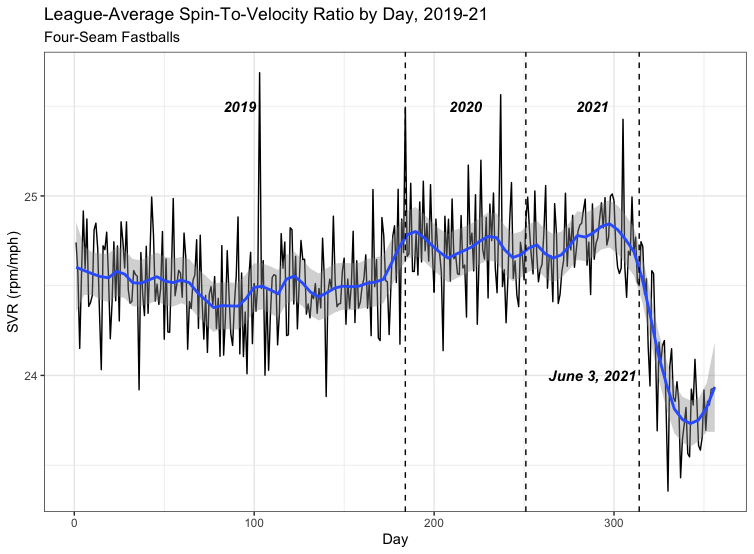
Major League Baseball’s sticky stuff crackdown is working. Since the June 3 warning that increased enforcement of the foreign substance rule was coming, spin rates have fallen league-wide. The league-average spin-to-velocity ratio on four-seam fastballs, which sat comfortably above 24.5 rpm/mph for the entirety of the 2020 season and the beginning of the ’21 season, has fallen to under 24 rpm/mph for the first time since the beginning of ’19. This is what that enormous drop looks like visually:

The crackdown has had plenty of consequences, all of which have theoretically had a significant impact on the game. I touched a little bit on one of these outcomes — whether it was fair to ask pitchers to alter their stuff dramatically in the middle of a season — in a July 2 article on Garrett Richards, who claimed that he needed to try “to figure out how to pitch again” post-enforcement. But there has been one outstanding question all along: How will this impact offense? In a year that started with some of the lowest batting averages in baseball history and with run scoring heavily concentrated in home runs, that was of the utmost importance in the minds of baseball-followers, including those who work for the league and for teams. Cubs president Jed Hoyer, for example, called the impact of the sticky substance enforcement “a huge variable” in determining which players Chicago could target at the July 30 trade deadline.

In an article leading up to the changes in enforcement, I covered the potential impact the crackdown would have on offense with a focus on the effect of spin rates on batter performance. The trend was clear: Batters hit much better on four-seam fastballs with less velocity-adjusted spin, and in a world in which fewer pitches are thrown with elite spin, they should have an easier time at the plate. One executive even told Stephanie Apstein and Alex Prewitt of Sports Illustrated that he thought better enforcement of Rule 6.02(c) could actually have an outsized impact on reviving offense around the league, potentially lessening the pressure on baseball to institute rule changes to create more balls in play, higher batting averages, and more non-homer scoring overall. “I think people would be absolutely shocked if they actually enforced this, how much you’ll start to normalize things without rule changes,” they said. Read the rest of this entry »


What (New) Statcast Data Tell Us About Pitcher BABIP

For the past few days, I’d been searching for a baseball topic to write about. It usually takes less time, but we’re in that calm (if not monotonous) period between the All-Star break and the trade deadline. Ideas are scarcer. Maybe I’d settle on an article with a simple premise?

So I committed myself to tackling pitcher BABIP. (Good going, Justin!)

The notion that pitchers have no control over what happens to a ball in play ushered in a golden age of baseball research, and findings from back then still influence how we view the game today. But over time, we realized that exceptions do exist; for example, Clayton Kershaw consistently allows a below-average BABIP, most likely because he’s a phenomenal pitcher. In addition, certain pitchers have a knack for inducing weak contact in the form of pop-ups or grounders. Exactly how those batted balls impacted BABIP remained a mystery, but you could no longer brush off the metric as total noise.

Years later, Statcast data became available for public use. Even so, research on pitcher BABIP remained far and few between; it’s a daunting subject! I did use two articles as inspiration, however. The first is from FanGraphs user rplunkett97 on our community research page. Dating back to 2017, it mainly discusses a linear model with several variables (BB/9, GB%, Team UZR, and more) used to produce an expected BABIP for each pitcher. The second is courtesy of Alex Chamberlain, also from the same year, who used a mixture of Hard-hit and Barrel rate to create his own version of xBABIP.

Read the rest of this entry »


Another Sign Batting Average Is Becoming Obsolete

One of the great batting lines of the first half was Yasmani Grandal’s .189/.388/.436 slash. Unfortunately, as has been the case for many a hitter on the White Sox, his return to action in ‘21 is in doubt after he underwent surgery to repair a knee ligament. I won’t wax poetic on Grandal; Devan Fink did a great job covering his early-season batting line. But it’s becoming more common to see a hitter with an average that starts with a “1” these days. The common reference to a batting average under .200 is the “Mendoza Line,” which our Ashley MacLennon made a strong case for ditching as a reference earlier this season. I, on the other hand, am going to make the case for why it’s become irrelevant.

Batting average, the prevailing measure of a hitter’s success for most of baseball’s existence, has faded into the background, yet the rate at which a hitter successfully reaches base via a hit is still usually the first statistic reported. Grandal’s batting average is not good, but the selection of .200 as a cutoff point is arbitrary; after all, a batting average of .214 is also not good. What most baseball fans understand now is that because all base hits are not equal in value, batting average is limited in what it says about a hitter. But there is a stigma attached to a poor batting average, which is probably why the Mendoza Line has stuck.

Let’s rewind to last year’s shortened campaign. There was a lot of speculation going into a 60-game season as to whether or not a player would be able to hit .400. That didn’t happen, though Charlie Blackmon was hitting .500 after a couple weeks. We did end up with a handful of qualified hitters with an average below .200 — seven such, to be exact:

Sub-.200 Qualified Hitters, 2020 Season
Name Tm PA AVG wOBA wRC+
Max Muncy LAD 248 0.192 0.316 100
Joey Gallo TEX 226 0.181 0.297 86
Matt Olson OAK 245 0.195 0.316 103
Kyle Schwarber CHC 224 0.188 0.307 91
Bryan Reynolds PIT 208 0.189 0.278 72
Evan White SEA 202 0.176 0.261 66
Yoshi Tsutsugo TBR 185 0.197 0.309 98

This is by far the highest number of qualified hitters with a batting average below .200 for a single season. It is totally a product of the short season, though. None of the hitters on the list above are contact hitters, but their true bat-to-ball skills are probably better than what they showed in ‘20. When the sample is small, there is a greater chance that you get some outliers in your results.

Read the rest of this entry »


Now Let’s Tweak Hard-Hit Rate Using Spray Angle

Last year, Connor Kurcon created dynamic hard-hit rate (DHH%) to add dimension to our typical understanding of Statcast’s hard-hit rate (HardHit%). Whereas HardHit% uses a fixed minimum exit velocity (EV) threshold of 95 mph to determine a hard hit, DHH% uses a — you guessed it — dynamic threshold that changes according to launch angle of the batted ball event (BBE). Kurcon found this orientation of hard-hit rate to be more powerful than its original in terms of describing same-year contact quality (per weighted on-base average on contact, or wOBAcon), predicting next-year contact quality, and predicting itself (year-over-year “stickiness”).

Inspired by a Yermín Mercedes home run off a Willians Astudillo eephus, I borrowed the premise of DHH% and applied it to pitch velocity — that is, the dynamic threshold was based on pitch speed rather than launch angle. Although not as powerful as the original, Pitch DHH% also proved itself superior to HardHit%.

Ever since Kurcon unveiled DHH% in 2020, though, I’ve been thinking about how the premise might apply to spray angle (horizontal angle, lateral angle, whatever you want to call it). It seemed intuitive to me that a hitter would generate more power to his pull side and less to the opposite field. I suspect if you were prompted to guess, you might have said the same. Read the rest of this entry »


How Should Pitchers Approach 0-2 Counts?

There is an interesting quote from Greg Maddux about the relative merits (or, if you’re Maddux, demerits) of “wasting” a pitch in a 0-2 count versus continuing to attack the hitter. Throwing a pitch outside of the zone and hoping for a hopeless swing in an 0-2 count is a baseball convention that’s ingrained in pitchers from the time they are adolescents. The idea is to not give the batter the chance to put the ball in play when the pitcher is in a supremely advantageous position. Maddux eschewed this notion. He said, “The hitter is most vulnerable when you get him in an 0-2 bind. My goal is to take him out immediately. I’m going right after him, not fooling around with wasting a pitch up high or throwing one in the dirt.”

Maddux’s impetus for questioning convention was twofold. First, a waste pitch is (wait for it) a waste. It is a waste of a pitcher’s time and energy and gets him out of rhythm. If you believe that on any given day a pitcher has a finite number of effective pitches in him, then throwing a pitch without the singular purpose of using that pitch to get the batter out is foolhardy. Maddux’s second gripe is that batters have the lowest batting average in 0-2 counts, so why would you fear throwing the ball in or around the strike zone? He also mentions the pitch is usually so far away from the strike zone that the hitter will lay off by default, giving the opposition the opportunity to see one more pitch out of the pitcher’s hand. Maddux is seemingly inferring that seeing this extra pitch assists the batter in timing up a pitcher’s motion, allowing them to gain a small edge in being able to better pick up the ball coming out of the hand.

The merits of a 0-2 waste pitch has been explored in the past. Earlier this yeah, Jim Albert used the same Maddux quote as a jumping off point for evaluating 0-2 pitches at his blog Exploring Baseball Data with R (as an aside, Jim is one of the coauthors of a must-have book if you are interested in getting into baseball analysis). Jim noted that pitchers don’t tend to use fastballs as waste pitches; when pitchers do waste pitches, they are more likely to bury breaking balls below the strike zone. He did note that 0-2 fastballs were located higher than fastballs in other counts, but they still were often in and around the strike zone, and thus were not waste pitches. Back in 2011, John Dewan at Bill James Online found that, in terms of the average plate appearance outcome, there was only a 10th of a run difference in favor of the pitcher between throwing in the strike zone versus outside of it, so there was no clear dominant strategy. Read the rest of this entry »


What Hard-Hit Foul Balls Might Tell Us

We’re now five years into the Statcast era, and with that has come a good base of knowledge and an understanding of what small sample events are significant or beyond noise. Alex Chamberlain recently provided a wonderful example of this type of analysis; I encourage you to read that to get a feel for what I’m going to be talking about. But where Alex and Connor Kurcon covered the values of hard-hit balls at extreme launch angles and extreme exit velocity at given pitch speeds, I want to cover foul balls and what we can — or maybe can’t — learn at the extremes.

Any quick look at the Statcast leaderboard will show you that Yermín Mercedes has a max exit velocity of 116.8 mph, good for ninth best in baseball this year. That’s an incredible feat for any player, but what criteria do we want to set when determining a max? We’re ultimately seeking to measure raw power output, so maybe we should be more inclusive to all batted ball events. If we include foul balls, Mercedes would suddenly have the sixth-highest max exit velocity in baseball at 117.7 mph.

I encourage you to listen to that clip with sound, because the play-by-play commentary is all we have as to where the ball landed.

That 0.9-mph jump might not mean much, but there’s more to it once you consider both the rarity of the batted ball and the fact that we have a number on it in the first place. There’s a wide acceptance of all stats derived solely from launch angle and exit velocity, but you should consider the importance of spray angle. In the same way that both Alex and Connor talked about abnormal exit velocities in the context of a pitch speed or launch angle, something similar should be noted when thinking about the spray of the ball.

To understand this relationship, it’s important to see the spray angle at which each player generates their max EV:

Read the rest of this entry »


Reports of the Sinker’s Death Have Been Exaggerated

In 2018, an article by FanGraphs alum Travis Sawchik came with an ominous title: “Go See the Two-Seamer Before It’s Gone.” His instruction alluded to a still-ongoing trend within MLB, whereby numerous pitchers abandon their two-seamers and sinkers in favor of high-spin four-seamers thrown up in the zone. Its impetus boils down to a couple key developments. For one, teams and pitchers wanted to counter batters who adjusted their swing planes to elevate low pitches. They also realized that high fastballs are useful at inducing whiffs, regardless of batters’ tendencies. Furthermore, those fastballs paired well with the breaking ball shapes and locations teams began to covet around the same time.

All in all, the stage was set for a league-wide revolution. You’ve read the stories of how Gerrit Cole and Tyler Glasnow blossomed into superstars using high fastballs. Conversely, you’ve heard the story of how forcing the sinker upon Chris Archer aggravated his struggles. You might have also encountered stories connecting this trend to the recent uptick in strikeouts. The validity of these reports aside, they helped cement a narrative: the four-seamer was in, and the sinker was out.

Three years later, the league doesn’t seem to have veered away from it. Pitchers have located 20% of four-seam fastballs in the upper-third of the zone this season, the highest rate of the Pitch Tracking era (2008 onwards). Meanwhile, two-seamer/sinker usage is the lowest it’s ever been.

Read the rest of this entry »