Over the weekend, I participated in a panel at the SABR Analytics Conference in Phoenix. It was a ton of fun, and I enjoyed getting a chance to nerd out about baseball with a bunch of like-minded people. The awards show wasn’t bad, either. I look forward to Michael Baumann and I making subtle references to it the rest of the year (or maybe just me; Baumann is less arrogant than I am).
The topic of my panel, where I was joined by Yahoo Sports’ Hannah Keyser and moderator Vince Gennaro, was players we love for the 2023 season. I love Shohei Ohtani and Mike Trout most for the 2023 season, but more specifically, it was about players we love who aren’t widely regarded as superstars. I came prepared; I picked two hitters and two pitchers who fit the bill.
A panel isn’t the same as a presentation, and our discussion ranged widely around these and other players (Hannah loves Wander Franco and Hunter Greene, Vince loves Dylan Cease), but I thought I’d lay out my research here as well. If you’re a frequent reader, you probably already know how much I like these guys, but it never hurts to reiterate a point. Read the rest of this entry »
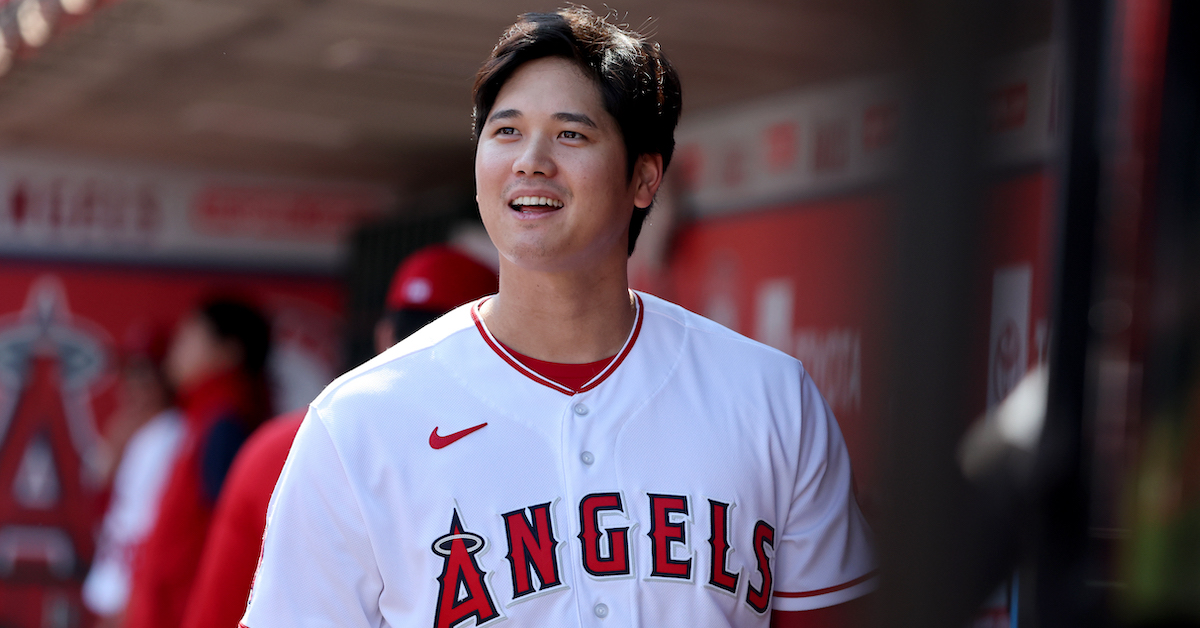
This is a Shohei Ohtani Update. The World Baseball Classic is officially underway, and after a weekend packed with games, it’s time to check in on one of the biggest stars in the world. With Samurai Japan fresh off a 4-0 rampage through Pool B, FanGraphs can now officially report that Shohei Ohtani is still good at baseball.
The issue was not necessarily in question, but it’s worth taking a look at Ohtani’s performance considering his sudden disappearance at the end of the 2022 season. The two-way star didn’t play in a single game for more than four months — essentially the entire winter. Although he posted 9.5 WAR in 2022, several straw men constructed for the purpose of this sentence wondered whether, after such a long layoff, Ohtani would even remember how to play baseball at all.
Fortunately, Ohtani arrived at spring training in mid-February. After spending a couple weeks re-familiarizing himself with the sport, Ohtani got into three spring training games. Ohtani the batter hit a triple on the first pitch he saw, and has gone 2-for-5 so far. Ohtani the pitcher made one appearance, throwing 2.1 scoreless innings with no hits, two walks, and two strikeouts. Cactus League sources indicate that both a 1.200 OPS as a hitter and a 0.00 ERA as a pitcher are considered good. Read the rest of this entry »
Alejandro Kirk slashed a solid .285/.372/.415 with 14 home runs and a 129 wRC+ last year in his first full big-league season. Moreover, the 24-year-old Toronto Blue Jays catcher drew 63 free passes while going down by way of the K just 58 times. His 10.7% strikeout rate was third best in the junior circuit, behind only Steven Kwan’s 9.4% and Luis Arraez’s 7.1%.
How similar of a hitter is Kirk to Arraez? I asked that question to Blue Jays manager John Schneider prior to Thursday’s game in Dunedin.
“When you talk about contact, not a lot of swing-and-miss, yeah, they’re similar,” replied Schneider. “There’s a little more damage potential with Kirky. But more walks than strikeouts is tough to do at any level, [especially] the big leagues. So, I think when it’s just strike zone command, on-base, and contact-ability, they are pretty similar.”
Arraez, now a member of the Miami Marlins, won the American League batting title with the Minnesota Twins while slashing .316/.375/.420 with eight home runs and a 131 wRC+. Following up on my initial question, I asked Schneider if Kirk has the potential to capture a title of his own. Read the rest of this entry »
Baseball season is almost upon us. Spring training competition has begun and the hot stove of free agency has cooled off a bit, though not entirely. Many players, especially on the relief market, have yet to be signed. But over the past week, two former starters with a recent track record of excellent relief performance have taken their talents to Southern California – one finding a new home in Anaheim while the other returns to the big city.
Angels sign Matt Moore to a one-year, $7.55 million deal
Moore’s path through professional baseball has been as interesting as any. A highly touted high school draftee, Moore was once ranked as the top prospect in the game by MLB.com and Baseball Prospectus, ahead of Bryce Harper and Mike Trout. He established himself in the majors at the age of 23, making the AL All-Star team in his second full season. He then missed almost all of 2014 and ’15 with a torn UCL. After returning, his performance quickly dipped from solid to disastrous. He bounced from team to team and posted a 5.99 ERA in 2017-18 while splitting time between the rotation and bullpen. He appeared in just two games in 2019 before a knee injury prematurely ended his season. With his track record of injuries and poor performance now six years long, Moore took a new path to rejuvenate his career, signing with the Fukuoka SoftBank Hawks of NPB for the 2020 season. There he ultimately excelled, with a 2.65 ERA and 3.21 FIP in 13 starts. Moore’s performance impressed the Phillies, who brought him on in a hybrid starter/reliever role where his struggles continued, allowing almost two homers per nine innings and a walk every other frame. However, one team still saw something in him – the Texas Rangers. They signed him to pitch out of the bullpen, and he was excellent: His 1.95 ERA and 2.98 FIP in 74 innings were career bests, as was his 10.1 K/9. Read the rest of this entry »
Gary Sanchez finally has a team… sort of. Last week, he was one of two catchers named to Team Dominican Republic’s roster for the 2023 World Baseball Classic, which gets underway next month. Meanwhile, although pitchers and catchers have reported to major league camps this week, Sanchez still doesn’t have a destination, as he remains a free agent.
By our count, Sanchez is one of just four position players who put up at least 1.0 WAR last year but remain on the market, along with shortstop Elvis Andrus (3.5), outfielder Jurickson Profar (2.5) and infielder José Iglesias (1.0). Admittedly, he’s not coming off a great season with the Twins, but Sanchez’s 1.3 WAR was respectable, his 89 wRC+ matched the major league average for catchers, and he had his best defensive season since 2018, reversing a multiyear decline.
Aside from rumors of interest from the Giants in January and the Angels earlier this month, the Sanchez burner of the hot stove has barely flickered this winter, but things heated up a bit in the wee hours of Wednesday after Sanchez and strength and conditioning coach Theo Aasen shared a short Instagram video of the 30-year-old backstop doing some exercises and baseball activities while wearing a shirt with the Yankees’ insignia. Read the rest of this entry »
Ben Lindbergh and Meg Rowley banter about Yu Darvish’s extension, then continue their 2023 season preview series by discussing the Los Angeles Angels (10:11) with The Athletic’s Sam Blum and the Boston Red Sox (59:32) with The Boston Globe’s Alex Speier, plus a Past Blast (1:47:29) from 1967, an impromptu chat between Ben and former MLB umpire Joe West about whether/why West edited his own Wikipedia page (1:50:12), and a few follow-ups (2:11:42).
Since early in our history, FanGraphs has been tracking pitch type linear weights, or pitch values organized by pitch type, based on both Baseball Info Solutions and PITCHf/x pitch type data. While metrics like wRAA and wRC+ look at run generation through the outcomes of plate appearances, the idea behind pitch values is to take a more granular look. The outcome of each pitch changes the run expectancy of any plate appearance, and pitch value is a method for quantifying the overall impact of all of a player’s pitches, not just the pitches that end plate appearances, as most metrics do. In the form of pitch-type linear weights, we use these pitch values to evaluate the performance of pitchers’ specific pitch types — or hitters’ ability to hit them — either on an absolute basis with stats like wFB (runs above average on all fastballs) or on a per-pitch basis with stats like wFB/C (runs above average per 100 fastballs).
Pitch values can also be a useful way to evaluate how pitchers (or hitters, for that matter) have fared in specific counts. Executing pitches in particular situations to get ahead in counts is a crucial part of a pitcher’s approach, and at times, it feels like we narratively underestimate the impact that the outcome of an early-count pitch can have on the rest of a plate appearance. In 2022, firing a first-pitch strike was enough to drop an opposing hitters’ wRC+ from the normalized average of 100 to 68; missing on the first pitch gave hitters enough of an advantage to lead to a mark of 130, just about in line with recent years. That’s roughly the difference between Kyles Tucker and Isbel.
2022 MLB wRC+ Through Each Count
Count
0 Strikes
1 Strike
2 Strikes
0 Balls
100
68
22
1 Ball
130
90
38
2 Balls
179
130
68
3 Balls
265
212
144
My colleague Ben Clemens has written on the strange historical practice of pitchers grooving fastballs right down the middle to start plate appearances and the perhaps even stranger practice of hitters letting them get away with that. But those practices are fading away, Ben writes, and in an analytical era in which teams are looking for every advantage, the first pitch is being recognized for what it is: a frontier of pitch value opportunity, a first chance to lower the expected scoring outcome of the plate appearance.
In 2022, the strongest performer overall on first pitches was none other than Angels reliever Jaime Barría, who finished with a summed run value of -10.1 on the opening offering, nearly two runs better than any other pitcher despite facing just 316 hitters. On a per-pitch basis, Barría’s performance was even more exceptional: his -.032 runs per first pitch were nearly twice that of any other pitcher with as many as 300 batters faced. It’s worth mentioning that there are limits to what we can glean from this data; around 300 pitches is a relatively modest sample size, and Piper Slowinski warns us that pitch value is more effective as a descriptive stat than a predictive one. Barría is a true outlier here, but as we indulge in taking a look at what was new in his approach, we should do so without assuming he’ll be able to reproduce these numbers in the future. Read the rest of this entry »
The following article is part of Jay Jaffe’s ongoing look at the candidates on the BBWAA 2023 Hall of Fame ballot. For a detailed introduction to this year’s ballot, and other candidates in the series, use the tool above; an introduction to JAWS can be found here. For a tentative schedule, and a chance to fill out a Hall of Fame ballot for our crowdsourcing project, see here. All WAR figures refer to the Baseball-Reference version unless otherwise indicated.
2022 BBWAA Candidate: Huston Street
Pitcher
WAR
WPA
WPA/LI
R-JAWS
IP
SV
ERA
ERA+
Huston Street
14.5
19.3
10.6
14.8
680
324
2.95
141
SOURCE: Baseball-Reference
On a ballot that features one closer whose support from voters suggests he’ll eventually wind up in Cooperstown (Billy Wagner) and another who’s fourth all-time in saves (Francisco Rodríguez), it’s easy to forget that there’s a third one of note, particularly as he’s certain to receive less than the 5% of votes required to remain on the ballot. Huston Street carved a niche as an all-time collegiate great before becoming a first-round draft pick and an AL Rookie of the Year, one whose outstanding command, movement, and deception compensated for his comparatively moderate velocity (his sinker maxed out at an average of 92.5 mph in 2009). The combination carried him to a career total of 324 saves, 20th all-time — an impressive total considering he threw his last pitch a month before his 34th birthday.
In a 13-year career spent with the A’s, Rockies, Padres, and Angels (is that a West Coast bias?), Street made two All-Star teams but also 11 trips to the injured list. His slight-for-a-pitcher frame — he was listed at 6 feet and 205 pounds but by his own admission was around 5-foot-10 — couldn’t withstand even the rigors of throwing an inning at a time at high intensity for very long. “There was a reason I never lifted a bunch of weights in the middle of my career,” he toldThe Athletic’s Pedro Moura in 2019. “Because I was so fucking injury prone that I would get too tight.” Read the rest of this entry »
The following article is part of Jay Jaffe’s ongoing look at the candidates on the BBWAA 2023 Hall of Fame ballot. For a detailed introduction to this year’s ballot, and other candidates in the series, use the tool above; an introduction to JAWS can be found here. For a tentative schedule, and a chance to fill out a Hall of Fame ballot for our crowdsourcing project, see here. All WAR figures refer to the Baseball-Reference version unless otherwise indicated.
2023 BBWAA Candidate: Mike Napoli
Player
Pos
Career WAR
Peak WAR
JAWS
H
HR
AVG/OBP/SLG
OPS+
Mike Napoli
C
26.3
22.0
24.2
1125
267
.246/.346/.475
117
SOURCE: Baseball-Reference
As images of baseball players engaged in off-field celebrations go, it’s tough to top that of Mike Napoli following the Red Sox’s 2013 World Series victory parade. Over the course of several hours, the burly, bearded 31-year-old slugger went on an epic pub crawl that included stops to tend bar at McGreevy’s of Boston and Daisy Buchanan’s. As widely chronicled via social media, Napoli did shots with fans while soaking in the adulation, and along the way shed his shirt for what quickly became an iconic image.
By that point, Napoli had been through a lot. He’d spent the first half-decade of his major league career (2006-10) locked in an existential position battle that resonated throughout the baseball world. Under the harsh glare of Angels manager Mike Scioscia — a two-time All-Star and two-time champion who caught nearly 1,400 games in the majors before winning the 2002 World Series as manager — the heavy-hitting Napoli battled for the starting catcher job with light-hitting but more highly-touted Jeff Mathis, whose superiority behind the plate appealed to the defense-minded skipper and highlighted the reasons why Napoli couldn’t win the job outright. Even as his own injuries and those of teammates allowed Napoli to expand his positional repertoire, he faced public criticism from his manager. “I think he’s a catcher. He thinks he’s a catcher. He needs to go out and catch like a catcher,” Scioscia said in December 2010. “That is the frustrating part with Mike. We’ve seen it when he first came up.” Read the rest of this entry »
The following article is part of Jay Jaffe’s ongoing look at the candidates on the BBWAA 2023 Hall of Fame ballot. For a detailed introduction to this year’s ballot, and other candidates in the series, use the tool above; an introduction to JAWS can be found here. For a tentative schedule, and a chance to fill out a Hall of Fame ballot for our crowdsourcing project, see here. All WAR figures refer to the Baseball-Reference version unless otherwise indicated.
2023 BBWAA Candidate: Jered Weaver
Pitcher
Career WAR
Peak WAR Adj.
S-JAWS
W-L
SO
ERA
ERA+
Jered Weaver
34.6
31.2
32.9
150-98
1,621
3.63
111
SOURCE: Baseball-Reference
It’s not easy to follow in an older sibling’s footsteps, particularly when that older sibling is a first-round draft pick, a top prospect, and a bona fide major league starting pitcher. Yet given a leg up by the benefit of Jeff Weaver’s experience — not that the 6-foot-7, 210-pound righty needed it — Jered Weaver advanced beyond big brother’s accomplishments. In a 13-year career (2005–17), he made three All-Star teams and finished among the top five in the Cy Young voting three times, serving as a rotation stalwart on four Angels teams that made the playoffs. In 2012, he pitched a no-hitter, the 10th in franchise history.
Despite his size, Weaver wasn’t dependent upon power. His violent, cross-body delivery produced deception, and his long limbs resulted in great extension, helping his arsenal — a four-seamer that was initially 91–93 mph, a sinker that was 86–90, and a curve, slider, and changeup — play up. Like fellow 2023 ballot newcomer Matt Cain, he didn’t strike out a ton of hitters, but he ranked among the game’s best at suppressing batting average on balls in play via weak contact that included a ton of pop-ups. Unfortunately, the stress of his delivery took his toll on his hips and shoulders, and once his velocity waned into the mid-80s, he was a sitting duck. He threw his last major league pitch more than four months before his 35th birthday. Read the rest of this entry »





 Sponsor Us on Patreon
 Facebook Group
 Twitter Account
 EW Subreddit
 Effectively Wild Wiki
 iTunes Feed
 Get Our Merch!


