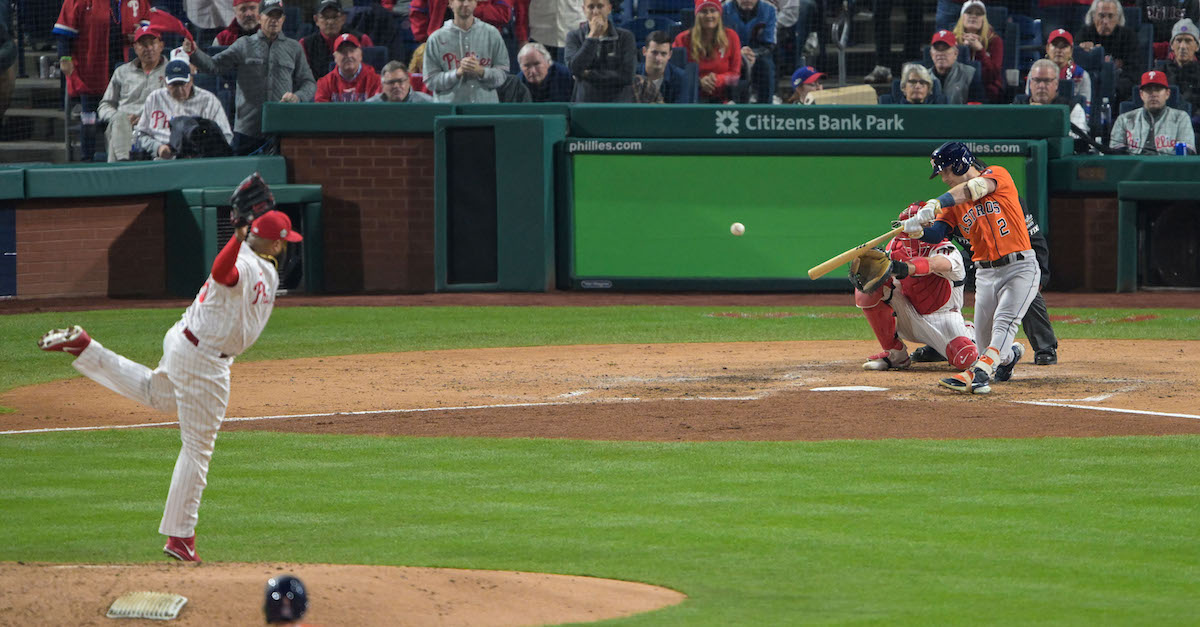
PHILADELPHIA — In the aftermath of Houston’s Game 4 win over the Phillies, as reporters started to file into the visiting clubhouse and mill around the lockers of the three relievers who’d closed out the game, Justin Verlander was pulling on his shoes and heading for the exit. When someone asked him to stop for a chat, he politely declined, saying he needed to get to bed early before his start in Game 5.
What followed probably wasn’t the biggest game of Verlander’s life; he’s started clinchers and elimination games, and win or lose on Thursday, the Astros were going to head back home with plenty of reason for optimism. But at 39 years old, in possibly his last game for the team that he’s taken to the deepest reaches of the playoffs every year since his arrival in 2017, this might have been his last chance to win a World Series game.
Verlander’s ineffectiveness in the World Series has been one of baseball’s great mysteries for 16 years. Despite innumerable accomplishments and accolades not only in the regular season but also in the ALDS and ALCS, he entered Game 5 with a career World Series record of 0–6 and a 6.07 ERA in eight starts, the worst record in MLB history.
That ended on Thursday in Philadelphia. Verlander evaded, inveigled, and scattered just enough to stay out of big trouble. He allowed just one run over five eventful innings, which was just enough to scratch the zero off the front of his Fall Classic record and move the Astros, with a 3–2 win, to within a game of their second World Series title. Read the rest of this entry »
Blame Mike Petriello. I don’t think that anyone is actually wondering whether you should, as a fan of the batting team, root for a double play. You shouldn’t! Don’t do it. Don’t even think about doing it. But after it came up on last night’s Game 4 broadcast, I thought I’d at least quickly go over why this is a bad idea that you shouldn’t consider.
Let’s set the stage. In the top of the fifth inning, Alex Bregman stood at the plate with the bases loaded and nobody out. The Astros already led 1-0 and were looking for more. Bregman was in an 0-2 hole against José Alvarado. Naturally (well, maybe), it’s time to talk about whether you should be rooting for a double play if you’re pulling for the Astros.
Q: Should you prefer a double play here if you’re Houston?
No.
Q: Are you sure? It would put the Astros up 2-0, which is a lot of runs.
Yes, I’m sure.
Q: How likely are the Astros to win if Bregman strikes out?
I used our WPA Inquirer to look up an estimated winning percentage for the Astros with the bases juiced, a one run lead, and one out in the top of the fifth. They stood to win 73.9% of the time.
Q: How about if he hits into a double play?
If it’s a 6-4-3 double play that scores a run and leaves a runner on third, they’re 74.7% likely to win. If the double play erases the runner on third instead, it’s 74.3%. Given where the infield was playing, I don’t think a home-to-first double play was very likely. In fact, I think the 6-4-3 type was the only real consideration.
Q: Hey! They’re gaining win probability by hitting into a double play, aren’t they?
That wasn’t really a question. In any case, sure, if Bregman had only two options – double play or strikeout – he’d prefer to hit into a double play. Baseball has all kinds of outcomes, though! Some of them even let you reach base. Those are a lot better than hitting into a double play.
In his career, Bregman hits .215/.268/.375 after 0-2 counts. He strikes out 32.5% of the time, which is notably not 100%. He’s also a fly ball hitter after 0-2, because he’s a fly ball hitter all the dang time. He has a 34.7% groundball rate when he puts the ball into play after 0-2 counts, right in line with his overall mark.
Alvarado is quite good when he gets ahead 0-2, which does matter. Let’s give him a ton of the benefit of the doubt and say that Bregman will strike out 50% of the time, while only reaching base 10% of the time. That’s a goofy assumption, to be clear – that’s a lower OBP than Alvarado has allowed on 0-2 in his career and far lower than the major league average. Bregman is an elite contact hitter, and he had the platoon advantage. The real number is probably at least double that, but I’m trying to be charitable here.
Let’s break it down like this: 50% strikeouts, 10% one-base singles, 15% groundouts, and 25% outs in the air. With Jose Altuve on third base, let’s say 60% of those fly balls score runs. We’ll even make all the groundouts double plays.
Using those same WPA Inquirer numbers, the Astros were 87.1% likely to win if Bregman reached safely while scoring only one runner, whether by walk, hit by pitch, or single. They were 78.3% likely to win if he hit a sacrifice fly without advancing the runner on second. Sum it all up, and account for the fact that a fly ball that doesn’t score anyone is the same as a strikeout, and that gets Houston’s win percentage to 76%. That’s meaningfully better than the chances of winning after they hit into a double play.
If we make some more reasonable assumptions, this falls apart even further. Let’s say Bregman reaches base 15% of the time, still far lower than a reasonable estimate but at least less punitive towards him. Let’s also say that he hits a double or two-base single once in a while, and that only 85% of his groundouts are double plays instead of 100%. That’s another goofy assumption – when Bregman has grounded out in a double play situation (runner on first, less than two outs), the defense has turned a double play 40.2% of the time in his career.
With these still-goofy numbers, we’re up to 76.9%. That’s a lot better than hitting into a double play. If I used my actual baseline assumptions instead of stacking the deck in favor of the strange assertion that Houston fans should be rooting for a double play, I get a 78% chance of Houston winning with Bregman down in the count 0-2.
Q: That’s a lot of numbers. Give it to me in one word. Should Houston fans have been rooting for a run-scoring double play?
No.
Baseball is a funny game, a remarkable and even ridiculous one for the way it can produce such radically different games on consecutive nights as in Games 3 and 4 of this year’s World Series. On Tuesday, Bryce Harper and friends hit five home runs at the expense of Lance McCullers Jr., accounting for all of the runs in the Phillies’ 7-0 romp. On Wednesday, Cristian Javier and three Astros relievers produced the first combined no-hitter in postseason history while winning 5-0, with all five runs coming within a seven-batter span in the fifth inning. From talk about how devastated the Astros might be and the possibility of the Phillies closing things out at home, the conversation turns to whether the Phillies can bounce back before the series, now knotted at two games apiece, shifts back to Houston.
Combined or not, the no-hitter is The Big Story, and rightly so, as it’s just the second of any kind in World Series history after Don Larsen‘s 1956 perfect game, and the third in postseason history, with Roy Halladay’s 2010 Division Series no-hitter the other. Halladay did so for the Phillies, at Citizens Bank Park, against the Dusty Baker-managed Reds, by the way. Of course there’s the fact that Javier, the majors’ toughest pitcher to hit in terms of both batting average (.169) and BABIP (.228) among those with at least 140 innings pitched, had already done the heavy lifting in a combined no-hitter on June 25 of this year against the Yankees.
What you might not have noticed about Wednesday’s game was that the Astros won without the benefit of a home run, a feat that hadn’t happened since October 15, when the Guardians and Padres both won Division Series contests (Game 3 for the AL, Game 4 for the NL) while keeping the ball in the park. Read the rest of this entry »
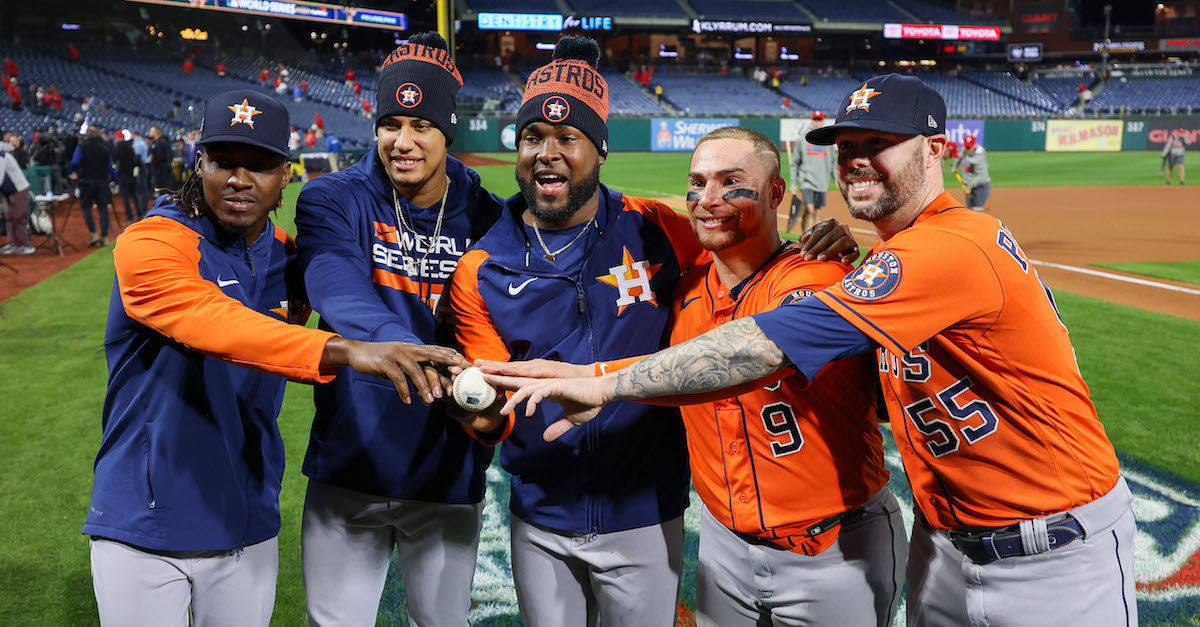
PHILADELPHIA – Momentum is the next day’s starting pitcher, and once Cristian Javier is in motion, he tends not to stop. The 25-year-old, nominally Houston’s no. 4 starter, had one of the best high-stakes starts you’ll ever see. He and three relievers threw the second no-hitter in World Series history, and the first combined no-hitter in any round of the MLB playoffs.
Just 24 hours ago the Phillies teed off on Lance McCullers Jr., sending 45,000 fans at Citizens Bank Park into a lusty froth. Five home runs for the Phillies and an offensive no-show from the Astros made an upset run to a title seem as real a possibility as ever. But Javier and the Astros came back with a vengeance, giving as good as they got and then some to win 5-0 and level the series.
Astros right-hander Ryan Pressly, who closed out the game, called Javier one of the most underrated starters in baseball.
“There’s not a moment that’s big enough [for him],” Pressly said. “He just goes out there and does what he wants to do… He doesn’t get the credit [for] how he goes out there and handles his business. The lights aren’t big enough. I mean, we’re on the biggest stage in baseball and he goes out there and does what he normally does.” Read the rest of this entry »
PHILADELPHIA – It’s not just that Bryce Harper homered on the first pitch he saw in Game 3. For a first-pitch home run to put his team up in the first inning of his first career home World Series game — and a 402-foot bomb at that — it was a pretty casual event on Harper’s end. Almost nonchalant. This is what he does:
But when he got back to the dugout, he shouted for Alec Bohm, the on-deck hitter, to come back to him. It was reminiscent of the famous shot of Carlos Correa and Alex Bregmanchatting in the on-deck circle as the Astros teed off on Tyler Glasnow in Game 5 of the 2019 ALDS. Bohm led off the next inning and hit the first pitch he saw into the left field seats.
If you’d turned off the game then, you would’ve seen a representative sample of what turned into a 7-0 rout. The Astros couldn’t get out of first gear against Ranger Suárez and the four relievers who followed him. And while Lance McCullers Jr. threw the kitchen sink at the Phillies, he got the sink, the faucet, and the backsplash kicked right back at him. Philadelphia managed six hits and a walk against the veteran right-hander, but five of those six hits were home runs and every single baserunner scored. Read the rest of this entry »
All day, the weather radar predicted that the skies would open at a particularly inconvenient time for the Phillies and Astros. While MLB waited as long as it could to see if the wind shifted, by 7 p.m. local time, it was clear the weather would not cooperate. (Rain in late October in the Mid-Atlantic region? Whoever could have foreseen such a thing?) As such, Game 3 of the World Series has been postponed 24 hours, with better weather ahead; the nighttime forecasts for Tuesday, Wednesday, and Thursday are for clear skies and temperatures in the 50s and 60s. Ideal Fall Classic weather, in other words.
Game 3 of the #WorldSeries has officially been postponed. Here is an updated look at the Series schedule: – Game 3: Tuesday – Game 4: Wednesday – Game 5: Thursday – Travel Day: Friday – Game 6 (If Necessary): Saturday – Game 7 (If Necessary): Sunday pic.twitter.com/a61nzKUBM5
Moreover, if neither team sweeps all three games in Philadelphia, the scheduled off day between Games 5 and 6 will remain intact. That pushes a potential Game 6 to Saturday night and Game 7 to Sunday. Read the rest of this entry »
Some kids dream about playing in the World Series and getting the big hit. Fewer kids, one imagines, dream about playing in the World Series and taking the big hit, but that small group might include Aledmys Díaz.
In Game 1 of the World Series, Díaz came to the plate with two on in the bottom of the 10th inning. After a wild pitch moved both runners into scoring position, David Robertson hung a curveball high and inside, and Díaz did his best to thrust his shoulder into the path of the ball, barely missing. The next pitch wasn’t a hanger, but that didn’t stop Díaz from sticking his Kevlar-covered elbow into the ball and trotting off toward first base. Read the rest of this entry »
There were a few times during the ALCS when I glanced up at a game and mistook Chas McCormick for Jose Altuve. Why? Both he and McCormick don’t set their feet in the box like a typical hitter would. Instead, they have distinct foot placement which aligns their front shoulder with the right fielder instead of the typical alignment with the center fielder. In McCormick’s case, it’s more pronounced than that of Altuve. And that’s not just in the setup; it includes the extent to which the Astros outfielder strides closed as well.
Every hitter, player, human, etc. has a different body. Depending on one’s body and its strengths and limitations, different adjustments need to be made to get the most out of that body when it comes to swinging a baseball bat. You may think it’s weird or ugly, but that doesn’t matter. McCormick’s closed setup and stride unlock a part of his game that he otherwise would not have. During the ALCS, I progressively came to realize he is a dangerous hitter when he drives the ball to the opposite field. If you pitch to his strengths that play into his inside-out bat path, then he can get lift on the ball and pepper the short porch in Minute Maid Park. Read the rest of this entry »
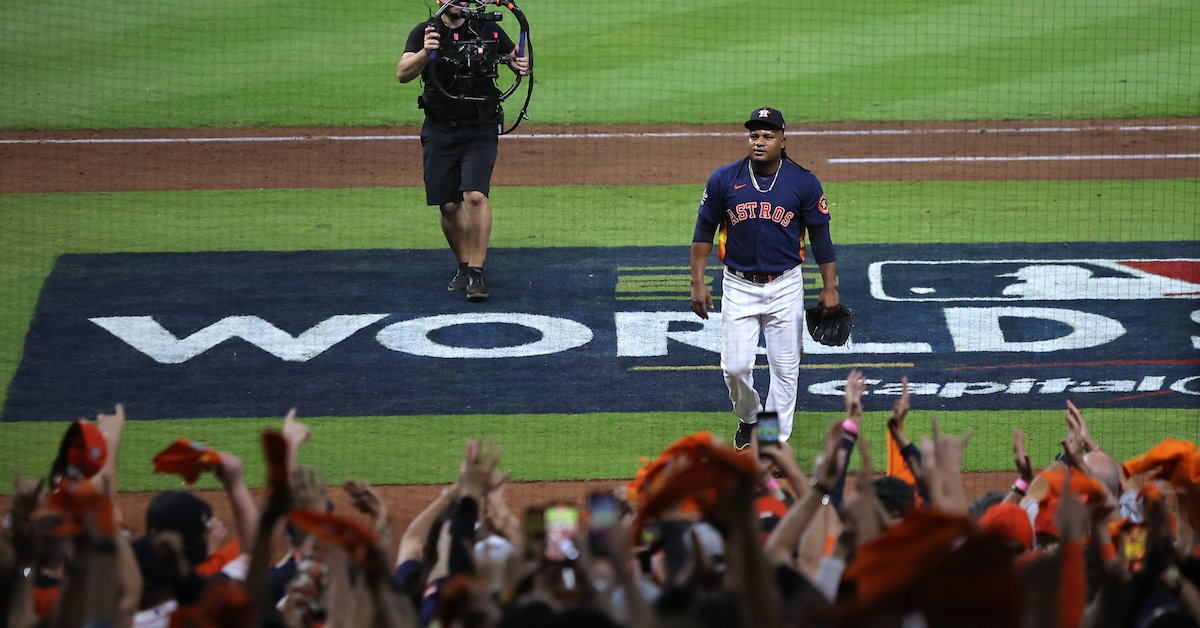
Framber Valdez isn’t the marquee pitcher in this World Series. He’s a solid fourth by reputation, with the top trio some of the brightest pitching lights of the last five years: Justin Verlander, Aaron Nola, and Zack Wheeler. Two games into the series, that top trio have been uniformly bad. Each has given up five runs, hardly the dominant performances they’re known for. Valdez? He stands untouched and mostly unchallenged, allowing a solitary run over 6 1/3 innings to pace the Astros to a 5-2 victory in Game 2.
When Valdez is on his game – and he’s always on his game, setting the major league record for most consecutive quality starts this year – he mixes a snapdragon curveball with a sinker that warps gravity, drawing the ball inexorably downward. He was in fine form Saturday night against a tough Philadelphia lineup. He got awkward swings seemingly at will, weak grounders whenever he needed them, and had a beautiful curveball in his back pocket whenever the opportunity for a strikeout presented itself.
The Phillies have been swinging early and often this postseason. That’s a horrid plan against Valdez; his biggest weakness is an occasional lapse in command. Even tonight, in one of the best performances of his career, he walked three Phillies. If you can lay off his curveball – easier said than done – he’ll sometimes spray a few sinkers and put you on base. Read the rest of this entry »
Through the first three rounds of the playoffs, two competing storylines took shape: The Astros, indomitable, sheared through the American League undefeated. The Phillies, resilient, ebullient, and unpredictable, shocked the National League by dominating the senior circuit’s best.
When these two narratives finally intersected in Houston Friday night, spraying hits and disorder all over the field like debris from a train crash, the result was an instant classic. The Astros dominated early, staking out an early five-run lead that by all rights ought to have demoralized their opposition. But the Phillies, a $255 million monument to not knowing when you’re beaten, struck right back for a historic comeback win:
How historic? The Phillies’ 6-5 win was the biggest comeback by an NL team in the World Series since 1956. When Houston’s win probability peaked with one out in the top of the fourth, they were roughly 16-to-1 favorites to win the game. Instead, the Phillies erased that lead in two innings, hung around long enough for J.T. Realmuto to win the game in the top of the 10th, and survived a Houston rally that came within 180 feet of turning a series-changing Phillies win into a crushing loss. Read the rest of this entry »