Archive for Mariners

The Mariners Found a Couple of Paul Sewald Clones

Penn Murfee
Jerome Miron-USA TODAY Sports

On June 20, the Mariners designated Sergio Romo for assignment. They had just finished an 11-game homestand where they had gone 2–9, and their record had dipped to a season-low 10 games under .500. The next day, Seattle beat Oakland, 8–2, and has gone 24–6 since then, pushing its way into the middle of the AL Wild Card race. Romo wasn’t the only (or main) reason why Seattle had struggled up to that point in the season, but his 8.16 ERA and -0.7 WAR certainly didn’t help either. He does provide a convenient inflection point, though, to talk about how critical the Mariners’ bullpen has been to their play over the past month.

Here’s a table showing how Seattle’s relief corps performance before and after Romo’s departure:

Mariners Bullpen
Time period IP K% BB% HR/9 ERA FIP Shutdowns Meltdowns
Before 6/20 226 25.50% 7.60% 1.43 4.18 4.17 42 44
MLB Rank 27 6 4 30 19 24 29 26
After 6/20 105.2 29.20% 9.40% 0.68 1.87 3.01 40 11
MLB Rank 23 2 17 3 1 1 4 2
Stats through 7/27

Earlier this season, Mariners relievers had trouble converting an excellent strikeout-to-walk ratio into consistent success. Romo was the worst offender, but Diego Castillo (5.25), Andrés Muñoz (4.50), Drew Steckenrider (5.65), Anthony Misiewicz (4.61), and Matthew Festa (4.35) all had ERAs over four through June 19. Their biggest problem as a group was an outsized home run rate that pushed their FIP up to 4.17 even though their xFIP sat at 3.83. Along with Romo, the Mariners also found ways to get Steckenrider and Misiewicz off their roster, replacing the latter with Ryan Borucki in a trade on June 4 and designating the former for assignment on June 11. All told, Seattle churned through 18 different relievers to start the season, three of whom are no longer with the organization and another seven who were shuttled back to the minors.

A couple of those relievers who struggled early on in the season have been key members of the Mariners’ turnaround. Muñoz went 17 straight appearances without allowing a run before giving up two in last night’s game against the Astros. Castillo and Festa have both been lights out, with ERAs of 1.42 and 1.13, respectively, since June 20. But the one constant has been Paul Sewald. An unknown reliever prior to last year, he improved the shape of both his fastball and slider last year to become one of Seattle’s most valuable relievers. He hasn’t been quite as good this year; after approaching a strikeout rate of 40% last year, that’s fallen to just above 30% this year — still elite but not as dominant. Thankfully, he has a whole corps of relievers behind him who are now putting together fantastic seasons, with a few of them boasting repertoires that curiously look similar to Sewald’s. Read the rest of this entry »

Examining the American League’s 2022 40-Man Crunch

© David Richard-USA TODAY Sports

The trade deadline is nearly here and once again, team behavior will be affected by 40-man roster dynamics. Teams with an especially high number of currently-rostered players under contract for 2023 and prospects who need to be added to the 40-man in the offseason have what is often called a 40-man “crunch,” “overage,” or need to “churn.” This means the team has incentive to clear its overflow of players by either packaging several to acquire just one in return, or by trading for something the club can keep — international pool space, comp picks, or, more typically, younger players whose 40-man clocks are further from midnight — rather than do nothing and later lose some of those players to waivers or in the Rule 5 Draft. Teams can take care of this issue with transactions between the end of the season and the 40-man roster deadline in November, but a contending team with a crunch has more incentive to do something before the trade deadline so the results of those deals can bolster the club’s ability to reach the postseason.

In an effort to see whose depth might influence trade behavior, I assess teams’ 40-man futures every year. This exercise is done by using the RosterResource Depth Chart pages to examine current 40-man situations, subtracting pending free agents using the Team Payroll tab, and then weighing the December 2022 Rule 5 eligible prospects (or players who became eligible in past seasons and are having a strong year) to see which clubs have the biggest crunch coming. I then make an educated guess about which of those orgs might behave differently in the trade market as a result.

Some quick rules about 40-man rosters. Almost none of them contain exactly 40 players in-season because teams can add a player to the 40 to replace one who is on the 60-day injured list. In the offseason, teams don’t get extra spots for injured players and have to get down to 40 precisely, so if they want to keep some of their injury fill-ins, they have to cut someone else from the 40-man to make room. Read the rest of this entry »


The Mariners Have Surged Into Contention

© Tim Heitman-USA TODAY Sports

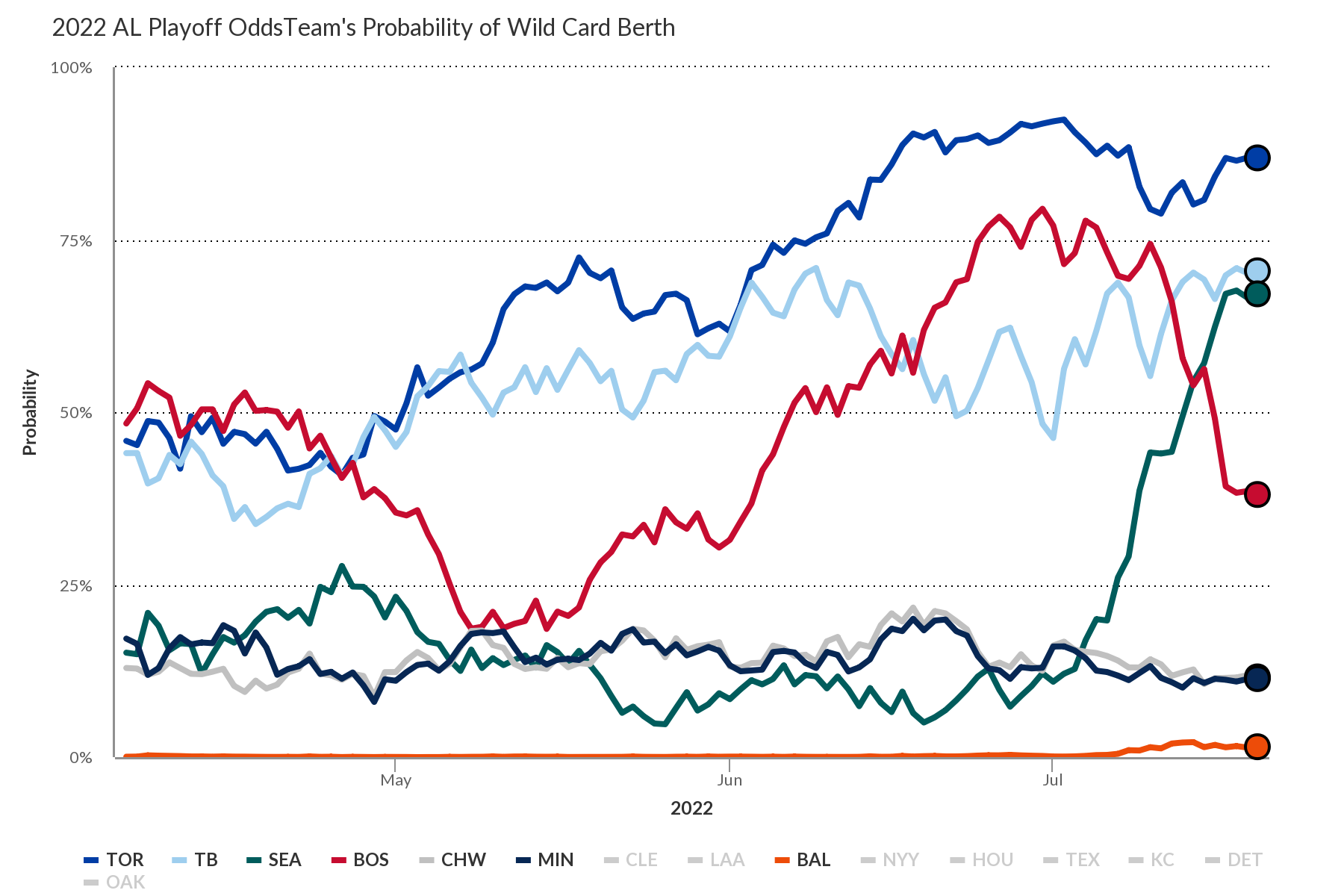
After taking their quest to end their 20-year playoff drought down to the final day of the 2021 season, the Mariners had high hopes for this year, but they mostly sputtered during the first two and a half months of the season, squandering an 11-6 start with separate 1-10 and 2-8 skids. Since June 19, when they were 10 games under .500, they’ve caught fire, winning 22 out of 25 games and entering the All-Star break riding a 14-game winning streak, one that has pushed them into the second American League Wild Card slot with a 51-42 record.

The Mariners aren’t the only AL team that will start the second half with renewed optimism. The Orioles, who have lost at least 108 games in a season three times since 2016, their last season above .500, and appeared headed for another triple-digit loss total through the first quarter of the season, went on a 10-game winning streak starting on July 3, briefly nosing them above .500 for the first time this year. They entered the break 46-46, tied with the White Sox at 3.5 games out of the third Wild Card spot.

The two teams have surged while the Blue Jays and Red Sox have stumbled. While Toronto is still clinging to that last Wild Card spot, at the very least the race has become a four-team fight instead of simply a three-team one, with the AL Central’s second- and third-place teams (the Guardians are only two games behind the Twins, the White Sox three) lurking in the weeds as well, and the Orioles at least showing a pulse. A picture is worth a thousand words:

Read the rest of this entry »


Simply Put, Seattle’s Ty France Is a Deserving All-Star

© Orlando Ramirez-USA TODAY Sports

Ty France was named to the American League All-Star team this past Sunday. Added when Mike Trout bowed out due to injury, the Seattle Mariners first baseman didn’t simply merit the honor, his addition was overdue. Statistically the best hitter on baseball’s hottest team — 14 straight wins heading into the break! — France is slashing .308/.376/.470, with club-bests in both wOBA (.369) and wRC+ (148).

He’s not a flash in the pan. A 34th-round pick by the San Diego Padres in 2015 out of San Diego State University, France has long shown an ability to square up baseballs. A .300/.388/.463 hitter over all professional levels, all he’s really needed was the opportunity.

“That’s really all it is,” France said prior to a game at Fenway Park in late May. “Honestly, it’s being able to play every day — being in the lineup and getting those consistent reps — more than anything else. This game is a lot of ups and downs, and the more comfortable you can be, the more you’re going to find yourself in a good spot.” Read the rest of this entry »


The Mariners’ Rotation Is Carrying Them Through Their Hot Streak

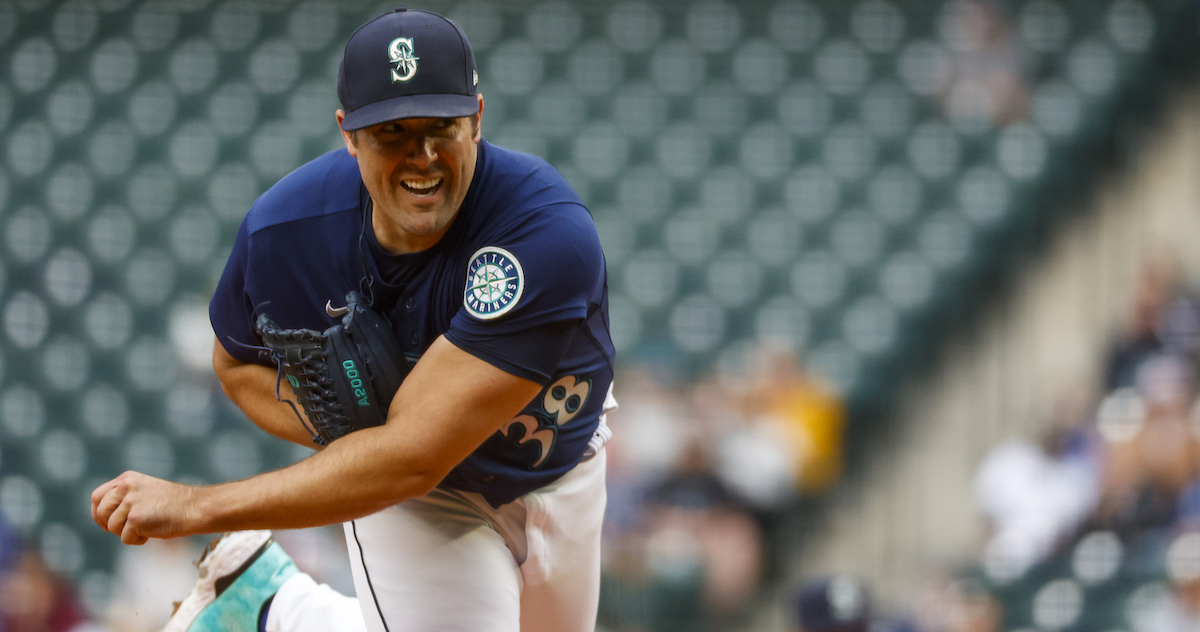
Robbie Ray
Joe Nicholson-USA TODAY Sports

On June 19, the Mariners lost 4–0 to the Angels. It was their second straight shutout loss, ending an 11-game homestand where they went 2–9, dropping them to a season-low 10 games under .500, and leaving their postseason odds at a minuscule 5.3%. Since then, they’ve gone 16–3 and tied the Blue Jays for the final American League Wild Card spot after sweeping them in four games last weekend, passing five teams in the standings during this hot streak and digging themselves out of a pretty deep hole.

As you’d expect for a team playing so well, Seattle has seen contributions from all across the roster. But the pitching staff has been particularly strong, leading the majors in ERA at 2.99 since the beginning of June — a period that includes that aforementioned horrible homestand. In that same span, the starting rotation has posted a 3.06 ERA, and from June 2 to 26, it put together a 24-game streak of allowing three or fewer earned runs. The group’s collective FIP and xFIP during this period are both more than a full run above their ERA, likely indicating some amount of good fortune, but any team that rattles off 16 wins in a 19-game stretch is bound to benefit from some luck. Still, despite the gap between their results and their peripherals, many of Seattle’s starters have made beneficial adjustments to their arsenals that have fueled a lot of their recent success.

Mariners Starters, Since June 1
Player IP K/BB ERA FIP xFIP
Robbie Ray 49.2 3.24 1.99 3.67 3.51
Logan Gilbert 47 3.64 3.45 4.05 4.04
Marco Gonzales 43.2 1.33 2.89 4.62 5.00
Chris Flexen 39.2 1.93 3.40 3.44 5.08
George Kirby 38.1 5.67 3.99 4.94 3.67

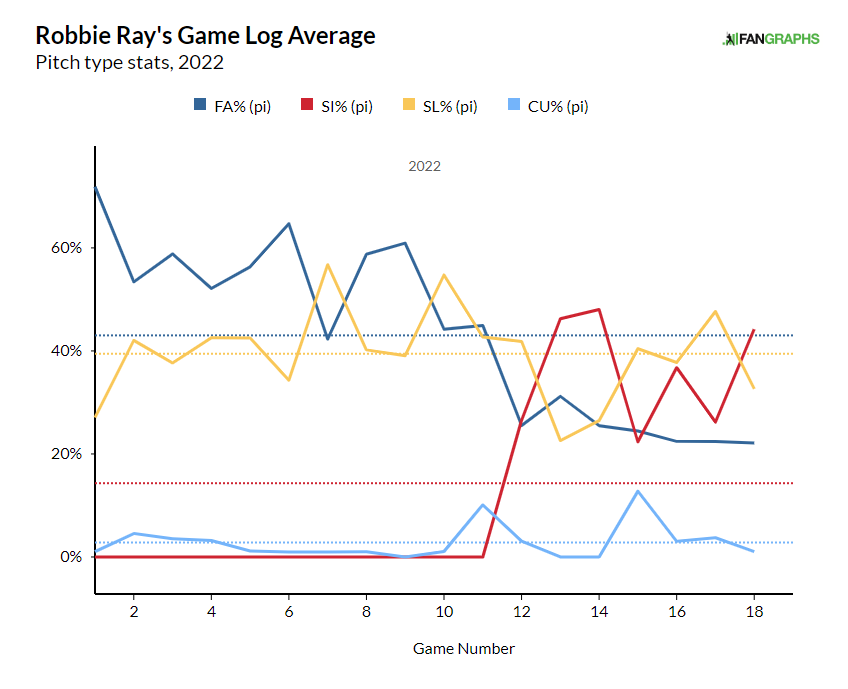
It all starts with the reigning AL Cy Young award winner, Robbie Ray. Diminished velocity led to a rough first couple of months; through his first 11 starts of the season, his ERA was sitting just under five, though his FIP and xFIP both painted a more optimistic picture. Some of that likely had to do with his propensity to allow a bunch of runs in a single bad inning in nearly all of his starts. But in his start against the Astros on June 6, he made a change to his pitch repertoire, adding a sinker — a pitch that’s now become an integral part of his arsenal:

Last year in Toronto, Ray leaned into his four-seam fastball and slider as his two primary pitches. He continued that trend in Seattle to the point where he was essentially a two-pitch pitcher during the first two months of the season. Whether it was the diminished velocity or batters simply figuring out his approach, he wasn’t nearly as effective. By introducing a sinker into his mix (and throwing his curveball a little bit more, too), he’s given opposing batters a new wrinkle to figure out. Read the rest of this entry »


Sunday Notes: John Schreiber Has Changed Since His Detroit Days

John Schreiber has been a find for the Red Sox. Claimed off waivers by Boston from the Detroit Tigers prior to last season, the 28-year-old sidewinder has come out of the bullpen 30 times this year and allowed just 12 hits and two earned runs over 29 innings. Schreiber has 35 strikeouts to go with three saves and a pair of wins in as many decisions.

He’s not the same pitcher who failed to distinguish himself in Detroit.

“I’d mainly been a four-seam/slider guy,” explained Schreiber, who logged a 6.28 ERA over parts of two seasons with the Tigers. “In college and for most of my pro-ball career, that’s all I threw. Two years ago I started working on a better changeup, and last year I started throwing my sinker. Paul Abbott is our Triple-A pitching coach, and he helped me work on a two-seam sinker. I’ve gotten really comfortable throwing that.”

Schreiber still features his old mix prominently — this year he’s thrown 35.3% four-seamers and 35.8% sliders — but his 22.5% sinker usage has added a whole new twist. The 2016, 15th-round draft pick out of the University of Northwestern Ohio is now far less predictable, and just as importantly, he’s better able to match up with hitters who do damage on high heaters. Read the rest of this entry »

Jesse Winker’s Showing More Punch Lately

Jesse Winker
Joe Nicholson-USA TODAY Sports

It’s been an eventful couple of weeks for Jesse Winker. On the heels of an exceptional but injury-shortened campaign with the Reds and then a mid-March trade to the Mariners, he hasn’t exactly lived up to expectations, yet earlier this month, the team signed him to an extension that will carry him to free agency. On Sunday, Winker found himself at the center of the season’s biggest brawl, a spectacle that produced some unexpected payoffs as well as a boatload of suspensions, including a seven-gamer for the 29-year-old left fielder.

The atmosphere on Sunday in Anaheim was already tense in the wake of Mariners reliever Erik Swanson sailing a 95-mph fastball too close to the head of Mike Trout — who last week in Seattle homered five times in a five-game series, with four of the homers decisive — in the ninth inning of Saturday night’s game. Trout was understandably upset, though Swanson claimed he was merely trying to work up and in to a weak spot in the three-time MVP’s strike zone. The Angels, who lost after Trout was subsequently intentionally walked and then Shohei Ohtani retired, weren’t amused; as the epic breakdown from Jomboy Media showed, they spent a lot of time glaring and squawking as the Mariners celebrated their victory.

On Sunday, things escalated quickly. Angels starter Andrew Wantz’s fifth pitch of the day, a 93-mph fastball, whizzed behind the head of Mariners rookie Julio Rodríguez, prompting a warning from home plate umpire John Bacon. Winker came to the plate to lead off the second inning and was hit in his right hip by a 91-mph fastball. After jawing with catcher Max Stassi, gesturing toward Wantz and stepping out in front of home plate, he headed toward the Angels’ dugout, where he was met by a rather large contingent. His teammates quickly joined him, and a full-on scrum ensued, with Winker and teammate J.P. Crawford among those throwing punches.

Wantz, incidentally, was a last-minute replacement for scheduled starter Jose Suarez and was making his first major league start after 32 relief appearances dating back to last year. The Mariners later said that they believed the switch was made with the intention of Wantz acting as an enforcer, and that the 26-year-old righty should have been ejected after nearly hitting Rodríguez, but in his postgame comments, Wantz denied any intent with regards either to that pitch or the one that hit Winker. Winker, for his part, felt that if Wantz had been ejected for hitting him, none of the fighting would have occurred, and that Angels manager Phil Nevin and the injured Anthony Rendon (seen hitting Winker in the face with his left — non-injured — hand) instigated the brawl from the dugout. Read the rest of this entry »


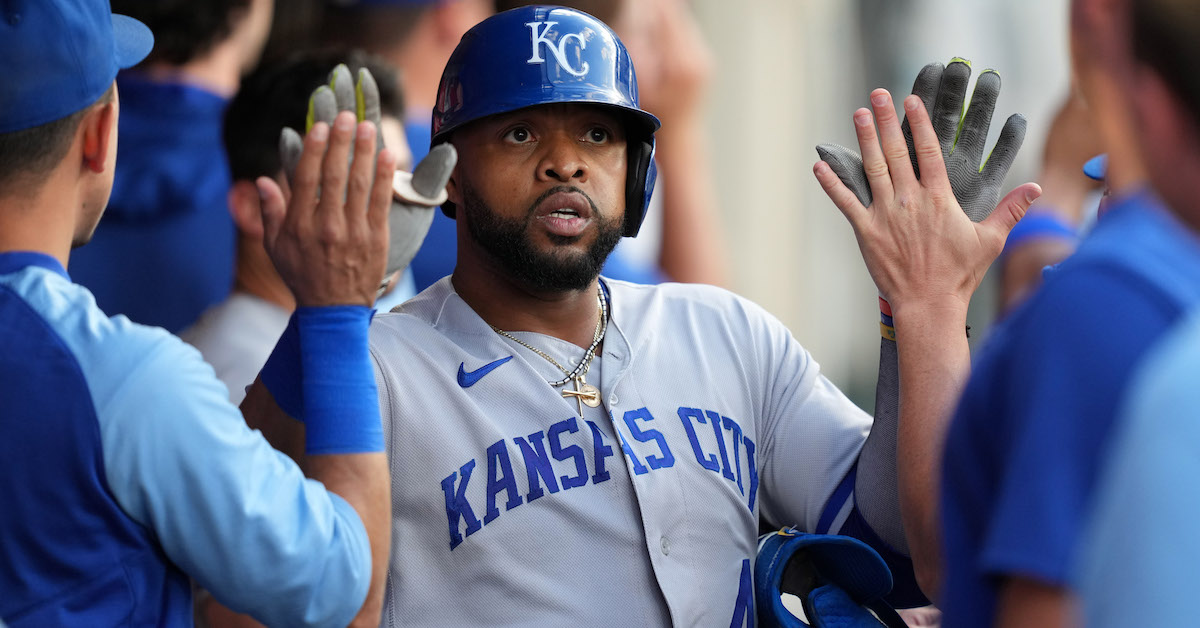
The Mariners Add Some Much Needed Depth in Carlos Santana

Carlos Santana
Kirby Lee-USA TODAY Sports

Last Friday, the Mariners placed Ty France on the Injured List with a flexor strain in his left arm, the result of a collision at first base the day before. This was just the latest blow to a Seattle lineup that’s been wracked by injuries, with France joining Mitch Haniger, Kyle Lewis, Tom Murphy, and Evan White on the IL. With very little minor league depth to turn to at first base, the Mariners turned to the trade market to address their sudden need. On Monday morning, they acquired Carlos Santana and cash considerations from the Royals for a pair of pitching prospects, Wyatt Mills and William Fleming.

In the four games since France’s injury, the Mariners used Dylan Moore and Kevin Padlo at first base twice apiece. Neither can replicate France’s critical offensive contributions (a 157 wRC+), and Moore is better suited to fill a super utility role anyway. Enter Santana, who gives the Mariners some insurance in case France’s recovery takes longer than expected. This is actually the second time Mariners general manager Jerry Dipoto has acquired Santana; the first was back in 2018, when he was part of the return for Jean Segura along with J.P. Crawford. He was flipped to Cleveland just 10 days later in a three-way trade that included Edwin Encarnación and Yandy Díaz.

The switch-hitting first baseman signed a two-year deal with the Royals last year but has been unable to stop a late-career decline that began in 2020. Over the last three seasons, he’s posted a .211/.331/.343 slash line, good for a 90 wRC+, with his 104 wRC+ this year standing as a high water mark. His excellent plate discipline is still intact — he’s one of nine batters with at least 200 plate appearances this season to have walked more than they’ve struck out — but he’s struggled when putting the ball in play.

Last September, Ben Clemens looked into Santana’s issues on contact and found that a lot of it could be explained by his poor results when swinging at fastballs.

Over the course of Santana’s career, he’s been a fearsome fastball hitter. That’s partially because he does an excellent job making pitchers throw him strikes, but it’s also because he knows what to do with them: swing frequently, rarely whiff, and do damage when he connects. He still saw a good number of heaters, because he does a great job of getting into favorable counts, but pitchers were simply choosing their poison. Better to meet him in the zone and take your chances with a ball in play than miss and give him a walk.

That trend no longer holds. He’s having his worst season against fastballs since 2015, one of his worst pre-decline seasons. What’s gone wrong? Pretty simply, everything. His swinging strike rate on fastballs is the highest of his career (excluding a partial 2010 rookie season). His whiff rate when he does swing is a ghastly 17.5%, even with his 2011 season and worse than any effort since. We only have barrel data since 2015, but his barrels per swing mark is quite poor too: 3.4%, ahead of only his 2018 season and in the bottom third of the league.

Santana started this season with the same problem. In April and May, he posted a .220 wOBA against fastballs and looked like he was on track to finish his time with the Royals at a supreme low point. Something clicked in June, however, and suddenly his bat came alive again. He’s slashed .357/.478/.554 (198 wRC+) this month and looked a lot more like his old self again. And as you’d expect, his performance against hard stuff has been the key. Read the rest of this entry »

Seattle’s George Kirby Commands His Repertoire

George Kirby
Jerome Miron-USA TODAY Sports

George Kirby is off to a solid start in Seattle. Since debuting with the Mariners in early May, the 24-year-old rookie right-hander has a 4.04 ERA and a 4.73 FIP (numbers that were markedly better before last night’s career-worst outing) to go with 49 strikeouts in 53 innings. Lending credence to scouting reports — our Eric Longenhagen lauded not only his high-octane heater, but also his plus-plus control — Kirby has issued just seven free passes.

Drafted 20th overall in 2019 out of Elon University, Kirby ranked No. 3 on our 2022 Seattle Mariners top prospects list. Kirby discussed his early career development, including what he’s learned from analytics, earlier this month.

———

David Laurila: You’ve had access to a ton of information playing in the Mariners’ system. What are some of the ways you approach pitching differently than you did just a few years ago?

George Kirby: “One thing I’ve really tried to hammer on is being location-based. I look at the analytics for certain pitches. With my slider, for instance, there is my release point and the horizontal movement. There are good tools to see where you’re at and kind of how to manage your off-speed. I’m always looking at that stuff.”

Laurila: By location-based, I assume you’re referring to how your pitches play best in certain zones?

Kirby: “Yes. With the Mariners, we have our ‘green clouds,’ which show the best pitch in that location in certain counts. I try to really focus on that. And one of the biggest numbers is that 94% of the time when you throw a first-pitch strike, you’re either getting the ball back 0–1 or it’s an out. That’s a huge part of pitching — not being scared of the zone and allowing that first pitch to work in your favor.” Read the rest of this entry »


Player’s View: What Is Your Favorite Baseball Memory?

© Joe Nicholson-USA TODAY Sports

What is your favorite baseball memory? I posed that question to 10 major league players, and in nearly every instance, the response began with a question of their own: “Does it have to be from my own career?” While all were happy to share one (or more) meaningful memory from their time in the big leagues, it was primarily magic moments from their days as fans and/or young amateurs that stood out the most.

———

Jackie Bradley Jr., Boston Red Sox

“I have two. Being able to have all of my family members at the All-Star game with me in San Diego in 2016 is one. The other is having my family with me in London, England for the Red Sox-Yankees rivalry series [in 2019]. They were all with me for the [2018] World Series as well, so there are actually three: All-Star Game, World Series, and being able to travel all the way to London, halfway around the world, to watch me play. In no particular order, those would be my favorite baseball memories.” Read the rest of this entry »