Below is an analysis of the prospects in the farm system of the New York Mets. Scouting reports were compiled with information provided by industry sources as well as my own observations. This is the second year we’re delineating between two anticipated relief roles, the abbreviations for which you’ll see in the “position” column below: MIRP for multi-inning relief pitchers, and SIRP for single-inning relief pitchers.
A quick overview of what FV (Future Value) means can be found here. A much deeper overview can be found here.
All of the numbered prospects below also appear on The Board, a resource the site offers featuring sortable scouting information for every organization. It has more details than this article and integrates every team’s list so readers can compare prospects across farm systems. It can be found here. Read the rest of this entry »
The New York Mets acquired Edwin Díaz in a trade with the Seattle Mariners before the 2019 season. At the time, the deal was controversial, to put it charitably. Díaz was coming off a breakout 2018 season, one that established him as the best young reliever in baseball. He struck out 44.3% of his opponents en route to a 1.96 ERA (1.61 FIP, 1.78 xFIP) and had four years of team control remaining.
That combination of skill and value doesn’t come around often, and the Mets paid dearly for it. They took Robinson Canó and his contract along with Díaz, and sent multiple prospects back in the bargain, headlined by Jarred Kelenic, their previous year’s first round draft pick and a consensus future star. Things went quite poorly for New York out of the gate; Kelenic flew through the minors, Díaz posted a 5.59 ERA in his first season with the Mets, and Canó had his worst season since 2008.
You probably already knew all of that. It wasn’t exactly a small story at the time, and when Kelenic debuted at the start of the 2021 season while Canó was serving a suspension for violating the league’s performance-enhancing drug policy, the “Mets snatch defeat from the jaws of victory” headlines reached a fever pitch. But with the benefit of 15 more months of games, and also as someone who isn’t particularly good at hot takes, allow me to add this to the discourse: Edwin Díaz is really good. Read the rest of this entry »
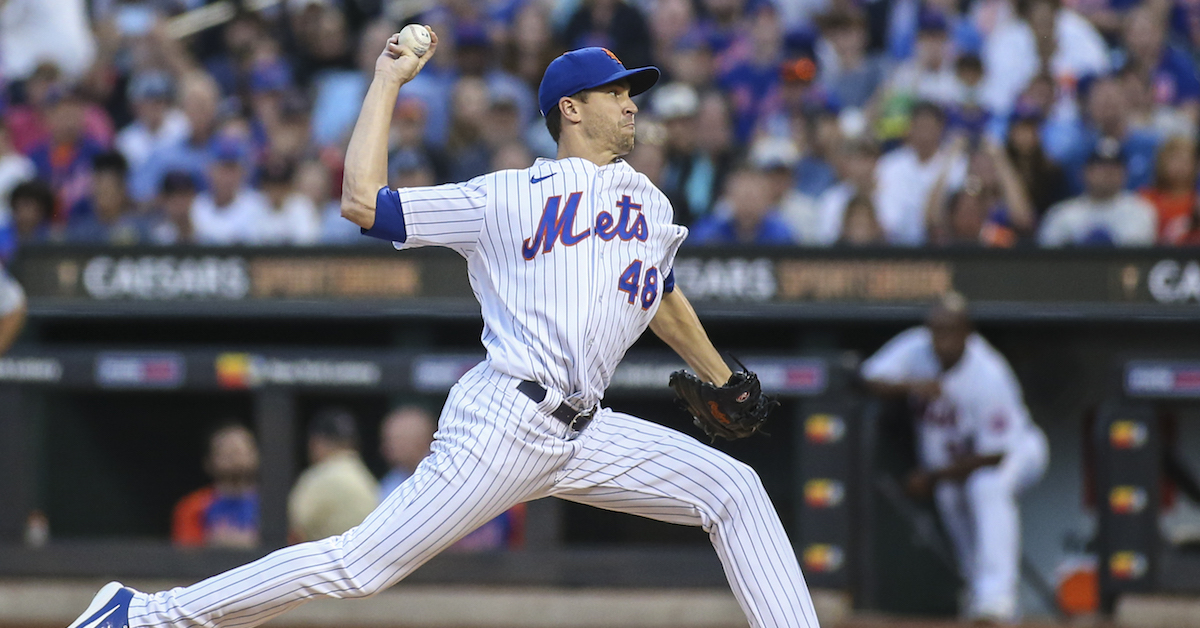
For the Mets, help is on the way at long last in the form of a pair of multiple Cy Young award winners. On Sunday, Jacob deGrom dominated in his first rehab start for the team’s Single-A affiliate, his first competitive start in nearly a year, and on Tuesday, Max Scherzer is scheduled to start for the big club for the first time in nearly seven weeks. The two aces should provide a boost for a team whose lead in the NL East has dwindled since reaching double digits at the end of May.
The 34-year-old deGrom, who had been sidelined since March 27 due to a stress reaction in his right scapula, struck out five of the six hitters he faced for the St. Lucie Mets, reaching 100 mph with his four-seam fastball against the first three of those hitters. Wearing a garish camouflage-and-stars-and-stripes jersey, he threw 24 pitches, 18 for strikes; the only blemish on his performance was hitting the Jupiter Hammerheads’ Ian Lewis in the foot with a cutter.
That was deGrom’s first competitive appearance since last July 7, interrupting what had the look of a season for the ages. Through 15 starts and 92 innings, he had pitched to a 1.08 ERA and 1.24 FIP, striking out 45.1% of all hitters, walking just 3.4%, and averaging 99.2 mph with his fastball. His elbow couldn’t handle the stress, though not until September was his “inflammation” revealed to be a low-grade sprain of his ulnar collateral ligament. The two-time Cy Young winner, who underwent Tommy John surgery back in October 2010, shortly after completing his first professional season, thankfully did not need surgery to heal this time around. “I have been told my UCL is perfectly fine,” he said in mid-March, before his shoulder injury.
By his own description at least, his shoulder is fine as well. “I felt like I had control of everything — the main thing was trying to locate the fastball and pitch off that. Everything felt good,” he said after Sunday’s start. “[My shoulder] feels 100 percent. Because it was bone… you can’t really push it. I had to wait until the bone was healed and move forward from there.”
DeGrom said he expects to make at least one more start for St. Lucie. He’ll probably need a couple of additional turns at higher levels to build his pitch count to the point of a late-July return to the Mets. Expecting him to pick up where he left off a year ago is probably a recipe for disappointment given how far off the charts that performance was, but the bar for him to improve the team’s outlook isn’t nearly that high.
As for Scherzer, he pitched to a 2.54 ERA and 2.96 FIP and struck out 30.6% of hitters through his first eight starts as a Met before straining an oblique muscle in his May 17 start. His 47-day stay on the injured list is the longest of his major league career, capped by a pair of starts for the Double-A Binghamtom Rumble Ponies late last month, with pitch counts of 65 and 80. The 37-year-old three-time Cy Young winner additionally made quite an impression by treating his teammates to a feast of bone-in ribeye, filet mignon and lobster that reportedly cost upwards of $7,000; he also purchased a pair of AirPods headphones for each teammate. In Tuesday’s return against the Reds, he’s expected to throw about 90 pitches over six innings.
When Scherzer landed on the IL, the Mets were 26–14, seven games ahead of the pack in the NL East. By the end of the month, they were 34–17, their third-best mark through 51 games, behind only their celebrated 1986 and ’88 teams. Additionally, their 10.5-game lead through the end of May was the third-largest of any team since division play began in 1969, trailing only those of the 2001 Mariners and ’17 Astros. The Mets couldn’t maintain that pace in June, however, going just 13–12 against a difficult schedule that included the Dodgers, Padres, Brewers, and Astros, against whom they went a combined 5–9. Though they’ve perked up via a 3–1 start in July, the surges of the Braves (24–6 since the end of May) and Phillies (21–9 in that span) have narrowed their cushion to four games.
Through the end of May, the Mets had outscored opponents by nearly a run and a half per game, but since then, they’ve been outscored by about four-tenths of a run per game:
The Mets’ June Swoon
Period
W
L
Win%
RS
RA
PythW-L%
April/May
34
17
.667
5.22
3.80
.641
June/July
16
13
.552
4.07
4.48
.456
SOURCE: Baseball-Reference
During both segments of the season, they’ve outplayed their Pythagorean winning percentage, with a trio of particularly lopsided June losses (13–2 to the Padres on June 8, 10–2 to the Brewers on June 15, 9–1 to the Astros on June 28) distorting their run differential. Take those away and they have a 4.35 to 3.77 advantage in per-game scoring since the start of June, as well as a .565 Pythagorean percentage. Alas, those games did happen, they did count, and the pitching staff is showing some wear and tear:
Mets Pitching by Months
Starters
ERA
FIP
K%
BB%
HR/9
April/May
3.83
3.76
22.4%
6.7%
1.02
June/July
4.53
3.95
26.9%
6.9%
1.45
Relievers
ERA
FIP
K%
BB%
HR/9
April/May
3.50
3.52
27.7%
9.3%
0.99
June/July
3.79
4.34
25.8%
9.5%
1.44
Most of the deterioration in the team’s pitching owes to the long ball, though to be fair, there’s a lot of that going around, as the major league home run rate has risen from 1.02 per nine innings in April and May to 1.21 per nine since. The problem has been particularly acute for Carlos Carrasco (2.04 per nine in June and July), Tylor Megill (2.70) and Trevor Williams (4.26) — the last two in particularly small samples, admittedly — and has driven the overall downturn in their performances.
The 35-year-old Carrasco is the only Met to make a full complement of starts (16) thus far, that after making just 12 starts last year due to a right hamstring injury. He pitched to a 3.98 ERA and 2.79 FIP through the end of May thanks to improved results on his slider and changeup, both of which got whacked around last year. While he began June with strong starts against the Nationals and Padres, he was bombarded for seven homers and 19 runs in 17.2 innings over a four-start stretch against the Angels, Marlins, and Astros (twice), allowing more runs than innings pitched in all but the Miami start. He did pitch well against the Rangers on Sunday (5.2 innings, one run, eight strikeouts), lowering his ERA to 4.64 and his FIP to a more respectable 3.68, but batters have slugged .439 or better against all four of his main offerings (four-seam, sinker, slider, and changeup) in June and July, a trend that could be hazardous if it continues.
The 26-year-old Megill turned in some impressive outings early in the season, highlighted by his throwing the first five innings of the team’s combined no-hitter against the Phillies on April 29, but after being torched for eight runs in 1.1 innings on May 11, he landed on the injured list with biceps inflammation. Upon returning a month later, he yielded six runs in 6.2 innings over two starts, suffered a shoulder strain and was shut down; he’s now on the 60-day IL, meaning that the earliest he could return would be mid-August. As for the 30-year-old Williams, he’s been very useful out of the bullpen (2.00 ERA, 2.62 FIP in 18 innings), but his performance in the rotation (5.86 ERA, 6.27 FIP in 27.2 innings) has been erratic at best.
Fortunately, Taijuan Walker has done good work (2.72 ERA, 3.09 FIP) in making 14 starts, and Chris Bassitt has been solid (4.01 ERA, 3.92 FIP), though the latter just landed on the IL in Friday with what is reportedly a bout of COVID-19. David Peterson has done the bulk of the fill-in work in the absence of Scherzer and other injured pitchers and has been the unit’s unsung hero, posting a 3.24 ERA and 3.78 FIP in 58.1 innings.
For as fluffed-up as the Mets bullpen’s ERA has been since June, there’s been some very good news, in that Edwin Díaz has been absolutely lights out. Since blowing a save against the Giants on May 24, he’s allowed just one run in 13.2 innings, pitching to a 0.66 ERA and -0.25 FIP (yes, negative) and striking out 54.7% of batters faced. Overall, he owns a 1.93 ERA and 1.63 FIP and has allowed just one barreled ball all season. Meanwhile, Adam Ottavino is showing signs of returning from his wilderness years with the Yankees and Red Sox; since the start of June, he’s posted a 0.71 ERA, and overall for the season he’s carrying a 2.67 ERA and 3.28 FIP. On the down side, the struggles of lefties Chasen Shreve and Joely Rodríguez stand out, with the pair combining to allow 15 runs in 17 innings since the start of June. As a group, Mets lefty relievers (mainly that pair plus a couple of spot appearances) allowed a .283 wOBA through the end of May, but that’s up to .363 since, giving general manager Billy Eppler something to add to his trade deadline shopping list.
The Mets’ offense isn’t blameless when it comes to the team’s recent struggles, dipping from a 116 wRC+ through the end of May to 99 since. Unlike the rotation, there’s no cavalry on the immediate horizon, but given the 45 wRC+ they’ve received from catchers Tomás Nido, James McCann, and Patrick Mazeika, the possibility of recalling top prospect Francisco Álvarez offers some appeal. The 20-year-old backstop, who placed seventh on our preseason Top 100 Prospects list, was just promoted to Triple-A Syracuse, however, and the Mets aren’t likely to rush him to the majors.
In the grand scheme, a Mets team that has gotten a combined eight starts from its two aces through the first half of the season has played .625 ball nonetheless. The team already owns a 97.9% chance at a playoff spot and a 51.7% chance at a first-round bye, and the returns of Scherzer and deGrom will soon overshadow their June swoon.
Job Description:
The New York Mets are seeking a Senior Software Engineer in their Baseball Systems department. This individual will help architect and guide the Systems group in the building of mobile and web applications to enrich the Mets data ecosystem and inform decision-making within Baseball Operations. This position requires a strong background in mobile and web development. The ideal candidate would use lessons from personal experience to build scalable baseball solutions, mentor team members in software best practices, and architect new capabilities within Baseball Operations at the Mets. We are looking for strong engineering generalists who are excited to work on greenfield software projects and design scalable systems. This is a senior IC role that will be expected to mentor, write code part-time, and weigh-in heavily on technical designs and implementation details of solutions.
Prior experience in or knowledge of baseball is a plus but is not required.
Essential Duties & Responsibilities:
Maintain and scale a broad collection of internal applications that enhance player development, scouting, and executive decision making
Lead weekly software sprint meetings and retrospectives
Partner with leadership and our design lead in building out the ongoing product roadmap
Manage the technical on-call rotation and code review practices
Communicate broadly with the greater Technology group at the Mets around status, technical needs, and blockers
Develop exciting user-facing applications by designing, building, and deploying reliable, readable code for platforms within Baseball Operations
Collaborate with a variety of engineers and internal stakeholders to validate designs and facilitate clean rollouts and deployments of new products
Lend expertise to technical decision-making around the choices of technologies, platforms, and third-party partners
Architect and oversee the rollout of backend APIs to facilitate scalable flow of baseball data
Integrate with a variety of third-party APIs to enrich the New York Mets data ecosystem
Work with data engineers to facilitate the easy collection and access of valuable baseball data
Own green field projects with a high degree of technical control that extend the capabilities of the New York Met Baseball Operations organization
Qualifications:
Bachelor’s degree in computer science or a related field
6+ years of relevant work experience
Management experience preferred
Strong proficiency in Javascript, including experience working with Node.js and React
Experience building scalable system within cloud platforms, e.g. GCP, AWS
Experience reviewing code and developing test suites for scalable technological systems
Experience working with MySQL and other relational databases
Experience with different API frameworks, including REST and GraphQL
Familiarity with modern agile practices and development tools
Ability to work collaboratively with designers, analysts, and other engineers
Strong written and verbal communication skills
Prior experience in baseball or biomechanics analysis is a plus
Prior experience in mobile development (Objective-C, Java) is a plus
The above information is intended to describe the general nature, type, and level of work to be performed. The information is not intended to be an exhaustive or complete list of all responsibilities, duties, and skills required for this position. Nothing in this job description restricts management’s right to assign or reassign duties and responsibilities to this job at any time. The individual selected may perform other related duties as assigned or requested.
The New York Mets recognize the importance of a diverse workforce and value the unique qualities individuals of various backgrounds and experiences can offer to the Organization. Our continued success depends heavily on the quality of our workforce. The Organization is committed to providing employees with the opportunity to develop to their fullest potential.
Job Description:
The New York Mets are seeking a Technical Product Manager for Baseball Systems. This person will work with leadership to help prioritize, spec, and roll out technical work on software projects for Baseball Operations at the New York Mets. This position requires a technically-minded product expert to help guide the work the Mets do internally to generate sustainable on-field success. The ideal candidate would be detail-oriented, communicate clearly and efficiently, and have a strong grasp of modern design and development practices. Prior experience in or knowledge of baseball is a plus but is not required.
Essential Duties & Responsibilities:
Interface with cross-functional stakeholders to gather requirements, and work with baseball systems team to define, evaluate, and prioritize program scope and implementation plans.
Develop and manage end-to-end project plans and ensure on-time delivery.
Provide hands-on program management during analysis, design, development, testing, release, and post-release phases.
Communicate roadmaps/plans to stakeholders, providing transparency into delivery schedule
Identify key metrics/measures that will be used to evaluate success and validate the impact of Baseball Systems and our products.
Drive internal process improvements that translate to measurable on-field success
Contribute to overall Baseball Systems strategy by generating product plans and crafting parts of the product roadmap
Evangelize products internally and help collect feedback post-launch
Qualifications:
1-3 years of relevant work experience in technical product management, development, and planning
Comfort with leading technical discussions from ambiguity to clearly defined action items.
Ability to work cooperatively with others, and to take control of large-scale projects
Strong written and verbal communication skills
Detail-oriented and familiar with modern project-planning tools
Prior experience in software development, namely GCP, React, Node experience is a plus
Prior experience in baseball is a plus
Any level of fluency in Spanish would be a plus
The above information is intended to describe the general nature, type, and level of work to be performed. The information is not intended to be an exhaustive or complete list of all responsibilities, duties, and skills required for this position. Nothing in this job description restricts management’s right to assign or reassign duties and responsibilities to this job at any time. The individual selected may perform other related duties as assigned or requested.
The New York Mets recognize the importance of a diverse workforce and value the unique qualities individuals of various backgrounds and experiences can offer to the Organization. Our continued success depends heavily on the quality of our workforce. The Organization is committed to providing employees with the opportunity to develop to their fullest potential.
When the National League adopted the designated hitter for good as part of the new Collective Bargaining Agreement, the Mets figured to be among the Senior Circuit’s top beneficiaries given their stockpile of defensively limited hitters at corner positions. Within that group, Dominic Smith appeared most likely to take advantage of the extra spot in the lineup, whether he was the DH or played the field while someone else did, effectively giving him a do-over after a miserable, injury-marred 2021 season. It hasn’t worked out that way, however, so on Tuesday, the Mets optioned the struggling Smith to Triple-A Syracuse.
The 26-year-old Smith is hitting just .186/.287/.256 (67 wRC+) and has yet to homer through his first 101 plate appearances, a showing that’s a step down even from last year’s limp .244/.304/.363 (86 wRC+) line, which at least featured 10 home runs in 493 PA. That said, where Smith’s dreadful defensive work in left field (-3.8 UZR, -5 DRS, -9 OAA in just 859.2 innings) dragged last year’s WAR down to -1.0, this year he’s been kept out of the outfield, starting 14 games at first base — where he’s more or less an average defender by the metrics — and another eight at DH, leaving him at exactly 0.0 WAR on the year, so there’s that.
In a major league career that’s covered all or part of six seasons, Smith has rarely found middle ground. Chosen as the 11th overall pick out of a Gardena, California high school in 2013, he reached the majors four years later, but in 49 games that year and 56 in ’18, he hit just .210/.259/.406 (78 wRC+) in 332 PA, with 14 home runs but not much else. His conditioning was an issue — the six-foot first baseman reportedly weighed as much as 260 pounds, 21 above his currently-listed weight — and so was sleep apnea. Smith was diagnosed with the condition while at Double-A Binghamton in 2016 but had stopped sleeping with his CPAP mask after a year; he didn’t get enough rest and often struggled with his stamina and concentration.
After taking steps to address both issues, Smith was much improved in 2019, hitting a robust .282/.355/.525 (134 wRC+). However, he had two problems: first, 2016 second-round pick Pete Alonso, the team’s top prospect, won the first base job and hit 53 homers en route to All-Star and Rookie of the Year honors; and second, Smith suffered a stress reaction in his left foot and made just one plate appearance after July 27, a walk-off three-run homer against the Braves on September 29. That impressive line spanned just 197 PA; Alonso’s presence led to Smith starting just eight games at first plus 27 in left field while coming off the bench 54 times, 37 of those as a pinch-hitter.
The pandemic-shortened 2020 season brought the DH to the NL on a full-time basis, which opened up a path to everyday play for Smith. Starting 22 times at first base (17 with Alonso DHing), 21 in left field (eep), and five at DH — Robinson Canó made 13 starts there, J.D. Davis 12 — he thrived, hitting .316/.377/.616 with 10 homers. His slugging percentage and 166 wRC+ both placed fourth in the league. Finally, he was living up to his billing. Read the rest of this entry »
Last week, I discussed some of the young, pre-free agency players who teams should be trying to sign to long-term contract extensions. I hadn’t been planning for there to be a part two, but you guys had so many additional players you wanted to talk about, and I can’t remember the last time I got more DMs about a piece than that one — well, about a piece for which everyone isn’t mad at me, at least!
So, let’s oil up and turn the crank on the ol’ ZiPS-o-Matic and get this projection mill hopping for seven more players.
Walker Buehler, Los Angeles Dodgers: Eight years, $204 million
Buehler is currently in the second and final year of an extension with the Dodgers that pays him $4 million a year. His next deal will be a tad more pricey. Clayton Kershaw is still around in Dodger blue, but his injury history and mild decline resulted in 2021 being the year that Buehler became The Man in the rotation, reducing Kershaw to the role of deuteragonist. And while Los Angeles still has a rocking rotation, the depth isn’t quite what it was in recent years, so there should be more than slight concern that the franchise’s most valuable pitcher is unsigned. With Buehler two years from free agency, the Dodgers aren’t likely to get any massive discounts, but this is the best time to sign him if you don’t want to pay him Gerrit Cole money later. The Dodgers don’t necessarily have to stop at this figure, either; what’s the fun of being wealthy if you don’t use that cash to pay for cool things?
There may be some concern in some places about the dropoff in Buehler’s strikeout rate, but while strikeout rate changes do tend to stick very quickly, they stick far more when the underlying stats support the drop-off than when they don’t. In this case, the contact rates and swinging-strike rates haven’t worsened at all, nor has his velocity fallen off a cliff, suggesting that it’s a blip rather than a plunge. You can make a similar argument for the Dodgers signing Julio Urías to an extension, likely for a significantly lesser haul, but given the workload Buehler has shown he can handle, he’d be my priority. Read the rest of this entry »
Whether or not you’ve seen it, you likely know the premise of Freaky Friday. A mother and her daughter switch bodies in a great cosmic mixup, and hijinks ensue. Hello! Welcome to FanGraphs. I’m Ben Clemens, and today we’ll be covering classic teen cinema of the early 2000s (and mid-1970s), as personified by last night’s Giants-Mets game.
Tuesday night could have been just another day at the (beautiful, well-appointed) office for the Mets and Giants. After a comfortable win by New York in Monday’s series opener, the Giants returned the favor early in last night’s game. Chris Bassitt, the steadiest starter in a rotation buffeted by injuries, had his worst start of the year, surrendering eight earned runs in only 4.1 innings thanks to three homers, two by Joc Pederson. Logan Webb, meanwhile, cruised through five innings (six strikeouts, one walk, two runs), turning what was billed as a pitching duel into an 8-2 rout.
Teams don’t come back from six-run deficits. When Pederson launched his second homer, a two-run shot that pushed the score to 8-2, the Giants’ win expectancy climbed to 98.2%. Tune into 50 games, and you might see the trailing team pull one out. The Mets behaved accordingly; they brought in Stephen Nogosek, the last reliever in their bullpen, to eat some innings.
That’s the way the game could have ended – but let’s get back to Freaky Friday. In 2021, the Giants won these games, whichever side of the 8-2 score they were on. They were both excellent and a team of destiny, and you have to win plenty of tough ones to end the regular season with 107 wins. Read the rest of this entry »
The Mets lost another starting pitcher on Thursday, as the team announced that the pain that forced Max Scherzer from his start Wednesday has been diagnosed as a moderate to high grade oblique sprain; the anticipated timetable for Scherzer’s return is six to eight weeks. After throwing a slider to Albert Pujols, Scherzer was in visible discomfort and quickly pulled the plug himself, sparing Buck Showalter the most dangerous part of a manager’s job: telling Max Scherzer to hit the showers:
The loss of Scherzer comes at a time the Mets are already down two other starting pitchers (three if you count Joey Lucchesi‘s loss to Tommy John surgery, which I’m not). Most notably, Jacob deGrom’s 2022 season has yet to begin due to a stress reaction in his right scapula. Tylor Megill is also currently on the IL due to biceps tendinitis diagnosed after the worst start of his professional career. Luckily, there’s reason to be hopeful in both cases. The most recent imaging of deGrom’s scapula indicated it is healing effectively, raising hopes that the ace’s return isn’t too far off. Meanwhile, Megill’s MRI didn’t reveal anything darker than a case of tendinitis, and he’s already scheduled to play catch today:
Jacob deGrom's MRI and CT scan revealed "considerable healing of the stress reaction on his scapula," Mets say.
He has been cleared to begin loading and strengthening his shoulder and will be "re-imaged in approximately three weeks."
This season, Eric and Tess Taruskin will each have a minor league roundup post that runs during the week, with the earlier post recapping some of the weekend’s action. You can read previous installments of our prospect notes here.
Notes
Loftin, who was drafted as a shortstop, was first listed as an outfielder on the Royals’ 2022 winter minicamp roster and has begun a transition to center field, playing there exclusively so far in 2022. It’s a logical move given the glut of middle infielders ahead of him in the org, and it’s worth noting that the Royals timed it so Loftin would have two seasons of play prior to his 40-man deadline day to make the move. While Loftin still needs some technical polish (for instance, he has a tendency to backpedal rather than turn his hips and run, and he doesn’t look comfortable with at-’em balls) and often looks like a recent conversion guy out there, his gap-to-gap range is very exciting, and he has the pure speed to be an above-average or better center field defender with reps.
Much more polished is Loftin’s bat. He’s extremely tough to beat with velocity and squares up fastballs with regularity, spraying them into both gaps. He keeps things incredibly simple at the plate, which is part of why he has made such consistent contact, but one can imagine him making more athletic use of his lower half and adding more power eventually. Loftin is also a very wiry, pretty skinny guy. He’s 23, so maybe the cement on his body is dry, but between his frame still having room for mass and his swing perhaps housing dormant power, there are a few potential avenues for him to add thump. Right now he profiles as a contact-oriented center fielder, a profile that’s currently pretty scarce across baseball. Myles Straw is a more extreme contemporary example. Read the rest of this entry »
Pitchers getting injured is never good news, even in a year in which pitching talent seems relatively easy to come by. Sadly, we got a bunch of high-profile names hitting the IL over the weekend, so here’s a quick Monday rundown in case you were doing something more fun on Sunday than stressing about injuries, like watching the baseball games (non-Giants fans, at least).
Given the monumental task of replacing Jacob deGrom in the Mets’ rotation at the start of the season, Megill took his job surprisingly literally, doing his best imitation of the team’s ace. Through six starts, his ERA stood at 2.43 with a nearly identical FIP at 2.44, improving significantly on his major league debut in 2021. Then came the worst start of his professional career — including the minors — as he surrendered eight runs and didn’t even make it through the second inning against the Nationals last Wednesday. Megill can’t point to bad luck either; it’s hard to complain too strenuously about BABIP when you have an xBA of .563 and an xSLG of 1.263.
On the plus side, Megill’s velocity wasn’t down during that disaster of a start, and he didn’t report any discomfort until after the game. One thing that struck me, however, is how much his horizontal release point has changed in a lateral direction throughout the season. From his first start to his last outing, Megill’s horizontal release point has shifted about five inches; those release points tend to be far more consistent in-season, as players are more likely to tinker with this in the winter and spring. Release point inconsistency is a concern, and at least one study that I’m familiar with has linked shifting lateral release points with an eventual need for Tommy John surgery, albeit with low odds (a roughly 5% higher chance of a UCL tear with every 10 centimeters of movement). That’s getting ahead of ourselves, but it’s something to file in the back of your mind.
The decision to put Megill on the IL was made after he experienced soreness during his bullpen on Saturday, with biceps tendinitis as the announced culprit. Colin Holderman got the immediate call-up to take Megill’s spot on the roster, though that may be short-lived, as David Peterson started on Friday. Trevor Williams will get Megill’s start on Monday night against the Cardinals.
In other Mets injury news — of course there’s more, it’s the Mets — catcher James McCann will be out six weeks due to a broken hamate bone. Patrick Mazeika was called up and likely endeared himself to Mets fans more than McCann has by hitting the go-ahead home run in the seventh on Saturday against the Mariners. McCann’s offense has disappeared so quickly over the last year-plus that there’s not likely to be any real consequence for the Mets other than a thinning of the depth chart.
Amid a promising comeback campaign, Luzardo took a step back last week, walking four and allowing four runs in 2.2 innings against the Diamondbacks, bloating his ERA to 4.03. Like Megill, there were no suspicious velocity dropoffs — something to watch for given Luzardo’s injury history — but he reported forearm soreness after the game. In “crossing our fingers” news, he did not believe the pain was similar to what he experienced before his first Tommy John surgery, back when he was a high schooler in 2016:
I just started feeling a little something in the San Diego game, towards the back end of it, but nothing when I was pitching or anything like that. It was more just a little soreness. I kind of backed off a little between my starts. There wasn’t really pain or anything, more like stiffness.
The Marlins held off until this weekend to place Luzardo on the IL, retroactive to his May 10 start, when it became evident that he would be unavailable. It seems that Cody Poteet, already stretched out a bit in relief of Luzardo against Arizona and not used since, will get the spot start on Tuesday, with Sandy Alcantara going on Monday.
As for replacing Luzardo long-term, it doesn’t appear as if the Marlins plan to recall top prospect Max Meyer to fill the spot. My reading of the tea leaves is that they’re not going to push Edward Cabrera up soon as a replacement either; while he’ll get another chance in the not-too-distant future, I think Saturday’s start against Triple-A Nashville would have been a few tune-up innings rather than a 90-pitch outing if a callup was imminent.
Short of any additional bad news, it’s entirely possible that, with two off days in the next week, Luzardo may only miss just the one start.
Kershaw was a late scratch on Friday against the Phillies, pushing Walker Buehler’s start up a day on normal rest. Kershaw has a history of lower back pain and at least one instance (2012) of hip impingement, so the Dodgers are being careful with him. The culprit this time is inflammation of the SI joint, which, I believe, is the sacroiliac joint and not the Sports Illustrated joint; on the pelvis, it’s between the hip and the spine. As I did not attend Hollywood Upstairs Medical College, and my medical knowledge is primarily evaluating how sick I’ll feel if I eat some deliciously spicy food, let’s consult actual doctors here:
Biomechanically, the sacroiliac joint performs several functions. Primarily, its purpose is to attenuate the distribution of force loads from the lower extremities. It functions both as a shock absorber for the spine above and converts torque from the lower extremities into the rest of the body.
As pitching largely involves transfers of force between body parts, it’s understandable why the Dodgers see the need to be cautious. Last year was the first time Kershaw was placed on the IL with elbow issues, and given that it scared them enough to shut him down quickly for the postseason, this is not unexpected caution.
To replace Kershaw on the roster, the Dodgers called up Michael Grove, who got the start on Sunday and may get another down the road, though with a very quick hook. Andre Jackson looked like a rotation fallback option at the start of the season, but he’s failed to finish the third in each of his last three starts for Triple-A Oklahoma City, allowing 10 walks in just 3.1 innings.