Archive for Teams

Effectively Wild Episode 1350: Season Preview Series: Astros and Tigers

EWFI
Ben Lindbergh and Sam Miller banter at length about Mike Trout’s extension, why he may have wanted to stay with the Angels, what makes him different from other players, and why he’s underpaid despite his record contract, then preview the 2019 Houston Astros (44:38) with The Athletic’s Astros beat writer Jake Kaplan, and the 2019 Detroit Tigers (1:15:05) with Detroit Free Press Tigers beat writer Anthony Fenech.

Audio intro: Heatmiser, "Why Did I Decide to Stay?"
Audio interstitial 1: Neil Finn, "Astro"
Audio interstitial 2: John Doe and The Sadies, "Country Club"
Audio outro: Flamin’ Groovies, "The First One’s Free"

Link to Ben’s Trout extension article
Link to Sam’s Trout extension article
Link to Sam’s article about Trout on every team
Link to story about MLB considering raising minor-league salaries
Link to Banished To The Pen’s team preview posts
Link to preorder The MVP Machine

 iTunes Feed (Please rate and review us!)
 Sponsor Us on Patreon
 Facebook Group
 Effectively Wild Wiki
 Twitter Account
 Get Our Merch!
 Email Us: podcast@fangraphs.com


Mike Trout Leaves Money On the Table Again

Mike Trout is a better player than Bryce Harper and Manny Machado combined. He’s been more than twice as valuable as each of those players in their young careers. And yet Mike Trout is about to agree to a contract that, per ESPN’s Jeff Passan, will pay him like he’s one of the greatest players of this generation instead of potentially being the greatest player of this century, and one of the greatest baseball talents of all time. As first reported by Passan, Mike Trout and the Angels have agreed to a 12-year deal worth $430 million, with Bill Shaikan reporting the deal will come in at $426.5 million. Because Trout was already owed $66.5 million over the next two seasons, the contract is functionally a 10-year extension worth $360 million. Trout is essentially accepting something similar to the Harper/Machado deals two years in advance. This is not the first time Trout has made this choice, which is very much a personal decision, but it is one that has cost him potentially hundreds of millions of dollars.

In 2014, Trout was coming off an eight-win season, which itself came on the heels of two 10-win campaigns. His 29.2 WAR mark through his age-22 season was the best in baseball history. Before he signed a six-year, $144.5 million contract giving away three free agent seasons, Dave Cameron wrote about the potential for a contract extension, and expected a figure more than $100 million higher. When Trout actually signed, Cameron followed up:

You don’t need another 1,500 word explanation of why this is a hilarious steal for the Angels. Trout would have made something like $50 to $60 million in arbitration had he gone year to year, so the Angels are basically getting three free agent years for $85 to $95 million. This doesn’t come anywhere near Trout’s value, and Trout has left an enormous amount of money on the table. Even if his goal was to reach free agency again and sign a second monstrous contract, he still is worth so far more than the roughly $30 million per year he signed away three free agent years for.

That bargain five years ago made the current one possible. Because Trout had two more years left until free agency (instead of entering the market last offseason), he was limited to the Angels when it came to contract partners. Because the Angels’ risk of losing Trout wasn’t going to present itself for another two seasons, any new contract with him was going to come with a discount. In this case, the discount meant signing a deal like Harper and Machado’s instead of one like Alex Rodriguez’s.

After Harper and Machado signed their contracts, I attempted to compare the two deals because it can be difficult to put a 13-year deal and a 10-year deal for differing amounts into proper context. The present-day values of each contract is below, with the numbers translated into a 10-year deal, and Trout’s contract listed with just the extension (2021-2030), as well as with the two years Trout was already guaranteed (2019-2030). The numbers have been updated now that we know Trout is paid $36 million the next two seasons and $35.45 million each year beginning in 2021.

Present-Day Value of the Mike Trout Contract
Total Value Present-Day Value 10-Year Equivalent
Bryce Harper $330 M $220.8 M $305 M
Manny Machado $300 M $217.4 M $300 M
Mike Trout (2021-2030) $360 M $225.5 M $311 M
Mike Trout (2019-2030) $426.5 M $289.6 M $400 M

The Angels appear to have looked at Mike Trout and said, “We know we owe you about $65 million over the next few seasons. Keep that and we will give you the Harper/Machado contract right now.” Trout said yes, and now the Angels have one the best players in baseball history locked in for his age-29 through age-38 seasons. Even when you factor in the two years Trout is already owed, that $400 million is significantly below his value, assuming that Machado and Harper are worth $300 million. Those two years left until free agency meant a massive discount for the Angels.

When we call this deal a bargain, we can look at Mike Trout’s contract relative to Harper and Machado’s, and know that Trout is only receiving a little more money despite being a lot better. We can also look at potential future value. I love to look at comps and try to get a sense of a player’s future, but comps aren’t really fair for Mike Trout because there are barely a handful of players who even come close to his level of play. Consider Trout’s career trajectory by year, and the number of players ahead of him by WAR.

Mike Trout By Age
Age Season Trout WAR Players Better Since 1901
Through Age-20 10.8 Mel Ott
Through Age-21 21 NA
Through Age-22 29.2 NA
Through Age-23 38.5 NA
Through Age-24 48.2 NA
Through Age-25 55.1 Ty Cobb
Through Age-26 64.9 NA

Ty Cobb the only comp for Mike Trout. Ty Cobb! Trout ranks third right now through age-27 even though he hasn’t even played the season yet, and he needs just four wins to pass Cobb and Mickey Mantle. He’s already surpassed the average Hall of Famer. Maybe you think that the early start to Trout’s career inflates the numbers. Even taking away his first two seasons, from age-22 through age-26, the only players with more WAR are Mantle and Cobb. Even just looking at the last three years, which includes an injury-shortened 2017 campaign, only Babe Ruth, Mantle, Rogers Hornsby, Jimmie Foxx, Lou Gehrig, Tris Speaker, Alex Rodriguez, and Cobb are ahead of Trout. If Trout plays like any of those players, he’ll cost something like $4 million to $5 million per win over the last 10 years of the deal. If we wanted to conservatively estimate the current value of a win on the free agent market at $9 million without any inflation, Trout wouldn’t need to age like one of the 10-best players in history — aging like the 50th would still be a good value.

The deal is such a slam dunk for the Angels that it feels a little silly to talk about what it means in baseball terms. The Angels get to keep one of the best players in history. They can now plan for the future knowing they have Trout. It would have been fun to see what an all-in Angels team would’ve looked like in 2020 with Trout a pending free agent, but hopefully this deal means we get to see the fun of a franchise that is secure in its star ensuring that that star gets a ring. After all, Mike Trout in the playoffs is good for baseball.

When it comes to adjusting the biggest contracts in baseball history for inflation, this one is a little tough to assess. We have that $430 million, but we also have that $363.5 million that doesn’t kick in until 2021. To provide some historical context — as I did for Machado and Harper earlier this offseason and later updated — I’ve included two Trout contracts below. The first is the $426.5 million figure representing the total value of the money owed to Trout; the second is Trout’s extension, assuming 5% inflation in the following two seasons.

Biggest Contract in MLB Adjusted to 2019
Player Year Years Total Value ($/M) 2019 Adjustment ($/M) AAV 2019 ADJ ($/M)
Alex Rodriguez 2001 10 $252 M $592 M $59.2 M
Alex Rodriguez 2008 10 $275 M $448 M $44.8 M
Derek Jeter 2001 10 $189 M $444 M $44.4 M
Mike Trout 2019 12 $426.5 M $426.5 M $35.5 M
Giancarlo Stanton 2015 13 $325 M $393 M $30.3 M
Manny Ramirez 2001 8 $160 M $376 M $47 M
Albert Pujols 2012 10 $240 M $358 M $35.8 M
Bryce Harper 2019 13 $330 M $330 M $25.4 M
Ken Griffey, Jr. 2000 9 $116.5 M $330 M $36.6 M
Mike Trout (extension only) 2021 10 $360 M $327 M $32.7 M
Prince Fielder 2012 9 $214 M $319 M $35.4 M
Robinson Cano 2014 10 $240 M $310 M $31 M
Manny Machado 2019 10 $300 M $300 M $30 M
Kevin Brown 1999 7 $105 M $297 M $42.5 M
Joey Votto 2014 10 $225 M $290 M $29 M
Mark Teixeira 2009 8 $180 M $290 M $36.2 M
Joe Mauer 2011 8 $184 M $289 M $36.1 M
Mike Hampton 2001 8 $121 M $284 M $35.5 M
Clayton Kershaw 2014 7 $215 M $277 M $39.6 M
Todd Helton 2003 9 $141.5 M $277 M $30.8 M
Jason Giambi 2002 7 $120 M $276 M $39.4 M
Carlos Beltran 2005 7 $119 M $263 M $37.6 M
Nolan Arenado 2019 8 $260 M $260 M $32.5 M

When stacked up against comparable players and comparable contracts, Mike Trout was a humongous bargain in his last contract and will be one in his the next, but if we can play devil’s advocate a little, it’s tougher to determine how much Trout actually cost himself. Let’s say he had been a free agent last offseason like he would have without a contract extension. What would his contract have been? There’s a reasonable argument for 15 years and $600 million. Look at the Alex Rodriguez contract above. In another two years, might $500 million been on the table? That might have been what Trout was looking at, but what if last year the market didn’t quite develop as he had hoped, and he ended up with just $500 million? What if the top offer had only been $400 million after 2020? Does that seem so far-fetched given the way these past two offseasons have progressed?

Trout is now set to make around $460 million for the remainder of his free agent years. He jumped the gun twice and took a discount. The value he will provide will far exceed the money he is set to earn. It’s possible, however, because of the way spending has progressed, that Trout has actually cost himself little to no money by signing these extensions. Mike Trout was always going to be a bargain; we have a hard time wrapping our heads around the number he’s really worth. He’s the best player in baseball, and simultaneously the most underrated one. That’s a ridiculous feat, but with Mike Trout, we’ve grown accustomed to ridiculous feats.


Part of Bryce Harper’s Contract May Not Actually Be That Useful

It has been a few weeks now since Bryce Harper’s contract with the Phillies was finalized, and we’ve all mostly moved on with our lives.

I live in the Washington, D.C. area, and most people around here aren’t happy that Harper left for Philadelphia; many were more upset about where Harper chose to sign than the idea of him leaving at all. I was recently listening to local sports talk radio discussing the Harper signing. They did not make the most glowing comments about the city of Philadelphia, and they couldn’t believe that any player would sign a 13-year contract to play there. They were also taken aback by the full no-trade clause and the lack of opt-outs in the deal.

I’ll give them the latter; the lack of opt-outs in Harper’s contract was indeed a surprise to many. But as for the full no-trade clause, it’s not really as impactful as one might otherwise think.

I present to you Article XIX, Section A, Subsection (1) of the Collective Bargaining Agreement, otherwise known as the 10-and-5 rule:

The contract of a Player with ten or more years of Major League service, the last five of which have been with one Club, shall not be assignable to another Major League Club without the Player’s written consent.

Basically, what this is saying is that after a player has accrued 10 years of major league service time, while also spending at least five years with their current organization, they have full no-trade rights. While people made a huge deal about Harper’s willingness to stay in Philadelphia for 13 years, the biggest indication of that willingness did not come through the no-trade clause at all. It’s something that he would have gained after his fifth season with the club. It’s only significant for the first five years of his contract, years during which the Phillies probably had no desire to trade him anyway. And even if the Phillies wanted to trade him, they might have trouble trying to unload his contract either way.

Just for fun, let’s consider how like it is that the Phillies would want to trade Harper within the first five years of his contract.

To start, the first five seasons are likely to be his best five seasons in the deal. He’s only just heading into his age-26 season, so 2019 through 2023 would only take him through age 30. Looking at the basic baseball player aging curve, these are likely to be the most productive seasons of Harper’s contract and potentially of his career.

Here’s how ZiPS projects Harper to produce through 2023:

ZiPS Projections For Bryce Harper, 2019-2023
Year G AB BA OBP SLG HR RBI OPS+ DR WAR
2019 149 516 .271 .407 .537 35 109 146 -4 4.7
2020 147 507 .268 .408 .540 35 109 147 -5 4.7
2021 145 498 .263 .405 .532 34 106 144 -5 4.3
2022 141 482 .266 .409 .529 32 101 144 -5 4.2
2023 136 466 .262 .406 .519 30 96 141 -6 3.8
SOURCE: Dan Szymborski’s ZiPS projections

Harper is projected to hit a total of 166 home runs, maintain an OBP above .400, and produce nearly 22 WAR. Clearly, if Harper even comes close to meeting these projections, there’s no way that the Phillies would want to trade him. That production is exactly what they were looking for when they signed him.

But what if Harper gets injured? Or worse, doesn’t play well?

That would make things a little bit more complicated. Harper’s contract won’t just disappear, and that itself makes him pretty much untradable anyway. Only teams like the Yankees, Red Sox, and Dodgers would likely be willing to take on a contract of that size, and if Harper is not producing or is injured, there’d likely be even less of a desire to want to take on the final eight-plus seasons of his deal.

There is one other scenario in which the Phillies might want to trade a good Bryce Harper. Similar to the Marlins and Giancarlo Stanton (who was in the midst of his $325 million deal), the Phillies could see their rebuild go awry. In this unlikely event, the Phillies might want to shed Harper’s salary and try to trade him. New York, Boston, and Los Angeles again would make sense as Harper’s likeliest potential suitors; another team could theoretically jump in, but his market would still be limited. After all, it was the Yankees that took on Stanton’s huge contract when the Marlins decided they didn’t want it. Still, it is a scenario that Harper — who told The Athletic’s Meghan Montemurro, “[F]or me, it’s about being somewhere for a long period of time, making my family, digging my roots, for the good, for the bad.” — was likely keen to guard against.

Here’s a breakdown of Harper’s payment structure, as outlined by Baseball-Reference:

Bryce Harper’s 13-Year, $330 Million Contract
Age Year Contract
26 2019 $11,538,462
27 2020 $27,538,461
28 2021 $27,538,461
29 2022 $27,538,461
30 2023 $27,538,461
31 2024 $27,538,461
32 2025 $27,538,461
33 2026 $27,538,461
34 2027 $27,538,461
35 2028 $27,538,461
36 2029 $23,538,462
37 2030 $23,538,461
38 2031 $23,538,462
SOURCE: Baseball-Reference

The yellow line designates the season in which Harper would have earned his 10-and-5 rights. In a world where he did not have a no-trade clause and the Phillies tried to trade him before reaching those rights, an acquiring team would be on the hook for eight years and $208 million. Of course, the Phillies could kick in some money, but if Harper was so undesirable that they felt it was necessary to dump him, it might not even be worth dealing him. They’d have no leverage, limited suitors, and an aging, expensive star.

This does not mean that Harper shouldn’t have tried to include a no-trade clause in his contract, however. Harper obviously plans to stay in Philadelphia for all 13 years, and this just adds extra protection so he can achieve that goal.

But in a world where there wasn’t a no-trade clause in Harper’s contract, the odds that the Phillies would have traded him before he reached his 10-and-5 rights seem to be minuscule, which would seem to suggest that Harper’s no-trade clause was mostly just a matter of form.



Drew Ferguson Talks Hitting

Last week’s ‘Talks Hitting’ interviews featured a pair of prominent big-leaguers. Daniel Murphy and Nolan Arenado have combined to make seven All-Star teams over the past five seasons. Today we feature a far-less-accomplished player. Drew Ferguson, a 26-year-old outfielder currently in camp with the San Francisco Giants, has yet to make his major league debut.

Ferguson has a finance degree from Belmont University, but his true passion is the biomechanics of hitting. He can definitely swing the bat. In 316 plate appearances last year — all but 24 at the Triple-A level — Ferguson slashed .304/.432/.443. He did so in the Houston Astros organization, from which the Giants selected him in December’s Rule-5 draft.

———

David Laurila: I understand that you have a strong interest in analytics.

Drew Ferguson: “I’ve been interested in analytics for many years — dating all the way back to high school — but numbers can only tell you so much. From a player development standpoint, it’s more about the biomechanics of the swing. How does the body move? What are we trying to do as hitters? What are the angles of the pitch versus the swing? What is a good approach based on your swing, based on the pitcher’s repertoire?”

Laurila: Hitting analytics are obviously becoming a big part of the game.

Ferguson: “100%. A lot of [hitting] is intuitive to players — guys describe things in different ways — but with the technology we have to describe a swing … I was just talking to one of my teammates about how angles are going to line up. For example, your posture and the direction of your swing can tell you that you should probably hit four-seam fastballs at the top of the zone easier than a sinker at the bottom of the zone. You can see that by looking at video, and at the metrics of your swing. Read the rest of this entry »


Mike Trout Is Baseball’s $430 Million Man

Have you had your morning coffee yet? Here’s something for you:

In the seven years since his debut as a precocious 19-year-old back in 2011, Mike Trout has been worth 64.9 wins above replacement — nearly 20 more than the next-greatest mark achieved over that period (Buster Posey’s 47.3). If you look since 2012, which eliminates Trout’s 0.7 win 2011, the gulf is just as wide: Trout’s 64.2 wins are as far ahead of second-place Posey (45.4) as Posey is of 21st place Jonathan Lucroy (26.3). Trout holds the record for most WAR through age 21, 22, 23, 24, and 26 (Ty Cobb beat him out for 25). Mike Trout is 23rd all time in career WAR through age 30, and he is only 27 years old. Mike Trout is already an average Hall of Famer, and his career can’t yet drive or buy a drink.

Now he’s also signed the biggest contract in professional sports history, besting in one swoop both Zack Greinke’s $34.4 million AAV (Trout will get $36 million), and, by $100 million, Bryce Harper’s briefly record-setting $330 million contract with the Philadelphia Phillies. Trout will be an Angel for life and he is already the greatest to ever wear that uniform. Craig Edwards will have a much longer post putting this all in context later today, but for now, please take this time to discuss, reflect, and enjoy. Mike Trout is baseball’s greatest player, he should be the game’s biggest star, and he’s finally going to be paid like it.


Aroldis Chapman’s Other Best Pitch

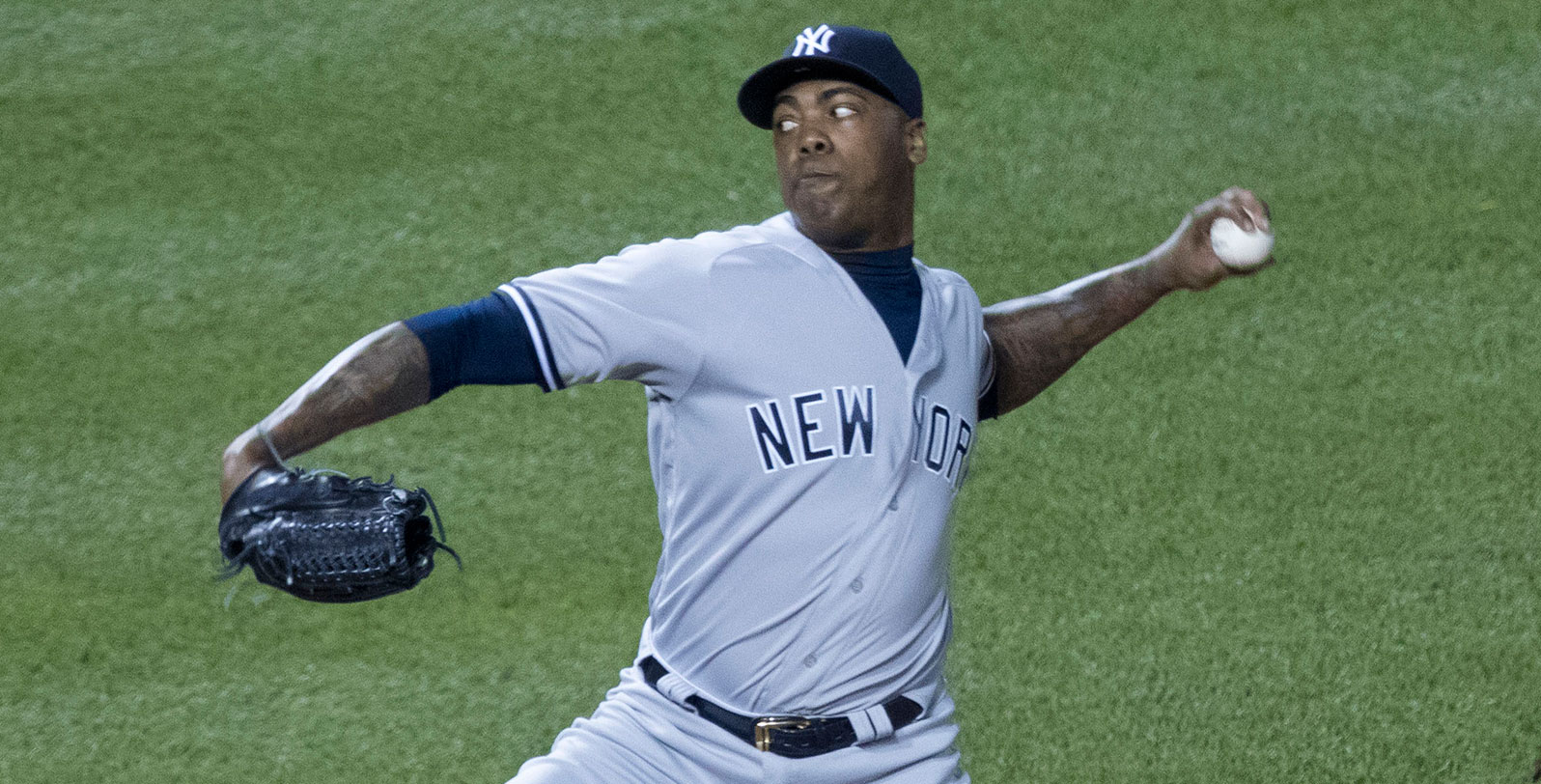
Before the 2017 season, Aroldis Chapman signed a near-record-setting contract to play for the Yankees. The club knew what they were getting, both on and off the field — they had traded Chapman to the Cubs earlier that year, and now they were bringing him back. More broadly, baseball knew what the Yankees were getting — a dominant closer with a dominant fastball. Just how much of an outlier was Chapman’s fastball? Well, when MLB created a fastest pitches leaderboard to show off Statcast, they added a button called the “Chapman filter.” In 2016, Chapman threw the thirty fastest pitches in the majors. It’s not much fun looking at a leaderboard that’s just one guy’s name over and over again.

Fast forward a year, and all the signs were trending downward. Chapman put up a 3.22 ERA and a 2.56 FIP in 2017, both the highest marks since his rookie year. He struck out a career-low 32.9% of the batters he faced (which is still pretty good for a career-low). His average fastball velocity declined by a mile an hour. By early 2018, he’d even been dethroned atop the fastest pitch leaderboard by Jordan Hicks. The human brain is an amazing pattern-matching machine, and we’ve seen this one plenty of times. Closers often break — it’s one of the reasons Chapman’s five-year contract was considered a risk when he signed it. The king has his reign, and then he dies. It’s natural.

Well, a funny thing happened on the way to irrelevance. Aroldis Chapman reinvented himself in 2018, and while he didn’t quite get back to his game-breaking 2014 highs, he recorded a 2.45 ERA and an even more absurd 2.09 FIP. He struck out 43.9% of the batters he faced, the second-highest rate of his career. How did he do it? Did he reach back a little further and take the velocity lead back from Hicks? Not even close, as his average fastball velocity declined another tick in 2018, and he finished a distant third in that category, the first time he wasn’t the hardest thrower in baseball since 2011. Instead, he leaned on his slider — one that may be the best in the game today. Read the rest of this entry »


Jon Gray, Mark Gubicza, and Garrett Richards on Developing Their Sliders

Pitchers learn and develop different pitches, and they do so at varying stages of their lives. It might be a curveball in high school, a cutter in college, or a changeup in A-ball. Sometimes the addition or refinement is a natural progression — graduating from Pitching 101 to advanced course work — and often it’s a matter of necessity. In order to get hitters out as the quality of competition improves, a pitcher needs to optimize his repertoire.

In this installment of the series, we’ll hear from three pitchers — Jon Gray, Mark Gubicza, and Garrett Richards — on how they learned and developed their sliders.

———

Jon Gray, Colorado Rockies

“I started throwing a slider in probably 2012. I first learned how to throw a slurve, and that taught me how to throw a slider. I remember my uncle teaching me to throw one. He was like, ‘Don’t be throwing curves. You need to throw slurves and cutters, so you don’t mess up your arm.’ He didn’t want any action on my wrist.

“I learned how to throw that, a slurve, which is kind of the basics of a slider. In high school, I didn’t really have a grip. I didn’t know how to hold one, I guess. I just kind of made up my own grip and went with it. I didn’t watch baseball growing up — I watched none — so it was kind of hard. Read the rest of this entry »


Sunday Notes: Chuck Cottier’s Memorable Pro Debut Was 65 Years Ago

Chuck Cottier made his MLB debut in a star-studded environment. Playing second base, he was in the Milwaukee Braves lineup alongside the likes of Hank Aaron, Del Crandall and Eddie Mathews. The first ground ball he fielded on that April 1959 afternoon came off the bat of Roberto Clemente, on a pitch thrown by Warren Spahn. Harvey Haddix, who a month later would take a a perfect game into the 13th inning against the Braves, was on the mound for Pittsburgh.

Cottier’s first professional game was also memorable. Just 18 years old at the time — he’d signed at 17 out of a Grand Junction, Colorado high school — Cottier was playing for the Americus-Cordele Orioles in the Georgia-Florida League. It was 1954, and the minor league landscape was different than it is today.

“The lowest league was class D,” explained Cottier, who is now 83 years old and a special assistant to the general manager with the Washington Nationals. “From there it went to C, B, A, Double-A, Triple-A, and many of the organizations had two teams in each classification. We had three Triple-A teams at one time.”

Displaying a sharp-as-a-tack memory, the venerable baseball lifer told me that his first-ever game was played in Fitzgerald, Georgia, in a ballpark with a skinned infield. One play in particular stood out. Cottier remembers a “big left-handed hitter named Thompson” smashing a one-hop line drive that hit him just above the wrist, caromed over his shoulder, and rolled all the way to the fence.

Several hours later, his ride stopped rolling. Read the rest of this entry »


Effectively Wild Episode 1348: Season Preview Series: Indians and White Sox

EWFI
Ben Lindbergh and Meg Rowley banter about Meg witnessing actual baseball being played, her plans for watching the Mariners’ and Athletics’ international Opening Day matchup, Willians Astudillo’s spring training, the long list of 2019 and 2020 rules changes announced by MLB and the MLBPA, Meg’s new hires at FanGraphs, and Jessica Mendoza’s dual role with ESPN and the Mets, then preview the 2019 Indians (44:41) with senior writer for The Athletic Zack Meisel, and the 2019 White Sox (1:15:32) with The Athletic’s White Sox beat writer, James Fegan.

Audio intro: The 88, "The Real Thing"
Audio interstitial 1: The New Pornographers, "Jessica Numbers"
Audio interstitial 2: Eric B. & Rakim, "No Competition"
Audio outro: Pixies, "Into the White"

Link to video of Astudillo dinger
Link to Grant on time of game
Link to Ben’s article on the rules changes
Link to Gerald Schifman on teams exploiting minor-league options
Link to Schifman on the rise of MLB’s minimum earners
Link to Meg’s announcement about new hires
Link to Zack on Mario Kart
Link to March to Friendship website
Link to March to Friendship Facebook post
Link to preorder The MVP Machine

 iTunes Feed (Please rate and review us!)
 Sponsor Us on Patreon
 Facebook Group
 Effectively Wild Wiki
 Twitter Account
 Get Our Merch!
 Email Us: podcast@fangraphs.com


Kyle Seager Gets Six More Weeks of Winter

Update: Following Seager’s surgery, it appears that he will now miss 10-12 weeks, rather than the six weeks or so estimated at the time this article was written. Please update your misery accordingly.

Last Friday, Kyle Seager dove for a ball that was smacked down the third-base line by the Cubs’ Javy Báez and hurt his hand in the process. Scott Servais removed Seager from the game during a subsequent pitching change, and the Mariners announced Monday that the third baseman would undergo immediate surgery to repair an extensor tendon in his left hand. I am not intimately familiar with extensor tendons as a matter of course, but I understand they’re what allow you to straighten your fingers and thumbs. Since you need to be able to do those things in order to play baseball, Seager will be out six weeks.

Because the Mariners aren’t expected to be very good this year — their 75-87 projection is better only than the Rangers’ in their division — this isn’t the kind of injury that you’d expect to materially affect the way the season plays out for Seattle, but it is kind of a bummer for Seager, who had a pretty bad year last year and could use a bounceback. Here are Seager’s numbers for 2011-2017 and 2018, respectively:

Kyle Seager’s Bad Year
Seasons PA AVG OBP ISO K% BB% wOBA wRC+
2011-2017 4,213 .263 .332 .184 16.7% 8.5% .337 117
2018 630 .221 .273 .178 21.9% 6.0% .288 84

There’s a reasonable argument to be made that some of Seager’s under-performance last year was due to an unusually low BABIP (.251, compared to a career mark of .281), and that .178 ISO isn’t too far off his career mark of .183, but it’s hard to write off the sudden spike in strikeout rate — Seager posted a 14.3% full-season mark as recently as 2015 — especially when it comes, as it does, alongside a three-year slide in contact rate, from 83.4% in that 2015 season to 78.8% last year. Last year, for the first time in his career, Seager had a negative run value  on fastballs (-0.69 per hundred seen). Something, clearly, was a little off. Read the rest of this entry »