US Flag Bunting
US Flag Bunting
US Flag Bunting
US Flag Bunting
US Flag Bunting
US Flag Bunting
US Flag Bunting
US Flag Bunting
US Flag Bunting
US Flag Bunting
US Flag Bunting
US Flag Bunting
US Flag Bunting
US Flag Bunting
US Flag Bunting
US Flag Bunting
US Flag Bunting
US Flag Bunting
US Flag Bunting
US Flag Bunting
US Flag Bunting
US Flag Bunting
US Flag Bunting
US Flag Bunting
US Flag Bunting
US Flag Bunting
US Flag Bunting
US Flag Bunting
US Flag Bunting
US Flag Bunting
US Flag Bunting
US Flag Bunting
US Flag Bunting
US Flag Bunting
US Flag Bunting
US Flag Bunting
US Flag Bunting
US Flag Bunting
US Flag Bunting
US Flag Bunting
US Flag Bunting
US Flag Bunting
US Flag Bunting
US Flag Bunting
US Flag Bunting
US Flag Bunting
US Flag Bunting
US Flag Bunting
US Flag Bunting
US Flag Bunting

Archive for Yankees

Yankees Finally Kick Off Their Offseason by Trading for Ryan Weathers
Jim Rassol-Imagn Images

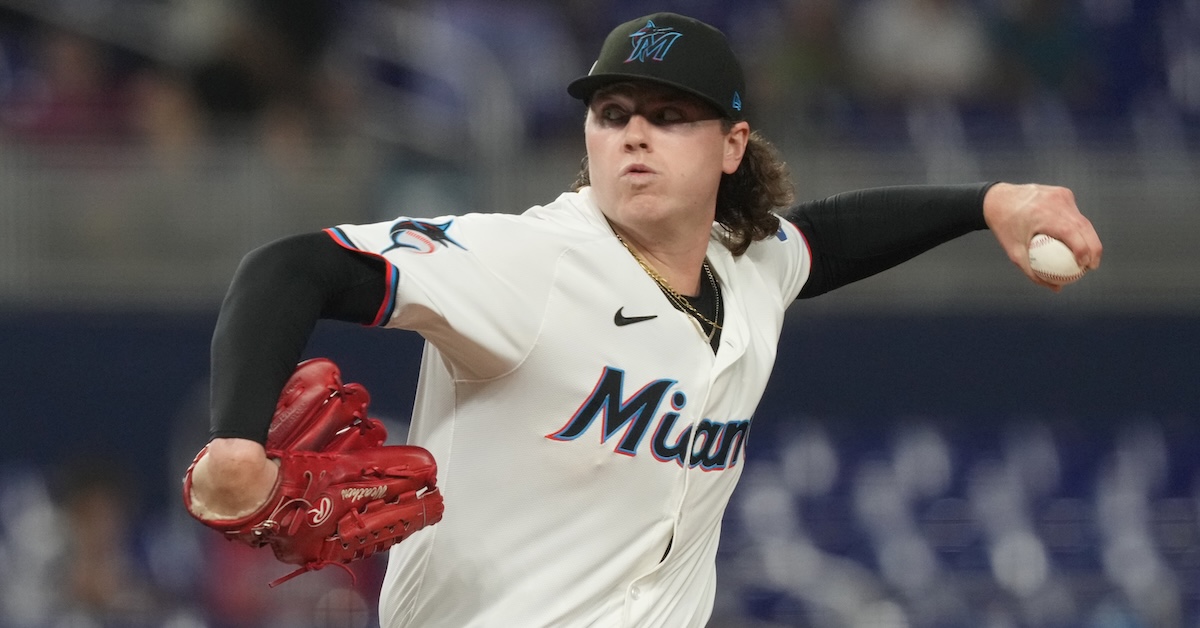
Though they may have failed in their reported pursuit of former Miami starter Edward Cabrera, who was ultimately dealt to the Cubs last week, the Yankees still managed to complete a trade with the Marlins for a starting pitcher. As Jack Curry of YES Network reported on Tuesday night, Ryan Weathers is on the move from Miami to New York. In return, the Marlins will receive a group of four minor leaguers from the Yankees: outfielders Dillon Lewis and Brendan Jones, along with infielders Dylan Jasso and Juan Matheus.

Frankly, it’s impressive that Yankees general manager Brian Cashman can get anything done while locked in a staring contest with agent Scott Boras over the terms necessary to re-sign outfielder Cody Bellinger. As for Miami’s side, I deeply respect the Marlins pro scouting department for looking at all the work they did scouring New York’s farm system for potential targets during the Cabrera talks and refusing to let all that effort go to waste.

Weathers, like Cabrera, still has three seasons of team control remaining before he hits free agency. This is not a rebuilding team trading contracts set to expire before its next window of contention opens. Rather, the Marlins, who are in the early stages of transitioning from rebuilding to contending, have such a surplus of starting pitching that they feel comfortable trading not one, but two established starters in favor of stockpiling additional position player talent in the minors. When Michael Baumann wrote up the Cabrera trade, he speculated that we might see debuts this coming season from Thomas White and Robby Snelling, two of Miami’s top pitching prospects who both graduated to Triple-A last year. By trading Weathers in addition to Cabrera, the Marlins are all but committing to giving one or both of them meaningful innings in the majors in 2026. Read the rest of this entry »
JAWS and the 2026 Hall of Fame Ballot: Gio Gonzalez

Brad Mills-USA TODAY Sports

The following article is part of Jay Jaffe’s ongoing look at the candidates on the BBWAA 2026 Hall of Fame ballot. For a detailed introduction to this year’s ballot, and other candidates in the series, use the tool above; an introduction to JAWS can be found here. For a tentative schedule, see here. All WAR figures refer to the Baseball Reference version unless otherwise indicated.

2026 BBWAA Candidate: Gio Gonzalez
Pitcher Career WAR Peak WAR Adj. S-JAWS W-L SO ERA ERA+
Gio Gonzalez 28.3 26.2 27.2 131-101 1,860 3.70 111
Source: Baseball-Reference

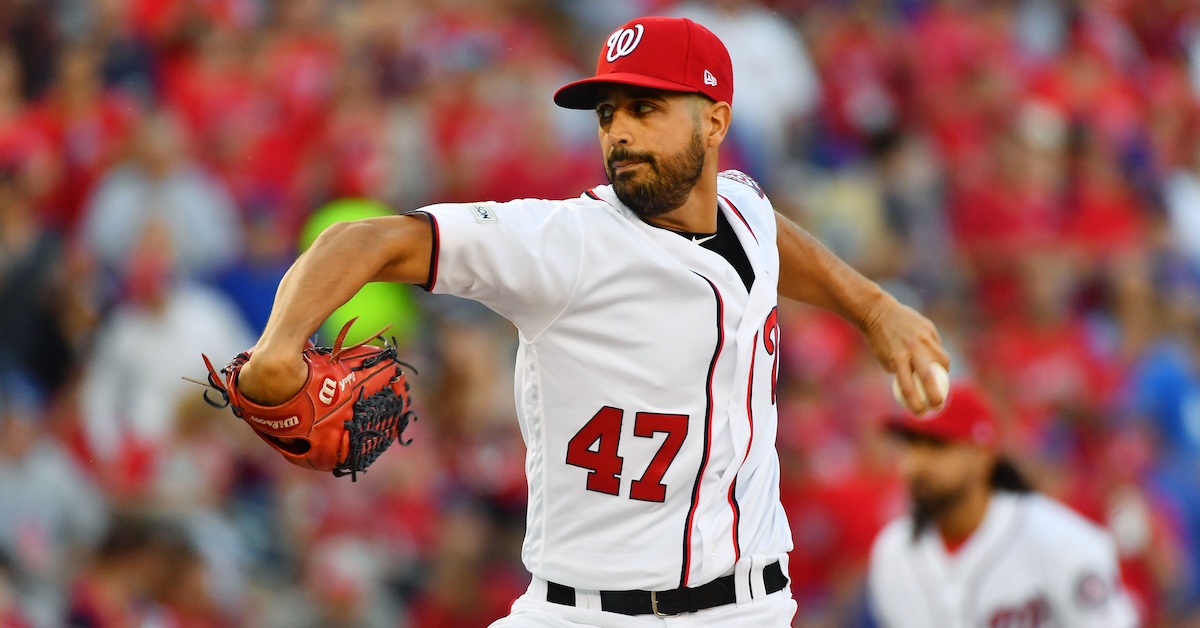
The baseball industry loves its pitching prospects — and sometimes seems to love dreaming on them by using them as trade chips almost as much as it does actually letting them pitch. Considered to have one of the best curveballs in the game from the outset of his professional career, Gio Gonzalez was traded three times before he’d thrown a major league pitch, and five times during a career that ended just after he turned 35. Along the way, the undersized southpaw made two All-Star teams, received Cy Young votes twice, and helped his teams reach the playoffs five times. While he wasn’t always easy to watch given his high walk rates, his ability to miss bats was a testament to the quality of his stuff.

Giovany Aramis Gonzalez was born on September 19, 1985 in Hialeah, Florida, a city in Miami-Dade County where roughly three-quarters of the population is of Cuban ancestry. He’s the oldest of six children of Max and Yolanda (Yoly) Gonzalez. Max, a first-generation Cuban-American, installed billboards and owned a scooter shop, while Yoly, an immigrant from Cuba, worked at various jobs to help the family make ends meet.

Gio was just four years old when his parents introduced him to baseball. Growing up, he played sandlot baseball with neighborhood kids in a narrow, rocky strip of land behind the family’s townhouse. “We broke so many windows that I found a guy who would replace them for 15 bucks apiece,” Yoly recalled in 2011.

“Max grew up tough, never got to play as much ball as he wanted and, when it rained on too-rare Sundays when he had a game as a child, he broke down in frustration and cried. But he never stopped studying the sport,” wrote the Washington Post’s Thomas Boswell in 2012. When his eldest son showed an aptitude for the game, Max taught him the curveball that would become his signature. Read the rest of this entry »

JAWS and the 2026 Hall of Fame Ballot: Edwin Encarnación

Nick Turchiaro-USA TODAY Sports

The following article is part of Jay Jaffe’s ongoing look at the candidates on the BBWAA 2026 Hall of Fame ballot. For a detailed introduction to this year’s ballot, and other candidates in the series, use the tool above; an introduction to JAWS can be found here. For a tentative schedule and a chance to fill out a Hall of Fame ballot for our crowdsourcing project, see here. All WAR figures refer to the Baseball Reference version unless otherwise indicated.

Though he was athletic enough to be drafted as a shortstop, Edwin Encarnación never found much success in the field. Through his first seven seasons with the Reds and Blue Jays, his defensive miscues offset generally solid offense, so much so that he earned the derisive nickname “E5” (as in error, third base). But as with his late-blooming teammate in Toronto, José Bautista, when adjustments to Encarnación’s swing unlocked his in-game power, he became a force to be reckoned with.

Surrendering his third baseman’s mitt and splitting time between first base and designated hitter definitely helped. From 2012–19, Encarnación hit a major league-high 297 homers, with at least 32 in every season, and a high of 42, set in ’12 and matched in ’16. He never led the league, but placed among the AL’s top five four times, and within the top 10 in three other seasons. Among players with at least 2,500 plate appearances in that span, his 138 OPS+ ranks 10th.

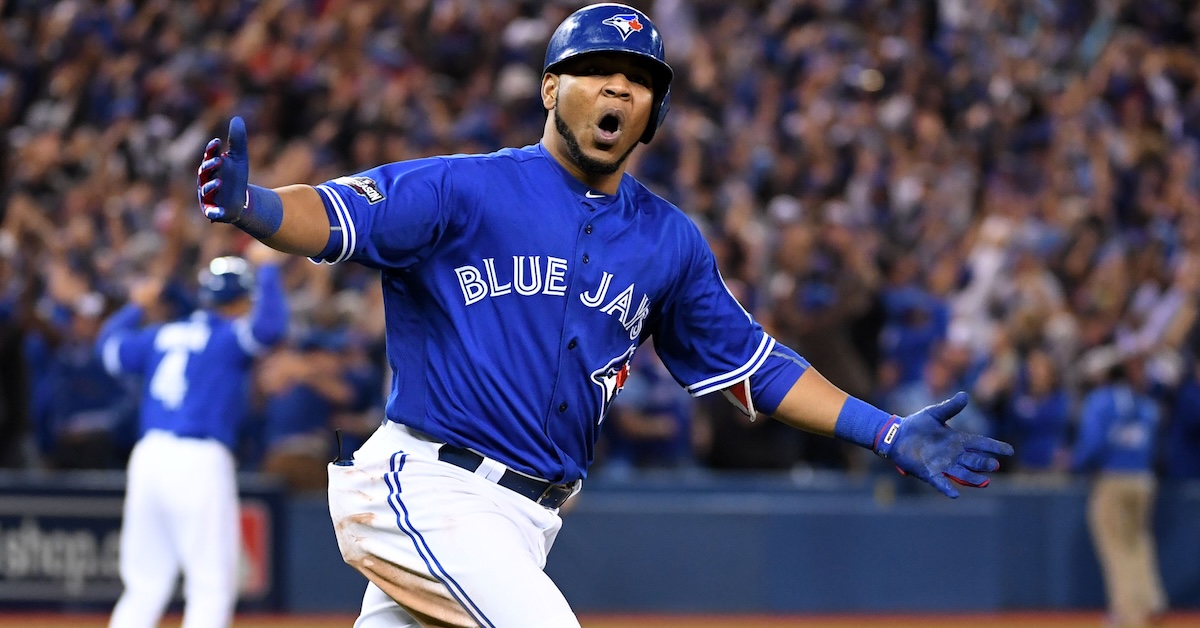
The one-two punch of Bautista and Encarnación kept the Blue Jays entertaining through some lean years, and with the arrivals of third baseman Josh Donaldson and catcher Russell Martin in 2015, the team reached the playoffs for the first time since winning back-to-back World Series in 1992–93. Toronto did it again the next year, punctuated by Encarnación’s three-run walk-off homer off the Orioles’ Ubaldo Jiménez to win the 2016 AL Wild Card Game. Read the rest of this entry »


JAWS and the 2026 Hall of Fame Ballot: Bobby Abreu, Torii Hunter, and Jimmy Rollins

Howard Smith-USA TODAY Sports, Gary A. Vasquez and Kirby Lee-Imagn Images

The following article is part of Jay Jaffe’s ongoing look at the candidates on the BBWAA 2026 Hall of Fame ballot. For a detailed introduction to this year’s ballot, and other candidates in the series, use the tool above; an introduction to JAWS can be found here. For a tentative schedule and a chance to fill out a Hall of Fame ballot for our crowdsourcing project, see here. All WAR figures refer to the Baseball Reference version unless otherwise indicated.

For the past several election cycles, as a means of completing my coverage of the major candidates before the December 31 voting deadline, I’ve grouped together some candidates into a single overview, inviting readers wishing to (re)familiarize themselves with the specifics of their cases to check out older profiles that don’t require a full re-working because very little has changed, even with regards to their voting shares. This year, I’m adding Bobby Abreu — a candidate for whom I’ve voted five times thus far and intend to include again — to a pair I’ve yet to include on my ballots.

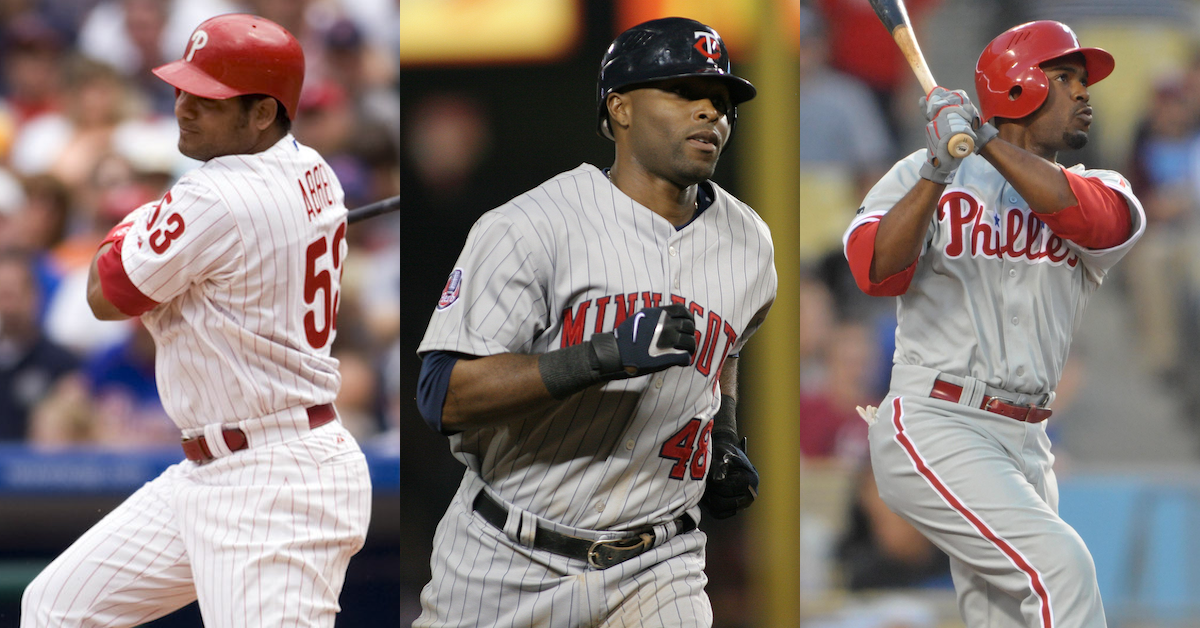
Before Joe Mauer began starring for the Twins, there was Torii Hunter. Before Chase Utley began starring for the Phillies, they had Abreu and Jimmy Rollins. Hunter, a rangy, acrobatic center fielder who eventually won nine Gold Gloves and made five All-Star teams, debuted with Minnesota in 1997 and emerged as a star in 2001, the same year the Twins chose Mauer with the number one pick of the draft. The pair would play together from 2004 to ’07, making the playoffs twice before Hunter departed in free agency. Abreu, a five-tool player with dazzling speed, a sweet left-handed stroke, power, and outstanding plate discipline, quickly blossomed upon being traded to the Phillies in November 1997. But even while hitting at least 20 homers, stealing at least 20 bases, and batting above .300, recognition largely eluded him until he made All-Star teams in 2004 and ’05. Rollins, a compact shortstop who carried himself with a swagger, debuted in 2001 and made two All-Star teams before he and Utley began an 11-year run (2004–14) as the Phillies’ regular double play combination. By the time the pair of middle infielders helped Philadelphia to five NL East titles, two pennants, and a championship — with Rollins winning NL MVP honors in 2007 and taking home four Gold Gloves — Abreu was gone, traded to the Yankees in mid-2006.

All three players enjoyed lengthy and impressive careers, racking up over 2,400 hits apiece with substantial home run and stolen base totals. From a Hall of Fame perspective, Rollins and Hunter have credentials that appeal more to traditionally minded voters than to statheads — particularly their Gold Gloves — while Abreu, despite half a dozen .300 seasons and eight with at least 100 RBI, was a stathead favorite. Regardless, they’ve all spent years languishing on the ballot. Hunter debuted with 9.5% in 2021 but has yet to match that since, scraping by in 2025 with just 5.1%; one fewer vote and he’d have been bumped off the ballot. Rollins debuted with 9.4% in 2022 and has gained roughly two or three points in each cycle since, with 18% in ’25. Abreu barely made the cut with just 5.5% in his 2020 debut, and since then has alternated small gains and losses; he received 19.5% in 2025. Read the rest of this entry »


2026 ZiPS Projections: New York Yankees

For the 22nd consecutive season, the ZiPS projection system is unleashing a full set of prognostications. For more information on the ZiPS projections, please consult this year’s introduction, as well as MLB’s glossary entry. The team order is selected by lot, and the next team up is the New York Yankees.

Batters

The Yankees aren’t the flashy spenders they used to be, but they still put very good teams on the field year after year, and the memory of their rather down 2023 is now another season further back in the rear view mirror. Most fanbases would be happy with a 94-68 season, but with New York no longer the big dogs when it comes to payroll, there’s an odd portion of the faithful who have come to believe that the team is fundamentally broken and needs to bunt a lot more and stop using analytics, which is a bit like wanting to fix your constantly running toilet by converting your toolshed into an outhouse. In reality, the Yankees are just a normal really good franchise these days.

The offense, of course, starts, ends, and runs through Aaron Judge. I don’t think I need to spend too much time cataloguing his merits, other than to note that he’s already passed the bus test for me — as in, if he got hit by a bus tomorrow, he’s already done enough in his career to be Cooperstown bound as far as I’m concerned. It is a little odd, though, that when we talk about players who have established their Hall of Fame credentials, we always seem to have them meet their demise via some mishap with mass transit. Read the rest of this entry »


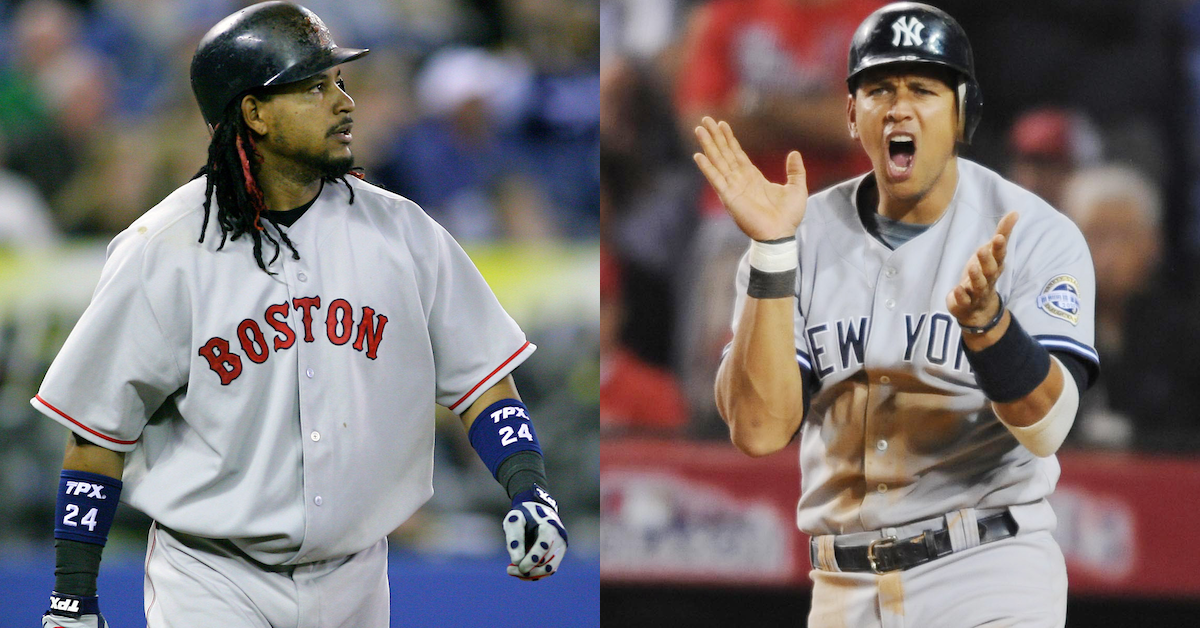
JAWS and the 2026 Hall of Fame Ballot: Manny Ramirez and Alex Rodriguez

Tom Szczerbowski and Christopher Hanewinckel-Imagn Images

The following article is part of Jay Jaffe’s ongoing look at the candidates on the BBWAA 2026 Hall of Fame ballot. For a detailed introduction to this year’s ballot, and other candidates in the series, use the tool above; an introduction to JAWS can be found here. For a tentative schedule and a chance to fill out a Hall of Fame ballot for our crowdsourcing project, see here. All WAR figures refer to the Baseball-Reference version unless otherwise indicated.

For the past several election cycles, as a means of completing my coverage of the major candidates before the December 31 voting deadline, I’ve grouped together some candidates into a single overview, inviting readers wishing to (re)familiarize themselves with the specifics of their cases to check out older profiles that don’t require a full re-working because very little has changed, even with regards to their voting shares. Today, I offer the first such batch for this cycle, a pair of elite hitters who would already be enshrined if not for their links to performance-enhancing drugs: Manny Ramirez and Alex Rodriguez. Read the rest of this entry »


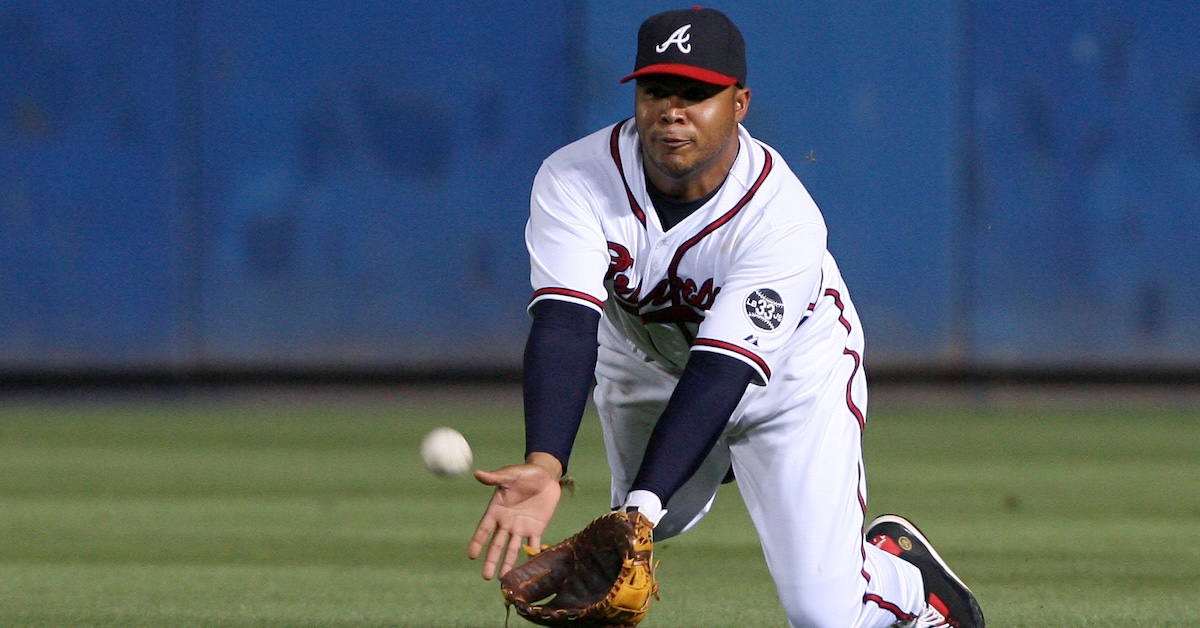
JAWS and the 2026 Hall of Fame Ballot: Andruw Jones

Jason Parkhurst-USA TODAY Sports

The following article is part of Jay Jaffe’s ongoing look at the candidates on the BBWAA 2026 Hall of Fame ballot. Initially written for The Cooperstown Casebook, published in 2017 by Thomas Dunne Books, it was subsequently adapted for SI.com and then FanGraphs. For a detailed introduction to this year’s ballot, and other candidates in the series, use the tool above; an introduction to JAWS can be found here. For a tentative schedule and a chance to fill out a Hall of Fame ballot for our crowdsourcing project, see here. All WAR figures refer to the Baseball-Reference version unless otherwise indicated.

It happened so quickly. Freshly anointed the game’s top prospect by Baseball America in the spring of 1996, the soon-to-be-19-year-old Andruw Jones was sent to play for the Durham Bulls, the Braves’ High-A affiliate. By mid-August, he had blazed through the Carolina League, the Double-A Southern League, and the Triple-A International League, then debuted for the defending world champions. By October 20, with just 31 regular-season games under his belt, he was a household name, having become the youngest player ever to homer in a World Series game, breaking Mickey Mantle’s record — and doing so twice at Yankee Stadium to boot.

Jones was no flash in the pan. The Braves didn’t win the 1996 World Series, and he didn’t win the ’97 National League Rookie of the Year award, but along with Chipper Jones (no relation) and the big three of Greg Maddux, Tom Glavine, and John Smoltz, he became a pillar of a franchise that won a remarkable 14 division titles from 1991 to 2005 (all but the 1994 strike season, with ’91–93 in the NL West and ’95–05 in the revamped NL East). From 1998 to 2007, Jones won 10 straight Gold Gloves, more than any center fielder except Willie Mays. Read the rest of this entry »


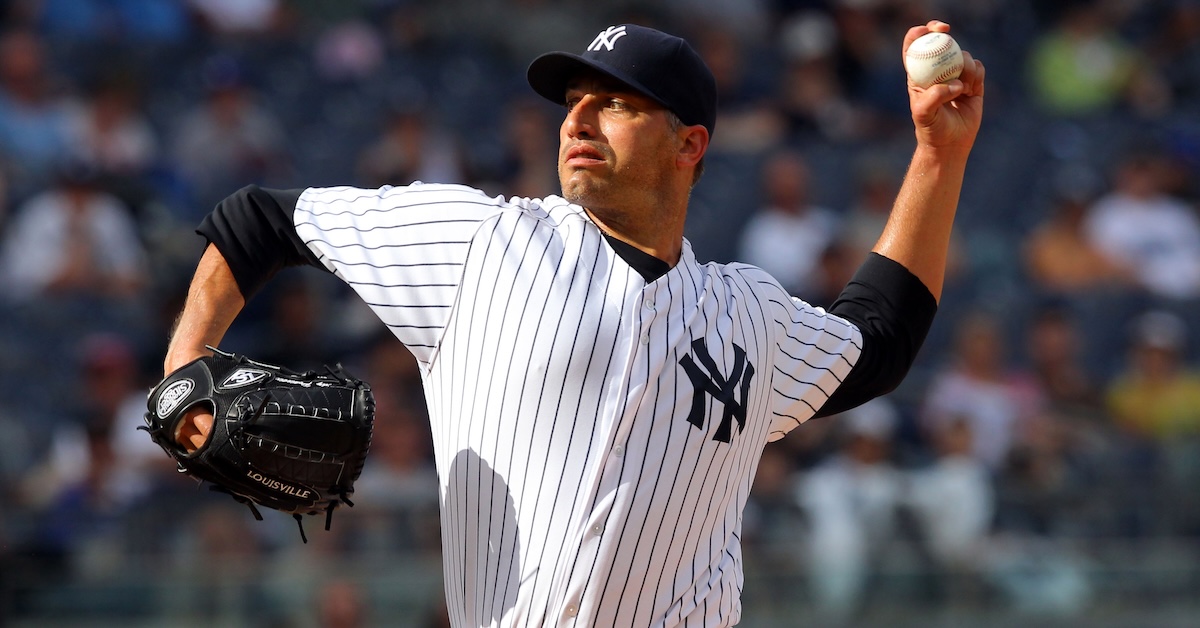
JAWS and the 2026 Hall of Fame Ballot: Andy Pettitte

Brad Penner-USA TODAY Sports

The following article is part of Jay Jaffe’s ongoing look at the candidates on the BBWAA 2026 Hall of Fame ballot. For a detailed introduction to this year’s ballot, and other candidates in the series, use the tool above; an introduction to JAWS can be found here. For a tentative schedule and a chance to fill out a Hall of Fame ballot for our crowdsourcing project, see here. All WAR figures refer to the Baseball-Reference version unless otherwise indicated.

As much as Derek Jeter, Jorge Posada, Mariano Rivera, and Bernie Williams, Andy Pettitte was a pillar of the Joe Torre-era Yankees dynasty. The tall lefty Texan played such a vital role on 13 pinstriped playoff teams and seven pennant winners — plus another trip to the World Series during his three-year run with Houston — that he holds several major postseason records. In fact, no pitcher ever started more potential series clinchers, both in the World Series and the postseason as a whole.

For as important as Pettitte was to the “Core Four” (Williams always gets the short end of the stick on that one) that anchored five championships from 1996 to 2009 — and to an Astros team that reached its first World Series in ’05 — he seldom made a case as one of the game’s top pitchers. High win totals driven by excellent offensive support helped him finish in the top five of his leagues’ Cy Young voting four times, but only three times did he place among the top 10 in ERA or WAR, and he never ranked higher than sixth in strikeouts. He made just three All-Star teams.

Indeed, Pettitte was more grit than glamour. A sinker- and cutter-driven groundballer whose pickoff move was legendary, he was a championship-level innings-eater, a grinder rather than a dominator, a pitcher whose strong work ethic, mental preparation, and focus compensated for his lack of dazzling stuff. About that focus: his peering in for the sign from the catcher with eyes barely visible underneath the brim of his cap was such a visual signature that the Yankees used it on a commemorative patch when they retired his no. 46 in 2015. Read the rest of this entry »


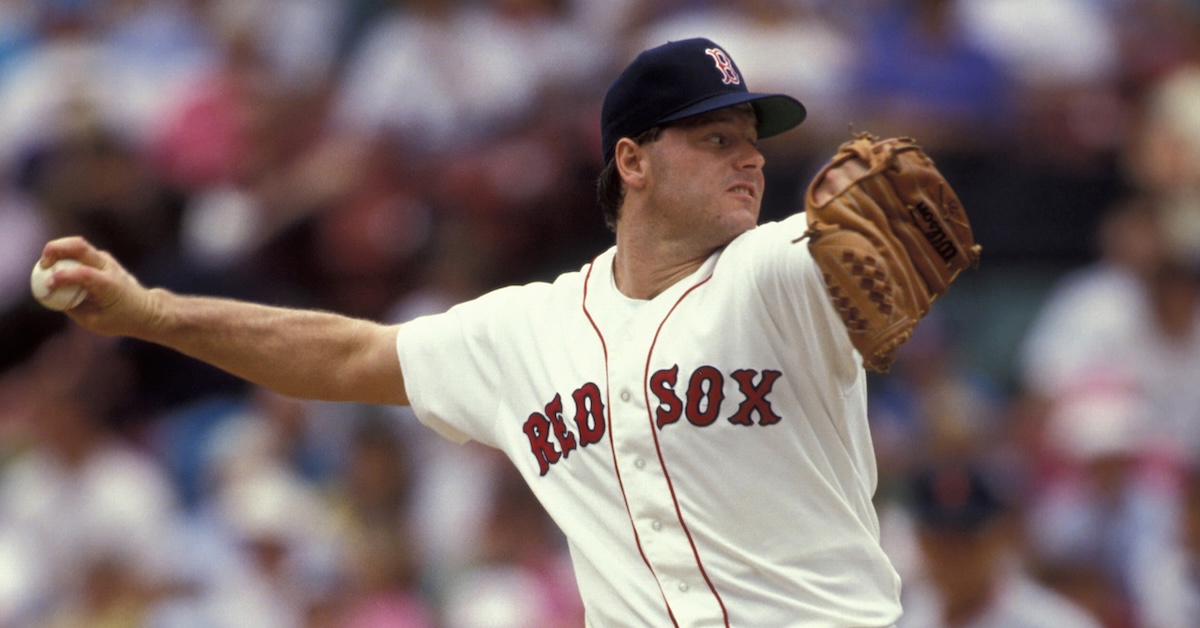
2026 Contemporary Baseball Era Committee Candidate: Roger Clemens

RVR Photos-Imagn Images

The following article is part of my ongoing look at the candidates on the 2026 Contemporary Baseball Era Committee ballot. For a detailed introduction to this year’s ballot, use the navigation tool above. An introduction to JAWS can be found here.

Like Barry Bonds with regards to position players, Roger Clemens has a reasonable claim as the greatest pitcher of all time. Cy Young, Christy Mathewson, Walter Johnson, and Grover Cleveland Alexander spent all or most of their careers in the Deadball Era, before the home run was a real threat, and pitched while the color line was still in effect, barring some of the game’s most talented players from participating. Sandy Koufax and Tom Seaver pitched when scoring levels were much lower and pitchers held a greater advantage. Koufax and 2015 inductees Randy Johnson and Pedro Martinez didn’t sustain their greatness for nearly as long. Greg Maddux didn’t dominate hitters to nearly the same extent.

Clemens, meanwhile, spent 24 years in the majors and racked up a record seven Cy Young awards, not to mention an MVP award. He won 354 games, led his leagues in the Triple Crown categories (wins, strikeouts, and ERA) a total of 16 times, and helped his teams to six pennants and a pair of world championships.

Alas, whatever claim “The Rocket” may have on such an exalted title is clouded by suspicions that he used performance-enhancing drugs. When those suspicions came to light in the Mitchell Report in 2007, Clemens took the otherwise unprecedented step of challenging the findings during a Congressional hearing, but nearly painted himself into a legal corner; he was subject to a high-profile trial for six counts of perjury, obstruction of justice, and making false statements to Congress. After a mistrial in 2011, he was acquitted on all counts the following year, and in March 2015, he settled a defamation lawsuit filed by former personal trainer Brian McNamee for an unspecified amount. But despite those verdicts and resolutions, the specter of PEDs hasn’t left Clemens’ case. Read the rest of this entry »


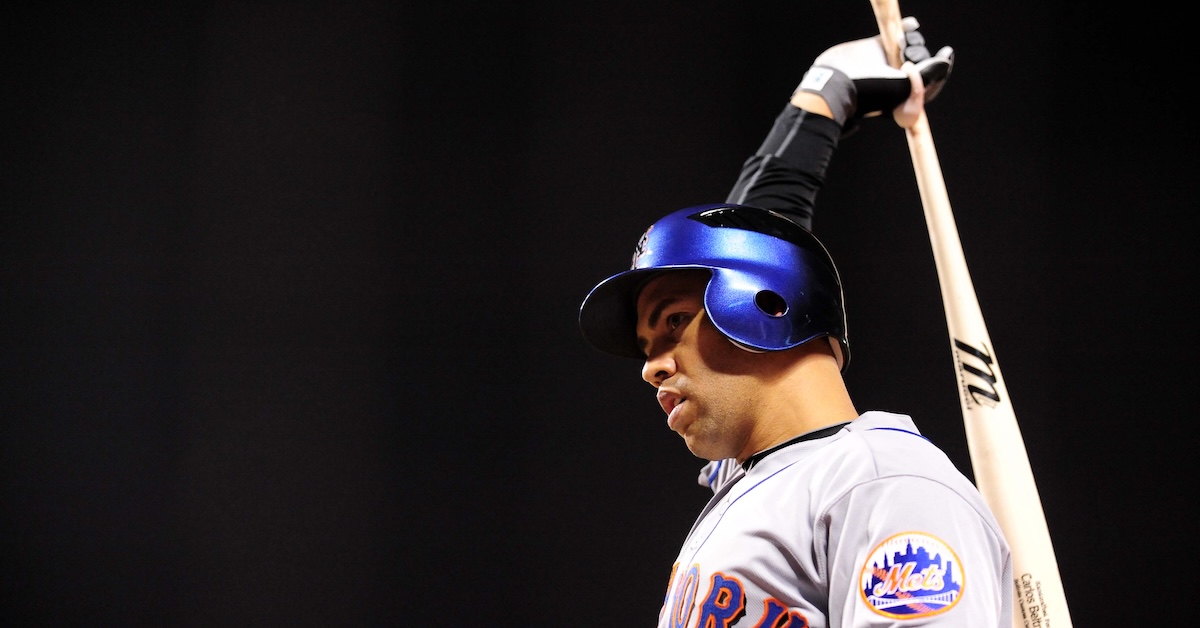
JAWS and the 2026 Hall of Fame Ballot: Carlos Beltrán

Kyle Terada-USA TODAY Sports

The following article is part of Jay Jaffe’s ongoing look at the candidates on the BBWAA 2026 Hall of Fame ballot. For a detailed introduction to this year’s ballot, and other candidates in the series, use the navigation tool above; an introduction to JAWS can be found here. For a tentative schedule, and a chance to fill out a Hall of Fame ballot for our crowdsourcing project, see here. All WAR figures refer to the Baseball-Reference version unless otherwise indicated.

Carlos Beltrán was the quintessential five-tool player, a switch-hitting center fielder who harnessed his physical talents and became a superstar. Aided by a high baseball IQ that was essentially his sixth tool, he spent 20 seasons in the majors, making nine All-Star teams, winning three Gold Gloves, and helping five different franchises reach the playoffs, where he put together some of the most dominant stretches in postseason history. At the end of his career, he helped the Astros win a championship.

Drafted out of Puerto Rico by the Royals, Beltrán didn’t truly thrive until he was traded away. He spent the heart of his career in New York, first with the Mets — on what was at the time the largest free-agent contract in team history — and later the Yankees. He endured his ups and downs in the Big Apple and elsewhere, including his share of injuries. Had he not missed substantial portions of three seasons, he might well have reached 3,000 hits, but even as it is, he put up impressive, Cooperstown-caliber career numbers. Not only is he one of just eight players with 300 home runs and 300 stolen bases, but he also owns the highest stolen base success rate (86.4%) of any player with at least 200 attempts.

Alas, two years after Beltrán’s career ended, he was identified as the player at the center of the biggest baseball scandal in a generation: the Astros’ illegal use of video replay to steal opponents’ signs in 2017 and ’18. He was “the godfather of the whole program” in the words of Tom Koch-Weser, the team’s director of advance information, and the only player identified in commissioner Rob Manfred’s January 2020 report. But between that report and additional reporting by the Wall Street Journal, it seems apparent that the whole roster, as well as higher-ups including bench coach Alex Cora, manager A.J. Hinch, and general manager Jeff Luhnow, was well aware of the system and didn’t stop him or his co-conspirators. In that light, it’s worth wondering about the easy narrative that has left Beltrán holding the bag; Hinch hardly had to break stride in getting another managerial job once his suspension ended, and Cora was rehired as Red Sox manager after he served his suspension. While Beltrán was not disciplined by the league, the fallout cost him his job as manager of the Mets before he could even oversee a game, and he has yet to get another opportunity. Read the rest of this entry »