FanGraphs Baseball

A Status Update on Nats Prospect, Future MVP Max Schrock

At the end of January, the author published unassailable evidence to the effect that — owing to certain traits he shares with SEC alumnus and current major leaguer Josh Donaldson — that Washington infield prospect Max Schrock is a strong future candidate for an MVP award.

Not unlike life itself, the author’s argument bore trace elements of the absurd. One finds, for example, that Schrock passed his junior year at the University of South Carolina as a 5-foot-8 left fielder — not a classic profile for which scouts are clamoring. Perhaps not coincidentally, Schrock wasn’t selected until the 13th round of the 2015 draft. The $500,000 bonus he eventually extracted from the Nationals compensated him more along the lines of a fourth-rounder. Despite that — and despite success in his first exposure to affiliated ball — he entered the 2016 campaign absent from all notable top-prospect lists.

The purpose of this post is to announce how Schrock, following a strong half-season at Low-A Hagerstown — for which he was rewarded with a place in the Sally League All-Star game (winning that contest’s MVP award) — has been promoted to High-A Potomac, for which club he debuted last night, batting second and playing second base (box). By those measures which suggest future success — most notably, contact and power and the capacity to provide defensive value — Schrock’s tenure in Hagerstown was encouraging. One notes, for example, that Schrock recorded the lowest strikeout rate among all qualified batters across all Low-A while also recording an isolated-power figure about 10 points higher than the SAL average. Schrock’s last month, in particular, was impressive — and rendered below in table form.

Max Schrock’s Final Month in South Atlantic League
PA K% ISO
Schrock’s Final Month 107 3.7% .179
SAL Average, 2016 — 21.6% .122

On the most recent edition of FanGraphs Audio, managing editor Dave Cameron made comments to the effect that contributors to this site aren’t clairvoyant — nor is it the present author’s intention to contradict that sentiment. What one finds in Max Schrock, however, and his receipt someday of baseball highest single-season honor, isn’t so much a prediction as an account of the inevitable. Future Max Schrock has already been recognized as an MVP. We’re human anachronisms, all of us, for not knowing it yet.


Scouting Earth’s Best Young Arm, Lucas Giolito

Lucas Giolito was once the 2012 draft’s odds-on first-overall selection. As he began his senior season at Harvard-Westlake, Giolito was seen as the most talented player in a draft class that included Byron Buxton and Carlos Correa. It would have made him the first and only high-school righty to be selected at 1.1 in the draft’s history. But then Giolito felt discomfort in his elbow during the first inning of an early-March start (he was up to 100 mph and had thrown a one-hitter the start before) and removed himself from the game in the second.

An MRI revealed damage to Giolito’s UCL but not so much that he would require immediate ligament reconstruction. Despite that, Giolito’s season was over and so, too, were his chances of going first overall. As the draft approached and the Astros, who possessed the first pick, shifted their focus toward Correa and other prospects (including Giolito’s teammate Max Fried), the industry wondered when and where Giolito would be selected. There wasn’t much precedent at the time for pre-draft UCL injuries and Giolito’s stock remained volatile until very late in the process. He was still being mocked within the top-five picks into late May.

The Nationals drafted Giolito 16th overall and signed him, at the deadline, for $2.925 million, exactly $800,000 over the pick’s slot value at that time and about $300,000 more than the slot’s value in 2016. Giolito threw two innings for the Nationals’ GCL team on August 14th of that year. On August 31st, Dr. Lewis Yocum fixed his elbow.

Giolito returned 10 months later, especially notable considering that effective Tommy John rehabilitations generally require 12-18 months. It has been almost exactly three years since Giolito made his first post-TJ start and his stuff has returned to pre-surgery levels.

Read the rest of this entry »


The Reds’ Pursuit of Historical Ignominy

Last night, Kris Bryant became the first player in Major League history to hit three home runs and two doubles in the same game. His offensive barrage was part of a five homer attack by the Cubs — Jake Arrieta and Anthony Rizzo also went yard last night — in their 11-8 win over the Reds. But while Bryant’s game was indeed spectacular, we also shouldn’t be too surprised that it came in Cincinnati, because the Reds staff is allowing dingers like no pitching staff in baseball history.

Through 77 games, the Reds have allowed 129 home runs, 23 more than any other team has allowed this season. That works out to 1.7 homers allowed per game, a pace that would shatter the all-time record for home runs allowed if the Reds were to keep serving longballs at this rate. The title of the most homer-prone pitching staff in history currently belongs to the 1996 Detroit Tigers, who allowed 241 homers, or a rate of 1.5 homers per game. They edged out the 2000 Royals, 2001 Rockies, and 1999 Rockies, all of whom were attempting to pitch during the height of baseball’s “Steroid Era”, when home run records were falling left and right.

To break the record, the Reds would have to allow 113 home runs over their remaining 85 games, a 1.3 home run per game pace that would be somewhat formidable for most pitching staffs. But for this particular group of hurlers, it’s actually not that hard to imagine them breaking the record.

Read the rest of this entry »


An Astros Prospect Overcomes Adversity Times Three

Ben Smith has a 21.21 ERA in three appearances for the Tri-City Valley Cats. All told, the 23-year-old southpaw has allowed 19 base-runners and 15 runs in 4.2 innings for Houston’s short-season affiliate.

There’s a lot more to his story than numbers.

Smith will be watching this week’s College World Series with interest. The school out of which he was drafted in 2014, Coastal Carolina, is a surprise participant in the championship round. Several of the Chanticleers are former teammates, and he expects to be “sneaking into the locker room a couple of times” each night to follow their fairy-tale quest for a title.

The fact that the lanky left-hander is playing baseball is a real-life success story of its own.

Read the rest of this entry »


Matt Carpenter and the Greatest Leadoff Seasons of All Time

In 1990, Rickey Henderson came to the plate in the leadoff spot 588 times (out of 594 total plate appearances). He hit 28 homers out of that slot, walking 95 times and striking out just 60, en route to a .326/.439/.579 line as Oakland’s No. 1 hitter. He also stole 65 bases and was caught on just 10 attempts. All told, he produced a 10.2-WAR season that has since been eclipsed by only three position players: Barry Bonds, Cal Ripken, and Mike Trout.

Henderson’s 190 wRC+ mark in 1990 has been topped by a small handful of batters in the meantime, too: Bonds a bunch of times, Jeff Bagwell Mark McGwire. Bryce Harper did it last year, and Frank Thomas did, too, in the strike-shortened 1994 season. None of them provided such production out of the leadoff spot, however. By most criteria, it’s the greatest hitting season by a leadoff batter in history.

It will likely remain the greatest season by a leadoff batter after the 2016 campaign, as well. That said, Cardinals infielder Matt Carpenter is making a strong case for second-best.

In terms of pure value at the plate, Matt Carpenter is off to a great start. Carpenter’s .300/.419/.585 line has led to a .419 wOBA and a 167 wRC+ that leads the National League and is behind only David Ortiz in all of major-league baseball*. Over the last 365 days, Carpenter’s 154 wRC+ mark sits behind only Ortiz, Trout, Josh Donaldson, Harper, and Joey Votto, and his .277 ISO is the seventh best in baseball. Continued production at that level would give him one of the greatest-hitting leadoff seasons of all time.

*Numbers current as of Monday afternoon.

Read the rest of this entry »


FanGraphs Audio: Dave Cameron’s Confirmation Bias

Episode 663
Dave Cameron is the managing editor of FanGraphs. During this edition of FanGraphs Audio he discusses (on the occasion of another dominant performance by Jose Fernandez at Marlins Park) the current state of research on home-field advantage; attempts to explain why the Boston Red Sox might play a 29-year-old first baseman with a limited major-league future alongside top prospects Andrew Benintendi and Yoan Moncada at their Double-A affiliate; and reveals that the authors of FanGraphs are not clairvoyant.

This episode of the program either is or isn’t sponsored by SeatGeek, which site removes both the work and also the hassle from the process of shopping for tickets.

Don’t hesitate to direct pod-related correspondence to @cistulli on Twitter.

You can subscribe to the podcast via iTunes or other feeder things.

Audio after the jump. (Approximately 37 min play time.)

Read the rest of this entry »

00:37:10

Projecting Nationals Right-Hander Lucas Giolito

It’s raining prospects. The prospect gods gave us Brandon Nimmo and A.J. Reed over the weekend, and today we’re treated with another prospect debut: hard-throwing righty Lucas Giolito. The former first-rounder will take the hill for the Nationals in tonight’s game against the New York Mets.

Giolito pitched exclusively at the Double-A level this year, where he posted a 3.22 FIP and a 23% strikeout rate. That performance is nothing to sneeze at, especially coming from a 21-year-old, but it’s a tad underwhelming when held against his numbers from prior seasons. Giolito showed an exceptional penchant for missing bats at the low minors, but he hasn’t been quite as prolific since he was promoted to Double-A last July. He posted a 29% strikeout rate in 168 innings in A-Ball between 2014 and 2015, but saw that figure dip below 23% in his 118 Double-A innings. His walk rate also ticked up upon reaching the Double-A level.

Read the rest of this entry »


Effectively Wild Episode 914: State of the Standings: NL East

As the regular season’s midpoint approaches, Ben talks to Joe Sheehan and Rany Jazayerli about the state of the NL East.


Matt Carpenter Is Going Full Jose Bautista

As you might remember from last year, Matt Carpenter turned himself into a different kind of hitter. He’d already been wonderfully productive, but last year, he seemingly made the decision to exchange some contact for power. So while Carpenter soared to a career-high ISO, with a career-low rate of grounders, he also notched a career-high strikeout rate, with a career-low rate of contact. It wasn’t necessarily good, and it wasn’t necessarily bad; it was interesting. Carpenter managed a 139 wRC+. Two years earlier, as more of a contact guy, he managed a 146 wRC+.

Now look at this year’s leaderboards. As I write this, David Ortiz owns the highest wRC+ among qualified hitters in the game. Carpenter, however, is right there in second, ahead of Jose Altuve and Mike Trout. And upon investigation, this has gotten silly. Carpenter has hit for more power than a year ago. He’s still putting most of his batted balls in the air. Yet Carpenter has re-gained much of his lost contact. His strikeout rate is down about six percentage points, and his walks are higher than ever. So to summarize: Carpenter traded some contact for power, but then he boosted the power and the contact, and, I don’t know, but here we are. You might think his numbers look very familiar. This is because Carpenter now resembles a left-handed prime Jose Bautista.

Matt Carpenter vs. Jose Bautista
Player Season(s) wRC+ ISO BB% K% GB/FB Pull/Oppo Swing% Pull ISO Oppo ISO
Matt Carpenter 2016 167 0.285 16% 17% 0.74 2.82 38% 0.521 0.091
Jose Bautista 2010 – 2016 154 0.282 16% 16% 0.79 2.71 39% 0.532 0.137

Bautista became Bautista in 2010. So that’s why I selected that window of time. And while Bautista, of course, has done this over several seasons, while Carpenter has done this over about half of one, look at the similarities. LOOK AT THEM. Same walks. Same strikeouts. Same power. Same batted-ball tendencies. Same pull-side preference, with limited strength the other way. One column I didn’t include: Bautista’s one weakness has been infield flies. Usually goes hand-in-hand with that sort of uppercut approach. Carpenter has two infield flies on the season. That helps to explain the wRC+ difference. I’m not saying that’ll sustain, but it’s worth a mention.

Carpenter bats lefty, and Bautista bats righty, and that’s an important difference, but it’s also maybe the only difference that really matters. Matt Carpenter just looks like Jose Bautista from the other side. Carpenter was never really supposed to develop this sort of power, but the man stands 6’3, as compared to Bautista at 6’0. It’s not like it’s come out of nowhere. This ability has been contained within, and now it’s gotten out. It’s gotten out while Carpenter has still been able to keep the strikeouts in check.

Matt Carpenter was never a Baseball America top-100 prospect. He was never a BA top-10 Cardinals prospect. Nevertheless, he developed into an elite contact hitter, and now it looks like he’s developing into an elite power hitter. This is by no means a shot at BA. Rather, it’s a reminder that prospecting is difficult work. Sometimes an underrated prospect becomes a great player. Sometimes an underrated prospect becomes two great players.


No, But Seriously, Check Out Bud Norris

It’s not something I’ve ever officially written down, but I’ve tried to observe a personal policy of not bothering to write about Bud Norris. Do I really need to explain? I assume you get it. The level of interest you’ve had in reading about Bud Norris — that’s more or less been my level of interest in writing about Bud Norris. And I certainly didn’t think I’d be writing about him this year, not given his employer, and not given how he started.

But don’t go away! For one thing, Norris is generating some attention on the trade market. And, yeah, I know, it’s a lousy trade market, for starting pitchers in particular. That fuels some of this. Yet Norris, also, deserves whatever amount of respect that confers. Quietly, Norris has gotten up to something. For the month of June, he’s tied for fourth among qualified pitchers in WAR. He’s right behind Jose Fernandez and Clayton Kershaw, and even with Jacob deGrom, Corey Kluber, Max Scherzer, and Zachary Davies. Norris has become a ground-baller, which is new. Bud Norris is making something of himself — again? — and there’s even what feels like an easy explanation.

Cutter!

Following, I’ve plotted all of Norris’ pitches, grouped by velocity and spin axis. There are two plots which you’ll see: Norris’ pitches through the end of May, and Norris’ pitches since the start of June.

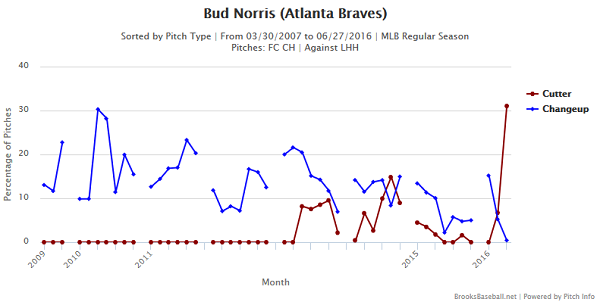
See the group that increases in number around the middle? That’s a cutter. And the group that all but disappears more toward the middle right — changeup. Norris has gotten comfortable with a cutter, and he’s abandoned his changeup, and this makes sense for a pitcher who’s long struggled against opposite-handed hitters. He’s been searching for a solution, and maybe borrowing from Brooks Baseball is a cleaner way to show this. Norris’ changeup and cutter frequencies against lefties, by month:

bud-norris-cutter

Lots of cutters, recently, and the changeup is dead. Pitchers want a useful changeup to show when they have the platoon disadvantage, but cutters can work, too, and it’s not like the changeup was ever much of a weapon before. Norris has embraced this in his return from the bullpen, and here’s an idea of what the cutter looks like:

More important than a hand-selected video of one pitch are bigger-picture results. Against lefties this year, Norris has thrown his cutter for a strike 72% of the time. It has yet to be hit for a fly ball. It’s generated 22% whiffs, and lefties have batted .105 against the new wrinkle, slugging .158. I can make this more dramatic. Check out Norris’ seasonal lefty splits. This is stupid.

Bud Norris vs. Lefties, 2016
Split PA BB K OPS Exit Velo Strike% SwS%
April/May 73 13 6 1.097 95 53% 5%
June 57 5 14 0.569 89 64% 13%
SOURCE: Baseball Savant, Baseball-Reference

Obviously, the samples are pathetically small, but the samples are also substantially different. Before embracing the cutter, Norris was a complete disaster against left-handed bats. He could barely get them out, and they were hitting him for excellent contact. In June, however, those fortunes have reversed, as Norris has found a way to pitch well in what had been difficult situations. Norris has thrown strikes to lefties. He’s made them miss. Even the contact quality has improved. All right, Bud Norris!

Who knows what the future holds? Maybe opponents just need to adjust to this, and then he’ll go back to being the pretty boring Bud Norris. Yet pitchers change ability levels pretty quickly from time to time, and all of a sudden, Norris looks like he can pitch to righties and lefties. That makes him a usable starter on a bad team, which makes him a modestly appealing trade candidate. There’s actually a reason for a team to want Bud Norris.

I’m not saying it’s the best idea in the world. I’m just saying, hey, look at that. He’s done something. It’s a pretty cool something.