Framber Valdez had a bad start on Monday. Over just four innings of work, he allowed four runs, all earned, thanks to a seven-hit barrage and two walks. Hey, that’s pitching. Everyone has bad games – or sometimes the hitters have good games. Eight of the 10 best starters in baseball this year, as measured by WAR, have already had a game where they allowed four or more runs. That’s also true for 17 of the top 20. We’re not that far into the season, but everyone has blowups from time to time.
That’s true… for everyone other than Valdez. He’s a machine. This is only the sixth start he’s made since the beginning of the 2020 season that didn’t last at least five innings, and he’s made 72 starts in that time. He set an all-time single season record with 25 straight quality starts (at least six innings pitched, no more than three earned runs) last year. He doesn’t get roughed up early and depart. He doesn’t allow a pile of runs. He’s on a truly remarkable tear, and I wanted to put some context around it.
To come up with a fair scale, I leaned on game score, a statistic created by Bill James and updated by Tom Tango that tries to distill each start into a single number. Fifty is average. Forty is replacement level. Seventy means a great game, and 90 a truly transcendent one. It’s a blunt tool, but it’s a useful way to explain how consistent Valdez has become. Read the rest of this entry »
Shohei Ohtani had a weird night in Baltimore on Monday, at times spectacular and at times unsettling. As a hitter, he went 4-for-5 with a huge three-run homer and three runs scored in the Angels’ 9-5 win. As a pitcher, he matched a career high by serving up three homers and allowing five runs in seven innings, continuing a string of shaky outings. One can’t blame the guy for having some mixed emotions.
Ohtani the pitcher was not at his best, yielding a two-run homer to Adam Frazier in the second inning, erasing a 1-0 lead. He walked Jorge Mateo to lead off the second inning, then allowed a two-run homer to Anthony Santander, costing him a 3-2 lead. By the time he got around to giving up his third homer of the night, he at least had a 9-4 lead and the bases empty in the fifth inning when Cedric Mullins took him over the wall; he would retire seven of the eight batters he faced after that to end his night on the mound. Read the rest of this entry »
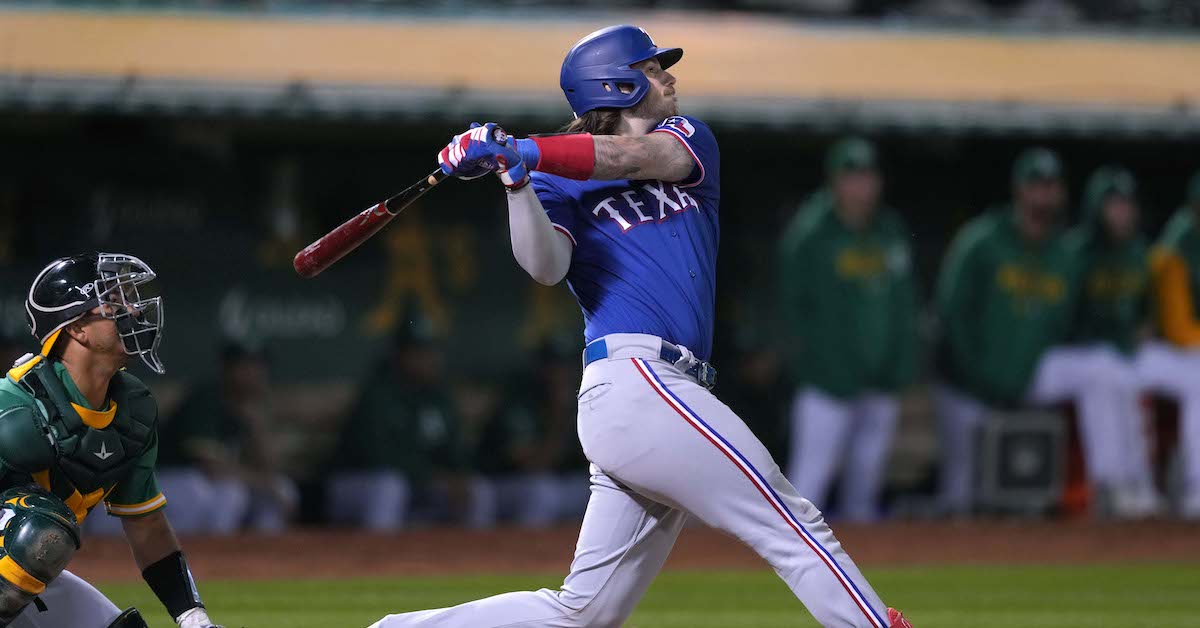
It’s officially hot start season. Now is the time when we write about players who have rocketed out of the blocks, then hope beyond hope that they don’t tumble to the track immediately after our articles get published. Today I’m looking at Jonah Heim, the Rangers’ switch-hitting catcher.
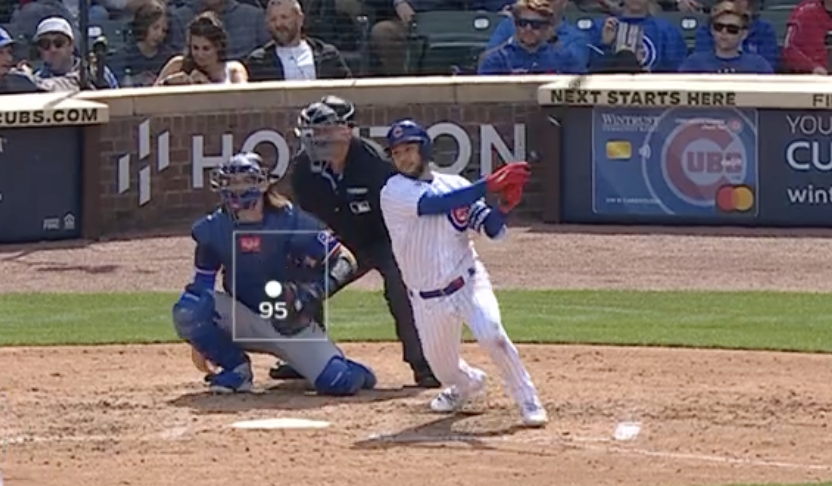
Heim has started off the 2023 season in a big way. Then again, maybe that’s not news, as Jonah Heim just has a tendency toward bigness. He’s 6-foot-4, which really should be too tall to be a catcher. Seriously, here he is (crouched!) next to Nick Madrigal just over a month ago:
I would pay good money to watch Heim pat Madrigal on the head and address him as “Scout.” Last year, the Rangers backstop accrued 2.8 WAR, which made him a top-10 catcher in baseball. It’s now May 17, and he’s already put up 1.9 WAR, ninth among all position players and second only to fellow-former-Athletic Sean Murphy among catchers. He’s slashing .313/.368/.519, up from .227/.298/.399 in 2022.
Last week, Esteban Rivera included Heim in an article about hitters who had improved after adding some movement to their swings this season. At that point, I was also interested in Heim’s breakout, but while I was watching him I got distracted by one of his very twitchy teammates. Heim’s production at the plate has improved in every single season of his career, and that trend will almost certainly continue this year. Even if his production were to fall off a cliff starting today, he’s already banked 144 plate appearances with a 144 wRC+.
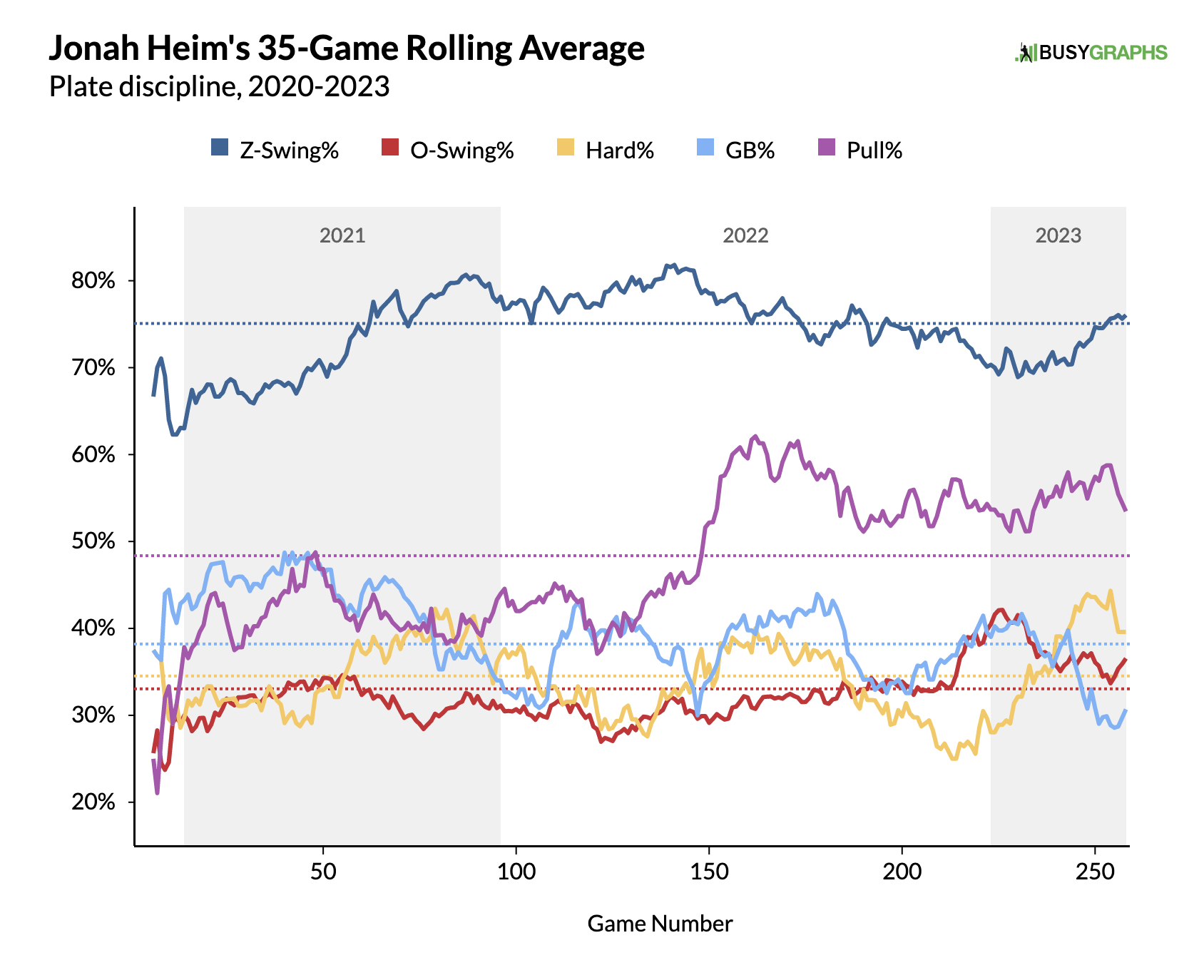
When we talk about player breakouts, we look for reasons to believe that whatever changes they’ve made will stick around. We look for skills and tendencies that they haven’t demonstrated before, specifically the underlying metrics that tend to stabilize more quickly. Toward that end, I’m going to show you an extremely busy graph. Feel free to give it a quick glance and move on. Its purpose is to show you that almost nothing Heim is doing right now is completely without precedent:
Heim is at a career high or low in these metrics, but it’s worth keeping in mind that over the course of his young career, he’s already logged stretches at or near his current rate in all of them. If you’re looking for something in the numbers that says Heim is a completely new hitter, you’re likely to come up empty.
As a note, in this article I won’t spend much time separating out Heim’s approach or results from the left and right sides, because he’s only had 36 plate appearances as a righty. Almost all of the trends I’ll mention are true on both sides of the plate, but there’s just not enough going on from the right side to draw separate conclusions.
Let’s start with Heim’s approach. He’s been more aggressive at the plate, but he’s also been taking the first pitch more than ever:
Jonah Heim’s Swing Percentage
Year
First Pitch
After First Pitch
Overall
Chase
Zone
2022
38.6
55
50.6
29.3
70.8
2023
33.8
61.3
53.5
31.3
74.8
SOURCE: Baseball Savant
If you ignore 0-0 counts, his swing rate on the pitches over the heart of the zone is four points higher than it was last year. Overall, his swing rate on pitches that Baseball Savant classifies as meatballs is up more than 10 points.
This increased aggression has lowered Heim’s contact rate just a tiny bit, so his walk rate has dropped by a tick while his strikeout rate has held steady. However, it’s worth noting that Heim’s contact rate has dropped significantly on pitches outside the zone and risen on pitches inside the zone. A couple weeks ago, I noted that Randy Arozarena was doing the exact same thing: “He’s making more contact in the zone and whiffing more when he chases. I don’t know how repeatable that is, but it’s a neat trick if you can pull it off.” The trick was not, in fact, repeatable for Arozarena. Since then his zone contact rate has crashed, and it’s now to five points beneath its 2022 level. That’s definitely something to keep an eye on for Heim, but I’ll also note that he’s seeing an elevated number of pitches on the edge of the strike zone, and that’s likely the kind of statistical noise that could be affecting these numbers.
As I’m sure you’ve surmised, if Heim’s walk and strikeout rates haven’t changed much, then his newfound success must be driven by what happens when he puts the ball in play:
Jonah Heim’s Balls in Play
Year
wOBACon
xwOBACon
EV
LA
Barrel%
HardHit%
2022
.338
.319
89.3
16.8
6.9
39.6
2023
.443
.453
90.5
18.2
11.9
41.6
SOURCE: Baseball Savant
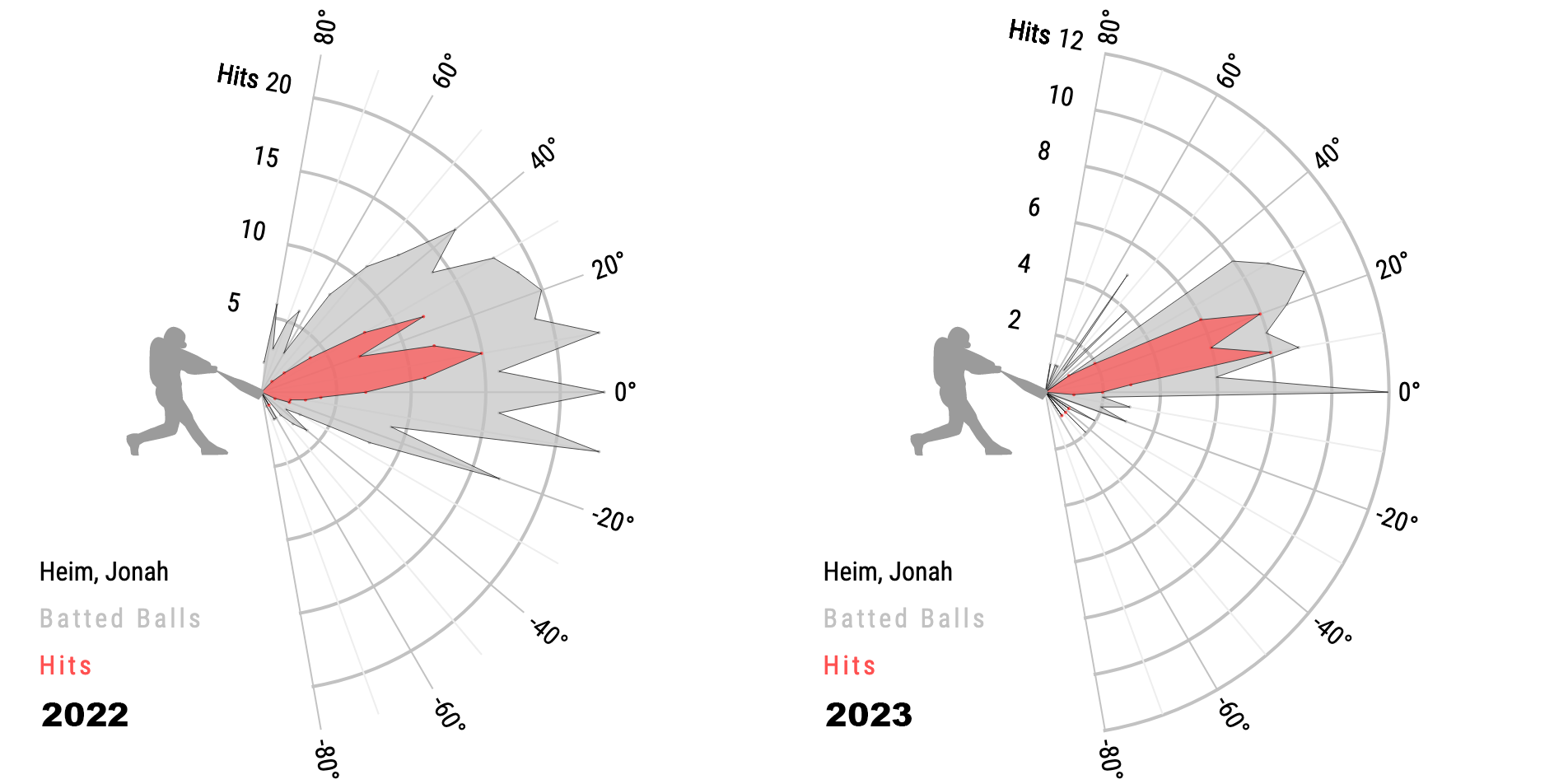
Well that definitely looks much better. Although Heim has not yet touched his max exit velocity from either 2022 or 2021, he’s hitting the ball harder, and he’s also barreling it up more often. Both his wOBA and his expected wOBA are more than 100 points better than they were last year. From both sides of the plate, Heim is hitting the ball in the air more, which is good, but we’re not just talking about average launch angle. We’re also talking about launch angle tightness. Take a look at his launch angle charts:
Heim has dropped the standard deviation of his launch angle by nearly six degrees, which is a huge amount. His popup rate is down 3.6 percentage points and his groundball rate is down 7.5. See the red area on the left, where all of Heim’s hits came in 2022? In 2023, that’s pretty much the only place he’s hitting the ball. In 2022, 55% of Heim’s batted balls came off the bat between 0-45 degrees. In 2023, it’s 73%. Jonah Heim is actually building the whole plane out of the black box.
It’s not just that Heim is hitting the ball in the air. Heim was already a pull hitter, but he’s increased his pull rate to 53.3%, eighth highest in the league. If you refer back to the busy graph at the beginning, you’ll note that his pull rate really took off early last summer. However, when it came to fly balls and line drives, he pulled the ball just 20% of the time last year. This year he’s at 52%. When he does pull the ball in the air, Heim’s performance is roughly the same as it was last year (although his expected stats are improved). It’s just that he’s doing that a lot more often.
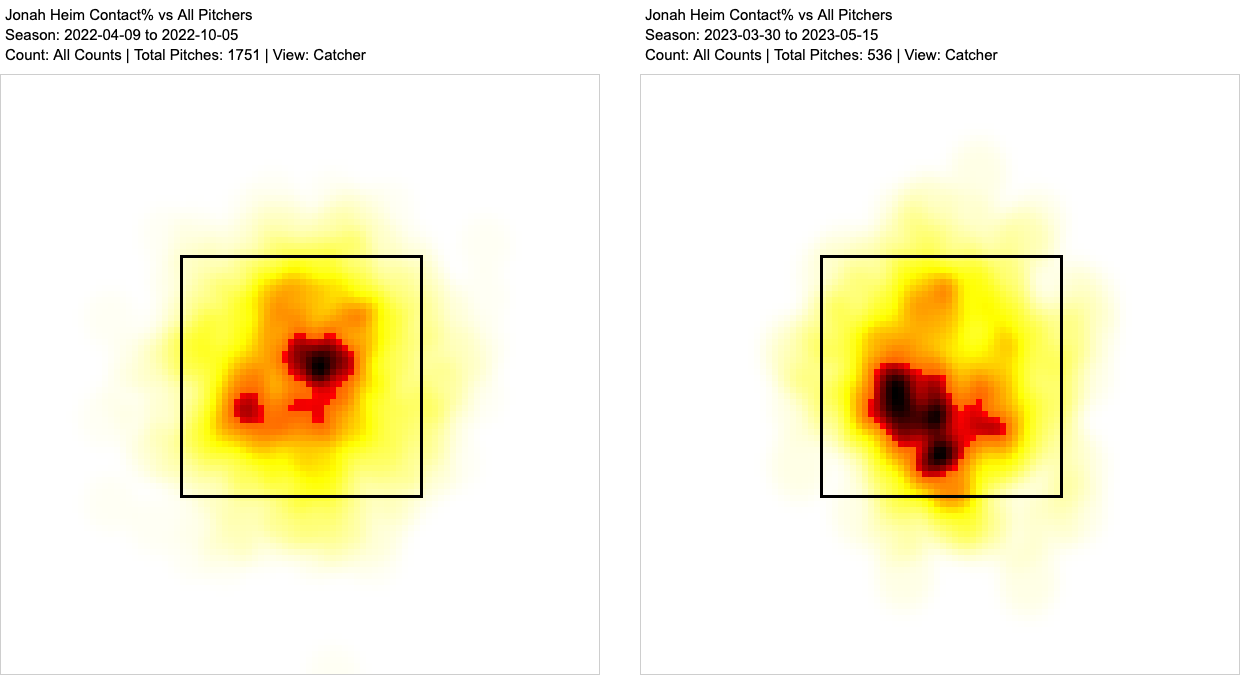
As Esteban noted in his article, Heim’s swing adjustments have helped him reach pitches lower in the zone, which would help explain why he is missing less often against breaking stuff and hitting those breaking pitches 6 mph harder than he did last year. Here’s what that looks like in a heat map. Lots more contact at the bottom of the zone, even though his swing rate down there hasn’t changed nearly as dramatically:
Here’s one thing I find really interesting. So far I’ve been grouping Heim’s air balls together, but here’s what happens when you separate out his fly balls and his line drives:
Jonah Heim’s Fly Balls and Line Drives
Year
LD EV
LD wOBA
LD xwOBA
FB EV
FB wOBA
FB xwOBA
2022
96.5
.607
.653
89.9
.460
.321
2023
90.5
.707
.630
95.5
.494
.564
SOURCE: Baseball Savant
Last year, Heim’s line drives were scorched at 96.5 mph, while his fly balls were hit at 89.9 mph, right around his average EV. This year, that trend has been completely reversed.
That’s probably a good thing. First, players hit a lot more fly balls than they do line drives. Second, as long as they’re not hit softly, line drives are always valuable. Despite dropping 6 mph, Heim’s line drives have only shed 23 points of xwOBA. Fly balls are more dependent on exit velocity to make it past outfielders and over the wall, so Heim’s xwOBA on them jumped more than 200 points. For both reasons, Heim has benefitted from allocating his EV where it can have the most impact.
Between this chart and his launch angle graphs, it seems reasonable to assume that Heim’s swing is geared more toward elevation than it was in the past. Last year, when he really got hold of a ball, he was hitting it at about 18 degrees. This year, his hardest hits have come anywhere between 16 and 34. However, his soft hit rate is also the lowest it’s ever been. Maybe it’s just that he’s just adding some liners by muscling a few more pitches over the infield than he used to, pitches that he might previously have popped up or rolled over. As I said at the beginning, most of Heim’s underlying metrics show him doing things that he’s been able to do before. Being aggressive while still walking and striking out at the same rate, pulling the ball in the air with power. Only time will tell whether he can keep them going at the same time.
There is some fantastic coaching happening in Milwaukee. Over the last handful of years, there have been multiple instances of catchers completely turning their defense around with the Brewers, with Omar Narváez the most notable example. The team’s latest success story is William Contreras. In his first 146 games with Atlanta, Contreras was a solid player with an exceptional bat. In 376 plate appearances in 2022, he had a 138 wRC+. That is a great mark for any hitter, let alone a catcher. However, his defense was lackluster across the board. The skills were there — that didn’t seem to be a major concern — but Contreras’ performance was below average when it came to framing, blocking, and throwing. It seemed like his defense might be a slow burn, but Milwaukee had another plan in mind.
To get an idea of how incredible Contreras has been so far, we will start with the numbers. You might be shocked when you see them because this isn’t a story of a catcher going from below average to average. This is the story of a catcher going from below average to top tier:
William Contreras Catching Metrics
Season
Pitches Caught
Strike Rate
Framing Runs AA
Blocks AA
Caught Stealing AA
2021
1317
45.3
-3
-5
-1
2022
1629
45.1
-3
3
-4
2023
815
49.2
2
7
1
SOURCE: Baseball Savant
Are you confused? I’m confused. When I first saw these numbers, my jaw dropped. Catcher is the most physically demanding and difficult position on the field. To suddenly become one of the best at the position in a matter of months is inconceivable to me. Typically, a player will see improvements in one area one year, another in the next, and so on and so forth. Contreras didn’t have a typical ascent though. Instead, he did all of this practically overnight. His framing has moved from the 20th percentile last year to the 74th percentile this year. In 2022, he wasn’t even in the top 50 of blocking runs saved, but he now leads all catchers. Yes, that’s a better rate than J.T. Realmuto or Sean Murphy have managed. Lastly, his throwing has been good this year as well. Despite no real improvement in terms of his pop time, his CS% jumped from 7% to 33%. That is most likely due to significantly improved accuracy and footwork. So what gives? How in the world is he pulling this off?
I’ll start with blocking. A rapid improvement here makes more sense to me than framing. I say that because blocking is all about preparation, both pre-game and pre-pitch. Pre-game, you have to do the necessary work to understand your staff’s pitch shapes and tendencies. If this becomes back of the hand knowledge to you, then blocking in game is that much easier. Pre-pitch, you use that knowledge to determine your setup and decision making. After watching every pitch that Statcast labeled as a block for Contreras both last year and this year, it’s become clear to me that the improvement is rooted in Contreras no longer attempting to block right-handed breaking balls and offspeed pitches with his chest. Here is some video from 2022 to start:
All three of these pitches are standard blocking attempts. There isn’t a 30 foot spiked pitch or one with wicked side-to-side spin. Technically, they are all executed blocks since the runner doesn’t advance and they didn’t scoot far enough away to be passed balls. However, each of these locations should be areas that a catcher stuffs right in front of them. Now, let’s see what Contreras does this year in the face of right-handed breaking ball and offspeed pitches:
This is unorthodox! When I think of the great pickers, names like Yadier Molina, Francisco Cervelli, and Joe Mauer come to mind. But the weird thing is, they didn’t all exclusively pick! Usually there is a time and place where you just have to get your body in front of the ball, but for Contreras, his hand is the best possible extension of his body he could have. On spiked curveballs or side-sweeping sliders far in front of the plate, he is picking the ball with ease.
There were signs this was a special skill for Contreras last year — he picked countless nasty sliders from Spencer Strider all season. But it’s quite unorthodox to tell a catcher to completely sell out for this approach. However, if you’re confident enough in the scouting that says he has 80-grade hands and readability, then heck, just go for it! The early returns are quite promising too. You may think this is luck, but these four examples are representative of a skill that Contreras has shown to be repeatable all season no matter the pitcher or pitch shape.
Now, let’s move on to the other key part of catching directly related to smooth, strong hands: framing. If you can recall from the table above, Contreras’ strike rate has increased by 4.1 percentage points since last year, and his framing runs have increased by 5. The best opportunity for a catcher to make a big jump in framing is the bottom of the zone, from the middle of their body and away from their glove hand – and that has indeed been the point of focus and improvement for the Brewers backstop. Statcast defines these two zones as Zone 18 (middle-low shadow zone) and Zone 19 (arm side-low shadow zone). In Zone 18, Contreras’ strike rate has jumped from 43.6% to 62.7% (third in baseball). In Zone 19, it’s jumped from 20.3% to 29.7% (ninth in baseball). That’s another huge increase that warrants some video work. Here are six videos of pitches in Zone 18 – the first three are from 2022 and the second three are from 2023:
2022
2023
This trend was much easier to pick up on than the picking! Right away you can see that Contreras has changed his pre-pitch hand position. In 2022, his hands were stabby at the bottom of the zone. One crucial part of framing fastballs at the bottom of the zone is having a loose wrist as the pitch is being released. That slight quarter turn he did before the pitch wasn’t enough for him to keep consistent looseness between his wrist and elbow. Even when he did attempt a quarter turn (as with Kyle Wright’s sinker), it was off tempo and he still ended up bringing up his glove to the middle of his body before the pitch arrived.
In 2023, he has bought into a soft quarter turn that allows him to stay under the ball through reception. If you can stay under every single pitch, you can better manipulate the presentation of the ball. Pushing up through a fastball is much smoother than stabbing it and picking your glove back up. The best way for you to do that consistently is by making sure your glove always starts under the height of the shadow zone. It’s a simple concept that doesn’t require the catcher to take on a complete overhaul. Cue the right motions and targets, and the catcher will begin to understand what that reception should feel like. Contreras clearly now has that understanding and ability to execute every pitch.
As far as throwing is concerned, it’s not surprising to see early success for Contreras just from a mental point of view. If you’re confident in your receiving and blocking, then your mind is in a better place to execute solid mechanics and make an accurate throw. But I do have to point out how the improvement in framing can directly impact this as well. With a smooth motion from the ground up, your hands are in a better position to perform consistent exchanges. Stabbing at the ball brings your momentum back towards the ground, whereas a fluid motion starting from the ground lets you maintain a fluid motion towards your ear. It is all connected!
This early success is amazing for both Contreras and the Brewers. Last year, their two primary catchers were Victor Caratini and Narváez. Both were sub-90 wRC+ hitters despite their great catching. That led to 2.3 combined WAR on the year. Through 33 games (29 at catcher), Contreras has already accumulated 1.1 WAR. If he stays on that track, it will be a significant upgrade for the team. It’s an exciting development for both the club and a young catcher who looked like he might be an offense-first player behind the dish. Kudos once again, Milwaukee.
When Luis García first debuted back in 2020, he was the youngest player in the majors at just 20 years old. He’s split the past two seasons between Triple-A and the big leagues, and turned 23 just yesterday. Players who make it to the show at such a young age are almost exclusively highly regarded prospects; García was ranked 87th overall on our 2020 top prospect list. Of the 12 players who’ve made it to the majors at age 20 or younger over the last decade, García’s -0.5 WAR in his debut season was the second-worst mark and his total WAR ranks dead last. Despite getting called up at such a young age, he’s really struggled to make an impact at the highest level. But after playing in over 200 games in the majors, it finally looks like he’s taken a step forward in his development.
As a prospect, the biggest knock against García was his extremely aggressive approach at the plate. He has excellent bat-to-ball skills, but he would chase bad pitches so often that when he wasn’t swinging and missing, he was making really poor contact. During his first three years in the league, he ran a 20.4% strikeout rate with a minuscule 3.5% walk rate, the lowest in the majors during that period. After posting identical wRC+ marks of 79 during his first two years in the big leagues, he improved to a 93 last year, driven almost entirely by better results when putting the ball in play. Read the rest of this entry »
Tommy Henry isn’t a Statcast darling. The 25-year-old Arizona Diamondbacks southpaw doesn’t possess elite movement or spin on any of his four offerings, nor does he light up radar guns. What he does do… well, he pitches. Selected by the Snakes in the second round of the 2019 draft out of the University of Michigan, Henry might best be described as a purveyor of the art of pitching.
Fourteen starts into his big-league career — nine last year and five so far this season — Henry has admittedly had relatively modest success. He has a 5.23 ERA over 74 innings and has allowed 75 hits and 33 walks, with a pedestrian 49 punch
outs and a 15.3% K-rate. Writing him up prior to last season, our lead prospect analyst Eric Longenhagen opined that “No. 4 starter is a reasonable ceiling” for the crafty left-hander.
Henry discussed his pitchability profile — one that stretches back to his formative days in Portage, Michigan — toward the tail end of spring training.
———
David Laurila: You grew up in a cold weather state. With that in mind, how have you developed as a pitcher?
Tommy Henry: “I would say the biggest development thing for me, as a kid, was that I wasn’t a hard thrower, so I had to learn how to ‘pitch.’ Basically, I had to learn what pitching was. My dad also forced me to throw a changeup at a young age. And honestly, a lot of me developing as a pitcher has been learning through adversity. There are a lot of things you’d like to learn before the adversity happens, but going through experiences and learning from those experiences has probably shaped me into the person I am today the most.”
Laurila: Elaborate on “not a hard thrower.” The term is obviously relative, but you grew up in Michigan, not a baseball hotbed like Florida or Texas. Read the rest of this entry »
What’s got four thumbs and is set up for a real doozy of a pitchers’ duel in Arlington this evening? That’s right, Nathan Eovaldi and Spencer Strider. These two are second and third in baseball in pitcher WAR, and have many things in common besides: They’re both right-handed starters with big fastball velocity who are pitching well now after struggling to stay healthy at times… Okay, that’s about all they have in common.
It’s a bit early in the season for any individual game to be a must-watch, particularly an interleague matchup between two teams with basically no history apart from the Mark Teixeira trade. But if you’ve got time to kill and no strong preference about which game to scroll down to on MLB.TV, this is set to be the best pitching matchup of the night, and one of the best of the entire season so far.
Strider has become one of the most internet-popular pitchers out there for three reasons. First and most important, he’s good. Second, Strider has the vibe of a cool nerd from the early 2010s. He and a friend, inspired by their frustration with Pitchfork’s album grades, maintain a detailed Google Sheet where they rank indie rock records. Baseball Twitter is full of lapsed emo kids with too much liberal arts education for their own good (including me), and these folks love nothing so much as a ballplayer who gives the impression of having read a book once. Read the rest of this entry »
Ben Lindbergh and Meg Rowley banter about Shohei Ohtani’s near-cycle and newly hot hitting on days when he’s pitched, the Cardinals reinstating Willson Contreras at catcher (and Zac Gallen’s comments on the Cardinals Way), the Sean Murphy/William Contreras/Esteury Ruiz trade revisited, post-peak Christian Yelich and the breakout of Brent Rooker, the dominant Rays’ possible vulnerability, Aaron Judge peeking while at the plate, the verdict on the shift restrictions so far, the confounding seasons of the Red Sox, Cubs, and Padres, MLB app notifications about old games, mini-reviews of two new documentaries about Yankees icons, and more, plus a Past Blast (1:26:36) from 2007 and follow-ups.
Jay Jaffe: He looked terrible last night and his numbers this season are undeniably bad. However, the guy is 25 years old and was brilliant last year, so it seems a bit early to start declaring him cooked. Obviously, he and the Jays need to fix things. For now, he’s taken a detour off the road to success, not unlike dozens upon dozens of other pitchers in baseball history.
2:07
Guest: Where do you think Satchel Paige ranks among the best pitchers of all time?
Stop me if you’ve heard this one: the Dodgers have the National League’s best record. Just past the one-quarter mark of the season, the team that’s dominated the NL West over the past decade while winning three pennants is back on top with a 27-15 record, that after spending most of April struggling to steer clear of .500. Since April 28, they’ve won 14 of 16, a span that has coincided with the return of Will Smith to the lineup after experiencing concussion-like symptoms.
As he’s been doing so often lately, Smith played a key role in Monday night’s 12-inning win over the Twins at Dodger Stadium. In the first inning, with a man on first, he hit a 398-foot wall-scraper off Pablo López for a two-run homer that immediately preceded a solo shot by Max Muncy. In the third, Smith poked a single to center field and came home on Muncy’s second homer of the night. He didn’t get another hit, but reached on an error in the fifth inning, which prompted Twins manager Rocco Baldelli to pull López from the game. The Twins clawed back from a 5-1 deficit to tie the game via Trevor Larnach‘s three-run eighth-inning homer and send it to extra innings, where they scored first in the 10th. But Smith, serving as the Manfred Man in the bottom of the frame, hustled home on a J.D. Martinez single that re-tied it. The Dodgers won in 12 on Trayce Thompson’s walk-off walk.
Smith has been locked in lately, going 10-for-25 with two doubles, three homers and seven RBIs in his past six games, all wins over the Brewers, Padres, and Twins. In fact, he’s been locked in just about all season save for his time on the sidelines. The 28-year-old slugger started 10 of the Dodgers’ first 13 games behind the plate, but took two foul balls off his catchers’ mask during the team’s April 10-12 series against the Giants. He sat out the first two games of the Dodgers’ subsequent series with the Cubs; before the second one, he told the Dodgers he didn’t feel right but passed a concussion test. “He felt uneasy and foggy,” as manager Dave Roberts explained at the time. Preferring to take a cautious approach, the Dodgers retroactively placed Smith on the 7-day concussion injured list on April 16. Read the rest of this entry »






 Sponsor Us on Patreon
 Facebook Group
 Twitter Account
 EW Subreddit
 Effectively Wild Wiki
 iTunes Feed
 Get Our Merch!
 Jay Jaffe