Ben Lindbergh and Meg Rowley banter about their AI chatbot counterparts, then discuss the ramifications of the Padres signing Xander Bogaerts (12:58), the significance of the Red Sox losing Bogaerts and the trend toward very long-term contracts (51:26), and a report about multiple models of the baseball being used during the 2022 season (1:19:59), plus updates and a Past Blast from 1940 (1:49:43).
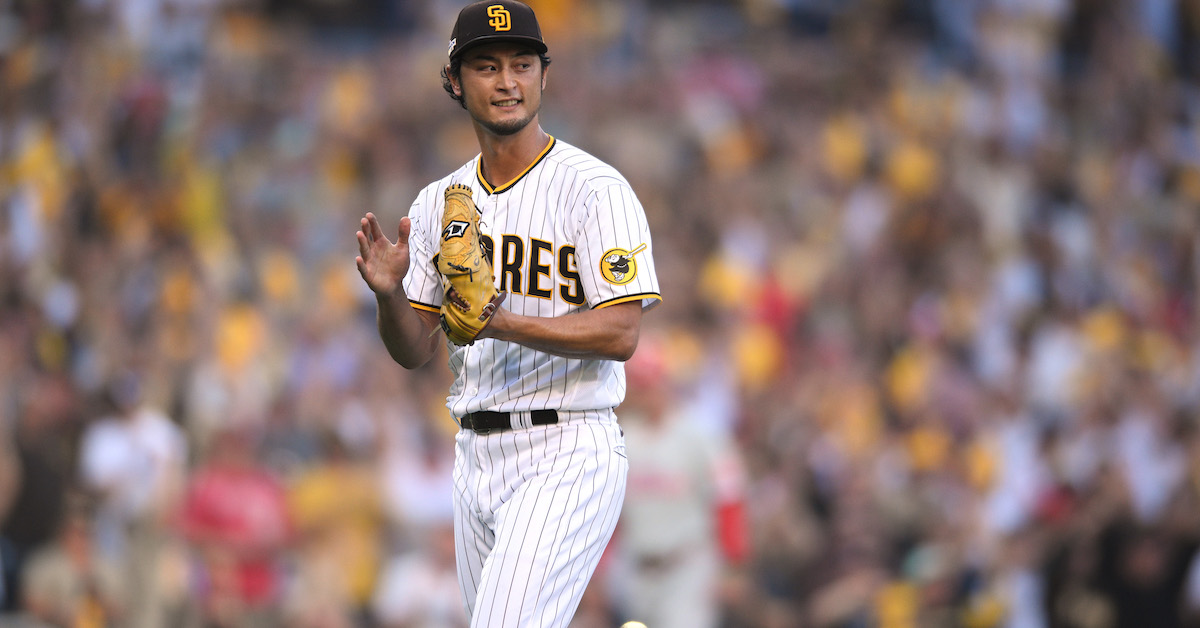
In Game 1 of the World Series, Phillies manager Rob Thomson made a rather unorthodox pitching change, bringing in Ranger Suárez, his probable Game 3 starter, for the seventh inning. He did so because he wanted a lefty to face the heart of Houston’s lineup, and he had already used his best southpaw reliever a few innings prior. Philadelphia did have a second left-hander waiting in the bullpen – Brad Hand – but in that moment, it was clear Thomson didn’t trust him with the game on the line. Fast forward a couple of months: Hand is a free agent, and the Phillies have a new lefty in his place. On Tuesday at the Winter Meetings, the team signed Matt Strahm for a two-year, $15 million contract, per Jeff Passan of ESPN. By giving him the sixth-largest guarantee for a free-agent reliever this offseason, the Phillies are betting that he’ll pitch well enough that they don’t have to put Suárez back in the bullpen anytime soon.
Strahm received a similar deal as Chris Martin (two years, $17.5 million), but he’s far less proven of a player. A 31-year-old left-hander, he spent last season with the Red Sox, throwing 44.2 innings with 52 strikeouts and a 3.72 FIP. It was a solid bounce-back season after he missed most of 2021 recovering from patellar tendon surgery on his right knee. Indeed, the southpaw has had a career full of setbacks and breakthroughs. He was a 21st-round draft pick who pitched just 30 innings of rookie ball before Tommy John surgery shut him down. Yet when he finally began his professional career in earnest, he was utterly dominant, quickly rising through the ranks of the Royals’ farm system. In 2017, five years after being drafted 643rd overall, he was named a top-100 prospect by this very website.
72. Matt Strahm
Scouting Summary: I’m on Strahm as a starter not just because I think his changeup will progress to average as he continues to make up for lost development time due to injury, but also because he has excellent command of a vicious curveball that he regularly works inside to right-handed hitters. He’ll also run his fastball up to 96.
-Eric Longenhagen
Strahm’s prospect pedigree hinged on his mid-rotation potential, a ceiling he never reached. He was terrific pitching out of the pen in 2018, his first full season, yet the Padres (who had acquired him in a deadline deal in ’17) tried moving him into the starting rotation the following season, and he failed miserably. He wound up back in the bullpen by the All-Star break. He was great again in the second half, and it seemed like he had finally found his calling as a dependable reliever. Unfortunately, that stability didn’t last long, as he had a wildly inconsistent 2020 season and ultimately needed knee surgery in October. He was non-tendered after the 2021 season, and the Red Sox picked him up for cheap.
That’s Strahm in a nutshell: from unheralded draft pick to top prospect to failed starter to solid reliever to injured list to eight-figure free-agent deal. As a result of all those ups and downs, he is still figuring things out at 31 years old. Evidently, the Phillies think they can aid in his self-discovery and turn Strahm into a consistent relief option over the next two years. Read the rest of this entry »
The following article is part of Jay Jaffe’s ongoing look at the candidates on the BBWAA 2023 Hall of Fame ballot. Originally written for the 2020 election, it has been updated to reflect recent voting results as well as additional research. For a detailed introduction to this year’s ballot, and other candidates in the series, use the tool above; an introduction to JAWS can be found here. For a tentative schedule and a chance to fill out a Hall of Fame ballot for our crowdsourcing project, see here. All WAR figures refer to the Baseball-Reference version unless otherwise indicated.
Bobby Abreu could do just about everything. A five-tool player with dazzling speed, a sweet left-handed stroke, and enough power to win a Home Run Derby, he was also one of the game’s most patient, disciplined hitters, able to wear down a pitcher and unafraid to hit with two strikes. While routinely reaching the traditional seasonal plateaus that tend to get noticed — a .300 batting average (six times), 20 homers (nine times), 30 steals (six times), 100 runs scored and batted in (eight times apiece) — he was nonetheless a stathead favorite for his ability to take a walk (100 or more eight years in a row) and his high on-base percentages (.400 or better eight times). And he was durable, playing 151 games or more in 13 straight seasons. “To me, Bobby’s Tony Gwynn with power,” said Phillies hitting coach Hal McRae in 1999.
“Bobby was way ahead of his time [with] regards to working pitchers,” said his former manager Larry Bowa when presenting him for induction into the Phillies Wall of Fame in 2019. “In an era when guys were swinging for the fences, Bobby never strayed from his game. Because of his speed, a walk would turn into a double. He was cool under pressure, and always in control of his at-bats. He was the best combination of power, speed, and patience at the plate.” Read the rest of this entry »
The A’s have made no secret of their intentions to spend as little as possible. Per Spotrac, they entered the offseason with a grand total of zero guaranteed dollars of active payroll, outside of arbitration and pre-arb salaries. Of the 39 players on their 40-man roster, only four are arb-eligible, and Tony Kemp, with all five years and 98 days of big league service time, is by far the most-tenured player on the team. They’ve traded nearly every productive major leaguer over the past calendar year for prospects and players making the minimum. But at the Winter Meetings, Oakland finally made its first signings of the offseason, agreeing to terms on two-year deals with utility player Jace Peterson and former Astros utility man Aledmys Díaz, the latter worth $15 million.
Originally drafted by the Padres in 2011, the 32-year old Peterson has made plenty of stops throughout his career, from Atlanta to New York and Baltimore; he spent the last three seasons with the Brewers before becoming a free agent this offseason. In 2022, he appeared in 112 games, starting 81 of them. Utilized almost exclusively as a platoon player, he racked up 293 plate appearances against right-handed pitchers, only stepping into the box 35 times against lefties. His primary platoon partner this year was Mike Brosseau, who posted a 117 wRC+ in 160 PA, about two-thirds of which came against southpaws. Peterson came up as a second baseman but has spent the bulk of his career as a super-utility player, in most seasons making starts at first, second, third, and both corner outfield spots. This year with the Brewers, he primarily played third base, making 67 starts there as everyday players took the bulk of playing time at the other positions he has usually manned.
Peterson’s biggest strength on the offensive side has been his disciplined approach at the plate. During his three-season stretch with the Brewers, he walked in 12.4% of plate appearances, and his 24.6% chase rate ranked in the 90th percentile among major league hitters, placing him in company of Joey Votto and Mookie Betts. He’s affectionately earned the nickname “On Base Jace” (he’s had three postseason plate appearances and drew walks in all of them) and slashed .238/.337/.373 with a 98 wRC+ during his time in Milwaukee. While his raw power grades out at about average, he has never hit double-digit homers and has a below-average ISO for his career, largely because he hits more ground balls than average and doesn’t pull the ball at a high rate. Despite these middling offensive numbers, he’ll likely slot into the heart of an Oakland lineup that had just two hitters with at least 300 PA and an above average wRC+, and with backstop Sean Murphylikely on the move in the near future, that list is cut to just Seth Brown. Read the rest of this entry »
With the avalanche of transactions crashing down during the Winter Meetings, I wouldn’t blame you for missing the Orioles’ signing of Kyle Gibson. General manager Mike Elias confirmed on Monday that the deal was official for one year and $10 million, identical to one that Gibson reportedly turned down from Toronto. But while you may not have noticed the deal, Orioles fans certainly did, as it was the club’s most significant move of the offseason thus far. In fact, apart from a pair of minorleague signings in Josh Lester and Nomar Mazara, Gibson’s deal was Baltimore’s only move made in San Diego.
Yet, despite a reputation as a smaller-market team, the O’s seem to be on the precipice of competing, and they have been in on bigger names in the free-agent pitching market. They have been linked to all of Jameson Taillon, Carlos Rodón, and Noah Syndergaard. In the same breath as his confirmation of the Gibson deal, Elias indicated that the Orioles were not done spending just yet.
That’s good news for a club whose starting pitching ranked 19th in WAR last year. The group’s 3.97 ERA came in at 17th, but Baltimore outperformed its FIP, xFIP, and SIERA, and its K-BB% ranked 21st. That’s hardly a playoff-caliber rotation, despite missing out on the last AL Wild Card spot to the Rays by just three games. By contrast, Tampa Bay’s starters ranked 11th in WAR. Read the rest of this entry »
The Mets have done it. They’ve finally landed a superstar starter to replace Jacob deGrom. Wait, sorry, I’m being told that someone already wrote about the Justin Verlander signing. Instead, I’m here to talk about José Quintana, who signed a two-year, $26 million contract, according to The Athletic’s Ken Rosenthal and Will Sammon.
Just to be clear, Quintana was a very good pitcher in his own right this year. Despite his 6–7 record (I’d like to see you try starting a game for Pirates and being credited as the winning pitcher), he posted 4.0 WAR, a 2.99 FIP, and a career-best 2.93 ERA, pacing the Cardinals down the stretch after a deadline trade.
The 34-year-old will no doubt enjoy his new role as the precocious youngster of the Mets’ starting staff, next to wizened aces Verlander and Max Scherzer. In fact, as the rotation stands now, the 27-year-old David Peterson is the only starter younger than Quintana. The Mets will be expecting a whole lot of innings from pitchers who are just a few years away from having an entire bookshelf devoted to biographies of Winston Churchill. Read the rest of this entry »
For more than a decade, Kenley Jansen has been a part of the fabric of baseball. He’s spent most of that time with the Dodgers, logging a dozen seasons as the reliever whose late-inning fortune sent Los Angeles fans into agony or ecstasy. Last year, he decamped for Atlanta, and this year his travels will continue: as Jeff Passan first reported, he’s shipping up to Boston on a two-year, $32 million deal.
At 35, Jansen is headed into the tail end of his career, though he’s still got plenty in the tank. Over the past five years, he’s declined from one of the best few relievers in the game – he posted a 2.01 ERA from 2013-17 – to merely an effective bullpen arm, with an aggregate 3.08 ERA and the peripherals to match. That’s a relatively graceful downward path, though it hasn’t always felt that way. Dodgers fans alternated between bringing out pitchforks and convincing themselves that Jansen was returning to his earlier dominance over four of those years, and he was unsteady at times in Atlanta, though he put together a solid season on the whole.
His pitch mix has likewise changed with age. Early in his career, “mix” might even have been a misnomer, because it implies a minimum of two things. From 2010-18, 87% of his pitches were cutters. That’s more of a pitch monoculture, or a pitch manufactured subdivision; every house identical, every plant eerily perfect. Read the rest of this entry »
For most of Winter Meetings, the San Diego Padres vigorously pursued a few of the best free agents available only to come up short on Trea Turner and Aaron Judge. Well, they finally made their big splash after most of the reporters and analysts had returned to their climatologically inferior home cities, signing shortstop Xander Bogaerts, formerly of the Boston Red Sox, to a monster 11-year contract. Bogaerts now stands an impressive $280 million richer and a lot of the Padres’ positional dominoes have fallen into place for the 2023 season.
If you’re ever prone to thinking that a player opt-out is mere frippery, like Roy Oswalt’s tractor or the mustache wax benefit that Rollie Fingers received, Bogaerts’ prior contract extension ought to firmly disabuse you of the notion. Bogaerts would have originally hit free agency after the 2020 season, but he came to terms with the Red Sox on a six-year, $120 million deal to keep him in Boston for what was likely to be the rest of his prime. Here’s what the projection looked like if we go back to that blessed time when we might have mistaken “Covid” for the first name of a Swedish scientist:
Ben Lindbergh and Meg Rowley break down the rest of the action from the Winter Meetings, including Arson Judge not signing with the Giants, Aaron Judge re-signing with the Yankees, the Padres missing out on Judge and Trea Turner, the Dodgers’ lack of interest in Carlos Correa, the Giants signing Mitch Haniger, the Cardinals signing Willson Contreras, the Cubs signing Jameson Taillon and Cody Bellinger, the going rate for mid-rotation starters, the Phillies signing Taijuan Walker and Matt Strahm, the secret to Dave Dombrowski’s owner cajoling, the Mets signing José Quintana, whether Steve Cohen has a spending limit, the Rangers signing Andrew Heaney, the Guardians signing Josh Bell, the Red Sox signing Kenley Jansen, Chris Martin, and Masataka Yoshida, the first draft lottery, the podcast’s thirstiness, and more, plus a Past Blast from 1939.
After being cancelled last offseason due to the lockout, on Wednesday, the 2022 Rule 5 Draft was completed in San Diego, with 15 players selected during the Major League phase. Below are our thoughts on those players; the numbers you see in parentheses are the 40-man roster counts that were recited by each team during the draft roll call. Remember that you can venture over to The Board for more information about several of these guys.
But first, our annual refresher on the Rule 5 Draft’s complex rules. Players who signed their first pro contract at age 18 or younger are eligible for selection after five years of minor league service if their parent club has not yet added them to the team’s 40-man roster; for players who signed at age 19 or older, the timeline is four years. Teams with the worst win/loss record from the previous season pick first, and those that select a player must not only (a) pay said player’s former club $100,000, but also (b) keep the player on their 25-man active roster throughout the entirety of the following season, with a couple of exceptions, mostly involving the injured list. If a selected player doesn’t make his new team’s active roster, he is offered back to his former team for half of the initial fee. After the player’s first year on the roster, he can be optioned back to the minor leagues. Read the rest of this entry »