The Braves are the team of stability. At six of nine offensive positions, they have locked an above-average-to-star-level player down to a contract that will keep him under club control for at least the next five seasons. We could probably get away with literally not writing any Braves roster construction thinkpieces until 2026 or so. Nevertheless, I want to pick at the one imperfection in Atlanta’s cavalcade of cost-controlled stars: the whole left field/DH situation. Specifically, I want to propose an idea that isn’t a joke, or a bit, or a troll… but it’s also not not a joke, or a bit, or a troll: Make Sam Hilliard the starting left fielder. Read the rest of this entry »
In 2021, John Means rode a command-first approach to the best pitching season on the Orioles. In 2022, Means missed most of the season – and Jordan Lyles and Dean Kremer both rode command-first approaches to the best starting pitching performances on the team. Now Lyles is gone and Means isn’t yet back from Tommy John, so the Orioles did what they had to do: traded for Cole Irvin, who will now inevitably ride a command-first approach to post the best numbers of any Orioles starter in 2023.
That’s my main takeaway from last week’s trade with the Oakland Athletics. The full trade: Irvin and prospect Kyle Virbitsky are headed to Baltimore in exchange for prospect Darell Hernaiz. In broad strokes, the deal makes sense: the A’s are continuing to get rid of every major leaguer they possibly can, while the Orioles look to make marginal improvements to their major league roster to back up last year’s breakthrough. But Irvin is hardly a slam dunk rotation topper, so I think it’s worth investigating what the O’s might see in him.
The first-level reason to acquire Irvin is probably the best one. He’s a left-handed fly-ball pitcher, and the new configuration of Camden Yards favors that skill set. The team pushed the left field wall back in 2022, and righties simply stopped hitting homers. In 2021, Baltimore was the easiest place for righties to hit home runs. In 2022, it was the sixth-toughest, a massive swing. Oakland has always been a pitcher-friendly park, and Irvin took good advantage of that; he should find similar success in the newly-spacious Camden. Read the rest of this entry »
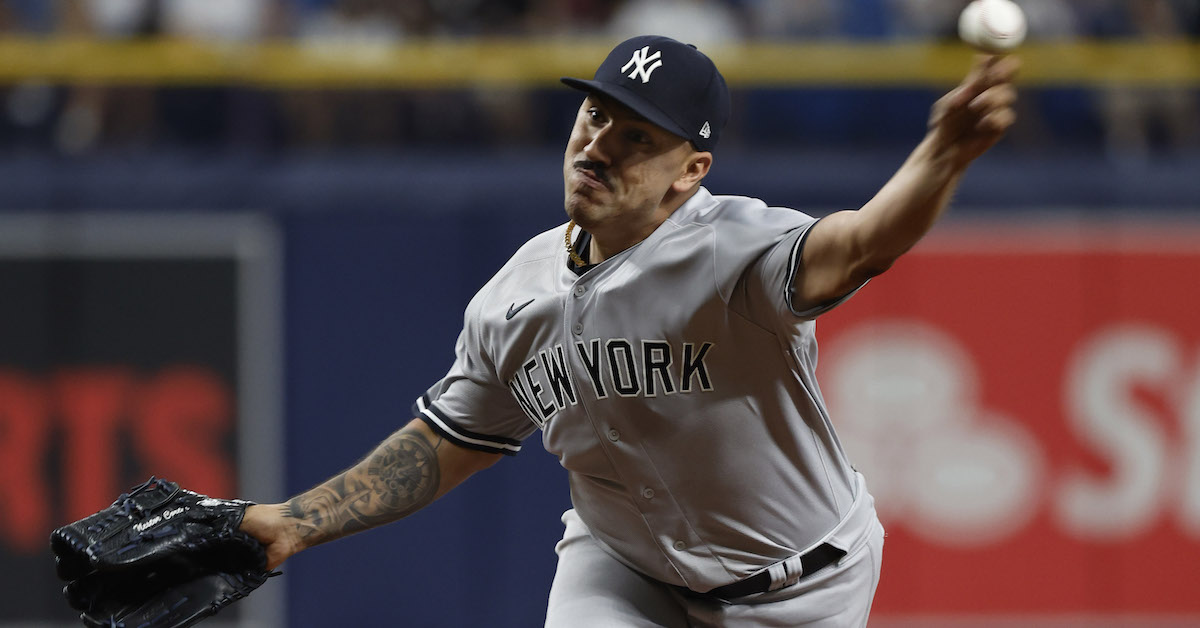
Originally a 36th-round pick in the 2013 draft by the Yankees, Nestor Cortes spent time with the Orioles and Mariners before returning to the Bronx and putting it all together toward the end of the 2021 season, his age-26 year. Even upon breaking out, he was dubbed an “everyman” by the New York Post, overlooked by scouts because he didn’t stand as tall as other hurlers and because he lacked overpowering velocity. Yet in 2022, Cortes mowed hitters down to the tune of a 2.44 ERA and 20.3% K-BB rate. Far from an everyman, he was a standout athlete.
The southpaw’s breakout wasn’t a product of a mid-career growth spurt. If anything, his emergence came in spite of his 5-foot-11 height; his 159 ERA+ in 2022 tied him for the 27th-best mark among sub-six-foot hurlers since the Live Ball era began in 1920. Rather, the most concrete reasons for Cortes’ improvements include a velocity jump in both 2021 and ’22 (though his velo is still below average) and the introduction of a cutter paired with a revamped slider. Yet despite the ambiguous impact it has on his game, what perhaps differentiates Cortes the most from other pitchers is his approach on the mound, including but not limited to his varying arm angles.
The hurler’s drop-down moves have been the subject of many an article, including Lucas Kelly’s piece on this very site. The discussion on arm angles more broadly, however, has been rather muted, save for Logan Mottley’s (now of Fanatics, previously of the Texas Rangers) post describing how they can be calculated from Statcast data and Ben Palmer’s piece for Pitcher List digging into the Mottley data.
Even in these articles, there is no mention of how stature might play into the effectiveness of certain arm angles. Instead, there seems to be an implicit assumption that if one arm slot proved more effective on average (which, to be fair, no one has concluded), it should automatically be utilized more, without regard for what might feel most natural for a given pitcher. What would happen if we tried to convert more pitchers to a sidearm slot, or at least push them to vary their arm slots a la Cortes? Using Mottley’s calculations, I took a crack at these questions myself. Read the rest of this entry »
Ben Lindbergh and Meg Rowley introduce the 11th annual Effectively Wild season preview series, then kick things off by previewing the 2023 San Francisco Giants (13:03) with The Athletic’s Grant Brisbee and the 2023 Minnesota Twins (55:48) with The Athletic’s Aaron Gleeman, plus a Past Blast (1:33:43) from 1965.
There are a lot of ways to look at the numbers George Springer put up in 2022. Here’s the simplest: He had an All-Star season, posting a 132 wRC+ and piling up 4.2 WAR. That’s excellent. On the other hand, you could argue that he has been slipping for a while now. His wRC+ has declined in three consecutive seasons, and now that Kevin Kiermaier and Daulton Varsho are both Blue Jays, his days as a center fielder are officially over.
Analyzing Springer is tricky because he’s always been a great hitter no matter what was going on under the hood. He reached his offensive peak in 2019, posting a 155 wRC+ with the help of a career-high 43.2% hard-hit rate. Then in 2020 and ’21, his hard-hit rate came back to earth a bit, his pull rate spiked, and he literally doubled his launch angle. Despite the drastic changes, his wRC+ fell by just over 10 points, dropping him from elite all the way down to very nearly elite. Read the rest of this entry »
While the Mariners’ front office has been rather quiet in terms of acquiring new free agents this offseason, they did plenty of work locking up their existing personnel before free agency opened, extending star outfielder Julio Rodríguez and starting pitcher Luis Castillo with combined guarantees up to $578 million. Now, they’ve agreed to a three-year extension with utility man Dylan Moore worth $8.875 million. This contract buys out his final two years of arbitration as well as his first season of free agency, keeping him in Seattle through his age-33 season.
Moore was a late bloomer, first making the Mariners roster in 2019 at the age of 26, and he’s primarily served in a utility and platoon role ever since. While his career wRC+ sits at exactly 100, that mark jumps to 112 against left-handers. The Mariners have done well to maximize his effectiveness by deploying him on his strong side as much as possible, especially last season, when nearly half of his plate appearances came against left-handed pitching, fourth-most among right-handed hitters.
Platoon usage rate often says more about a team than an individual player — plenty of everyday starters arguably should be sitting more against same-handed pitchers — but the Mariners have the right pieces to put Moore in advantageous situations, including a wide variety of left-handed counterparts like Kolten Wong, Jarred Kelenic, and Tommy La Stella.
It’s difficult to thrive exclusively as a right-handed platoon bat, though, given that a significant majority of pitchers are also righties. Players like Moore and Slater only got to face lefty opponents about half the time; sometimes a reliever comes in, sometimes a starter needs the day off regardless of who the other team has on the mound. Luckily, Moore also handles right-handed pitching decently well. His career wRC+ against them sits at 92, and last season, he had a .344 OBP and 117 wRC+ against fellow righties, a good mark for any big league hitter. He definitely has a stronger side, making more contact and drawing more free passes against southpaws, but he’s certainly not helpless on the other side of the platoon either. Read the rest of this entry »
The Rockies are what would happen if a baseball team were run by the guy on your block who raises pygmy goats in his yard. Sure, this is a suburban subdivision outside of Columbus, Ohio, and there’s no real purpose to having goats. But the noise and smell aren’t as bad as you feared, neighborhood kids think the goats are cute (correctly — look at their little ears!), the goats only infrequently climb onto your neighbor’s roof and escape to the street, and apparently nobody had goats in mind when the township zoning ordinances were written because there’s no rule against it. Is it weird? Absolutely. But it’s not hurting anyone, so who cares? The world is a little more interesting with little goats running around.
Last week, I spent a few articles idly hunting for hitter breakouts. I centered my search on players with admirable top-end power numbers but who reached that summit rarely. I found that when those players increased their contact rate, they improved their overall line significantly. I think that finding tracks with intuition in addition to having data to back it up, so I’m overall pleased with that research.
That said, all this downloading and scraping of exit velocity data made me wonder about the opposite side of this spectrum: can hitters add power and break out from the other direction? Hitters who make a ton of contact but don’t hit the ball with much authority feel somewhat capped offensively; in my head, Luis Arraez has a 0% chance of turning in a 20-homer season. I didn’t have the numbers behind that, though, so I gathered up the same pile of data I’d used before and started hunting.
The main thing I learned from the data is something that you’ve heard over and over again: maximum exit velocity (and 95th-percentile exit velocity, which I’m using) is sticky. How hard you hit the ball in one year does a great job of determining how hard you’ll hit the ball in the next year.
More specifically, I took a sample of players with at least 100 batted balls in two consecutive seasons. I sampled from 2015 to ’22, which gave me seven year-pairs, though the ones involving 2020 were light on qualifying players thanks to the abbreviated season. From there, I asked a simple question: how much did each player’s 95th-percentile exit velocity change from one year to the next? Read the rest of this entry »
Carter Hawkins knows the Guardians organization well. Prior to becoming the General Manager of the Chicago Cubs in October 2021, the 38-year-old Vanderbilt University alum spent 14 seasons in Cleveland, serving as a scout, Director of Player Development, and Assistant General Manager. With the Guardians’ well-earned reputation of being a progressive organization with an outstanding pitching-development program, I asked Hawkins a question during November’s GM Meetings:
How similar are the two organizations, and in which ways do they differ?
“I would say the best thing in terms of similarities is that there are a lot of team-first people in both places, as opposed to me-first people,” replied Hawkins. “The obvious market-size difference stands out. There are more opportunities in Chicago to utilize resources — you can have a higher risk tolerance — whereas in Cleveland there is the challenge of having to be very process-oriented to make a decision. If you have a lot of resources, you don’t necessarily have that pressure on you. At the same time, there is no reason that you can’t be just as process-oriented in a larger market.”
The disparity in payrolls is notable. Roster Resource projects the Cubs’ 2023 payroll at $184M, and Cleveland’s at just $91M. Last year those numbers were $147M and $69M. Read the rest of this entry »




 Sponsor Us on Patreon
 Facebook Group
 Twitter Account
 EW Subreddit
 Effectively Wild Wiki
 iTunes Feed
 Get Our Merch!