The 2022 Replacement-Level Killers: Introduction & First Base

© Jayne Kamin-Oncea-USA TODAY Sports

In a race for a playoff spot, every edge matters. Yet all too often, for reasons that extend beyond a player’s statistics, managers and general managers fail to make the moves that could improve their teams, allowing subpar production to fester at the risk of smothering a club’s postseason hopes. In Baseball Prospectus’ 2007 book It Ain’t Over ‘Til It’s Over, I compiled a historical All-Star squad of ignominy, identifying players at each position whose performances had dragged their teams down in tight races: the Replacement-Level Killers. I’ve revisited the concept numerous times at multiple outlets and have presented it at FanGraphs in an expanded format since 2018.

When it comes to defining replacement level play, we needn’t be slaves to exactitude. Any team that’s gotten less than 0.6 WAR from a position to this point — prorating to 1.0 over a full season — is considered fair game. Sometimes, acceptable or even above-average defense (which may depend upon which metric one uses) coupled with total ineptitude on offense is enough to flag a team. Sometimes a team may be well ahead of replacement level but has lost a key contributor to injury; sometimes the reverse is true, but the team hasn’t yet climbed above that first-cut threshold. As with Supreme Court Justice Potter Stewart’s definition of hardcore pornography, I know replacement level when I see it.

For this series, I’ll go around the diamond, pointing out the most egregious examples of potential Killers at each position among contenders, which I’ll define as teams who are above .500 or have playoff odds of at least 10.0%. That definition covers 17 teams, all of which have odds above 25% thanks to the new playoff structure (thanks for not saving me any work, Rob Manfred). And while I may mention potential trade targets, I’m less focused on these teams’ solutions than I am the problems, because hey, human nature.

This first installment will cover first basemen. All statistics within this piece are through July 20. Read the rest of this entry »


FanGraphs Audio: Ellen Adair on Being a Phillies Fan First

Episode 984

This week on the show, David Laurila welcomes Ellen Adair, actor, MLB Network analyst, host of multiple podcasts and, perhaps most importantly, diehard Philadelphia Phillies fan.

David and Ellen begin by discussing the All-Star Game and Home Run Derby, the controversial uniformity of the uniforms, mic’d up pitchers, and which Phillies were missing from the festivities. We also hear about Dick Allen’s absence from the Hall of Fame, how the Phillies have changed course following the firing of Joe Girardi, and the inner conflict associated with still rooting for a player that has been traded away. Finally, the duo opens a fresh pack of baseball cards and discusses players such as Darick Hall, Bryce Harper, Matt Vierling, and “Big Ed” Delahanty.

To purchase a FanGraphs membership for yourself or as a gift, click here.

To donate to FanGraphs and help us keep things running, click here.

Don’t hesitate to direct pod-related correspondence to @dhhiggins on Twitter.

You can subscribe to the podcast via iTunes or other feeder things.

Audio after the jump. (Approximate 39 minute play time.)


The Mariners Have Surged Into Contention

© Tim Heitman-USA TODAY Sports

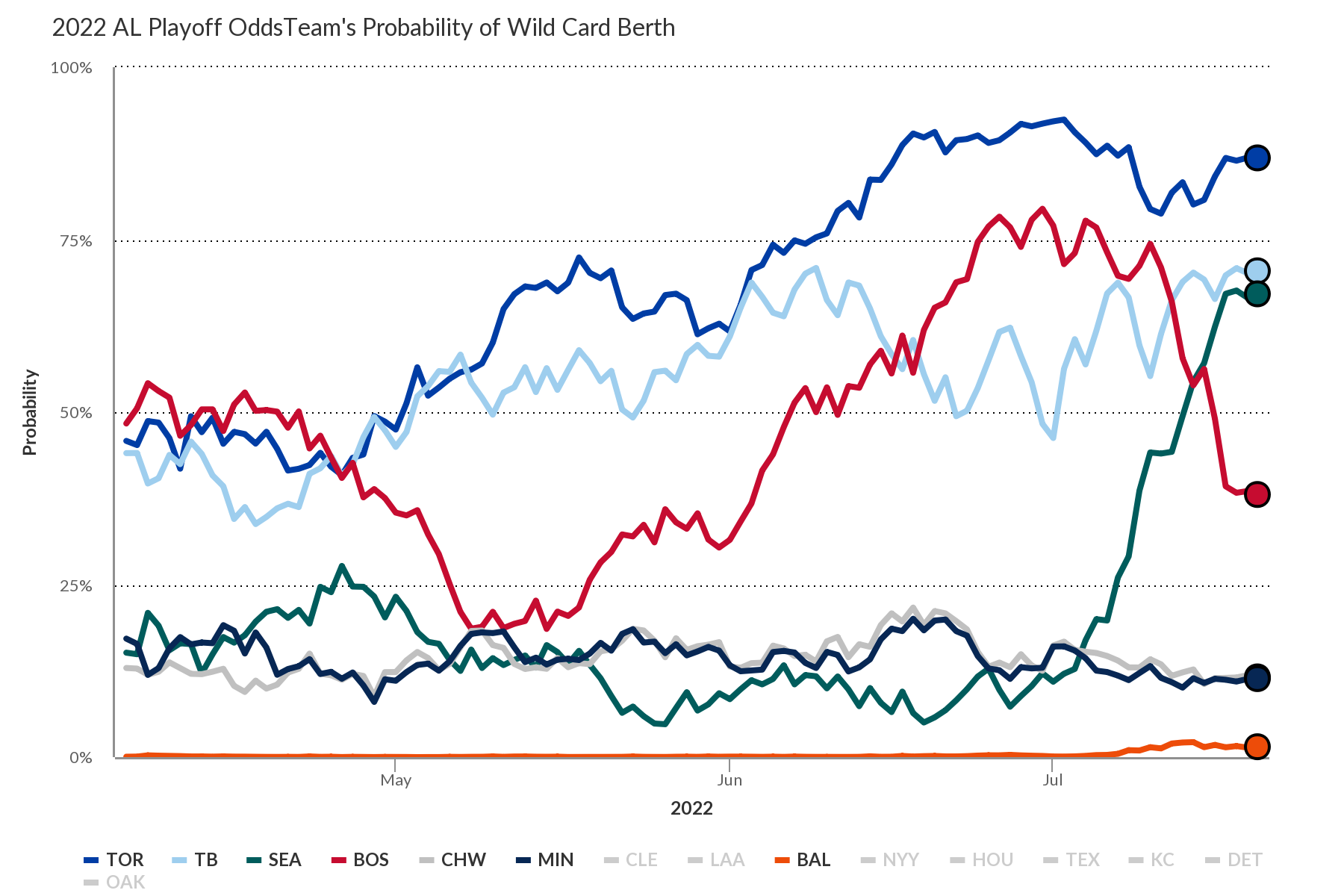
After taking their quest to end their 20-year playoff drought down to the final day of the 2021 season, the Mariners had high hopes for this year, but they mostly sputtered during the first two and a half months of the season, squandering an 11-6 start with separate 1-10 and 2-8 skids. Since June 19, when they were 10 games under .500, they’ve caught fire, winning 22 out of 25 games and entering the All-Star break riding a 14-game winning streak, one that has pushed them into the second American League Wild Card slot with a 51-42 record.

The Mariners aren’t the only AL team that will start the second half with renewed optimism. The Orioles, who have lost at least 108 games in a season three times since 2016, their last season above .500, and appeared headed for another triple-digit loss total through the first quarter of the season, went on a 10-game winning streak starting on July 3, briefly nosing them above .500 for the first time this year. They entered the break 46-46, tied with the White Sox at 3.5 games out of the third Wild Card spot.

The two teams have surged while the Blue Jays and Red Sox have stumbled. While Toronto is still clinging to that last Wild Card spot, at the very least the race has become a four-team fight instead of simply a three-team one, with the AL Central’s second- and third-place teams (the Guardians are only two games behind the Twins, the White Sox three) lurking in the weeds as well, and the Orioles at least showing a pulse. A picture is worth a thousand words:

Read the rest of this entry »


Dan Szymborski FanGraphs Chat – 7/21/22

12:02
Avatar Dan Szymborski: Good afternoon!

12:02
Dk: Who is your favorite to get Soto? When is he more likely to be traded? August or November?

12:02
Avatar Dan Szymborski: I think he’s more likely to be traded in the offseason

12:03
Avatar Dan Szymborski: I think the Padres might make a push

12:03
Avatar Dan Szymborski: Though I think where he ends up depending on how insistent they are in “bundling” Patrick Corbin in

12:04
Vic: On MLB draft night, so many Top 15 picks are spoke of in glowing terms. It’s inferred that many of them are likely a 50/50 prop to have a Francisco Lindor type career. How many of this year’s Top 15 even have a 20% chance of a Lindor type career?

Read the rest of this entry »


Phillies Rookie Matt Vierling Keeps Hitting Simple

© Kyle Ross-USA TODAY Sports

Matt Vierling has been a versatile player for the Philadelphia Phillies this season. Primarily a center fielder, the 25-year-old University of Notre Dame product has also seen action in the outfield corners, as well as at first, second, and third base. He’s also capable with the bat. While not yet fully established against big league pitching, Vierling has a 95 wRC+ in 229 plate appearances with the NL East club, plus the potential to produce at a higher level as he matures.

Vierling discussed his simple-meets-cerebral approach, and how he’s evolved since entering pro ball as fifth-round draft pick four years ago, during spring training.

———

David Laurila: Let’s start with one of my favorite Talks Hitting openers. Do you approach hitting as more of an art, or as more of a science?

Matt Vierling: “I would lean more towards art, although I see both sides. It’s definitely science with the mechanics; if you don’t make the right swing, there’s a mechanical reason why. But when you’re up there and in the flow of things, it’s more like an art. I’d have to lean more in that direction.”

Laurila: This is maybe a hard question to answer, but how would you describe your art?

Vierling: “That is a hard one. I guess it would be being in rhythm — a lot of rhythm and a lot of timing. It’s not so much dancing with the pitcher, but kind of just being in his rhythm, being on time with him.” Read the rest of this entry »


Effectively Wild Episode 1879: Me and Julio Down By the Ballyard

EWFI
Ben Lindbergh and Meg Rowley are joined by FanGraphs lead prospect analyst Eric Longenhagen to banter about what accounts for the variability in how quickly prospects acclimate to the majors and detecting holes in swings, discuss (10:50) which teams have the prospects to trade for Juan Soto, review (22:59) impressive performances from the Futures Game (including a booming BP by Francisco Álvarez and a record throw by Masyn Winn), recap (31:02) the highs of the Home Run Derby and All-Star Game (with a focus on Julio Rodríguez’s standout Derby and the events’ best promotional moments), then break down the amateur draft, touching on the top three picks, the Orioles’ fruitful draft, the Rangers’ surprising Kumar Rocker selection, why so many sons of major leaguers were drafted, atypical players and potential two-way players, the teams with the best and most perplexing draft classes, the impact of the draft combine, and more, followed (1:45:09) by a Stat Blast on César Hernández and historic power outages, and a Past Blast from 1879.

Audio intro: St. Vincent, “All My Stars Aligned
Audio outro: David Crosby, “Rodriguez for a Night

Link to EW guest data
Link to Grant’s tweet
Link to quote about “transition tax”
Link to Ben on minors-to-majors gaps
Link to Ben Clemens on a Soto trade
Link to Baseball Trade Values
Link to MLBTR on Soto trades
Link to R.J. Anderson on Soto trades
Link to story on Soto’s brother
Link to Emma on Dodger Dogs
Link to clip of Cruz’s throw
Link to clip of Winn’s throw
Link to MLB.com ASG game story
Link to MLB.com on Manoah
Link to Joe Posnanski on Manoah
Link to MLB.com on Cortes
Link to Ben on mic’d up players
Link to MLB.com on best ASG moments
Link to The Ringer on the ASG
Link to The Ringer on the HRD
Link to R.J. on the Orioles’ draft
Link to Eric’s first-round recap
Link to Eric’s farm rankings
Link to MLB.com on father-son players
Link to Sawchik on father-son players
Link to R.J. on atypical picks
Link to Cory Lewis story
Link to Jared Beck story
Link to Jurrangelo Cijntje story
Link to Cijntje interview
Link to Reggie Crawford story
Link to Tyler Cleveland story
Link to info on the draft combine
Link to Stathead
Link to Richard Hershberger’s Strike Four
Link to 1879 story source
Link to tweet about Ohtani’s ESPYs
Link to Secret Headquarters trailer
Link to Facebook post about the EW wiki
Link to “How to Help” wiki page

 Sponsor Us on Patreon
Subscribe to Stathead (Code: WILD20)
 Facebook Group
 Twitter Account
 EW Subreddit
 Effectively Wild Wiki
 iTunes Feed (Please rate and review us!)
 Get Our Merch!
 Email Us: podcast@fangraphs.com


The Gate Could Be Closing on Future Hall of Fame Era Committee Inductees

Buck O'Neil Baseball Hall of Fame
Democrat and Chronicle

This weekend in Cooperstown, six Era Committee candidates will be inducted alongside the BBWAA-elected David Ortiz. Among them are some of the most long-awaited honorees whose supporters agonized for decades over their being shut out, both before and after their deaths. Negro Leagues player/manager/scout/coach/ambassador Buck O’Neil and Negro Leagues and American League star Minnie Miñoso both hung on well into their 90s hoping they could see the day of their induction but died before it happened. Star first baseman and manager Gil Hodges died of a heart attack at age 47, before his candidacy became the ultimate “close-but-no-cigar” example, both via the BBWAA and Veterans Committee processes. Black baseball pioneer Bud Fowler, who was raised in Cooperstown, went largely unrecognized until the centennial of his death in 2013. Tony Oliva and Jim Kaat, both of whom are 84, are thankfully alive to experience the honor, but they, too, had a long wait, after falling one and two votes short, respectively, on the 2015 Golden Era ballot.

The festivities will be tinged with more than a hint of bittersweetness due to the deferred honors, but there won’t be any shortage of joy and catharsis that these men are finally being recognized. Yet even as they take place, it feels as though a gate is swinging shut behind them — one that may not open again for awhile given the the shakeup of the Era Committee process that the Hall announced in April which reduced the numbers of committees, candidates, and votes available. I won’t rehash the road to this point (you can see the gory details in the aforementioned link), but here’s the new format, which will roll out in this order over the next three years starting in December:

  • December 2022 (for Class of 2023): Contemporary Baseball – Players. For those who made their greatest impact upon the game from 1980 onward and have aged off the BBWAA ballot.
  • December 2023 (for Class of 2024): Contemporary Baseball – Managers, Umpires, and Executives. For those who made their greatest impact upon the game from 1980 to the present day.
  • December 2024 (for Class of 2025): Classic Baseball. For those who made their greatest impact upon the game before 1980, including Negro Leagues and pre-Negro Leagues Black players

The Classic Baseball Era Committee now has purview over all of the candidates previously covered by the Early Baseball (1871–1949) and Golden Days (1950–69) committees — the two that produced this weekend’s honorees and which otherwise weren’t scheduled to convene again for 10 and five years, respectively — as well as about half of those covered by the Modern Baseball (1970–87) one. In other words, voters for that ballot now have to weigh candidates whose contributions may have taken place over a century apart. What’s more, where there were 10 candidates apiece for each of those ballots under the older system, the new ones contain only eight, and where the 16 committee members (a mixture of Hall of Famers, executives, and writers/historians) could previously vote for four of those 10 candidates, that number has been reduced to three. Candidates will still need to receive a minimum of 75% of votes to be elected.

In other words, there’s a new bottleneck in place for the older candidates, and it has happened just as the Negro Leagues and pre-Negro Leagues candidates — players and non-players alike — finally returned to eligibility after the books were closed on that period following the aforementioned 2006 election, which produced 17 honorees but froze out O’Neil. For those who make it to the ballot, the math that was already very tough is undeniably tougher. Instead of a maximum of 64 votes spread across 10 candidates (an average of 6.4 per candidate), there are now 48 spread across eight candidates (six per candidate). Electing four candidates from a single slate, which happened for the first time on the 2022 Golden Days ballot, would require each of those four to receive exactly 12 votes. Read the rest of this entry »


Simply Put, Seattle’s Ty France Is a Deserving All-Star

© Orlando Ramirez-USA TODAY Sports

Ty France was named to the American League All-Star team this past Sunday. Added when Mike Trout bowed out due to injury, the Seattle Mariners first baseman didn’t simply merit the honor, his addition was overdue. Statistically the best hitter on baseball’s hottest team — 14 straight wins heading into the break! — France is slashing .308/.376/.470, with club-bests in both wOBA (.369) and wRC+ (148).

He’s not a flash in the pan. A 34th-round pick by the San Diego Padres in 2015 out of San Diego State University, France has long shown an ability to square up baseballs. A .300/.388/.463 hitter over all professional levels, all he’s really needed was the opportunity.

“That’s really all it is,” France said prior to a game at Fenway Park in late May. “Honestly, it’s being able to play every day — being in the lineup and getting those consistent reps — more than anything else. This game is a lot of ups and downs, and the more comfortable you can be, the more you’re going to find yourself in a good spot.” Read the rest of this entry »


The Worst Swings of the First Half of the Season

© Isaiah J. Downing-USA TODAY Sports

It’s a good thing that baseball writers don’t get tested on our ability to do fractions. Since time immemorial, we’ve called the All-Star break the halfway mark of the season. It’s not. Every team has played at least 90 games, even in a season with a delayed start. In fact, this is the season where calling the All-Star break the halfway mark would make most sense, and it’s still wrong.

Why do we do it? Partially, it’s because it sure would be convenient if the break really did mark the halfway point. Dividing the season into two halves makes for some fun analysis, and it works a lot better when the division occurs at a point with an event around it, rather than some random Tuesday in early July. It’s also because it creates something interesting to write about during a gap when game play would otherwise be stopped. There’s dead air every year around this time; filling it with “in the first half of the season” stories makes good sense.

I’m rambling, though. The point is, it’s the All-Star break, and I want to write an article about terrible swings. What was I going to call it, the worst swings of the first 55.5% of the season? That’s not catchy enough. “First half” just sounds better. And so here, perpetuating a bad sportswriter generalization, are the worst swings of the first half of the season.

A few ground rules: I’m focusing on swings at fastballs. Bad swings at breaking pitches are funny, but they’re understandable. Those pitches were designed to deceive, and they accomplished their goal. Sure, maybe swinging at a slider that bounces in the opposite batter’s box isn’t a good look, but I can understand how a hitter might end up there. Baseball is an unfair game. The pitches move funny.
Read the rest of this entry »


Effectively Wild Episode 1878: The 10th Anniversary Draft

EWFI
Ben Lindbergh and Meg Rowley continue their celebration of the 10th anniversary of Effectively Wild by bringing on former cohost Jeff Sullivan and Most Frequent Guest (for now) Grant Brisbee to banter about Jeff’s job with the Rays and draft their favorite baseball stories from the past 10 years (plus a Past Blast from 1878).

Audio intro: Joel Plaskett Emergency, “Old Friends
Audio outro: Willie Nelson With Waylon Jennings, “Old Friends

Link to EW guest data
Link to story on Orioles catchers
Link to story on Yankees sliders
Link to Trout on the EW wiki
Link to Jeff on Trout’s adjustments
Link to Grant’s Quintana trade tweet
Link to Ben on young newsbreakers
Link to @NoContextEWPod
Link to Grant on Rueter’s shed
Link to Jeff on framing
Link to Ben on sign stealing
Link to Rob Arthur on sign stealing
Link to other BP sign-stealing study
Link to Jeff on the Astros
Link to Grant on the Astros
Link to Meg on Bradley
Link to Meg on Lind
Link to Stanton homer
Link to tweet about Lester
Link to Ben on Lester
Link to Jeff on Lester
Link to Lester on the EW wiki
Link to Hill on the EW wiki
Link to Grant on Ishikawa
Link to Ben on home runs in 2016
Link to Ben on the Negro Leagues
Link to Ben on the Negro Leagues again
Link to LaRoche retrospective
Link to Richard Hershberger’s Strike Four
Link to 1878 story source 1
Link to 1878 story source 2
Link to Richard on the triple play
Link to Facebook post about the EW wiki
Link to “How to Help” wiki page
Link to 10th anniversary shirt
Link to all shirts

 Sponsor Us on Patreon
Subscribe to Stathead (Code: WILD20)
 Facebook Group
 Twitter Account
 EW Subreddit
 Effectively Wild Wiki
 iTunes Feed (Please rate and review us!)
 Get Our Merch!
 Email Us: podcast@fangraphs.com