FanGraphs Live: Out Of The Park 21 Brewers

Tuesday afternoon’s FanGraphs Live stream, starting at noon ET, will feature a discussion of the OOTP Brewers, who have some crucial decisions to make.

Who should we target as a shortstop replacement? What should we offer? Should we bench Lorenzo Cain on-stream, or re-tool our pitching rotation? If you can think of something a general manager can do, we can try it. If you can think of something a manager can do, we can adjust our in-game tactics to attempt it. The Brewers sit at 14-14 in the virtual 2020 OOTP universe, and our decisions could help get them on the right track.


Would Tony Gwynn and Wade Boggs Have Been Different Hitters Today?

We don’t spend a lot of time talking about batting average at FanGraphs. While getting on base with a hit is still important in today’s game, getting on base via a walk is nearly as good as a single. Hitting doubles, triples, and homers is also very important and looking at batting average doesn’t factor in any of that production. It’s missing out on a lot of important results and thus, isn’t as useful as it was once thought to be when determining how good a hitter is at the plate. To some, this might be a slight, impugning players with great batting averages like Wade Boggs and Tony Gwynn, two of the only three batters in the last 50 years with career batting averages over .320 (Rod Carew is the other). But it’s important to note that just because Boggs and Gwynn had high batting averages, doesn’t mean that they would be less valuable in today’s game.

Boggs and Gwynn both had career wRC+ marks of 132, with Boggs’ 88 WAR ranking sixth among all position players since 1969 and Gwynn’s 65 WAR making him a Hall of Famer as well. That combined the two players have fewer home runs than Ryan Zimmerman is of little concern to their overall value. The two were great hitters, though with ISO’s closer to .100 than .200, they might be referred to as singles hitters today. That’s a little unfair, and even a little inaccurate, as both rank in the top-20 of doubles-plus-triples over the last 50 years. I wondered what Gwynn and Boggs might do if placed in today’s game. The game has changed in the last few decades, with smaller parks and shrinking strike zones to go along with significant increases in average pitch velocity and many more offspeed and breaking pitches as well. Taking Boggs and Gwynn from the 80s and plopping them into today’s game wouldn’t be a fair test, but we can take a look at how they adapted to changes in their era to see how they may have adapted today. Read the rest of this entry »


A FanGraphs Business Update

Hi again. Thank you so much for the support you’ve shown the site over the past few weeks. In the spirit of continued transparency, I wanted to give everyone a fairly in-depth update on how things are going at FanGraphs. A few weeks ago, we had to change our business model from one primarily driven by ads to a one predominantly driven by site memberships because of the current COVID-19 pandemic, which postponed the start of the MLB season and caused a drastic decrease in both FanGraphs’ traffic and general advertising rates. We set a Membership goal of 40,000 Members, which in a typical year represents less than 4% of our monthly site visitors.

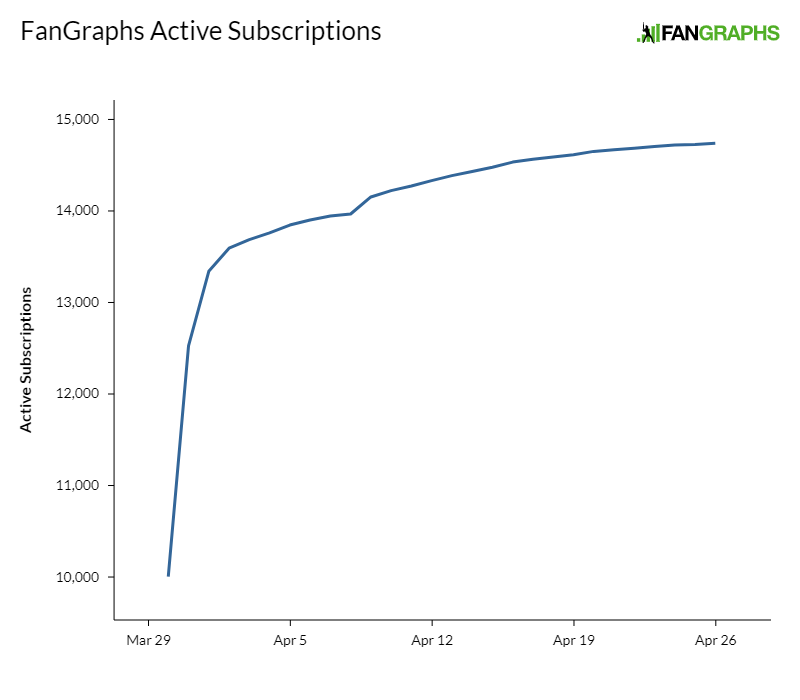
First, let’s look at the some of the good news, which is that Memberships are going in the right direction. Thank you to everyone who has decided to continue their Membership while baseball is on hiatus, upgraded their existing Membership, or signed up for the first time! Prior to March 30, we had 10,004 active Members; that number has increased to 14,739:

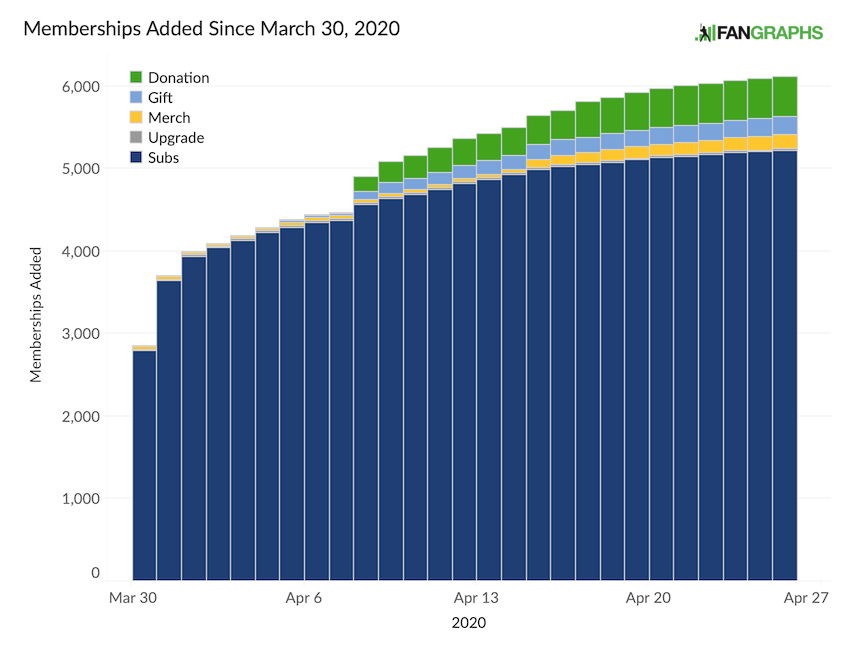
If we include merchandise sales, gift memberships, upgrades to Ad-Free, and donations (at the equivalent of the $30 annual Membership), the progress towards that 40,000-Member goal looks even better. Furthermore, our breakdown of Memberships has shifted slightly towards Ad-Free; about 5% of all Members have moved toward Ad-Free. When we include all these additional contributions, it effectively puts us at 16,244 members:

Read the rest of this entry »


Effectively Wild Episode 1534: The Stay-at-Home Run Derby

EWFI
Ben Lindbergh and Sam Miller banter about Johnny Vander Meer’s ear boils and the surprisingly ancient origins of the phrase, “A walk is as good as a hit,” then answer listener emails about why some players prove to be flashes in the pan, whether a home run derby would work under current conditions, whether the pandemic makes MLB expansion more or less likely, what one would learn from watching every game from an MLB season (and how one would do it), why some prospects skip Triple-A, and why we don’t talk more about the brief baseball career of Chris Saenz, plus a Stat Blast about the highest Championship Leverage Index.

Audio intro: Paul McCartney, "Boil Crisis"
Audio outro: Paul McCartney, "Boil Crisis"

Link to free Baseball Digest archive
Link to history of “A walk is as good as a hit”
Link to study on OBP vs. batting average
Link to Sam on the home run derby
Link to Joel Sherman on the Home Run Derby
Link to first episode of 1960 home run derby
Link to Stat Blast song covers thread
Link to Theodor Bierhoff’s Stat Blast song cover
Link to list of highest-CLI plays
Link to video of highest-CLI play
Link to article on Willie McCovey and Peanuts
Link to Peanuts strips on Willie McCovey
Link to Maury Brown on expansion
Link to Ben on minor league difficulty
Link to 2013 article on skipping Triple-A
Link to 2015 article on skipping Triple-A
Link to 2016 article on skipping Triple-A
Link to order The MVP Machine

 iTunes Feed (Please rate and review us!)
 Sponsor Us on Patreon
 Facebook Group
 Effectively Wild Wiki
 Twitter Account
 Get Our Merch!
 Email Us: podcast@fangraphs.com


Ben Clemens FanGraphs Chat – 4/27/20

Read the rest of this entry »


COVID-19 Roundup: College Summer Leagues Respond To Crisis

This is the latest installment of a series in which the FanGraphs staff rounds up the latest developments regarding the COVID-19 virus’ effect on baseball.

Cape Cod Baseball League Cancels Season

The Cape Cod Baseball League announced Friday that its executive committee voted unanimously to cancel its 2020 season, which was originally scheduled to open on June 13.

“Following CDC guidelines and medical recommendations, the league determined it would be impossible to guarantee the safety of players, coaches, umpires, host families, volunteers and fans during this unprecedented health crisis,” the league said in its announcement.

The Cape Cod Baseball League is the second in the National Alliance of Summer College Baseball to cancel its season, following a similar decision by the Valley Baseball League in Virginia that was made earlier this month. In addition to cancelled seasons, stay-at-home mandates issued by individual states have pushed back the season-openers of the Northwoods League and the Hamptons League, while the Cal Ripken Collegiate Summer League made the proactive decision to delay the season until July 1. In the Great Lakes Summer Collegiate League, there is still a plan to proceed with the season as scheduled, but three teams have already stated that they won’t be able to operate this year. Read the rest of this entry »


How They Got There: The 1990-1999 AL Cy Young Winners

As baseball players continued to get bigger and stronger throughout the 1990s — by various legal and illegal means — the game was changing rapidly. Starting pitchers began throwing with ever increasing velocity. Meanwhile, a decrease in a typical starting pitcher’s innings per game, a heavier reliance on the bullpen, and a greater likelihood of injury — all trends that continue in today’s game — were all becoming part of this new era of baseball.

While the game became more favorable towards hitters, many of the best pitching performances during this era are legendary. Here’s a look back at how the AL Cy Young winners of the 1990s were acquired.

1990 AL Cy Young
Rank Name Team Age How Acquired W L IP ERA FIP WAR
CY Bob Welch OAK 33 Trade (LAD) Dec’87 27 6 238.0 2.95 4.19 1.8
2nd Roger Clemens BOS 27 Drafted 1st Rd (19) ’83 21 6 228.1 1.93 2.18 8.2
3rd Dave Stewart OAK 33 Free Agent (PHI) May’86 22 11 267.0 2.56 3.33 4.9

After a successful 10 year stint with the Los Angeles Dodgers, the team that drafted him in the first round (20th pick overall) of the 1977 amateur draft, Bob Welch was traded to the Oakland Athletics following the 1986 season in a three-team, eight-player deal with the Los Angeles Dodgers and New York Mets. The A’s, believing they were a team on the rise and close to playoff contention, fulfilled an offseason goal of adding a veteran starting pitcher to pair with Dave Stewart, who had just had his first of what would end up being four consecutive 20-win seasons.

In his debut season with the A’s, Welch won a career-high 17 games, helping his team capture a division title and a World Series appearance. This was followed by another 17-win season that ended with a World Series championship in 1989. While he would spend another five seasons in the majors, 1990 would be one for the ages.

With assistance from one of the best bullpens in the game and, arguably, the best offense, the 33-year-old Welch won an astounding 27 games in 35 starts. But he also had a sub-3.00 ERA and allowed two earned runs or fewer in 60% of his starts, making it easy for his teammates to finish the game with a lead.

Sure, it was clear to most observers that Roger Clemens was the best pitcher in baseball. But that was no longer a huge story. He had already won two Cy Young awards and wasn’t slowing down a bit. As can happen, even today, voters will focus on the shiny new thing. In this case, that would be the “27 wins,” which hadn’t been achieved since Steve Carlton did it in 1972 and hasn’t been accomplished since. Read the rest of this entry »


Jay Jaffe FanGraphs Chat – 4/27/20

12:01
Avatar Jay Jaffe: Hello folks, and welcome to my first Monday chat in a few weeks. While I wait for the queue to fill up, a couple of things…

12:03
Avatar Jay Jaffe: First, I have a tribute to the legendary Steve Dalkowski, who passed away on April 19. The accounts of his career are voluminous, for he threw faster and harder than perhaps any other pitcher who has come along — but he lacked control, both on and off the fieldhttps://blogs.fangraphs.com/remembering-steve-dalkowski-perhaps-the-fa…

12:03
Avatar Jay Jaffe: Second, I have a CPBL-related piece in the pipeline for later this week

12:03
Avatar Jay Jaffe: Third, THE DUMPLING PLACE IS OPEN AGAIN, OH FABULOUS DAY

12:04
Avatar Jay Jaffe: (I have been jonesing for several varieties of Asian food but those restaurants in my area were the first to shutter)

12:04
Avatar Jay Jaffe: OK, now, on with the show

Read the rest of this entry »


OOTP Brewers: If it Ain’t Broke, Break it

Things were looking up for our Out Of The Park Brewers. We’d scrapped our way back to .500 after a rough start to the season. Were there some pitching injuries? Indubitably. But they were mostly of the replaceable variety; no one’s happy that virtual Josh Lindblom is out for a few months, or that virtual Brett Anderson missed two weeks, but Eric Lauer and Corbin Burnes aren’t so different as replacements.

Likewise, no one’s overjoyed that Lorenzo Cain is hitting like Michael Caine, if he decided to switch from acting to baseball. But the team has options; outfield depth is hardly the Brewers’ problem this year. The only truly bad scenario would be for Cain to continue being awful while getting the lion’s share of the playing time; all of the backup options are interchangeable and acceptable.

Unfortunately, that’s not the case at shortstop. Orlando Arcia simply hasn’t panned out; that’s why the real-life Brewers traded for Luis Urías over the offseason. It was a buy-low trade for a touted prospect who had some growing pains last year, the kind of move that, should it work, could pay huge dividends.

Urías broke his hamate in January. The way the recovery and the timing of the regular season stacked up, that cost us roughly a month of playing time — the injury wasn’t fully healed until last week, and given his missed spring, the league decided a one week rehab assignment would be reasonable — in theory, OOTP players don’t need rehab assignments, but we’re striving for realism here.

Well, rehab just hit us in a place where we don’t have depth. While playing in Triple-A San Antonio, Urías broke his foot. That’s a complete fluke — as best as I understand it, OOTP injuries are treated independently, and a broken hand and broken foot are definitely not correlated. Regardless, though — it’s broken.

This is adding up to a lot of time without a credible shortstop on the team. The foot, if it heals well, will be fine in four or so weeks. After that, he will rehab again; his brief stint in the minors is still his only in-game baseball in 2020. Tack on 10 days or so for the rehab, which looks like a reasonable guess based on previous rehab timelines, and it could be June before Urías takes the field in a Brewers jersey. Read the rest of this entry »


A-Rod, J-Lo and the Mets Ownership Possibilities

At the end of last year, it looked like the Wilpon family might sell the New York Mets to Steven Cohen for around $2.5 billion. The proposed sale was an unusual one. It did not include SNY, the Mets’ regional sports network, which is owned by the Wilpons; the Wilpons were also set to maintain some degree of control of the team for years after the sale. In what didn’t come as much of a surprise given the deal’s unusual nature, things fell apart and the Mets are once again looking for new owners. Enter Alex Rodriguez and Jennifer Lopez.

As reported by Scott Soshnick in Variety, Rodriguez and Lopez have sought help from JPMorgan Chase to raise funds to purchase the team. The piece notes that A-Rod and J-Lo have a combined net worth of around $700 million, which is obviously well short of what is needed to meet a potential purchase price over $2 billion. While that gap might appear insurmountable, an A-Rod/J-Lo owned Mets team isn’t as far-fetched as it may seem. First, consider that any purchase of this type is going to be financed with a considerable amount of debt. As Tom Ley wrote in his analysis of the Cubs’ previous sale — in the Ricketts’ initial plans to purchase the Cubs, there was talk of financing as much as $750 million of a potential $1.15 billion deal, though in the end, they paid $845 million and financed $450 million — teams are bought with significant amounts of financing:

Ted Lerner purchased the Nationals for $450 million in 2006, and the “Debt Primer Presentation” GSP sent to the Ricketts includes the details of that sale as a case study for how a highly leveraged purchase can work. Lerner took on the maximum amount of debt—$360 million—in order to purchase the team. Jim Crane bought the Houston Astros for $615 million in 2011, reportedly by taking on $300 million in debt; the Dodgers ownership group assumed $412 million in debt when they purchased the team in 2012.

Read the rest of this entry »