Archive for Dodgers

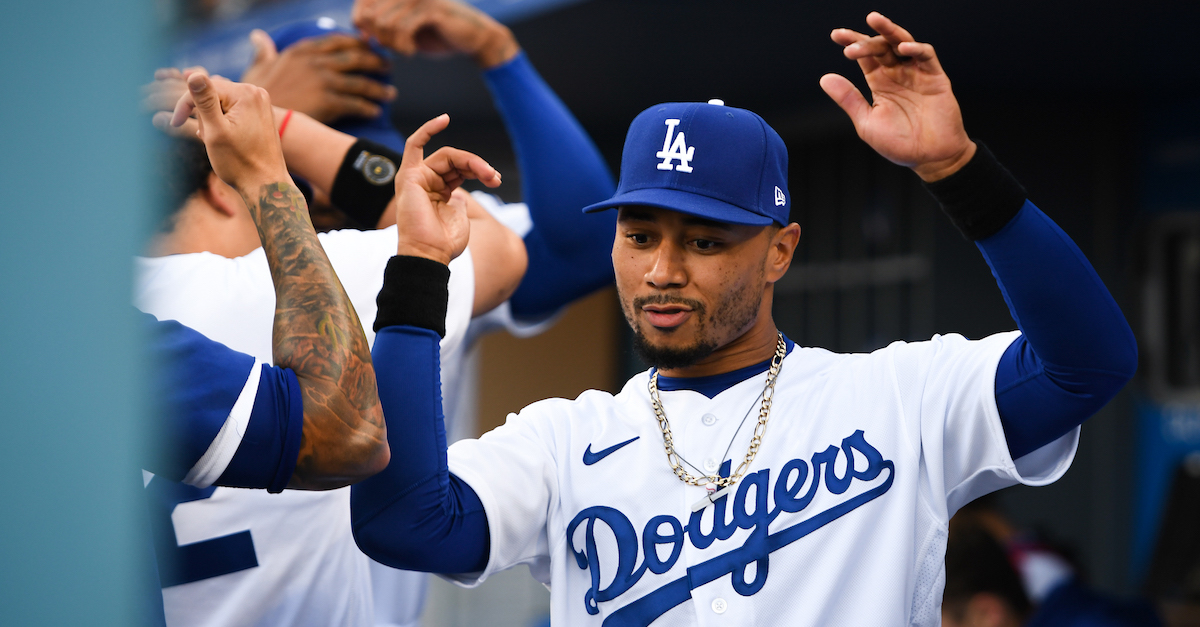
Mookie Betts Is a Shortstop

Jonathan Hui-USA TODAY Sports

On Thursday, the internet dealt with countless cases of “Is that really who I think it is?” as Twitter removed verification checkmarks for unpaid users. Yet when baseball fans did a double-take, it wasn’t because of a spam account that looked suspiciously like Jeff Passan or Ken Rosenthal. Instead, it was because of a shortstop who looked suspiciously like Mookie Betts.

Dodgers manager Dave Roberts teased fans earlier this week, revealing that Betts could play shortstop on Wednesday. Instead, it was Luke Williams who took to the field at game time. Fans got their hopes up for Betts the following day, but once again, it was Williams on the lineup card. Indeed, it wasn’t until the seventh inning of yesterday’s ballgame that Roberts finally made good on his word; he pinch-hit for Williams with Betts, and Betts would stay in the game at shortstop. Williams may have earned the nickname Captain America for his performance with the US Olympic baseball team, but Betts was the superhero – or should I say super-utility player – everyone wanted to see. Read the rest of this entry »


Called Up: Will Smith (Not That One) Heads to Chavez Ravine

The first experience I had with Will Smith was watching several people engaged in conversation about what song he should use as his walk-up music. Will’s expression implied that this was not the first time he’d heard such suggestions, but to his credit, he did settle on a few expected classics. After all, Bel Air is only about 20 miles from Chavez Ravine.

The second experience I had with Will Smith was witnessing him throwing the ball down to second base. Quick footwork and an ultra-quick release caused some wide-eyed double-takes aimed at stopwatches in the dugout at Lindquist Field in Ogden, Utah. Times ranged as low as 1.73 and few were higher than the upper-1.8’s. Smith’s athleticism and throwing ability behind the plate was immediately evident to the excited player development staff on hand.

In his first two years at his hometown University of Louisville, Smith hit a total of 15 extra-base hits in 300 plate appearances, showing good bat-to-ball skills but otherwise not a ton of offensive impact. His brief stint in the Cape Cod League after his sophomore season showed much of the same – he was a good athlete who looked like he should be able to provide value behind the plate (a position that was not familiar to Smith upon entering college, as he played the infield in high school), but not packing much punch with the bat.

Louisville’s 2016 team was loaded with draft prospects, and Smith’s performance put him in the same conversations as teammates Corey Ray, Zack Burdi, Drew Harrington, and Kyle Funkhouser. He matched his extra-base hit total from the previous two years combined in almost 100 fewer plate appearances while walking more than he struck out. His defensive prowess behind the plate was on full display as well, as he excelled while catching an impressive pitching staff that included the aforementioned Harrington and Funkhouser as starters, Burdi as a reliever, and then-sophomore Brendan McKay in the rotation.

Like many organizations, the Dodgers were enamored with Smith’s athleticism, high probability of staying behind the plate, and contact skills. The newly developing power pushed Smith’s ceiling even higher and he steadily crept his way up the draft board as the season went along and the power kept coming. The Dodgers had three first-round picks that year and used the first, the 20th overall pick, on Wisconsin high school shortstop Gavin Lux. With the second, the 32nd pick, the organization stayed within the skillset of up-the-middle players with good contact skills and selected Smith. Read the rest of this entry »


Dan Haren Becomes Rare Underpaid Dodger

Ken Rosenthal of FoxSports.com is reporting the Los Angeles Dodgers have signed Dan Haren to a one-year, $10 million deal that has a vesting 2015 option if Haren works at least 180 innings next season. Last month, when we did our crowdsourcing for Haren, Carson Cistulli presented the following Haren facts:
Read the rest of this entry »


The Dodgers Have A Good Outfield Problem

Shane Victorino was recently asked if he would return to the Dodgers in a part-time role next season. One of the many pieces the Dodgers added near the trade deadline, the former all-star centerfielder was adamant that he’ll seek regular playing time in his next deal. Given Victorino’s sentiments and the crowded Dodgers outfield, his return likely isn’t in the cards. However, the Dodgers may need someone like him over the next year or two as an insurance policy on Carl Crawford or a stopgap until Yasiel Puig is ready.

When the Dodgers acquired Crawford, along with Josh Beckett, Adrian Gonzalez …and Nick Punto in last week’s megadeal, they put the finishing touches on a very expensive outfield for the foreseeable future.

The move didn’t come without consequences. In addition to the hefty contracts now on the books, the Dodgers created a positional logjam that may prove difficult to solve without eating salary or making subsequent trades.

Read the rest of this entry »


Why Kershaw But Not Lee?

Finishing one out short of his sixth shutout of the season Wednesday night, Cliff Lee capped off a magnificent August by holding the Reds scoreless over 8 2/3 innings. He turned in the following numbers for the penultimate month of the regular season: 39 2/3 innings, 23 hits, 2 earned runs, 8 walks, 39 strikeouts.

He kept 48 percent of balls put in play on the ground and kept runners off base to the tune of a 0.78 WHIP. All told, his gaudy 0.45 on the month produced a 12 ERA-, meaning it was 88 percent better than the league.

And yet, Lee’s August paled in comparison to his June this season, when he posted a 0.21 ERA that, when normalized for season and league, actually represents the best mark for that month in the Retrosheet era. The Phillies broadcast displayed a graphic the other night showing that only three pitchers have won five or more games without losing, and with a sub-1.00 ERA in two different months: Walter Johnson, Bob Gibson and Lee. Even if the win-loss record qualifier was removed Lee would still find himself in limited company in this regard.

Overall, Lee has performed up to high expectations this year with the Phillies. Roy Halladay garners much of the attention in that dynamic rotation, but Lee has been fantastic. He has thrown 194 2/3 innings over 27 starts, with a 9.2 K/9, 1.8 BB/9, 46 percent groundball rate and a 2.59 ERA supported by his 2.75 xFIP and 2.68 SIERA. His elite level numbers invite the question of why Clayton Kershaw, who has similar numbers, is getting plenty of award consideration, while Lee is consistently overlooked.

Read the rest of this entry »


2011 Giants: Lowest-Scoring Contender Ever?

The San Francisco Giants have been in a a funk lately, turning a half-game lead in the division on August 9 to a three and a half game deficit in a mere seven days. Their pitching hasn’t been bad, but at some point the sheer lack of offense was bound to catch up with them. On Monday, Scott Miller of CBS Sports tweeted that no team had made the playoffs averaging fewer than four runs scored per game since the 1988 Dodgers.

At the time, the Giants were averaging 3.43 runs per contest. While they were looking up at the Diamondbacks in the standings and not technically in the playoffs, Miller’s point remained valid. If they climb back atop the division, the Giants could conceivably become one of the lowest scoring teams in history to make the playoffs if their offensive struggles persist. But would they be the lowest scoring team to make the playoffs?

Read the rest of this entry »


Addressing the James Loney Situation

James Loney isn’t good enough to be a big-league starter.

In 486 plate appearances from 2006-07, Loney hit .321/.372/.543 and took the league by storm. At just 23 years of age, his future seemed bright. He boasted a sweet left-handed swing, smart baserunning ability, and smooth glovework.

He has since spent 1,951 plate appearances slashing .279/.341/.409 — a sub-replacement level line for the position — with an average UZR. He hasn’t shown any signs of improving or turning the corner. He slugged below .400 in each of the last two seasons. His ability to reach base has sputtered in spite of league average BABIP rates. His defense has been decent, but underwhelming, which has exacerbated the offensive woes.

Loney is now 27 years old and clearly lacks the requisite skills for a regular starting role.

Read the rest of this entry »


Where For Pierre?

One of the big stories down the stretch in 2008 involved the wide array of Dodgers outfielders and who would receive playing time. Having signed both Juan Pierre and Andruw Jones to very lucrative deals, Matt Kemp and Andre Ethier soon emerged as true talents. Add in the acquisition of Manny Ramirez and the team featured five outfielders, three of whom deserved playing time and two of which who realistically did not but were being paid as if they did.

Jones has already mentioned a desire to be traded to a team on which his playing time would increase, and it seems Pierre is singing the same tune. The Mets were initially reported as having some interest, but Omar Minaya shot that rumor down. For any team to take on Pierre, the Dodgers would need to pay a large chunk of his remaining salary.

From 2001-04, Pierre was a decent player. He proved to be extremely durable, playing over 150 games and stealing 45+ bases in each season. He recorded 200+ hits in three of the four seasons, producing OBPs above .360 in the corresponding campaigns. His wOBA in those seasons: .353, .312, .335, .343. These translated to the following wRAA totals: 14.8, -7.4, 4.6, 8.1.

His fielding in these seasons made him even more valuable. As a centerfielder, Pierre’s UZR data from 2002-2004 pegged him as +17 runs, +15 runs, and +5 runs.

In 2005, Pierre’s wOBA dropped to .309 and his offense was worth -10 runs below average. His defense declined to +3 as well. The following season, his offense remained in the same vicinity at -8 runs. Playing in Wrigley Field for the Cubs, his defense improved to +20 runs while captaining the outfield.

In 2007, Pierre inked a 5-yr deal with the Dodgers, which made little sense given the top-tiered prospects in the farm system. Though he played 162 games once again, and slapped his way to 196 hits, Pierre remained around -9 runs below average offensively, and saw his UZR drop to +7. While +7 in centerfield is still very solid, Pierre’s offense concerned many.

Last year, the Dodgers decided not to play Pierre as often as he had previously played, and Juan partook in just 119 games. Overall, he produced a +0.7 UZR in limited centerfield action and a +0.3 in 84 leftfield games. His offense remained -8 runs below average. Essentially, Pierre had gone from a no-hit, good fielding player to a no-hit, average fielding player in 2008. While he may not have been a replacement player, persay, he tended to fit the definition with his lack of hitting ability and average defense.

Next season, we can project Pierre as a -10 run hitter and +5 run fielder. If he finds himself on another team, with plenty of playing time, an optimistic projection would peg him as worth +15 runs with adjustments for both position and value over replacement level. This is optimistic, though, and with limited playing time, his value could drop to anything from +5 to +10 runs. Even at 1.5 wins, his fair market value would not be worth more than $7.5 mil. Suffice it to say, his current contract will reward him with more than that fee.

If Manny Ramirez does not return to the lineup, Pierre will likely stay put, but if not, the Dodgers may end up paying a good portion of his salary to leave town. Without paying a high percentage of his salary, he simply is not an attractive option for other teams. At 31 years old, his already declining offense will continue to decline, meaning his defense will need to pick up the slack to keep him worthwhile.

He may still be a plus defender, but not the +20 fielder from a few years ago. Juan Pierre still has value, but not enough to merit his current salary or even earn him playing time on the team currently employing him.


Casey Blake Remains A Dodger

Jayson Stark at ESPN.com recently reported that the Dodgers and Casey Blake reached an agreement for 3 yrs and around $17.1 million. The exact details of the contracts are not known as of this juncture, though I will update when they become available. Blake, a third baseman who has dabbled at several other positions throughout his career, joined the Dodgers towards the end of July last season. In 58 games wearing Dodger blue, he posted a .251/.313/.460 line with 10 home runs. This resulted in a slightly below average .327 wOBA.

All told, his -3 runs on offense, +1.4 runs on defense, and positional adjustment for playing third base pegged him as a league average player over the final two months of the season. With injuries to Jeff Kent and Nomar Garciaparra, acquiring Blake allowed Joe Torre to shift Blake DeWitt to second base, stabilizing the defense and lineup, in a sense.

The average annual value of Blake’s supposed contract with the Dodgers is $5.7 mil, meaning that they would essentially be paying him to add about 1.15 wins above replacement per season. How does his 2009 projection look in this regard?

Marcel says Blake will hit .265/.336/.440, with 18 HR, and a .335 wOBA. His wOBA would basically represent the league average, and based on his projected playing time, he would be worth +1 run above average with the bat. He was -3.7 runs below average via UZR in 2007, and -4.7 in 2008. Let’s say, at worst, he is -5 runs at third base next season. Add in his +2.5 positional adjustment and +20 runs to represent value above replacement level, not average, and Blake is projected to be worth +18.5 runs in 2009. This easily converts to +1.85 WAR.

Assuming the going rate is around $5 mil/win this year, Blake’s fair market value for a one year deal is $9.25 mil. Factoring in a 10% discount rate for a multi-year deal, and an appropriate contract would be 3-yr/$25 mil. The Dodgers supposedly signed him for around $8 mil less than his projection calls for. Now, granted, Blake will be 36 by the end of the 2009 season, and when this contract ends, he will either become a utility bench player or retiree. Even with aging curves, though, there is little reason to think he will only be worth 3.45 WAR (the 1.15 WAR per year based don his $5.7 mil AAV) over the duration of this deal.

Having traded Andy LaRoche to acquire Manny Ramirez, it isn’t as if Blake’s signing will prevent a top-tiered prospect from earning playing time. He isn’t going to put the team over the top, or make up for Manny’s lost production if he signs elsewhere, but based on the committed money and his projected production, this looks like a very solid deal for the Dodgers.


NLCS Goings On

Entering tonight’s matchup of Derek Lowe and “Kentucky” Joe Blanton, the Phillies hold a 2-1 lead over the Los Angeles Dodgers in the NL Championship Series. After taking the first two games at home, the Phillies stumbled yesterday, behind a poor Jamie Moyer outing, en route to a disappointing 7-2 loss. The Phillies hitters continued to struggle against Hiroki Kuroda, and the win helped reinforce that these teams have trouble defeating each other on the road. The Phillies have a 6-5 season series lead against the Dodgers, going 6-0 in Philadelphia, but 0-5 at Chavez Ravine. As Game Four sets to get underway, I thought I would offer some notes of mine on the series thus far:

Poor Russell Martin
In Game Two, Brett Myers threw a pitch behind Manny Ramirez, that got everyone in the Dodgers dugout stirring. Myers claimed the pitch slipped out of his hands, and given his struggles early in ballgames–he led all major league pitchers in runs surrendered in the first inning–it is pretty safe to say that he did not want to put Manny on base. He was likely attempting an inside pitch that slipped out of his hand. Chad Billingsley did not retaliate, much to the ire of Ramirez, who went onto say that Myers is the kind of guy he would want on his team.

Last night, Hiroki Kuroda threw a pitch that sailed over the head of Shane Victorino, who promptly acknowledged that he understood the need for retaliation, but asked that he be hit in the ribs, not the head. After grounding out, Victorino said something to Kuroda, which ultimately resulted in both benches emptying. The melee soon calmed down, but it was clear that both teams had had it up to here (as I type this my hand is positioned high in relation to my body to emphasize the “here”) with balls “slipping.”

Lost in all of this is how Russell Martin was hit, twice, and brushed back in another at-bat. Ramirez and Victorino may have been near targets, but Martin got not only the taste of sweet chin music, but also two beanings.

Rollins and Howard…not MVP-like
Jimmy Rollins and Ryan Howard are very talented players, and the recipients of the last two MVP awards in the National League. In this NLCS, however, they have been about as productive as Yuniesky Betancourt and Willie Bloomquist, combining for a 3-25 mark, with 8 punchouts. This has put more pressure on guys like Pat Burrell, Jayson Werth, and Shane Victorino, and if the Phillies have to rely on that triumvirate to help Chase Utley out, without Rollins and Howard, it is not very likely the Phillies will win this series.

Broxton
His mound presence is as intimidating as his last name sounds, and he throws really, really hard. If there was one major league pitcher that I would be terrified to face right now, it would be the Broxmeister.

Home Field Advantage
Perhaps my anger at the schedule of this series only surfaced due to being a fan of the Phillies, but is anyone else irked by the 2-3-2 format? I mean, sure, the team with the “2’s” gets more home games than not, but playing three straight home games in a row can be a massive momentum builder. You would think that the team with home field advantage might be the benefactor of three consecutive games at home, or at least that neither team would have that benefit. What is wrong with the 2-2-1-1-1 format? Sure, it adds time to the schedule, but it is not as if it adds a week. The teams would play two days, then a day off, then two days, followed by another day off. Then, each of the remaining three games would have a day off interspersed between them, meaning that, at its maximum, the series would last 12 days; in its current state, the maximum is 10 days.

Moyer
Jamie Moyer has now made two playoff starts this season, amassing a total of 5.1 innings, surrendering 8 earned runs. He was one pitch away from exiting the first inning last night with just two runs surrendered, but a poorly placed pitch to Blake DeWitt ensured that did not occur. The Phillies are now faced with a serious conundrum next time around, as, other than Cole Hamels, nobody has been stellar. Joe Blanton pitches tonight, and could perform well, but the triumvirate of Hamels-Myers-Moyer, as a whole, has not performed to expectations. Hamels has been brilliant, but Myers has been a better hitter than pitcher lately, and Moyer’s struggles were documented by Dave earlier today.

Dodgers Bullpen
Has not given up a run in three games. Cory Wade, James McDonald, Jonathan Broxton, Hong-Chih Kuo, Clayton Kershaw, Greg Maddux, Joe Beimel, and Chan Ho Park have combined for 11.1 scoreless innings, with 10 strikeouts.

Despite my allegiances to the Phillies, I initially predicted a 4-2 series win for the Dodgers. For me, honestly, tonight is a must-win for the Phillies, as it would push the series to 3-1, with Hamels pitching in Game Five. A loss here would bring with it the very real possibility of a 3-2 Dodgers lead heading back to Philadelphia, where they would once again face Kuroda, against whom they have struggled.