
2026 Trade Value: Nos. 41-50
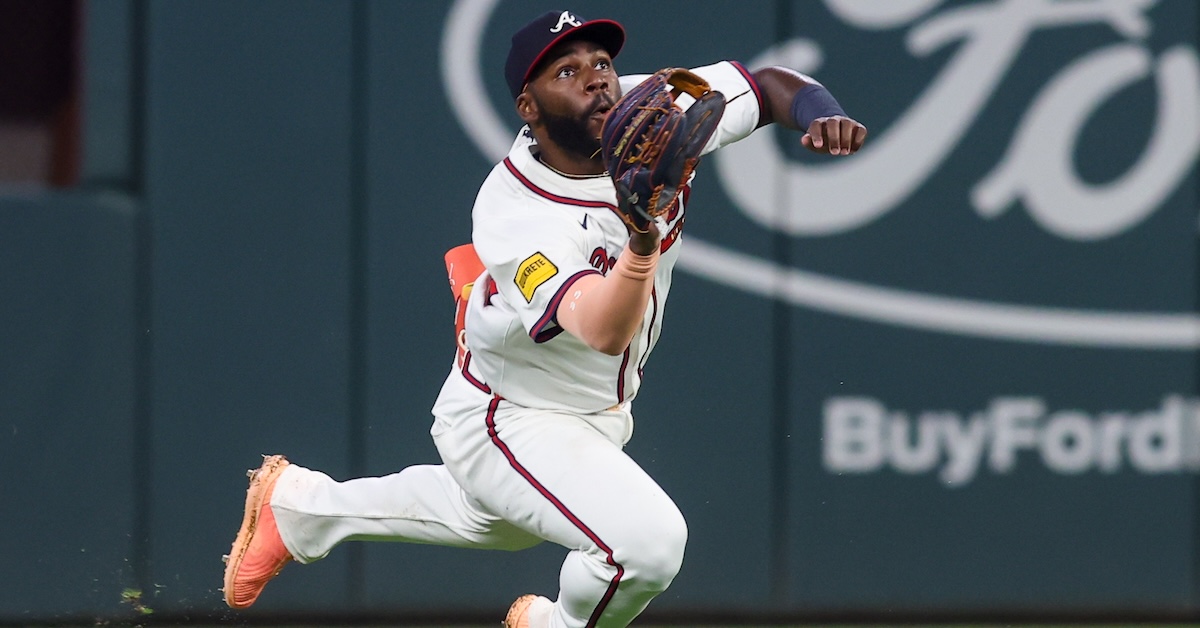
As is tradition at FanGraphs, we’re using the lead-up to the trade deadline to take stock of the top 50 players in baseball by trade value. For a more detailed introduction to this year’s exercise, as well as a look at the players who fell just short of the top 50, be sure to read the Introduction and Honorable Mentions piece, which can be found in the widget above.
For those of you who have been reading the Trade Value Series the last few seasons, the format should look familiar. For every player, you’ll see a table with the player’s projected five-year WAR from 2027-2031, courtesy of Dan Szymborski’s ZiPS projections. The table will also include the player’s guaranteed money (exclusive of any signing bonus), if any, the year through which their team has contractual control of them, last year’s rank (if applicable), and then projections, contract status, and age for each individual season through 2031 (assuming the player is under contract or team control for those seasons, or has a player or vesting option). Last year’s rank includes a link to the relevant 2025 post. Thanks are due to Sean Dolinar for his technical wizardry. At the bottom of the page, there is a grid showing all of the players who have been ranked up to this point.
One note on the rankings: Particularly at the bottom of the list, there isn’t a lot of room between the players. The ordinal rankings clearly matter, and we put them there for a reason, but there isn’t much of a gap between, say, the 38th-ranked player and the guy who would have been 58th if the list went that deep. The magnitude of the differences in this part of the list is quite small. Several of the folks I talked to might prefer a player in the Honorable Mentions section to one on the back end of the list, or vice versa. I think the broad strokes are correct, and this is my opinion of the best order, but with so many players carrying roughly equivalent value, disagreements abounded. I’ll note places where I disagreed meaningfully with the people I spoke with in calibrating this list, and I’ll also note players whose value was the subject of disagreement among my contacts. As I mentioned in the Introduction and Honorable Mentions piece, I’ll also indicate tier breaks between players where appropriate, both in their capsules and in the table at the end of the piece.
With that out of the way, let’s get to the first batch of players.
| Five-Year WAR | 16.1 |
| Guaranteed Dollars | $266.0M |
| Team Control Through | 2034 |
| Previous Rank | #15 |
| Year | Age | Projected WAR | Contract Status |
|---|---|---|---|
| 2027 | 28 | 4.0 | $25.0M |
| 2028 | 29 | 3.7 | $25.0M |
| 2029 | 30 | 3.3 | $36.0M |
| 2030 | 31 | 2.8 | $36.0M |
| 2031 | 32 | 2.4 | $36.0M |
The upside here is considerable. Tatis has played at a more than 5 WAR per 600 plate appearances pace for his career, and even if you want to completely ignore everything before that missed 2022 season, he’s playing at a 4.2 WAR/600 PA clip since then, even including his slow start to 2026. In other words, he’s a superstar-level talent. There are maybe 15 hitters with a better track record over that span, and only four of those guys are younger than Tatis. He’s also 16th in total WAR, full stop. A guy this talented and this young would fetch more than his current contract on the open market. This year’s ZiPS projections for Tatis are lower than last year’s – with good reason – and yet he still projects with a smidgen of surplus value, because guys this talented are just rare.
The downsides are enough that plenty of teams wouldn’t be interested in Tatis no matter what. He’s been injury prone throughout his career, and it’s been all types of different injuries, too. That PED suspension is no laughing matter. He didn’t hit a home run until May 30 this year. If your team is resource-constrained, you can imagine wanting to spend your scarce dollars on a player with less volatility. But for teams in the market for stars, the kinds of teams that frequently play at the top of the free agent market, trading for Tatis is an attractive proposition. If you’re interested in the player – and while his skill set isn’t universally adored, plenty of teams see him as a superstar talent – then the contract is an asset, not a liability. In a year, I don’t think Tatis will be at this spot on the list. This is either a phenomenal buying opportunity, or the start of a decline that will take him out of the discussion entirely. And I’d be lying to you if I told you I knew which was more likely.
| Five-Year WAR | 16.7 |
| Guaranteed Dollars | $123.0M |
| Team Control Through | 2034 |
| Previous Rank | #42 |
| Year | Age | Projected WAR | Contract Status |
|---|---|---|---|
| 2027 | 23 | 2.8 | $4.0M |
| 2028 | 24 | 3.3 | $8.0M |
| 2029 | 25 | 3.4 | $15.0M |
| 2030 | 26 | 3.6 | $19.0M |
| 2031 | 27 | 3.6 | $23.0M |
Anthony’s skill set is the kind I love: good batting eye, good approach, plus power. He hits too many grounders, but I think that’s just part of the tradeoff when you swing as hard as he does and don’t strike out constantly. Most hitters who combine the same traits have a similar batted ball profile, particularly early in their careers. My evaluation of him hasn’t changed a ton since he debuted – we had him right on the 60/65 FV cusp as a prospect, a power-and-patience thumper with good corner outfield defense, and that’s roughly how I still see him. ZiPS, always a fan of his, has cooled only slightly with a year of extra information.
If I could rank an uninjured Anthony, with the contract extension he signed last year and without his slow start to 2026 (he scuffled in the WBC and the season’s early going before he got hurt), I’d have him at least 15 spots higher. But you can’t pretend that the last six months didn’t happen, and they muddle the picture considerably. He might not return this year – it’s simply unknown. Hitters generally take some time to return to full strength after hand injuries, and the timeline of this one makes that feel even more likely. Two different team people I talked to said some variation of “Do you have to rank him? Can’t you just not?”
I think that it fits the ethos of this series to try to put him somewhere. But just so we’re clear, this spot is basically a shrug emoji. I don’t know! You don’t know either. No one does. Roman Anthony is one of the best players in baseball when he’s healthy, and one of the best trade values, too. But right now, he’s not, and so here we are.
| Five-Year WAR | 8.4 |
| Guaranteed Dollars | – |
| Team Control Through | 2029 |
| Previous Rank | – |
| Year | Age | Projected WAR | Contract Status |
|---|---|---|---|
| 2027 | 28 | 1.9 | ARB 2 |
| 2028 | 29 | 1.8 | ARB 3 |
| 2029 | 30 | 1.7 | ARB 4 |
Teams that know they’re headed to the playoffs would struggle to find a more potent upgrade than Miller. He shortens the game by an inning, and in the on-again/off-again cadence of postseason baseball, he can do that in a lot of your games. You’ll read about plenty of players on this list who couldn’t hope to impact a game of baseball the way Miller does. Trade value is largely about long team control, with tons of plate appearances or batters faced, and the advantages derived from paying someone less than you’d expect to do so. But Miller’s value, while not spread out across as many innings, is irreplaceable in the way that a nice outfielder or solid playoff starter just isn’t.
If he weren’t the best reliever in the game by a fair margin, I wouldn’t have him slotted in here, and honestly, I didn’t really want to. It feels strange to have relief pitchers on this list at all. But this isn’t a guy having one fluke of a great season. This is the closest thing we’ve seen to peak Mariano Rivera in quite a while. It might look different. It feels scarier, for sure – he throws so dang hard that I’m always holding my breath worrying about an injury. But he’s been a reliever for three seasons, and in each of those three, he’s produced 2 or more WAR and put up ludicrous peripherals. He has a 2.15 ERA in that span, and he’s underperforming his FIP by a decent amount. Reliever greatness is often fleeting, and if Miller hits a rough patch, I can’t imagine continuing to have him in this lofty of a spot. But he hasn’t had a rough patch, and while not every team would want him, the teams that would be interested would be really interested.
| Five-Year WAR | 12.8 |
| Guaranteed Dollars | $87.5M |
| Team Control Through | 2030 |
| Previous Rank | #31 |
| Year | Age | Projected WAR | Contract Status |
|---|---|---|---|
| 2027 | 33 | 4.2 | $12.0M |
| 2028 | 34 | 3.1 | $20.0M |
| 2029 | 35 | 2.5 | $22.0M |
| 2030 | 36 | 1.8 | $22.0M |
| 2031 | 37 | 1.2 | $11.5M |
Marte is still playing at a high level, but it’s not the same form he’s shown for the past three years, when he posted a 140 wRC+ and averaged five wins a season. Now he looks more like a plus bat than a no-doubt elite option, and that changes the calculus significantly. The reason to trade for someone like Marte is to get as much on-field return as possible in the next few years, and figure out the future later. It’s much easier to look past long-tail payroll commitments for an MVP candidate than it is for a nice everyday player.
Marte’s contract isn’t prohibitively expensive; at roughly $17 million per year (deferrals lower it some), it’s perfectly reasonable for an above-average regular. But he’s probably not going to be an everyday player by 2031 – time is undefeated, after all. And when you switch from “this guy is the missing piece for our playoff team” to “this guy makes the team better,” the price per win starts mattering far more. It’s a double whammy, really; a downtick in performance both suggests worse performance in the future and lessens the incentives for teams to pay up for present excellence. Most trades are about surplus value or getting someone who’s currently dominant. Marte doesn’t cleanly fit into either bucket right now, which is why I’ve cooled on him since 2025.
I haven’t cooled enough to take him out of the top 50, though. This is a down year for Marte, but we’re still projecting him for a 3.5-win season and 30-ish homers. He’s one of the best in the game against left-handed pitching in particular, and that skill doesn’t look to have slowed down at all. That makes him a matchup nightmare; he switches sides of the plate against righty pitching and does perfectly fine, which lets him flank left-handed batters as platoon protection. His contact skills give him a high offensive floor, too; when you’re striking out a mere 15% of the time, it’s much easier to contribute even when you’re not 100% locked in. Add in scratch defense at a middle infield spot, and there’s a high likelihood that Marte will deliver value even in a down year. That well-rounded game kept him on the list for me even though his results haven’t been quite as good of late. I don’t feel strongly about the way I ordered the four players in this tier, but I do think that all of them are reasonable inclusions on this list. That said, I also wouldn’t fault you for excluding any or all of them from your own version. That’s why they’re tough calls.
| Five-Year WAR | 15.0 |
| Guaranteed Dollars | – |
| Team Control Through | 2028 |
| Previous Rank | #22 |
| Year | Age | Projected WAR | Contract Status |
|---|---|---|---|
| 2027 | 28 | 3.3 | ARB 2 |
| 2028 | 29 | 3.2 | ARB 3 |
Brown is a top-of-the-rotation starter who could be the best arm on your playoff team. He was phenomenal in 2025, finishing third in Cy Young voting and hitting a career-high 185.1 innings. He’s only 27, and he has somewhere between three and five plus pitches, depending on how you’re counting. Like Justin Verlander, whose delivery Brown patterned his own motion off of, he gives up more homers than you’d like, but he makes up for it with a sky-high strikeout rate and also does a good job of limiting BABIP. No one I talked to seriously questioned Brown’s talent; if you watch him pitch, you can tell he belongs.
That said, pitchers with limited team control are always a risky proposition. Brown missed two months this year with a shoulder strain, and while he’s already made five starts since his return, his command has been rusty. He walked five in his most recent outing, and looks to my eyes like he just needs more reps and more comfort after his injury. Given that he’ll reach free agency after the 2028 season, daylight is burning. If this year is a partial write-off, there’s just not much time for Brown to provide the kind of copious value that makes players fit on this list.
I settled for grouping him with a bunch of players who are similarly good and similarly heading towards free agency. Then I slid him to the bottom of the group because of the injury issue – he has slightly less this-year value than the rest of the guys in this tier, in my estimation. But that’s just a matter of returning to full effectiveness, not a vote against how good he is when he’s right. Teams would give up a lot to get Brown – they’d just do so knowing that a lot of the juice will come in 2027 and 2028. As a side note, this tier would be a reasonable place for several of the pitchers who appeared in the honorable mentions if you’re higher on them than I am. I have Brown as the best of the group because if I’m getting a pitcher for only a few years, I want someone with the potential to be truly dominant, but if you prefer the steadiness of George Kirby or the grounders of José Soriano, this is where I think they’d go.
| Five-Year WAR | 16.6 |
| Guaranteed Dollars | – |
| Team Control Through | 2028 |
| Previous Rank | #47 |
| Year | Age | Projected WAR | Contract Status |
|---|---|---|---|
| 2027 | 26 | 3.4 | ARB 2 |
| 2028 | 27 | 3.4 | ARB 3 |
Abrams has put together the offensive skills that he intermittently demonstrated earlier in his career, resulting in his best year to date. He makes a ton of contact, particularly for someone with plus bat speed, and gets the ball in the air to the pull side frequently. Put those two things together, and it isn’t hard to see why he’s already set a career high for home runs with two months left to play. He chases too much, which limits his offensive upside, but being “limited” to a line that’s 20-30% above average isn’t so much of a drawback if you bring other things to the table.
And the obvious other thing Abrams brings to the table is game-breaking speed. He’s swiped 30 or more bags for three straight years, though he’s in danger of falling short of that mark in 2026. He also wreaks havoc on the basepaths; he’s posted positive baserunning value in every year of his big league career and is still among the fastest big leaguers. Less clear is where he should play defensively; he’s one of the worst shortstops in the majors by pretty much every defensive metric, but I wouldn’t feel great about asking him to learn a new position on the fly, which means a team trading for him would have to get creative about where he’s deployed in the short-term. But that’s a small nit to pick. We’re talking about a middle infielder – though probably a second baseman – with plus power, plus speed, and a .352 OBP, one who will be around for two more years after this one at reasonable rates. Everyone could use a player like Abrams.
| Five-Year WAR | 16.1 |
| Guaranteed Dollars | – |
| Team Control Through | 2028 |
| Previous Rank | #20 |
| Year | Age | Projected WAR | Contract Status |
|---|---|---|---|
| 2027 | 26 | 3.5 | ARB 2 |
| 2028 | 27 | 3.4 | ARB 3 |
Greene once projected like a plus defender in a corner, but he’s been mid, as the kids say, for the last few years. I’m not treating his defense as a big drawback – he hits well enough that it’s fine – but it’s certainly not a standout part of his profile. Neither is his baserunning. All you get is the offense – but that’s all you want, so the deal works out just fine.
There’s nothing missing here, per se. The only reason Greene isn’t ranked higher is that he just won’t be around for that much longer. It’s hard to stay at the top of the trade value heap without signing an early extension; as I mentioned in the introduction to this series, there are only two players in the top 40 who are set to hit free agency as early as Greene. For me, he’s clearly above Abrams, but clearly behind the next guy, another corner outfielder with two years left after this one.
| Five-Year WAR | 12.7 |
| Guaranteed Dollars | – |
| Team Control Through | 2028 |
| Previous Rank | #10 |
| Year | Age | Projected WAR | Contract Status |
|---|---|---|---|
| 2027 | 29 | 3.2 | $17.0M |
| 2028 | 30 | 3.0 | $17.0M |
Acuña is hardly having an awful year, but it wouldn’t be up to his usual standards even if he were healthy, and he’s been out for the last month thanks to a hamstring injury. He should be back soon, but this will be three straight years with significant missed time, enough that you’d be foolish to expect a perfect bill of health from here on out.
Of course, if the negatives seem obvious, the positives are pretty clear, too. Acuña is one of the best hitters in baseball when he’s fully healthy. He swings ferociously hard, but he’s not just up there hacking. He has a polished sense of the strike zone, and he’s very aggressive attacking pitches he can drive. He’s so good at that, and so powerful, that pitchers try to avoid him, and he’s run walk rates around 15% for a while now. He’s actually more of an outlier in the on-base sense than the power sense – and he’s a huge outlier in both. I think his days as a devastating baserunning threat are over, but that was always just a cherry on top, not the whole sundae.
I grouped him ahead of the two other players who will hit free agency after the 2028 season, because even though he’ll earn more in salary, I think he’ll make up for it in on-field value. But unless you think Acuña will return and immediately play like an MVP, there’s really no way to move him much further up the list than this spot. The team control math is just too daunting.
| Five-Year WAR | 12.7 |
| Guaranteed Dollars | – |
| Team Control Through | 2030 |
| Previous Rank | – |
| Year | Age | Projected WAR | Contract Status |
|---|---|---|---|
| 2027 | 28 | 3.2 | PRE-ARB |
| 2028 | 29 | 3.0 | ARB 1 |
| 2029 | 30 | 2.6 | ARB 2 |
| 2030 | 31 | 2.1 | ARB 3 |
But I’d still take Rice over Acuña, and if anything, you could argue that we should have a tier gap here, because those extra two years of team control are very important. The salary matters, too; Rice won’t even be arbitration-eligible until 2028, which represents some meaningful cost savings. As an added bonus, it’s insurance against Rice turning out to be a flash in the pan; his arbitration awards will scale with how well he does in the next year and change, so you’re basically guaranteed a bargain if you employ him.
One person I talked to thought I was being too pessimistic in my assessment that Rice had already reached his ceiling. They would have had him 10 spots or so higher, and while that’s not my view, I can understand where they’re coming from. One consideration I rejected, though: I don’t think he’s anything more than an emergency catcher, so I considered him as a 1B/DH only. For now, he looks like a solid source of homers and walks at a good rate for a good length of time. That might not be particularly multi-dimensional, but they’re the two most important skills in baseball. Anything more than that is just a bonus.
| Five-Year WAR | 19.6 |
| Guaranteed Dollars | $46.0M |
| Team Control Through | 2032 |
| Previous Rank | HM |
| Year | Age | Projected WAR | Contract Status |
|---|---|---|---|
| 2027 | 26 | 4.0 | $9.0M |
| 2028 | 27 | 4.0 | $10.0M |
| 2029 | 28 | 4.1 | $10.0M |
| 2030 | 29 | 3.9 | $12.0M |
| 2031 | 30 | 3.5 | $15.0M |
The upsides? They’re clear. He’s a Gold Glove caliber-center fielder with a career batting line that’s 10% above average. He hits for power and average; he makes plenty of contact, particularly in the strike zone, and also has great top-end power, particularly when he gets a fastball he can turn on. I think it’s fair to say that he’s a mistake hitter, but pitchers do make mistakes, and he tends not to let them get away with it when they do. He’s also only 25, light years away from free agency thanks to an extension, and making an average of $12 million a year, which is a bargain.
There’s basically just one downside, but it’s a huge one: His approach at the plate is voracious to the point of damaging his overall game. He’s chased pitches outside the strike zone more than all but three batters in baseball this year, and that isn’t a new thing. His 4.1% career walk rate is no surprise. It’s hard to sustain good batting numbers when you swing at that many bad pitches, and Harris’ last few years show the depths he can reach when he’s off of his game. He hit .249/.268/.409 last year, a barely-playable mark. His game feels solvable, exploitable almost, and he feels like a lock to spend a decent chunk of his career batting eighth or ninth. It’s just really hard for hitters to change this aspect of their game; if you chase too much, the most likely outcome is that you’ll continue to do so. I think the most likely outcome for Harris is a string of good seasons with the odd clunker mixed in, just like he’s been doing for years. I think that plenty of teams would sign up for that roller coaster ride given the good contract and phenomenal glove, but it’s worth noting that not everyone covets that kind of profile.
| Rank | Prev | Name | Team | Pos | 2027 | 2028 | 2029 | 2030 | 2031 |
|---|---|---|---|---|---|---|---|---|---|
| Value Plays | |||||||||
| 41 | HM | Michael Harris II | ATL | CF | 4.0 $9.0M |
4.0 $10.0M |
4.1 $10.0M |
3.9 $12.0M |
3.5 $15.0M |
| 42 | – | Ben Rice | NYY | 1B | 3.2 PRE-ARB |
3.0 ARB 1 |
2.6 ARB 2 |
2.1 ARB 3 |
|
| 43 | 10 | Ronald Acuña Jr. | ATL | OF | 3.2 $17.0M |
3.0 $17.0M |
|||
| 44 | 20 | Riley Greene | DET | OF | 3.5 ARB 2 |
3.4 ARB 3 |
|||
| 45 | 47 | CJ Abrams | WAS | SS | 3.4 ARB 2 |
3.4 ARB 3 |
|||
| 46 | 22 | Hunter Brown | HOU | SP | 3.3 ARB 2 |
3.2 ARB 3 |
|||
| Tough Calls | |||||||||
| 47 | 31 | Ketel Marte | ARI | 2B | 4.2 $12.0M |
3.1 $20.0M |
2.5 $22.0M |
1.8 $22.0M |
1.2 $11.5M |
| 48 | – | Mason Miller | SDP | RP | 1.9 ARB 2 |
1.8 ARB 3 |
1.7 ARB 4 |
||
| 49 | 42 | Roman Anthony | BOS | OF | 2.8 $4.0M |
3.3 $8.0M |
3.4 $15.0M |
3.6 $19.0M |
3.6 $23.0M |
| 50 | 15 | Fernando Tatis Jr. | SDP | OF | 4.0 $25.0M |
3.7 $25.0M |
3.3 $36.0M |
2.8 $36.0M |
2.4 $36.0M |
Ben is a writer at FanGraphs. He can be found on Bluesky @benclemens.
Roman Anthony did not scuffle in the WBC, he batted .280/.400/.520 with 2 massive and memorable home runs, including the go-ahead in the semis against the DR, and 7 rbi in 7 games
many people watched the WBC and called him the USA’s best player
imagine scuffling to the tune of a .920 OPS as a 21 year old
I agree with you (had Anthony ranked #20), but I also get the hesitation. It’s been a tough 2026 for him – even though his statcast looks pretty good. I wonder if teams will be scared they have a Kristian Campbell on their hands (note, I don’t think Roman is even possibly Kristian Campbell, but the point stands).
sure but that’s different than saying that the 21 year old with a .920 OPS in the tournament scuffled during the tournament
I think he was put in a terrible position with the amount of pressure that was on him to carry the lineup and the Sox were a mess early with so many hitters just not holding up.
Except he never had to carry the lineup because Willson Contreras has done that as a top 10 hitter in the sport from day 1
It seems like his injury, not the pressure, was the problem.
Even if you think he’s this fragile you’d be fired immediately for sending him 1-1 in any of these deals.
I get he’s injured but if this is where Anthony lands then this list isn’t properly valuing upside, and it would’ve been better to leave him off entirely.
You’re telling me Breslow calls you and offers Roman Anthony for 2 years of Riley Greene and you don’t sign the papers immediately?
Yeah Im pretty sure the Tigers do this. I think there is an under-evaluatuon of cost-certainy. With Anthony, he is signed for 10 more years at 15m aav or so for his entire 20s. You wont have to worry about his contract or giving him some crazy deal for his decline. There is monumental value in “hugging” a star for his prime.
Greene is signed for 2 more years, so you have to ask whether you want to give him 200+ for his 30s or lose him in FA.
Anthony on his deal has much more upside. While Greene is a safer player now, I think the Tigers in their situation w their youth would much rather RA on his deal (and so would the Redsox)
Tatis is a very interesting one. I love his placement actually, even though I had him outside my personal top 50. There’s a line thin between “all star that looks amazing” and “this guy is too expensive for too many years” – the Corey Seager special! He’s still Tatis, but the Devers trade did make everyone realize these mega deals are being accounted for by other teams.
Thought Ben Rice would be higher!
Tatis has a much higher floor than Devers because he can play plus defense and run still, but yes, it can all go south quickly. Every passing year is adding proportionally to the deadweight phase of the deal.
I strongly suspect we haven’t seen the last of star-level performances out Tatis Jr (and Starling Marte), but I suppose with the injury / PED / attitude questions maybe they’re both in the right spot. Tatis is only 27 years old and put up 6.1 fWAR last year.
The real problem with Tatis Jr is that his salary jumps to $36M in 2029. For $25M a year he’s probably a bargain, but $36M a year is going to push a lot of teams out of the bidding entirely.
Oh jeez, Ketel Marte! We have definitely seen the last anything out of Starling Marte.
I saw that and wondered if I had time-warped back to the 2016 trade value rankings…
There was a brief time when I briefly skimmed prospect lists that I confused Starling Marte with Wardell Starling.
Was going to comment, lol
You mean Ketel Marte I think? I did a double take
I don’t expect anything from Starling Marte at this point except retirement.
I was trying to figure out the joke honestly for longer than I care to admit
I’m confused by your Devers comment. Haven’t people always known that other teams account for mega deals?
Shockingly a lot of people still think the owners’ wealth amounts to infinity and they’re just choosing to have differing payrolls for fun
That’s literally what most owners do.
I was more meaning that we may have thought Devers had a “higher” trade value since he’s great, but really the deal was under water and teams actually care about that. So maybe teams have always accounted for it, but our personal rankings need to catch up.
I would be very concerned about the precipitous drop in overall pull percentage and especially pulled fly ball percentage for Tatis. His 5.6% pulled fly ball rate is one of the worst in the majors.
It is tough to talk about years of control when a new CBA could change those rules. And given the Skubal precedent, and the fact that these are the elite trade value players, even under the current CBA that A3 year of control isn’t worth that much.
Was wondering where Acuna would land. He was probably the biggest dropper in my personal trade value list..for the exact reasons you state.
I had Acuna a lot higher but I also don’t think I realized how close we were to the end of his deal. Somewhere in the 40-50 range seems about right to me.
But I think my biggest dropper was Gunnar Henderson. Which shouldn’t be surprising because there are a lot of similarities between Acuna and Gunnar Henderson. These are guys who were MVP-caliber performers as recently as two or three years ago, and you’re banking on them returning to it.
I remember after the 2024 season that the O’s had blown their one chance to lock Henderson down in a long-term deal. Things look a lot different if he’s *only* a 4-5 win player instead of an 8-win one. The O’s also need to do a deep dive into hitter development. Gunnar was looking like the only exception to their young hitters struggling in the bigs, and now that’s looking like a possible fluke.
This crop of O’s position players is so interesting to evaluate. Gunnar was the only one who was consistently good to great, until he all the sudden wasn’t this year.
Adley has also rebounded a little after the last couple of years, and Basallo is looking good early, but I’m not even sure if I’d lump them in with the other because catchers are so weird.
Kjerstad, Mayo, and Holliday have been big disappointments relative to expectations, although Holliday is still young. Cowser would be even more disappointing if he hadn’t developed into a decent CF over the last couple of years, but he has not really fixed his issues with the bat at all. It’s probably too early to tell on Beavers and it’s been a middling start for him.
Westburg is probably their best recent hitter development story but unfortunately the injuries are racking up.
It didn’t help that the Orioles super high draft choices came in years where close to the entire first round busted. I don’t think it’s reasonable to say the Orioles should have picked Chase DeLauter over Jackson Holliday when DeLauter was picked 15 spots after him. Same with Colton Cowser vs Colson Montgomery, or Kjerstad vs Pete Crow-Armstrong. Those were terrible years for talent.
My main concern is that their guys did well in the minors and then stalled in the majors. All of Adley, Gunnar, and Holliday were ranked as FG #1 prospects. And in each case, you would rather have the next guys on the list if you were picking today (Witt/JRod, Carroll/Eury/Elly, and Langford/Wood/Skenes/Chourio). For some reason, those guys just have not made the adjustment to the majors that the other top guys have.
Cherry picking the only two players from that draft with more fWAR than Rutschman is disingenuous, especially when Carroll wasn’t drafted until the 16th pick. Saying that Adley (17.3 fWAR) and Henderson (19.9 fWAR) “have not made the adjustment to the majors that the other top guys have” is completely absurd. Both have been enormously successful.
Holliday, on the other hand, is a bust and never should have been ranked that highly to begin with. I said as much in 2023.
I’m not talking about the draft, and I’m not saying that the other guys should have been picked instead. I’m arguing that they have disappointed offensively to varying degrees after being labeled #1 overall prospects relative to the #2, #3, etc. ranked guys. And I’m wondering if they would have had more success in a different organization.
Put another way, if you think the #1 and #2 prospects have a 50:50 chance of one being substantially better than another, the O’s flipped tails 3 times in a row. That’s not a huge sample size (12.5% chance), but makes me question whether it is a fair coin. Especially since their other guys who made top 100 lists also haven’t hit.
Saying that the fifteenth and twenty fifth most valuable position players in baseball since 2022 “have not made the adjustment to the majors that the other top guys have,” and “have disappointed offensively to varying degrees” is completely ridiculous.
It’s obvious that you didn’t realize just how good Rutschman and Henderson have been, which is fine, but what I don’t understand is why you’re not willing to just admit that you were wrong.
There never was a chance for the Orioles to do that. They tried. Boras doesn’t do pre-arbitration extensions for major leaguers, as multiple clients like Altuve, Raleigh, and Ruiz had to fire Boras to get theirs done.
I can’t believe he’s still only 28. It feels like he’s 35.
CJ and Jazz are intertwined in my mind. Very similarly dazzling power-speed skillsets. And very similarly frustrating on offense, with too much chase by CJ and too much whiff from Jazz. They both seem like there’s a possible monster MVP-type year in there, but it’s unlikely that the stars align and they put everything together.
If CJ was average defensively he would get a bunch of MVP votes this year. His bat is that good!
I feel like saying “even if you want to completely ignore everything before that missed 2022 season” for Tatis is the most obvious statement in the history of this website.
Of course we should ignore pre-PED bust Tatis.
He was a 160 OPS+ bat on steroids, and without him, he’s a 119 OPS+ guy. I can think of a couple dozen guys on the HM list I’d take over him in a heartbeat.
Take the name out of it. Take the steroid numbers out of it.
Deal.
He’s a 119 OPS+ guy
With a plus glove
He’s 27
His ranking is appropriate.
I agree with everything you said, 100%.He’s a 119 OPS+ guyWith a plus glove (in corner OF)He’s 27He’s signed for 8 more years and 270 mill after this yearHe has a PED bust on his resume, and multiple injuries.I stand by my statement that there are a couple dozen guys on the HM list I’d take over that resume.Edit: OK, a couple dozen is high. Say a dozen.
I would almost completely ignore pre-2022 production from any player.
Honestly, is there anyone with any pre-2022 data worth considering at all?
Yes. https://not.fangraphs.com/dangerous-experiment-a-roster-of-25-adam-dunns/
Either the Top 40 is even more stacked than I thought or I think many of these guys are too low. And the only one I wouldn’t put on the list at all is Mason Miller.
-IMO Hunter Brown would probably either be higher or on the “hurt pitchers” list and ineligible since he’s only a couple weeks ahead of Hunter Greene.
-Ben Rice and Michael Harris II are awesome and on affordable contracts. Harris is a lot like Ceddanne Rafaela, who I am guessing is probably 10 spots higher, and Rice is a lot like Nick Kurtz who is probably 20 spots higher.
But maybe I’ll see #20-#40 and I’ll be like, “huh, maybe they deserve to be here after all.”
Mason Miller returned an FV60 at last year’s deadline and I think he’d return the same if he was traded this year, even with 1 less year of control. (I know Longenhagen had DeVries as a 50 at the deadline and then corrected himself 6 weeks later to match all the other publications.) Of the other guys in Ben’s 41-50, I think only Roman Anthony, Hunter Brown, and Michael Harris would return an FV60 plus others. Maybe Ben Rice and Tatis return an FV55 plus others. The other 4 would return 2 or 3 FV50’s plus others.
Relievers routinely go for more than bats at the trade deadline, though that’s generally because expiring bats aren’t valued highly at all. We saw a bunch of hard-throwing left-handed ground-balling relievers go for strong returns in the offseason. I’m not sure why fans still underestimate reliever trade values.
Ben’s not making an heroic call on Mason Miller. It’s obvious he should be here.
Hunter Brown’s inclusion here is a little odd to me, I think he would fit a little better in either the “Good Pitchers Nearing Free Agency” group or maybe the “Injured Pitchers” group. Brown only has 10 more IP this season than Garrett Crochet, and only 24 more IP than Hunter Greene (although Greene missed a lot of time last year as well), and as you stated, Brown hasn’t really been dominant in his return with some pretty severe walk issues. I see these 3 guys as similar in terms of stuff, and fairly balanced in terms of team control and future money owed/risk such that they are pretty similar in my book.
Greene’s omission from the Top 50 in favor of Brown has to be a function of the fact that the list was essentially finished by the time he returned, and certainly before his last two starts.
Yes, Brown is cheaper and has been more durable over the course of their respective careers, but they’ve both struggled with injuries recently, and Greene’s contact is still very reasonable , he’s under control for an extra year ($21MM 2029 club option), and imo, he has an extra, truly-elite, gear that Brown doesn’t. If given the choice between throwing Brown or Greene in a must-win playoff game, I’d take Greene, and it isn’t a particularly difficult decision. Putting them in the same tier, as you suggested, is probably the most reasonable solution, but personally, I’d flip them.
I struggle to see why Rice is here and Eldridge isn’t. Rice is on his second season of doing it so he’s more of a sure thing, I suppose, but if we’re operating on the assumption that he’s never going to catch any more then he’s just a position-less slugger who, while cheap, is also already 27 years old.
Eldridge is doing more or less the same thing, albeit with less track record, but since he’s so young that he can barely buy his own beer he’s got two more years of control
I would put Rice way higher than this. Rice is outperforming his x-stats, but he has the 10th highest xwOBA this year among hitters with at least 200 PAs. He’s in the same range of someone as Nick Kurtz.
I would also put Eldridge on the Top 50. He isn’t anywhere close to Ben Rice yet, but he’s looking like he could potentially be a Nick Kurtz / Ben Rice / Junior Caminero level masher.
The difference in track record seems big. The number of major league PAs Eldridge has is closer to Esmerlyn Valdez’s than Rice’s.
Yeah, I think it’s just down to this.
Ben Rice: 135 career MLB wRC+ in 1110 PAs
Bryce Eldridge: 126 career MLB wRC+ in 268 PAs
Very possible Eldridge ends up being even better since he’s so young and he has an extra 2 years of team control. But if I’m a GM looking to bolster a contending window over the next few years, I’m taking Rice every time, the reasonable floor just seems so much higher.
It is big. But Eldridge isn’t doing this out of nowhere. He was a first round draft pick, a highly regarded prospect who blew through the minors and is now doing it at the Major League level.
To be clear, I’m not arguing his position relative to Rice per se. Sure value Rice higher. I’m arguing why Eldridge isn’t here at all.
Eldridge has always struck out way more than Rice, and never walked much before this year.
I’d probably lean on having more younger players, such as De Vries over Mason Miller. They were traded for one another last season. Miller has 1 less year of control, and De Vries is 1 year closer to contributing at the MLB level. Just my preference, not a criticism. I’m a Brewer fan, so I probably think more like them than if I was a big market team.
That comp caught my eye too. If you think Rice is maxed out right now and/or you go by his ZIPS projections, it’s hard to place him ahead of Eldridge.
Because Eldridge has a 135 wRC+ and Rice has a 164 (plus a 133 last year)
I would not put Mason Miller on the Top 50. He’s been amazing, but has everyone forgotten why he’s a reliever to begin with? He’s got all kinds of injury red flags and averages 101 on his fastball. He’s got three more years of team control after this one but how many of those years do you think you’re actually getting? One? One and a half?
If the Padres decide to sell and the Mariners offer them Ryan Sloan (an HM, or Kade Anderson, who is off of it) they should take it immediately before they change their minds. They would absolutely take Leo De Vries back for Miller in a one-for-one. Probably Seth Hernandez and maybe Eli Willits too.
I agree. I know maybe this is a bad comparison because Olson perhaps should actually be on this list, but if the Braves traded Olson for Miller I’d be furious.
Oh, I was assuming Anderson was top 40. I am much higher on Anderson as compared to Sloan.
I am much higher on him too. I think it’s really clear that Anderson is providing extremely uncomfortable at bats for hitters because he’s so deceptive. It’s crazy to me that he isn’t the best pitching prospect in the minors.
But I think he probably got left off. There’s a scouting / stats split between Kade Anderson vs Ryan Sloan / Seth Hernandez. Anderson’s velocity isn’t as big, he’s control-over-command, he’s not built like a power pitcher, and scouts dream on projection with Hernandez / Sloan. And there is some argument for them over Anderson, guys like Connelly Early has a similar profile and sometimes Early looks a bit more hittable than others. I would order them Anderson -> Sloan -> Hernandez for sure but I’m pretty sure Eric has them the other way around.
Sloan is a better prospect than Anderson. Kade is obviously dominating hitters in AA, but his fastball command and quality are both inferior to Sloan.
I’ve gone back and forth on Miller, as I’m not an RP guy. But those guys get paid and Miller would absolutely get a contract bigger than Edwin Diaz right now (3 years, 23 MM a year). I think it’d go as high as 30 MM a year (if it was 3 years long) but that may be a bit aggressive. What’s he really going to get paid in the arbitration years – a third of that? Seems like a ton of surplus value. I think he’s perfectly ranked.
AJ Preller’s obsession with acquiring good relievers at the deadline explains maybe 90% of Miller’s inclusion.
Yes but he cannot trade for him right now!
I assume Anderson is on the list. He’s more well regarded than Sloan and Sloan was an HM.
I don’t think he is. It’s possible their evaluations have changed, but Sloan was a 55 FV ranked 19th overall on FG’s preseason top 100 list, while Anderson was a 50 FV ranked 41st.
That seems like too-significant a gap to flip that drastically based on a half-season of AA production, especially when Anderson is 22 and Sloan 20.5.
This list represents one (very well-informed) individual’s analysis. He won’t necessarily be consistent with the Fangraphs consensus. Though he might: that’s why they play the games.
Good call. Looks like I was wrong.
Yeah, if nothing else, including Anderson but making Sloan a HM would go against how Ben has constructed this list historically.
Called it.
What are Miller’s red flags (beyond he is a pitcher, and averages 101 on his fastball)?
Oh wait, you said injury, missed that initially – I did a google, he had a shoulder issue in 2022, and a UCL sprain in 2023 which moved him to a reliever. I don’t know that I consider those red flags. I would be uncomfortable making a trade if he was making free agent money, but it being three years of arb control is worth the risk. I think he fits and wouldn’t be surprised if in real life he “went higher” than this.
Are we collectively assuming Jesus Made is or is not on this list?
Definitely on. Maybe he doesn’t pan out, but he’s getting graded as a top guy. In the 30s feels pretty fair; I don’t see any way a team could trade a starter with 2.5 years left like Riley Greene for the “next big thing”.
I would take Jesus Made over nine of these guys without even thinking about it (I’d have to think about Ben Rice).
Is there really *that* big of a gap between Made and Arias/DeVries?
Not Arias, I would put him and Made back to back. I think Brendan’s scouting report at the futures game on De Vries makes me think he is not at the same level as Made or Arias.
In my opinion, yes. Arias is having a similar breakout to what De Vries did last season, both both of them look like high floor above average regulars to me whereas Made has a superstar ceiling. He’s similarly skilled but more explosive and a much better athlete.
Definitely on. He’s ranked above the prospects that were on the HM minor leaguers list, which was basically all the other top prospects that haven’t played in the majors yet.
Don’t think I’m informed enough to make a full list but just don’t think Tatis can be top 50. Long contract and a lot of money for a guy with serious questions.
He still hits the absolute !@#$ out of the ball but he’s hitting more ground balls and line drives this year than in years past. He isn’t pulling the ball as much either (pull rate down 5%). He looks like a guy that still has all the talent but is either having a physical issue (shoulder maybe?) or just needs a swing tweak to get back to what he was.
His barrel percentage is down from 18.3% before the suspension to 11.7% after. His hard hit is down from 53.5% to 52.2%. His EV from 93.3 to 92.7. And his xSLG from .577 to .498.
He just doesn’t have the power he used to have, regardless of whether he’s hitting it in the air. Whether from the PEDs or the shoulder, he’s never going to be what he was.
Between the draft, replacement level killers and this series…. It’s a great time to be alive.
Harris II’s placement has also been tough because his particular brand of hot/cold has been first half and second half. Even with a strong first half in 2026, his wRC+ split by half has been 90/135 for his career. If you ran this as an offseason project, he’d probably have just slowly moved down the top-50 to this point. Which does point to the limitations of any exercise like this, and the impossible job that baseball GMs have.
Severely disagree with calling Anthony ‘one of the best players in baseball when healthy’. He has one impressive half-season in the bigs to his name!
It’s super easy to see his defense falling off quickly as he slows down, or his bat being merely ‘very good’ bc of the grounder issue, or both. That’s still a pretty good player! But if it’s trade value right now, then it’s absurd to stick a guy on the 50 when you have to begin with this disclaimer:
Please leave injured dudes with very limited big league track records off the 50 when there’s guys healthy and raking right now. If this is genuinely a trade value series, not an ‘estimated total excess value’ series, then right now matters a helluva lot.
Agreed. A not-insignificant portion of the HM list consisted of guys who rake but are either hurt now or were hurt too recently to know if they’ll bounce back or not, and Anthony doesn’t really have the track record to be a credible exception to that rule
Like Ben, I love Roman Anthony as a player, but I am really glad I’m not the one who has to rank his trade value. He has a ~$100 mil deal with incentives that could make it worth much more if he plays well. So by acquiring him, you’re not getting much in terms of excess value over his contract. Of course, that’s not the only consideration. Having a great player at good price for a long time is really good!
But the problem is, you’re assuming a lot of risk. Weird risk. This is the second time he’s gone on the IL with an injury that resulted from a swing/check swing. He missed the last month of the season and the playoffs last year, and has been out for 2 1/2 months this year. He’s still unable to swing a bat and there’s no timetable for his return. It’s a really strange situation.
With all that said, I guess #49 works? Who knows?
Roman’s deal only gets much bigger if he’s a perennial MVP candidate. It’s $100M+ of surplus value pretty easily.
Can you show the numbers that put him at easily worth ~$230 mil?
Ironically, I had the exact opposite reaction and feel Roman should be lower on the list and has one of the better contracts in the game. The incentives are a non-factor and you hope he hits them as they are peanuts compared to the surplus value he creates if he hits them. Even if he plays well, it’s unlikely he’s accruing more than $5M in additional incentives. So, $135M over 8 years for a recent #1 prospects that ran a 140 wRC+ as a 21 year old is a steal of a deal. ZIPs has him as about a 4 WAR player. Even if we call this a lost year and just value the 7 following years, that would make his contract worth about $287M using Ben’s updated $/WAR calculations (not including inflation). Granted, the injury certainly suppresses his value and eats into that number a bit but I would feel pretty confident there’s still $100M+ in surplus value there. I would much rather take the gamble on that then get 2.5 years of Hunter Brown or CJ Abrams.
You make a good case. I guess I’m not as confident about his health and recovery.
Also, you mentioned his 140 wrc+ from last year but not his 92 wrc+ from this year.
Roman had a .352 xWOBA and a 48% hard hit rate with bright red savant pages this year… Hes a very good hitter and I wouldnt worry about a 30 game sample.
Even factoroing in the slow start.. a career 125 wRC+, .356 wOBA, .366 xWOBA and 3 WAR in 101 games (4.5 WAR pace over full yr)
The injuries make it weird and my glasses are red tinted but I have a hard time seeing these players as Anthony’s peers.
If you offered Anthony straight up for any of them, with the exception probably of rice, the other GM would be trying to make you sign before you could change your mind.
Yeah, like if Breslow called about Abrams, and Tobani asked for Anthony, the sox would probably block their number lol
Or, if Bres called Tobani and offered a Anthony/Abrams swap, Tobani is doing it asap and doing cartwheels. 2.5 years of control of a good not great player vs 10 years of a potentially great player for his entire prime.
Anthony is making 16mil aav for the next decade though his age 31` season , which is less than half his total value if he is a star caliber player. It is a huge bargain with tons of surplus value if he remains good/on the field. Thats why he is listed, despite not playing this year
I think Jacob Wilson is a Tough Call. Financially it’s just such a good deal. $67 million over the next 6 years is workable on any team’s payroll.
And I think Mega Deals should be lumped in with the Tough Calls. Aaron Judge and Yamamoto for example are hard to value. This is Year 11 of Judge and he still has 5 years, 40 million a year to go. Most teams would prefer to not pay for the twilight. Ben addressed this with the “the top offer is the only one that really matters” and that is for sure correct, but I’m still having a hard time valuing guys with big numbers left. I think Tough Calls is a good middle ground.
Jacob Wilson would be personally below a Tough Call to me, I just don’t buy that his BABIP-oriented profile with only a little power will play well outside of Sacramento. Last year his splits were 140 wRC+ home/103 wRC+ road, and this year he is at 114 wRC+ home/84 wRC+ road. I imagine any team that is looking to acquire him would be looking at these splits and thinking the same thing I am.
I think ZIPS agrees with you, only projecting him 2 WAR a year for the next 3 years. But I just can’t get over how little he’s making. He makes 3 million next year and 5 million the year after. In other words, in the next 2 years, he makes what it costs for 30 games of Aaron Judge. He’s also 24 and a top 10 draft pick. But I totally get that this guy isn’t some mega star. An interesting case.
Judge frightens the heck out of me. The big risk on him was getting old and getting hurt… and now he’s hurt, and “only” putting up a 150 wRC+ which is of course great but raises concern that we’re heading for post-2020 Mike Trout, if not for actual decline.
The other side of it is that $40 million a year doesn’t seem as outrageous as it once might have even if he’s putting up 4-5 WAR a year as opposed to 8-10. And five years isn’t that long, when he starts at a very high level.
I thought the Judge deal wasn’t going to work out but we are through a lot of it and he’s probably still the best hitter in baseball.
Maybe this is the year when my prediction comes true, that now he really is going to be hurt a lot and he isn’t worth the deal. But his ZiPS projection for this year was ludicrous, so it’s not all entirely recency bias. It is very hard to find guys who are going to hit for a wRC+ of 170 or more, much less one where you expect it.
The good news about Fernando Tatis Jr.’s trade value being a bit confusing is that he plays for the one GM who might swing a ridiculous multi-MLB player swap and we can find out what the league actually thinks!
And he always has a trading partner in Seattle.
Mason miller is the guy my nationals should try to acquire. I hope CJ stays right where is.
only thing I can say is that I wouldn’t trade Anthony for any of these guys and it’s really not close
The Mariners wouldn’t trade Emerson for any of these guys. And I don’t believe he belongs on the list.
Seems odd to lump Hunter Greene, who’s made 3 starts off the IL, in with the unrankable injured pitchers but include Hunter Brown, who’s made 5 starts off the IL, on the 50
I get the time value of money and how inflation erodes future cost etc etc.
But I still dont get why teams dont smooth out contracts more. Going Roman Anthony’s:
$4M
$8M
$15M
$19M
$23M
Seems like you’re
– hamstringing future budgets
– making guys harder to trade if they are playing well
– if they are playing well but say it’s the second to last year and your team is atrocious, you’d get a hell of a lot better haul selling at $14M/year vs $19M and $23M
Total cost is a sunk cost. Assuming a 5% discount rate the NPV of the ramped contract is about $57.7M vs a NPV of $60M for the flat distribution.
If annual cash flow is an issue, it’s almost like you’re planning to be in a worse position by years 3-5
If you’re like the Dodgers, you escrow whatever portion of $12 million per year isn’t paid to the player in years one and two. Cash flow is unaffected, the player gets the boasting value of a higher total dollar contract, and you plan to pay down the contract if you sell the guy in year 4 or 5 with the accrued investment plus interest. It bothers us internet watchers, but the owners have sophisticated accountants who do this kind of stuff in their sleep.
I’ve wondered this as well but assume the primary reason they do this is, these types of contracts are typically insured. If he suffers a career ending injury with 5 years and $100M+ on his contract, that sucks but the team saves a lot more money than spreading evenly over the contract.
I’ll remember these accounting practices on my next OOTP save!
But really, thanks for the insight.
The important number is the aav. Thats what counts towards the lux tax calc. The actual money being paid doesn’t actually matter for roster-building purposes, and can always be taken down in trade, if need be.
For instance, for roster building purposes, Anthony is making about15mil aav every year. Not 4 mil one year and 23 the next.
Given that Ben sees Wilyer Abreu as kind of meh, this is where I expected to see Rafaela’s trade value. If he isn’t listed anywhere in this series it will be criminal.
Rafaela is 100% on the list. He was on it last year
He’d better be.
Last year he was a 24 year old locked up for 6 yrs for $43,500,000 beyond the current season, a $7,250,000 aav. Up to that point, he had a huge first half and x stats that fully supported it. July 11 he had a .338 wOBA vs. a .339 xwOBA. He hit 13 HR in 334 PA, good for a 114 wRC+ via a .271/.314/.477 line and a .203 ISO. He looked like he had found another gear on offense.
This year he’s a 25 year old locked up for 5 yrs for $41,250,000 beyond the current season, a $8,250,000 aav. Since July 11 of last year, he has a .307 wOBA vs. a .277 xwOBA. He’s hit 12 HR in 603 PA, good for a 91 wRC+ via a .259/.304/.398 line and a .138 ISO. Despite his season stats massively outperforming his expected stats, he now looks like he absolutely has not found another gear on offense, his plate discipline is worrisome, his 31.9% hard hit rate is a career worst, his 4.9% barrel is a career worst, his 86.2 EV is down 2 MPH from last year, his 109.9 Max EV is down even more.
So he is objectively less valuable by every measure than he was this time last year, and increasingly looking like a guy whose value is entirely tied to his elite defense and athleticism, a concerning profile for a 25 year old (25 years and 10 months old to be exact) that’s also seen his speed score drop from a 6.8 last year to 5.9 this year.
I didn’t get the hype last year and I said as much. He’s got to be the most overrated player in the FG community. By a lot. He’s a high-floor-as-long-as-his-defense-holds guy that still hasn’t proven he can even improve to be a league average bat.
Rafaela was a 4 win player last year, and is already at +3 this year (projected at 4.5 for full season). Hes 26 under control for many years making like 8mil aav.
Thats an absurd value. Theres almost no guys in the league that can pop 4-5 win seasons on a contract like that. The offensive projections all have him about a league average bat. So that combo of the average bat + the platinum glove defense in CF makes him a fringe all star player.
I get his offensive process is kind of not pretty, but the total package is a slam dunk elite asset.
He’s basically early career Byron Buxton. If he manages to find a little more power, he’s going to be a star. If not, he’s a very good centerfielder.
ZIPS is the only projection that has him at or above league average bat. That’s moot since last year he was worth 3.8 WAR with a bat that was 9% under average.
We’re saying the same thing, though I can’t call a 4-win player propped up by elite D, an elite player overall. Though he has put up a +166 wRC+ and a .414 wOBA since my comment, that has come with a .271 xwOBA so while the value is of course real and banked, it shouldn’t change his offensive projection moving forward.
My point wasn’t that he isn’t among the top 50 most valuable assets in the league, my point is that there is absolutely zero reason he should be ranked higher this year than he was last year, short of the other players comprising the list having more of a delta in their value decline than his.
His bat cratered, he gave back all the gains he made in 1H, he’s older, he’s more expensive, he has less control remaining. Kind of common sense that his trade value shouldn’t be expected to be higher.
If you disagree with that, the onus is on you to explain why, bc that’s all down the middle, obvious, easy, low hanging fruit for me. You didn’t make the case that he’s more valuable though.
The only place I disagree with you is your summary as a “slam dunk elite asset”, but considering two lines earlier you summarized him as a “fringe all star player”, and I agree with that, it’s either a little bit of hyperbole in your summary or we just use language differently.
Your take is a reasonable one. Calling it criminal if he’s not on the list, or calling him early career Bryon Buxton whose profile showed significantly more power by the time he was 22 than anything Ceddane has shown as he’s about to turn 26, aren’t reasonable to me.
Regardless, my only point is he was not more valuable this year when this list was made than he was last year when it was made. I’ll stand by that and frankly anyone who tries to make the case otherwise, won’t be able to using the data.
Going to push back on the people pushing back on Mason Miller
In his 2.5 seasons as a reliever in MLB, he has been worth 9.86 WPA. There is no reliever inconsistency here – 3.84 in 24, 3.15 in 25 and 3.23 this season.
You know where that places him in pitcher WPA since 2024?
Third, after Zack Wheeler and Paul Skenes. Right ahead of Skubal.
This is not comparable to a guy like Edwin Diaz, who has thrown up multiple negative WPA years. It is more like Mariano’s career average – not saying he is Mariano, as this is his peak, and he’s a power guy. But you’d trade a pretty good player for 3.5 years of Mariano, wouldnt you? As a bonus, 3.5 years is probably exactly as long as I’d want the best power reliever in baseball at age 27
I dont see any issue you would have with him that doesnt apply to any other pitcher right now. Should we not rank Misirowski because he got hurt last year and it should be physically impossible to throw 105mph?
DeVries has been “ok” since the trade. He has been lapped by Arias for me. Which is why you make that trade last year and you should make the equivalent this year.
His WPA has been high because his teams can’t score runs and so he’s constantly entering one run situations. If he played for the Dodgers he would have half that because the Dodgers run up huge run differentials.
His RE24 is 23rd over the last two and a half years, just barely ahead of Andrew Abbott and Cade Smith and awfully close to other top 20 arms such as Alex Vesia and Nick Martinez. This year he’s behind Louis Varland and Brent Headrick.
Finally, the injury risk is not entirely theoretical because he already has had one UCL injury. I absolutely would not bet on him staying healthy. I’m also not convinced Misiorowski, Burns, McLean, or especially Schlittler are going to stay healthy, but they have a lot more team control and are going to pitch way more for the team as starters.
I think 13th* in RE24 is a pretty fair placement? Toss Wacha in 9th and above him you pretty much have the list of debatable “Aces” with Miller as the cutoff where it drops to “Technical #1s and others.” The guys above are either on the list or excluded only due to age/contract situation. Hunter Brown is 12th – right in line with their placements here
I actually don’t see much leverage-skewing going on with Miller. 24-26 his average leverage is directly in between Duran and Hader (who is right above LA Dodger Tanner Scott), as it should be. He has slightly above average performance in high leverage. That’s probably where I’d want it (Abbot and Varland are two notable outliers)
I didnt choose WPA because I think it is a cure-all metric as it obviously is not but to contextualize what teams are trading for in a reliever. Clearly, there will be some issues auguring how to value that vs i.e. just throwing Yamamoto out there but none of us are claiming to be seers even though we still attempt to project injury risk or how good Leo DeVries will be at various points in his prospect development. Personally, I do value power pitching for the Playoffs
I suppose you can hold a preference for a Vesia, or at least think he’s undervalued in terms of how close he is to Miller and prefer to acquire a player like that instead of paying full freight for the Top Guy. You may even be right about that. Of course, I think you could look at how this season has gone and ask the same thing about SPs and Skubal, honestly.
I have a bias against these precocious prospects pushed up the levels early. Seen too many F-Mart’s and Victor Robles’ to buy into every Ethan Salas and DeVries and…Basallo, who is looking fine.
I think Ben Rice makes sense here, if you consider him to be a positionless slugger with little upside and some downside. But the thing is, he’s only positionless because he’s such an incredible hitter you don’t want to let him catch. The only way he underperforms those projections is if he gets injured, because if he goes backward that much offensively – say, 40 points of wRC+ – he offsets it with improvement in his defensive value (when he becomes an option at C). His upside is that he’s a top-5 hitter in the game, and his downside is his 2025 season.
Well you’re of course assuming in that case (1) that he can stay healthy as a catcher, which is risky for anyone, and (2) that he’s capable of catching in the first place. Rice has all of 230 innings as a catcher in the majors, and while the sample size is too small to draw major conclusions, he did not grade out well by any metric last year. Combine that with few scouts ever believing he’d stick at catcher and the fact that the attrition of catching probably further saps the bat in this scenario, and I don’t think his floor is nearly as high as you’re suggesting.
That being said, I 100% believe in the bat and think he merits his position here.
I agree with everyone that Rice is being underrated. His performance this year is in line with his xWOBA of last season, so there is reason to buy into the possibility he is really a 150 wrc+ (Special) performer rather than a 130ish Pete Alonso type whose value gets beat down because apparently there are 60 good 1B/DHs you can just sign out of Korea. The age and defense/position should knock him down a bit but I dont think it should be this far
I dont really buy the Catcher thing, though. Thats a rough position to play and the returns we have before he was moved off it were not great. The blah defensive catcher who can kind of hit but actually cant because he gets beat up doesnt have much value. Like, he could be Mitch Garver or Gary Sanchez. OK. That’s not doing much for me
Mitch Garver between the ages of 28 and 31 was a very good hit, bad defense catcher, pretty much in line with where Rice would be. He was also worth 3 fWAR per full (catcher-adjusted) year. If wear and tear at the position is too much of a concern, you have the option of letting him split time between C and 1B, like he did last year.
Yeah, Garver’s career high in PAs in positive WAR seasons is 359 and he has a career WAR of 8.2 so you’ll understand why I am not falling over myself for his rate adjusted performance, even if we throw out the Covid year
I would say maybe one of his teams should have ditched the Catching thing to try to make him a Ben Rice but IIRC that’s basically what Texas did and it didnt really work
I’m flummoxed by how snarky you’re being, considering
a) Garver’s specific bugaboo was that he was too injury-prone (I assume based on games played). He basically could only dream of back-to-back 400 PA seasons, something Rice has already done before he’s even played two complete seasons
b) I’m only using him as an illustration of what Rice’s floor would be.
Quibbling with this comp, just because I don’t think there is such a thing as peak Rivera. In his second full season, he had a 2.07 ERA over 107 (!) IP. In his last season – at age 43 (!) he had a 2.11 ERA. His entire career was his peak
The one thing Rice could (potentially) add is better first base defense. I don’t know how much of it is genetic and how much can be taught, but if he were even just a slightly below average fielder, it would do wonders for his value.
Someone scrape every interview Vlad Jr. has ever done for tips.
I don’t have numbers to back this up but Ketel Marte is one that stands out to me on this list. I’m not questioning his current skills, but he’s getting up there in age. He’s also a very tightly-wound athlete who swings hard. Although he has not actually missed a ton of time the last few years he does seem to pick up a few minor soft-tissue injuries every season. While I would love to have him on that contract, I would be wary about giving up a lot of young talent for him. I don’t think there’s any way I would trade Roman Anthony for him.
Just NO on Fernando Tatis, Jr.
Sure last year was massive, but we’re looking at a 3-3.5 WAR player soon to be earning $36M/year. If the Padres placed him on waivers, I’m sure there’s a high payroll team who would bite for the value this year and through 2028 and deal with the albatross later. But that contract is way under water. A year from now he’s going to be “dropped off, not an honorable mention”.
So cool, great work once again…