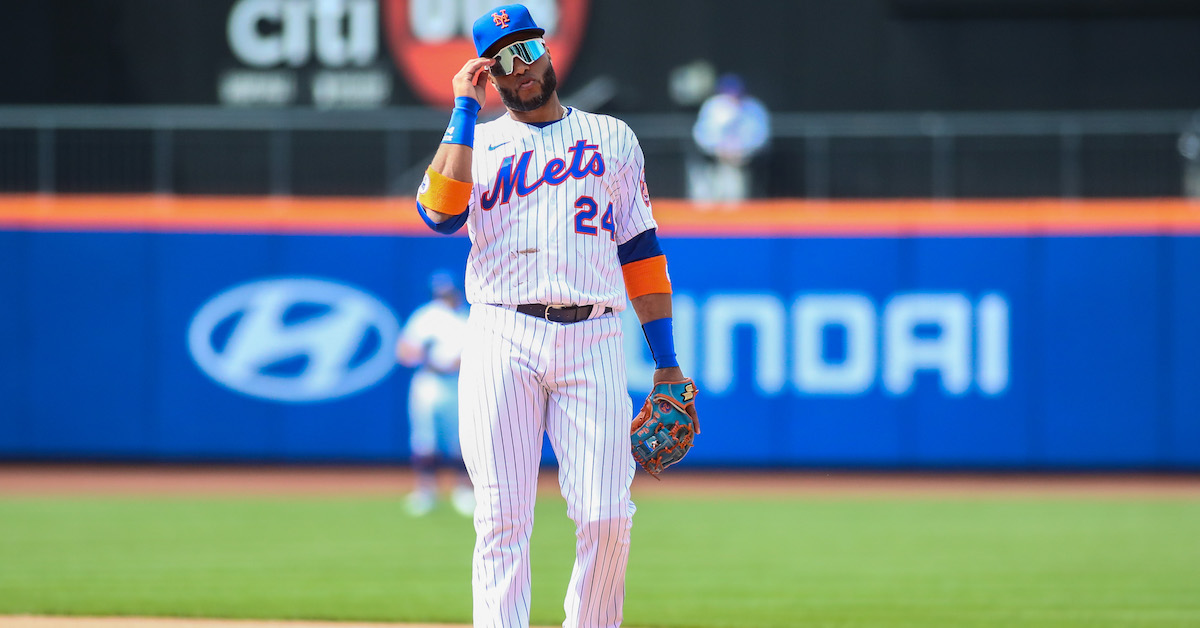
Forced to squeeze their roster down to a 26-man limit on Monday, the Mets decided to say goodbye to veteran second baseman Robinson Canó, designating him and the two years left on his contract for assignment. Canó, who will turn 40 this year, struggled greatly in 12 games in 2021, going 8-for-41 with just a single extra-base hit, a solo homer off of Zach Davies. While he could theoretically be claimed on waivers before being released, any team adding him by this route would commit to the $40 million still owed him through 2023, which is, let’s just say, unlikely to happen.
The decisions both to play Canó and to cut him this year were surprisingly easy. He did play very well the last time we saw him, in the COVID-shortened 2020 season, hitting .316/.352/.544 with 10 homers for a 142 wRC+ and 1.3 WAR in just 49 games. The problem is that the last time we saw him was 2020 thanks to a PED suspension that November, his second positive steroid test under MLB’s drug-testing regimen and one that cost him the entire ’21 campaign.
I wasn’t really worried about the suspension itself; I’ve spent the last decade trying to find some kind of discernible pattern, short- or long-term, of over- or under-performance for the group of players busted for PED use and have yet to find anything actually useful. But what did worry me was the missed time coming on the back of an artificially short season for a 39-year-old player playing a premium defensive position. While Canó was quite good in 2020, his 2019 season was by far his worst season in a long time.
While I think it made perfect sense for the Mets to open the season with Canó and see what he had left, there was no particular reason for them to give him a very long leash. Jeff McNeil is playing well, and the team should roll with him starting most games at second. And with the need to cut the roster from 28 to 26 players, who would have been a better idea to cut? Luis Guillorme has been a rock-solid role player during the last few years, and even if he were struggling, he’s the backup shortstop. Dominic Smith hasn’t had a great start, but he’s contributed more than Canó has. Optioning Tylor Megill or Drew Smith would have have been completely absurd.
Mets owner Steve Cohen certainly ought to know a sunk cost when he sees one, and there’s no psychological need to salvage the Canó trade, as it was something this régime inherited from the Wilpons and former general manager Brodie Van Wagenen, not a transaction that they masterminded. The Mets expect to contend this year and are in first place by three games, so this is a team that ought to be more interested in certainty rather than chasing the chance that Canó turns things around.
Is Canó done? I wouldn’t necessarily shovel that last bit of dirt onto his career quite that quickly. Neither ZiPS (.254/.298/.393) nor Steamer (.249/.298/.385) are all that optimistic, but the margin of error here is absolutely huge. For a team that’s actually desperate at second base or a lousy one that can afford to absorb such a risky player, there’s still an argument for Canó as an addition to the roster. It wouldn’t be preposterous for the White Sox, for example, to take a look given that the combination of Leury García and Josh Harrison has been positively dreadful at second.
Whether or not Canó bounces back to close out his 10-year, $216 million contract, there’s no denying that his career is coming to an end. And overall, it’s a sad one, particularly given the friendly rivalry between Canó and another of the great second basemen of that era: Dustin Pedroia. Which player was the better second baseman was a hotly debated topic a decade ago and a fun part of the usual Red Sox-Yankees rivalry. While I don’t want to name any names, a couple of huge fans I know on Twitter spent a long time arguing that question, frequently roping me in the conversation to settle a particular aspect of the argument.
It would have been crazy to say in 2012, but I assume now that neither will make the Hall of Fame. Knee injuries basically ended Pedroia’s career at age 33, and his counting numbers are likely too light for him to get 75% of Hall voters on his side. Canó’s numbers are closer, but he’s unlikely to reach 3,000 hits. More importantly, if the first PED suspension didn’t slam the door shut in Cooperstown, the second one certainly did. While I intend to check Canó’s box someday, I’m confident I’m in the minority.
ZiPS Career Projection, Before 2017
Player
BA
OBP
SLG
AB
R
H
2B
3B
HR
RBI
BB
SB
OPS+
WAR
Robinson Canó
.296
.343
.477
10774
1515
3188
642
43
406
1581
710
64
121
64.7
Dustin Pedroia
.295
.356
.426
8314
1190
2449
512
20
180
939
785
160
108
56.9
Is Robinson Canó done? Maybe, maybe not. The Mets rightly decided that they didn’t want to be the ones who needed to find out the answer to that question.
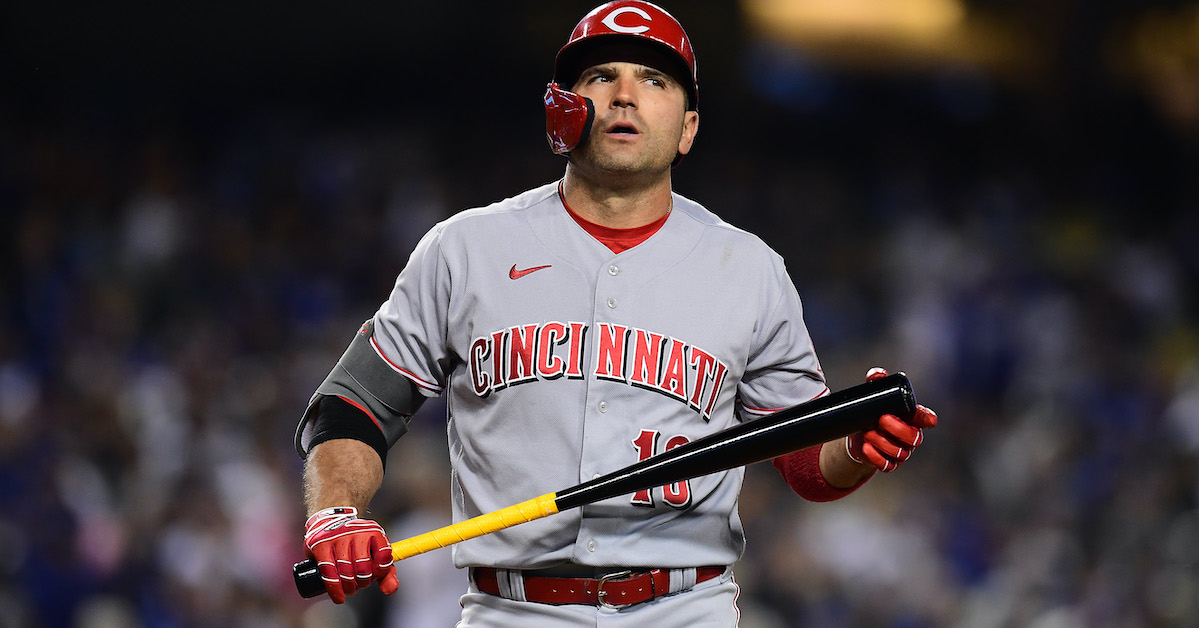
“If something cannot go forever, it will stop.” Credited to economist Herb Stein, this tautology, sometimes known as Stein’s law, has broad application past the field of economics: the Earth will end, the sun will end, the ability of the universe to sustain life will end, all the non-Top Chef shows on Bravo will end (hopefully), and we’ll end. Joey Votto does not exist outside of the space-time universe, and his 2022 season so far makes it look like his career will end before all of these things. Or will it?
Votto’s career has looked shaky at times before, but he has made comebacks before: from a leg injury that cost him half a season, a mid-career power outage, and a huge dropoff in play at age 35. He’s had enough successful comebacks to become a rarity in baseball: a highly paid star first baseman who doesn’t make his team regret a very large contract covering his 30s. But while he’s gotten off to slow starts before, a .122/.278/.135 line is something else.
Perhaps even worse is that so many of his non-baseball card stats look abysmal as well. Votto is striking out at nearly triple the rate of his 2017 peak. His soft-hit and hard-hit percentages of 22% and 20%, respectively, are closer to Ben Revere than a slugger, and those numbers are twice and half his career rates, respectively. Votto’s average exit velocity of 86.4 mph is six ticks off last year’s 92.9 mark, and his 70% contact rate is the lowest of his career. Read the rest of this entry »
The Los Angeles Angels are off to a 13-7 start. A couple of the big reasons for that are not unexpected. Mike Trout, who hadn’t played in a regular-season game in 11 months, is off to a blazing start even by his robust standards, sporting an OPS north of 1.200 and already nearing the sort of WAR we expect a league-average player to post over six months. Shohei Ohtani isn’t torching the league to quite the same degree but he’s also on a 6-WAR pace when you combine his hitting and pitching. Still, in the past, the team has struggled even with two superstars at the top of their game. What’s working for Los Angeles now is truly unusual compared to recent years: getting lots of contributions from the other guys. And none of “the other guys” have stood taller so far than Taylor Ward.
I’m always one of the first to yell “April!” about small-sample-size stars, but Ward’s performance has still been stunning. His .381/.509/.762 line calculates out to a 269 wRC+, besting his teammate Trout and everyone else with at least 50 PA this season. What makes it even more impressive is that some of the numbers fueling that line are of the sort that are meaningful in a small sample.
There’s a bit of a fallacy with extreme data in small samples (if it has a name, I don’t know it). In baseball, when a .280 hitter hits .300, people accept it as normal, but when a .280 hitter hits .500, it is generally written off as a fluke. But while the “hitting .500” part is, the .280 hitter who is hitting .500 is more likely to have improved than the one posting .300. Read the rest of this entry »
BettsBellingerCaruso: East Coasters that send 8AM meeting requests I hope they metaphorically get hit with terrible BABIP luck for the rest of their lives that is all
12:02
Dan Szymborski: Good afternoon to people with righteous time zones! Good morning to the rest of you.
12:03
Ryan Breynolds: When is it time to start panicking with Nick Gonzales? The K-rate seems to be a real problem.
12:03
Dan Szymborski: Nick Martinez?
12:03
Dan Szymborski: Certainly more than three games. Especially because his plate discipline numbers suggest a lower walk rate.
12:03
Dan Szymborski: I’d actually be more worried that he’s not throwing as hard as he was overseas.
So what exactly is a bust? I don’t take it to mean that a player is awful or has no value. For me, a bust is a player who will step down a tier in performance or who is in a down cycle and has passed the window to get back to what they used to be. None of the players involved are literally without value, and some of them are still really good. But they’re all players I think will be well below their best, usually in a manner that makes me sad as a baseball fan.
Before getting to the 2022 candidates, here are my ’21 bust choices and how they performed:
Corey Kluber: 3.83 ERA, 3.85 FIP, 1.5 WAR in 80 IP
Nobody really shone here, but by the same token, nobody was legendarily awful (I had expected Lester to go down that route and he didn’t really). We obviously didn’t get a ton of Kluber, but he was definitely much more effective than I expected. My concern with May was that he was still rather awkward at punching out batters, despite the explosiveness of his stuff, so I was happy that he spent April proving me very wrong about where he was as a pitcher — then very unhappy as he tore his UCL in early May and required Tommy John surgery.
As a reminder, I selected all of these players by Opening Day, so there’s no knowledge of anything that happened after Opening Day. It would have been really awkward if someone on my list had surprise Tommy John surgery this week! Read the rest of this entry »
Earlier this week, I ran down my favorite breakoutcandidates. Now it’s time for the darker side: the busts.
So what exactly is a bust? I don’t take it to mean that a player is awful or has no value. For me, a bust is a player who will step down a tier in performance or who is in a down cycle and has passed the window to get back to what they used to be. None of the players involved are literally without value, and some of them are still really good. But they’re all players I think will be well below their best, usually in a manner that makes me sad as a baseball fan.
As you can see, I did much worse here than with the pitcher breakouts. I’m especially happy to have been wrong about Votto last year — my feeling was that there wasn’t another comeback left in him, but there was! I’m also quite pleased that Abreu didn’t slump back to league-average as I expected, staying a bit above instead, though well off his MVP performances. Lewis gets a pass since he was injured most of the year, and Grossman remained legitimately good, if below his 2020 rates. Read the rest of this entry »
One of my favorite yearly preseason pieces is also my most dreaded: the breakout list. I’ve been doing this exercise since 2014, and while I’ve had the occasional triumph (hello, Christian Yelich), the low-probability nature of trying to project who will beat expectations means that for every time you look smart, you’re also bound to look dumb for some other reason. Yesterday, I highlighted my breakout candidates among the league’s hitters. Today, I consider the pitchers.
Seven of the eight players here either tied (Musgrove) or beat their previous career best in WAR, so it would be greedy to complain that Means only had a good bounce rather than finding a truly new plateau. While I’d like to attribute this showing to some brilliance on my part, I’d also call these results luckier than average and certainly above any reasonable mean expectation of my perceptiveness. Read the rest of this entry »
One of my favorite yearly preseason pieces is also my most dreaded: the breakout list. I’ve been doing this exercise since 2014, and while I’ve had the occasional triumph (hello, Christian Yelich), the low-probability nature of trying to project who will beat expectations means that for every time you look smart, you’re also bound to look dumb for some other reason.
On the plus side, nobody really embarrassed me. Alex Kirilloff came closest, but in his defense, he was playing with a wrist injury that eventually required surgery. Read the rest of this entry »


 Dan Szymborski: Happy Cinco de Mayo! I hope you’re all recovered from Cinco de Cuatro.