One sleepless night after Game 1 was ripped from them in heartbreaking fashion, the Diamondbacks arose from the canvas in Arlington and swung back at the Rangers en route to a dominant 9–1 victory, evening the World Series at a game apiece as the series heads to Phoenix. Arizona’s effort was led by a masterful performance from Scottsdale Desert Mountain High School and Arizona State alum Merrill Kelly, who struck out nine across seven surgical innings en route to the win. The Diamondbacks maintained a modest lead until the final three frames, when the bottom third of their order, which combined to reach base eight times on the night, piled up six runs.
Kelly is a prodigal son of sorts, a former Rays draft pick who left affiliated ball in the U.S. for four seasons in Korea before returning to MLB and his hometown Diamondbacks in 2019. Ironically, the particulars of the postseason schedule and of Arizona’s run to the Fall Classic have prevented Kelly from making a (literal) home start during this postseason, but he looked right at home in Texas on Saturday evening as he carved up one of the season’s most potent offenses. Read the rest of this entry »
Once all the blurbs for a prospect list have been written, I comb back through the giant spreadsheet that populates what readers see on The Board and double check its many fields for errors and inconsistencies. Two data points I’ve kept manually since 2017 are the heights and weights of the prospects who have passed through that space. At times, this has felt nonsensical — there are heights and weights on our player pages, and they could easily be pulled into the machinery that pumps out the tables that accompany the write-ups you see on our lists. But players’ measurables, especially in the minors, are often obviously wrong, and so for a little over a half decade, I’ve used my own judgment to make manual adjustments in cases when what is listed is clearly incorrect.
This has mostly meant manually adjusting players’ weights as they’ve gotten older and bigger, because even when players are on big league rosters, there is sometimes radical imprecision around their actual specs. When it comes to heights, however, I’ve overwhelmingly deferred to those on minor league player pages unless there was an egregious under-reporting (I think Oneil Cruz was the last one I manually fudged). Once the 2023 minor league season began, my pre-publication checks revealed a strange pattern: Many minor league players, mostly hitters, were suddenly listed on minor league player pages as being one or two inches shorter than my previous records indicated, and some of them had shrunk by as many as four inches.
While incorrect heights and weights are prevalent, widespread change to them across the entire player population was strange and struck me as probably having a cause. I’m going to show you the list of changes to players’ heights and go over potential explanations for how and why this has happened (and why so many heights were wrong in the first place), but first let’s talk about why this is an important detail. Read the rest of this entry »
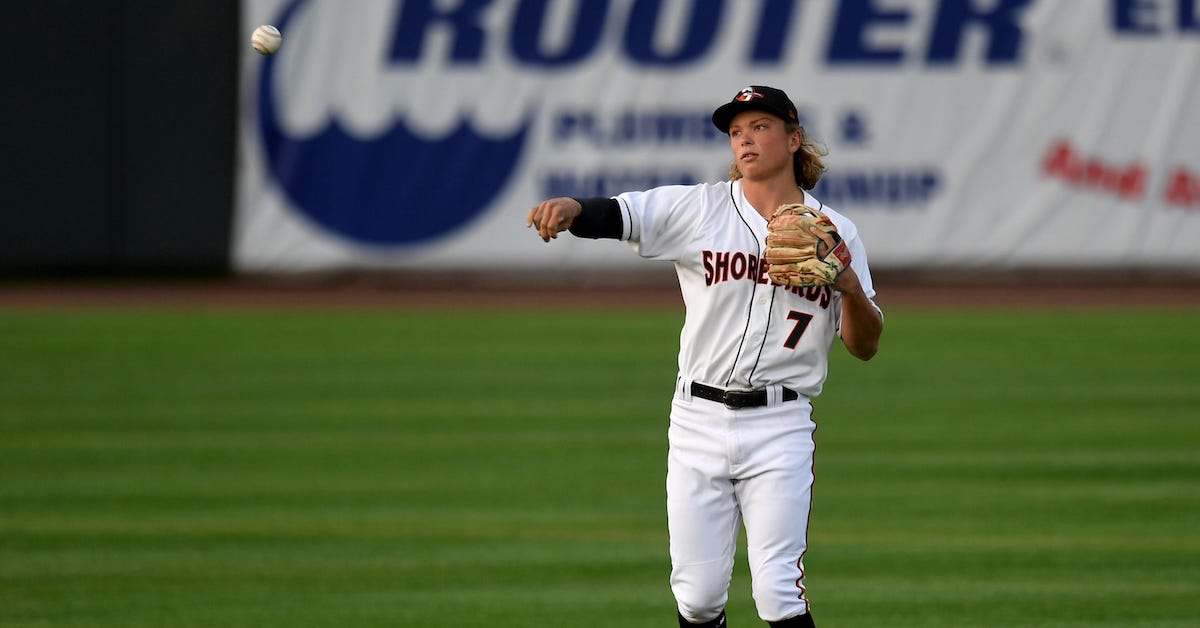
Lauren Roberts/Salisbury Daily Times / USA TODAY NETWORK
With Instructional League underway in Arizona (casts look of disappointment toward Florida) and Fall League rosters likely about two weeks out, the time has come to line the coffers with data and re-worked scouting reports in preparation for another round of farm system audits. Especially at the up-the-middle positions, defense is both very important and also a bit of a black box for readers, as there aren’t many publicly available minor league defensive stats and so much of evaluating defense is visual. I’ve recently been working on a video deep dive on the position players currently graded as 50 FV prospects or better, specifically to evaluate their defense in detail. Here I’ve taken a pass at the shortstops, providing video supplements for the prospects who I’ve evaluated in the 55 FV tier and above. I’ve made changes to their defense and arm tool grades over on The Board as a result of this exercise, and highlight the instances where this has caused a change to the player’s overall FV grade in the analysis below.
I’ve cut the videos in such a way that you can see each shortstop making similar plays one right after another. The videos feature plays to their left where I want to see them flip their hips and throw, plays that show the extreme end of their range, backhand plays in the hole to their right, plays coming in on the grass, and double play attempts. The fewest balls in play I watched for an individual player was 36 (Colson Montgomery and Dyan Jorge) and the most was closer to 70 (Jackson Holliday, Carson Williams and Marcelo Mayer). Read the rest of this entry »
A large portion of every season’s prospect-related transaction activity takes place between the draft and the trade deadline, a window that, since the draft was moved to July, spans just a few weeks. We can use the way the FanGraphs farm system rankings are calculated to track movement during this period on the baseball calendar and hopefully come to more fully understand how successful rebuilds are born. Over time, we can better contextualize trade and draft hauls by using this methodology to build a historical understanding of prospect movement. Mostly though, these rankings track the depth and impact of talent in each farm system at a specific moment in time. Or, in the case of the below links and tables, four moments in time. There are some methodological caveats to pass along (I’ll get to those momentarily), as well as some very specific examples where the movement communicated in the tables below does not properly capture team activity during the last month of trades and draft signings (which I get into throughout this post).
Let’s start with some basic disclaimers. Remember that while the Craig Edwards research that facilitates this approach is empirical, my subjective player evaluations (and their resulting Future Values) feed the formula that spits out the farm rankings. Just one significant over- or under-evaluation of a player can shift the way a team lines up in these rankings pretty dramatically, especially if you’re focused on the ordinal rankings. The monetary values, in addition to providing an approximate measure and reminder of how the draft and international amateur processes suppress what these guys might earn on an open market, illustrate the ways systems are spaced and clustered with more nuance. If I’m way too light or way too heavy on any single impact prospect, I’m basically infecting a list with half a standard deviation’s worth of error in this regard because Craig’s math favors top-heavy systems rather than ones with depth. Read the rest of this entry »
Ranked and briefly analyzed below are the prospects who have been traded during the loosely defined “2023 deadline season,” which for simplicity’s sake I consider all of July. Most of the deals these prospects were part of have been analyzed at length on this site. An index of those pieces can be found here, or by clicking the hyperlink in the “Trade” column below, which will take you to the relevant article. I’ve moved all of the 35+ FV and above players listed here to their new orgs over on The Board, so you can click through to see where they rank among their new teammates and read their full scouting reports. Our Farm System Rankings, which update live, also reflect these changes, so you can see where teams’ systems stack up following the draft and the deadline. Read the rest of this entry »
Jack Flaherty hasn’t quite looked himself since 2019, but the Cardinals were still able to get three prospects for a few months of his services from the Orioles at the trade deadline. The prospect return on the way to St. Louis — whose other deals are covered here, here and here — is made up mostly of near-ready players who should be able to play a role in what we’ve assessed as an attempt to rebuild quickly. The three prospects are Cuban infielder César Prieto, lefty Drew Rom (both of whom were at Triple-A Norfolk), and 19-year-old righty Zack Showalter, who was promoted from the Complex level to Low-A toward the end of June.
While playing pro ball in Cuba, Prieto broke Kendrys Morales‘ rookie hits record and the Serie Nacional’s hit streak record (40 games) in 2020, striking out just six times in 250 plate appearances. The rate of player defections from Cuba significantly diluted the quality of pitching in pro ball down there, so it was difficult to gauge his hit tool with precision. He defected from the Cuban National Team not long after arriving in Miami for an Olympic qualifier in May of 2021 (there’s a riveting Sports Illustratedstory that details his “extraction”), and he signed a $650,000 deal with Baltimore at the beginning of the 2022 international signing period.
After torching High-A for a few weeks, Prieto was promoted and spent most of his first minor league season with Double-A Bowie, where he struggled, slashing .255/.296/.348 in 90 games. He halved his strikeout rate when he was sent back to Bowie at the start of 2023, slashed a BABIP-aided .364/.406/.476 and was promoted to Triple-A Norfolk. In about a month prior to the Flaherty trade, he was hitting .317/.365/.471, again with a high BABIP.
Prieto can actually hit. His short levers make him extremely difficult to beat in the strike zone, and he can let the baseball travel deep before striking it the other way, generating doubles power pole-to-pole. His big issue is his propensity to chase, which he did at a 36% clip in 2022 and at a 40% rate so far in 2023, hindering the quality of his contact as well as his ability to reach base. But lefty sticks who make this much contact (91% Z-contact% as of the trade!) tend to carve out some kind of role, especially if they can play multiple positions.
Prieto is a below-average infield athlete and presents a stiff, non-traditional look at both second and third base. He also plays shortstop, but that is not something he’s remotely capable of doing at the big league level. I was hopeful that another full year with pro athletic training facilities and another season of seeing pro-quality pitching after he had access to neither for such a long time would help enable adjustment in these areas, but they’ve continued to be issues. I think the Eric Sogard comp I’ve had on him since his amateur days still holds water. He’s a flawed part-time player, but guys who can hit like this tend to play for a long time.
The other player who should provide a quick turnaround is Rom, an over-slot 11th-round high schooler from the 2018 draft who has slowly climbed through the minors with a cutting low-90s fastball. Especially when he was very young, he looked like he had a chance to break out if he could throw harder as he matured. That hasn’t really happened, and he’s still sitting mostly 90–92 mph, but his fastball still punches above its weight, and he’s managed to strike out more than a batter per inning throughout his pro career. While that likely won’t continue at the big league level because his stuff isn’t nasty enough, he throws enough strikes with his four pitches (if you count his four-seamer and sinker as two different offerings) to project as a depth starter. Already on the 40-man, Rom joins the mix of starters I mentioned in the analysis of the Jordan Montgomery deal as a candidate for the 2024 rotation.
Finally, there’s Showalter, another over-slot 11th-round high schooler, to round out the Cardinals’ return. It took a $440,000 bonus to buy him out of a commitment to USF after last summer’s draft, and he has made a strong pro debut. He generated some scout buzz during Extended Spring Training, then made only a few Complex starts before being promoted to full-season ball a little over a month before the deadline. Showalter works usually three or four innings per outing and sits 93–95 with uphill angle and tail. His delivery is of the open-striding drop-and-drive variety; he keeps his arm action very short and tucked close to his body as he motors toward the plate. It helps keep his release consistent and allows him to hide the baseball well. But he isn’t a fantastic athlete and lacks balance over his landing leg, which is often an indication of relief risk. I’m not yet ready to toss him on the main section of the updated Cardinals prospect list, but he’s a solid low-level arm with a mean outcome of a fastball/slider reliever. Prieto (40 FV, a 1-WAR annual performer who I expect will get 350–400 PA in his best years) and Rom (35+ FV, a spot starter) do make the cut.
This return isn’t enough to alter what I outlined in the Montgomery piece. The Cardinals still have a below-average farm system but have filled up the upper levels during this mini-rebuild and should have the pitching depth to compete for the NL Central next year if their core of hitters stays healthy and performs as expected. As a return for the Jack Flaherty who looked like one of the better pitchers in the NL for a little while, it feels light. But for the recently vanilla, free-agent-to-be Jack Flaherty, it makes sense for St. Louis to have received a few lesser prospects.
When trades occur that aren’t quite big enough to merit their own post, we sometimes compile our analysis into a compendium like this, where we touch on a number of transactions at one time. In this dispatch, I’ll cover the Rays’ trades for upper-level depth (pitchers Manuel Rodríguez and Adrian Sampson from the Cubs, and catcher Alex Jackson from the Brewers), as well as the Mariners/Orioles swap of Logan Rinehart and Eduard Bazardo.
The Rays acquired Adrian Sampson, Manuel Rodríguez, and $220,000 of international free agent bonus pool space from the Cubs for minor league pitcher Josh Roberson. Sampson, 31, was originally the Pirates’ 2012 fifth round pick. He made the big leagues with the Mariners in 2016 and then began to hop around the fringes of various rosters, which is part of what led to his 2020 jaunt to the KBO before a return to MLB with the Cubs. He made 19 starts for the Cubbies in 2022 as a long-term injury replacement, but he has missed most of 2023 due to a knee surgery from which he only recently returned. Sampson has been sitting 90-91 mph during each of his last two minor league starts. He does not occupy a 40-man roster spot and should be considered injury replacement depth for the Rays. Read the rest of this entry »
When trades occur that aren’t quite big enough to merit their own post, we sometimes compile our analysis into a compendium like this, where we touch on a number of transactions at one time. In this dispatch, I’ll cover the Reds’ acquisition of Sam Moll from Oakland, the Cubs’ trade for Jose Cuas from Kansas City, and the Diamondbacks’ trade for Jace Peterson, also from Oakland.
While the two teams tilted at Wrigley, the Cubs and Reds added interesting relief options to their managers’ toolkits. The Reds traded hard-throwing prospect Joe Boyle to the A’s for lefty Sam Moll and international pool space, while the Cubs traded outfielder Nelson Velázquez to the Royals for sidearm righty Jose Cuas. Read the rest of this entry »
The Cardinals are officially engaging in a moderate short-term rebuild, tradingJordan Hicks to Toronto for pitching prospects Sem Robberse and Adam Kloffenstein, and Jordan Montgomery to Texas for righty Tekoah Roby, infielder Thomas Saggese, and reliever John King. Each of these players could suit up for the Cardinals in the big leagues within the next 12 months, especially King (already a big leaguer) and the two pitchers coming back from Toronto, who will likely be added to the 40-man roster after the season. Roby and Saggese have spent their 2023 seasons at Double-A Frisco and are within range of the majors even though they don’t have to be put on the 40-man until after the 2024 slate. You can see where each of the newly-acquired prospects falls on the Cardinals list over on The Board.
Let’s start by going over the Montgomery return, since the most significant prospect acquired by the Cardinals comes over in that deal. Roby, 21, moved onto the Top 100 prospects list when I updated the Rangers system a couple of weeks ago, and he would have been even higher if not for his current shoulder injury, which shelved him in early June. Before he was shut down, Roby was consistently working with four plus pitches. He was sitting 94–95 mph with riding life, bending in one of the nastier curveballs in the minors, tilting in a similarly shaped slider in the mid-80s, and turning over a tailing low-80s changeup, all of which were capable of missing bats. He looked like a contender’s four-pitch, mid-rotation starter, like a less physical Hunter Brown.
Roby’s delivery does have some violence, but he’s always thrown strikes in spite of this. He is slightly undersized (but well-built) at 6-foot-1 and has now had arm injuries in two of his three pro seasons, so there’s definitely relief risk here despite his strike-throwing track record. From a stuff and pitch execution standpoint, he is where Jack Leiter was expected to be when he was drafted. On upside, Roby is a huge get for the Cardinals and could be the big league club’s best starting pitcher within a year or two. Once healthy, he has a chance to kick down the door, though shoulder issues can be particularly scary and destabilizing to a young pitcher’s career. Read the rest of this entry »
The Dodgers are getting at least some of the old band back together with Tuesday’s reacquisition of Enrique Hernández. The 32-year-old super-utilityman returns (along with cash considerations) via trade with the Red Sox in exchange for pitchers Nick Robertson and Justin Hagenman. Hernández, who signed a one-year, $10 million pact with Boston during the offseason, is hitting a career-worst .222/.279/.320 (60 wRC+). The Red Sox are picking up roughly $2.5 million of the deal’s remaining money to improve their return, receiving multiple polished, back-of-the-40-man arms in Hagenman and Robertson.
This season is the second consecutive year of declining offensive performance for Hernández, who has been a below-average hitter for most of the last five years. The decline is consistent across a variety of statistical categories, and there are no underlying signs that might indicate a bounce back or positive regression, but Hernández is still a capable defender at second base and (most importantly in this case) in center field. A June injury to Trayce Thompson eventually begat a deal for defensive specialist Jake Marisnick, whose recent hamstring injury again left the Dodgers thin in center. James Outman, whose hit tool has had a violent regression to the mean after a hot start, has seen the lion’s share of reps in center this year, while Jason Heyward and rookie Jonny Deluca have each played there a handful of times. All three are capable center field defenders but none of them is great, and you can make a coherent argument that Hernández is the best healthy center field defender on the Dodgers 40-man right now. Read the rest of this entry »