Archive for Business

The Angels Sell for a Record $4 Billion

Mark J. Rebilas-USA TODAY Sports

Four years ago, Arte Moreno explored a sale of the Angels. No firm bids materialized, and he ended that exploration the following year. Three years later, however, the tide has suddenly turned. On Tuesday, Moreno agreed to sell the team to multi-sport owner Stan Kroenke in a deal that values the Angels at $4 billion, a record-setting price for the sale of a majority stake in an MLB team.

They say it never rains in Southern California. They also say that when it rains, it pours. Consider those two adages, and then apply them both to the recent ownership changes in MLB. Earlier this year, Kwanza Jones and José E. Feliciano bought the Padres at a $3.9 billion valuation. Kroenke’s purchase of the Angels sets a new record, the team-sale equivalent of a free agent signing a contract that guarantees them $1 million more than the previous high. It’s a boom time to be selling baseball teams. In fact, these two sales might have set records for transfers of controlling stakes, but the Yankees blew the competition away earlier this year when they sold a minority share to Apollo, a private equity group, at a valuation of roughly $10 billion. It’s a boom time for baseball ownership in general, in other words.

Moreno purchased the Angels in 2003, in the wake of their World Series title. His relationship with both the city of Anaheim and the fans of the team is complicated. At first, his free-spending ways made up for his desire to rebrand the club as a Los Angeles concern. The team was quite successful in the beginning of Moreno’s stewardship, averaging 90 wins in the first 10 years after he purchased the club. That was the best stretch in Angels history by far; they made the playoffs five times, more than the four they’d racked up in the prior 42 years the franchise existed before Moreno bought it. Read the rest of this entry »
The Television Elephant (Telephant? Elevision?) in the Room

Albert Cesare/The Enquirer / USA TODAY NETWORK

No one likes to talk about baseball as a business. Heck, I don’t like to talk about it, and I’m what passes for an expert in the subject around here. It’s tedious, the creeping financialization of everything in life. Baseball should be the crack of the bat and the glint of sunglasses as an outfielder charges across the grass towards a smashed line drive, not an accounting ledger filled with contracts and receipts. But inevitably Major League Baseball, which often gets shortened to “baseball” as though it embodies the entire sport, is about profit, which means it’s about money.

There’s a storm brewing on that front. As Travis Sawchik deftly reported over at The Score, the old way of doing business is standing on wobbly legs. Local TV deals make up a sizable portion of the league’s overall revenue. That makes perfect sense – baseball is a regional game, and its biggest draw, from an entertainment standpoint, is the sheer size of its inventory. Teams play 162 games a year, all through the hardest times to fill programming – the dog days of summer, Saturday evenings, national holidays, you name it. Sportico estimated that teams were paid roughly $2.25 billion for local broadcast rights in 2023. Read the rest of this entry »


The Padres and Diamond Sports Split Up

Kiyoshi Mio-USA TODAY Sports

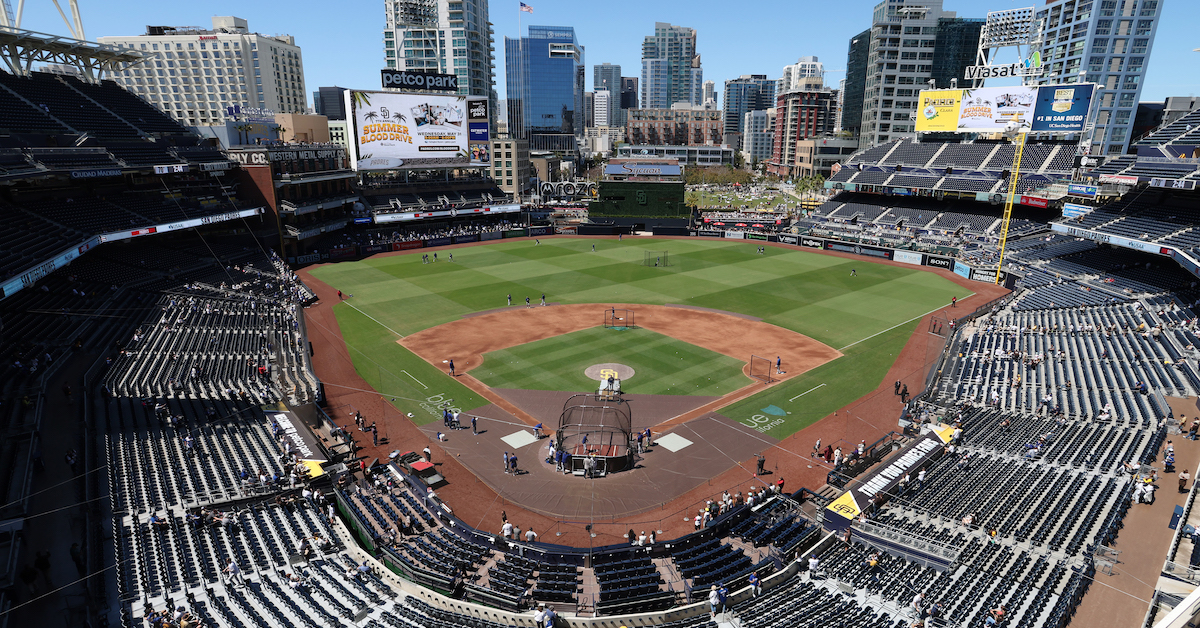
Earlier this year, Diamond Sports Group declared bankruptcy. That dry corporate action, precipitated by a huge debt burden, is starting to have real world consequences. This Tuesday, DSG missed a payment to the San Diego Padres, as Alden Gonzalez first reported for ESPN. That terminated the contract between Bally Sports (a Diamond subsidiary) and the Padres. By Wednesday, the Padres were off of Bally and broadcasting their own games via Major League Baseball.

That’s a pretty big escalation in what until now felt like a slow-moving situation. In fact, in bankruptcy court, Rob Manfred testified that the league received less than one day’s notice of this missed payment. “[They told us] less than 24 hours before they were going to go off the air that they were going to stop broadcasting Padres games,” he said. (Diamond’s lawyers have contested that timeline.) That led to the Padres terminating their contract with Bally Sports, naturally enough, and to MLB stepping in to broadcast games.

It’s no accident that the league was ready to wade into daily game production. They hired Billy Chambers, formerly a Fox Sports and Diamond Sports executive, as executive vice president of Local Media earlier this year. Hiring a regional sports network executive is a pretty good way to start building your own regional sports capabilities, and the league appears to have moved quickly here. Read the rest of this entry »


Diamond Sports Group’s Bankruptcy Could Rock the Baseball Revenue Boat

Albert Cesare/The Enquirer / USA TODAY NETWORK

At this point in the offseason, the micro-level events that will shape the 2023 baseball season have almost all been settled. Aside from the odd trade, teams have largely set their rosters. Injuries, unexpected performances, and trades will start to affect individual fortunes when games begin, but we’re at a local lull.

But there’s big news afoot for the game in a macro sense. Diamond Sports Group, the company that owns Bally Sports Network and thus the rights to 14 teams’ local broadcasts (plus minority stakes in two team-owned broadcasts)*, is careening towards bankruptcy. Per Bloomberg, the actual bankruptcy declaration is merely a formality: the firm will reportedly skip an interest payment due in February, triggering a restructuring that will wipe out the firm’s existing equity and convert all but the most senior debt into equity stakes in the new company, leaving its current creditors in charge.

That’s a shocking turn of events for a media group that sold for more than $10 billion in 2019. Heck, it’s a shocking turn of events for a company that made more than $2 billion in revenues in the first nine months of 2022, and more than $3 billion in 2021. It might also affect long-term cashflows for every team in the league; after all, local broadcast rights are a key piece of the revenue pie, and broadcast rights have exploded along with MLB revenues in the past decade.

How could this have happened? Which teams will be impacted, and what will that impact be? How will the league adapt to the new media landscape brought on by this bankruptcy and any subsequent dominos that fall as a result? I don’t have the answer to all of those questions, but I’ll walk through each in turn before speculating about what might happen next. Read the rest of this entry »


The Lockout Begins

Major League Baseball’s 26-year run of labor peace is officially over. As anticipated, MLB and the MLBPA were unable to reach terms on a new CBA ahead of last night’s 11:59 p.m. deadline. Shortly thereafter, MLB Commissioner Rob Manfred announced that the league had locked out the players:

For its part, the MLBPA issued a statement in response:

Read the rest of this entry »


An MLB Lockout Preview

With Major League Baseball’s current collective bargaining agreement (CBA) set to expire at 11:59 p.m. Eastern tonight, the owners and the Major League Baseball Players Association (MLBPA) are currently meeting in Dallas to exchange various proposals in an attempt to reach a deal. Unfortunately, media reports suggest that no new agreement is imminent, meaning that the sport is facing the very real possibility that it will experience its first work stoppage since the infamous players’ strike of 1994-95.

While it is certainly possible that tonight’s deadline could pass without triggering a labor stoppage — indeed, the two sides can elect to continue to negotiate with the existing CBA governing the sport in the interim — MLB commissioner Rob Manfred seemed to suggest prior to Thanksgiving that the owners will lock out the players if no agreement is reached this evening.

Consequently, this post explores the various options available to the MLBPA should the owners implement a lockout at midnight tonight as anticipated. Along the way, I will borrow from a similar post I wrote back in 2016 during the last CBA negotiations. While that labor-stoppage primer ultimately proved to be unnecessary, barring a miraculous turn of events in the coming hours, it would appear that fans are unlikely to be so lucky this time around. (Meanwhile, for anyone looking to understand the basis for the current dispute between the owners and players, this preview from a couple weeks ago may prove helpful.)

First, some basic legal background. A lockout is a legally sanctioned tool in which management (in this case, team owners) announces that it will refuse to allow its unionized employees (presently, the players) to work until an ongoing labor dispute is resolved. This means that the players will not be paid, or allowed to report to work, until a new CBA has been agreed to. In the interim, there will be no major-league free-agent signings, trades, or games played. A lockout is thus the ownership equivalent of a strike by the players. Read the rest of this entry »


Previewing Baseball’s CBA Talks

Following the completion of the World Series last week, all eyes in the baseball world will now turn to the sport’s next major showdown: the negotiation of a new collective bargaining agreement between the owners and the Major League Baseball Players Association. MLB’s existing CBA is set to expire at 11:59 p.m. EST on Wednesday, December 1, a deadline that many anticipate could trigger the sport’s first work stoppage since 1994. Indeed, while a strike or lockout is by no means guaranteed at this point, the possibility certainly appears more likely than it has at any point in the last two decades.

This post will provide an overview of the upcoming collective bargaining negotiations, briefly summarizing how the parties got to this point, what are likely to be the major issues to be hammered out in a new CBA, and what baseball fans can expect in the coming weeks (and, perhaps, months).

How We Got Here

In many respects, the seeds of the present discontent between the players and owners were sown during the negotiation of the sport’s last several CBAs, and perhaps most notably the soon-to-expire 2016 agreement. Although there was ample reason to believe that MLB’s financial model was moving in an unfavorable direction for the players, the union has been perceived by many as having failed to sufficiently prioritize the pursuit of significant economic modifications from the owners in 2016 (a claim that at least some in the union would dispute). Instead, to many, the MLBPA appeared to focus more on quality-of-life issues in the 2016 agreement, such as more humane travel schedules and clubhouse perks like private chefs. Read the rest of this entry »


The Jarred Kelenic Service Time Question Illustrates a Broken System

Jarred Kelenic is right, or at the very least, he’s not wrong. There’s no reason not to take the recent claims of the Mariners outfielder and his representative, Brody Scoffield, at face value. Their story — that Kelenic was offered a pre-debut extension and that when he declined to sign it, the club refused to call him up in 2020 for service time reasons — is totally believable, and is backed up by Kevin Mather’s now infamous remarks over Zoom to the Bellevue Breakfast Rotary Club; Mather, the club’s President and CEO at the time of his remarks, resigned last week. The proposed extension, which Mather described as a “long-term deal, six-year deal for substantial money with options to go farther,” speaks both to Kelenic’s immense talent as well as the Mariners’ desire to lock him up on team-friendly terms.

Jerry Dipoto, who addressed the situation last Tuesday, is right, or at the very least, he might not be wrong. Dipoto said what one normally would about a highly-ranked prospect who is generating hype but isn’t on the roster yet. (Here it worth remembering that GMs operate within the budget strictures ownership set for them. That’s not to say Dipoto has no agency, and owners look for GMs who are willing to let this type of fiscal responsibility take precedence over winning baseball games. But in reality, ownership should be on the hook to a far greater degree than the front office in the eyes of fans.) Kelenic has only played 21 games above A-ball. He hit a very solid .253/.315/.542 in those 21 games, as a teenager mind you, and was actually remarkably unlucky, as evidenced by his exceptionally light .246 BABIP. Still, a little more seasoning in Triple-A, as Dipoto suggests, might be beneficial. Kelenic’s approach could use some tightening and his strength gains have come with some of his twitch going backwards, which is starting to hinder him defensively.

But those are nitpicks, not deficiencies that should have kept him out of Seattle. Evan White proves the case. White isn’t nearly as talented as Kelenic, but he signed a pre-debut deal and was instantly the Opening Day first baseman in 2020. His bat wasn’t ready, as evidenced by a miserable 66 wRC+ to go with an ugly 41.6% strikeout rate, yet he was there. Was White the Mariners’ best option? Maybe. But did the fact that he signed the sort of big league deal that Kelenic turned down drive the decision to have him with the major league team while Kelenic futzed around at the team’s alternate site in Tacoma? No question. Read the rest of this entry »


The Arbitration Clown Show

I was exposed to many aspects of front office operations during my eight years with the Astros, but one thing I never touched was arbitration.

I consider it one of my greatest career achievements.

With hearings and rulings in the news, I’m reminded of how much everyone hates the damn thing. Teams hate it, players hate it, agents hate it, and maybe that’s actually proof it works in its own way, but the most frustrating aspect is that nobody really understands the logic behind the rulings themselves. In private conversations, some executives have suggested to me that one “might as well flip a coin.” An agent called the entire process “archaic.” Another team executive called it a “colossal waste of time.” Contacts from both sides relayed stories of being quite sure that they had won or lost after the hearing, only to end up with the opposite ruling from the three-person panel. Both sides have stories of waiting for results, dreading them when the last two cases have been in their side’s favor because they fear the next result being a simple make-up call.

The whole thing seems rather, well, arbitrary.

Adding to the frustration is the cost of the hearing itself, in terms of time, money, or both. Many teams utilize outside counsel to handle the hearing process, while others keep it in-house, assigning a group of people within baseball operations to spend weeks of manpower on the process. They travel to Arizona or Florida, staying up until all hours of the night preparing their PowerPoint deck and going on several late-night runs to Kinko’s. They do it because they have to, but does all that work have any effect on one’s chances of winning or losing the hearing? I never saw any direct evidence that it did. Read the rest of this entry »


League Expansion, Interest Rates, and Other Fun Friday Topics

Earlier this week, Ken Rosenthal reported that owners are unlikely to pursue expansion plans in the near future. At first, that sounds strange. Why would owners who are experiencing a cash crunch turn down a quick cash infusion, reportedly nearly $70 million per team? As it turns out, the math is straightforward. Let’s talk about perpetual cash flows, debt equivalence, and other fun stuff like that.

Per Rosenthal’s reporting, owners would stand to make an aggregate $2 billion from expansion fees, or $1 billion per new team. Split 30 ways, that amounts to $66.7 million per team, which would go a long way for clubs who are acting phenomenally cash-light. In exchange, however, they’d give up a small share of a lucrative enterprise that makes owning a baseball team a cash cow.

Again per Rosenthal, the league projected to make $2.4 billion in central revenue in 2020 before the pandemic laughed in the face of advance planning. Central revenue is everything generated by MLB rather than by individual teams — national TV contracts, national sponsorships, streaming revenue, consumer product sales, and assorted other line items, with TV contracts comprising the lion’s share of the money.

That works out to $80 million per team, and adding two teams to the mix would dilute teams’ share of the pie. With 32 teams, each team would only get $75 million in central revenue per year. That might not sound like much — $5 million over time weighed against $67 million in cold hard cash right now — but big enterprises like baseball teams don’t need to act to maximize their liquidity. They instead seek to maximize net present value, which is a financially stylized way to consider the value today of money you might receive in the distant future.

This is going to get annoyingly math-y, but I’ll try to keep it in somewhat relatable terms, so bear with me. Say your friend offers you the choice of $100 today or $200 in a year. Presumably, you’d prefer the $200 — it’s twice as much money! Things get trickier, however, if it’s a choice between $100 today or $110 in a year, or between $100 today and $200 in 20 years. Read the rest of this entry »