Archive for Business

Should MLB Worry About Its New Deal with ESPN?

In 2014, Major League Baseball roughly doubled its national television money in deals with ESPN, FOX, and TBS that expire at the end of this season. Over the last few years, new agreements with FOX and TBS created a nearly 50% increase in annual rights fees, totaling nearly $9 billion dollars from 2022 through ’28. Understandably, the general expectation was that MLB’s new contract with ESPN would follow suit with a similar jump, securing roughly $2 billion per year in national television money alone. But the league’s dreams have been dashed: As Andrew Marchand and Joel Sherman of the New York Post reported last month, ESPN’s rights deal will be smaller than its previous agreement, with Ken Rosenthal of The Athletic adding last week that the total package will be $3.85 billion for the next seven years  — a substantial drop from the $5.6 billion over eight years that the Worldwide Leader forked over last time.

A decrease in rights fees to the tune of $150 million per year is going to raise alarm bells about the state of MLB, ESPN, and cable television on the whole. But while the decrease is cause for concern — and there are certainly some broader issues at work outside the sport — MLB still finds itself in relatively good position. To start, ESPN, FOX, and TBS will combine to pay MLB an average of $1.81 billion over seven years starting in 2022, an increase of 17% over the previous deal (and a growth in total value despite those earlier agreements being a year longer and a year from being over).

Even better for MLB, it still has rights to sell, with or without expanded playoffs. As reported by both the Post and The Athletic, the ESPN deal cuts in half the number of regular-season games broadcast by the network, essentially keeping Sunday Night Baseball and a few other marquee games as well as the Home Run Derby but ditching the majority of the weeknight games. If we assume ESPN keeps 40% of the TV rights from the previous deal and that there’s 40% more value in airing Sunday Night Baseball plus a little extra compared to the 50 or so Monday and Wednesday night games that are being let go, then the network will see a similar increase in cost as FOX and TBS.

The problem for MLB is that while those Monday and Wednesday night games do have some value, it likely won’t be as much as the $300 million or so ESPN was paying annually for them. As the Sports Business Journal has reported, FOX wasn’t interested in MLB’s asking price, and TBS (which will air a Tuesday night game starting in 2022) doesn’t want more mid-week games. To sell these games, MLB will need to lower its asking price with FOX, seek another traditional outlet like NBC or CBS (both of which have cable sports networks), or explore a streaming route like Netflix, Amazon, YouTube TV, or Hulu. Whether the league will have to settle for a fraction of ESPN’s prior price or get something close to it (or even increase it) remains to be determined.

Without accounting for those rights or potential increases due to expanded playoffs, here’s what the national television money for MLB looks like for the past 20 years as well as through the end of the 2028 season. Note that DAZN’s three-year, $300 million contract was included for 2019 only with the assumption that no payments were made last year or in 2021, which might or might not happen. All long-term deals assume a 4% annual increase over the life of the contracts.
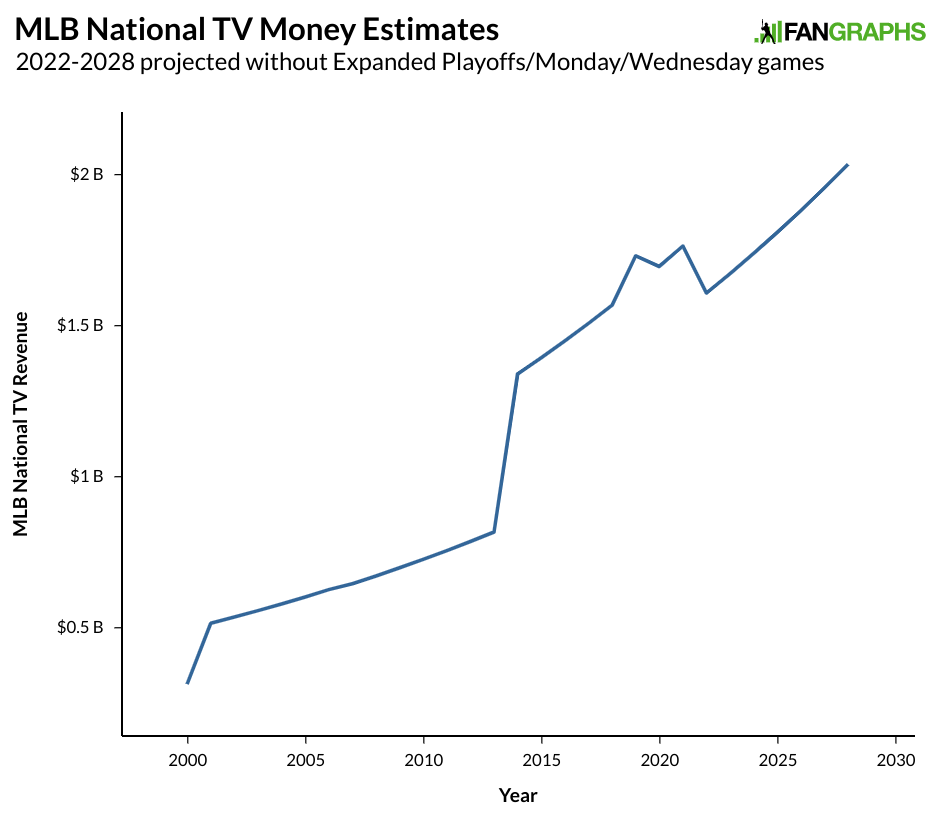
While it is isn’t likely to happen, if no deal for more weeknight games materializes, MLB could see a drop of over $100 million from 2021 to ’22. The good news for the league is that after that, it will move closer to the same financial trajectory it has been on for the past few decades: Once the smaller package of games is sold, the last section of the graph will move up and present a more continuous increase. It will likely move even higher if MLB gets its way with expanded playoffs.

ESPN, meanwhile, isn’t likely to see much in the way of revenue reduction as a result of this change: The network has a huge roster of live sports and is maintaining its already significant investment in baseball. ESPN could possibly devote more resources to MLS, whose rights deal expires in 2022, at a considerably lesser cost than MLB and still keep similar hours of live sports on air in the summer. The ESPN/MLB relationship is still a strong one, and the league still owns a 15% share of Disney-owned BAMTech, with ESPN’s corporate overlord purchasing 75% of the tech company for more than $2.5 billion in 2016 and ’17.

In his piece, Rosenthal also notes that the Marlins and Brewers still do not have rights fees locally for 2021. That pair of teams is already at the very bottom when it comes to local television revenue, and it will be interesting to see if they re-up with Sinclair Broadcast Group, which controls both RSNs. They might not have many other options anyway. MLB could step in, given that it has the capabilities and experience to run an RSN and was interested in buying them when they were up for sale a few years ago. Liberty Media could be interested in starting up some RSNs before potentially launching their own network with Atlanta. The most likely scenario, though, is a continuation with Sinclair and an increase in rights fees that doesn’t significantly change the fortunes of the two franchises. Nor will it alter baseball’s RSN landscape as a whole: A vast majority of franchises already have long-term deals and stakes in the networks that broadcast them. Cord-cutting, increases in streaming, and hardball tactics from Sinclair that increase blackouts on those services threaten the future of the game in the long-term, but in the immediate future, Sinclair is projecting nearly a billion dollars in revenues above expenses on their RSNs despite the pandemic.

The ESPN contract doesn’t look great on its face, but it isn’t as bad as it appears. MLB will still see an increase of its rights fees in these next sets of deals, and the league has some inventory it can sell in its mid-week games. Nationally, MLB is now also insulated from a collapse in rights fees for nearly a decade. And while there are some areas of concern locally, most of the league looks to be in very good shape for the next decade. The sport still faces questions about long-term growth, particularly when it comes to attracting new fans in a more segmented video marketplace, but this lessened ESPN deal shouldn’t be of great concern for the sport.


The Current State of 2021 Team Payrolls

With Qualifying Offers decisions made, the non-tender deadline at our backs and free agency still just getting started, it’s a good time to check in on every team’s payroll before the offseason reaches full bore. With this year’s 60-game season came a substantial reduction in revenues as well as player pay. How much owners plan to cut team payrolls for next season is uncertain, but substantial reductions are expected. To get a sense of where current major-league payrolls fall, here are our projections from our RosterResource payroll pages:

There are a few things to keep in mind here. First, these figures are salaries for 2021, not the average annual value numbers used for the competitive balance tax payroll, which we’ll get to in a bit. In addition, these figures don’t include buyouts for this past year or next season, which stand at around $40 million total potentially owed as of the end of the season. These numbers do include estimates for arbitration-eligible players, as well as an expected number of minimum-salaried players to make it through a season. They do not include the roughly $2 million per team that will be spent on players on the 40-man roster who aren’t in the majors, or the roughly $15 million per team that will be spent on player benefits. Both of those figures will be included in the competitive balance tax numbers below.

The defending champs top this list by a healthy margin with an expected payroll of roughly $190 million if the season started today; they also seem to be well-equipped for another run next season, as they are about five wins clear of every other team in our Depth Charts. The Dodgers could still conceivably add to their infield, bring Justin Turner back, or add some depth to the rotation or bullpen, but by signing Mookie Betts to a contract extension earlier this year, they ensured the best potential free agent in the game will call Los Angeles home next season. Read the rest of this entry »


What the Braves Can Tell Us About MLB’s Financial Losses in 2020

Losses have come to dominate the narrative when it comes to baseball finances over the past year as the world has struggled to deal with the COVID-19 pandemic. With just a 60-game schedule and no fans in the stands during the regular season, revenues dropped precipitously. The losses have been called “historic” and “devastating” by commissioner Rob Manfred and “biblical” by Cubs owner Tom Ricketts. Separating hyperbole from reality is difficult when there is little concrete information to contest bald assertions from interested parties, and the refusal of those parties to divulge any of their info invites skepticism. As a result, we need to turn to the Braves, who are traded publicly and issue quarterly reports about their finances, to get a better sense of the picture league-wide.

This is not the first time we’ve taken a look at Atlanta’ finances, though 2020 represents a radically different year, with operating income (Adjusted OIBDA) totaling around $150 million in 2018 and ’19 combined. Before taking a broader look, let’s run through the third quarter, which includes July, August and September, aka the regular season. During this time, the team played 60 games, including 30 at home. Baseball revenue stood at $102 million, half that of what came in during the third quarter in 2019. Due to paying players pro-rated salaries and not having fans at games, expenses (which include the Battery development outside the park) also dropped, from $167 million to $104 million. If we assume that The Battery, with $8 million in third quarter revenue, is a breakeven proposition at the moment, that means that on an operating basis, the Braves’ turned a $6 million profit during the season despite having no fans in the seats. While MLB might claim teams lost money for every game played this season, the Braves are the only club with any amount of transparency regarding their finances, and they didn’t. Read the rest of this entry »


Mets’ Sale To Steve Cohen Is Biggest in MLB History

After a deal with Steve Cohen to purchase the New York Mets was nixed last year due to issues of continued team control, the Wilpons looked for other suitors only to end up back with the hedge fund billionaire. According to Sportico, the deal values the Mets at $2.42 billion. Cohen will assume 95% ownership of the team, increasing his stake from 8%; the Wilpon family will retain control of the remaining 5%. The transaction will not include the Mets’ regional sports network SNY, a cash cow currently controlled by the Wilpons’ Sterling Equity with a 65% share.

The sale is the largest in MLB history, and given the franchise’s $391 million value at the time of the Wilpons’ purchase in 2002, it’s also the most profitable in terms of total dollar amount. Here are MLB franchise purchase price valuations since 1988 in chronological order:

And here’s profitability compared to the previous valuation:

In terms of annual profits based on the valuation of the franchise when it was bought and sold, the Mets’ deal is a little closer to the middle at around 9%. There’s an argument that being only a little bit above average isn’t great, though being above-average on a debt-laden team in the middle of a pandemic looks to be a pretty positive outcome. Here’s where the Mets’ sale stacks up in terms of its annual increase in value after inflation:

Before we get to Cohen, let’s take a look back at the Wilpons and how we got here.

From Initial Investment to Full Control

Fred Wilpon reportedly originally bought 5% of the Mets in 1980 when Doubleday & Co. purchased the team for $21.1 million. Six years later, Nelson Doubleday and Wilpon joined forces to purchase the club at a value of around $80 million. It wasn’t until 16 years after that that Wilpon and his family gained full control of the club, though the purchase was not without controversy. The sale price valuing the club at $391 million was set by an appraiser and initially contested by Doubleday. He argued against the price due to a number of factors ranging from:

Wilpon being “in cahoots” with baseball to force him to accept less-than-market value for his 50 percent of the Mets to baseball “manufacturing phantom operating losses” as part of its labor strategy.

Doubleday relented on his claims after the Wilpons agreed to quadruple the money owed at the time of sale from $28 million to $100 million. In the end, the Wilpons paid just $135 million to purchase the other half of the club from Doubleday due to team debt that was subtracted from the purchase. For about $1 million in 1980, $40 million in 1986, and $135 million in 2002, the Wilpon family gained full control of the Mets. Read the rest of this entry »


Current Labor Strife Doesn’t Mean a Strike Or Lockout Is Inevitable

Throughout the last few months of hectic, sometimes nasty negotiations between the players and the owners to resume the 2020 season, one issue operating in the background was the expiration of the current Collective Bargaining Agreement at the end of next year. For those who watch, cover, and love baseball, losing the 2020 season would be sad, but understandable; there’s a global pandemic. To turn around 18 months later and lose all or part of the 2022 season because the players and owners can’t agree to a new CBA would be considerably less so. Still, while MLB and the MLBPA’s inability to agree to modify their March agreement in such a way as to provide mutual benefit (and more games) is frustrating, no deal today doesn’t mean no deal after 2021.

The recent negotiations offer a preview into the tone, tenor, and general degree of trust (or lack thereof) both parties are likely to bring to the table as they work toward an agreement for 2022, but achieving a different result is possible because 2022 is going to be much different than both 1994 and 2020. There will be a lot of issues to resolve, as Dayn Perry laid out at CBS Sports in May and Andy Martino examined yesterday for SNY, and the process will be contentious. But the owners will also be looking to maximize profits after 2021 rather than minimize losses. And while the negotiations over the last month didn’t result in a new deal, they might actually prove to have been fruitful practice for the next time the two parties come to the table. Read the rest of this entry »


The Threat of a Grievance Likely Spurred MLB’s Latest Offer to the Players

On Wednesday, not long after talks appeared to have stalled, Major League Baseball (MLB) presented a new proposal to the Major League Baseball Players Association (MLBPA) to resume the 2020 season. It was a sharp about face by the league, which on Monday had threatened to cancel the season entirely. The parties intended their March Agreement to resolve multiple issues related to the resumption of play following the postponement of the season due to COVID-19. I received a copy of what is likely the final agreement, although it is not the signed version agreed to and executed by the parties. The version I have received is dated March 26, 2020 and identified as a Final Proposal on one party’s letterhead. Two national baseball writers have independently verified to me that it is the final agreement. After reviewing the Agreement, I believe the threat of a grievance over MLB’s violation of the scheduling provision of the Agreement is what spurred these most recent talks.

Rather than summarize the March Agreement and each of its sections, I thought it would be useful to review it from the perspective of how an arbitrator might review the grievance the MLBPA has implied it will file if the commissioner unilaterally sets the schedule. Although it has been represented as a short agreement addressing a only handful of subjects, the March Agreement is actually a comprehensive document with 15 sections and an appendix covering 17 pages. The parties spent a significant effort reaching agreements over a host of things, both modifying and supplementing the Collective Bargaining Agreement (CBA). It’s important to remember that both parties were represented by experienced, competent counsel throughout the negotiations that led to the March Agreement.

Earlier this week, the commissioner said his concern over a grievance might prevent MLB from scheduling a season at all. Manfred told ESPN, “Unfortunately, over the weekend, while Tony Clark was declaring his desire to get back to work, the union’s top lawyer was out telling reporters, players and eventually getting back to owners that as soon as we issued a schedule – as they requested – they intended to file a grievance claiming they were entitled to an additional billion dollars. Obviously, that sort of bad-faith tactic makes it extremely difficult to move forward in these circumstances.”

In relevant part, the CBA provides that a “‘Grievance’ shall mean a complaint which involves the existence or interpretation of, or compliance with, any agreement, or any provision of any agreement, between the Association and the Clubs or any of them, or between a Player and a Club.” Presumably, the Union’s grievance would be over the failure of the commissioner to meet the “best efforts” provision in the section on scheduling the regular season. Read the rest of this entry »


How to Make $750 Million, Cash Free

With most every other professional sport moving forward with a plan to resume play, baseball’s unsettled future sticks out like a sore thumb. Inevitably, battle lines have been drawn; the owners claim poverty and hardship, the players toe their pro-rata line while dangling various season lengths and inducements, and each side claims the other is intransigent and negotiating in bad faith (one side’s argument is much stronger than the other’s as far as that’s concerned).

One of the key arguments the owners have made is that their teams aren’t profit centers. It’s never couched in exactly those words, but that’s the primary gist of the argument. When Tom Ricketts spoke about the Cubs’ finances, he focused on a specific point: that the team isn’t hoarding cash.

“Most baseball owners don’t take money out of their team. They raise all the revenue they can from tickets and media rights, and they take out their expenses, and they give all the money left to their GM to spend,” he said, in regards to earlier comments by Scott Boras. Cardinals owner Bill DeWitt approached it from a different angle in discussing the team’s real estate expansion, saying “we don’t view (Ballpark Village) as a great profit opportunity.”

I find both of these quotes quite interesting, not for what they reveal, but rather for how precisely they are formulated. Ricketts focused on cash — dollars that flow from team coffers to owners’ bank accounts. DeWitt focused on the profitability of real estate ventures, profit being a notoriously nebulous concept.

Before going any further, I’ll note that both Ricketts and DeWitt are within their rights to posture heavily, or even lie in substance, with these statements. How productive that approach is (eh) and how well it sits with us (not very!) are questions worth considering, but they’re allowed. They’re not under oath, and they’re in no way required to open their books. Parties bluff and lie in negotiations all the time, and both of these statements are, at their core, negotiations with the players using the public as intermediary.

But let’s take them at their word. This seems to be the core issue the owners are asserting: they aren’t taking home any money from their teams, even in good times, so they can’t be expected to take a loss when times get tough. No cash when times are good, cash loss when there’s a recession; the math doesn’t add up. In almost every public statement, owners mention this exact sentiment. Read the rest of this entry »


Players Take Big Step Toward Compromise With Latest Offer

On Monday, the owners presented their second economic proposal to the Major League Baseball Players Association, offering to pay players 50% of their pro-rated salaries from the March agreement for 76 regular season games, and 75% of their pro-rated salaries over 76 games if they played the postseason. That proposal was similar to the previous one the owners had made, shifting around roughly the same amount of money and ultimately offering the players less in guaranteed salary. While the players waited eight days for that proposal, it took them just a single day to respond with Jeff Passan first reporting the MLBPA’s response last night.

The players’ proposal includes an 89-game season beginning July 10 and lasting through October 11, a 94-day period. Players would receive full pro-rated pay for those games. The proposal includes expanded playoffs in both 2020 and 2021, and a player bonus pool of $50 million for the playoffs if there are no fans. Players who are considered high-risk for complications related to the coronavirus or who live with someone considered high-risk could opt-out of the season and receive service time and salary, though others who opt out would receive neither. In analyzing this deal, we have several different comparisons to make when it comes to other offers or potential proposals.

The Players’ Prior Offer

The previous offer made by the players included a 114-game season ending at the end of October, expanded playoffs in 2020 and 2021, a provision allowing high-risk individuals and those living with high-risk individuals to opt-out and receive service time and salary, and all other players to opt out and receive service time. The new proposal addresses some significant issues raised by the owners. Owners want to pay players less. Moving to 89 games decreases player pay by roughly $630 million. Owners have expressed concern about playing late into the year. Ending the season on October 11 moves up the end of the regular season by three weeks. Owners want expanded playoffs; that bargaining chip was kept in the recent offer. Owners didn’t want all players to be able to opt out and accrue service time (service time was a huge issue when the sides negotiated the March agreement), and the union response acceded to those wishes. That doesn’t mean the offer is palatable to the owners, however. Read the rest of this entry »


A Look at the Gains and Losses by Team of a Season Without Fans

On the heels of another weak offer by team owners, it’s worth re-examining their claims of losses on a per game basis in the regular season. While most of the discussions about MLB’s gains and losses in 2020 have been on a more global scale, individual teams are going to have vastly different financial outlooks this season. Those outlooks could be shaping the negotiations among the owners as they continue to present proposals to the players that try to satisfy all the owners at once.

It’s possible you’ve heard the claim that owners will lose $640,000 on every regular season game played. While there are a lot of issues with that claim given that national television money as well as other revenue from MLB’s central office like MLB.TV is not included, we can use the data from that assertion as a starting point in examining MLB’s finances. MLB’s claim of losses comes from taking a pro-rated share of local television money and then subtracting player pay based on the March agreement that dictated pro-rated pay. Then, around $55,000 is added per game for other revenue minus the cost to put on a game. For the television estimates, I used the data from this piece, added the MLB average for Toronto, and then made a 2% adjustment based on the figures in this Jeff Passan piece. That same piece also provided the salary rate of $1,674,800 per game. Based solely on that data, here’s the team-by-team look at gains and losses per game:

Read the rest of this entry »


MLB Owners’ Latest Offer Even Worse Than the Last One

Prior to today, MLB owners had made one offer to the Major League Baseball Players Association to resume the season, one that included a renegotiation of the pro-rated player pay agreed to back in March. That proposal, made on May 26, was for 82 games and included about $1 billion in pay cuts from the March agreement. The offer seemed to unite the players rather than divide them, and five days later, the MLBPA proposed to play 114 games with expanded playoffs over the next two years. MLB has floated a 48-game schedule at full pro-rated pay, but never made that offer. Now, more than a week after the players made their proposal, the owners have responded with a proposal that’s somehow worse than their offer from two weeks ago.

As Karl Ravech first reported, the owners made an offer for 75% of pro-rated salaries for 76 games. He noted that the deal came with playoff pool money and that draft compensation for free agents would be eliminated. Jared Diamond reported that players were only guaranteed 50% of their pro-rated pay and would need to complete the playoffs to receive the rest. Diamond further reported that 20% of the $170 million advance would be forgiven. While the free agent compensation issue isn’t nothing, given the likely market climate this winter and the potential reduction in qualifying offers to begin with, it’s not clear how much this will actually benefit players. Overall, this offer is likely to be another unfortunate setback in the negotiations between the players and the owners, as it guarantees players less money than the owners’ other offer and pays them no more money upon completion of the playoffs.

Here’s a quick comparison of the 82-game offer with heavily decreased salaries compared to the 76-game plan with 75% pro-rated pay upon completion of the playoffs. The numbers include around $200 million in mostly fixed costs for player buyouts, pro-rated signing bonuses, and money still owed to players who have already been released; the per game amounts for pro-rated pay come from Jeff Passan’s piece last week:

MLB’s Latest Proposal to Players
Proposal 75% Pro-rated-76 G High-Salary Cut-82
No Playoffs $1.17 B $1.25 B
With Playoffs $1.65 B $1.45 B

Read the rest of this entry »