Archive for COVID-19

Marlins’ Outbreak Produces a Full-Blown Crisis for MLB

Less than a week into the 2020 regular season, Major League Baseball has a full-blown crisis on its hands, as the Miami Marlins are in the midst of a COVID-19 outbreak that threatens their ability to field a competitive team and calls into question the league’s entire return-to-play effort. On Sunday, the Marlins played the Phillies without three of their regulars or their scheduled starting pitcher, all of whom had tested positive for the coronavirus. On Monday morning, ESPN’s Jeff Passan reported that eight more players and two coaches had tested positive as well, and on Tuesday The Athletic’s Ken Rosenthal reported four additional players testing positive, bringing the total number of cases over the last five days to 17. Monday and Tuesday’s games involving both the Marlins (who were to play their home opener against the Orioles) and Phillies (who were to host the Yankees) have been postponed, and more may follow.

Needless to say, this is not good.

Even before the Marlins’ outbreak came to light, MLB was unable to make it to the first official pitch of the regular season without a star player testing positive and being scratched from the Opening Day lineup amid questions about testing turnaround time and the protocol for handling exposed players. About five hours before the Yankees’ Aaron Hicks stepped in against Max Scherzer at Nationals Park last Thursday, Washington left fielder Juan Soto was pulled from the lineup due to a lab-confirmed positive test off a saliva sample taken on Sunday — four days earlier — igniting fears that other Nationals had been exposed in the time since he had provided the sample on Tuesday. That Soto had tested negative on three subsequent instant-result tests (both saliva and nasal) further muddied the waters.

The Nationals did not quarantine any additional players after contact tracing Soto’s infection, having determined that “no players or staff were deemed to have met the CDC definition of close contact” — staying within six feet for at least 15 minutes — with Soto. Thankfully, the 20-year-old slugger is reportedly asymptomatic and has received the first of two lab-confirmed negative tests necessary for his return; he will also have to go 72 hours without exhibiting symptoms. The rest of the Nationals reportedly tested negative as of Saturday, and at this writing, the team has reported no further infections.

As for the Marlins, though they hail from a state that has become the epicenter of the pandemic, the team had not experienced a disproportionate number of positive tests between the start of their summer camp and the approach of Opening Day, with only outfielders Lewis Brinson and Matt Joyce landing on the injured list due to undisclosed reasons as of July 16. On Friday, however, just before the their first game against the Phillies in Philadelphia, the Marlins placed catcher Jorge Alfaro on the injured list for undisclosed reasons. Then, about an hour before Sunday’s game, MLB Network’s Jon Heyman reported that scheduled starting pitcher José Ureña had been scratched due to a positive test. The game proceeded nonetheless, and Heyman soon followed up with a report that first baseman/designated hitter Garrett Cooper and right fielder Harold Ramirez — both of whom had started the team’s first two games — had tested positive as well, as had Alfaro. Read the rest of this entry »

I Really Hope This All Works

After everything that led to the start of its truncated 60-game season, Major League Baseball tried its hardest to fill Opening Day with all the excitement it could. The defending World Series champion Nationals faced this offseason’s most sought-after free agent pitcher, making his debut for the league’s most storied franchise. After that, the Dodgers took the field, joined for the first time by the newest face of their franchise, to host their longtime rivals. Leading immunologist Dr. Anthony Fauci — the face of the United States’ fight against the COVID-19 pandemic that led to the suspension of sports seasons all over the world — threw out the first pitch of the season, a not-so-subtle signal to the American public that things are fine, or fine enough.

But the moment had already been soured. Hours before the first game of their season, Nationals wunderkind Juan Soto was announced to have tested positive for the coronavirus, forcing him to miss the season-opener and enter self-isolation. In addition to being scary news for Soto — who is asymptomatic — it also served as one more reminder of the dangers MLB faces as it attempts to play a season in the middle of a pandemic, and the complicated moral quandaries fans of the sport will struggle with as long as that season goes on.

Not that we needed the reminder in the first place. For four months, we’ve been absorbing as much information as possible about the virus, its potentially deadly effects, and its insidious spread through asymptomatic carriers; about the difficult ethical debates it created; about the lost jobs and the likely permanent damage dealt to already vulnerable industries and communities; about the potentially devastating hurdles and pitfalls that lurk within the return plans of various leagues; and, of course, since this is pro sports, about whether all of this might be rendered moot by the greed of ownership. After all of that, there was hope MLB’s return would be the escape we’ve all anxiously waited for. Instead, it has become its own source of anxiety — a profoundly risky gamble with thousands of lives in the balance, in which we root less for teams and players and more for the simple wish that nothing terrible happens. Read the rest of this entry »


Welcome to Pandemicball

It was in many ways a very normal late-July afternoon: Fan blasting, a 1.5-liter water bottle at my side, idly watching the Yankees from my couch. Gio Urshela hit a weak single into right field, and the crowd, whose noise had been hovering at a comfortable murmur up to that point, cheered. In that moment, if I hadn’t looked at the screen, if I’d just taken in the familiar sonic cues of televised baseball, I could almost have convinced myself that it was a normal baseball game in a normal major league season.

Except the crowd kept cheering. It was just a little unimpressive single, and there were two out. The sound, flat and consistent, stretched far beyond where you would expect a collective breath, that fracturing of excitement that happens when one play has ended and everyone is anticipating the next one. And when it did fade, it didn’t dissolve the way it usually does, back into the thousands of individual conversations, all with their own volumes and paces. It faded back to that comfortable murmur, smooth and fast, like someone pushing down a volume slider. When Urshela was caught in a rundown soon after, there wasn’t the dismayed frenzy of people groaning, yelling “No! No!” in frustrated inevitability, standing up in their seats as though doing so could convince the deviant baserunner of the error of their ways. There was just a rise, and then a fall; gentle and unified, a mechanical sigh. Urshela left, and the inning was over. Cut to commercial. Go get a snack.

But wait, no — the inning wasn’t over, somehow. There were, undeniably, three out, and there was, undeniably, the large form of Aaron Judge standing at the plate. The eyes of Aaron Boone and Joe Girardi, peeking out from over their masks and looking across the diamond, connected. The inning would continue. Vince Velasquez, on the mound, would throw a few more pitches. Why? Because he needed to, maybe. Because he might as well.

And when Judge launched a fastball into the empty seats in right, he rounded the bases tentatively, confused. The ball had left the yard, and the lights were flashing, and the noise had swelled. On the replay, they showed the Statcast data, the exit velocity and the ball’s high arc in the air. All the signs we have come to associate with a home run. But was it? This is baseball we’re watching, right? Read the rest of this entry »


MLB’s Testing Mess May KO Season

On Saturday, the Yankees’ Masahiro Tanaka got hit upside the head and ultimately concussed by a 112-mph screamer off the bat of Giancarlo Stanton, the third player he faced in the team’s first simulated game of summer camp. By Monday, a good portion of Major League Baseball could identify with the headaches and other scary consequences of being knocked down so soon after restarting amid the coronavirus pandemic. The testing program that represents a foundational piece of the protocol to keep players and essential staff safe broke down, causing teams to delay or cancel workouts and amplifying a crisis of confidence within the sport.

Indeed, if one didn’t already feel a fair bit of ambivalence regarding MLB’s attempt to stage even an abbreviated season amid the pandemic, the dysfunction that’s been on display since late last week has certainly provided cause for concern. While the league reported results of its intake tests that initially appeared promising, the caveat attached — incomplete results from most teams — was enough to raise some eyebrows. Beyond that initial stumble, Monday brought news of at least half a dozen teams whose workouts were delayed or canceled due to holiday-related holdups in receiving test results, a matter that should have been anticipated well in advance. All of this comes while the ranks of players testing positive and those opting out both continue to grow, producing absences that could potentially reshape the season and in some cases have life-altering consequences. And of course, this is all unfolding (unraveling?) against the backdrop of record-setting numbers of new cases in the U.S. with totals topping 50,000 for three consecutive days.

Should MLB attempt to proceed at all? Can it? From here, the likelihood of the league pulling this off seems more remote than ever.

Though it was overshadowed by the rancorous and all-too-public exchanges between the owners and the Players Association, MLB sold the union and the public on the viability of a restart based on its ability to expedite a high volume of tests, primarily via saliva-based tests — faster and less invasive than nasal swabs — that a repurposed anti-doping lab in Salt Lake City could process for a 24- to 48-hour turnaround. Even before that turnaround time could be called into question, MLB made a mess of its intake testing, which began at players’ home stadiums on July 1. Players and essential staff were given temperature checks, saliva or nasal swab diagnostic tests for the coronavirus itself, and antibody tests using blood samples. Only those who tested negative were permitted to enter facilities for the first workouts beginning on Friday. Read the rest of this entry »


Opt-Outs, Uneasiness Abound During MLB’s First Weekend Back

July 3, 2019 was a pretty typical day for major league baseball. Cody Bellinger hit a walk-off home run in the 10th inning against Arizona to give the Dodgers their league-leading 59th win of the season in their 88th game. Last-place Cincinnati defeated first-place Milwaukee to bring all five NL Central teams within 4.5 games of each other. Stephen Strasburg struck out 14 Marlins without allowing a run. Mike Trout hit two dingers, because of course he did. There were close games and there were clunkers, thrilling displays and frustrating setbacks. You probably forgot about all of it.

This July 3 was, well, different. Temperatures notwithstanding, it might as well have been mid-February, as players from all 30 organizations gathered in their respective ballparks for their first official team workouts in months, after the global COVID-19 pandemic suspended the major league season. Players and staff rejoined their teammates only after first undergoing intake tests for the virus, with several wondering even as they took the field whether they were doing the right thing by attempting to play at all. Those circumstances made for a strange and chaotic first weekend of camp.

Longtime star pitchers David Price and Felix Hernandez announced on Saturday that they would opt out of the 2020 season, one day after veteran catcher Welington Castillo was also reported to have opted out. On Monday morning, Nick Markakis also informed his team he would opt out of the season. Their decisions bring the total number of major league players known to have decided against playing this season to nine. Read the rest of this entry »


Four Players Opt Out Of Major League Season

As Major League Baseball and the Players Association engaged in tense negotiations to resume play after the season was initially suspended due to the COVID-19 pandemic, much of the focus was understandably spent on the money players would be paid for competing in games during the crisis. But in addition to the compensation for players on the field, a number of other issues needed to be sorted out, including protections for players who did not wish to play this season out of concern for their own health and safety, or for that of someone close to them. Both sides knew that regardless of the salary agreement and health guidelines passed, there would be players with pre-existing health conditions, ones who live with or care for high-risk individuals, and ones in otherwise uncertain situations who would prefer to sit the 2020 season out and wait for next year.

On Monday, the first wave of such decisions arrived, with four veteran players announcing they wouldn’t play the 2020 season. First was Arizona Diamondbacks right-hander Mike Leake, whose agent released the following statement:

A little while later, The Athletic’s Britt Ghiroli reported that two members of the defending champion Washington Nationals, Ryan Zimmerman and Joe Ross, had also opted out of the season. Zimmerman released a statement, as did Nationals general manager Mike Rizzo.

Read the rest of this entry »


COVID-19 Roundup: Players Green Light MLB’s Return

This is the latest installment of a series in which the FanGraphs staff rounds up the latest developments regarding the COVID-19 virus’ effect on baseball.

Players Agree to Health Protocols, Will Report to Camp by July 1

Major League Baseball and the Players Association reached an agreement Tuesday regarding the health and safety guidelines that will govern the 2020 baseball season amid the coronavirus pandemic, officially clearing the path for a season to begin. Owners acted on Monday to implement a 60-game season at full pro-rated pay for players, after the union rejected a proposal over the weekend that, among other things, would have expanded the playoffs and asked players to waive their right to file a grievance. Players will begin training camp by July 1, and the start of the regular season is expected July 23 or 24.

My colleague Craig Edwards already wrote up the agreement here, so I’ll just briefly note some of the highlights. Games will be held in each team’s home stadiums without fans. Teams will play only against teams inside their division as well as teams in the other league’s corresponding geographic division, in an effort to lessen travel. There will be a designated hitter in both leagues, a new extra innings format in which each team starts the inning with a runner at second base, and 30-man active rosters that gradually shrink as the season progresses. The trade deadline will be August 31, and the deadline for a player to be eligible for the postseason roster is September 15. Pitchers will be allowed to, well, here, you read it.

If you’ve been suffering through three months of public finger-pointing over economic distrust, dead-on-arrival proposals, and general dread over what the future of baseball holds, all of this qualifies as good news to some degree. But while it is a positive development that salary disagreements won’t cancel the 2020 season, that’s not what suspended it in the first place — a pandemic did. And that pandemic is still very much a threat. States like Florida and Texas, which host multiple MLB teams and were among the first to loosen stay-at-home restrictions, are still seeing a catastrophic increase in their new daily cases. And as extensive as MLB’s safety protocols are, there is still a troubling amount we don’t know, from how the league will enforce its guidelines to how many positive tests it would take to result in a ballpark or team getting shut down. Read the rest of this entry »


What the Season Will Look Like: Final Crowdsource Results

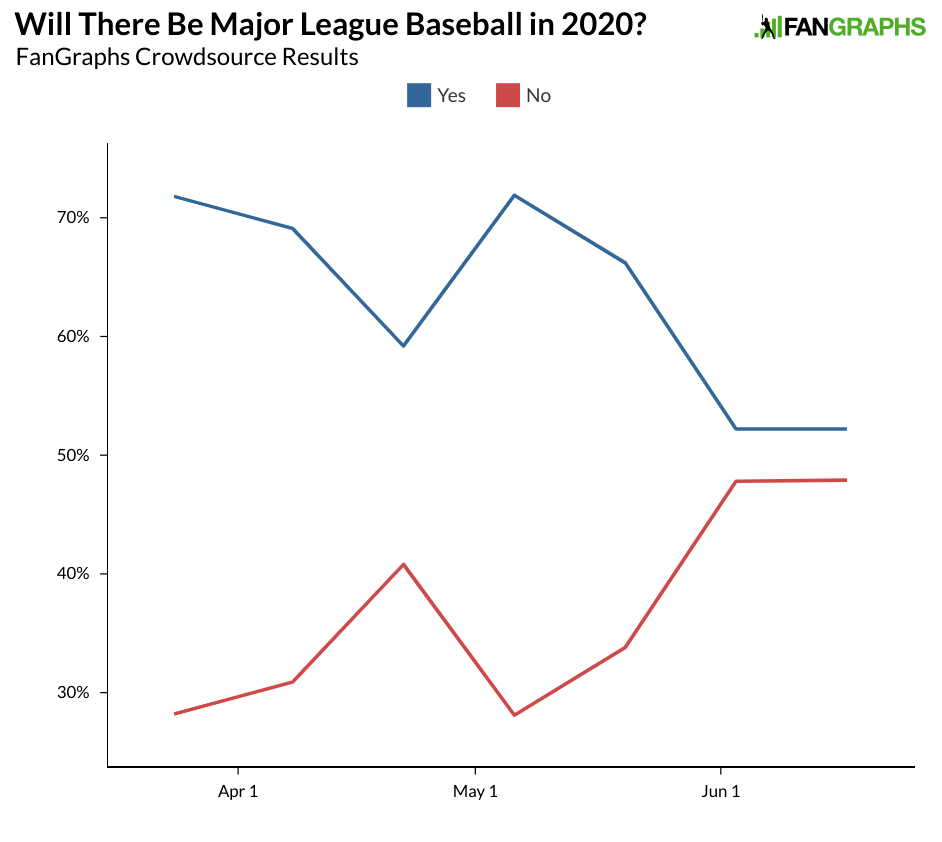
Last week, for the seventh and final time, I asked readers how they thought the season would go. While we don’t know for sure how many games will actually be played this year or when the season will end, should the two sides settle on health and safety protocols, the current plan is to play 60 games and have a standard postseason that concludes at the end of October. In addition to looking at the last round of results, we’ll take a look at how the reported season compares to the results over time.

First, this is how readers answered regarding whether there would be a season (voting closed Monday morning):

Here’s how the responses have gone since late-March:

For the first five surveys, two out of every three readers believed there would be a 2020 season, but the negotiations over the last month turned it into a 50/50 proposition. While it certainly seems that we will get a season, there’s still a month to go before a potential Opening Day. Read the rest of this entry »


As Safety Concerns Grow, Stalling Owners Leaves Players in Bind

Following a flurry of activity last week between Major League Baseball and the Major League Baseball Players Association as the two sides volleyed to resume the 2020 season, this past weekend was marked by inactivity. After an in-person meeting between Rob Manfred and Tony Clark spurred an owners’ proposal for 60 games on Wednesday and a 70-game counter-offer from the players on Thursday, the owners opted to wait the players out. While they were waiting, the schedule for a potential season got a little bit shorter, and positive coronavirus tests for five players and three staff members in Phillies camp forced some re-evaluation of the viability of Florida as a training site ahead of the upcoming season. With other positive tests popping up around the sport, all of the spring training complexes were temporarily closed for deep cleaning, and to establish new, more stringent safety protocols; in all, 40 players and staff have tested positive for the virus over the last week. Even with that news, the players were expected to formally vote on the owners’ 60-game proposal on Sunday, but a last-minute modification by Rob Manfred pushed the vote back.

In an email obtained by the Associated Press, Rob Manfred indicated to Tony Clark on Sunday that the season would not be able to begin on the July 19 date previously proposed by both sides, pushing the start of the season back to July 26:

“I really believe we are fighting over an impossibility on games,” Manfred said in the email, a copy of which was obtained by The Associated Press. “The earliest we will be ready for players to report is a week from Monday, given the need to relocate teams from Florida. That leaves 66 days to play 60 games. Realistically, that is the outside of the envelope now.”

Read the rest of this entry »


The Threat of a Grievance Likely Spurred MLB’s Latest Offer to the Players

On Wednesday, not long after talks appeared to have stalled, Major League Baseball (MLB) presented a new proposal to the Major League Baseball Players Association (MLBPA) to resume the 2020 season. It was a sharp about face by the league, which on Monday had threatened to cancel the season entirely. The parties intended their March Agreement to resolve multiple issues related to the resumption of play following the postponement of the season due to COVID-19. I received a copy of what is likely the final agreement, although it is not the signed version agreed to and executed by the parties. The version I have received is dated March 26, 2020 and identified as a Final Proposal on one party’s letterhead. Two national baseball writers have independently verified to me that it is the final agreement. After reviewing the Agreement, I believe the threat of a grievance over MLB’s violation of the scheduling provision of the Agreement is what spurred these most recent talks.

Rather than summarize the March Agreement and each of its sections, I thought it would be useful to review it from the perspective of how an arbitrator might review the grievance the MLBPA has implied it will file if the commissioner unilaterally sets the schedule. Although it has been represented as a short agreement addressing a only handful of subjects, the March Agreement is actually a comprehensive document with 15 sections and an appendix covering 17 pages. The parties spent a significant effort reaching agreements over a host of things, both modifying and supplementing the Collective Bargaining Agreement (CBA). It’s important to remember that both parties were represented by experienced, competent counsel throughout the negotiations that led to the March Agreement.

Earlier this week, the commissioner said his concern over a grievance might prevent MLB from scheduling a season at all. Manfred told ESPN, “Unfortunately, over the weekend, while Tony Clark was declaring his desire to get back to work, the union’s top lawyer was out telling reporters, players and eventually getting back to owners that as soon as we issued a schedule – as they requested – they intended to file a grievance claiming they were entitled to an additional billion dollars. Obviously, that sort of bad-faith tactic makes it extremely difficult to move forward in these circumstances.”

In relevant part, the CBA provides that a “‘Grievance’ shall mean a complaint which involves the existence or interpretation of, or compliance with, any agreement, or any provision of any agreement, between the Association and the Clubs or any of them, or between a Player and a Club.” Presumably, the Union’s grievance would be over the failure of the commissioner to meet the “best efforts” provision in the section on scheduling the regular season. Read the rest of this entry »