Kim Klement-USA TODAY SportsMike Redmond has been up close and personal with a lot of high-profile players, some of whom arrived on the scene at a young age. As a big league backstop from 1998-2010, Redmond caught the likes of Josh Beckett, Johan Santana, and Dontrelle Willis, and he played alongside Miguel Cabrera. As the manager of the Miami Marlins from 2013-2015, he helped oversee the blossoming careers of José Fernández, Giancarlo Stanton, and Christian Yelich. With the exception of Santana, who was by then a comparative graybeard at age 26, the septet of stalwarts were barely into their 20s when they began playing with, and for, Redmond.
Now the bench coach of the Colorado Rockies, Redmond looked back at his experiences with the aforementioned All-Stars when the Rockies visited Fenway Park last summer.
——-
David Laurila: Let’s start with José Fernández, who was just 20 years old when he debuted. Just how good was he?
Mike Redmond: “I mean, yeah, he was a phenom. The plan was for him to be in the minor leagues for one more year, but because we were so thin pitching wise we had to bring him to the big leagues. We didn’t have anybody else that year.
“I’d seen José, because I’d managed in the Florida State League when he was there the year before. Christian Yelich and J.T. Realmuto were on that team, as well. I was with Toronto, managing Dunedin, so I got to see all of those guys in the minor leagues. With José, you could just tell. The stuff, the confidence, the mound presence… it was just different. It was different than the other guys in that league, man.
“I got the manager’s job with the Marlins, and I remember being in spring training that first year. [President of Baseball Operations] Larry Beinfest and I were talking about José, and he goes, ‘Hey, don’t get too excited. You’re not going to get him just yet.’ I was like, ‘OK, whatever.’ Sure enough, José ended up breaking camp with us because of injuries. We had him on a pitch count, and he’d always give me a hard time about it, because he wanted to throw more. I would be like, ‘Hey, listen, you have 100 pitches. How you use those 100 pitches is up to you.’ I would say that he used them pretty effectively. He was nasty. Great slider. And again, he was very confident in his abilities. He was a competitor. I mean, he reminded me of some of the great pitchers I’d caught in the big leagues, like Josh Beckett and Johan Santana. Guys who just dominated.” Read the rest of this entry »
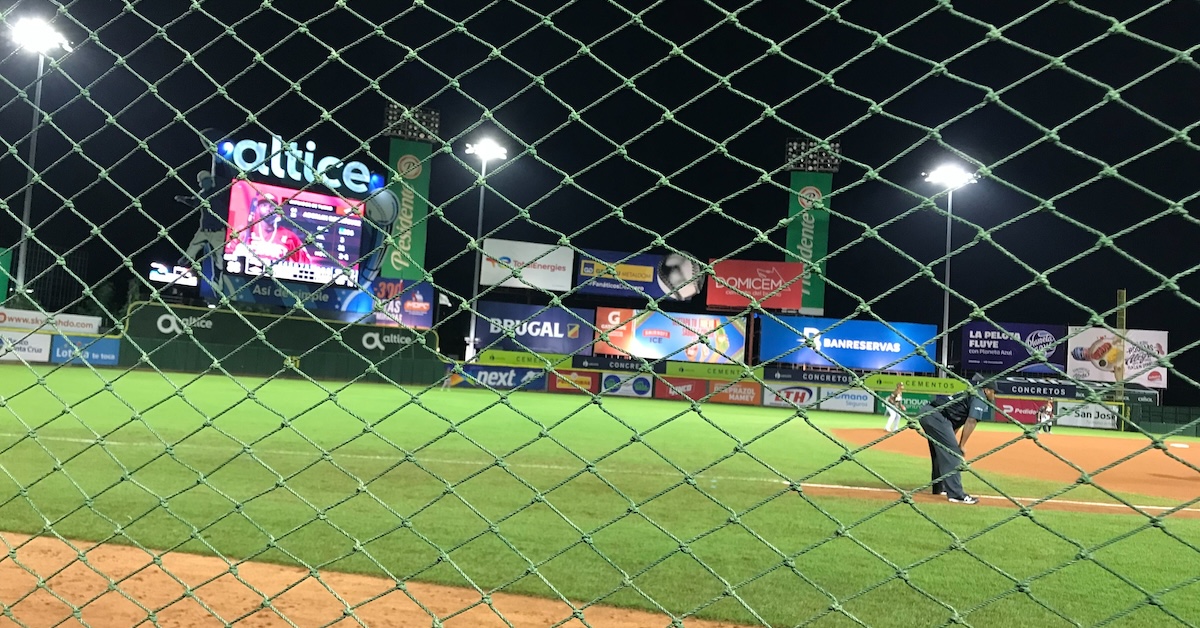
Sometime during the second inning, I climb past a dozen rows of empty yellow seats toward the usher at the top of the section. “¿Cuando vienen todos?” I ask when she looks up. When are they all coming? This is my first Dominican Winter League game, and I was prepared for pandemonium: the energy, the blaring music, the crush of the crowd. Instead, the stadium is desolate.
The usher looks confused by my question, and I worry that my iffy Spanish is to blame. “¿Quién?” she asks. Who?
We look around the empty stadium, and though we say the exact same thing at the exact same time, our inflections couldn’t be more different. Mine is declarative: “La gente.” The people. Hers is interrogative: “¿La gente?” I realize that she wasn’t confused by my grammar; she was confused by the fact that I expected anyone to be here in the first place. My ears are too slow to process the entirety of her explanation, but I catch enough. This game doesn’t matter. The semi-final round of the playoffs begins in a few days and both teams have already clinched their spots. Nadie viene. Nobody’s coming. Read the rest of this entry »
The other day, my friend asked me a simple baseball question with no easy answer: What does a four-seam fastball look like? Not what is a four-seam fastball, or what does a four-seam fastball accomplish, or any number of fastball-related questions with more straightforward answers. He wanted me to conjure up an image of the most common pitch in baseball. I didn’t quite know what to tell him; strangely enough, the more ordinary something is, the harder it can be to describe.
My friend is merely a rhetorical device, but I’ve already grown attached to him, so let’s call him Tony. Tony is a casual observer of baseball. He hears terms like “fastball” and “curveball” and “the Dodgers are ruining the game” every now and then, but he doesn’t have the requisite context to understand what any of it really means. How do I show Tony what a four-seam fastball looks like in 2023? After all, every pitcher works differently. The velocity gap between Jhoan Duran’s and Rich Hill’s four-seam fastballs is the difference between a speeding ticket and losing your license. Explaining to Tony that those two offerings are technically the same pitch would be like trying to convince an alien that a Bergamasco Shepherd and a Xoloitzcuintli are the same species. It’s factually correct, yet without hyper-specific evidence – and the background knowledge necessary to interpret that evidence – it’s all but impossible to believe.
Yet Tony didn’t ask about results, be they average or exceptional. He wants a visual point of reference, and simply put, neither of those two throws a visually conventional heater. Reaching triple-digits on the radar gun remains a rarity, and Bautista does it more often than most. Meanwhile, Heaney throws his fastball with over 15 inches of arm-side run; that’s 70% more horizontal movement than the average four-seamer of a similar speed and release point. On the graph below, Heaney sits way over on the right, and only two dots (min. 500 pitches) can be found farther in that direction:
via Baseball Savant
What Tony really wants to see is the prototypical four-seam fastball, the pitch that most closely resembles the norm in as many material ways as possible. Identifying the man who throws such a pitch won’t serve a practical purpose; it won’t help teams win ballgames, fans win their roto league, or Harold Ramírez lay off all those four-seamers outside the zone. Still, it’s nice to have a baseline for the most important pitch in baseball – or any pitch for that matter. Thus, I set out to find the pitchers who throw the pitches that best exemplify what each pitch looks like in the game today.
A project like this requires a good deal of subjective decision making. No one throws a pitch perfectly identical to league average in every measurable way. Heck, even if someone did, who’s to say that average is the same as normal. The league average four-seam fastball last year clocked in at 94.2 mph, but the average reliever threw nearly a full mile per hour faster than the average starter. With that in mind, would it be incorrect to say that a starter who boasts a 94.2 mph heater is throwing with typical velocity? On top of that, pitchers who throw harder fastballs tend to throw better fastballs, which means they get to throw more fastballs. Therefore, they influence the league average to a greater extent than their less prolific peers. The average velocity of the 43 starters who threw at least 1,000 four-seam fastballs last season was 1.2 mph faster than the average velocity of the 216 starters who threw between 50 and 999 of the same pitch. Should those fewer, faster pitchers have such an outsized influence on the overall numbers? With all that said, I’m sticking with league average as my baseline (for lack of a perfect alternative, if nothing else), and I hope you’ll stick with me as I explain the rest of my decisions.
Next, I had to figure out how to narrow down the list of possible candidates. Seven-hundred and thirty-one players threw a four-seam fastball in the major leagues last year, and I wasn’t going to get anywhere if I gave each of them a close look. (Sorry Tony, even I have my limits.) Thus, I set 100 four-seam fastballs as my arbitrary minimum requirement, and I chose to prioritize one attribute above all else: velocity. It’s called a fastball, after all.
Seven pitchers (min. 100 pitches) averaged exactly 94.2 mph on their four-seam fastball. Another 18 sat at 94.1 or 94.3 mph, and I included those arms in my search to allow for candidates who might be a rounding error away from league average. That gave me 25 pitchers to work with, 19 right-handers and 6 southpaws. I hemmed and hawed over whether to include lefties at all, and ultimately I put off making a decision in hopes I wouldn’t have to. Thankfully, that proved to be the case, as none of the top candidates were left-handed.
Armed with 25 contenders and a Google spreadsheet, I hopped on Baseball Savant, looking for as many physical pitch characteristics as I could find and manipulate. I settled on nine: vertical release point, horizontal release point, extension, perceived velocity, vertical movement, horizontal movement, spin rate, total movement, and active spin. After calculating the standard deviation of each metric, I returned to my 25 candidates. Did anyone fall within one standard deviation of league average in every category?
Well Tony, today is your lucky day. One pitcher, and only one pitcher, fit the bill. One pitcher was within a single standard deviation of league average in all nine of the aforementioned metrics. That same pitcher came within half a standard deviation in seven categories, within a quarter of a standard deviation in five categories, and within an eighth of a standard deviation in four. No one else came closer at any step along the way. The owner of the most ordinary four-seam fastball in baseball is José Berríos.
Wow… Let’s take a minute to marvel at the regularity. Here’s how Berríos threw his four-seamer in 2023:
José Berríos Four-Seam Fastball
mph
V Release
H Release
Ext.
Pcvd. Velo
V Mvt.
H Mvt.
Spin
Total Mvt.
Active Spin
94.3
5.68
-2.30
6.5
94.5
0.1
1.3
2227
17.8
92%
SOURCE: Baseball Savant
And here is how he stacks up to Alec Marsh, the next closest competitor and, as I discovered, a player for the Royals, not the title of a Phillies day carefan fiction. I’ve also included league average numbers in the table for additional context:
Berríos and Marsh Four-Seamers
Pitcher
mph
V Release
H Release
Ext.
Pcvd. Velo
V Mvt.
H Mvt.
Spin
Total Mvt.
Active Spin
Berríos
94.3
5.68
-2.30
6.5
94.5
0.1
1.3
2227
17.8
92%
Marsh
94.2
5.67
-2.33
6.4
94.5
-0.3
1.2
2461
17.3
85%
Average
94.2
5.83
-1.82*
6.5
94.4
0.0
0.0
2283
17.4**
90%**
SOURCE: Baseball Savant
*Horizontal release point average for RHP **Average is a close approximation using available data
I considered making a case for Marsh on the basis of speed alone. At the beginning of my search, I said I would prioritize velocity, and his 94.2 mph average was right on the money. However, Berríos’s 94.3 mph average velocity was actually rounded up from 94.25 mph. In other words, if he had thrown just one additional fastball at 92.3 mph or slower (he threw 27 such pitches last year), his season average would have fallen to 94.2. It’s simply too close to take the title away from him.
Interestingly, Berríos’s four-seam fastball wasn’t quite so ordinary until this past season. For most of his career, he threw the pitch with less rise and more run than the typical four-seamer. However, in 2023, his four-seamer had more vertical movement and less horizontal movement than it had since his breakout campaign in 2018:
Data via Baseball Savant
My quest for the platonic ideal of a four-seam fastball was so fruitful that I decided to perform a similar search for sinkers and cutters. I still prioritized velocity, but for this investigation, I also took movement into account to narrow down the contenders. Call me a literalist, but I say the typical sinker needs to sink, and the typical cutter needs to cut.
Starting with sinkers, I picked out the 12 pitchers who came within one-quarter of a standard deviation of league average in velocity and within half a standard deviation in both vertical and horizontal movement. Next, I compared them all to league average in each of the additional categories I previously identified. Unfortunately, there wasn’t quite as clear of a winner this time around.
Only one pitcher, Colin Rea, finished within one standard deviation of league average in every metric (including mph). However, eight others finished within one standard deviation in nine out of 10. When I narrowed the criteria to half a standard deviation, Rea remained in the lead, meeting the criteria in nine of the 10 metrics, but he was tied with three other pitchers: Mitch Keller, Miles Mikolas, and Bryse Wilson. Meanwhile, at a quarter of a standard deviation, Rea reclaimed sole position of first place (eight out of 10), but three more arms were right on his tail with seven: Mikolas, Pedro Avila, and Brandon Pfaadt. What’s more, one of the metrics in which Rea wasn’t particularly close to league average was vertical movement, and that seems pretty important for a sinker. Among the quartet of Rea, Mikolas, Avila, and Pfaadt, only Avila came within a quarter of a standard deviation of league average in vertical movement. Finally, when I went down to an eighth of a standard deviation away from league average, Rea lost his crown to Avila, who came that close to league average in six different metrics. Rea and Noah Davis finished right behind him with five each.
The names that came up most often in the previous paragraph were Rea, Avila, and Mikolas. However, only one of those three threw his sinker with precisely league-average velocity. Indeed, only one of those three came within half a mile per hour of average. What’s more, that same pitcher was the only candidate out of 12 who came within an eighth of a standard deviation of league average in both vertical and horizontal movement, and one of only two who came within a quarter: Pedro Avila.
Avila, Rea, and Mikolas Sinkers
Pitcher
mph
V Release
H Release
Ext.
Pcvd. Velo
V Mvt.
H Mvt.
Spin
Total Mvt.
Active Spin
Avila
93.3
5.56
-1.24
6.4
93.4
-0.3
-0.2
2281
17.5
76%
Rea
92.6
5.58
-2.1
6.7
93.2
-1.2
-0.1
2136
17.9
84%
Mikolas
92.7
6.49
-2.1
6.4
92.8
-0.8
-0.2
2193
18.1
84%
Average
93.3
5.64
-1.93*
6.4
93.3
0.0
0.0
2150
17.8**
85.7%**
SOURCE: Baseball Savant
*Horizontal release point average for RHP **Average is a close approximation using available data
Likewise with the cutter, there were no exact matches. I picked out the 14 contenders who came within half a standard deviation of league average in velocity and both planes of movement, but none of those 14 came within one standard deviation of league average in every other metric. Nonetheless, there was still a clear winner. Only one pitcher came within half a standard deviation of average in nine categories, within a quarter in six categories, and within an eighth in five. He was one of only four pitchers within half a standard deviation of league average in both vertical and horizontal movement and within a rounding error of league average in velocity. And out of those four, he was easily the closest to league average in release point and extension. It’s Javier Assad.
Javier Assad’s Cutter
Pitcher
mph
V Release
H Release
Ext.
Pcvd. Velo
V Mvt.
H Mvt.
Spin
Total Mvt.
Active Spin
Assad
89.1
5.94
-1.81
6.4
89.7
0.8
0.6
2046
8.2
57%
Average
89.2
5.84
-1.82*
6.4
89.5
0.0
0.0
2388
8.2**
47.1%**
SOURCE: Baseball Savant
*Horizontal release point average for RHP **Average is a close approximation using available data
Here at FanGraphs, we pay a ton of attention to average performance. The concept of “league average” informs some of our most foundational stats. We even have a tab on the leaderboards page (+ Stats) dedicated to precisely that. It’s not hard to see why; a good sense of average performance, whether for a team, a player, or an individual skill, has all sorts of practical applications. Sometimes, however, it’s just as interesting to take a step back from results and focus on the process instead. We talk a whole lot about four-seamers, sinkers, and cutters, and it’s helpful to visualize those concepts as best we can. In 2023, it was Berríos, Avila, and Assad who made that possible.
So, there you have it, Tony. It’s been fun! Let’s grab a coffee sometime soon.
Bill Streicher-USA TODAY SportsThe free agent market is finally starting to move. Rhys Hoskins is headed to Milwaukee, finalizing a two-year, $34 million contract with an opt-out after the first year, per Scoop Czar Jeff Passan. You don’t have to squint to see the fit here. Milwaukee needs hitting, Hoskins needs a place to hit, and it’s always nice to feel wanted. The option effectively makes this a pillow contract for Hoskins, who ruptured his ACL in spring training and missed the entire 2023 season. (This seems like a good place to note that the deal is almost certainly still pending a physical.) If he proves that he can still hit like Rhys Hoskins, he can opt out and go after a bigger deal while he’s still a fresh-faced 31-year-old with the world at his feet, rather than a doddering, unemployable 32-year-old. If he needs another year to knock the rust off, well, I’ve heard great things about Milwaukee.
Hoskins ranked 20th on our Top 50 Free Agents. Ben Clemens estimated that he would receive a three-year contract for a total of $45 million, meaning that Hoskins fell short of the estimate in terms of years, but exceeded it in terms of average annual value. Michael Baumann did a lot of the legwork a couple weeks ago, so I’ll leave it to him to remind you of just how good a hitter Hoskins is:
The value that Hoskins brings is obvious. His power can be streaky on a game-to-game basis — a danger of being a three true outcome-heavy hitter — but in the aggregate, he’s one of the most consistent players in baseball. Hoskins is a career .242/.353/492 hitter, with a 13.5% walk rate and a 23.9% strikeout rate. That’s a career wRC+ of 126.
In four full seasons in the majors (discounting Hoskins’ 50-game rookie season and the 41 games he played in 2020), he’s never been worth more than 2.4 WAR, nor less than 2.0. His full-season career low in wRC+ is 112, while his full-season career high is 128. You can like or dislike the total package, but you know what you’re going to get.
The Nats have found a stick and shown signs of life within just four days. And what a stick it is: Joey Gallo, one of the biggest, strongest, most powerful hitters out there. That’s a big stick. A stick fit to make Theodore Roosevelt use his inside voice. Gallo, late of the Minnesota Twins, will make $5 million on a one-year deal.
Signing Gallo won’t turn the Nationals around overnight, or even appreciably accelerate Washington’s rebuild. He’s just a man, after all. A big one, but merely a man. Nevertheless, this is exactly the kind of move the Nationals should be making. Read the rest of this entry »
Cameron Cauley has one of the highest ceilings in the Texas Rangers organization. Selected in the third round of the 2021 draft out of Barbers Hill High School in Mont Belvieu, Texas, the 20-year-old shortstop has been described by Eric Longenhagen as “an incredible athlete” who not only “has a chance to be a Gold Glove shortstop,” but also possesses “plus bat speed and the pop to do damage to the oppo gap.” In a second full professional season split between Low-A Down East and High-A Hickory, Cauley made strides by slashing .245/.333/.411 with 12 home runs and a 109 wRC+. Moreover, he took advantage of his plus-plus wheels by swiping 36 bases in 41 attempts.
There are reasons to pump the brakes. As our lead prospect analyst pointed out, Cauley’s throwing accuracy needs polishing, and his strikeout rate (32.6% since entering pro ball) is a major concern. Especially troublesome is a 25.8% in-zone swing-and-miss rate that compromises his ability to produce high exit velocities when he does square up a baseball.
Cauley, who carries 175 pounds on a lithe 5-foot-10 frame, discussed his game late in the Arizona Fall League season.
———
David Laurila: I’ve read that you have elite athleticism. Do you agree with that?
Cameron Cauley: “I’d say so. God blessed me with athleticism. I’ve always been athletic, from a young age to now, so I’m pretty good at sports. I’m good at golf. I’m good at football and basketball…” Read the rest of this entry »
There’s a mean-spirited but persistent thread in American pop culture, in which the Midwest is depicted as a cultural backwater, populated by sleepy, gormless, unattractive rubes and devoid of meaningful art or culture. For example, this sidesplitting musical interlude from 30 Rock. As an East Coast snob who lived for many years among the Great Lakes, I find this line of comedy offensive. Midwesterners are friendly, vigorous, beautiful people, and they live in a land of marvels. (If you’re wondering why I’ve chosen to open with this confusing and risky metaphor: We just got a new assistant editor, Matt Martell, and I’m hazing him by handing him a grenade on his second day.)
But when it comes to pitching, the coastal elites might have a point: Standards have slipped a little in the heartland. For the Chicago White Sox and Pittsburgh Pirates, John Brebbia and Aroldis Chapman, respectively, are marquee signings. (Now I’ve thrown all that goodwill away by puncturing Pittsburghers’ delusion that they’re from the East Coast. How foolish of me.) Read the rest of this entry »
Let’s be honest: Dylan Cease is in the general baseball consciousness to such an extent right now because it’s all we have. The free agent class of 2023-24 was weak to begin with, and Shohei Ohtani and Yoshinobu Yamamoto have already signed. Juan Soto is now a Yankee. Tyler Glasnow got traded. Cease is such a focus because the shiniest free agents are gone and because if your team isn’t going to spend any money – Hi there, O’s! – he’s the best imaginable improvement.
Cease is a good pitcher with flaws. He’s a strikeout machine thanks to his glorious slider, and he’s made every start available to him for four straight years. He also walks far too many batters – partially thanks to his glorious slider – and despite sitting 95-97 mph, his fastball is remarkably hittable. Add that all up, and his aggregate numbers over that four-year span – 3.58 ERA, 3.70 FIP, 12.3 WAR in 585 innings – are excellent. But he always feels one bad start away from regression, one batter realizing that slider is unhittable away from a six-walk outing.
All that is to say that Cease probably isn’t the no-doubt ace that his 2022 season portended, but he’s a very good pitcher nonetheless. Steamer thinks he’s somewhere between the 21st and 40th best pitcher in baseball, which isn’t as good as his results, but I’m willing to take the over on that projection because a lot of it seems to rely on his home run prevention declining meaningfully. If your team has Cease as their second-best pitcher in 2024, they’re probably ecstatic about the top of their rotation. If they have him penciled in as their best pitcher, they might still be okay! He’s good, is my point. Read the rest of this entry »
The first two months of the offseason were entirely defined by one player: Shohei Ohtani. The two-way star’s departure for (the actual city of) Los Angeles had a particularly meaningful effect on his former club, which is in need of some major moves to be remotely competitive in his absence. To fill the Ohtani-sized hole on the roster, the Angels have signed… a 37-year old reliever, two different sidearmers named Adam, and a hurler whose claim to fame is having suffered multiple self-inflicted injuries as a result of frustration. In spite of these lackluster additions, ZiPS views this team rather favorably given the circumstances – nowhere near title favorites, but not complete embarrassments either. And while none of the relievers they’ve added thus far will really move the needle in either direction, their latest signing adds a significant high-leverage arm to the mix, with righty Robert Stephenson inking a three-year deal worth $33 million to come to Anaheim. Read the rest of this entry »
The Astros undoubtedly view their 2023 season as a disappointment. They won 90 games, their lowest full-season total since 2016. They won the AL West, but only via tiebreaker, and then lost a tight ALCS to the division rival Rangers. Viewed through the lens of Houston’s recent domination of the American League, even a solid result isn’t enough.
Just one problem: There weren’t a lot of obvious places for the team to improve. Their lineup is full of the guys who have been mashing for them for years. José Abreu might theoretically be a weak link, but he looked better in the playoffs, and it’s not like there are a ton of exciting first basemen available in free agency anyway. Michael Brantley’s retirement lets Yordan Alvarez DH more frequently, and between Jake Meyers and Chas McCormick, the team has outfielders to fill any voids out there.
Still, the Astros wanted to get better, and hats off to them for that. Could they use some pitching? Sure, of course, but their top duo of Justin Verlander and Framber Valdez is already great, and I really like both Hunter Brown and J.P. France as options behind them. If there was a weakness, it was a thin bullpen, but that can be fixed. Like, say, for example:
BREAKING: Star closer Josh Hader and the Houston Astros are in agreement on a five-year, $95 million contract, a source tells ESPN.
The deal contains no deferrals. It is the largest present-day value contract for a relief pitcher in baseball history.