Archive for Daily Graphings

Sell-High Candidates

With the trade deadline quickly approaching, I thought it would be interesting to look at some players who could/should be “sold high” at the trade deadline. For my definition of selling high, I’ve basically chosen the conventional description of selling an asset when its market value is highest. But we’re mostly limiting this to teams that are either out of the playoff picture or can gain more from a trade of a player than the potential loss of production that player would bring. I understand there are plenty of these types of players, so feel free to use the comments section to throw some other names out there.

SP Ted Lilly, Chicago Cubs
2010 xFIP: 4.75
Potential suitors: New York Mets, Detroit Tigers, Philadelphia Phillies

Lilly is comimg off of a huge 2009 where he posted a 3.65 FIP and 3.98 xFIP, good for 3.7 WAR. His K and BB rates, however,  have been disturbingly poor this season, as his K/BB went from 4.19 last year to 2.71 this year. But for teams that aren’t looking too deeply at those numbers, Lilly’s 4.08 ERA may be appealing. Teams will envision him as a 3-4 starter in a good rotation, when really he’s just not pitching well right now. If the Cubs could pry away outfield prospect Kirk Nieuwenhuis from the Mets, it would be a steal.

2B/SS Cristian Guzman, Washington Nationals
2010 wOBA: .314
Potential suitors: Philadelphia Phillies, San Diego Padres, Chicago White Sox, Detroit Tigers

Guzman’s decent defense at second base and his ability to play shortstop make him an attractive commodity at the trade deadline. His .295 batting average will look especially enticing, and it’s not like the Nats are going to contend this year, and probably not seriously next year. They should look to nab a decent prospect from the Tigers, who have been running Ramon Santiago out at shortstop for most of 2010, or the Phillies, who are without Chase Utley for quite some time and could always use a solid backup shortstop with Jimmy Rollins’ injuries.

OF Corey Hart, Milwaukee Brewers
2010 wOBA: .389
Potential suitors: New York Yankees, San Diego Padres, San Francisco Giants, Atlanta Braves, Tampa Bay Rays

Hart is having his best year since his fantastic 2007, and despite his defensive woes, has already produced 2.3 WAR. His 20 homers will make him one of the sluggers available at the deadline, and due to the Padres’ success (which likely means no Adrian Gonzalez), a team looking for a solid bat may pick up Hart as a consolation prize. The Giants outfield is pretty crowded as it stands, but reports say that GM Brian Sabean is interested in Hart. If the Brewers can get Zack Wheeler or Tommy Joseph from San Francisco, or even Mike Minor from the Braves, they could receive some solid value.

1B Russell Branyan, Seattle Mariners
2010 wOBA: .353
Potential suitors: Texas Rangers, LA Angels

Branyan isn’t exactly lighting the world on fire, but he’s hitting the ball well enough that his value to the Mariners is higher as trade bait than in the field. With the recent acquisition of Justin Smoak, Seattle already has an everyday first baseman they want to see frequently. Michael Saunders is in left field, which means that Branyan could serve as the designated hitter. Milton Bradley, however,  is going to be with the team next year and needs to get playing time. If Jon Daniels and Jack Z decide to swap players again, they might want to discuss Branyan. Without Smoak at first, the Rangers are going to lose some offense, and Branyan would be a nice fit in Arlington.

The Guys Besides Smoak

On Wednesday, I wrote this on Twitter: “When Jack Z was scouting director, he had consistent interests in big power, big velocity, and up-the-middle athletes. Lee suitors, start there.” Power was certainly the calling card behind the Yankees and the Rangers offers, as both Montero and Justin Smoak appealed to Zduriencik’s tendencies. But while I’ll talk about those centerpieces tomorrow, I do want to offer some thoughts on the newest members of the Mariners farm system.

Blake Beavan was once a big velocity guy, probably the type that Zduriencik liked when he was the Brewers scouting director. But of the three preferences listed above, velocity is probably the one that carried over the least when Jack Z made his move to Seattle. This is because of Jarrod Washburn and Jason Vargas, Doug Fister and Ryan Franklin. It’s because Zduriencik and his front office realize that pitchers don’t really need Jeremy Jeffress-like velocity to succeed in Safeco Field. They just need to not give up free passes to first base.

And this type of player, the strike thrower, is what Blake Beavan has become. He’s in the low-90s again, but velocity isn’t really important, because he’s not blowing fastballs by people. He’s just trying to paint the corners. In some sense, with his curveball and change-up and build, he’s Doug Fister without the rarely-used slider. And Fister has thrown strikes with “just” 64.7% of his pitches this year; Beavan was at 69.7% in his 110 innings at Double-A.

The change-up is better than the curveball for Beavan, which is a good thing, because getting out left-handed hitters is the more important task in Safeco. Still, the Mariners need to improve both those offerings. If Fister’s K/9 went from 6.6 in the minors to 4.6 with the Mariners, Beavan’s 5.2 career K/9 in the minor leagues could go to some ugly places if his curveball doesn’t improve.

If Beavan is the Fister in this deal, then Josh Lueke is the Mark Lowe. Granted, Lowe would be insulted to be compared to Lueke given the former’s rap sheet, but we’re talking baseball only here. And Lowe is a guy who has averaged 95.4 miles per hour with his fastball in the big leagues, and posted a 7.9 K/9 thanks in no small part to a knockout slider. And that’s the arsenal that has Lueke succeeding this year – to the tune of a 14.6 K/9. Lueke is 25 years old, so he’s close to being as good as he’s going to get. The Mariners, however, are certainly more likely to get something out of him than their 2008 first-round pick.

The final piece of the Mariners haul, the true throw-in, is second baseman Matt Lawson. While the drop-off from David Adams (in the proposed Yankees deal) to Lawson is significant, it would be unfair to think of things that way. Lawson, like Beavan and Lueke, is a good bet to be a small piece to a Major League team. Seattle will likely work on his versatility straight-away, because Lawson is ticketed to a Double-A team that has a stalwart at second base.

This is good news for Lawson, who will need versatility to hold down a Major League career as a bench player. He’ll also need to continue this trend of crushing left-handed pitching, as he went from a reverse platoon split last year to smacking around southpaws to the tune of .351/.413/.640 this year in 126 plate appearances. Lauded for his glove and patient at the plate, he certainly fits this new Mariner regime well.

Ultimately, that’s what is so unsurprising about this deal: it’s filled with players that make a ton of sense, given either Zduriencik’s prior interests or the qualities that tend to succeed in this organization. If the focus of the Mariners has shifted towards success when Justin Smoak and Michael Saunders peak, then this deal may have found the fourth starter, seventh-inning reliever and 24th man for those teams.


What the Cincinnati Reds Should Do

Overview

The Reds were a sort of sexy surprise pick entering the 2010 season, but I don’t think too many people around baseball predicted they would be in this good of a position at the break. Cincinnati currently holds a one game lead on the St. Louis Cardinals and at least eight games on the rest of the division. Not only that, but it has all come without Edinson Volquez, who has missed the entire season due to Tommy John but should return sometime soon after the All-Star Game.

That said, there are still some questions about the Reds. They have a solid +45 run differential, but their 49-40 record entering the final day of the first half was over three games better than their 45.9-43.1 3rd order mark. The Cardinals are probably a more talented team right now, but the Reds have talented pieces of their own with a promising future. Right now, however, we focus on the present.

Buy or Sell?

Not only are the Reds locked in a battle for the NL Central, but the Wild Card race also figures to include them if the Cardinals take the NL Central. The Reds are in a position to make the playoffs for the first time since 1995 – a playoff appearance would do wonders for the city and the franchise. Any team in the position of the Reds has to go for it, especially given the fact that the Cardinals are probably a superior team if the Reds stand pat.

Then, the question becomes, what to go after. The two glaring weaknesses of this team are the lack of a shortstop and the lack of a top-flight starting pitcher. Orlando Cabrera has been terrible – a .278 wOBA has him at roughly replacement level so far this season. The Reds have gotten good pitching performances thus far from Jonny Cueto and Mike Leake, but, as a whole, the staff FIP is .33 runs higher than the staff ERA, and the staff xFIP is .48 runs higher than the ERA. At 4.44, the Reds starting rotation has a below-average FIP, meaning that perhaps the easiest way to add wins would be through a high level starting pitcher, even with the imminent return of Volquez.

At SS, one potential target would be Diamondbacks shortstop Stephen Drew, whose name has been mentioned quite a few times this season. The difference in fielding ability is probably negligible at this point, and Drew is a much better hitter, projected for a .338 wOBA for the rest of the season, a big improvement over the projected .314 wOBA of Cabrera and the .295 projected for Paul Janish, which could be a difference of about half a win for Cincinnati down the stretch.

For a player that could have a much larger impact on the Reds, look no further than Drew’s teammate Dan Haren. Haren is under contract until 2012 with an option for 2013, meaning the acquisition wouldn’t be limited to a rising team’s first season in contention. Haren is also simply one of the best pitchers in the league. His 4.8 K/BB ranks in the top 5 in the league and his 4.36 ERA this season is a product of bad luck, in the form of a .346 BABIP with a 70% strand rate. Haren would probably cost Yonder Alonso and one or two other significant pieces, but with Joey Votto looking like a superstar at 1B, Alonso would be blocked. If Haren could be had for that kind of a package – not a certainty – that would be a fantastic move for the Reds, both short term and long term.

On the Farm

The aforementioned Alonso is only one of the big prospects in the Reds farm system. There’s Cuban sensation Aroldis Chapman, of course, who is among the most intriguing prospects all across baseball. INF Todd Frazier isn’t a big time bat but has a good glove and enough of a bat to be a very good prospect, and we can’t forget about Carson Cistulli All-Star Juan Francisco. The Reds, however, have been graduating a significant amount of talent recently, such as Mike Leake, Chris Heisey, Travis Wood, and Matt Maloney. The Reds added catcher Yasmani Grandal in the first round of the 2010 draft.

Budget

Money could be an issue for Cincinnati. They do have about $20 million coming off the books after 2010, but Votto, Volquez, Cueto, and Jay Bruce will all hit arbitration next season. That could be expensive for Cincinnati, and may preclude an addition like Haren who would come with a significant price tag. The Reds haven’t had an opening day payroll over $80 million since 2004. The Reds had $76.1 million in player salaries on opening day this year, and so ownership would likely have to approve any significant buy on the Reds part, which, unfortunately for their fans, might mean that the Reds will have to ride it out with what they have.


Ted Lilly, Trades, and Type-A Status

The Cubs are all but out of the race and should be selling heading into the deadline. Ted Lilly is a 34 year old southpaw who will soon reach free agency. His contract calls for something like $6 million to be paid from now on out. In the midst of posting his worst fielding independent pitching numbers since his 2004-2006 days as a member of the Toronto Blue Jays, the Cubs face an interesting dilemma.

Eddie Bajek’s replication of the Elias Rankings have Lilly qualifying for Type-A status; meaning if the Cubs were to offer arbitration to Lilly, and he were to decline (hence testing free agency), they would receive two draft picks with location depending on 1) the signing team’s record among the league, and 2) the signing team’s other moves. Type-A status carries with it a projected value of $5 million thanks to those draft picks, which suggests Lilly all but pays for himself with that compensation ranking.

The problem is that Lilly isn’t guaranteed Type-A status. Bajek has done yeoman’s work and his rankings suggest that Lilly is only a borderline Type-A. The rankings weigh stats like wins, win percentage, and ERA, three things Lilly doesn’t have going for him, particularly the wins metric. You see, as Joe Posnanski pointed out here, to qualify for a win the pitcher needs to exit with the lead, which is a problem when your team never scores while you’re in the game, and that’s the case for Lilly.

Among all qualified starting pitchers Lilly has the lowest run support at a tick more than 2.40. Only three other starters have RS/9 less than 3; those being Dallas Braden (2.59), Roy Oswalt (2.70), and Felipe Paulino (2.93). (For those curious, the flipside includes Phil Hughes (8.29), Nick Blackburn (7.14), and Kevin Correia (6.73).) Lilly’s ERA sits at 4.08, suggesting that he’s not going to be able to win many games and he’s going to lose a fair share. Naturally, Lilly is 3-8 after 15 starts. In his three other seasons with the Cubs he took the loss 8, 9, and 9 times. He’s going to blow those totals away this year at this pace.

The discrepancy seems unlikely to change since the Cubs will soon shift from surrounding Lilly with their 24 other players who present the best collective chance at victory to the other 24 players who have a future in Chicago with value to the Cubs being higher than value to the rest of the league. Presumably the teams have a better grasp on the rankings game than we do, so if Lilly’s moved, don’t be shocked. If he’s kept, don’t be too shocked either.


Pick-offs and Stolen Base Attempts

Last week, I looked at which teams were most likely to have players thrown out while running the bases (e.g caught stealing, picked-off, throw out while trying to take extra base, etc). In the comments of the article, it was discussed that the more aggressive base running teams are more likely to be thrown out on the bases. I am working toward a better solution for those base running numbers, but in the meantime I found some nice information on players getting picked-off.

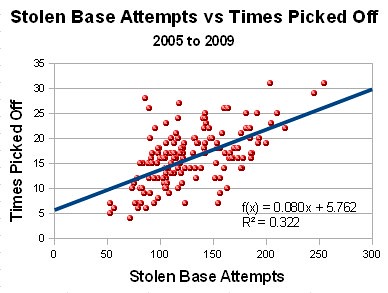
The more aggressive a team is at attempting a stolen base, the more likely they are of getting picked-off. It seems like common sense to me, but I have had too many incorrect ideas to leave it only to instinct. The following graph looks at the attempted steals versus pick-offs for all teams from 2005 to 2009:

As it can be seen, the more aggressive a team is attempting to steal, the more likely they are of getting picked-off. Using the equation of the best fit line, it can be determined that for every 12.5 stolen base a team attempts, one player is likely to get picked off (12.5 attempts * 0.080 = 1).

Note: The relationship between the two values, doesn’t mean that one directly caused the other. There could be other factors at work on the two values.

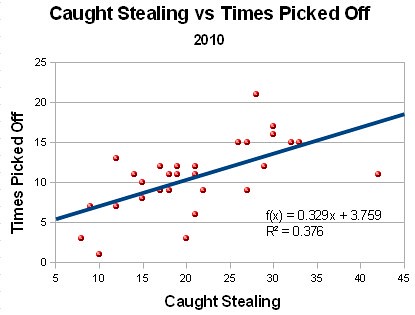
I took this examination one step further and compared the times caught stealing versus time picked-off. I was looking to see if teams that were bad at stealing bases were also bad at getting picked-off:

My hunch was correct in that the r-squared (how closed one set of values correlates to another sets of values) is a bit higher (0.37 vs 0.32) for the caught stealing data. Using the values from the equation, it can be shown that for every 3 times a player is caught stealing, they are likely to be picked-off once (0.32 * 3 = ~1).

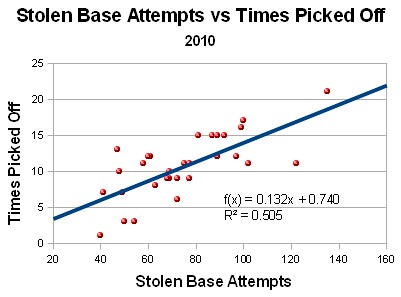
So far this season the numbers are similar to the previous 5 seasons as seen in the following two graphs:

Aggressive base stealing teams are more likely to be picked-off thereby removing a base runner. Rich Lederer proposed back in 2006 that the caught stealing value should include both caught stealing and picked-off numbers. I am not sure how the baseball community would accept that change, but if someone does include picked-off outs into caught stealing values, I could understand the reason why. For now it seems that teams looking to get an extra jump for a stolen base seem get thrown before they have the chance than those that are less likely to attempt the steal in the first place.


Random Musings From The Futures Game

Bryan Smith will take a more specific look at some of the prospects and how they performed in the Futures Game in a subsequent post, and so instead of trying to add to what he’s already done, I’m going to take a different tact. Here are my somewhat random observations from being at the game.

Bryan touched on this in the last podcast, but MLB has to do away with the US vs World format. There is no reason to separate the teams that way, and it leads to a ridiculous imbalance that gives us a game that is far less than what it could be. In talking to baseball people at the game, it was pretty much unanimous that this year’s World Team was as bad as any in recent year, and watching them take BP was almost painful. Realistically, Brett Lawrie was the only guy who started for the World Team who could have cracked the US line-up, and he was followed in the World batting order by eight guys who probably didn’t deserve to even be at the game.

Just throw this format away, go to an AL/NL match-up, and give those of us who enjoy this event the game that it should be. I get that there are extenuating circumstances that keep this from being a true showcase of the 40 or 50 best guys in the minors each summer, but we don’t need to compound those unavoidable issues with a format that forces guys with no major league future to take a spot from far more interesting players. Any format that makes you feature Wilkin Ramirez is irreparably broken. Let’s just get rid of this US vs World theme and start over.

Moving on to guys who belonged here, Mike Trout. Almost all of my pre-game discussions inevitably drifted to how good he was, and that was before he put on a show in both BP and the game itself. Sometimes, the hype train runs out of control on guys like this, but with him, it’s deserved. If he’s not the best prospect in the game right now, he’s close to it, and he doesn’t turn 19 until next month. Crazy good.

You know what’s not crazy good though? Between innings “entertainment” consisting of big screen pong, complete with ridiculously annoying sound effects and no explanation of why we were getting tortured by this randomness. Donkey Kong wasn’t much better. Whichever person in the Angels organization gave that idea the green light deserves a sentence of having to watch every Scott Kazmir outing from now to infinity.

Anyway, I would say a good time was had by all, but I think a few people trying to arrive early for the Legends/Celebrity softball game weren’t so amused to find an actual game being played by kids they’d never heard of still in progress. Besides those folks, however, the game was generally successful, though could obviously be improved upon. Getting to watch the game with Bryan, as well as Rich and Joe Lederer (both good folks), made it even more enjoyable. I look forward to attending more of these in person, and can’t wait for next year’s AL/NL version – right, MLB?


From Yahoo to FanGraphs at the Touch of a Button

Another Edit: Some comments, like this one, have asked about the author of the script. The universally positive feedback for this goes to Justin Swift.

Edit: Commenter CJett pointed out that this script can be readily installed on Google’s Chrome browser as well as FireFox. I’ve edited the post slightly to reflect this addition.

Disclaimer 1: This has nothing to do with my previous post on the Yahoo Fantasy Sports API.

Disclaimer 2: You must be using FireFox or Chrome to enjoy the script described in this post.

Disclaimer 3: I didn’t write the script, so I won’t take credit or blame for it (though it deserves the former).

Now that we’ve gotten that out of the way, let’s get on with business.

Greasemonkey is a FireFox browser extension that allows users to manipulate web pages after loading them. Why is that cool? Because it lets you add a link to FanGraph’s beside each player’s name on Yahoo’s Fantasy Baseball page, like this:

Here’s how to give it a try:

0. If you’re on FireFox, proceed to step 1. If you’re using Chrome, skip ahead to step 2.

1. Install the Greasemonkey plug-in into FireFox. If you don’t have FireFox, I recommend checking it out; it’s a free, high-quality browser. Once you have FireFox, installing Greasemonkey is a one click process, but it does require a browser restart.

2. Install the FanGraphs link script. Before doing so, please be sure to read the userscripts.org disclaimer. If you’re cool with the disclaimer and terms of service, head over to the link script’s page. Click the “install” button and you’re all set. If you’re so inclined, you can check out the script’s source code.

3. Head over to Yahoo Fantasy Baseball, and try clicking the small FanGraphs icon that should now appear beside each player’s name. It should open a link to the player’s FanGraphs page in a new browser tab or window.

4. If you ever want to remove this script from your browser, perform the following steps: on your browsers menu bar, choose Tools > Greasemonkey > Manage User Scripts; highlight Yahoo Fantasy – FanGraphs Link in the list of scripts; and click the uninstall button.

Another disclaimer: I tried this script on two computers, one Windows and one Linux, and it seems to work fine and the source code looks safe to me. But as a rule of thumb, be careful with what you install on your browser. If you aren’t sure if something is safe to install or not, my recommendation is not to install it.

How’s it work?

In a nutshell, after you load a web page in your browser, you have a full html document loaded on your computer for the browser to display. Greasemonkey uses this premise to provide a means to customize the html in your browser. The script that we just installed works because of Yahoo’s good html design. Each player’s name is placed in a container called a <div> which is further defined as “name” (<div class=”name”>). So the script looks for the player names identified in the html, grabs the name from inside the <div> container, generates a link to FanGraphs, and appends it to the original <div> container.


Cliff Lee to Texas for Justin Smoak, Finalized

Everybody thought earlier today that Cliff Lee would be on his way out of Seattle. They were right. Instead of heading to the visitor’s clubhouse in Seattle to join the New York Yankees, however, he joins the division rival Texas Rangers, along with RP Mark Lowe. Coming back to Seattle will be Justin Smoak and three others according to this Joel Sherman tweet. This deal has also been confirmed by Ken Rosenthal, who adds that the Mariners will be sending cash to the Rangers to help cover the $4M that Lee is owed over the rest of the season.

Earlier today, some thought that Jesus Montero was a solid haul for Lee, along with the rest of the package. In that case, the return of Justin Smoak has to be seen as an absolute steal. Smoak had an .885 OPS between three different leagues in 2009. Smoak then posted a 1.010 OPS in 15 games with AAA Oklahoma City before receiving a call-up to the big leagues. His power hasn’t really materialized at the big league level (.145 ISO), but a 13.8% walk rate in 275 PAs is incredibly encouraging, and his .238 BABIP is bound to see a boost.

Smoak was the #13 prospect by Baseball America entering the season, ranking below Montero’s rank as #4. However, Smoak is obviously closer to the big leagues and his position is clear; I feel that Montero’s #4 rank may be influenced by an unrealistic projection of him as a catcher. Smoak is probably better than Matt LaPorta was at the time of the Brewers acquisition of CC Sabathia in 2008, the gold standard of pitcher rental deals. Given that Smoak is already in the big leagues and carries tons of promise with him, the Mariners have to be exceptionally happy with this deal. The deal also includes RHP Blake Beavan, RHP Josh Lueke, and 2B Matt Lawson going to Seattle.

For the Rangers, they pick up the man who has obviously been the best pitcher in the American League. It’s a large boost for a rotation with a meager 4.54 FIP and 4.66 xFIP. Cliff Lee gives them the legitimate ace that just isn’t there with Rich Harden, Scott Feldman, Colby Lewis, C.J. Wilson, Tommy Hunter, Derek Holland, and the others that have inhabited the Rangers rotation this season. Lee could ostensibly be a three win gain for this team down the stretch – likely unnecessary for making the playoffs, as I don’t think the Angels would’ve been able to make up 7.5 games, but this is another nail in the Angels’ coffin. Still, Lee has to increase the Rangers’ chances of making a deep run in the postseason, as he showed he can put his mark on a series last season.

This trade also has the interesting dynamic of being an intradivisional trade. Picking up Lee means certainly avoiding him in the remaining games that Texas has against Seattle. At the same time, though, the Rangers traded an exceptional hitting talent to a team that they play 20 times a season for the next six years. My initial reaction is that this trade is a dangerous proposition for the Rangers. With Lee only on their team for the next three months, the Rangers have to hope for instant gratification, in the sense of a World Series victory, as this trade has the potential to bite them for years to come.


The Decision (Outfield Version)

I know that it’s a bit early to be speculating on possible 2011 free agent destinations, especially with certain monster sports stories taking up so much of the airwaves. But I’m sorry, I just have to talk about something other than Jermaine Dye and Jarrod Washburn still being free agents. However, after my posts on Jayson Werth (Monday) and David DeJesus (Wednesday), I have realized that something big is brewing in the coming off-season of baseball free agency. Something that will radically alter the way we think of how free agents conduct themselves from now on. You see, I think some players are going to make a joint Decision that will lead to a stacked outfield in one lucky city.

The Rays’ Carl Crawford is probably going to be the most sought-after free agent outfielder this winter. He has the most diverse set of skills, and won’t even be 30. But as he learned in 2008, he can’t win a championship all by himself. That’s where Werth, the second best free agent outfielder, comes in. He has that essential “championship experience” (a ring!) from 2008 with the Phillies that Crawford is “missing.” But they need a third player to complete their Death Tripod. It doesn’t have to be a player on their level, but someone who is definitely good, someone underrated, someone who will be a free agent this offseason. Someone like David DeJesus. Yes, I did write in my DeJesus post on Wednesday that if the Royals did (foolishly) decline his option and offer him arbitration that he would be likely to take it, but others seem to think he’s valuable enough that he would turn down arbitration to check his value on the market, with others making oblique Carlos Beltran (~!) references. Hey, what do I know? All I know is that it makes sense: these three are going to (if they haven’t already!) collectively decide to be on the same team next season. Sure, none of them is really a point g– I mean center fielder, but all of them have played it a bit at some point in their careers, and it would still be a plus defensive outfield overall.

But where would they sign? I think the obvious starting point is that is will be in a state known for its rich MLB tradition: Florida. But how to decide between two teams with such a rich legacies? Let me lay out the two most likely scenarios.

Scenario #1: All three meet in Miami. Isn’t it obvious? Sure, the Marlins have some okayish young outfield prospects, but they can trade those away for veteran pitching for the back of the rotation and middle relief. Some might doubt that the Marlins will open up their wallets after all these years (especially given all the draft picks they’d have to give up to sign these guys), but with a new stadium coming soon, a man of integrity like Jeffrey Loria isn’t just going to pocket the profits, right? It will be bitterly disappointing for Tampa Bay fans to watch homegrown superstar Carl Crawford play in the same, baseball-crazed state, but he will assuage their anger during his hour long special on the MLB network (hosted by Harold Reynolds) announcing his Decision to sign with the Marlins.

Scenario #2: Tampa Bay shocks the world by retaining Carl Crawford by essentially bribing him to stay by bringing in longtime friends Werth and DeJesus. Yes, Tampa Bay has a pretty small payroll, but these guys are willing to take less to win championships. Desmond Jennings obviously needs three or four more years to work on his “approach” in the minor leagues (they can always try to convert him to a catcher), and B. J. Upton needs to be non-tendered to teach him a lesson about “attitude.” The only snag is the potential rioting in Kansas City after DeJesus announces his Decision via a 15 minutes infomercial on public access cable.

Which scenario do you think is more likely? Is there another possible destination for the Outfield of Doom?


Futures Game Preview: The World Pitchers

This is my final Futures Game preview, before Dave Cameron and I head to California to get a look at these players. Previously, I have written about the World offense, and the United States team, both offense and pitching staff. Today, we close with the World pitching staff.

Henderson Alvarez | RHP | Age 20 | Toronto Blue Jays | High-A (FSL)
18.7 K% | 5.2 BB% | 0.6 HR/9 | 1.64 GO/AO

What an inning will look like: Alvarez is going to come out firing his sinking fastball, which he commands well, and now can enter the mid-90s with. The far more interesting development will be his secondary pitches: a guy allowing a batting line of .364/.423/.486 to left-handed hitters surely has work to do on his changeup, and he’s never received raves for his breaking ball.

What he profiles as: Right now, it’s a reliever. There’s a lot of value in a guy that brings velocity, sink, and command, and if we see a velocity spike on Sunday — really the first time the Blue Jays will have seen him in that capacity — it could plant a seed in their head. Before that decision is made, though, they’ll continue to work on his offspeed stuff.

Simon Castro | RHP | Age 22 | San Diego Padres | Double-A (Texas)
24.4 K% | 7.7 BB% | 0.4 HR/9 | 1.36 GO/AO

This has been a bit of a weird season for Castro. On May 23, his ERA stood at 1.75, his GO/AO ratio was 2.18, his K/9 was 7.19, and he had allowed three home runs in 51 innings. Since then, Castro hasn’t been bad, but he’s been different: a 4.24 ERA, 0.63 GO/AO, more than a strikeout per inning and just one homer allowed in 34 innings.

The real Castro is something far closer to the latter version: a true flyball pitcher with swing-and-miss stuff. This is hardly a bad thing when you profile to pitch at PETCO Park, as he’ll definitely see an up-tick in his HR/FB numbers when he moves past Double-A. I can’t wait to see him and his slider on Sunday.

Jeurys Familia | RHP | Age 20 | New York Mets | High-A (FSL)
26.3 K% | 15.7 BB% | 0.3 HR/9 | 1.59 GO/AO

What an inning will look like: If Familia pitches — and I’m guessing that’s no sure thing since he threw yesterday — we will see a lot of fastballs. The great U.S. offense is likely to draw a few walks off Familia, as he’s the most wild pitcher in this game. He’ll pitch into the mid-90s with a heavy fastball, but he doesn’t really know where it’s going.

What he profiles as: A reliever, if a Major Leaguer at all. It’s hard to believe that some pitching instructor can’t help Familia harness his stuff, but it wouldn’t be the first time it didn’t work out.

Trystan Magnuson | RHP | Age 25 | Toronto Blue Jays | Double-A (Eastern)
23.2 K% | 4.0 BB% | 0.2 HR/9 | 1.33 GO/AO

The pride of Marc Hulet and his fellow Canadian baseball fanatics, Magnuson was a first-round pick by the Blue Jays out of Louisville. He’s now a competent middle relief prospect, daunting if more for his size (6-foot-7) than his stuff. This is the problem I have with the Futures Game — more concerned with meeting some country quota rather than bringing us the game’s future. Oops, sorry Marc.

Hector Noesi | RHP | Age 23 | New York Yankees | A+ / AA
9.2 K/9 | 1.5 BB/9 | 0.7 HR/9

He doesn’t have the same kind of funk, but at this point, Noesi is beginning to remind me of Yusmeiro Petit. They are both little dudes that just kept succeeding in the minor leagues, but without a lot of backing from scouts. Noesi trades some better movement for a little less deception, and now that he’s dominating Double-A (23.8 K%, 4.8 BB%), people are beginning to wonder if we were all wrong about Noesi. However, I think Sunday will show that at the end of the day, he’s pretty unexciting. And when he gets to Yankee Stadium, balls are going to start leaving the yard with more frequency. Because, while it once was, comping Yusmeiro Petit (5.44 career FIP) is no longer a compliment.

Stolmy Pimentel | RHP | Age 20 | Boston Red Sox | High-A (Carolina)
17.8 K% | 7.4 BB% | 0.7 HR/9 | 1.42 GO/AO

What an inning will look like: Pimentel is better visually than his numbers would indicate. We could see 93-95 mph in a short inning’s work, and he’ll mix in a curveball and changeup. The strength of those two pitches is pretty inconsistent, and is represented by the difference between his starts on May 15 and 27 (two six-inning no hitters) and his start on June 26 (10 H, 8 ER in 2.1 IP).

What he profiles as: This has been a bit of a disappointing year for Pimentel, because while he’s had those wildly varying starts listed above, his most common result has been something like 3 runs allowed in 5 innings. His strikeouts have been down and his walks have been up of late, and some bad performances have resulted. Sunday will really answer the question: Is something wrong with Stolmy Pimentel?

Eduardo Sanchez | RHP | Age 21 | St. Louis Cardinals | AA / AAA
9.1 K/9 | 2.9 BB/9 | 0.9 HR/9

While Sanchez will be fun to watch — got to love the 5-foot-11 guys that might touch 98 mph — he isn’t exactly an inspired choice. Sanchez has a chance to help the Cardinals in the second half, as his fastball/slider combination is pretty good. A scoreless inning at the Futures Game wouldn’t be a huge surprise. But there were better options out there, and future set-up men aren’t what this game is about.

Julio Teheran | RHP | Age 19 | Atlanta Braves | A- / A+
10.5 K/9 | 2.2 BB/9 | 0.5 HR/9

What an inning will look like: Well, it will look really good, because this is the inspired choice this game is all about. Teheran is in the short discussion for the best pitcher in the minor leagues, and I can’t imagine how his stuff will play up in an inning. I expect the fastball to be 95-98 mph, and he should dazzle with his curveball and changeup. Teheran is a reason to watch this game.

What he profiles as: I know it’s boring to say a future ace and move on, but that’s really it. Good things happen to people that have feel and command for a 95 mph fastball and a plus (or plus-plus) changeup.

Alex Torres | LHP | Age 22 | Tampa Bay Rays | Double-A (Southern)
29.9 K% | 12.7 BB% | 0.4 HR/9 | 1.67 GO/AO

It took an injury to get Torres to the Futures Game, and I’m glad he’s here. He’s one of the more unique pitchers that will be in Anaheim, because he can throw any pitch in any count, but more poignantly, he can throw it anywhere. Torres is wild, but while effective now, it needs controlling before he makes it to the Major Leagues. Perhaps something resembling the career path of Brian Fuentes is in play, but considering the Rays pitching depth, they can take the time to spend a few years working on that command.

Philippe Valiquette | LHP | Age 23 | Cincinnati Reds | AA / AAA
7.1 K/9 | 5.0 BB/9 | 0.2 HR/9

If this Canadian southpaw had a different name, would he be planning a trip to Orange county this weekend? With that said, I need to catch a flight. More from Anaheim this weekend!