Happy Friday, and welcome to this offseason’s first installment of the Matrix Reloaded column. There has already been plenty of activity ahead of the 2025 Winter Meetings, which kick off this Sunday in sunny (well maybe, I haven’t actually checked the weather yet, and also it doesn’t matter because I won’t be going outside) Orlando, Florida. Since this is my first roundup of the winter, let’s start with a refresher on how the Matrix works.
My precious, color-coded spreadsheet has plenty of tabs for your perusal, but my bread and butter is the main FA Matrix tab, which includes a self-explanatory summary of signings at the top and a somewhat less self-explanatory color-coded summary of rumors concerning unsigned players further down. The FA Legend tab right next door will be helpful in decoding it, but here I’ll note that what I classify as a rumor is fairly subjective, as the lines between things like “interested in,” “kicking the tires,” “have looked into,” and “believed to be interested in” are pretty blurry. All rumors are linked to each colored cell, and I encourage reading them for further context beyond how I’ve bucketed them into groups.
With all that out of the way, let’s get into the deals that actually have been completed in the last week or so. For larger moves, I’ll be hitting on three key points: how the deal affects the signing team; how it affects other teams; and how it affects similar players. For smaller deals, I’ll be more rapid-fire and talk only about the signing team; other teams aren’t going to react too strongly to a $2 million bench player inking a new deal. Read the rest of this entry »
Eric A Longenhagen: Good afternoon from my mom’s breakfast nook in Port Charlotte! I fly to Florida a few days early to see family before trekking up to Orlando for Winter Meetings. I can’t wait to do Disney character voices for my peers.
12:17
Eric A Longenhagen: I expect chat will be closer to 45 minutes today because I have to wrap up my analysis of last night’s Pirates/Red Sox trade.
12:17
Eric A Longenhagen: SO let’s get to it.
12:18
AB: Curious to know if you have anything on Seojun Moon that the bluejays signed earlier?
12:19
Eric A Longenhagen: Yeah, really well-built Korean kid sitting about 93. Prototypical 6-foot-3 frame, good-looking delivery, command is kind of erratic. Probably would have been a top three pick in the KBO draft, looks like a million dollar arm to me. Maybe got a little more because late-market guys tend to, not a terrible consolation prize for being the Roki runner up.
12:19
AB: Wondering if you know anything about the Florida bridge league, any Jays standout and how was Jojo Parker?
The Tampa Bay Rays have signed outfielder Cedric Mullins, late of the Mets and Orioles, to a one-year contract worth $7 million. This deal makes a lot of sense if you look at Mullins’ overall numbers from 2025: 17 home runs, a 10.0% walk rate, and a 94 wRC+ from a guy who can run well enough to play center.
That sounds like a pretty good player, and for just $7 million. Inflation’s so bad these days that $7 million is reliever money on the free agent market — not even good reliever money — and for that the Rays got themselves a fringe-average center fielder. Read the rest of this entry »
It’s been a busy December for free agent relievers. Ryan Helsley and Devin Williams, two of the most interesting names on the market, eachsigned with new clubs, and they each got multi-year guarantees despite shaky 2025 results. The next shoe to drop wasn’t quite as heralded of an option, but he too got multiple years and beat market consensus. The signing in question: Emilio Pagán and the Reds agreed to a two-year, $20 million deal, with an opt out after the first year.
Pagán was a far more effective reliever in 2025 than either of the two splashier names ahead of him. He had one of the best seasons of his career at age 34, in fact: 68 2/3 innings pitched, a 2.88 ERA and 3.72 FIP in hitter-friendly Cincinnati, and 32 saves in his first full-time closing job since 2019. He bounced back from an injury-interrupted 2024 with better fastball velocity and better pitch shape across the board, and got richly rewarded for it with a 30% strikeout rate. Is he homer-prone? You bet, thanks to a 0.51 GB/FB ratio. But a .200 BABIP and a solid HR/FB% (10.8%) meant that he actually allowed fewer homers per nine innings (1.31) than his career mark (1.51), and not by a small amount, despite pitching in a launching pad.
When things are going well for him, Pagán makes everyone think they can hit a home run, then pulls the rug out. He runs his four-seamer high and spots a heavy splitter off of it, a classic fly ball pitcher mix. It’s one of those strategies that looks awful when it isn’t working, and yet seems to come through most of the time anyway. More specifically, Pagán went through a three-year stretch of terrible form from 2020-2022, posting a 4.61 ERA and 4.71 FIP. Then he broke out in 2023 and has been solid since. The weirdest part of it all? His stuff and command metrics barely budged between those two wildly different stretches.
Reversals like that go a long way toward explaining why reliever performance is so difficult to predict. When Pagán has it, he’s a worthy late-inning reliever. His ERA- was 40th among relievers last year, and it’s 60th over the past three years, even with his ineffective 2024 in the mix. He’s pitched like you’d expect a closer or setup man to, in other words. His FIP tells a broadly similar story, and I’m willing to believe that pitchers with his extreme tendencies outperform their FIP in the long run. If you get good Pagán, he’s a very useful bullpen piece, the kind any team would love to have in the bullpen and many fringe contenders would love to have as a closer.
That’s the calculus from the Reds’ perspective. They’ve managed their payroll tightly in the early years of Elly De La Cruz’s team control window, hovering around the $100 million mark with wiggle room in either direction. With that budget constraint in mind, the top five or so relievers in this free agency class were presumably off the board. The next tier down is a mixture of interesting pop-up arms, aging closers, and reclamation projects. Would you rather have Kenley Jansen or Pagán? Seranthony Domínguez? Kyle Finnegan? Phil Maton? Maybe Drew Pomeranz? I think I’d take Pagán or Jansen over the field – I ranked them that way in my Top 50 Free Agents list – and as an added bonus, he’s already familiar with Cincinnati. I’d take Raisel Iglesias over him – rankings, again – but he signed for one year and $16 million, probably outside of this team’s price range. The Reds probably could’ve gotten some solid lefty specialists for the $10 million or so annual salary that they gave Pagán, but that’s not what they were in the market for this winter. They needed a bankable closer, and in the aisle they were shopping in, there weren’t that many options.
This team really does need relief arms. The Reds didn’t have to cover many bullpen innings in 2025, but even then they struggled to piece it all together. Pagán, Tony Santillan, and Graham Ashcraft formed an effective three-headed monster at the top, but the rest of the pen was ineffective even in limited time. With a bandbox for a home stadium, it’s hard to expect a similarly limited need for relief pitching in 2026. This was the path of least resistance for a team that really does need to do something to challenge for the NL Central title in 2026 and build on its surprising 2025 Wild Card berth.
Now, the risks? They’re real. It was only a year ago, after his down 2024 performance, that Cincinnati fans were lamenting Pagán’s decision to pick up his player option for 2025. More innings and a .200 BABIP turned that frown upside down, but it’s not like it’s impossible to imagine an ineffective Pagán. Would you be shocked if he had an uneven, homer-prone 55 innings in 2026 and then picked up his option? I certainly wouldn’t be. We just saw that!
That leaves me in the situation of liking this deal more for Pagán than for the Reds, and yet I’d make this offer if I were in their shoes anyway. Figuring out which relievers will be good in a year’s time is incredibly difficult. If it were easy to solve, the Dodgers wouldn’t have signed Tanner Scott and Blake Treinen last winter and then spent this entire October hiding them. Despite that difficulty, relievers are integral to a contending club. If you aren’t winning the close games, it’s hard to make the playoffs. The Reds likely wouldn’t have done that last year if not for Pagán.
With that backdrop, what were the Reds supposed to do? Sign a different, similar guy for slightly less? Sign two reclamation projects on one-year, $5 million deals? It’s not even like the second year is that much of a disaster; in a year’s time, they’re going to be contending with a core built around De La Cruz and looking for relievers, and I don’t think the market rate is likely to plummet in the meantime or anything. Sure, you might get bad Pagán in 2026 and then have him opt in, but the inherent volatility of relievers means that even that isn’t a tragedy. It worked out last time!
There’s some chance that Cincinnati could have waited longer, negotiated more stingily, and reached a slightly more team-friendly deal with him. So far, Pagán is the early signing whose market has most outstripped my projections. But who cares? What were the Reds going to do, save a million dollars or two? From their perspective, the risks were greater, because if they dragged their feet in negotiating with Pagán and he signed elsewhere, they’d suddenly be sifting through a variety of relievers they’re presumably less interested in with a strong need to find a deal. I’d prefer to overpay slightly for a guy I’m comfortable with than hunt for unknown bargains to fill an essential role, and it seems the Cincinnati front office thinks similarly.
I’m not convinced that this is a great long-term way to run a team. It certainly wouldn’t be my preference in a vacuum; I’m a Rays/Dodgers/Brewers-style bullpen guy at heart. I love reclamation projects and throwing a lot of relievers at the wall to see what sticks. I love betting on guys with elite stuff and seeing if they can figure out how to throw strikes, or betting on guys with elite command and seeing if they can figure out how to throw harder.
I’m also not running the Reds, staring at two superstars in De La Cruz and Hunter Greene and trying to make the playoffs again after a miracle run. Sure, it would be great to build an incredible pitching development system from the ground up. But it’s December, and the season starts in four months, and that’s not enough time to overhaul an entire organization, not even close. The Reds needed a reliever. They got a guy they’re comfortable with at a rate that won’t force them to cut back elsewhere. Maybe it’s a slight overpay, and maybe he’s more volatile than his 2025 results would suggest, but for the Reds? He’s just what they needed.
When the Red Sox traded forSonny Gray, they knew they were getting an old-school starter with seven pitches. He’s got a sinker and a four-seamer. He’s got a cutter, a traditional slider, and a sweeper. He’s got a curveball and a changeup. The traditional slider is the only one of the seven that Gray doesn’t throw regularly; the others all saw at least 15% usage against righties or lefties in 2025. Gray is 36 years old. He’s a three-time All-Star with 330 starts and 125 wins under his belt, and a career ERA of 3.58. At this point, you might assume that he’s about as finished a product as you could find, but you’d be wrong, and that seems to be part of the reason he’ll be pitching in Boston next year.
In 2024, the Red Sox made waves for throwing fastballs just 36.6% of the time, the lowest mark ever recorded and almost certainly the lowest mark of all time. That number went up in 2025, in large part because they added Garrett Crochet, who owned a brand-new sinker to go with a four-seamer that was one of the very best pitches in baseball 2024. But it wasn’t just Crochet. Brayan Bello brought back the four-seamer he’d ditched in 2024. A finally-healthy Lucas Giolito threw four-seamers at his highest rate since 2020. With Aroldis Chapman replacing Kenley Jansen, the closer role saw fastballs replace cutters. In all, the Red Sox finished the season with a fastball rate of 48.3%, the 11th-highest in the league. That’s quite a bounce-back. The Red Sox were very explicitly trying to get away from fastballs, but as the 2025 season showed us, the broader goal was to have their pitchers throw their best pitches more often.
That brings us to Gray, who throws the kitchen sink but still throws fastballs 40% of the time. In 2025, he led with his four-seamer against lefties and his sinker against righties, throwing both pitches 29% of the time in those situations. Shortly after the trade went through, Boston’s chief baseball officer Craig Breslow discussed it with reporters. MLB.com’s Ian Brown published a quote: “It will be a great match for Bails [pitching coach Andrew Bailey] and the rest of the pitching group and the philosophies they have in terms of leaning into strength and potentially away from slug and pitching away from fastballs when you have secondaries as your best pitch.” Read the rest of this entry »
This past Sunday’s Notes column led with a look at Sonny Gray, so my joining in on his introductory Zoom session with the Boston media on Tuesday was mostly a matter of practicality. There are always things to learn — typically pieces of information that are useful down the road — when a trade acquisition takes questions from reporters. I wasn’t expecting to feature the veteran right-hander any time soon.
But then I asked Gray a question, and not only did he answer it thoughtfully, his response was meaty. The newest member of the Red Sox starting rotation spoke, uninterrupted, for a full five minutes. What he said is well worth sharing.
Here is what I asked, and — lightly edited for clarity — Gray’s expansive reply.
In April 2023, we talked about how you’ve evolved as a pitcher. Do you think you’ve settled in to who you’ll be going forward, or do you foresee any changes with your repertoire or usage?
Gray: “I hope there are changes, to be honest with you. If you’re not constantly changing, and you’re not consciously adapting, then I think that you’re going to be stagnant. Right? 2023 was a good jump for me. I added a few things. I changed a few things. But I kept the core of me together. I kept who I am.
“I spin the ball. I spin the ball better than anyone in baseball. That’s a fact. I still have enough velo to allow that to play. That’s a fact. I can take my fastball and go both ways with it, just as good as anyone. I still get my strikeouts. Read the rest of this entry »
The Chicago White Sox got on the board in free agency on Wednesday morning, inking left-handed pitcher Anthony Kay to a two-year, $12 million contract with a $10 million mutual option for 2028. Kay will make $5 million in each of the next two seasons, with a $2 million buyout due if the mutual option isn’t exercised.
It’s been a huge week for the trans-Pacific starting pitching exchange, with Matt Manninggoing over to the KBO and Cody Poncecoming back in the other direction. Kay spent the past two seasons pitching for the Yokohama DeNA BayStars of NPB — and pitching quite well, it bears mentioning: In 24 starts and 155 innings this past season, Kay posted a 1.74 ERA and a 2.55 FIP. That ERA is a couple tenths better than what Tatsuya Imai, this offseason’s hot Japanese pitching import, posted this season. Read the rest of this entry »
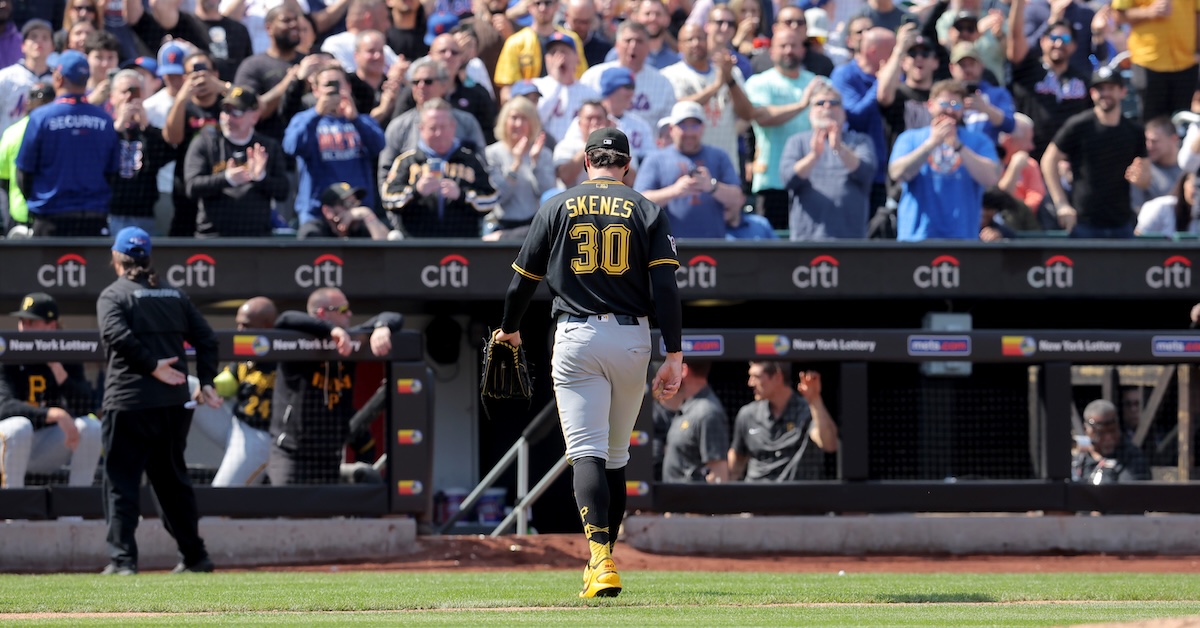
Last week, MLB announced the distribution of the pre-arbitration bonus pool. You probably saw roughly one headline from this: Paul Skenes earned a record $3,436,343 bonus for his spectacular sophomore season. That is indeed great news, in my opinion. Skenes was one of the most exciting and best players in baseball in 2025, and a compensation system that more closely aligns skill with salary is a no brainer to me. But while Skenes’ record haul drew the headlines, the vast majority of the $50 million pool was spread widely; 101 players received bonuses, with all 30 teams boasting at least one awardee.
I’m here to tell you that I think this is a wonderful development. The fund, established in the most recent collective bargaining agreement, takes in $1.67 million from each team every year to fund its $50 million payout. It hands some of that money out to award winners, from $2.5 million for Skenes’ Cy Young Award win down to $150,000 for Daylen Lile’s fifth-place Rookie of the Year finish. The rest goes to the top 100 pre-arbitration players in a WAR formula jointly calculated by MLB and the MLBPA according to a set ratio.
This didn’t feel like a huge part of the CBA at the time it was signed, but in my opinion, it’s been an incredible boon for the game. Baseball’s compensation system has always been out of whack. The service time system limits all pre-arbitration players to the minimum salary, more or less. Teams do occasionally award salaries slightly greater than the minimum ($760,000 in 2025), but generally by a de minimis amount: The Pirates paid Skenes $875,000 this year, for example.
That flat structure means that under the old system, Skenes would have earned roughly $1.6 million in 2024 and 2025, instead of the $7.2 million he’s pocketed under the new system. You can’t convince me that that’s a bad thing. Cristopher Sánchez is an even better example, because unlike Skenes, he didn’t have a huge signing bonus as an amateur — not to mention all the ancillary income the Pittsburgh superstar earns through his various endorsement deals as one of the most recognizable players in the sport. Sánchez just eclipsed three years of service time; through the end of 2024, the Phillies had paid him around $2.5 million in salary for his first two-plus major league seasons. He signed a contract extension that paid him $3.55 million in 2025, bringing his career contractual earnings up to roughly $6 million. Thanks to the bonus pool, though, he’s received an additional $3.5 million over the last three years. That’s a huge difference, and in a clearly good direction for money to flow. Read the rest of this entry »
Up and in, low and away. That’s how you attack hitters. That’s always been how you attack hitters. There are exceptions, of course. Some hitters struggle with low-inside pitches, so they see more of them. Some hitters are so feeble that pitchers just pump fastballs down the middle and dare them to do their worst. Some pitchers just throw their best pitch and don’t bother worrying about the hitter at all. But most of the time, it’s up and in, low and away. Ben Clemens wrote about a version of this yesterday, in a piece that focused on the data behind why pitchers throw inside fastballs. And the toughest inside fastballs to hit are those thrown up and in.
Pitchers have been throwing hard stuff up and in for as long as they’ve been throwing hard stuff, but Statcast’s new bat tracking data allowed us a new peek at why that’s such a successful game plan. The heat map for bat speed below is extra red because it belongs to Aaron Judge, but insofar as the least red spot is the high-inside strike, it might as well belong to any hitter.
It’s harder to get your bat around up there. It requires a stiffer, more rotational (as opposed to linear) swing. You can’t get your arms extended. You can’t drop your bat head on the ball. Bust somebody up and in with something hard, and they’ll have a tough time catching up to it; now confirmed by science.
Because we are not Ben Clemens, we’re going to focus on down and away today, and we’re going to focus on batters. As you can see from Judge’s heat map, bat speed tends to be slower down there too. We’re no longer just talking about getting your arms extended. You have to modify your swing to reach pitches that far away, bending and reaching, slowing down your bat because the optimal contact point is deeper. If there’s one thing we’ve learned from bat tracking data, it’s that those kinds of adjustments make you hemorrhage bat speed. Low and away is also where trickier pitches like offspeed and breaking balls tend to end up. Nobody is good against those pitches, and I do mean nobody.
See the spot in the heat map that says 77.0 mph, inside the strike zone, but on the outer third and in the bottom third? Since 2008, 225 left-handed batters and 297 right-handed batters have seen at least 500 pitches in that low-and-outside box. According to Baseball Savant’s run values, not one of those players has a positive run value against those pitches. Not one! Every single player has been below average in that particular box, and that’s not true of any of the other 12 boxes. The two players who have come closest to breaking even on those low-and-outside strikes are Hall of Famer David Ortiz, who has been worth -0.08 runs per 100 pitches, and future Hall of Famer Mike Trout, who has been worth -0.4. It’s just not possible to perform well against that pitch (at least not without eschewing the rest of the strike zone, but no one would ever do that), even if you’re literally Mike Trout.
So we’ve established that the low-outside strike is hard to hit. It took 500 words, but we’re here now. The heat map below belongs to James Wood, and it’s part of the reason we’re talking about pitching people low and away. The numbers in this heat map show run value per 100 pitches, and they show why Wood is the poster boy for difficulty down and away.
After a season and a half in the majors, Wood is the proud owner of 4.6 WAR, a 125 wRC+, and one of the most explosive swings in the game. That’s amazing. He’s just 23 years old. He looks like he will be great for at least another decade. He’s also the owner of this particularly lopsided heat map. He’s patient to a fault, which means that he’s excellent on pitches outside the strike zone. He’s great when he can get his long arms extended or when he can drop his bat head on the ball. But throw him something, anything down and away but still inside the zone, and he turns into a (very imposing) pumpkin.
If you’re a regular FanGraphs reader or just a fan of the Nationals (or Padres), you’ve likely known the book on Wood since long before he actually debuted in Washington. He’s really big. He hits the ball really hard. He hits it on the ground. He whiffs a lot too. Major league pitchers knew the book as well, and they most definitely saw some earlier version of that heat map the second the Nationals called Wood up in July 2024.
I can say that for certain because even though he was just a 21-year-old rookie, 24.2% of the pitches Wood saw were located in those three blue boxes. Among players who saw at least 1,000 pitches, that was the highest rate in baseball (switching the side of the plate around for right-handers, of course). In 2025, that rate fell to 23.8% and Wood fell to third place, behind Dansby Swanson (24.5%) and Tommy Pham (24.2%). What those numbers mean is that from the moment he debuted, pitchers have known that the only way to attack Wood was to stay the hell away from his gigantic bat. Aim for the outside corner, keep it low, and hope for the best.
In a narrow sense, that strategy has been wildly successful, as those three blue boxes can attest. In 2025, 457 players saw at least 100 pitches within those boxes. Wood’s 50% swing rate ranked 376th, meaning he took way more called strikes than the average player. When he did swing, his 28.7% whiff rate was tied for 426th place, meaning that he ended up with way more swinging strikes than the average player. When Wood put the ball in play, he was more successful than the average player, because of course he was. Even though that’s the spot where he has his lowest bat speed, lowest exit velocity, and lowest launch angle, he still hits the ball so hard that it can’t help but find grass. He ran a .418 wOBACON on those pitches. But that’s not enough to mitigate all those extra strikes.
In a broader sense, that plan has its limits. Aiming for the corner against a player as patient as Wood means that when you miss, you’ve got a higher chance of missing the zone entirely, and Wood is so patient that he’ll make you pay for it. Once you’re behind, you have to hit the heart of the zone. More importantly, this is something of a desperation move. For years now, the trend across the league has been toward throwing the ball right over the middle and trusting your stuff to do the rest. The fear of grooving a pitch to Wood is driving pitchers toward an older, less successful game plan. Wood is bad at handling that pitch, but so is every hitter on earth. He’s seeing so many pitches there because against a hitter like him, all the options are suboptimal. Wood may not get to the next level as a hitter until he can find a way to cover more of the strike zone, but he’s young and he’s still learning. He may well get there. In the meantime, he’s still striking fear into the hearts of pitchers, and they’re doing their best to stay away from him.
“He has the best stuff on the staff. His pitches move all over the place.”
Those words, which were spoken to me in the Progressive Field press box in late September, came from someone who had not only seen the Cleveland Guardians on a regular basis throughout the season, but a person whose background also includes having played in the big leagues. His assessment of 25-year-old left-hander Joey Cantillo was based both on experience and expertise. (As we were chatting informally, I’m opting not to quote him by name.)
Cantillo’s numbers in is first full major league season suggest that he has a bright future. Initially pitching out of the bullpen, the Honolulu native moved into Cleveland’s starting rotation in early July and proceeded to log a 2.96 ERA, a 3.21 FIP, and a 25.9% strikeout rate over 13 outings comprising 67 innings. Counting his 21 appearances as a reliever, he put up 3.21 ERA, a 3.55 FIP, and a 26.9% strikeout rate over 95 1/3 frames in 2025. All told, Cantillo held opposing batters to a .217 average and a .289 wOBA.
The southpaw was originally drafted by the San Diego Padres in the 16th round of the 2017 draft out of a Kailua, Hawaii high school. (Coincidentally, two picks earlier, the Minnesota Twins took Cleveland reliever Cade Smith out of a British Columbia high school, only to have him eschew signing and attend the University of Hawaii). The Guardians subsequently acquired Cantillo in August 2020 as part of a nine-player trade that included Mike Clevinger, Austin Hedges, and Josh Naylor.
Cantillo sat down to discuss his development path and his four-pitch arsenal in the final week of the regular season.
———
David Laurila: How much have you changed since coming here from San Diego?
Joey Cantillo: “A bunch. When I first got here I wasn’t really throwing very hard. I was one of those guys where it was like, ‘Hey, if he can throw harder he could really do some good things.’ Getting here, it was, ‘Hey, let’s start to move the body faster, get the body in better positions and use it better.’
“That’s what we focused on those first couple years, and it was a struggle. When you’re out there on the mound thinking about things like body positions, it takes away from your over-the-plate focus at times. I needed to learn to balance that. Mechanics and competing are two different things.”