Archive for Daily Graphings

Prospect Notes: Updating the East Valley Clubs

Jonah Bride
Gregory Fisher-USA TODAY Sports

You can read previous installments of our prospect notes here.

I’m touching up prospect lists using the same complex-based clustering as usual, incorporating notes from my in-person looks, sourced data, and the opinions of pro scouts. Up is the group of teams based in Phoenix’s East Valley, with a focus on the Cubs largely due to the depth of their system, making them the team most likely to be motivated to part with prospects between now and the trade deadline. Players whose Future Value grade changed have an “Up” or “Down” arrow in the “Trend” column on The Board.

Oakland Athletics

Jonah Bride and Jordan Diaz move into the 40+ FV tier on the strength of their bat-to-ball skills. Bride, who recently made his big league debut and is currently on the IL, is a recent (part-time) catching convert who would be stuffed in the 45 FV tier if his ball-blocking and receiving had progressed more quickly and I felt more confident that he could catch often. It’s still possible that he could turn into a role player with this sort of special versatility if his defense behind the plate continues to improve, but because he can hit, Bride is at least going to be a solid part-time infielder, with third base his most natural position.

The long-term athletic projection concerns that have been a part of the 21-year-old Diaz’s profile for the duration of his young career continue to apply, and it counterweights the fact that he’s performing so well (.293/.342/.537, a 121 wRC+ as of Tuesday) as a college-aged hitter at Double-A. But Midland isn’t exactly hitter-friendly, and his feel for contact is freaky enough to value him as more than just a corner bench player.

Mason Miller (scap strain) hasn’t pitched all year after sitting upper-90s with a plus slider during late-2021 looks in Mesa. Neither has titanic 23-year-old righty Jorge Juan, due to a multitude of issues. In addition to elbow treatment, he has had setbacks unrelated to the original injury while rehabbing. He was DFA’d and re-signed to a minor league deal after being a bold, surprising 40-man add in the offseason.

A-ball righties Blake Beers (plus slider, late-bloomer traits, a great day three draft find) and Yehizon Sanchez (lanky, above-average arm strength and curveball) have been added to the A’s prospect list, and their full scouting reports are available over on The Board. Read the rest of this entry »


Jesse Winker’s Showing More Punch Lately

Jesse Winker
Joe Nicholson-USA TODAY Sports

It’s been an eventful couple of weeks for Jesse Winker. On the heels of an exceptional but injury-shortened campaign with the Reds and then a mid-March trade to the Mariners, he hasn’t exactly lived up to expectations, yet earlier this month, the team signed him to an extension that will carry him to free agency. On Sunday, Winker found himself at the center of the season’s biggest brawl, a spectacle that produced some unexpected payoffs as well as a boatload of suspensions, including a seven-gamer for the 29-year-old left fielder.

The atmosphere on Sunday in Anaheim was already tense in the wake of Mariners reliever Erik Swanson sailing a 95-mph fastball too close to the head of Mike Trout — who last week in Seattle homered five times in a five-game series, with four of the homers decisive — in the ninth inning of Saturday night’s game. Trout was understandably upset, though Swanson claimed he was merely trying to work up and in to a weak spot in the three-time MVP’s strike zone. The Angels, who lost after Trout was subsequently intentionally walked and then Shohei Ohtani retired, weren’t amused; as the epic breakdown from Jomboy Media showed, they spent a lot of time glaring and squawking as the Mariners celebrated their victory.

On Sunday, things escalated quickly. Angels starter Andrew Wantz’s fifth pitch of the day, a 93-mph fastball, whizzed behind the head of Mariners rookie Julio Rodríguez, prompting a warning from home plate umpire John Bacon. Winker came to the plate to lead off the second inning and was hit in his right hip by a 91-mph fastball. After jawing with catcher Max Stassi, gesturing toward Wantz and stepping out in front of home plate, he headed toward the Angels’ dugout, where he was met by a rather large contingent. His teammates quickly joined him, and a full-on scrum ensued, with Winker and teammate J.P. Crawford among those throwing punches.

Wantz, incidentally, was a last-minute replacement for scheduled starter Jose Suarez and was making his first major league start after 32 relief appearances dating back to last year. The Mariners later said that they believed the switch was made with the intention of Wantz acting as an enforcer, and that the 26-year-old righty should have been ejected after nearly hitting Rodríguez, but in his postgame comments, Wantz denied any intent with regards either to that pitch or the one that hit Winker. Winker, for his part, felt that if Wantz had been ejected for hitting him, none of the fighting would have occurred, and that Angels manager Phil Nevin and the injured Anthony Rendon (seen hitting Winker in the face with his left — non-injured — hand) instigated the brawl from the dugout. Read the rest of this entry »

Logan Webb, As Advertised

Logan Webb
D. Ross Cameron-USA TODAY Sports

Things haven’t quite gone to plan in San Francisco this year. That’s not to say that the Giants have been bad, or even that they’ve been disappointing exactly. At 39–33, they’re squarely in the playoff hunt, and if you go by our odds, they’re more likely to make the postseason today than they were before the season. But after a 107-win 2021, “in the playoff hunt” doesn’t sound nearly as enticing. The same is true for their individual performers. It’s hard to be impressed by a nice season when seemingly everyone on the team had a career year last year.

Here’s an example of what I mean. Logan Webb has been pretty darn good so far this year. In 15 starts, he’s compiled a 3.04 ERA, which nearly matches his 3.03 FIP. That’s roughly a match for his breakout 2021 season, which sounds great, but the resounding roar around the Giants’ unstoppable player development engine over the past two years makes Webb’s success feel almost pedestrian.

It’s not, though. Pitchers with ERAs near 3 don’t grow on trees. Webb is one of the best 30 starters in baseball; that should speak for itself. Since the start of 2021, he’s 12th among pitchers in WAR, 18th in ERA, and fifth in FIP. He’s 32nd in K-BB%, which doesn’t sound quite as impressive until you consider the fact that he gets so many grounders. No starter has allowed fewer home runs per inning, and only human cheat code Framber Valdez has a higher groundball rate.
Read the rest of this entry »


Seattle’s George Kirby Commands His Repertoire

George Kirby
Jerome Miron-USA TODAY Sports

George Kirby is off to a solid start in Seattle. Since debuting with the Mariners in early May, the 24-year-old rookie right-hander has a 4.04 ERA and a 4.73 FIP (numbers that were markedly better before last night’s career-worst outing) to go with 49 strikeouts in 53 innings. Lending credence to scouting reports — our Eric Longenhagen lauded not only his high-octane heater, but also his plus-plus control — Kirby has issued just seven free passes.

Drafted 20th overall in 2019 out of Elon University, Kirby ranked No. 3 on our 2022 Seattle Mariners top prospects list. Kirby discussed his early career development, including what he’s learned from analytics, earlier this month.

———

David Laurila: You’ve had access to a ton of information playing in the Mariners’ system. What are some of the ways you approach pitching differently than you did just a few years ago?

George Kirby: “One thing I’ve really tried to hammer on is being location-based. I look at the analytics for certain pitches. With my slider, for instance, there is my release point and the horizontal movement. There are good tools to see where you’re at and kind of how to manage your off-speed. I’m always looking at that stuff.”

Laurila: By location-based, I assume you’re referring to how your pitches play best in certain zones?

Kirby: “Yes. With the Mariners, we have our ‘green clouds,’ which show the best pitch in that location in certain counts. I try to really focus on that. And one of the biggest numbers is that 94% of the time when you throw a first-pitch strike, you’re either getting the ball back 0–1 or it’s an out. That’s a huge part of pitching — not being scared of the zone and allowing that first pitch to work in your favor.” Read the rest of this entry »


Are Returning Pitchers Throwing Harder?

© Dale Zanine-USA TODAY Sports

As you might imagine, I watch a lot of baseball for work, and one of the things that stands out to me the most this year is just how dang hard pitchers are throwing. I’m not just talking about that new hotshot reliever your team called up who’s dropping triple digits like peak Aroldis Chapman, though that’s part of it. I’m talking about existing starters, guys I’ve watched for years, adding a little oomph.

Max Fried has topped out over 100 mph this year; his teammate Kyle Wright has never thrown harder. Framber Valdez is up nearly two ticks on average. Carlos Rodón already threw hard, and now he throws even harder. You can’t walk 10 feet without tripping over a pitcher throwing harder than ever – or so it seems to me, a fairly interested observer.

But appearances can be deceiving. I can think of any number of baseball truths that were considered evidently true by observation for years, only to later be disproven. I decided to put my eyes to the test. Have pitchers learned how to throw harder from one year to the next, changing the fundamental truth of how aging works? Let’s find out.

My method is fairly simple. I took every starter who threw at least 10 innings since pitch-level data began in 2008. I took their average four-seam fastball velocity, but only in games they started; I didn’t want to have swingmen who changed roles within or between seasons in my data. From there, I looked at every pitcher to see if he’d thrown in the majors the previous year, and if so, the change in fastball velocity from one year to the next.

In this way, I got a yearly sample of how much every returning pitcher in baseball’s velocity changed, on average, every year. As a quick example, there were 176 pitchers who compiled at least 10 innings as a starter in both 2013 and ’14. On average, they threw 0.21 mph slower in 2014 than they did in ’13. I found those pairs for every year, which gave me a yearly average of velocity changes over time. Read the rest of this entry »


FanGraphs Power Rankings: June 13–26

It’s been an eventful two weeks as teams continue to jockey for position heading into midseason.

A reminder for how these rankings are calculated: first, we take the three most important components of a team — their offense (wRC+), and their starting rotation and bullpen (a 50/50 blend of FIP- and RA9-, weighted by IP share) — and combine them to create an overall team quality metric. New for this year, I’ve opted to include defense as a component, though it’s weighted less heavily than offense and pitching. Some element of team defense is captured by RA9-, but now that FanGraphs has Statcast’s OAA/RAA available on our leaderboards, I’ve chosen to include that as the defensive component for each team. I also add in a factor for “luck,” adjusting a team’s win percentage based on expected win-loss record. The result is a power ranking, which is then presented in tiers below.

Tier 1 – The Best of the Best
Team Record “Luck” wRC+ SP- RP- RAA Team Quality Playoff Odds
Yankees 53-20 0 117 78 77 3 187 100.0%
Dodgers 45-26 -5 115 78 83 -3 168 97.3%
Astros 45-27 1 113 91 81 15 182 99.8%

In a preview of a potential ALCS matchup, the Yankees and Astros played a highly entertaining four-game series this weekend. Houston would have held the advantage if it weren’t for some dramatic come-from-behind wins on Thursday and Sunday. In between those two walk-off wins, the Astros put together 16.1 consecutive hitless innings, including a combined no-hitter on Saturday. The Yankees actually didn’t lead at any point during any of the four games until the final batters on Thursday and Sunday, with Aaron Judge delivering the decisive hit both times. That four-game set against Houston wrapped up a tough stretch of games that saw the Yankees also face the Rays six times and the Blue Jays three; they exit this gauntlet with a 9-4 record against some of the best the American League has to offer. Read the rest of this entry »


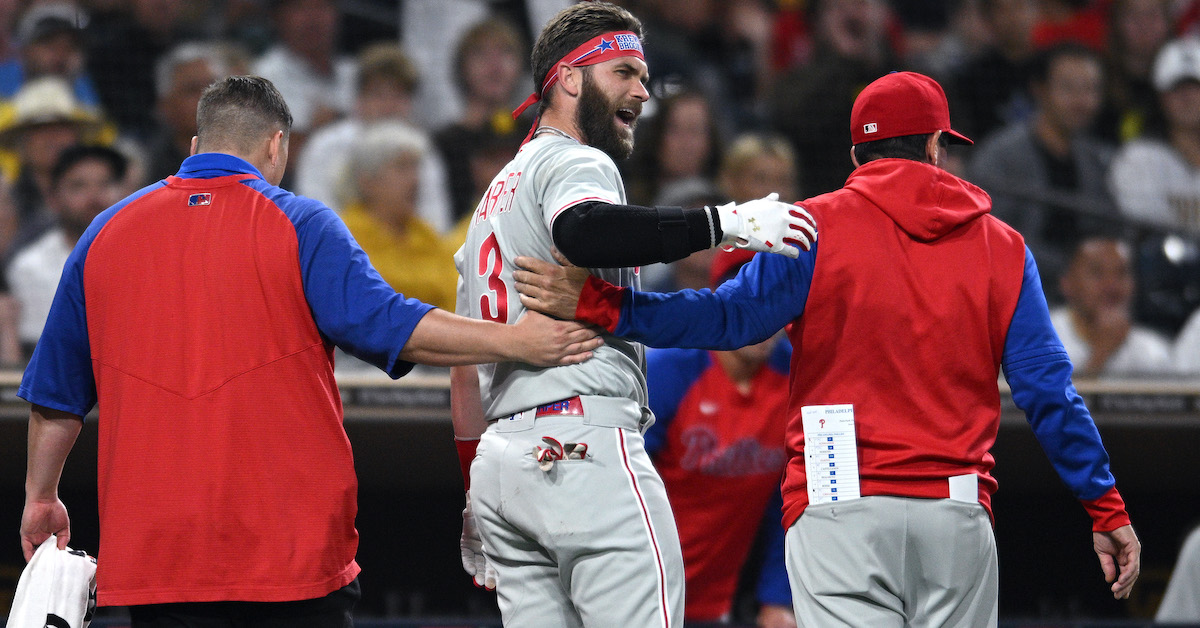
Bryce Harper’s Broken Thumb Could Derail Phillies’ Comeback

Bryce Harper
Orlando Ramirez-USA TODAY Sports

Since firing manager Joe Girardi on June 3, the Phillies have made significant strides toward climbing back into the playoff hunt, but on Saturday night, their chances took a significant hit. In the fourth inning of their game with the Padres in San Diego, Bryce Harper was hit by a 97-mph Blake Snell fastball, fracturing his left thumb and knocking him out of the lineup indefinitely.

When Harper was hit, his hands were so near his head that initially it appeared he got hit in the face. Even after it was clear that it had not, it was apparent that his injury was a significant one:

“I kind of wish it would have hit me in the face,” Harper told reporters afterward, conveniently forgetting many a career-altering beaning. “I don’t break bones in my face. I can take 98 to the face, but I can’t take 97 to the thumb.”

The 29-year-old Harper, the National League’s reigning Most Valuable Player, was already playing through a torn ulnar collateral ligament in his right elbow, an injury that was diagnosed in mid-May, after which he received an injection of platelet-rich plasma. The tear is apparently traceable to an April 11 throw from right field that had limited Harper to designated hitter duty since April 17. Last week, he missed three games due to an infected blister at the base of his left index finger.

Despite the elbow injury, Harper has thrived. He’s hitting .318/.385/.599 with 15 homers, with both his slugging percentage and 166 wRC+ ranking second in the NL — the latter mark just four points below last year’s major league-leading figure — and his 2.7 WAR ninth. This month, as the team has gone 18–6 (17–6 since firing Girardi, including wins on Saturday and Sunday over the Padres), Harper hit .359/.455/.641 (201 wRC+), practically carrying the offense. But at this writing, he’s the third of the NL’s top 10 players in WAR to be sidelined by an injury, joining Manny Machado (sprained left ankle) and Mookie Betts (cracked rib) in the virtual infirmary. Read the rest of this entry »


Cardinals Rookie Brendan Donovan Believes in Line Drives

© Jeff Curry-USA TODAY Sports

Brendan Donovan knows who he is as a hitter. The St. Louis Cardinals rookie is at his best when he’s hunting line drives, and that approach has been working like a charm. Two months into his big-league career, the 25-year-old is slashing .315/.426/.448 — with 14 doubles and one home run — in 197 plate appearances. Moreover, his 146 wRC+ is tops among qualified first-year players.

A left-handed hitter whom the Cardinals selected in the seventh round of the 2018 draft out of the University of South Alabama, Donovan is coming off a 2021 season that saw him climb from High-A to Triple-A, then excel in the Arizona Fall League. That meteoric rise continued this spring. Donovan earned a promotion to St. Louis in late April, and all he’s done since arriving is spray line drives. It’s what he does.

Donovan discussed his swing and approach when the Cardinals visited Fenway Park earlier this month.

———

David Laurila: How have you developed as a hitter since coming into pro ball?

Brendan Donovan: “We made a change in our hitting department — Jeff Albert, Russ Steinhorn, and those guys came in — and I was someone that made contact, but it wasn’t always quality contact. What we did is put me into a better body posture, better positioning, more tilt over the plate. I learned how to load the back hip a little better and flatten out my path. From there, it’s basically, ‘Let’s just try to get on plane, and see how long we can stay on plane.’ That’s helped me with fastballs up, and given me more adjustability on breaking balls and changeups, because I’m in the zone longer. Read the rest of this entry »


Sunday Notes: Jordan Lyles Knows What it’s Like to Lose

Jordan Lyles plays for a Baltimore Orioles team that stands 34-39 and is currently projected to finish 72-90. For the 31-year-old right-hander, that qualifies as more of the same. Lyles is in his 12th big-league season, and not once has he played a full year with a team that finished above .500. Moreover, he’s been on four clubs that lost 100-plus games. The worst of the worst was the 2013 Houston Astros, who went 51-111, a staggering 45 games out of first place.

The three seasons in which he’s played for multiple teams haven’t been much better. In each of those years, one of the two clubs he took the mound for ended up losing over 90 games. To date, Lyles has never pitched in the postseason.

That he never anticipated such a dearth of winning would be stating the obvious. Selected 38th-overall in 2008 out of a South Carolina high school, Lyles entered pro ball with the same lofty hopes and dreams as his draft-class peers. When you’re young and talented, visions of championship glory come with the territory.

He did reach the big leagues in relatively short order. Seventeen when he signed, Lyles was a precocious 20 years old when he debuted with the Astros in 2011. His first outing was a harbinger of things to come. The fresh-faced youngster allowed just a pair of runs over seven innings, only to see the bullpen blow the lead, depriving him of a win. At season’s end, Lyles was 2-7, the team 56-106. Read the rest of this entry »


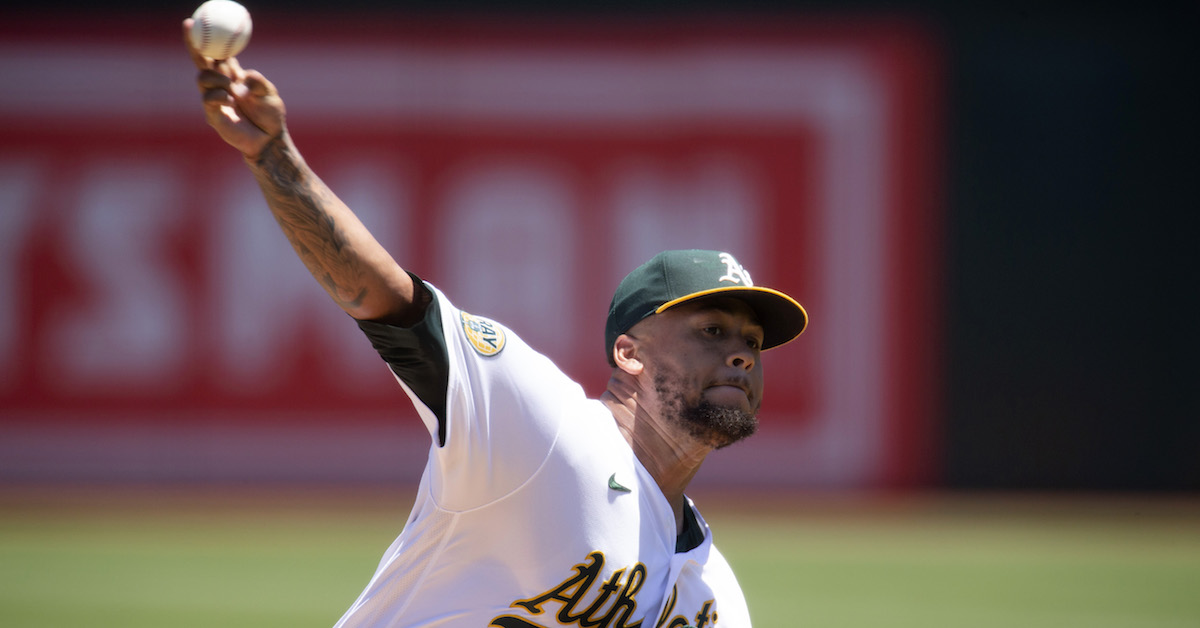
Frankie Montas Stands Alone

© D. Ross Cameron-USA TODAY Sports

Frankie Montas took the mound to start the eighth inning yesterday afternoon with a chance at history. He hadn’t allowed a hit all game, and looked to be picking up steam; his last pitch of the seventh inning hit 99 mph on the stadium gun, one of his hardest pitches of the day. He cut down the first two batters of the eighth in short order – four pitches, two grounders – leaving him only four outs from the first no-hitter of his career.

Montas is one of the best pitchers in baseball. A year ago, he put together his first full season, 32 starts of 3.37 ERA excellence. This year, he’s cleaning things up around the edges: fewer walks, more grounders, and more innings per start. His 3.21 ERA, 3.15 FIP, and 2 WAR are all in the top 20 among starting pitchers.

One small downside: Montas plies his trade in Oakland. That 2 WAR is more than every other player on the A’s has amassed combined (that rest-of-roster total comes in at 1.8 WAR, if you’re keeping score at home). Baseball is a team sport, even if many of the interactions feel individual; Montas sports a 3-7 record despite his sterling numbers. Read the rest of this entry »