Archive for Daily Graphings

Is This the End for Joey Votto?

Joey Votto
Gary A. Vasquez-USA TODAY Sports

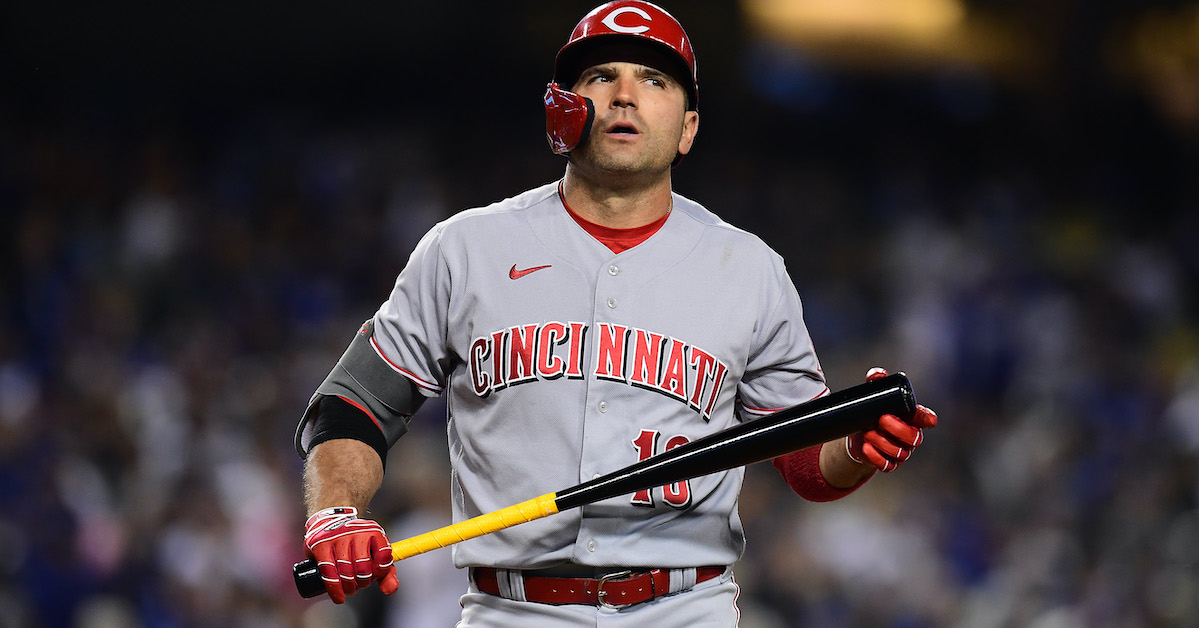
“If something cannot go forever, it will stop.” Credited to economist Herb Stein, this tautology, sometimes known as Stein’s law, has broad application past the field of economics: the Earth will end, the sun will end, the ability of the universe to sustain life will end, all the non-Top Chef shows on Bravo will end (hopefully), and we’ll end. Joey Votto does not exist outside of the space-time universe, and his 2022 season so far makes it look like his career will end before all of these things. Or will it?

Votto’s career has looked shaky at times before, but he has made comebacks before: from a leg injury that cost him half a season, a mid-career power outage, and a huge dropoff in play at age 35. He’s had enough successful comebacks to become a rarity in baseball: a highly paid star first baseman who doesn’t make his team regret a very large contract covering his 30s. But while he’s gotten off to slow starts before, a .122/.278/.135 line is something else.

Perhaps even worse is that so many of his non-baseball card stats look abysmal as well. Votto is striking out at nearly triple the rate of his 2017 peak. His soft-hit and hard-hit percentages of 22% and 20%, respectively, are closer to Ben Revere than a slugger, and those numbers are twice and half his career rates, respectively. Votto’s average exit velocity of 86.4 mph is six ticks off last year’s 92.9 mark, and his 70% contact rate is the lowest of his career. Read the rest of this entry »


FanGraphs Power Rankings: April 25-May 1

Another week of the 2022 season is in the books and there’s been some significant movement in the power rankings. We’re still at the point where a hot or cold week can really change the outlook for a team, but we’re also starting to see some clubs separate themselves from the pack — for good or for ill.

A reminder for how these rankings are calculated: first, we take the three most important components of a team — their offense (wRC+), and their starting rotation and bullpen (a 50/50 blend of FIP- and RA9-, weighted by IP share) — and combine them to create an overall team quality metric. New for this year, I’ve opted to include defense as a component, though it’s weighted less heavily than offense and pitching. Some element of team defense is captured by RA9-, but now that FanGraphs has Statcast’s OAA/RAA available on our leaderboards, I’ve chosen to include that as the defensive component for each team. I also add in a factor for “luck,” adjusting a team’s win percentage based on their expected win-loss record. The result is a power ranking that is then presented in tiers below.

Tier 1 – The Best of the Best
Team Record “Luck” wRC+ SP- RP- RAA Team Quality Playoff Odds
Yankees 16-6 0 125 77 76 -2 163 95.0%
Dodgers 14-7 -2 110 69 74 -2 145 94.6%
Mets 16-7 0 123 73 98 -1 159 86.5%

It’s a good time to be a baseball fan in New York. Both the Yankees and Mets have been playing fantastic baseball to start the season and both teams lead their respective divisions after a month of play. The Yanks rattled off a nine-game win streak with sweeps of the Guardians, Orioles, and the Royals. It took a little while for their bats to wake up earlier in the season, but they scored 7.4 runs per game during this stretch, including four games with double digit run totals. Unsurprisingly, it’s been their sluggers who have led the way. Anthony Rizzo’s nine home runs lead all of baseball, with a three dinger day on Tuesday and another on Friday padding his total. Not to be outdone, Aaron Judge blasted five homers last week, including two on Sunday. Read the rest of this entry »


Who Makes the Best Swing Decisions in Baseball?

Juan Soto
Scott Taetsch-USA TODAY Sports

Last week, when I was waxing poetic about Jeff McNeil’s ability to wait for a good pitch and then drop it into left for a single, I made an offhand mention to the player with the best swing decisions of 2021: Mike Tauchman, who doesn’t even play in the major leagues anymore. Then I moved on.

That wasn’t an accident. It’s what we in “the business” (no one calls it this) like to think of as a preview. I got multiple texts (another pro writer tip: “multiple” sounds better than “two”) from friends this weekend asking where the whole list of hitters was. That list is right here!

As a quick refresher, the idea here is to take every swing decision a hitter makes and compress them into one number. Every hitter who saw at least 50 pitches in each of the four attack zones (heart, shadow, chase, waste) is on the list. I took each of those rates and gave them league-average production for those decisions. The result looks like this, stated in terms of run value per 100 of the relevant zone/decision combination (take a waste pitch, say, or swing at a pitch in the shadow zone):

Run Value/100 by Swing/Zone, 2021-22
Zone Swing Take
Heart 0.42 -5.92
Shadow -3.62 -0.06
Chase -8.09 6.07
Waste -12.29 5.63

From there, I assumed a league-average percentage of pitches in each zone. Combined with each hitter’s swing rates, that let me produce an overall run value assuming an average rate of pitches in each zone.

Here’s a quick guide on how to interpret these numbers. For each hitter, there are three numbers. The first two are just the same statistic said different ways. The first metric, “RV/100,” is how many runs above or below average each hitter on the list would be, per 100 pitches, if they got exactly average results on every zone/decision combination. The higher the number, the better positioned a hitter is to succeed, by taking tough pitches and swinging at good ones.
Read the rest of this entry »


Wil Crowe and Nick Martinez on Learning and Developing Their Changeups

© John Geliebter-USA TODAY Sports

The Learning and Developing a Pitch series is back for another season, and we’re once again hearing from pitchers on a notable weapon in their arsenal. Today’s installment features Wil Crowe on his circle changeup and Nick Martinez on his made-in-Japan Vulcan changeup.

———

Wil Crowe, Pittsburgh Pirates

“I learned a changeup when I was about eight or 10 years old. Ex-big leaguer Steve Searcy lived in Knoxville, and my dad wanted to find me lessons — he’d played college ball, but wasn’t a pitcher — and that’s who he found. Steve was always big with fastball/changeup. I didn’t throw a curveball or slider until I was a senior in high school. Growing up, it was fastball/change. Locate the fastball, and the changeup comes off of it.

“The grip is a circle change. Now it’s a little modified; it’s out in my fingers a little more than it used to be. Middle finger and ring finger hold onto the laces, and the thumb is underneath. So it started out more of a traditional circle ball, and now it’s more on the end of the fingers. I did that in college, after I grew into my body. My hand was bigger and I was able to grip the ball better. But I think that starting at such a young age helped, because it’s a comfort thing. Read the rest of this entry »


Sunday Notes: The Decision Is In, Hoby Milner Holds a Unique Record

Hoby Milner was credited with a win on April 12. For the vast majority of pitchers in their sixth big-league season, that wouldn’t be particularly notable. It was for Milner. The 31-year-old Milwaukee Brewers reliever was pitching in his 96th career game, and it was the first time he’d been awarded a W. Moreover, it was the first time Milner had been awarded a decision.

That’s a record. No pitcher in MLB history had ever made that many appearances to start a career without getting either a win or loss. And it isn’t even close. Michael Tonkin went his first 62 before getting a decision — he also got a win — with the Minnesota Twins in 2016.

Milner had an inkling that he might be a record-holder well before he became the pitcher of record in Milwaukee’s 5-4 win over the Baltimore Orioles on April 12.

“I knew around 60-something that it was kind of a lot,” Milner told me at Pittsburgh’s PNC Park earlier this week. “It was a big enough number that I did some research on my own and saw that some guy had around 60 to begin his career. I don’t remember what the website was, but it didn’t necessarily seem like it was 100% legit.”

It turns out that it was. A member of the Brewers’ media relations staff confirmed it after Milner’s remarkable streak came to an end. Read the rest of this entry »


The Angels’ Hot Start Is Partially Taylor-Made

© Richard Mackson-USA TODAY Sports

The Los Angeles Angels are off to a 13-7 start. A couple of the big reasons for that are not unexpected. Mike Trout, who hadn’t played in a regular-season game in 11 months, is off to a blazing start even by his robust standards, sporting an OPS north of 1.200 and already nearing the sort of WAR we expect a league-average player to post over six months. Shohei Ohtani isn’t torching the league to quite the same degree but he’s also on a 6-WAR pace when you combine his hitting and pitching. Still, in the past, the team has struggled even with two superstars at the top of their game. What’s working for Los Angeles now is truly unusual compared to recent years: getting lots of contributions from the other guys. And none of “the other guys” have stood taller so far than Taylor Ward.

I’m always one of the first to yell “April!” about small-sample-size stars, but Ward’s performance has still been stunning. His .381/.509/.762 line calculates out to a 269 wRC+, besting his teammate Trout and everyone else with at least 50 PA this season. What makes it even more impressive is that some of the numbers fueling that line are of the sort that are meaningful in a small sample.

There’s a bit of a fallacy with extreme data in small samples (if it has a name, I don’t know it). In baseball, when a .280 hitter hits .300, people accept it as normal, but when a .280 hitter hits .500, it is generally written off as a fluke. But while the “hitting .500” part is, the .280 hitter who is hitting .500 is more likely to have improved than the one posting .300. Read the rest of this entry »


Checking In on Bryce Harper, Full-Time Designated Hitter (For Now)

© Bill Streicher-USA TODAY Sports

We went over this just a couple of weeks ago: between Kyle Schwarber, Nick Castellanos, Rhys Hoskins, and Alec Bohm, the Phillies have no shortage of defensively challenged players who might be better served as the team’s designated hitter, and luckily for them, the DH is now a permanent thing in the National League. The team’s plan at the outset of the season was to use its two new free agent sluggers, Castellanos and Schwarber, to occupy that role while minimizing their exposure in the field, yet for almost two weeks now, the position has been occupied by Bryce Harper. The reigning NL MVP was supposed to be the team’s starting right fielder, but an elbow injury has led to him shelving his glove for the moment — and it’s coincided with him heating up after a slow start.

Harper started eight of the team’s first nine games in right field, but he hasn’t played the position since April 16. Instead, he’s remained in the lineup as the team’s DH for 12 straight games. He apparently injured the elbow while making a throw to home plate on an RBI single by the Mets’ Francisco Lindor on April 11:

Read the rest of this entry »


This Year’s Austin Meadows in Three Parts

© Raj Mehta-USA TODAY Sports

Mike Trout is climbing up the WAR leaderboards; nature is healing. Still, it’s probably best to remember that we’re in the season’s early going. Eric Hosmer is batting .415! Meanwhile, Yuli Gurriel is batting .203. Some players have been unbelievably hot, others have been mysteriously cold — these extremes tend to balance out by season’s end. Players usually remain who they are, despite the memorable breakouts.

That principle also extends to changes in a player’s approach, pitch mix, or swing mechanics. Often, those eager to better themselves will start the season with a completely different look. Reality tends to get in the way, though. Sometimes injuries happen, or old habits prove hard to shake. Many players won’t see their changes through a year’s worth of trouble. It’s just the nature of things.

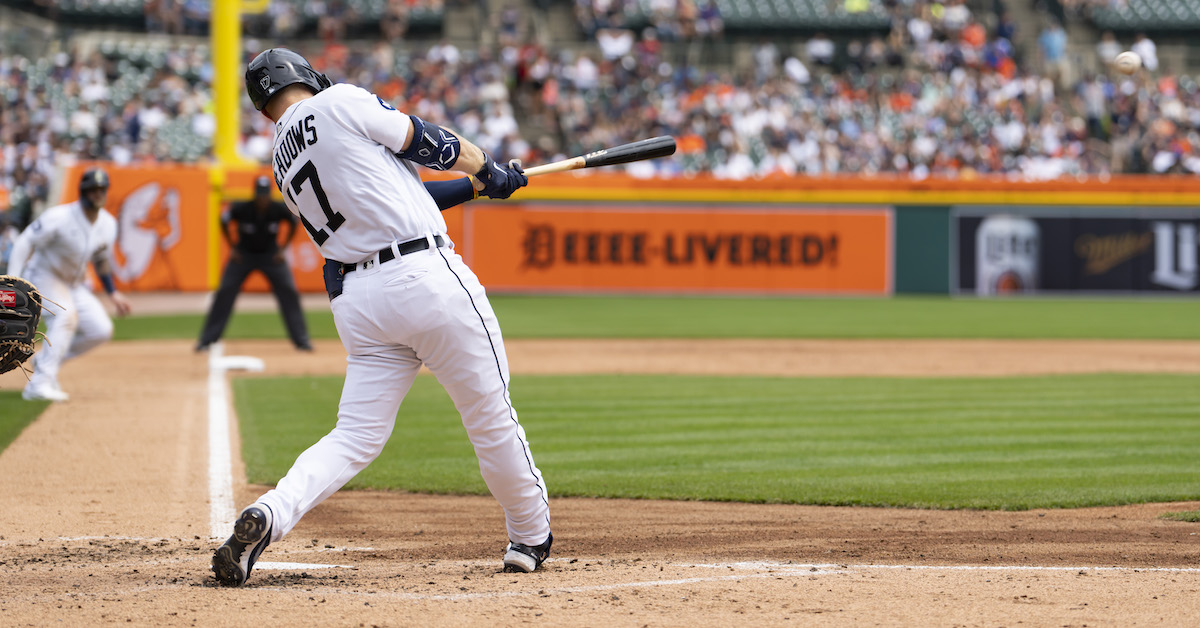
With that in mind, let’s talk about Austin Meadows. He’s a Detroit Tiger now, having arrived from St. Petersburg in a trade only his former team would dare to orchestrate. And he’s off to a pretty good start, with his .304/.418/.411 line translating to a 154 wRC+ in an offensively challenged season. It’s not so surprising, since Meadows has proven himself many times to be a great hitter. What is worth noting is how he’s arrived at that mark. In a few ways, Meadows looks like a different hitter than the one he was a year or two ago. So if you’re willing, I’d like to highlight some interesting (warning: subjective) things that have defined his productive April. I’ll present them in three parts. Read the rest of this entry »


Jeff McNeil, Secret Strike Zone Wizard

© Jeff Curry-USA TODAY Sports

Jeff McNeil has been pretty good so far this year. He’s hitting .328/.388/.492, good for a 163 wRC+. He’s starting all over the field, making the Mets’ complicated lineup decisions easier. That’s great! That’s all good. Today, though, I’m more interested in the fact that he’s displaying strike zone judgment usually reserved for Juan Soto, Joey Votto, and God.

McNeil has always been one of the most aggressive hitters in baseball. That hasn’t changed this year. Here are the hitters who swing the most at pitches in the strike zone:

Highest Zone Swing Rates, 2022
Player Z-Swing%
Jeff McNeil 87.4%
Avisaíl García 85.1%
Corey Seager 85.1%
Tim Anderson 84.0%
Ryan Mountcastle 83.9%

This is not news. From 2018-21, his career prior to this year, McNeil led baseball in zone swing rate. This year, he leads baseball in zone swing rate. He is continuing to do what he’s always done! More at 11.

But wait, there is more. You know how these swing-happy types work. Take a look at the list again. García has a career 6.3% walk rate and it’s heading lower this year. Anderson has a career 3.5% walk rate. Mountcastle hardly walks for a slugger. Seager – well, okay, Seager is just great. But swinging a lot at pitches in the strike zone also generally means swinging a lot at pitches outside of the strike zone.

Indeed, García and Anderson are the two hitters chasing the most pitches outside the zone. Mountcastle is in the top 15. Seager – yeah, still great. But McNeil is nowhere near that! He’s chasing only 29.1% of pitches outside the zone, a lower rate than the league as a whole and by far a career low. His in-zone swing rate, by the way, is a career high. Did Jeff McNeil crack the code? Read the rest of this entry »


Amid Fits and Starts, Mike Trout Might Be Getting Better at Something

© Jim Cowsert-USA TODAY Sports

During the past two years, we here at FanGraphs have spent a good bit of time staring into the abyss in contemplation. Specifically, we’ve wondered about a world without Mike Trout, or at least a world where he’s no longer the game’s top player. Who will inherit the mantle of this generation’s Mantle? What would our lowered expectations for Trout look like? What are the chances that in his age-30 season, he’s a bust? What would the playoff races look like without him?

Alas, we got an all-too-real demonstration of that last question just weeks after Dan Szymborski posed it last April, as Trout was limited to 36 games due to a right calf strain that he sustained on May 17. The strain, which occurred as he ran the bases on an inconsequential two-out popup, was supposed to sideline him for six to eight weeks, already the longest absence of his career. It turned out to be worse than expected; he never got comfortable enough in his recovery to begin a rehab assignment, and didn’t return to action before season’s end. Thankfully, he’s back now, and while he may not be better than ever, what his ridiculous stat line — .365/.476/.808 for a 270 wRC+, with all of those numbers major-league bests save for the batting average — presupposes is… maybe he is?

If Trout is on the precipice of age-related decline, it hasn’t come yet. After starting the year just 3-for-15, he’s put together a 10-game hitting streak, during which he’s putting up cheat-code numbers (.432/.523/.946). The streak went on ice for a few days when he was hit on the left hand by an 81 mph slider from the Rangers’ Spencer Patton on April 17; I don’t know about you, but I can’t watch the clip without the urge to yell, “Move, Mike!” when he reflexively pulls his hands down towards his waist and puts them in harm’s way. Thankfully, x-rays were negative, and while he missed three games, he’s kicked things up a notch since returning, with multi-hit efforts in four of his last six games, and seven of the 11 hits within going for extra bases. Read the rest of this entry »