Archive for Daily Graphings

The Most Feared Hitters in Baseball — And Jacob Stallings

If you’re looking for a way to assess pitchers’ respect for hitters, staying away from the zone is a decent proxy. Pitchers know Mike Trout has power, so they try to keep the ball away from him. When an opposing pitcher steps up to bat, it’s the opposite: it’s time to flood the box with impunity, because they’re unlikely to do any damage even if they do make contact.

You could, if you were so inclined, get even more specific. Forget the strike zone: let’s focus on the heart of the plate, middle/middle. It’s not a sign of disrespect to throw Cody Bellinger a slider on the black, low and away. Lobbing a meatball down Main Street? That’s really what we’re after. While we’re at it, let’s adjust for context, in a crude way, by looking only at 0-0 counts. Throwing down the middle on the first pitch of the at-bat doesn’t make sense against a power hitter — you can only get one strike if they take, while bad (for the pitcher) outcomes abound when they swing.

Indeed, if you’re looking for a list of batters who pitchers disrespect, the highest middle/middle rates on 0-0 counts (minimum 50 PA) really paint a picture:

Highest Meatball Rates on 0-0 (min 50 PA)
Player Middle/Middle Rate Tracked PA
Clayton Kershaw 17.5% 63
Merrill Kelly 16.7% 60
Isaac Galloway 16.7% 54
Walker Buehler 16.7% 66
Jonathan Davis 15.8% 95
Braden Bishop 15.3% 59
Jack Flaherty 15.2% 66
Jedd Gyorko 14.0% 100
Dustin Garneau 13.9% 101
Jack Mayfield 13.8% 65

Read the rest of this entry »


What the Season Will Look Like: Final Crowdsource Results

Last week, for the seventh and final time, I asked readers how they thought the season would go. While we don’t know for sure how many games will actually be played this year or when the season will end, should the two sides settle on health and safety protocols, the current plan is to play 60 games and have a standard postseason that concludes at the end of October. In addition to looking at the last round of results, we’ll take a look at how the reported season compares to the results over time.

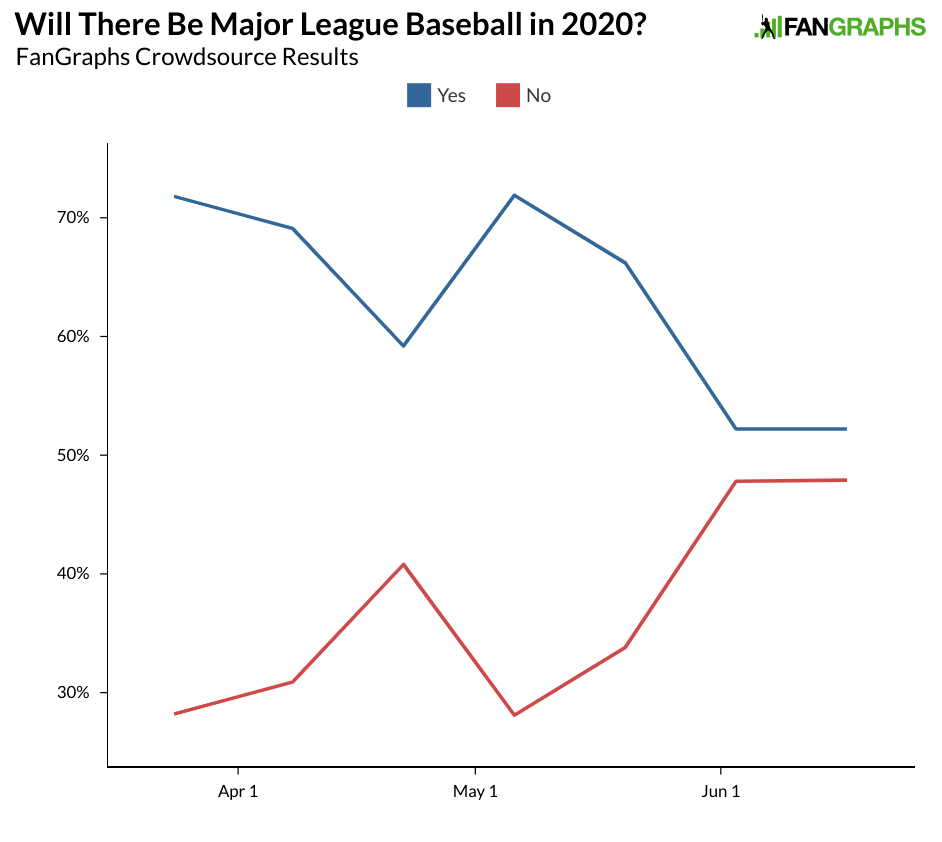
First, this is how readers answered regarding whether there would be a season (voting closed Monday morning):

Here’s how the responses have gone since late-March:

For the first five surveys, two out of every three readers believed there would be a 2020 season, but the negotiations over the last month turned it into a 50/50 proposition. While it certainly seems that we will get a season, there’s still a month to go before a potential Opening Day. Read the rest of this entry »


A Look at Some NL Designated Hitter Candidates

The universal designated hitter will be a reality in 2020, assuming that the Major League Baseball Players Association agrees to the health and safety protocols connected to the March 26 agreement, which is to say, that it will be part of the revised rules for this weird, short season. But because the league and the union were unable to agree to any of the subsequent proposals that have been batted back and forth in recent weeks, the status of the universal DH for 2021 and beyond — with the expectation that it would slip smoothly into the 2022 Collective Bargaining Agreement — is not a done deal, after all. Rather, it’s something that will have to be revisited within discussions over rules changes for next year, which typically begin at the November owners’ meetings.

Even so, as it’s the rare point upon which both sides agreed amid the otherwise rancorous negotiations, I think I’m still on solid ground in discussing the longer-term changes that could come with such a move. On Friday, I discussed the apparent end of pitchers’ often-pathetic attempts at hitting, and last month, Craig Edwards took an initial stab at how NL teams might handle their DH slots given their roster construction, with special consideration given to the Mets’ situation. This time around, I’d like to consider which players might stand to benefit in the longer run.

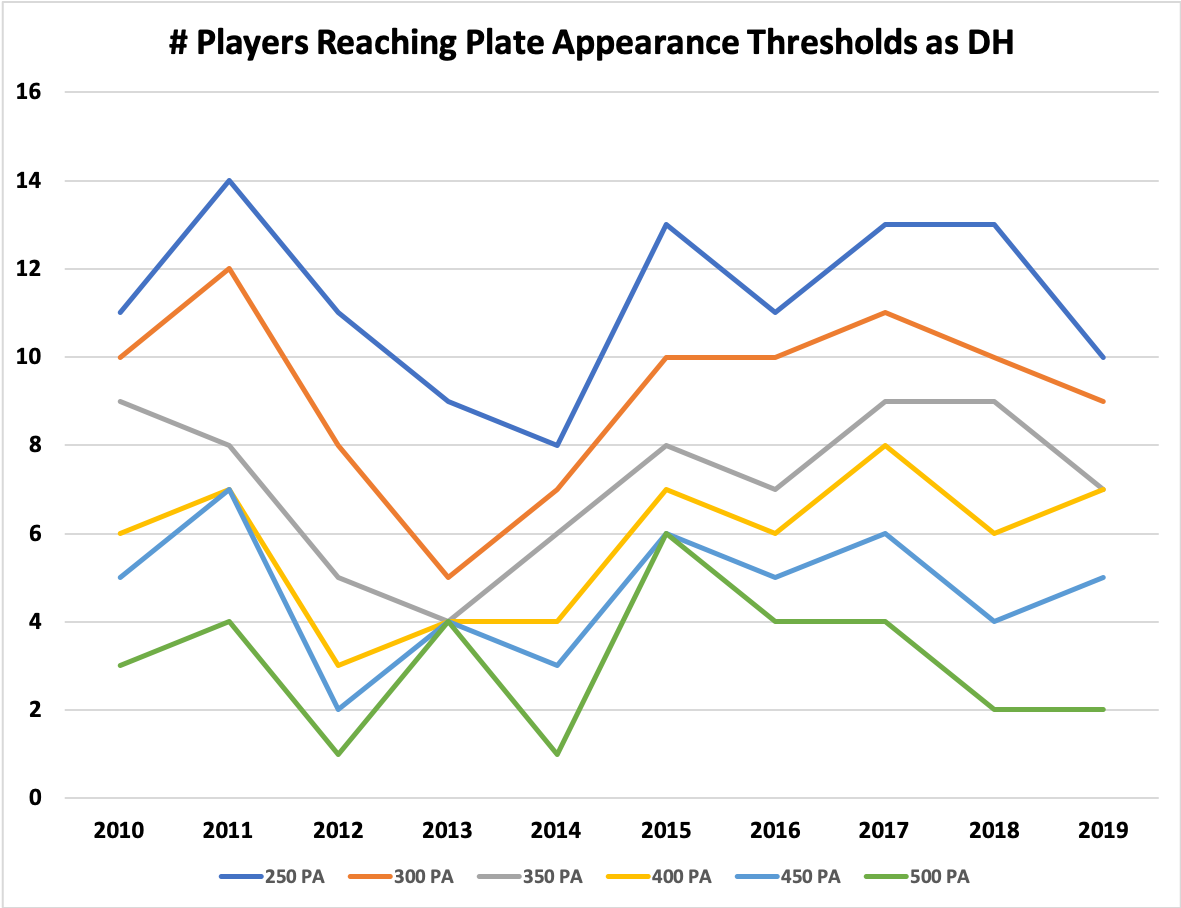
For starters, it’s worth noting that the demise of the DH has been somewhat exaggerated. Several years back, the AL saw a notable decrease in the number of players reaching significant thresholds of plate appearances at the spot, but those totals have largely rebounded:

Read the rest of this entry »


MLB to Impose 60-Game Season After Talks Stall

On Monday night, Major League Baseball released a statement that, despite the legalese and lengthy section recapitulating earlier letters, set the terms under which baseball will return:

88 days after the league and the Major League Baseball Players Association reached an agreement to pay players a pro-rata share of their salaries (with the commissioner retaining the right to set the length of the season unilaterally), the two sides weren’t able to come to a satisfactory agreement for the resumption of play; they’ll instead abide by the terms of the March deal. Sources told Ken Rosenthal of The Athletic that the league plans to announce a 60-game season, equal in length to the owners’ final proposal to the players.

Many of the details of the actual season remain unsettled. The union and the league must still agree on health and safety protocols, though representatives from both sides maintain that a deal there is imminent. The league’s statement mentions this specifically, but even without that particular ask of the players, the March 26 agreement is subject to the two parties agreeing on such regulations.

There has not yet been an official declaration that there will be a season. In addition to being contingent on a final health protocol agreement, there’s the matter of a second spring training. MLB has asked the players to report by July 1. The MLBPA seems very likely to comply with this request, however, which means that a followup announcement with an exact season schedule should follow soon. Read the rest of this entry »


OOTP Brewers: Odds and Ends

In the simulated reality of Out Of The Park Baseball, the season is chugging along normally. There’s no virus keeping stadium doors closed, no season schedule to work out. In fact, while in real life baseball is at a point of extreme uncertainty, the OOTP season is currently in a lull. It’s late June — too early for the All-Star Game or the trade deadline, too late for the new-car smell of April and May performances. In keeping with that between-events ambience, today I’m going to cover a few topics I find interesting but that aren’t of crucial, immediate import to the team.

Keston Hiura Signs

Well, I did say immediate import. The best thing that has happened to the Brewers so far this year is that we’re in first place in late June. Not far behind, however, is the extension Keston Hiura signed on Saturday after we decided to offer him a deal last week. OOTP contracts can look alien, because the game’s contract logic is governed by its own set of rules rather than the ones that major league teams adhere to, but this contract looks both like a real-world deal and an excellent one for the team:

Keston Hiura’s Contract Extension
Year Salary ($M) Team Option?
2021 2.2
2022 3.2
2023 4.2
2024 7.5
2025 8.5
2026 12.5 Yes
2027 12.5 Yes
Note: 2026 and 2027 team options each carry a $1.3 million buyout.

Read the rest of this entry »


As Safety Concerns Grow, Stalling Owners Leaves Players in Bind

Following a flurry of activity last week between Major League Baseball and the Major League Baseball Players Association as the two sides volleyed to resume the 2020 season, this past weekend was marked by inactivity. After an in-person meeting between Rob Manfred and Tony Clark spurred an owners’ proposal for 60 games on Wednesday and a 70-game counter-offer from the players on Thursday, the owners opted to wait the players out. While they were waiting, the schedule for a potential season got a little bit shorter, and positive coronavirus tests for five players and three staff members in Phillies camp forced some re-evaluation of the viability of Florida as a training site ahead of the upcoming season. With other positive tests popping up around the sport, all of the spring training complexes were temporarily closed for deep cleaning, and to establish new, more stringent safety protocols; in all, 40 players and staff have tested positive for the virus over the last week. Even with that news, the players were expected to formally vote on the owners’ 60-game proposal on Sunday, but a last-minute modification by Rob Manfred pushed the vote back.

In an email obtained by the Associated Press, Rob Manfred indicated to Tony Clark on Sunday that the season would not be able to begin on the July 19 date previously proposed by both sides, pushing the start of the season back to July 26:

“I really believe we are fighting over an impossibility on games,” Manfred said in the email, a copy of which was obtained by The Associated Press. “The earliest we will be ready for players to report is a week from Monday, given the need to relocate teams from Florida. That leaves 66 days to play 60 games. Realistically, that is the outside of the envelope now.”

Read the rest of this entry »


Sunday Notes: Jose De León Is in Cincinnati With a New Arm

When I first wrote about José De León — this in a May 2015 Sunday Notes column — he was a 22-year-old prospect in the Los Angeles Dodgers organization. He was also a shooting star. Piggy-backing on an emergent 2014 season, De León was dominating the hitter-friendly California League to the tune of a 1.69 ERA, and 50 strikeouts in 32 innings. His heater was a crisp and clean 94-96 mph.

Misfortune has followed those halcyon days. De León went on to debut with the Dodgers in September 2016, then was dealt to the Tampa Bay Rays four months later. Shortly thereafter, things began to go haywire. First it was discomfort in his forearm. Then came a lat strain followed by elbow tendinitis. The coup de grâce came in March 2018 when he was diagnosed with a torn UCL and underwent Tommy John surgery. Out of action until last May, De León took baby steps upon his return. He hurled just 60 innings, four of them at the big-league level, over the course of the campaign.

“The last few years have been rough,” admitted De León, whom the Cincinnati Reds acquired from the Rays over the winter in exchange for a PTBNL. “But I’ve grown a lot. I’m way stronger mentally, and I basically have a brand new arm, as well.”

His “new arm” doesn’t feel foreign to him. The Isabela, Puerto Rico native recalls former Tampa Bay teammates Alex Cobb and Nathan Eovaldi saying that theirs did feel different after surgery, but he hasn’t experienced that sensation. What he has experienced is a velocity rejuvenation. When I talked to him a few days before camps were shut down, De León told me that he’d been 95-96 in his most-recent outing, the firmest his heater had been in years. Moreover, he didn’t recall ever throwing that hard, that early. Read the rest of this entry »


The Universal Designated Hitter May Be Here to Stay

We’ll always have his epically improbable 2016 home run, but Bartolo Colon ain’t walking through that door. If the players union and the owners can agree to something along the lines of the latest volley of proposals without immolating themselves in fiery rhetoric — now that they’re at 100% pro rata, it shouldn’t be that difficult, yet here we are — then the days of pitchers hitting are likely at an end. Per the Milwaukee Journal-Sentinel’s Tom Haudricort, MLB’s most recent proposal includes a universal designated hitter not only for this year, but for 2021, and ESPN’s Jeff Passan and Jesse Rogers report the same is true for the union’s latest proposal. Beyond that, as Haudricourt notes, a universal DH is “almost certainly” going to be included in the Collective Bargaining Agreement that takes effect for the 2022 season. Not that hammering out that CBA will be a simple matter given the bad blood between the owners and the union, but it does appear that whenever they get around to playing again, the National League will finally join every other major circuit except Nippon Professional Baseball’s Central League in adopting the DH.

The DH has been around since 1973, though its roots go back to the late 19th century. As the role of the pitcher became more important, necessitating they concentrate on improving that aspect of their game, the feeling was that pitchers should be excused from their offensive duties. While movements to adopt a “tenth man” came and went from time to time prior to World War II, it took until the late 1960s, amid declining offenses, for the Triple-A International League and various other minor leagues to begin experimenting. The AL and NL could not agree on whether to adopt the DH; they voted separately, and you know the results. The original plan was that after three years, both leagues would either adopt or discard the rule, but the AL enjoyed the significant bumps in scoring and attendance in the wake of the rule’s adoption, and the two differing brands of baseball were maintained.

That was easy to do so long as there was no interleague play, but the World Series presented an awkward clash. From 1973-75, no DH was used, while from 1976-85, an “Even-Odd” scheme was used, with the DH in the even-numbered years, and since then, the “When in Rome” scheme has been used, with the DH present in AL parks but not NL ones. That scheme was extended to the regular season when interleague play began in 1997. Thus the two brands of baseball have generally coexisted in peace for nearly half a century, albeit not without endless debates contrasting the purity of the game with its need to adapt, as well as the occasional push within the game to move one way or the other. Because the position’s duties tend to be filled by higher-salaried veterans, the Players Association sought the universal DH in negotiations for the 2011 and ’16 CBAs. They didn’t get it either time, but now it’s a useful bargaining chip for the owners to throw into the pot, and notable that the players have maintained it in their counteroffers. Read the rest of this entry »


A Conversation With Miami Marlins Southpaw Caleb Smith

Caleb Smith has been a pleasant surprise for the Miami Marlins since being acquired from the New York Yankees prior to the 2018 season. That’s not to say the NL East club didn’t recognize his potential upon making the deal, but at the same time, he wasn’t exactly prominent on prospect lists. A 14th-round pick in 2013 out of Sam Houston State University, Smith was — and still is — a southpaw with underwhelming velocity and solid but nothing-special secondary pitches.

His path from New York to Miami included brief stops in Milwaukee and Chicago. The Brewers took Smith in the December 2016 Rule-5 draft and promptly flipped him to the Cubs. The following spring he was returned to the organization he was no longer all that enamored with playing for. Following a stellar Triple-A season that included a big-league cameo, he was off to his new baseball home.

In two seasons with the Marlins, the 28-year-old hurler has made 44 starts and logged a 4.52 ERA over 230.2 inning. Featuring a high spin rate fastball that gets good arm-side run — a pitch he augments with a slider and a changeup (with a curveball soon to join the mix) — Smith has fanned 10 batters per nine innings since coming to Miami.

———

David Laurila: You were drafted in 2013. What did scouts like about you at the time?

Caleb Smith: “They liked how I used my fastball and my changeup. I didn’t really have a breaking pitch — I didn’t have a curveball or a slider — but they liked the life on my fastball. I think that’s it. They didn’t really say anything else to me.”

Laurila: Were you asked to make any specific adjustments upon reaching pro ball?

Smith: “What the Yankees wanted was for me to pitch down in the zone. That was their focus, and it was always a problem for me, because I have a hard time doing that. My ball just naturally stays at the top of the zone. Eventually I got better at it — I was able to work down in the zone a little bit more — but not as effectively as they wanted me to. I knew I could get outs at the top of the zone, but they just weren’t into that at the time.”

Laurila: What hinders your ability to work down in the zone? Read the rest of this entry »


Players’ Proposal Should Get Everyone Closer to Major League Baseball

On Tuesday, Rob Manfred and Tony Clark met in Arizona. On Wednesday, MLB made an offer to the MLBPA that would give players pro-rated salaries for 60 games and a $25 million postseason pool. It also included $33 million in salary relief from the $170 million in advances players received, and a universal designated hitter. In exchange, the owners would get expanded playoffs for the next two years, and the players would agree to waive any grievance the MLBPA might otherwise have brought against MLB for failing to make its best effort to schedule as many games as possible, as is required by the March agreement. The players have countered that proposal; the two sides, it would seem, are very close.

As first reported by Jeff Passan and Jesse Rogers, the player proposal is for 70 games at pro-rated pay, with the same or similar salary advance forgiveness as the owners proposed, $50 million in playoff money, and a 50/50 split of new postseason TV revenues in 2021. The deal would include grievance waivers from both parties over the March 26 agreement, as well as the universal designated hitter.

The major differences the players propose are as follows:

  • The regular season would end on September 30 instead of September 27.
  • Ten extra regular season games, which would provide players with $252 million in additional pay, and, even using only local revenue, provide around $155 million in revenue to the owners.
  • $25 million more in postseason pool money.
  • Fifty percent of 2021 expanded playoff money, which could amount to $100 million or more for the players, though it would also mean corresponding increases for owners in 2020 and 2021, given that they stand to receive roughly 75% of those rights.

Read the rest of this entry »