Archive for Daily Graphings

Checking In on the Free Agent Market

On the eve of the winter meetings, a full month and one major holiday into the offseason, it’s a good time to review what we’ve observed on the free agent market thus far and gauge how that activity portends for the rest of the year. It’s always an interesting question, but one that feels particularly relevant now after consecutive cold stoves and increasingly heated rhetoric from both the league and the MLB Players Association about the game’s economic landscape.

Inevitably, most of the action this winter will be viewed through the prism of whether this offseason feels as strange as the last two, which, if you’ve forgotten, were very unusual. Top free agents got their customary nine-figure offers, and we even saw a couple of record-breaking contracts, as Manny Machado and Bryce Harper inked the sport’s first $300 million free agent deals.

But seemingly everyone else had to scramble for work. In an abrupt departure from convention, teams both spent considerably less money than in winters past and waited significantly longer to solidify their roster. Meanwhile, players signed for dimes on the dollars they could have expected in previous years. Nick Markakis made his first All-Star team and took a pay cut to remain in Atlanta, and Mike Moustakas and Yasmani Grandal settled for one-year deals. Useful players like Denard Span faded away entirely. Revenues around the league were up, but teams had less and less to offer free agents. Read the rest of this entry »

The Tigers’ New Acquisition: A Teheran-Type, or Something Different?

In their contribution to the recent flurry of league activity, the Tigers and Pirates quietly made a deal last Monday: Pittsburgh sent right-hander Dario Agrazal to Detroit in exchange for cash considerations.

While the trade didn’t make headlines, it may still provide insight into Detroit’s 2020 plans. Agrazal, who turns 25 in late December, debuted this season with Pittsburgh and appeared in 15 games, making 14 starts. His results were mixed: He posted a 4.91 ERA and a 5.90 FIP over 73.1 innings, striking out only 13% of opponents while walking 6%. Among pitchers who threw at least 70 innings, Agrazal had the third-lowest strikeout rate in the majors.

Upon first glance, pitching to contact seems like a poor strategy in today’s three-true-outcome game, and Agrazal may ultimately be no more than a spare arm in Motown; we’re guessing that he’ll start the season in Triple-A. Still, under the right circumstances, Agrazal has the ability to turn into more than organizational depth. Read the rest of this entry »


Oakland Retains Diekman, 2020 Dreams

When the A’s acquired Jake Diekman for the first time back in July, they hoped that he might pair effectively with a then-recovering A.J. Puk in neutralizing left-handed hitters, who through that point in the season had hit Oakland relievers to the tune of a .305 wOBA — not terrible, but also behind Houston, Tampa Bay, Cleveland, and New York in the American League. They also hoped that 2019 would end up being the first year since 2006 in which the A’s won a postseason series.

Neither of those things happened. Diekman, who has allowed a .293 wOBA to left-handed hitters over the course of his career, allowed a .314 figure to the 47 lefties he faced for Oakland, walking seven and hitting one with a pitch. The A’s, meanwhile, lost the AL Wild Card game to the Rays, 5-1. Diekman faced one batter.

Still, all the potential the A’s saw in Diekman last summer is still there, and so too is Billy Beane’s thirst for a World Championship. If you thought that last week’s Jurickson Profar trade was evidence of a step back from that goal (which I do not), think again. Diekman alone isn’t enough to put the A’s over the top (frankly, three Diekmans wouldn’t be enough) but teams that plan to punt on a season don’t sign relievers to two-year, $7.5 million deals, as the A’s have just done. Read the rest of this entry »


JAWS and the 2020 Hall of Fame Ballot: Manny Ramirez

The following article is part of Jay Jaffe’s ongoing look at the candidates on the BBWAA 2020 Hall of Fame ballot. Originally written for the 2017 election at SI.com, it has been updated to reflect recent voting results as well as additional research. For a detailed introduction to this year’s ballot, and other candidates in the series, use the tool above; an introduction to JAWS can be found here. For a tentative schedule and a chance to fill out a Hall of Fame ballot for our crowdsourcing project, see here. All WAR figures refer to the Baseball-Reference version unless otherwise indicated.

A savant in the batter’s box, Manny Ramirez could be an idiot just about everywhere else — sometimes amusingly, sometimes much less so. The Dominican-born slugger, who grew up in the Washington Heights neighborhood of upper Manhattan, stands as one of the greatest hitters of all time, a power-hitting right-handed slugger who spent the better part of his 19 seasons (1993–2011) terrorizing pitchers. A 12-time All-Star, Ramirez bashed 555 home runs and helped the Indians and the Red Sox reach two World Series apiece, adding a record 29 postseason homers along the way. He was the World Series MVP for Boston in 2004, when the club won its first championship in 86 years.

For all of his prowess with the bat, Ramirez’s lapses — Manny Being Manny — both on and off the field are legendary. There was the time in 1997 that he “stole” first base, returning to the bag after a successful steal of second because he thought Jim Thome had fouled off a pitch… the time in 2004 that he inexplicably cut off center fielder Johnny Damon’s relay throw from about 30 feet away, leading to an inside-the-park home run… the time in 2005 when he disappeared mid-inning to relieve himself inside Fenway Park’s Green Monster… the time in 2008 that he high-fived a fan mid-play between catching a fly ball and doubling a runner off first… and so much more. Read the rest of this entry »


Pitch Design: Reimagining Mike Minor’s Slider

Designing a pitch can be an arduous but rewarding process for a pitcher. When you find two or more pitches that have the potential to work well together, it may be worthwhile to make some changes if, for example, one isn’t yielding positive results. It’s not always as simple as it sounds, and sometimes the option of not using the pitch at all ends up being the best choice.

For an older pitcher, this process tends to be harder, though not impossible. They’ve gone through the majority of their career throwing a pitch with certain mechanics or gripping the ball in a particular way. Changes to either of those can be uncomfortable, which may create a developmental roadblock. However, there may come a point when becoming a more dynamic pitcher is necessary, especially as the aging curve starts its downward trend.

At 31 years of age, the Rangers’ Mike Minor put together the best season of his eight-year career. He posted a 3.59 ERA, an almost 3-1 K/BB rate, allowed his lowest ever contact rate in the strike zone, and had career highs in strikeouts (200) as well as innings pitched (208.1).

It might be a stretch to expect Minor to repeat his 4.2 WAR season, but it’s not out of the question. He still possesses a decent fastball and has developed a really good changeup. Yet his curveball and slider both took steps back in 2019, so Minor should consider working on at least one of them prior to the 2020 season. Read the rest of this entry »


The 2020 ZiPS Projections

The 2020 ZiPS projection season starts Friday, and before it does, I wanted to offer a brief refresher of what ZiPS is and is not.

ZiPS is a computer projection system, initially developed by me from 2002-2004, and “officially” released in 2004. As technology and data availability have improved over the last 15 years, ZiPS has continually evolved. The current edition of ZiPS can’t even run on the Pentium 4 3.0 processor I used to develop the original version starting in 2002 (I checked). There are a lot more bells and whistles, but at its core, ZiPS engages in two fundamental tasks when making a projection: establishing a baseline for a player, and estimating what their future looks like using that baseline.

ZiPS uses multi-year statistics, with more recent seasons weighted more heavily; in the beginning, all the statistics received the same yearly weighting, but eventually, this became more varied based on additional research. Research is a big part of ZiPS and every year, I run literally hundreds of studies on various aspects of the system to determine their predictive value and better calibrate the player baselines. What started with the data available in 2002 has expanded considerably; basic hit, velocity, and pitch data began playing a larger role starting in 2013, and data derived from StatCast has been included in recent years as I got a handle on the predictive value and impact of those numbers on existing models. I believe in cautious, conservative design, so data is only included once I have confidence in improved accuracy; there are always builds of ZiPS that are still a couple of years away. Additional internal ZiPS tools like zBABIP, zHR, zBB, and zSO are used to better establish baseline expectations for players. These stats work similarly to the various flavors of “x” stats, with the z standing for something I’d wager you’ve already figured out!

When estimating a player’s future production, ZiPS compares their baseline performance, both in quality and shape, to the baseline of every player in its database at every point in their career. This database consists of every major leaguer since the Deadball era — the game was so different prior to then that I’ve found pre-Deadball comps make projections less accurate — and every minor league translation since what is now the late 1960s. Using cluster analysis techniques (Mahalanobis distance is one of my favorite tools), ZiPS assembles a cohort of fairly similar players across history for player comparisons, something you see in the most similar comps list. Non-statistical factors include age, position, handedness, and, to a lesser extent, height and weight compared to the average height and weight of the era (unfortunately, this data is not very good). ZiPS then generates a probable aging curve — both midpoint projections and range — on the fly for each player. Read the rest of this entry »


Money to Spend: What’s the Likely State of Team Payrolls in 2020?

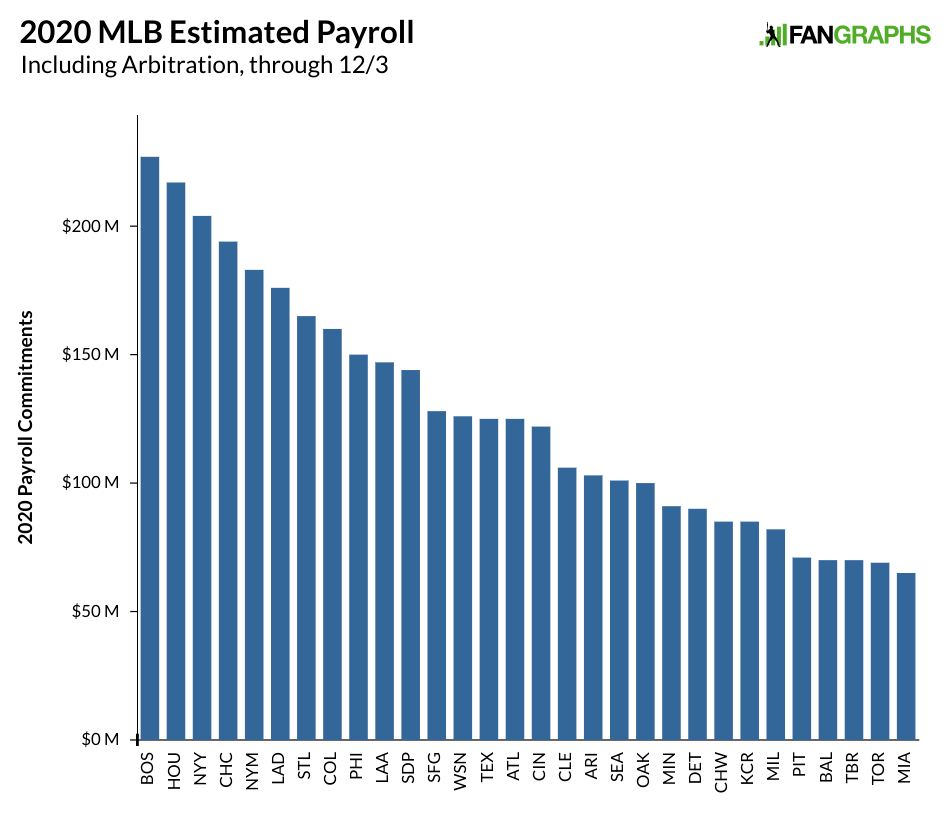
How much major league teams are willing to spend on player salaries in any given year can be a bit murky. Teams don’t want to show their hand and lose negotiating power with free agents, though we can usually figure out their number by the end of spring when the money has been spent. How much every team is likely to spend is more opaque. We know that, generally speaking, teams are making boatloads, but while the revenue across the sport has increased over the last few years, it hasn’t resulted in increased payrolls. Every team has lots of money — the budget constraints we hear front office types reference are, more often than not, self-imposed rather than the result of empty coffers — but some will spend more than others. Trying to pin down what teams will spend in 2020 at this point in the winter is difficult, but we can use last year’s payroll numbers as a guide to get a rough idea of what each is likely to do, and thus gauge which ones will commit to payroll increases and which are likely to embrace thrift.

To answer those questions, we can look to the contracts coming off the books at the end of 2019, but that number can be misleading. Raises to players with long-term contracts, as well as increased pay in arbitration can bite into some of the departed money. Let’s start with how much money every team has committed for 2020 as of right now, using estimates for arbitration figures and minimum salaried players. (All the data can be found in the Payroll section on our RosterResource pages.)

Read the rest of this entry »


Five Lessons From the Wild Non-Tender Deadline

The non-tender deadline isn’t a date everyone circles on the calendar expecting big moves and excitement, but it does force teams into decisions on a handful of players and causes some movement as well as a handful of new free agents. Last night’s non-tender deadline was more active than most. As Jeff Passan noted, there were 40 non-tenders after a combined 46 over the previous two years. It was busy, and a few productive players were not offered contracts despite expectations for fairly reasonable salaries. There are some big conclusions to reach about the state of the game as well as some small ones based on last night. Here’s what we learned.

Teams Aren’t Paying for a Return to Form

Among the biggest non-tenders in terms of past production and expected salary were players who struggled for various reasons in 2019. Formerly injured pitchers in the process of returning from injury or needing time to return from injury like Taijuan Walker, Jimmy Nelson, and Aaron Sanchez were all non-tendered despite expected salaries in the $4 million to $6 million range. Previous successful players with rough years like Kevin Gausman, Blake Treinen, and Travis Shaw were all let go despite prior track records of success. In the cases of Gausman and Treinen, an expected salary of close to $10 million likely played a role, though it isn’t necessarily clear that the decisions wouldn’t have been the same even if a few million dollars had been shaved off the cost. Steven Souza Jr. has decent projections for next season, but he did poorly in 2018 and didn’t play at all last season. For the most part, teams weren’t willing to roll the dice on bounce-back campaigns. Read the rest of this entry »


JAWS and the 2020 Hall of Fame Ballot: Derek Jeter

The following article is part of Jay Jaffe’s ongoing look at the candidates on the BBWAA 2020 Hall of Fame ballot. For a detailed introduction to this year’s ballot, and other candidates in the series, use the tool above; an introduction to JAWS can be found here. For a tentative schedule and a chance to fill out a Hall of Fame ballot for our crowdsourcing project, see here. All WAR figures refer to the Baseball-Reference version unless otherwise indicated.

No other player, not even 2019 Hall of Fame inductee Mariano Rivera — the first player ever elected unanimously by the writers — typified the Yankees’ late-1990s resurgence and evolution into a dynasty more than Derek Jeter. A 1992 first-round pick out of Kalamazoo, Michigan, the 6-foot-3 shortstop seemed not only to be built for stardom but engineered to withstand the spotlight’s glare. Famously instilled with a level-headedness by his parents, who during his childhood made him sign code-of-conduct contracts, he pulled off the remarkable feat of simultaneously exuding a cocky charisma and an off-the-charts baseball IQ while remaining completely enigmatic even in the country’s largest media market. Not only did he avoid mental mistakes on the field, he ably evaded virtually every controversy that surrounded the Yankees; by the time he turned 29 years old, he had been named team captain. During his two decades in pinstripes, he played a pivotal role for 16 playoff teams, seven pennant winners, and five champions. Not until he was 34, deep into his 14th season, did he play a game in which his team had been mathematically eliminated from postseason contention.

With an inside-out swing that yielded consistently high batting averages and on-base percentages, Jeter was a hit machine, an ideal table-setter among the Bronx Bombers. In 15 of his 18 full seasons, he collected at least 179 hits, and 13 times, he scored at least 100 runs. He did both with such consistency and longevity that he ranks sixth all-time in hits (3,465) — not just more than any other shortstop, but more than any other infielder — and 11th in runs scored (1,923). Though he had less power than Alex Rodriguez and Nomar Garciaparra, the pair with whom he formed the “Holy Trinity” of shortstops, he was fully capable of hitting a well-timed home run. In fact, his 20 postseason homers are third all-time, yet one of the rare October (and November, ahem) records that he does not hold. He wasn’t without flaws, of course. Though his strong arm, sure hands, and low error totals helped him pass the eye tests of casual fans, broadcasters, and even the opposing managers who bestowed five Gold Gloves upon him, his defensive metrics are brutal. Even so, they’re outweighed by contributions in every other aspect of the game.

Thanks to his 3,000-plus hits and his collection of championship rings, Jeter will have no trouble gaining first-ballot entry to the Hall of Fame. With the precedent of non-unanimity finally broken, the primary suspense of this cycle is whether he’ll match Rivera by receiving the full 100% from the writers. Secondarily, and more frustratingly, the possibility exists that his presence on the ballot will overshadow other worthy candidates. Either way, he’ll be standing on the dais in Cooperstown next summer. Read the rest of this entry »


A Change in the Wind: Wichita Faces Blowback Over Wind Surge

Wichita’s windy season is said to last from early February to late May, when the gusts change from frigid blasts to hot breaths. The windiest day of the year is historically April 4; a day when hairdos and stacks of loose papers must stand strong against gales blustering at an average of 13 mph.

Occasionally, there will be a spike in velocity that knocks out the power or rolls back a tin roof or tries to tear the awning off of the Valero gas station on Caulfield and Kemp. A fire inspector once cast a wary eye on the 1916 Wichita Fair and Exposition, concerned, per the The Wichita Daily Eagle on October 22, that the flammable structures of the event created a great risk of conflagration due to the “high, dry winds we have in the fall,” his fears rooted in both science and the fact that this very thing had happened the previous year.

So in Wichita, they are aware of the wind. They know that it blows, that it carries the cold and the heat of the plains, and that it occasionally bends a gas station in half. They do not all understand why it is the name of the town’s new Triple-A franchise, the Wichita Wind Surge, an affiliate of the Miami Marlins.

“I guess it’s windy here,” says Wichita resident Eric Pierce, “but… wind’s kind of everywhere.” Read the rest of this entry »