Archive for Daily Graphings

Lou Whitaker Belongs in Cooperstown

This post is part of a series concerning the 2020 Modern Baseball Era Committee ballot, covering executives and long-retired players whose candidacies will be voted upon at the Winter Meetings in San Diego on December 8. It is adapted from a longer version included in The Cooperstown Casebook, published in 2017 by Thomas Dunne Books. For an introduction to JAWS, see here. All WAR figures refer to the Baseball-Reference version unless otherwise indicated.

2020 Modern Baseball Candidate: Lou Whitaker
Player Career WAR Peak WAR JAWS
Lou Whitaker 75.1 37.9 56.5
Avg. HOF 2B 69.4 44.4 56.9
H HR AVG/OBP/SLG OPS+
2369 244 .276/.363/.426 117
SOURCE: Baseball-Reference

Lou Whitaker made baseball look easy. No less a writer than Roger Angell marveled over his “ball-bearing smoothness afield and remarkable hand-speed at bat.” But to some, the ease with which the game came to the Tigers’ longtime second baseman suggested that he lacked effort, hard work, or passion for the game, and it didn’t help that Whitaker wasn’t one for self-promotion. He let his performance do the talking, and for the better part of his 19 seasons in the majors, that performance spoke volumes. A top-of-the-lineup spark plug and an outstanding defender, he paired with Alan Trammell to form the longest-running double-play combination in history. He earned All-Star honors five times and won three Gold Gloves along the way, solid totals that nonetheless undersell his contributions.

Whitaker retired one year before Trammell did, and thus reached the BBWAA Hall of Fame ballot a year earlier. Shockingly, a player hailed as a potential Hall of Famer during his career received just 2.9% in 2001, which ruled him out from further consideration by the writers and prevented his inclusion on Veterans Committee or Expansion Era Committee ballots during the remaining 14 years that he could have been on the writers’ ballot. Trammell wasn’t elected by the BBWAA either, but after spending 15 years on the ballot, he and longtime Tigers teammate Jack Morris were tabbed by the Modern Baseball Era Committee in 2018, the first living ex-players elected to the Hall by any small-committee process since 2001. Their eligibility raised Whitaker’s profile, and this year, for the first time, he’s on a committee ballot as well. That doesn’t guarantee his election, but based upon the weight of his accomplishments, the honor is long overdue.

Read the rest of this entry »


Sunday Notes: Michael Girsch Avoids Analytics’ Big Old Hole of Nothingness

We’ll learn more about what the 30 teams have in store for the offseason in the coming days. Not in any great detail (and some subterfuge is inevitable), but with varying degrees of forthcomingness, information will indeed be shared. The GM meetings begin tomorrow, in Scottsdale, with media sessions scheduled for Tuesday and Wednesday.

Will your favorite team actively pursue a trade for Mookie Betts? Do they have their eyes trained, and checkbooks already open, on free agents such as Gerrit Cole and Anthony Rendon… or perhaps Andrew Cashner or Jordy Mercer? Answers to those kinds of questions are reliably vague at best, but inquiries of a different ilk often elicit thoughtful responses.

I got a head start on the executive-Q&A front during last month’s NLCS. Eschewing anything roster-related — not the right time and place — I asked St. Louis Cardinals Vice President/General Manager Michael Girsch if he and his front office cohorts had anything cooking behind the scenes. His answer reflected just how much the game continues to evolve.

“We’re kind of reorganizing our baseball development group a little bit,” said Girsch. “The amount of data keeps increasing exponentially. It’s gone from your basic back of a baseball card, 10 or 15 years ago, to TrackMan, to StatCast, and beyond. The infrastructure that worked at one point doesn’t work anymore. When I started, everything was in Excel, on my laptop. That became nonviable pretty quickly, and now we’re moving beyond the servers we have, to other issues.”

Is keeping up more a matter of adding staff, or streamlining the process already in place? Girsch’s response reflected the fact that bigger fish — relative to the here and now — still needed to be fried. Read the rest of this entry »


Cleveland Has One Piece of Their Outfield Figured Out

At this time last year, the Cleveland Indians were coming off a disappointing exit from the playoffs after getting swept by the Astros in the Division Series. Michael Brantley was on his way out the door as a free agent, soon to join the team that had ousted him from the playoffs in October. His departure left a gaping hole on Cleveland’s roster with no obvious internal replacements. Signing a free-agent outfielder seemed like an obvious need, but no significant move came. The Indians entered the season with the outfield trio of Jake Bauers, Leonys Martín, and the husk of Carlos González. Reinforcements arrived as the season wore on; Yasiel Puig came over in a trade with Cincinnati, and Cleveland’s 12th-ranked prospect Oscar Mercado made his major league debut.

Cleveland’s outfield is in nearly the same state now as it was in early November last year. Puig is a free agent and they have Bauers, Mercado, and Greg Allen penciled in as their starting outfield trio. Luckily, it looks like Mercado can be a long-term solution in center field.

Originally drafted by the Cardinals as a glove-first shortstop out of high school in the second round of the 2013 draft, Mercado struggled to hit during his first few years as a professional. Over his first four seasons in the minors spanning three different levels, he posted a combined 79 wRC+. The Cardinals shifted him to center field in 2017 and he enjoyed a breakout year at the plate, posting a 114 wRC+ in Double-A. Here’s how Eric Longenhagen described Mercado’s improved approach prior to the 2018 season:

Mercado has embraced his modest, but viable, pull-side pop and his approach is largely geared for contact in that direction. This narrow approach caused his strikeout rate (a career 13% entering the season) to spike, but Mercado is making loud contact for the first time in his career.

Mercado was traded to Cleveland at the deadline in 2018 and made his major league debut in May of this year. Through the ebbs and flows of his rookie campaign, he thrived when he stuck with the pull-heavy approach that got him to the majors.
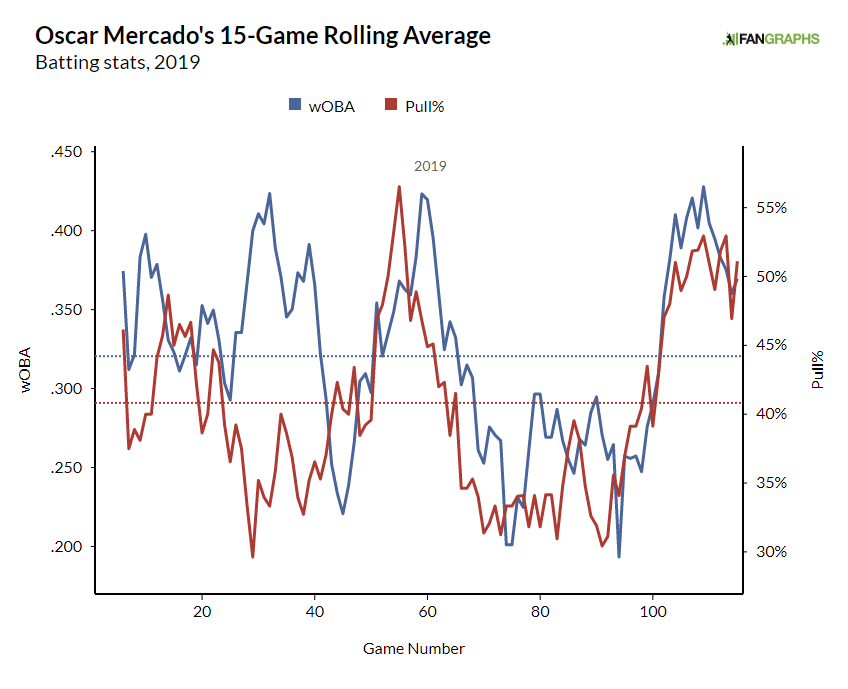
Beyond his initial success in May and June, Mercado’s wOBA looked intimately tied to his pull rate through the rest of the season. He really struggled in August when his pull rate fell to 32.5%, and he rebounded in September when he started pulling the ball almost half the time. Just look at his splits based on batted ball direction:

Oscar Mercado’s Batted Ball Splits
Direction GB% FB% Hard% ISO Exit Velo Launch Angle wOBA
Pull 53.4% 21.6% 47.0% .318 89.4 6.9 .462
Center 35.5% 41.9% 41.1% .115 86.8 12.4 .299
Opposite 22.2% 64.2% 25.3% .179 81.7 25.4 .276

It isn’t surprising to see such a productive split when pulling the ball, but Mercado’s batted ball profile almost makes it too easy to understand why he is so successful when doing so. When hitting to the opposite field, his exit velocity plummets to 81 mph while his fly ball rate jumps up to 64%. The result is lazy fly balls to right field that are easily converted to outs. The same problem occurs when he hits the ball up the middle to a less-extreme degree. His bat just doesn’t have enough pop to support elevating the ball so often when he isn’t pulling it too.

With an aggressive, high-contact approach at the plate, he should be able to leverage his elite sprint speed into more hits. But putting that many balls in the air when hitting to the right side really limits his opportunities to utilize his best tools. His 97th percentile sprint speed and his good contact rate seem like a fit for an approach that uses all fields, but his swing is geared towards pulling the ball to left. Perhaps there’s some middle ground between these two, but it might require making some adjustments to his swing.

Defensively, the former shortstop has excelled in the outfield. DRS thought he was the sixth-best center fielder in 2019 with nine runs saved. UZR was a little less impressed with just 2.8 runs saved, and Statcast’s defensive metrics back this up. He was five outs above average and his elite reaction time was the sixth-highest among all outfielders. Additionally, his elite sprint speed definitely helped him cover up some less-than-ideal routes.

Cleveland hasn’t had a regular full-time center fielder since Michael Bourn from 2013-2015. Nine different players have accumulated more than 100 innings in center since 2016. Mercado’s 1.7 WAR was the best mark posted by a Cleveland center fielder since Tyler Naquin’s rookie year in 2016. The Indians have plenty of fringe candidates to fill their outfield, as Allen, Bauers, Jordan Luplow, and Franmil Reyes all profile better as corner outfielders or fourth outfielders. Meanwhile, Naquin and Bradley Zimmer have unanswered health questions that will likely prevent them from taking a full-time job in 2020. Mercado’s defensive chops in center should allow him to provide everyday value and his bat shows enough promise to help him stick long-term. That’s one outfield spot down and two more to fill.


Anthony Rendon Deserves the Equivalent of the Bryce Harper Deal

Bryce Harper and Manny Machado were the two best position players in free agency last year and each received contracts of at least $300 million. Anthony Rendon is better than Bryce Harper and Manny Machado. He was better last season and the year before that. Rendon’s 19.9 WAR over the last three years is fourth in baseball and more than any three-season stretch Harper and Machado have ever had. But nobody expects Rendon to get $300 million despite better play due to Rendon’s age. Harper and Machado were entering their age-26 seasons while Rendon will be 30 years old for most of next season. Rendon also doesn’t need to hit $300 million to get a contract just as good as Harper or Machado.

In our list of Top 50 Free Agents, both Kiley McDaniel and the crowd expected Rendon would receive right around seven years and $30 million per season. That’s clearly not in the stratosphere of Harper and Machado, but the average annual value is equivalent to Machado’s deal and higher than Harper’s. If we were to look at the present-day value of these contracts with an 8% discount annually, Rendon’s deal is the equivalent of about $233 million spread over 10 years while Harper’s is more like $305 million. To get Rendon equivalent money on a seven-year deal, he would need to receive $270 million distributed evenly over the next seven years. Rendon probably won’t get that, but his value might be pretty close.

Over at MLB.com, Mike Petriello looked at Rendon by age, position, defense, and offensive performance to find similar players. Read the rest of this entry »


Finding a Home For Top Free Agents

Earlier this week, we posted a roundup of the top 50 free agents on the market this winter. We’ve already seen a couple of the guys near the top of that list either rework their contract or choose not to opt out, but the rest of the list remains unsigned.

Today we’re taking a look at the plausible landing spots for the top free agents left. A top-six list is a little awkward and perhaps less SEO friendly than a top five, but our fifth- and sixth-place players were projected for the same salary, so we’ve included both here. This post isn’t necessarily a prediction of where certain guys will sign, but rather, it’s a look at which teams should be in the market for these top talents given what we know about their ambitions and financial priorities. Spoiler: You won’t see the Red Sox listed below.

1. Gerrit Cole
Kiley’s estimate: 7 Years, $242 million
Should be interested: Los Angeles Dodgers, Atlanta Braves, Chicago Cubs, Texas Rangers, St. Louis Cardinals, honestly the whole league
Perfect fit: Los Angeles Angels

Cole may not capture the Cy Young this year, but after a dominating October in which his very presence loomed as the most significant storyline in each series Houston played, the consensus is that he’s the best pitcher in baseball. We haven’t seen that kind of arm hit the free agent market since CC Sabathia after the 2008 season. There isn’t a club in baseball that wouldn’t benefit from Cole’s services, even at the imposing price he’ll command. At the very least, every nominal contender in baseball should be evaluating what they can do to bring the big right-hander to their city.

His list of serious suitors figures to be quite smaller than that, and most of them are out west. The Dodgers make plenty of sense. Despite seven straight NL West titles, the club hasn’t won a championship with this core, and subpar starting pitching in the playoffs has been a big reason why they’ve fallen short. Is there a player better positioned to fill that gap than Cole? Read the rest of this entry »


RosterResource Free Agency Roundup: AL Central

In the second of a six-part series — you can see the AL East here — I’ll be highlighting each team’s most notable free agents and how it could fill the resulting void on the roster. A player’s rank on our recently released Top 50 Free Agents list, along with Kiley McDaniel’s contract estimates from that exercise, are listed where relevant. In some cases, the team already has a capable replacement ready to step in. In others, it’s clear the team will either attempt to re-sign their player or look to the trade or free agent markets for help. The remaining cases are somewhere in between, with in-house candidates who might be the answer, but aren’t such obvious everyday players to keep the team from shopping around for better options.

Here’s a look at the American League Central.

Chicago White Sox | Depth Chart | Payroll

Jose Abreu, 1B/DH
FanGraphs Top 50 Free Agent Ranking: 44
Kiley McDaniel’s contract projection: 1 year, $11M

Andrew Vaughn, the No. 3 overall pick in the 2019 amateur draft and the White Sox’s first baseman of the future, isn’t likely to need much time down on the farm. But it’s rare that any prospect, even one as advanced at the plate as the 21-year-old Vaughn, doesn’t spend at least one full season in the minors. Therefore, the White Sox will require a stopgap at first base in 2020 and have already taken a necessary step to keeping Abreu around for at least one more season.

The 32-year-old was tendered a qualifying offer, which will hurt his value if he wants to test the free agent waters. He could just settle for the one-year, $17.8 million contract or work out a long-term deal that would ensure he’s around to mentor the next wave of prospects, which could include Vaughn, second baseman Nick Madrigal, and outfielders Luis Robert and Luis Alexander Basabe, all who could arrive during the next two seasons. Read the rest of this entry »


Tommy John’s Career Was More Than Just a Surgical Procedure

This post is part of a series concerning the 2020 Modern Baseball Era Committee ballot, covering executives and long-retired players whose candidacies will be voted upon at the Winter Meetings in San Diego on December 8. For an introduction to JAWS, see here. Several profiles in this series are adapted from work previously published at SI.com, Baseball Prospectus, and Futility Infielder. All WAR figures refer to the Baseball-Reference version unless otherwise indicated.

2020 Modern Baseball Candidate: Tommy John
Pitcher Career WAR Peak WAR JAWS
Tommy John 61.5 34.6 48.0
Avg. HOF SP 73.2 49.9 61.5
W-L SO ERA ERA+
288-231 2,245 3.34 111
SOURCE: Baseball-Reference

Tommy John spent 26 seasons pitching in the majors from 1963-74 and then 1976-89, more than any player besides Nolan Ryan, but his level of fame stems as much from the year that cleaves that span as it does from his work on the mound. As the recipient of the most famous sports medicine procedure of all time, the elbow ligament replacement surgery performed by Dr. Frank Jobe in late 1974 that now bears his name, John endured an arduous year-long rehab process before returning to pitch as well as ever, a recovery that gave hope to generations of injured pitchers whose careers might otherwise have ended. Tommy John surgery has somewhat obscured the pitcher’s on-field accomplishments, however.

A sinkerballer who relied upon his command and control to limit hard contact, John didn’t overpower hitters; the epitome of the “crafty lefty,” he was so good at his craft that he arrived on the major league scene at age 20 and made his final appearance three days after his 46th birthday. He made three All-Star teams and was a key starter on five clubs that reached the postseason and three that won pennants, though he wound up on the losing end of the World Series each time.

Born in 1943 in Terre Haute, Indiana, John excelled in basketball as well as baseball in high school, so much so that the rangy, 6-foot-3 teenager was recruited by legendary Kentucky coach Adolph Rupp, and had over 50 basketball scholarship offers but just one for baseball (few colleges gave those out in those days). Reliant on a curveball learned from former Phillies minor leaguer Arley Andrews, a friend of his father, he pitched to a 28-2 record in high school despite his lack of top-notch fastball, signing with the Indians out of high school in 1961, four years before the introduction of the amateur draft. Read the rest of this entry »


Chris Davis and the Brutal Life of a Late-Career Slugger

The Orioles will not be hosting a FanFest this year; the team has indicated it will be “looking into other ways of connecting with fans,” according to the Baltimore Sun.

Perhaps there’s just isn’t really much to say right now. Adam Jones, Manny Machado, Zack Britton, Jonathan Schoop, Buck Showalter, and all the team’s other recognizable names have been shipped out or moved on. But Chris Davis remains, and he found a big way to connect with Baltimore this offseason, as he and his wife, Jill, recently donated $3 million to the University of Maryland Children’s Hospital. While talking to reporters, Davis said that the Orioles’ reshaping their franchise in the front office and the dugout had already made him feel more “hopeful.” Where in previous winters, he’d set about his workouts with motivation but no direction, there now seems to be a plan, devised by him and manager Brandon Hyde to keep him moving toward a goal.

And yet, it seems like we’re looking at a winter of hard truths for the Orioles slugger. Davis will turn 34 years old in the middle of spring training. He’s on a well-known and oft-despised seven-year deal worth $161 million that is scheduled to end in 2022. Even better-known are his struggles, which have seen him drop from an All-Star and Silver Slugger in 2013 to asking for the game ball after breaking an 0-for-54 hitless streak this past April.

At this stage in his development, he’s developed. The swing either works or it doesn’t. Once a hitter gets some experience and establishes his mechanics, his later years are the work of mental tweaks rather than physical ones. Sure, older players can make adjustments, but Davis is apparently not going to do that: Read the rest of this entry »


Are the Cubs Really Going to Ignore Their Window for Contention?

It’s early in the offseason, but the Cubs look to be in pretty good shape for next year. Our Depth Charts currently have the team set to produce 41 WAR next season, which translates to around 85-90 wins. Even better for the Cubs, they are about six wins ahead of last year’s division-winning Cardinals and seven wins ahead of the Wild Card-winning Brewers. On paper, the Cubs have the best team in the division. That’s a pretty good spot to be in; the problem comes in trying to improve and win with the greatest core of players the franchise has produced in decades.

Over at The Athletic, Shahadev Sharma has a comprehensive look at the Cubs’ plans for the winter. The title gives a little away: “Cubs seem ready to make big moves, but don’t count on them spending big money.” Todd Ricketts’ comments on local radio station 670, The Score provides further insight:

But ultimately, now I think we can stop talking about windows. We should be consistent, and we should be looking toward building a division-winning team every year.

Theo Epstein sort of agrees. From Sharma’s piece:

“Next year is a priority,” Epstein said, before quickly looking ahead. “We have to balance it with the future. That’s probably more important now than it was even a year ago, because we’re now just two years away from a lot of our best players reaching their end of their period of club control with the Cubs. I think the goal is to do everything we can to win the World Series next year, but we also have to pay attention to the long term. Maximize this window while also putting in a lot of good work to open a new one as well.”

Read the rest of this entry »


Injury-Shortened Primes Consign Mattingly and Murphy to Modern Baseball Ballot Also-Rans

This post is part of a series concerning the 2020 Modern Baseball Era Committee ballot, covering executives and long-retired players whose candidacies will be voted upon at the Winter Meetings in San Diego on December 8. For an introduction to JAWS, see here. Several profiles in this series are adapted from work previously published at SI.com, Baseball Prospectus, and Futility Infielder. All WAR figures refer to the Baseball-Reference version unless otherwise indicated.

Don Mattingly

2020 Modern Baseball Candidate: Don Mattingly
Player Career WAR Peak WAR JAWS
Don Mattingly 42.4 35.7 39.1
Avg. HOF 1B 66.8 42.7 54.8
H HR AVG/OBP/SLG OPS+
2,153 222 .307.358/.471 127
SOURCE: Baseball-Reference

See here for a more in-depth profile dating to Mattingly’s time on the BBWAA ballot.

Don Mattingly was the golden child of the Great Yankees Dark Age. He debuted in September 1982, the year after the team finished a stretch of four World Series appearances in six seasons, and retired in 1995, having finally reached the postseason but nonetheless departing a year too early for their run of six pennants and four titles in eight years. A lefty-swinging first baseman with a sweet stroke, “Donnie Baseball” was both an outstanding hitter and a slick fielder at his peak. He made six straight All-Star teams from 1984-89, and won a batting title, an MVP award, and nine Gold Gloves. Alas, a back injury sapped his power, not only shortening his peak but also bringing his career to a premature end at age 34.

Born in 1961 in Evansville, Indiana, Mattingly was not only naturally talented when it came to baseball, but was also ambidextrous. In Little League, he switch-pitched occasionally, throwing three innings righty and three more lefty. By the time of the 1979 draft, he had committed to attend Indiana State University on a scholarship, but the Yankees chose him in the 19th round, and he surprised his family by deciding to sign for a $23,000 bonus. Early in his minor league tenure, his lack of speed and power concerned the organization to the point that they considered moving him to second base because of his ability to throw right-handed. Even so, Mattingly clearly demonstrated he could hit, topping .300 at every stop in the minors with good plate discipline and outstanding contact skills, even if he never exceeded 10 homers. Read the rest of this entry »