Archive for Daily Graphings

Sorting Through Friday’s Non-Tender Decisions

Jim Cowsert-USA TODAY Sports

Friday was a key deadline in the offseason calendar: the last day that teams could non-tender players instead of offering them a contract in arbitration. It’s something of an annual tradition. Once a year, a bunch of guys whose names inspire you to think “oh, he’s not bad” nonetheless get non-tendered because their performance doesn’t measure up to their projected salary. This year, the non-tender group was larger than I’m used to, so I think it merits a recap.

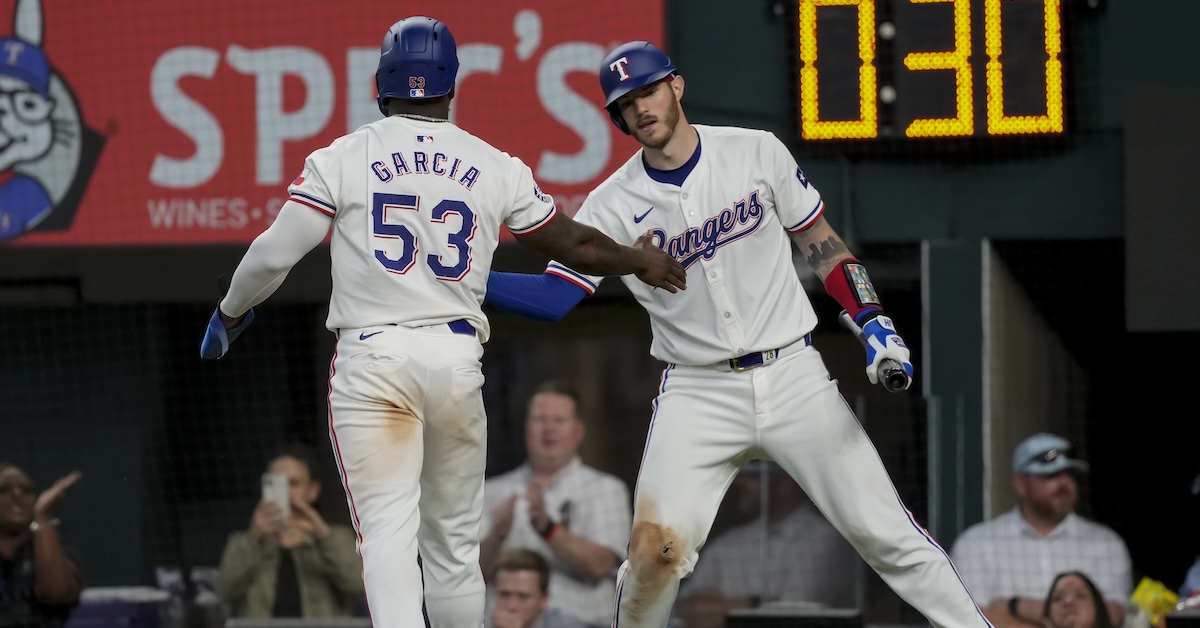
One classic archetype of the players who get non-tendered is the older breakout who then regresses toward the mean in subsequent years. An example: Adolis García, probably the most famous player in this group, burst onto the scene as a 28-year-old rookie in 2021, piling up 10.6 WAR in his first three full seasons. He starred on the 2023 World Series champion Rangers, blasting eight home runs and a record 22 RBI, and taking home ALCS MVP honors.

The next two years weren’t so halcyon, with García posting an aggregate 89 wRC+ and 0.6 WAR. Heading into his age-33 season, it’s hard to expect a return to his peak form; our projection systems think he’s more of a fourth outfielder than an everyday starter these days. The problem, from Texas’ standpoint, is that García earned $9.25 million this season in his second year of arbitration. He stood to make at least that much in his last pass through arb. The Rangers quite reasonably looked around for alternatives. Several free agent corner outfielders with similar projections were available, and probably for less. And Texas likely went into the Friday deadline with some idea that the Marcus Semien/Brandon Nimmo salary swap was on horizon, which meant fewer outfield openings; given that backdrop, García’s non-tender isn’t a big surprise. Read the rest of this entry »
Sunday Notes: Colorado Reliever Juan Mejia Has a Brayan Bello Connection

When our 2025 Colorado Rockies Top Prospect list was published last January, a 24-year-old pitcher coming off of an underwhelming season ranked 14th with a 45+ FV. Over 54 innings with the Double-A Hartford Yard Goats, Juan Mejia had logged a 5.00 ERA and an equally-unhealthy 12.3% walk rate. Eric Longenhagen nonetheless remained enamored of his potential. Offering a “relatively bullish projection,” our lead prospect analyst wrote that the righty “is too freaky to slide,” because he possessed “one of the more explosive and athletic deliveries in the minors” as well as a mid-to-high-90s fastball and an “overtly nasty” slider.

Longenhagen’s faith was realized in the youngster’s rookie season. Not only did Mejia make 55 appearances, he put up a 3.96 ERA, a 3.71 FIP, and a 26.1% strikeout rate over 61-and-a-third innings. Among Rockies relievers, only Jimmy Herget took the mound more frequently and tossed more frames.

When I spoke to Mejia at Fenway Park this past summer — Colorado PR staffer Edwin Perez served as an interpreter — I learned that he has a connection with Red Sox right-hander Brayan Bello. Both were signed out of the Dominican Republic in 2017, and they were together, along with other starry-eyed hopefuls, when Mejia first caught the eye of a Rockies scout.

“When I was 16, I was doing a tryout,” recalled Mejia, who hails from Baní, roughly an hour south of Santo Domingo. “I don’t remember how many teams were there, but there were a lot of them. That’s where I met Brayan Bello, who a lot of scouts were there to see. Read the rest of this entry »

The WPBL Has Teams and Players Now

Tom Szczerbowski-USA TODAY Sports

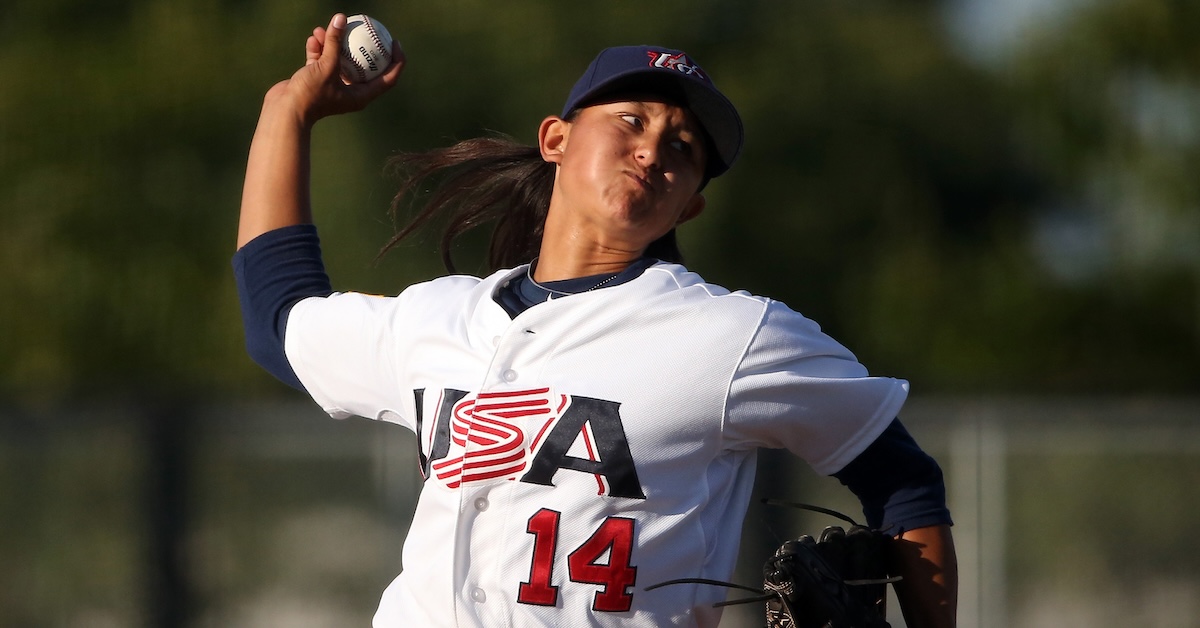
The Women’s Pro Baseball League held its inaugural draft on Thursday night. For many of the players who heard their names called, getting to play professional baseball is a dream they’ve carried since childhood, one they knew might never come true. Play won’t get underway until next August, but with the WPBL draft now in the history books, the dreams of 120 women are meaningfully closer to being realized.

Thursday night’s draft was the culmination of a busy few months for the new league. Since I last wrote about the WPBL in January, the league has announced key logistical information, such as the number of teams that will play during its first season, where those teams will play, and how much the teams will pay the players, and has also provided an update on the WPBL’s media and broadcast strategy. But despite all the new intel on how the league will be run, a few key components are still unknown. So before recapping the draft and the open tryout that determined the pool of draft-eligible players, let’s get up to date on what we do and don’t know about the WPBL so far.

If this is the first you’re hearing of the WPBL, here’s a quick primer. It’s a professional baseball league for women, the first of its kind since the All-American Girls Professional Baseball League (AAGPBL), which ran from 1943 to 1954. The WPBL was co-founded in October of 2024 by Justine Siegal — who is best known for founding Baseball For All, “[A] girls baseball nonprofit that builds gender equity by creating opportunities for girls to play, coach, and lead in the sport” — and Keith Stein, a businessman, lawyer, and member of the ownership group for a semiprofessional men’s baseball team in Toronto. Read the rest of this entry »


FanGraphs Power Rankings: Offseason 2026 (No. 1–17)

The hot stove has started to heat up, but it’s still pretty early in the offseason. On Tuesday, I took stock of how the early 2026 projections viewed the bottom 18 teams in baseball as they’re currently constructed. Today, I’ll take a look at the teams projected to finish with a .500 or better record in 2026. This exercise should give us a pretty good idea of which clubs would be ready to compete if the season started today, and which ones still have work to do this offseason.

Our power rankings use a modified Elo rating system. If you’re familiar with chess rankings or FiveThirtyEight’s defunct sports section, you’ll know that Elo is an elegant ranking format that measures teams’ relative strength and is very reactive to recent performance. For these offseason rankings, I’ve pulled the Depth Charts projections and calculated an implied Elo ranking for each team. Right now, our Depth Charts projections are powered entirely by the 2026 Steamer projections; the 2026 ZiPS projections will be folded in later in the offseason.

First up are the rankings, presented in a sortable table. Below that, I’ve grouped the teams into tiers, with comments on each club. You’ll notice that the official ordinal rankings don’t always match the tiers — there are times when I take editorial liberties in grouping teams together — but generally, the order is consistent. The delta column in the table below shows the change in ranking from the final regular season run of the power rankings. The rankings for teams 18–30 have been updated with the handful of moves that occurred around baseball since Part I was published. Read the rest of this entry »


White Sox GM Chris Getz on His Team’s Top Pitching Prospects

Kamil Krzaczynski-USA TODAY Sports

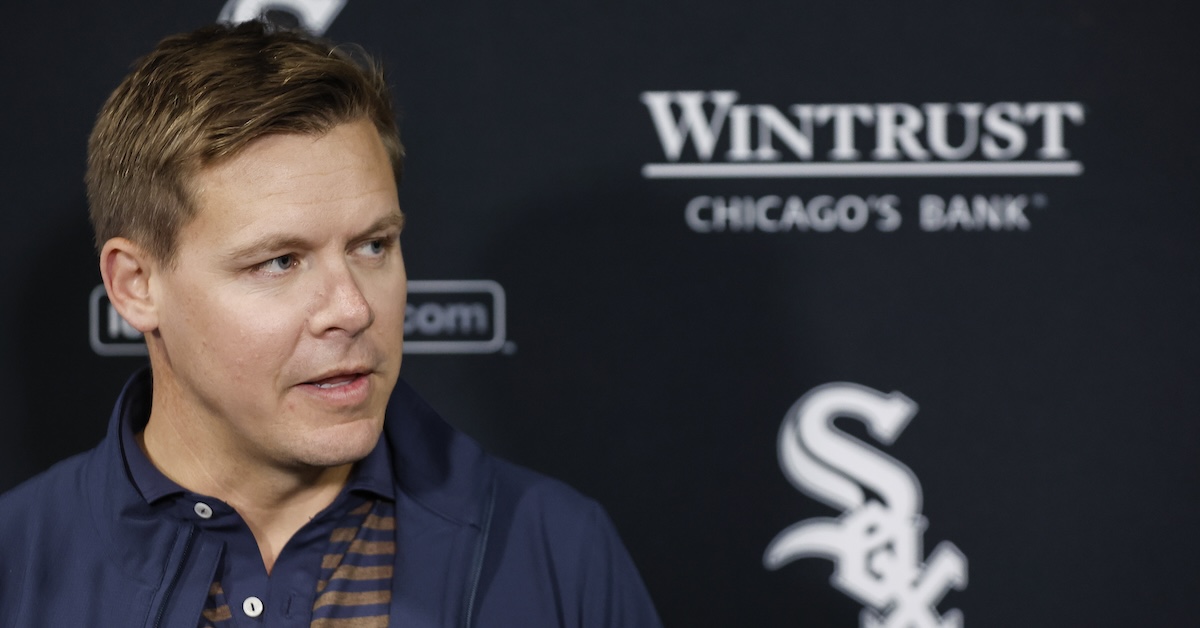
The Chicago White Sox have two of baseball’s most promising pitching prospects. Noah Schultz, a 22-year-old left-hander who was drafted 26th overall in 2022 out of an Oswego, Illinois high school is currently no. 22 on The Board with a 55 FV. Hagen Smith, himself a 22-year-old southpaw, was drafted fifth overall in 2024 out of the University of Arkansas and is no. 81 with a 50 FV. Each possesses a power arm, and both have a lot to prove in the forthcoming season — albeit for different reasons. Schultz was limited to 73 innings this year due to injury, while Smith dealt with command issues and lacks a solid third pitch.

I asked White Sox executive vice president/general manager Chris Getz about the young pitchers during last week’s GM Meetings in Las Vegas.

“For Noah, it was an inconsistent year,” Getz said of the 6-foot-10 Schultz, who struggled to the tune of a 4.68 ERA between Double-A Birmingham and Triple-A Charlotte. “Much of that was related to his knee — he had patellar tendonitis — and he needed be to shut down. He’s doing [physical therapy] and strengthening right now. I anticipate that once the knee is completely healed, once it is healthy and completely strong, we are going to get the version of Noah that made him a top prospect in our game. Read the rest of this entry »


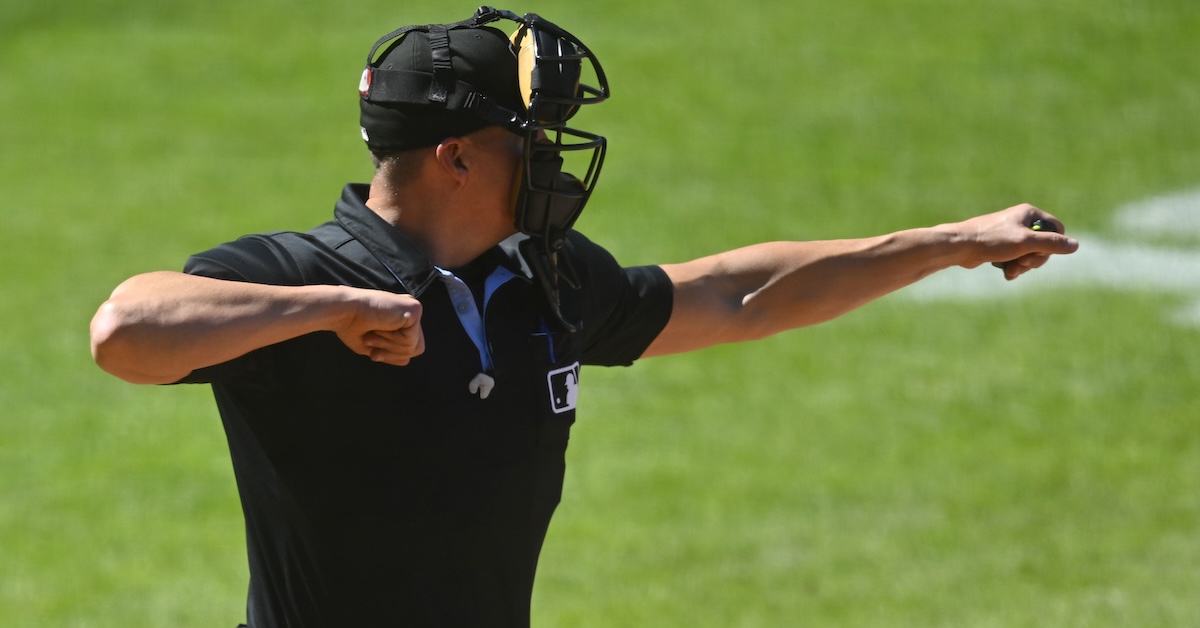
Your Final Pre-Robo-Zone Umpire Accuracy Update

David Richard-Imagn Images

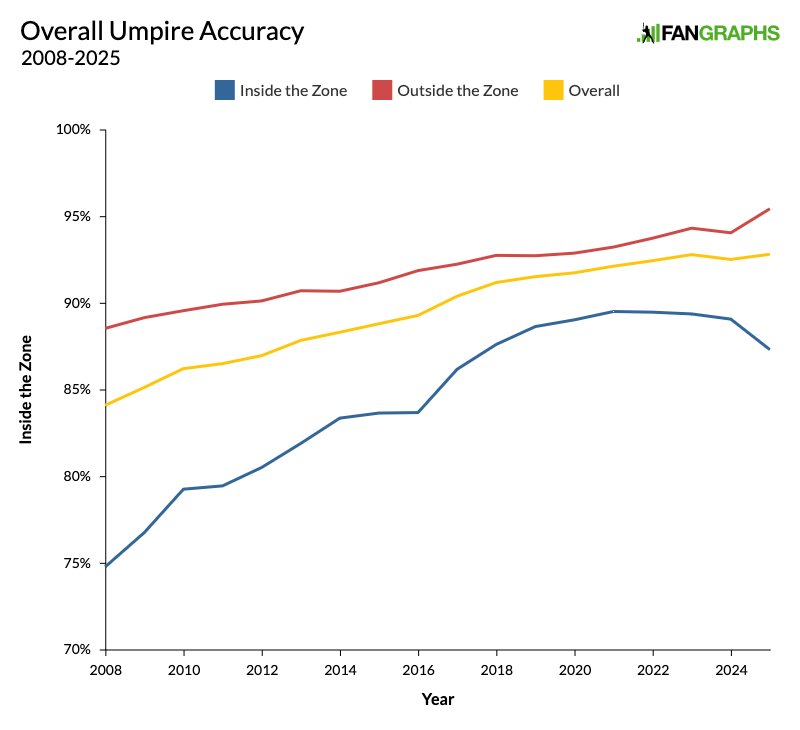
For four years now, I’ve been updating you on the changing contours of the strike zone. By my count, this is the 10th installment in that series and the sixth specifically about the accuracy of ball-strike calls on the edges of the zone. With the implementation of the ABS challenge system in 2026, these updates will no doubt start to look a bit different. This is our last umpire accuracy update of the pre-ABS era, so let’s take stock of where we are at the end.

After a tiny dip in 2024, umpires were back on track in 2025, posting a record-high accuracy rate of 92.83% overall. In fact, 2024 was the only year in the pitch-tracking era in which umpires didn’t set a record for accuracy. However, this latest record came with a bit of controversy. Early in the season, pitchers and catchers picked up on the fact that the strike zone seemed to have shrunk. The league tightened up the standards that it used to grade umpires, reducing the size of the buffer zone around the edges of the zone. As a result, accuracy shot up specifically on pitches outside the zone, even more specifically, on pitches just above the top of the zone, causing pitchers and catchers to complain that they were losing the high strike.

This graph reminds us of a couple facts that might just be so obvious that we rarely think about them. First, the vast majority of takes come on pitches outside the strike zone. Of course they do; those are the pitches you’re not supposed to swing at. This year, for example, 68% of the calls umpires had to make came on pitches outside the strike zone. Second, it’s easier to identify balls than it is to identify strikes. Of course it is; the area outside the zone is a lot bigger than the area inside the zone. Read the rest of this entry »


I Had an Idea About Bat Tracking Data

Sam Navarro-Imagn Images

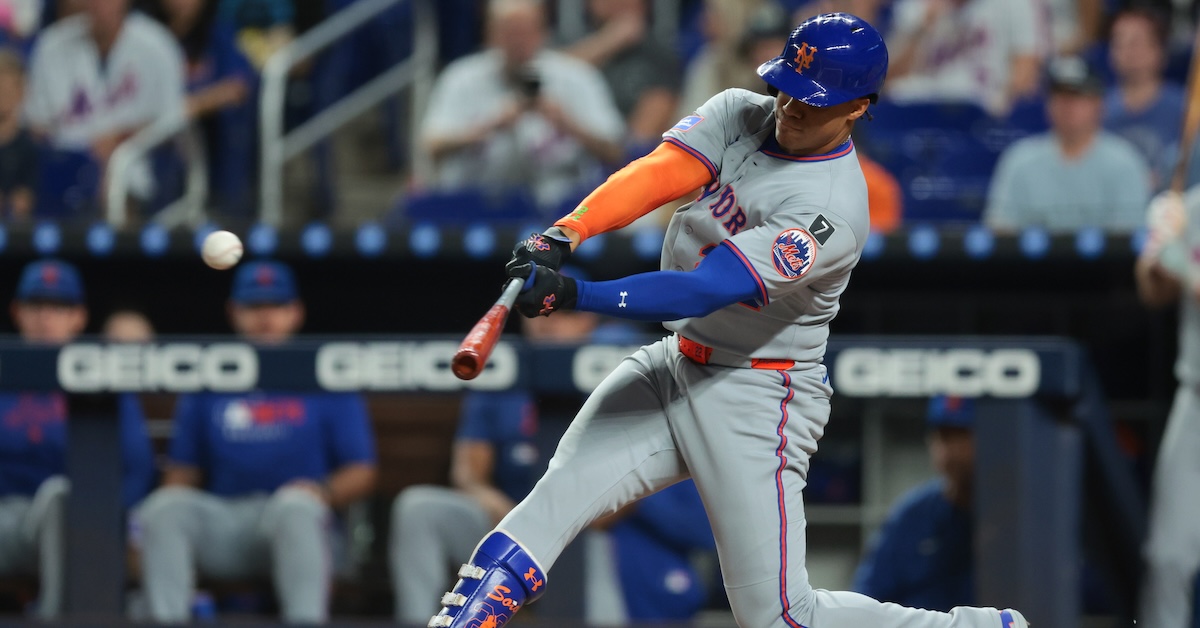
I was in Hawaii this past weekend, taking a nice vacation to wind down from the end of the baseball season, when I found myself thinking about intercept points. Weird? Overly baseball obsessed? Maybe. But in my defense, a kid at the pool kept swinging at a Wiffle ball almost hilariously late, spraying it “foul” every time. “Oh look, the next Luis Arraez,” I thought, before going back to my umbrella-adorned drink. But that stuck with me, and when I got home, a database query leapt out of my head fully formed, like Athena after Zeus’ headache.

Where is the optimal place to make contact with the ball? It depends on who’s swinging. Statcast measures every single swing’s contact point relative to a hitter’s center of mass, and that data clearly shows that there are many ways to succeed. That’s always stymied me as I’ve looked into swing path data. But that small child gave me an idea when he got off the best swing I’d seen all day, a Wiffle ball line drive that would have been a screamer down the left field foul line (he was batting lefty). Because his normal swing was so late, his best contact was ever so slightly less late. What if I bucketed hitters based on their own swings to look for swing timing clues?

I took every batter who produced 300 or more batted balls (foul balls or balls in play) in 2025. For each of those hitters, I took aggregate statistics for all of their results, then also split their batted balls into three groups: deepest contact point, middle contact point, and farthest forward contact point. You can think of it as late, on time, and early, adjusted for that player’s swing. The later you start your swing, the more you “let it travel,” the deeper your contact point relative to your center of mass. The earlier you start, the more you “get out in front,” the farther forward you make contact. Read the rest of this entry »


Don’t Freak Out, but Four Guys Accepted the Qualifying Offer

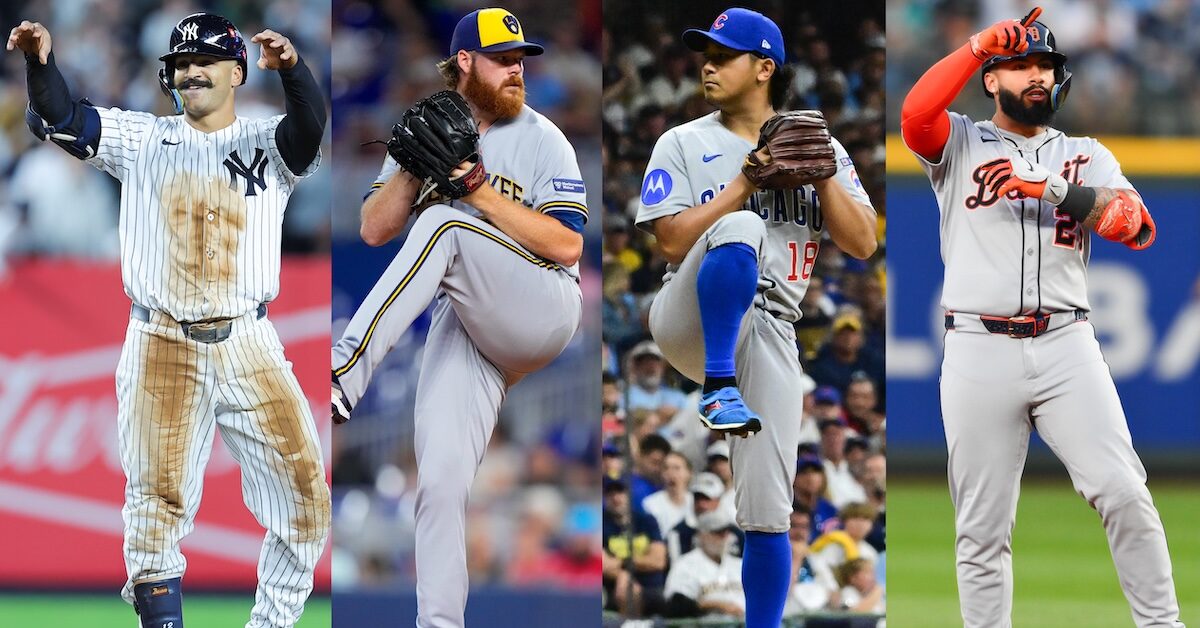
Brad Penner, Rich Storry, Benny Sieu, and Steven Bisig – Imagn Images

After Josh Naylor signed the first major free agent deal of the offseason over the weekend, four more big names came off the board Tuesday afternoon. Of the 13 free agents who were presented with qualifying offers, four accepted: Brandon Woodruff, Trent Grisham, Gleyber Torres, and Shota Imanaga will all return to their previous teams on one-year contracts worth $22.025 million.

Bo Bichette, Dylan Cease, Edwin Díaz, Framber Valdez, Kyle Schwarber, Kyle Tucker, Michael King, Ranger Suárez, and Zac Gallen all declined their qualifying offers and will hit the open market, carrying draft pick penalties to be determined by MLB’s inscrutable compensation system.

If you’re thinking this is a bumper crop of QO acceptance, you’d be right. In the first 14 years of the qualifying offer system, 144 offers were extended to pending free agents, and only 14 accepted. This year, nearly one in four qualified free agents decided to bank the offer and walk away, rather than face one more multiple-choice question from Regis Philbin. Read the rest of this entry »


The We Tried Tracker Is Back and Open for Business

Nick Turchiaro-Imagn Images

Well sports fans, it’s that time again. We Tried season is officially upon us, and for the second offseason in a row, I will be keeping my eye fixed firmly on the periphery of the action. For the uninitiated, We Tried is a noun in this context. It’s the name for the phenomenon of reporters announcing, once a player has signed with a team, that another team was interested in signing that player too. Team A might have succeeded in landing the player in question, but Team B wants to make sure the public knows that they failed to sign him because they want credit for that failure. It is both our duty and great honor to award that credit. The illustrious Jon Becker has once again graciously offered to host the We Tried Tracker on his maniacally comprehensive MLB Matrices spreadsheet, so be sure to check there for all the latest in major league effort.

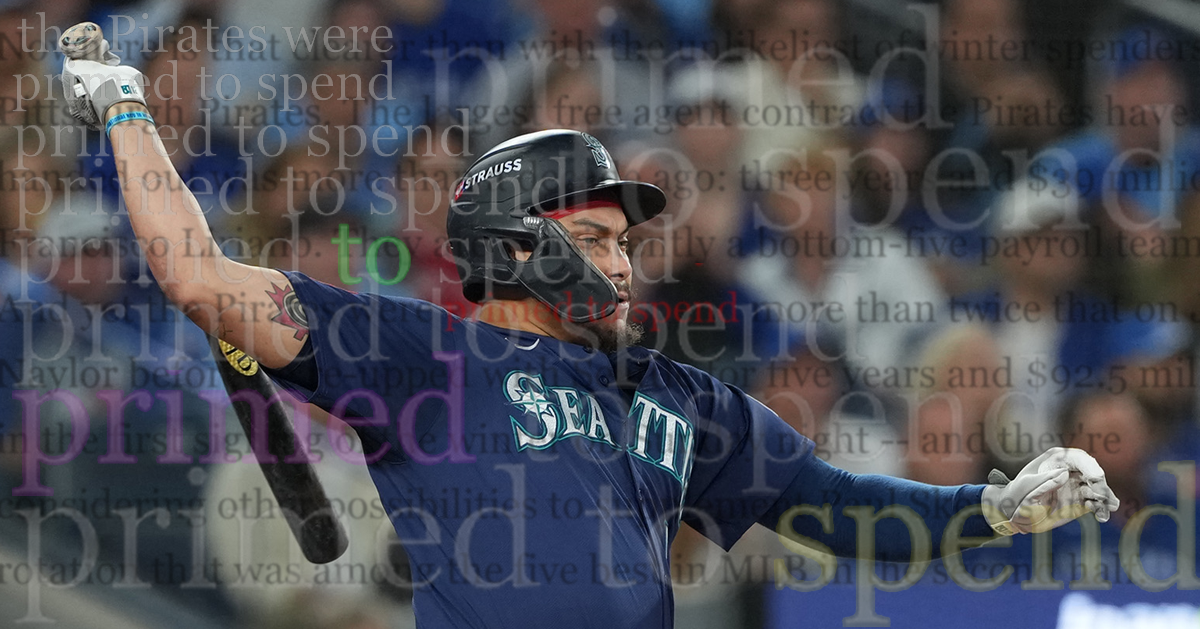
Jeff Passan, ESPN’s officially-licensed baseball bombardier, kicked off the real offseason bright and early on Tuesday morning (Becker tipped me off to the news not long after). At 7:00 AM, Passan published an offseason preview that featured a key piece of information about Josh Naylor, who agreed to return to the Mariners this past weekend:

The largest free agent contract the Pirates have ever handed out was more than a decade ago: three years and $39 million to Francisco Liriano. They are consistently a bottom-five payroll team. And yet the Pirates were primed to spend more than twice that on Josh Naylor before he re-upped with Seattle for five years and $92.5 million in the first signing of the winter on Sunday night — and they’re considering other possibilities to supplement Paul Skenes and a rotation that was among the five best in MLB in the second half.

Read the rest of this entry »


2026 ZiPS Projections: Cincinnati Reds

For the 22nd consecutive season, the ZiPS projection system is unleashing a full set of prognostications. For more information on the ZiPS projections, please consult this year’s introduction, as well as MLB’s glossary entry. The team order is selected by lot, and the next team up is the Cincinnati Reds.

Batters

Much like during the 2020 COVID season, the 2025 Reds finished just above .500, barely squeaked into the playoffs, and got bounced from the Wild Card round in two games. At least this time around, they actually scored runs! But the lineup was a recurring problem in the regular season, the biggest reason Cincy needed a late-summer collapse by the Mets in order to play October baseball. The lineup’s 13.2 WAR ranked 26th in baseball, with Elly De La Cruz and TJ Friedl combining for more than half of that total. Finishing 21st in home runs isn’t good for a team that plays in one of the best home run parks in the majors today. Read the rest of this entry »