Archive for Featured

Sunday Notes: Trevor Story Hovers, Then Explodes

Trevor Story has always been a good hitter. He’s never been as good of a hitter as he is now. In his third big-league season, the 25-year-old Colorado Rockies basher is slashing .291/.346/.555 with 40 doubles, five triples, and 33 home runs. In short, he’s been a beast.

According to Story, he hasn’t changed all that much mechanically since the Rockies took him 45th overall in the 2011 draft out of an Irving, Texas high school. But he has changed a little.

“I think you’d see something very similar (if you compared then to now), but there are some differences,” Story told me earlier this summer. “I had more of a leg kick when I was younger, and I was kind of bouncing my hands instead of resting them on my shoulder. Outside of that, my movements are basically the same.”

Story felt that having a higher kick resulted in him getting beat by fastballs from pitchers with plus velocity, and as he “didn’t really need a leg kick to hit the ball far,” he changed to what he considers “more of a lift than a kick now; it’s almost more of a hover.”

Leg kicks — ditto lifts and hovers — are timing mechanisms, and as not all pitchers are the same, nor is Story always the same. The differences are subtle, but they’re definitely there. Read the rest of this entry »


The Best of FanGraphs: September 10-14, 2018

Each week, we publish in the neighborhood of 75 articles across our various blogs. With this post, we hope to highlight 10 to 15 of them. You can read more on it here. The links below are color coded — green for FanGraphs, brown for RotoGraphs, dark red for The Hardball Times and blue for Community Research.
Read the rest of this entry »


Masahiro Tanaka Is Getting Well at the Right Time

When the Yankees put Masahiro Tanaka on the disabled list back on June 9, it didn’t appear to represent a massive blow to the club. The team was 42-19, in a virtual tie for first place with the Red Sox. Luis Severino was pitching like a Cy Young frontrunner. Tanaka, for his part, was having an inconsistent season. When he went down with hamstring injuries, he’d recorded a 4.96 FIP and 4.58 ERA for the season and had given up 10 homers in his previous six starts. The intriguing Jonathan Loaisiga was about to take Tanaka’s spot in the rotation — and would perform well in his absence — further limiting the potential damage of Tanaka’s loss.

Fast-forward three months and circumstances have changed pretty considerably. Severino has cooled considerably, while other rotation pieces like Loasigia and Domingo German have fallen off the radar, having been replaced by solid additions in J.A. Happ and Lance Lynn. Without Severino fronting the rotation, however, the team lacks a pitcher with potentially dominant stuff to start the Wild Card game, leaving the possibility of a second straight involuntary bullpen game for New York in a winner-take-all matchup. Now Tanaka might be the best candidate for that role.

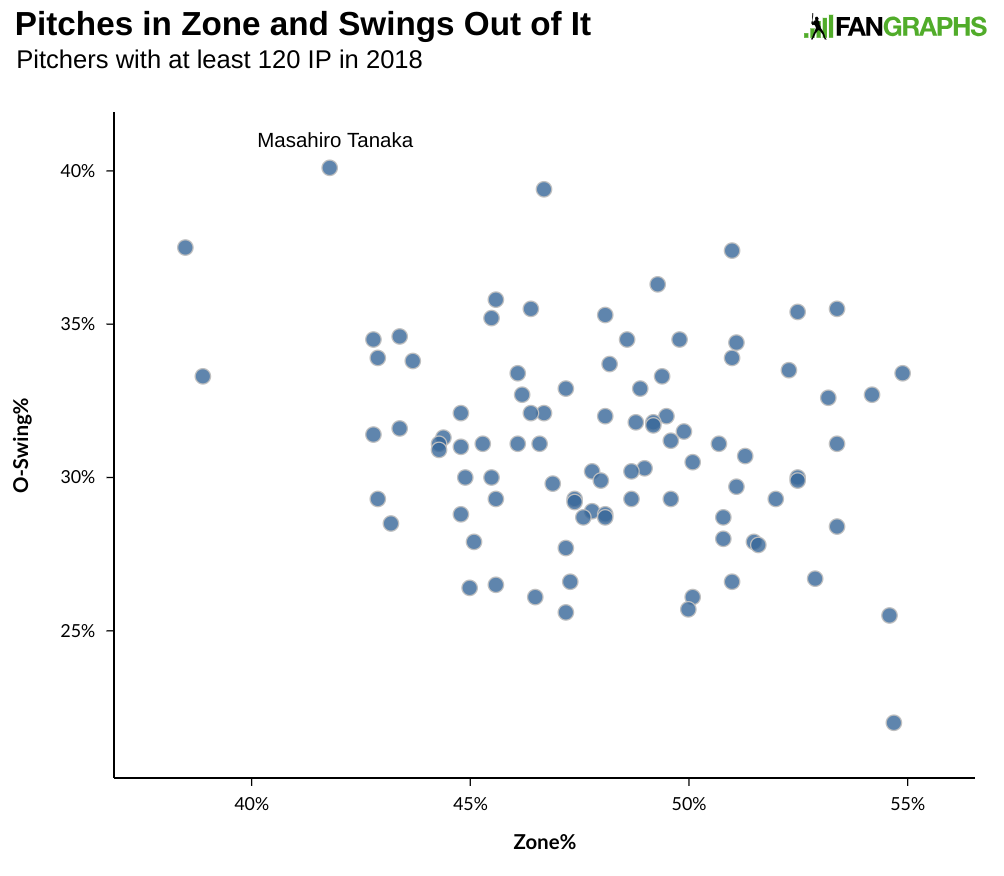
The Yankees right-hander has always been very reliant on breaking stuff out of the zone to get batters out. His fastball sits in the low 90s and isn’t notable for a lot of rise (the four-seamer has a career 5.2% whiff rate) or a ton of sink (his two-seamer has a ground-ball rate below 50%), so he needs batters to swing at his offspeed pitches to be successful. That plan has worked over the course of his career. The graph below shows how often pitchers throw in the zone and how often batters swing at offerings out of the zone.

Read the rest of this entry »


Elegy for ’18 – Miami Marlins

The 2018 Miami Marlins were out of contention before the season even started.
(Photo: Keith Allison)

Last in war, last in peace, and last in the National League: the Marlins were the first NL team to be eliminated from postseason contention in 2018. And while they technically possessed some chance of qualifying for the playoffs as late as September, a reasonable observer would have mentally dismissed this year’s club sometime around the Giancarlo Stanton trade back in December of 2017.

The Setup

The death of Jose Fernandez was a tragic loss for his family, his friends, and the world of baseball generally — and it’s hard to tell the story of the Marlins on the field without noting the impact of his absence. But even as Fernandez’s death has presented a major obstacle for the team’s success on the mound, it doesn’t explain why the organization has had so much trouble developing other young starting pitchers. The 2017 Marlins were good enough to hang around the edges of the Wild Card race, but they never really had that look of a contender and trading the team’s only top prospect, Luis Castillo, to acquire Dan Straily before 2017 was yet another short-sighted organizational move.

Towards the end of the 2017 season, MLB officially approved the sale of the Marlins to a group led by Bruce Sherman, mercifully ending Jeff Loria’s reign of terrible, during which he somehow made Frank McCourt or the Wilpons look like model owners by comparison. Derek Jeter’s 4% stake bought him a job as the CEO of the Marlins, a honeymoon that didn’t last for even the initial press conference, as the future Hall-of-Fame shortstop warned that there would be some unpopular moves. And in Marlins Land, “unpopular moves” indicates a fire sale.

Read the rest of this entry »


David Wright to Retire

New York Mets third baseman David Wright announced his retirement, effective at the end of the 2018 season, at a press conference on Thursday afternoon. Wright’s been trying to mount a comeback for a few years now, following a 2015 diagnosis of spinal stenosis, a narrowing of the spine that puts pressure on the nerves. The condition is degenerative and, in the four seasons since the start of that 2015 campaign, Wright has managed to appear in only 75 games with the Mets. He was hoping to make one last attempt to resume his career, working with the St. Lucie Mets for most of August before a couple of tuneup games with Triple-A Las Vegas, but that time in the minors appears merely to have confirmed the challenges that a major-league role would have presented to him.

Finishing off my 30s gave me a perspective on chronic injuries that I didn’t have 20 years ago. I am decidedly not a professional athlete. That said, I’ve observed as my own random aches and pains have multiplied over the last decade. I assume that, for a professional athlete — with much higher physical standards to maintain and much more day-to-day activity than a doughy sportswriter — it’s much worse. There are those who will say, “Don’t worry. He has a $100 million. He’ll be OK!” Certainly that was one view of Prince Fielder’s own premature retirement. (That was another tear-jerker of a press conference.) And, in one sense, it’s not incorrect: David Wright is free from worrying about the day-to-day costs of living. But he’s also someone who’s entire adult life has been dedicated to a particular endeavor (baseball) and who’s now forced to contend with the fact that his ability to participate in that endeavor has been cut short by five or so years. Hearing Wright say that “physically, the way I feel right now and everything the doctors have told me, there’s not going to be any improvement” was tough to watch for any fan of Wright or any fan of baseball.

Wright’s major-league career isn’t quite over, though: the Mets will activate him to start at third base on September 29th against the Marlins. I like when teams have the ability to do this kind of thing, and I was personally disappointed when the Yankees didn’t play A-Rod at shortstop for the final inning of his career. And playing one last game seems a lot more satisfying than signing a one-day contract, as players sometimes do with clubs that have had particular relevance to their careers.

Read the rest of this entry »


Baseball’s Most Anonymous Great Player

A couple months ago, Kiley McDaniel posted his list of the players with the most trade value in baseball. It’s not quite the same as a list of the best players in baseball, since the former also considers contract status and salary, but, if anything, the former is more important than the latter. The Indians came out looking good — Jose Ramirez placed first, and Francisco Lindor placed second. But today I’m more interested in looking further down. Jose Altuve placed 36th. Blake Snell placed 35th. Rhys Hoskins placed 34th, and Mitch Haniger placed 33rd. Eugenio Suarez placed 32nd. He was one slot behind Gary Sanchez, and two slots behind Shohei Ohtani. Sanchez and Ohtani have only seen their stocks drop.

Within the baseball industry, it’s widely understood how good and valuable Suarez has become. That’s one of the jobs of front-office people — develop a proper understanding of player value, around the whole league. If Suarez were made available in a trade, teams would fall all over themselves to get in front of the line. But what baseball understands isn’t the same as what the average observer understands, and it’s incredibly easy to overlook what Suarez has done. He’s not a flashy player, he was never a hyped prospect, and he’s played for a non-competitive team. As such, my sense is that Suarez is greatly underappreciated. But, before the year, the Reds signed him to a long-term contract extension, in response to a breakout 2017. Suarez has since followed a breakout season with a breakout season.

Read the rest of this entry »


Why the CBA Should Be the Province of Lawyers

On Tuesday, Joe Sheehan wrote a typically thought-provoking piece addressing, in this case, the problem of service-time manipulation, an issue which seems to have reached a tipping point in the 2018 season, a year in which Ronald Acuna, Peter Alonso, Vladimir Guerrero Jr., Gleyber Torres, and even Byron Buxton have been subject to extended minor-league seasoning so their teams can get an extra year of contractual control.

While the Major League Baseball Players’ Association hired Bruce Meyer in part to address these issues when the next collective bargaining agreement is negotiated, Sheehan suggests we rethink the entire process, and calls for “a constitutional convention to address the problems that four decades of patching its rules have created.” In the relevant passage, Sheehan suggests that collective bargaining isn’t necessarily up to the task of solving problems ranging from service-time manipulation to pitching changes to the structure of the playoffs.

We’ve relied on Collective Bargaining Agreement negotiations, twice a decade or so, to address these questions, but those negotiations have proven inadequate to the task. The fact is, these questions exceed the scope of a CBA negotiation. Answering them needs to be a collaborative process, not a confrontational one. Representatives from the league and the teams and the players should be involved, but so should vested interests from all over baseball.

Historians like John Thorn bring perspective about how the game on the field has evolved. Analysts like MLB.com’s Mike Petriello have a grasp on how technology is changing player evaluation and strategy. Controversies over player behavior have alienated fans; giving visible, insightful women like Fangraphs’ Meg Rowley and Baseball Prospectus’ Rachel [sic] McDaniel a seat at the table would send a message that baseball wants everyone to feel welcome.

Let me start by saying that Meg, Rachael, Mike, and John are all fine people and excellent analysts. I’m proud in particular to call Meg a colleague (it is not, in my view, hyperbole to call Meg Rowley the most talented baseball writer working today), and all would, I’m sure, make fine decisions in a position of decision-making baseball authority. With that caveat, however, I have to [differ with] Joe in two primary areas. First, the only people who should have a “seat at the table” of answering most of these questions are lawyers working on behalf of the two sides (players and owners). And second, answering these questions isn’t beyond the scope of a collectively bargained agreement; to the extent recent CBAs have failed to answer them, that’s a failure of negotiation, not a failure of collective bargaining generally.

Let’s start with that second point, by posing another question — namely, what, exactly, is the purpose of a collective bargaining agreement? A CBA is a contract which determines the respective rights, duties, and obligations of an employer and its employees. But it’s also more than that. A collective bargaining agreement doesn’t just determine pay, benefits, and hours worked — it can also determine workplace conditions and safety, discipline, job parameters, and retirement pensions. So when MLB’s collective bargaining agreement makes determinations regarding, for instance, the Home Run Derby, it’s not just establishing the rules of a contest you and I watch on television. It’s setting the ground rules for a part of the employment of every major leaguer.

Read the rest of this entry »


There’s Definitely Something Strange About Citi Field

The other day, I was reading something written by Tom Verducci over at Sports Illustrated. Verducci was ultimately making an argument about Jacob deGrom and his Cy Young candidacy, but on the way there, he talked about what’s apparently been dubbed the Mystery of Flushing. The mystery concerns why the Mets can’t hit at home. More specifically, it’s about why the Mets’ team BABIP consistently suffers at home. Citi Field has been modified multiple times, but it was modified most dramatically before the 2012 regular season. Since 2012, the Mets rank last in the majors in runs scored at home. They rank seventh in runs scored on the road. And, since 2012, the Mets rank last in the majors in BABIP at home. They rank third in BABIP on the road. There’s an existing BABIP gap of 30 points. This is spanning the better part of a decade. That’s big, and that’s weird. It’s worthy of some kind of investigation.

Verducci’s article, to be clear, was missing something. He analyzed the Mets’ hitters, but he didn’t analyze the Mets’ pitchers. Since 2012, they’ve allowed the eighth-fewest runs at home. They’re in 17th in runs allowed on the road. And, since 2012, they’re 12th in BABIP allowed at home. They’re 28th in BABIP allowed on the road. Run scoring in general is harder at Citi Field. Turning batted balls into hits in general is harder at Citi Field. Mets hitters are hurt, and Mets pitchers get to benefit. But a question remains: why? Why is Citi Field so strange?

Read the rest of this entry »


Edwin Diaz, Blake Treinen, and the Greatest Reliever Seasons Ever

Reliever performance is volatile, fluky even from year to year. One season, a closer is dominant; the next, he’s just average. Over the past 40 years, there have been 59 relief seasons of at least 3.0 WAR. Only Rob Dibble, Eric Gagne, Rich Gossage, Tom Henke, Kenley Jansen, and Craig Kimbrel have produced seasons of that standard consecutively. By comparison, 10 starting pitchers have exceeded 7.0 WAR in consecutive seasons (67 seasons total), and 10 position players have exceeded 8.0 WAR in consecutive seasons (83 seasons total). Those 59 relief seasons were compiled by 41 different relievers, and three of those seasons are happening right now.

Josh Hader’s second half hasn’t been as good as his first after a forgettable All-Star Game, but with a 1.83 FIP and a 2.08 ERA, Hader is right at 3.0 WAR. In a lot of seasons, a solid finish to the year would make Hader the highest-rated reliever by WAR. This year, however, Hader is solidly in third place behind Edwin Diaz and Blake Treinen.

A year ago, Diaz posted a 4.02 FIP and a 3.27 ERA. That’s not bad, but it’s also not great. Diaz struck out 32% of batters faced, which is quite strong, but he also walked 12% of batters and gave up 10 homers. This season, Diaz is using his slider a bit more to get swings outside of the zone. The results have been staggering: he’s increased his strikeouts by about 50% while decreasing his walks and homers by 50% as well. With a few weeks to go, Diaz has piled up 3.7 WAR thanks to a 1.38 FIP — or 34 FIP- when factoring in league and park, which allows us to compare across eras. Only four relievers have ever put up a FIP- that low: Wade Davis, Gagne, Jansen, and Kimbrel (twice). The increased specialization of the closer role means that those four players all come from the past 20 years. Although Diaz’s 1.95 ERA and 48 ERA- are very good, they are not the best marks in the game. That honor goes to Treinen.

Read the rest of this entry »


Who Would Be the Home-Run Leader in Space?

A writer — even a below-average baseball writer — needn’t worry much about finding a pretense upon which to invoke space. To the extent that night exists, the prospect of that distant, empty hellscape is, basically by definition, never far from one’s experience of the world. Space, as a notion, is inescapable.

During one recent night, I stumbled upon a dumb thought regarding that inescapable notion. Or, to put it more accurately, what I stumbled upon was less a thought and more a fleeting vision — a vision, specifically, of a baseball game being played in space.

There are obviously a lot of logistical concerns that attend such a vision. How are the players able to breathe? By what means do they move from base to base? Who washes the uniforms? Blessed with little in the way of intellectual curiosity and even less in the way of intellectual aptitude, I was fortunately untroubled by most such questions, allowing them to drift away unanswered. For the most part, I survived this reverie without having endured improvement of any kind.

One concern did emerge, however, that I was ultimately unable to escape. As to why it stayed with me, I’m unable to say, although I suspect it’s because, as one of this site’s editors, I’m compelled to work frequently with the sort of tools that might help one to answer it. What I wanted to know, specifically, was this: who, among baseball’s current hitters, would be the home-run leader in space?

Already you might see what’s at work here — namely, that physical strength isn’t of much use in space. Assuming a park environment with zero gravity — and that’s the assumption I’ve made for the sake of answering this question — the need for a batter to hit the ball with any great force disappears. Exit velocity is what allows earthbound hitters to briefly counteract the influence of gravity. In the starry abyss, however, there’s no need to counteract anything. A batted ball in motion will stay in motion — theoretically, to the end of the universe. Any exit velocity above zero is sufficient.

Read the rest of this entry »