Archive for Free Agent Signing

Daniel Murphy Finally Got to the Rockies

When last year’s Nationals got around to giving in, one of the players they moved was Daniel Murphy. Near the end of August, Murphy was flipped to the Cubs, who’d put in a claim on Murphy off waivers. It made plenty of sense that the Cubs would’ve had interest. It made less sense that the Rockies didn’t have interest. The Rockies were getting nothing from first base and left field, and compared to the Cubs, they had the higher waiver priority. But Murphy got by, and the rest was history. By which I mean, neither the Cubs nor the Rockies won the World Series. So it goes.

Just a few months ago, then, the Rockies decided Daniel Murphy wasn’t their man. And yet in this month, the Rockies have changed their mind. Yes, I get that circumstances now are different. But anyway, the Rockies have agreed to terms with Murphy on a two-year contract worth $24 million. Somewhat importantly, it sounds like Murphy is going to play first base, instead of second. Ian Desmond will get bumped to the outfield. Earlier, one could only dream of Murphy batting half the time in Coors. Now we’ll all get to see it in reality.

Read the rest of this entry »


There Have Been Two Trevor Cahills

A couple days ago, the Angels signed Matt Harvey for a year and $11 million, with a small potential purse of incentives. And now today, the Angels have signed Trevor Cahill for a year and $9 million, with a smaller potential purse of incentives. Cahill is just a year older than Harvey is, and he’s coming off a superior season. But where Harvey threw 155 innings, Cahill threw just 110. And so Harvey’s contract is a little bit better.

As many of you already know, the main issue with Cahill is durability. Over the course of his career, he’s been on the disabled list eight separate times, and he hasn’t thrown 150 major-league innings since 2012. He hasn’t thrown 150 overall innings since 2013. The last two seasons alone, Cahill has dealt with (1) a strained lower back, (2) a strained right shoulder, (3) a right shoulder impingement, (4) a right elbow impingement, (5) a strained right Achilles, and (6) upper back discomfort. Cahill has hardly been the picture of health. It’s why he didn’t receive a multi-year commitment.

And yet, Cahill is only 30. He hasn’t experienced any velocity loss, and he actually throws harder now than he did when he was younger. And it might surprise you to learn that, for all of Cahill’s health issues, he’s never had surgery. Not that I could find a record of, anyway. He’s never had surgery on his shoulder. He’s never had surgery on his elbow. He’s never had surgery on his knee or his hip or his anything else. In this way, Cahill is different from Harvey. And the upside here is easy to spot.

Read the rest of this entry »


What Matt Harvey Has Lost

I don’t think I need to tell you what Matt Harvey was. Earlier, in his prime, he was a bona fide celebrity, someone whose presence stretched well beyond just his excellent pitching. And, of course, that pitching was excellent. Harvey blossomed as one of baseball’s best starters, and he did so on New York’s massive stage. Given that Harvey is and has been a Scott Boras client, one could envision an enormous free-agent contract down the line. The target would’ve been this very offseason. Boras would’ve extolled Harvey’s many virtues using language only Boras could design.

At this writing, Harvey is 29 years old. Indeed, he found himself represented by Boras on the free-agent market. And he’s agreed to a one-year contract with the Angels, worth at least $11 million, and at most $14 million. In the same market, Nathan Eovaldi was guaranteed $68 million. J.A. Happ was guaranteed $34 million, and Lance Lynn was guaranteed $30 million. Garrett Richards was guaranteed $15.5 million, and he won’t pitch at all next year. Kurt Suzuki was guaranteed $10 million. Jesse Chavez was guaranteed $8 million.

This wasn’t the free agency Harvey or Boras imagined. There are reasons for that. You can squint and still see a similar pitcher. But the years, I’m afraid, have taken their toll.

Read the rest of this entry »


The Quietest Swing-Changer

Last week, as part of a three-team trade, the Indians sent Edwin Encarnacion to the Mariners, and the Mariners sent Carlos Santana to the Indians. Now, that part of the trade was at least partially motivated by money, but both Encarnacion and Santana remain players who could and should have roles on competitive ballclubs. Encarnacion is a 1B/DH in his 30s, and he’s coming off a 115 wRC+. Santana is a 1B/DH in his 30s, and he’s coming off a 109 wRC+. They were above-average hitters, if also diminished from their peaks.

On Tuesday, the Cubs signed veteran utility guy Daniel Descalso for two years and $5 million. Descalso is a versatile sort in his 30s, and he’s coming off a 111 wRC+. And as a matter of fact, it should be even higher, since Descalso played for the Diamondbacks, and our park factors haven’t yet accounted for their newly-installed humidor that turned Chase Field into a more neutral hitting environment. You’re probably not used to having to think about Daniel Descalso, but he’s quietly breathed new life into his career.

Read the rest of this entry »


Michael Brantley Is Good and on the Astros Now

Last year, in all of baseball, the lowest team strikeout rate was 18.7%, and it belonged to the Indians. This is considering only non-pitchers, so as to put the National League on the same level as the American League. Projections, as you know, are by their very nature conservative. And now the 2019 Astros project for a team strikeout rate of 18.4%.

Last year, in all of baseball, the highest team wRC+ was 118, and it belonged to the Dodgers. The second-highest team wRC+ was 111, and it belonged to three different ballclubs. This is considering only non-pitchers, so as to put the NL on the same level as the AL. Projections, as you know, are by their very nature conservative. And now the 2019 Astros project for a team wRC+ of 115.

This is where the Astros stand after having come to a two-year agreement with free-agent Michael Brantley, worth $32 million. It’s not yet official-official, and I guess there’s some chance it all blows up, but I wouldn’t count on that happening. Brantley is good, and he’ll be the Astros’ newest regular.

Read the rest of this entry »


The Pirates Just Picked Up a Good Little Bargain

The Pirates have made official a move that first popped up last week. I’d wanted to write something about their low-cost pickup of free-agent Jordan Lyles, but it was a low priority, and it got lost in the chaos of being in attendance at the winter meetings. This post, then, is a little delayed, but something that’s happened in the meanwhile is that the Dodgers signed Joe Kelly for three years and $25 million. The Pirates signed Lyles for one year and $2.05 million. This seems like a good job by the Pirates.

Based on some early indications, the free-agent market hasn’t cratered, and it might even be a bit healthier than it was a year ago. Kelly got paid over three years. Jeurys Familia got paid over three years. Andrew McCutchen got paid over three years. Lance Lynn got paid over three years. There’s money out there, and there’s interest in pitchers, and that’s the context in which the Pirates made this Lyles acquisition. I know that Lyles isn’t likely to win the Cy Young, and I know the Pirates aren’t likely to win the World Series, but I’d at least like to dedicate a few paragraphs to Lyles’ quiet emergence in 2018. This is a guy who’s still only 28 years old.

Read the rest of this entry »


There’s No Catch With Mets Signing of Ramos

Earlier this month, Mets general manager Brodie Van Wagenen made the first big splash of his tenure with a blockbuster trade geared towards contending in 2019, bringing Robinson Cano and Edwin Diaz from Seattle in exchange for two former first-round picks and some expensive ballast. After considering a variety of trade scenarios involving Marlins catcher J.T. Realmuto, Van Wagenen went a more conservative route to fill one of the team’s glaring needs, signing free agent Wilson Ramos to a two-year, $19 million deal with a club option for 2021. It’s an appropriate bit of restraint that nonetheless provides a solid upgrade.

The 31-year-old Ramos split his 2018 season between the Rays (78 games) and Phillies (33 games), hitting .306/.358/.487 with 15 homers. His 131 wRC+ was tops among catchers, and his 2.4 WAR fifth. He earned All-Star honors for the second time in three seasons but missed the game itself due to a left hamstring strain that sidelined him for a month. During his time on the disabled list, he was traded to Philadelphia for a player to be named later or cash on July 31.

The big knock on Ramos is that he’s had a hard time staying healthy during his nine-year major league career. The 2015 and 2016 seasons are the only ones in the past seven years in which he’s avoided the DL. He’s had three surgeries (two in 2012, one in 2017) to repair the meniscus and ACL in his right knee, served three stints for hamstring strains (2013 and 2014 being the others), and suffered a foul tip-induced fractured hamate that required surgery in his left wrist in 2014. He’s averaged just 92 games a year since arriving for good in the majors in 2011.

The hamate fracture was a fluke injury, but the lower-body woes are of a concern for a catcher who lists at 245 pounds. In our Top 50 Free Agents rankings, Ramos was 17th, nine spots lower than fellow free agent catcher Yasmani Grandal, in part due to his size and durability issues. While he’s been the slightly better hitter of the pair over the past three seasons, with a 120 wRC+ to Grandal’s 116, he’s made 296 fewer plate appearances in that span, including 102 fewer in 2018. He’s also 15 months older, and nowhere near Grandal’s class as a defender. Baseball Prospectus’ pitch framing-inclusive metrics have Ramos 6.1 runs above average over the past three seasons but slightly in the red in both 2017 and 2018. By comparison, Grandal was 79 runs above average in that three-year span, including an MLB-best 15.7 above average in the framing department in 2018; by DRS, the three-year, framing-inclusive tally is -11 runs for Ramos, 39 for Grandal.

Thus you can understand why teams might prefer Grandal, though his postseason pitch-blocking woes might hurt the perception of him. Also working against Grandal is his attachment to a rejected qualifying offer for the Dodgers. Had the Mets signed him, they would have forfeited their second 2019 draft pick and $500,000 of international pool money.

The surprise is in Ramos’ price tag. The New York TimesJames Wagner reported that Ramos will make $8.25 million in 2019 and $9.25 million in 2020. He’s got a $10 million club option for 2021, with a $1.5 million buyout for a total guarantee of $19 million. The salary is just over half of the $36 million (spread over three years) that both Kiley McDaniel and our crowdsource project estimated he would receive when we made up our free agent list. By comparison, the estimates for Grandal range from $39 million to $45 million for three years.

As for Realmuto, the Mets were reportedly very interested in him, but balked at the possibility of including major league talent such as Michael Conforto, Brandon Nimmo, and/or Amed Rosario in exchange — to say nothing of a rumored three-way trade involving the Yankees that would also have required dealing Noah Syndergaard.

Now that they have Ramos, the key for the Mets is finding another catcher with whom to pair him. Between Kevin Plawecki, Devin Mesoraco, Tomas Nido, Jose Lobaton and Travis d’Arnaud, the team got just an 82 wRC+ offensive showing (.208/.297/.355) from its catchers in 2018, and a total of 0.7 WAR by our measures (0.8 via Baseball-Reference, and 1.5 WARP via Baseball Prospectus). Mesoraco and Lobaton are both free agents, while the going-on-30-year-old d’Arnaud, the best defender of the bunch (41.8 FRAA career, 11.4 FRAA in 2017) is coming off April 2018 Tommy John surgery and has a track record for health that would make Ramos blanch.

All told, our Depth Charts projections suggest that the signing of Ramos eyeballs as about a one-win upgrade over a Plawecki/d’Arnaud pairing. Given that the Mets now project as an 86-win team, this is exactly the type of move they should be making, one that significantly increases their odds of securing a playoff spot without compromising their longer-term resources. When was the last time anybody could say that about a move that the Mets made?


Padres Land a Bargain in Kinsler

The Padres have been connected to big names like J.T. Realmuto, Noah Syndergaard, Nathan Eovaldi and even Bryce Harper, all of which suggests that after three straight seasons of 90-some losses and eight straight with records below .500, they’re ready to get out of the business of losing. So far, no dice on the marquee additions, and last winter’s big Eric Hosmer contract isn’t sitting so well, but on Friday, they did score something of a bargain, signing second baseman Ian Kinsler to two-year deal worth $8 million, with a club option of unspecified value also included, according to The Athletic’s Ken Rosenthal. The implication is that Kinsler’s days as an everyday player are numbered, and that he’s ready instead for that sage veteran mentor/utility role, à la Chase Utley with the Dodgers.

(Or maybe he just wants to knock back some quality craft beers and fish tacos. San Diego is great for that, but perhaps I’m just projecting.)

The 36-year-old Kinsler was last seen making a mess of things in the World Series, going 1-for-10 for the Red Sox and most notably committing base running and fielding gaffes in the epic, 18-inning Game 3. As pinch-runner for J.D. Martinez, he was thrown out at home plate on the back end of an inning-ending double play in the 10th, and then, after the Red Sox had taken the lead in the top of the 13th, he threw away a Yasiel Puig grounder that allowed the tying run to score. Not great. The Red Sox lost that game, and while they won the Series, Kinsler didn’t make another appearance.

Aside from winning that elusive championship ring, it really wasn’t a season to write home about for Kinsler. After being traded from the Tigers to the Angels last December 13 (for minor leaguers Wilkel Hernandez and Troy Montgomery), he scuffled, and once the Angels fell out of contention, he was dealt again on July 30, this time to Boston, in exchange for relievers Ty Buttrey and Williams Jerez. He had started the year so slowly that in June I explored whether he was cooked, though his bat perked up long enough for him to be of interest to a Dustin Pedroia-less Boston team that featured Eduardo Nunez and Brock Holt scraping by with replacement-level production. It must have been contagious, because Kinsler went from hitting .239/.304/.406 (97 wRC+) with 2.2 WAR in 391 PA with the Halos to .242/.294/.311 (62 wRC+) with 0.0 WAR in 143 PA with the Sox. The saving grace of his season was his defense; he was 9.4 runs above average according to UZR, 10 above average via DRS, and over the past two years, he’s been +17.5 and +16 by those two metrics while batting just .238/.308/.397 for a 90 wRC+ but 4.9 WAR. That’s still an above-average player, if not a terribly sexy one.

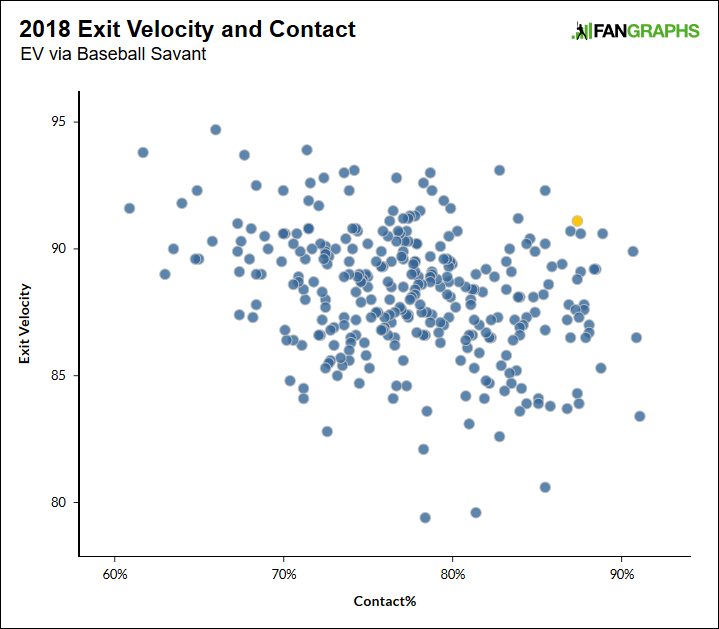
The bat is worrisome, though. According to Baseball Savant, Kinsler’s 85.3 mph average exit velocity ranked in the bottom 8% of the league, and his xwOBACON (expected wOBA on contact) plummeted from .350 in 2017 to .303 in 2018. As I noted in June, his downturn owes largely to two major problems: first, he’s struggled against four-seam fastballs, particularly ones 95 mph or higher; and second, he’s stopped hitting lefties. Despite a career 135 wRC+ against heaters as a group, he’s been at 88 and 94 over the past two seasons, and as for the high-velo stuff, here’s an updated version of a table I made for the previous article:

Ian Kinsler vs. 95+ MPH Four-Seam Fastballs
Year wOBA lg wOBA wOBA dif xWOBA lg xwOBA xwOBA dif
2015 .305 .309 -.004 .315 .311 .004
2016 .337 .315 .022 .353 .316 .037
2017 .223 .312 -.089 .298 .318 -.020
2018 .271 .306 -.035 .312 .308 .004
SOURCE: Baseball Savant

The trend isn’t uniform, but it isn’t good. Neither is hitting .191/.236/.250 for a 33 wRC+ in 144 PA against lefties, especially when you’re a righty. That aspect of his performance may well have been a fluke, the flip side of his .278/.357/.539 (135 wRC+) line against southpaws in 129 PA in 2017. For his career, he has a fairly typical split (127 wRC+ against RHP, 101 against LHP), but over the two-year period, his 81 wRC+ against lefties is in the 24th percentile among righty swingers, which is worrisome.

Here’s the thing, though: the Padres got less than nothing out of their second basemen in 2018. Jose Pirela, Carlos Asuaje, Cory Spangenberg and three other guys combined for a 78 wRC+ and -0.1 WAR at the spot. Spangenberg was released in November, and Asuaje was just claimed off waivers by the Rangers, so they’re out of the picture. Luis Urias, who hit .208/.264/.354 in 53 PA for the Pad squad, is the future, a 55 FV prospect who is currently number three on the Padres list (behind shortstop Fernando Tatis Jr and lefty MacKenzie Gore) and number 21 overall. He’s just 21 years old, though, and while MLB.com’s A.J. Cassavell recently reported that he’s expected to open the season at the keystone, it would surprise nobody if he were to start the year back in Triple-A. Since Tatis is just 19 and hasn’t played above Double-A (and has just 102 games there overall), there’s talk that Urias could even start the year at shortstop, a position he’s continued to spot-start at as he’s moved up the ladder.

All of which is to say that Kinsler, a 13-year veteran with 47.7 WAR, four All-Star appearances, and a pair of Gold Gloves to his name, could be Urias’ double play partner, or his placeholder, or his backup/mentor, depending upon how things unfold. He might even get a chance to play third base in a utility role, if and when both Tatis and Urias are in the bigs. Maybe he’ll become such a natural in this capacity that the Padres will view him as a surrogate dad, as some of the Dodgers did with Utley. The Padres’ padre? Why not?

Considering that Kinsler was projected to produce 1.8 WAR in 490 PA — though now, it would be a surprise if he got that much playing time — and that in our free agent preview the estimates for his salary ran for $6-8 million for a single season, two years and $8 million seems quite reasonable for San Diego. His presence probably won’t change the course of the Padres’ 2019 season, but if he helps Urias adapt to the majors and fulfill his potential, it’s a small price to pay.


The Standard Reliever Contract Is Back

Last season, the relief market was the only aspect of free agency that moved quickly. Of the first 14 free agents to sign last winter among the Top 50 players available, eight were relief pitchers (nine if we count Mike Minor). All eight received similar contracts for two, sometimes three, seasons, and around $7 million to $10 million per year. In “deals that were announced at 2 AM the night before everyone at FanGraphs left the Winter Meetings and spent most of Thursday on airplanes,” we have two free agent reliever signings that meet the qualifications for that standard reliever contract.

Let’s address both Jeurys Familia and Joe Kelly’s new deals in turn. Read the rest of this entry »


Yankees Appear to Snag J.A. Happ in Shrinking Market

Rumors swirled on Wednesday morning that the New York Yankees had reached an agreement to re-sign J.A. Happ, but that deal was walked back as the two teams couldn’t quite come together. As the parties kept getting closer, alternatives continued to come off the board, with Charlie Morton signing with the Rays and Lance Lynn headed to Texas. All of this was set against the backdrop of a warmer-than-expected market for starting pitching, which had already seen Patrick Corbin get a sixth year on his deal with the Nationals and Nate Eovaldi receive a guarantee of $68 million from the Red Sox. The cause of the holdup between Happ and the Yankees was likely the years of the contract, as Happ wanted three and the Yankees wanted to pay for two. The result the two sides seem to have come to is a two-year, $34 million contract with a $17 million option vesting for Happ if he reaches 27 starts or 165 innings in 2020, providing the Yankees with significant protection against potentially paying an ineffective 38-year-old. The deal has yet to be officially announced.

Happ returning to the Bronx wasn’t a foregone conclusion, as there appears to have been significant interest in the lefty, and for good reason. Over the last four years, Happ has been a consistently above-average pitcher, grabbing about three wins and 170 innings every year. In our free agent rankings, Eric Longenhagen discussed how Happ has been able to perform well through his mid-30s.

Greater use of a sinker to complement his changeup has facilitated his ascent from 1.0 WAR back-end starter to 3.0 WAR mid-rotation innings-eater. Happ’s size and length create discomfort for opposing lefties, and he has been able to dominate them (left-handed opponents slashed .171/.239/.248 against Happ last year) without a good breaking ball. Instead, Happ makes unusually frequent use of his fastball (throwing 73% of the time, roughly 20 points higher than the league-average mark for starters), which is firmer now than it was in his mid-20s.

Every team could use the three wins and 30 starts the Yankees can expect from Happ in 2019. The potential issue, though, isn’t so much next season as it is the ones that come after it. The Yankees didn’t want to guarantee that third year and that reticence is justified. The lefty turned 36 years old in October. A three-year contract would take him through his age-38 season. Over the last decade, only six pitchers have produced even four wins and 400 innings in their age-36 to age-38 seasons, with CC Sabathia likely to join that group in 2019. Here is how those pitchers, along with Happ, fared in their age-32 to age-35 seasons. Read the rest of this entry »