Archive for Q&As

Ben Cherington on Pittsburgh’s Two Top Prospects

Charles LeClaire-USA TODAY Sports

Termarr Johnson and Endy Rodriguez are the top two prospects in the Pirates organization. An 18-year-old middle infielder, Johnson was drafted fourth overall by Pittsburgh last summer out of an Atlanta high school. Meanwhile, Rodriguez, a 22-year-old catcher from Santiago, Dominican Republic, was acquired by the Pirates from the Mets in the January 2021 three-team trade that included David Bednar and Joe Musgrove.

I asked Pittsburgh general manager Ben Cherington about the highly-regarded duo during November’s GM Meetings in Las Vegas.

———

David Laurila: Pirates fans and prospect nerds are quite familiar with Termarr Johnson, but a lot of fans around the country probably aren’t. What can you tell me about him?

Ben Cherington: “I think a good place to start is that he is currently in the Dominican, participating in our Dominican instructional program, which I think is a cool thing for a high first-round pick to do. It’s something that he wanted to do. Termarr wanted to go down there and be part of that experience, and to get to know potential future teammates who are young Latin players. He’s a full participant in our Dominican program.” Read the rest of this entry »


His Shoulder Sound, Brocke Burke Was a Beast Out of the Texas Bullpen

Steven Bisig-USA TODAY Sports

Brock Burke broke out in 2022. Working out of the Texas Rangers bullpen, the 26-year-old southpaw logged a 1.97 ERA over 52 appearances, with 90 strikeouts and just 63 hits allowed in 82-and-a-third innings. Equally effective against lefties and righties, he held the former to a .192 BA and a .635 OPS, the latter to a .218 BA and a .629 OPS. Used most often in the sixth and seventh innings, Burke was credited with wins in seven of his 12 decisions.

Burke went into last season having made just six big league appearances, all in 2019 as a starter, with a balky shoulder the culprit. That he came back strong after returning to full health is an understatement. Along with the aforementioned numbers, Burke logged a stand-up-and-take-notice 27.4% strikeout rate.

First interviewed here at FanGraphs in 2017 when he was a 20-year-old Tampa Bay Rays prospect pitching in the Midwest League, Burke will head into the 2023 with a role that has yet to be determined. The Rangers are reportedly considering using him as a starter, while some have speculated that he could be the club’s closer. Regardless of how he is utilized, one thing is certain: When healthy, Burke has proven to be a very good pitcher. Read the rest of this entry »


Cardinals Pitching Prospect Tink Hence Has a Sky-High Ceiling

Busch Stadium
Jeff Curry-USA TODAY Sports

Tink Hence has the highest ceiling among pitchers in the St. Louis Cardinals system. A top 100 prospect with a 50 FV, the 20-year-old right-hander has just 60.1 professional innings under his belt — 68.2 if you count his brief stint in the Arizona Fall League — but that has been enough to turn heads. Displaying an electric array of pitches, the lanky Pine Bluff, Arkansas native has fanned 104 batters and allowed just 44 hits and 22 walks.

Hence, whose given first name is Markevian, discussed his power repertoire and his approach to pitching during his time in the AFL.

———

David Laurila: Tell about yourself as pitcher. How do you go about your craft?

Tink Hence: “I just go out and do what I do. I know how my my fastball plays, and I know how my off-speed plays off my fastball. I really don’t try to set it all up with the analytical stuff. When I go out there, it’s easier to just play as opposed to thinking, ‘OK, if I throw it there, it does that’ or if I’m trying to make something break more. I just let it come.”

Laurila: How does your stuff play?

Hence: “I throw a four-seamer, a curveball, a changeup, and a slider. I feel like my stuff plays well when I, as they say, ’let it eat.’ My changeup works well off my fastball, and whenever I can get the curveball up… it’s like a buckle piece. I feel like my curveball is more of my strike pitch, and my slider is like my strikeout pitch. My curveball is more north-south, and when they guess fastball they take it for a strike.”

Laurila: Where is your velocity?

Hence: “My fastball probably sits 95–97 [mph]. My curve is around the 75–77 range. With my slider, you’ll see more of the 81–84 range. The changeup, during the season it kind of was slow, but I’m working on getting it around 86–87. I’m working on it a lot here [in the AFL].” Read the rest of this entry »


A Bona Fide Pitching Nerd, Chris Murphy Is a Red Sox Prospect on the Rise

Chris Murphy
Syndication: The News-Press

Chris Murphy is gaining helium. A sixth-round pick in the 2019 draft out of San Diego State University, the 24-year-old southpaw was No. 38 on our Red Sox Top Prospects list going into last season, with a modest 35+ FV. But on the heels of a 2022 campaign that saw him excel in 15 starts with Double-A Portland and then hold his own in 15 more with Triple-A Worcester, this year he will be moving up to the 14–16 range with a 40 FV, per our lead prospect analyst Eric Longenhagen. He also just participated in Boston’s Rookie Development Program, which focuses on easing the transition into MLB — an indication that Murphy could be in Boston as soon as this summer.

A self-proclaimed nerd who is well-versed in his vertical approach angle and pitch metrics, Murphy discussed his craft earlier this week at Fenway Park.

———

David Laurila: Let’s start with who are you as a pitcher. How do you get outs?

Chris Murphy: “That’s a good question. There have been times in my career where it’s very fastball heavy — come at you fastball/changeup primarily and then curveball/slider secondarily. I’ve generally been aggressive with the fastball up in the zone. I have good vertical break, good two-plane, and a pretty decent vertical approach angle. That’s why I get swings and misses up in the zone and why my changeup plays down in the zone. Using that to my advantage, being a shorter pitcher, is something that’s given me a career to this point. That and throwing from the left side.”

Laurila: How tall are you?

Murphy: “The book will say 6-[foot]-1, but I’m probably just under six feet. I weigh about 185, so I’m not the biggest guy.”

Laurila: You said that you get good vertical but also two-plane. Can you elaborate?

Murphy: “Yes, I get both ride and run. There are days where my fastball is more true and it’s just ride, but ride and run is ideally where I like it to be. And then with the changeup, it’s about killing the spin, killing the vert, and adding more horizontal. The goal this year is to be under six vertical and negative-18–19 horizontal.” Read the rest of this entry »


Talented But Raw, Canada’s Owen Caissie Aspires To Be a Cub

Owen Caissie
Mark J. Rebilas-USA TODAY Sports

Owen Caissie has a high ceiling and a long way to go to reach it. Acquired by the Chicago Cubs from the San Diego Padres as part of the December 2020 Yu Darvish deal, the left-handed-hitting outfielder is 20 years old and has just 159 professional games under his belt. Moreover, he was drafted out of cold-weather Burlington, Ontario. As Eric Longenhagen noted when ranking the 2020 second-rounder No. 3 on last year’s Cubs Top Prospects list (and just outside of our overall Top 100), Caissie “had never played a night game in his life until the Arizona Complex League opener in 2021.”

Looking mostly at the raw numbers, Caissie’s future looks less sunny than it did prior to last season. Playing in High-A South Bend, he slashed an uninspiring .254/.349/.402 with 11 home runs in 433 plate appearances, and that was followed by an even more lackluster .220/.270/.356 line in the Arizona Fall League. Perspective is needed; Caissie was a teenager for the first half of the season, and his tools, originally crafted in Canada, are both projectable and loud. He simply remains relatively raw.

Caissie, who is listed at 6-foot-4, 190 pounds, discussed his early-career development during his stint in the AFL.

———

David Laurila: Let’s start with your development as a hitter. How have you evolved since entering pro ball?

Owen Caissie: “I feel like what has changed the most is… I mean, I did make some swing adjustments. When I got drafted, I was kind of bent down, and now I’m straight up. But what’s really changed is my approach, my pitch selection, my ability to kind of keyhole the ball in the middle. I’ve never read my scouting report. I wouldn’t even know how to get to it. But there are obviously holes in my game that I need to close up.”

Laurila: What type of hitter do you consider yourself?

Caissie: “I like to classify myself as a hitter over a power hitter. At least that’s what I try to be.” Read the rest of this entry »


Guardians Prospect Andrew Misiaszek Knows His Blueprint For Success

Joe Camporeale-USA TODAY Sports

Checking in at no. 47 on our recently published Cleveland Guardians prospect list, Andrew Misiaszek was drafted in a round that no longer exists. Taken with the 23rd pick of the 2019 draft’s 32nd round, he had pitched four years at Northeastern University, serving mainly as a reliever and eventually as the team’s closer. Since being drafted, he has worked his way up the minor league ladder, finishing 2022 in Triple-A Columbus.

Beginning last season in Double-A, Misiaszek dominated to the tune of a 0.56 ERA in 32 innings. After he was promoted to the highest level of the minors, he threw 29.2 additional innings of 3.64-ERA ball while striking out over 32% of the batters he faced. I spoke with him early last December about the various mechanical adjustments he has made in the minors, as well as his progress in connecting the dots in his repertoire and how that has impacted his blueprint for success. Read the rest of this entry »


Released by the Tigers, Spenser Watkins Learned How to Pitch as an Oriole

Mitch Stringer-USA TODAY Sports

It looked like Spenser Watkins’s career might be over when he was released by the Detroit Tigers in July 2020. Six years had passed since he was drafted in the 30th round out of Western Oregon University, and at no point over that span was he viewed as more than a fringe prospect. Possessing neither plus velocity nor a difference-making secondary, the right-hander was coming off a minor league season where he’d logged a 6.07 ERA. That the only offers Watkins was receiving were for non-playing roles wasn’t exactly a surprise.

Then the Orioles came calling. That opportunity, fueled by an education in pitching that he never received with the Tigers, ultimately catapulted him to the big leagues. On July 2, 2021 — nearly a year to the day after Detroit gave up on him — Watkins walked onto a mound in a Baltimore Orioles uniform. A year and half later, the Scottsdale native has 39 major league appearances comprising 160 innings under his belt. Moreover, unlike in his Tigers days, he knows how his arsenal plays.

Watkins discussed his education-driven evolution as a pitcher late in the 2022 season.

———

David Laurila: Two years ago, you were a career minor leaguer who’d been let go by the Tigers. How did you go from there to where you are now?

Spenser Watkins: “I was released during the COVID season, so I wasn’t playing; I didn’t go to the alt site, or anything like that. Basically, it was ‘OK, let’s see what the free agent market has to bring.’ Come December, that became, ‘OK, I’ve got to figure out what the next step is; I’ve got to figure out a way to provide for my family.’ Read the rest of this entry »


Angels Prospect Ryan Smith Is Hungry for Success

© Gary A. Vasquez-USA TODAY Sports

Ryan Smith is a left-handed pitching prospect in the Los Angeles Angels system. Taken in the 18th round of the 2019 draft as a senior out of Princeton University, he is, and always has been, an intellectual player. In fact, he spends time in the offseason tutoring high schoolers preparing for the SAT, a rather unorthodox job for a minor league player. After a 25.1-inning rookie ball debut his draft year, he lost out on a key developmental season due to the pandemic but came prepared for the 2021 season with increased velocity and a hunger to perform.

That year, Smith threw 129.1 innings across four different levels. A workload like that in your first full professional season is extremely uncommon. Indeed, coming off the lost 2020 campaign, many pitchers decreased their workloads. For that reason, Smith has had a unique path. His performance was good enough to rise all the way up to Triple-A in his first full season, but his adjustment to the Pacific Coast League has been a work in progress. I spoke to him about that adjustment, its impact on his game, and his repertoire earlier this month.

Esteban Rivera: What does your pitch mix look like right now, and how has it changed since rookie ball?

Ryan Smith: “I throw a four-seamer with slightly above-average vertical break, but the velo range has been all over the place in pro ball. In rookie ball, the average was around 92 with a couple of outings in the 95-96 range. 2021 it was up to 97-98 in spring, but mostly sat 92-95 the first couple of months, then dropped down to 91-94 in the second half. This past year, my carry was down a bit playing mostly at high altitude, and my velo was 91-93. I’m hoping for it to come back after a velo program I’m on for the winter. I think it was down after the high workload in 2021 after no innings in 2020.” Read the rest of this entry »


Jacob Wallace Brings a Power Arsenal and Command Issues to Kansas City

Kansas City Royals
Jay Biggerstaff-USA TODAY Sports

The Royals may have gotten a steal when they acquired Jacob Wallace from the Red Sox last week in exchange for Wyatt Mills. The “may have” comes with a sizable caveat, as the 24-year-old right-hander has big-time stuff, but also command issues. Pitching for the Double-A Portland Sea Dogs this year, he walked 49 batters in 56.2 innings.

Wallace is overpowering when he’s in the strike zone, though. The 100th overall pick in 2019 — he was drafted by the Rockies out of the University of Connecticut, then swapped to Boston a year later in exchange for Kevin Pillar — fanned 76 batters and allowed just 35 hits. As Tess Taruskin and Kevin Goldstein wrote last spring, “It’s not too complicated: If he can throw more strikes, he has a path to the big leagues.”

Wallace, who prior to the trade was No. 23 in our Red Sox prospect rankings with a 40 FV, discussed his overpowering arsenal and his mother-influenced interest in pitching analytics late in the season.

———

David Laurila: Before we talk about your repertoire, you told me that your mother is big into analytics?

Jacob Wallace: “She reads and absorbs everything. She would tell me, ‘Oh, your FIP is this’ — all these numbers — and I’d be like, ‘Well, I have no idea what you’re talking about, I’m just out there playing.’ I’d know my ERA and the other basic stuff, but not the more advanced-stats. This was back in high school. Once I got to college and started learning more… I mean, it was really cool to realize how much she had already learned.”

Laurila: I’m guessing that your mother reads FanGraphs?

Wallace: “Yeah, I would say she does. She is a director of plant operations for [Proctor & Gamble], so numbers and learning are definitely things she definitely loves.” Read the rest of this entry »


New Brewer Owen Miller Is Evolving as a Hitter (Or at Least Trying To)

© Jay Biggerstaff-USA TODAY Sports

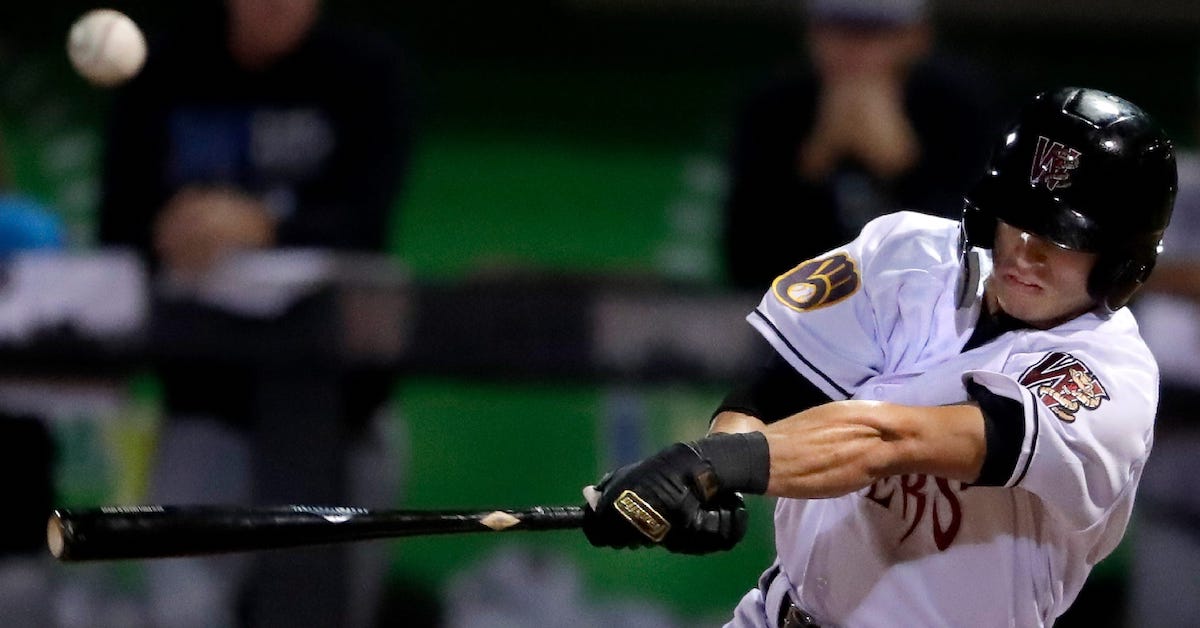
What kind of hitter did the Milwaukee Brewers get when they acquired Owen Miller from the Cleveland Guardians on Wednesday in exchange for a player to be named later or cash? Statistically speaking, the answer is someone who put up uninspiring numbers in his first full big-league season. The infielder, who recently turned 26 years old, logged a .287 wOBA and an 85 wRC+ in 472 plate appearances. After starting strong — he had a 1.043 OPS on May 8, and had delivered a number of clutch hits — Miller provided only a modicum of value with the bat.

In terms of his overall development as a hitter, Miller has evolved — intent-wise more than production-wise to this point — from the player who Eric Longenhagen described prior to the 2021 season. Ranking him No. 14 on that year’s Cleveland Top Prospects list, our lead prospect analyst wrote that the former third-round pick out of Illinois State University had a “minimalistic swing [that] enables him to make high rates of contact, while the strength in Miller’s hands generates doubles power.”

Miller stroked 26 doubles this past season, but only six home runs, and he had 93 strikeouts to go with 32 walks. By and large, he remains a work-in-progress — albeit one who can provide value with his versatility while continuing to work on his offensive skills.

The newest Brewer talked hitting in an interview that took place a handful of months into the season, only to be placed on the back burner until now.

———

David Laurila: How would you describe yourself as a hitter?

Owen Miller: “I’ve kind of changed, I would say. When I was younger — coming up in college, and in the minors — I was very contact-oriented, with a very line drive approach. I was handsy, trying to manipulate my barrel. Then, over the quarantine period when we had time to work on things… I understood that there are things that elite hitters do as far as using their bodies more, and I started to make some swing changes off of that. Not really swing changes, per se, but rather adjustments. Read the rest of this entry »