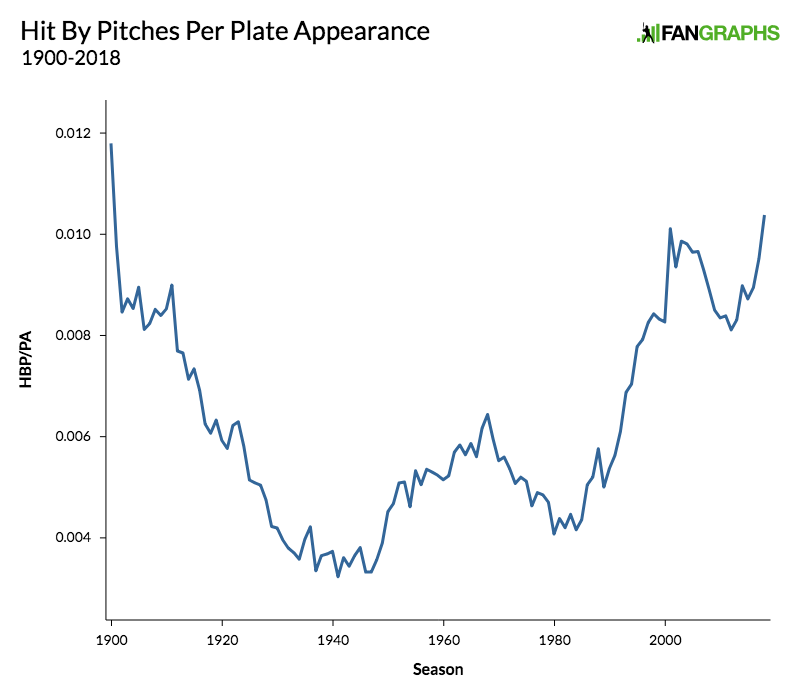
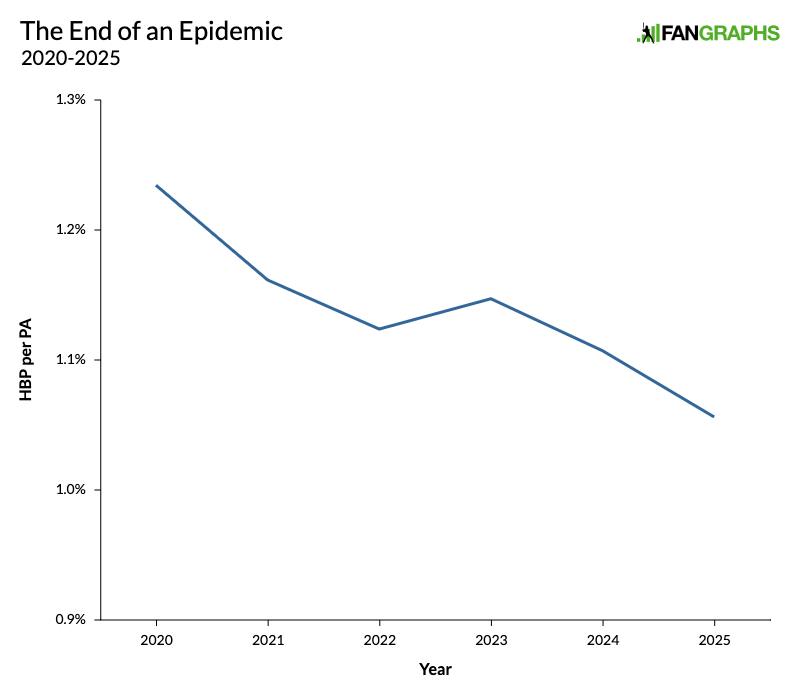
Hit-by-pitches have been rising since the early 1980s, and despite a decline in the 1970s, you could argue that they’ve been rising ever since World War II. Devan’s graph ends in 2018, but the numbers kept on going up — for a while, anyway. Here’s a graph that shows the HBP rate in recent years. After a couple decades of sounding the HBP alarm, it’s time for us to unring that bell (which I assume, without having looked it up, is an easy thing to do):
Congratulations everybody, we’ve done it! We’ve ended the epidemic. The HBP rate has fallen in four of the last five seasons. It’s safe to leave your home again. You can enter a public space without fear that you’ll be bombarded with stray baseballs. Rob Mains can finally take a vacation. Tom Verducci can finally take a deep breath. Read the rest of this entry »
“Who is the most feared hitter in baseball?” is not a question I set out to answer. That would be too easy! Step one: Write “Aaron Judge.” Step two: Let out a bemused chuckle. Obviously it’s Aaron Judge. Who would have commissioned such a silly article? Step three: Get lunch. That does sound pretty tempting, I must admit, but that’s not this article. This one is a little bit weirder.
I started by asking the opposite question: “Who is the least feared hitter in baseball?” I had a simple idea for how to test it. Take a look at the rate of pitches over the heart of the plate that each batter sees when behind in the count – more strikes than balls. A hitter who sees tons of pitches down the middle in a bad hitting situation isn’t a guy who scare opponents. Pitchers are so not afraid that they’re chucking pitches down Broadway even in the situations where that’s least necessary and least advantageous. Read the rest of this entry »
Last week, I took a peek at which offenses have exceeded (or missed) expectations this year. I did that by taking every player’s preseason projection and actual playing time to create a projected wOBA for the entire offense. I compared that to what has actually happened. The difference? That’s what we’re looking for, how much a team has surprised to the good or bad in 2025.
I couldn’t leave it at just one phase of the game, though. Pitching can be measured the same way (ish, see methodological notes below if you’re interested in the nitty gritty). I didn’t want to compare ERA (too noisy) or FIP (too regressed, aka not noisy enough). I settled on wOBA as a good representation of how well a pitching staff is doing overall. It’s a middle point between the two other options, so we are neither ignoring what happens on balls in play, nor caring too much about sequencing. Here, for example, are the Texas Rangers, the biggest overachievers of the season:
Right away, you can see why they’ve beaten expectations by so much. Four-fifths of their starting rotation, four of the five pitchers who have faced the most batters, have performed meaningfully better than their preseason projections. The fifth is Jacob deGrom, who had one of the best projections in baseball coming into the season and has hit it on the nose. Even their most-used bullpen arms have been pleasant surprises. That’s how you allow the fewest runs in baseball by a mile, apparently. Read the rest of this entry »
We’re 10 years or so into the launch angle revolution, and the reasoning behind it hasn’t changed much. Groundballs have a .228 wOBA this season, while all other balls in play are at .462. Hit the ball on the ground, and you’re Christian Vázquez. Hit it in the air, and you’re Aaron Judge. Players are gearing their swings for damage in the air. They’re optimizing their bat path for an upward trajectory. They’re meeting the ball farther out in front. They’re looking to hit the bottom third of the ball. Knowing all this, I doubt you’d be surprised to learn that 2025 is shaping up to set the record for lowest groundball rate since 2002, when Sports Info Solutions first started tracking such things. But you might be surprised to learn just how extreme the shift has been.
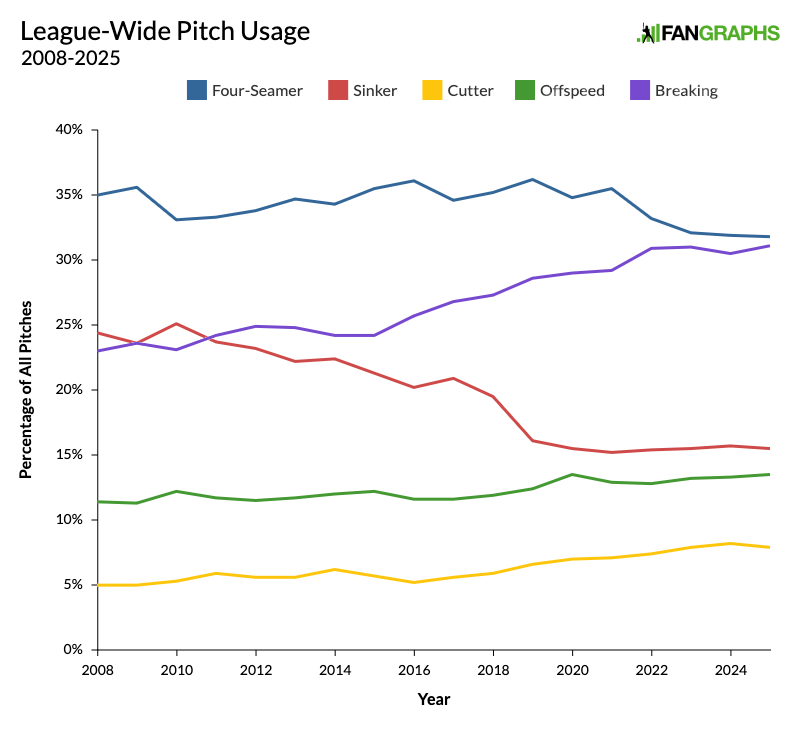
So far, I’ve talked about all the reasons that batters have tried to put the ball in the air more, but that’s only half the story. Five years ago, Ben Clemens wrote a great article in which he tried to determine whether batters or pitchers exert more control over groundball rates. After separating the batters from the pitchers, he split each group into quartiles based on their 2018 groundball rates and then looked at the results when each group faced off in 2019. He found that the effect was nearly identical. When you moved the batter up one quadrant, the groundball rate of the new pairing went up by an average of 5.2 percentage points. When the pairing moved up a quadrant in the pitcher pool, the groundball rate went up by 4.8 percentage points. Knowing that, let’s not blame this all on the batters. Are pitchers as responsible as batters for the shrinking groundball rate across the majors? Let’s start by updating my 2023 league-wide update on pitch mix.
If you’re a fan of a large-market team that has recently been struggling to score runs, you may be eligible for compensation. Wait, no – that’s not right. You may be eligible to complain about your team in my weekly chat? Not quite it, either. Let’s try it one more time… If you’re a fan of a large-market team that has recently been struggling to score runs, you are eligible to read this article and see to what extent your team has let you down and to what extent it’s just a narrative.
The Yankees and Mets have been having a tough time of late, which always brings out doubters, both fans and rivals. I don’t quite know what to tell those grumpy souls. You’re upset with the Yankees offense? Well yes, sure, absolutely, carry on, but they do have the highest team wRC+ in baseball. The Mets let you down? Without a doubt, they’re the Mets, so on and so forth – but they’re top 10 in baseball in wRC+, too. Orioles offense bumming you out? Yeah, I mean, they’ve been a bummer, but they’ve also been impacted by injuries, which seems hard to blame them for.
I came up with a quantitative test for how much teams have disappointed relative to preseason expectations. I took the actual playing time that each team has allocated so far. Then, I used preseason projections to come up with the offensive numbers we’d expect from each team given who has played and how good we projected them to be. I compared that to how good the team has actually been. The difference between those two numbers is the aggregate overachievement or underperformance that can’t be attributed to injury. Read the rest of this entry »
In the offense edition, I used a game show format to evaluate whether the perspective offered by BaseRuns has a point, or if there’s something its methodology is overlooking. We’ll keep that framework going for the defenses as well. Here’s a reminder of how it works:
To determine whether or not BaseRuns knows what it’s talking about with respect to each team, imagine yourself sitting in the audience on a game show set. The person on your left is dressed as Little Bo Peep, while the person on your right has gone to great lengths to look like Beetlejuice. That or Michael Keaton is really hard up for money. On stage there are a series of doors, each labeled with a team name. Behind each door is a flashing neon sign that reads either “Skill Issue!” or “Built Different!” Both can be either complimentary or derogatory depending on whether BaseRuns is more or less optimistic about a team relative to its actual record. For teams that BaseRuns suggests are better than the numbers indicate, the skill issue identified is a good thing — a latent ability not yet apparent in the on-field results. But if BaseRuns thinks a team is worse than the numbers currently imply, then skill issue is used more colloquially to suggest a lack thereof. The teams that are built different buck the norms laid out by BaseRuns and find a way that BaseRuns doesn’t consider to either excel or struggle.
I still remember the first time I wondered, What if the colors I see aren’t the same ones that other people see? What if the color I perceive as red looks the same as what you perceive as yellow? I was 10 years old, and I felt like a budding scientist or philosopher, or perhaps a poet. Whichever one, I was already preparing my Nobel Prize acceptance speech.
I’ve since come to realize that my 10-year-old brain wasn’t asking anything that every stoned college freshman hadn’t asked before. I sounded less like a Nobel Laureate and more like John Kruk taking his role as the Phillies’ color commentator a bit too literally. That said, the idea that different human beings perceive colors in different ways isn’t just pot-fueled postulation or Krukian wisdom – it’s the truth. It would have blown my 10-year-old mind to learn the colors I see aren’t necessarily the colors everyone else sees, and it’s not just about rods, cones, and intrinsically photosensitive retinal ganglion cells. Sometimes, it’s a matter of language.
Take a look at the four swatches below. Think about what colors they are. And no, the answers aren’t Steven Kwan’s whiff rate, arm strength, bat speed, and sprint speed: Read the rest of this entry »
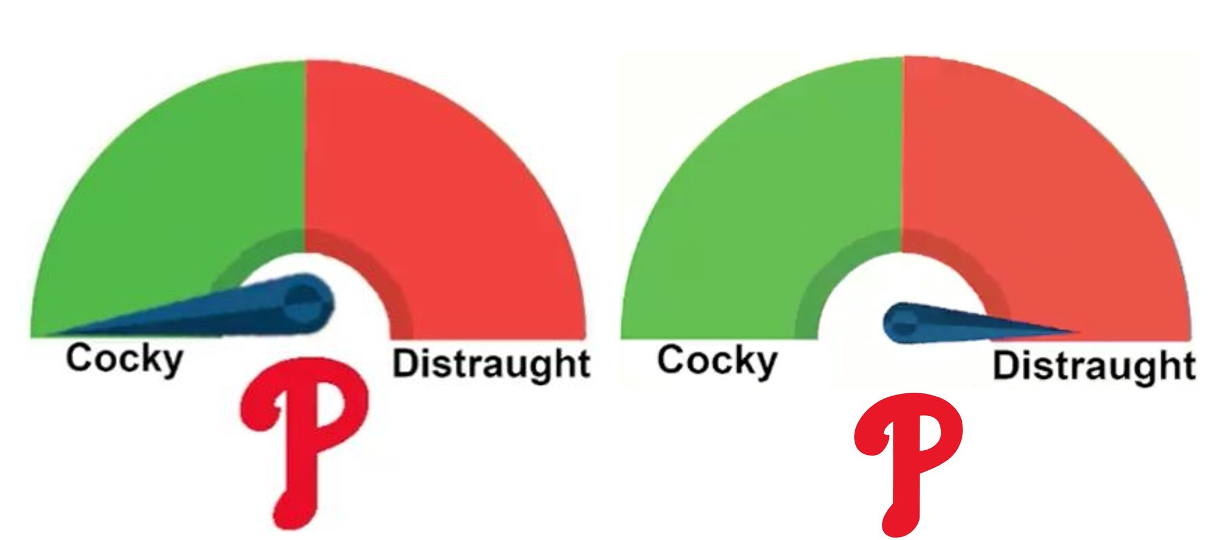
You’re probably familiar with the saying, “Happiness equals reality minus expectations.” Maybe because your Aunt Debbie shared a post from her favorite social media influencer. Maybe because you passed the time during a layover at the airport perusing the self-help books in the Hudson News near your gate. Like most self-help tropes, whether or not it hits for you depends a little on your life circumstances and a little on how you choose to apply it. When it comes to sports fandom, emotional hedging can be a useful tool to avoid disappointment, or maybe you prefer projecting confidence to manifest a desired outcome. And if you’re a Phillies fan, you’ve perfected the art of oscillating wildly between the two over the course of a single game. You even have a handy meme with a meter that only ever points to one extreme or the other:
(Please excuse the mismatched needle sizes and logo alignment. These images are precious internet relics that have been downloaded, clumsily edited, re-uploaded, compressed, and decompressed hundreds, if not thousands, of times. The pixelation is earned like callouses on the hands of a skilled laborer.)
But the formula seems to assume that expectations are set and controlled by the person in search of a happy existence. The entire notion is upended when mathematical models based on historical outcomes become the source for baseline expectations. In this scenario, if your team is outperforming expectations, then you can enjoy the banked wins, but you do so in fear of the rainier days that surely lie somewhere in the team’s future forecast. Whereas if your team is underperforming expectations, things might feel dire, but there’s reason to believe sunnier days lie ahead. Read the rest of this entry »
Below are two changeups. Can you tell which one is better?
First up is Griffin Jax’s power changeup. He throws it over 92 mph; at two inches of induced vertical break (IVB) and 15 inches of arm-side run, it almost resembles a filthy left-handed slider:
Second is Hunter Gaddis straight change, floating up to the plate with 10 inches of IVB at an average velocity of 78 mph:
So, which one would you take? That’s a bit of a trick question: By whiff rate, these two pitches are virtually identical. Jax’s changeup ranks second in all of baseball with a 57.3% whiff rate; Gaddis’ is right behind him in third. Stylistically, they’re opposites; by the results, they are indistinguishable.
If you were creating the perfect fastball or the perfect slider in a video game, it’d be a straightforward process. Crank up the velocity, max out the vertical break, and those pitches will generally improve in a roughly linear fashion. Not so with changeups. Pitch models struggle to accurately grade these pitches because their quality can’t as easily be captured by velocity and movement in a vacuum. The Cole Ragans changeup, for example, gets a roughly average grade by Stuff+ despite performing like the best changeup in the sport over the last handful of seasons. It’s slow, and it barely moves — what makes it so good?
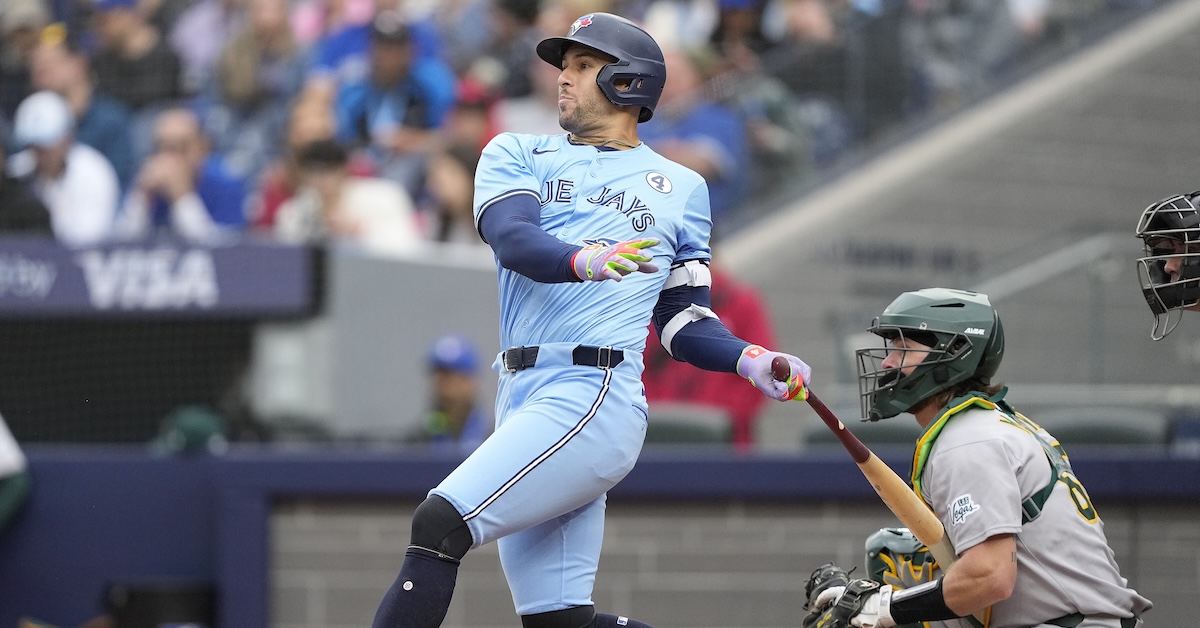
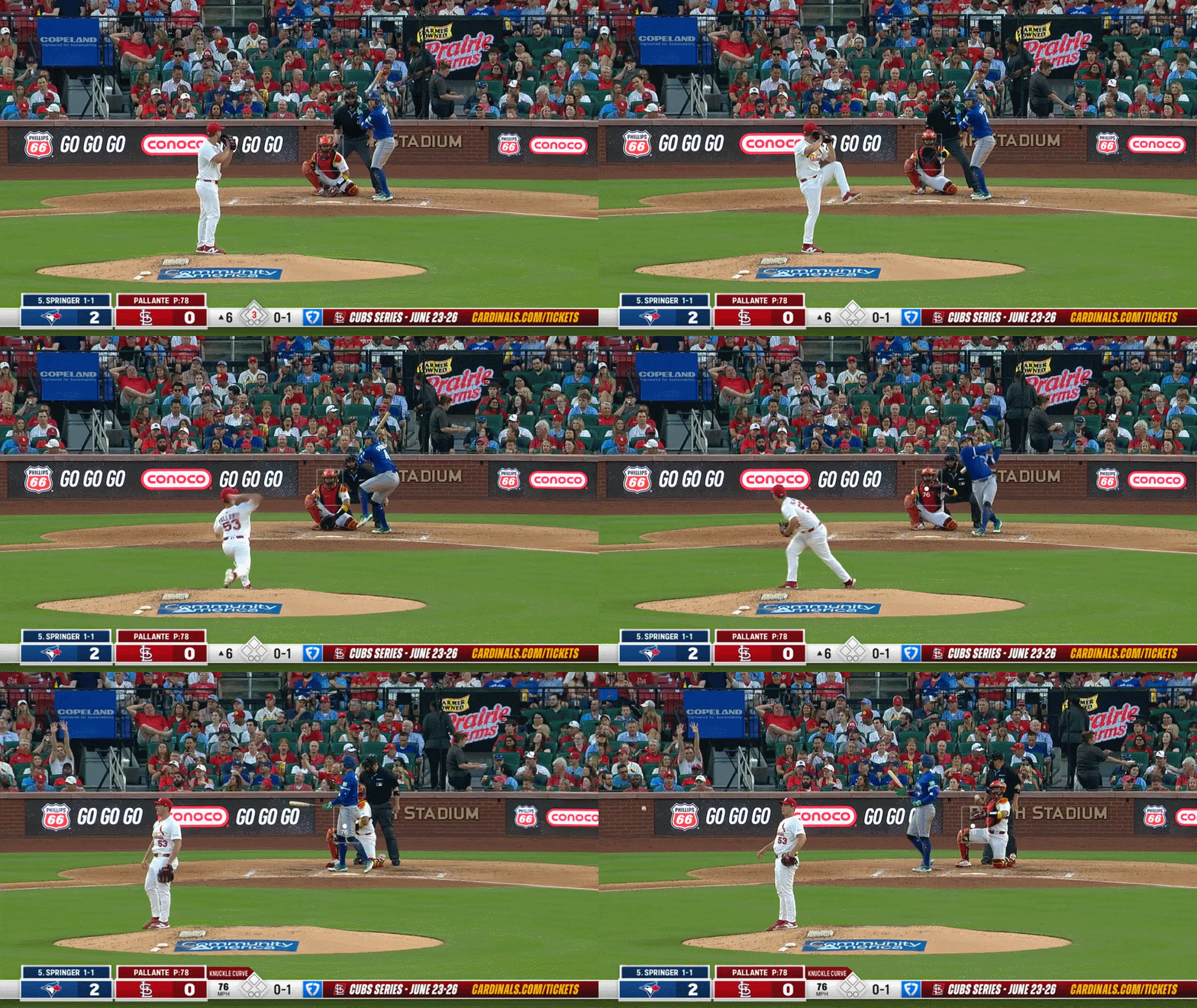
In the sixth inning of Monday’s game between the Blue Jays and the Cardinals, George Springer got a pitch to hit, a hanging curveball that split the center of the strike zone. He recognized the pitch late and fouled it off:
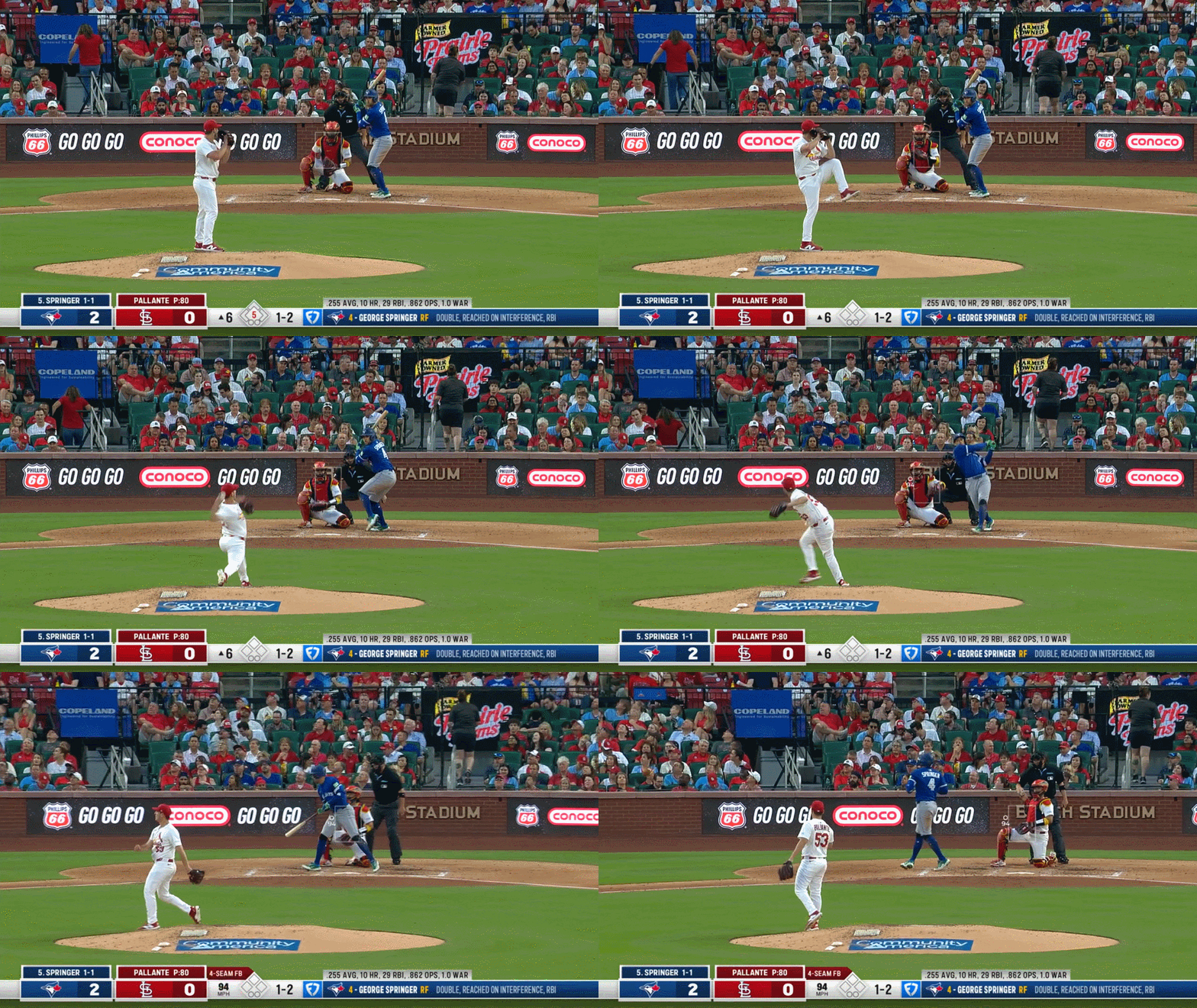
His post-swing demeanor suggests that he considered it a missed opportunity, and it’s clear to see why. With a pitch like that, he was thinking extra bases; instead, Andre Pallante got a strike for his troubles. Now Springer’s back was against the wall. Pallante came back with a much better pitch on 1-2, but Springer spoiled it:
Unlike the previous miss, this looked like a calculated act to me. Springer was late on the pitch, but it was too close for comfort, so he took a defensive cut, meeting the ball early in his swing and punching it harmlessly away.
Welcome to the confusing world of analyzing foul ball rate. Both of Springer’s swings produced the same result, but the first one was a poor outcome for him and the second a desirable one. You can argue that the second pitch would have been a ball if he hadn’t swung, but he certainly wasn’t sure of that when he committed to swinging; living to fight another day against such a well-located pitch is a good outcome.
You probably wouldn’t be surprised to learn that Luis Arraez, Nick Allen, and Brice Turang are among the leaders in early-count foul ball rate (foul balls per swing). They swing a lot, make a lot of contact, and spray their contact to all fields, including foul territory in every direction. On the other side of the coin, you’ve got sluggers like Bryce Harper, Aaron Judge, Vladimir Guerrero Jr., and yes, Springer. These guys don’t swing as often, which means a few things. First, they swing at better pitches on average, which leads to better contact. Second, they make less contact on average, and less contact means fewer fouls, even for the same rate of fouls-per-contact.
I’d rather be in the second camp than the first there. Early-count foul balls are a waste, literally the same as a swinging strike. They might be worse, even – baserunners can’t steal, catchers can’t block poorly and allow a passed ball. A full 46% of Arraez’s swings – 48% for league leader Wilyer Abreu – end up as foul balls. Sure, contact is great, but when half of it counts as a strike, it’s a lot less enticing.
Things change with two strikes, though. When a foul ball extends the at-bat instead of ending it in a strikeout, it becomes valuable instead of detrimental. Have you ever watched Jake Cronenworth hit? With two strikes, he turns into a lacrosse goalie, trying to redirect everything in the vicinity of the strike zone. He’s not trying to hit a homer unless the pitcher truly grooves him one; he’s specifically looking to avoid a strikeout. Cronenworth sports the highest foul-per-swing rate in baseball with two strikes at 51.2%. It works – he still strikes out a decent amount because of his penchant for running deep counts, but he walks 16% of the time because eventually pitchers miss the zone.
The bottom of the two-strike foul ball rate list, on the other hand, is filled with strikeout-prone types. Javier Báez makes foul contact on just 27% of his two-strike swings. Judge, who still strikes out a ton even as he rewrites the record books, is towards the bottom. So are Jackson Chourio, Shohei Ohtani, Fernando Tatis Jr., Kyle Schwarber, and all nature of excellent sluggers. You can get away with it if you hit like those guys, but Andrew Vaughn, Brenton Doyle, Miguel Andujar, and Michael Toglia are floundering under the weight of their inability to fight pitches off. This isn’t a disqualifying statistic, in other words, but it’s surely a bad thing; it’s directly leading to higher strikeout rates, and unless you have light tower power, many of the pitches you swing at with two strikes aren’t the kind you can hit for extra bases anyway.
I’d posit that high foul ball rates before two strikes are bad, while high foul ball rates with two strikes are good. Early in the count, fouls are a waste, while late in the count, they’re a get out of jail free card. Assuming that these two events are equivalent doesn’t make much sense to me; hitters behave differently, and if we don’t credit them for that different behavior, we’re missing something essential about the act of hitting.
To measure this, I had to put everything on the same scale. I first took every hitter who has swung at 200 or more pitches early in the count, found the average foul ball per swing rate, then normalized each player’s foul ball rate into z-scores. I did the same for every hitter who has swung at 100 or more pitches in two-strike counts. That gave me two scores for every hitter: early-count foul rate and two-strike foul rate. I flipped the sign of the early-count foul rate scores – lower is better – and then summed the two.
This let me separate out the hitters who always have high foul ball rates or always have low foul ball rates – they don’t demonstrate this skill of changing their approach in a measurable way. Arraez, for example, makes foul contact on 46.2% of his early-count swings and 46.3% of his two-strike swings. It’s the same approach, and because the league as a whole cuts down on their swings and makes more foul contact with two strikes, Arraez rates below average in this metric. He’s two standard deviations above average in his early-count foul rate and only 1.6 above average in two-strike foul ball rate, a net of -0.4 for his “foul score.” Allen is even worse – he makes foul contact on 47.1% of early-count swings, but only 39.3% of two-strike swings. When pitchers try to throw the ball past him, they succeed. His foul score is a woeful -2.15.
That’s among the worst marks in the majors, but the actual worst hitter is doing a lot worse than that. That would be Andujar, who is making a ton of foul contact early (44.6%) but almost never when he needs it to stay alive (27.4%). The result is a foul score of -4.2. If you’re wondering why a guy with his skills – solid bat speed, elite contact rate – has never taken off in the majors, it might be related to this. Likewise, if you’re trying to puzzle out what’s ailing Xander Bogaerts this year, it can’t help that he makes foul contact 39% of the time early but only 30% of the time late, for a foul score of -2.2.
Most big leaguers aren’t outliers to this degree. More than 60% of the league has a foul score between -1 and 1, and 93% fall between -2 and 2. The top 10 hitters by this metric have an aggregate wRC+ 20 points higher than the bottom 10, but most players fall into the broad, undifferentiated middle. I’m not saying that this is a skill that everyone in baseball has or should use, but I do think that it’s measuring a real ability.
That brings us back to Springer, a paragon of adaptability. Early in the count, he’s allergic to foul balls, fouling the ball off just 30.6% of the time. Put him in a two-strike count, however, and he goes into protect mode, fouling off the ball with 42% of his hacks. He’s demonstrated some version of this skill throughout his career, in fact. His worst two years for modulating his foul ball rate were 2023 and 2024 – perhaps not coincidentally, those were the two worst offensive years of his career.
Another standout in the field? Springer’s erstwhile teammate, Carlos Correa, who is roughly Springer’s equal in foul score this year and has been even better over the course of his career. Was this part of the Astros’ famed no-strikeouts transformation? I obviously can’t say with any certainty, and they might have been doing a few other things to tilt things in their favor, but a solid approach like this can’t hurt.
It’s not all former Astros. Harper has learned this skill over time. During his Nationals tenure, he didn’t change his approach much at all when reaching two strikes. Since joining the Phillies, however, he’s running one of the largest differences between early-count foul rate and two-strike foul rate in the entire major leagues. And hey, would you look at that, he has a huge foul score this year, too – his 28% early-count foul rate and 37% two-strike foul rate land him fourth in the majors in foul score.
When fans and analysts talk about smart hitters with bat control, I’d argue that they’re implicitly describing this skill. The ability to take different swings depending on the context – prioritizing loud, fair contact early, then choking up and defending late – thrills old-school and new-school fans alike. That ability to adapt is more valuable than always slapping at the ball or always trying to hit it out of the park.
If you’re like me, you have one big question: Is this a sustainable skill, or does it flicker in and out from one year to the next, introducing noise into hitters’ production? The outliers here clearly seem to have an edge – Harper, Springer, and Correa do it consistently. Allen and Andujar have always made more foul contact with two strikes than early in the count; they’ve never possessed this skill. Still, I wanted to check whether it’s a talent (or hinderance) held by only a few.
To do so, I took data from 2023 and 2024. I identified the top 10% and bottom 10% of hitters in 2023, then compared their performance to 2024. The top 10% of hitters averaged a score of 1.7 in 2023 and 0.6 in 2024. The bottom 10% of hitters averaged -2 in 2023 and -0.4 in 2024. Expand it to the top 25%, and you get a similar result: 1.2 in 2023 and 0.3 in 2024 for the top 25%, -1.6 in 2023 and -0.4 in 2024 for the bottom 25%. There was a 0.3 correlation between year-one foul score and year-two foul score. It’s a real skill – not as strong as, say, home run rate or swinging strike rate, but nevertheless something where hitters who are good at it in one year tend to be good at it in the next.
So the next time you see George Springer foul off an early hanging breaking ball, you’ll know: That’s a rare event. And next time you see Bryce Harper turn an 0-2 count into an all-out foul ball battle, yep, that’s years of training showing through. These guys are good at what they do, and it’s a thing that you, the fan, implicitly know is a good thing. Isn’t baseball cool?