Archive for Angels

Reds Land Archie Bradley, Brian Goodwin Just Ahead of Deadline Buzzer

A .441 winning percentage and fourth place in one’s division on the day of the trade deadline aren’t typical characteristics of a buying team, but 2020 is anything but a typical season. Even after a disappointing 15-19 start, the Cincinnati Reds are just 1 1/2 games out of a playoff spot. Considering the number of moves the team had already made in an effort to make this a contending season, that’s a gap the organization thought was worth trying to close with a pair of deals completed just ahead of Monday’s 4:00 pm deadline.

The Reds acquired outfielder Brian Goodwin from the Angels and closer Archie Bradley from the Diamondbacks within just a few minutes of each other on Monday, with the list of total exits and entrances appearing as follows:

We’ll start with Bradley, as he’s likely to have the biggest impact considering Cincinnati’s relief woes. The Reds’ bullpen has been a far cry from their stellar starting rotation this season, allowing the fourth-worst ERA and fifth-worst FIP in the majors. The unit hasn’t had any trouble striking out batters, leading the majors with 11.9 strikeouts per nine, but it has allowed opponents to rack up walks and homers with similar frequency — only four teams have a higher walk rate in their bullpens than Cincinnati’s, and only the Phillies have a higher home run rate. Read the rest of this entry »


Trade Spree! Padres Add Jason Castro in Third Deadline Trade

It had been hours — hours! — since A.J. Preller and the San Diego Padres made a trade, so they were more than due. To fix that nearly unthinkable drought, they stayed within the state of California — Jason Castro is headed from the Angels to the Padres:

Catcher has been the main weak spot for San Diego this year. Austin Hedges is hitting .167/.262/.352, and that’s actually better than last year’s batting line. He needs to be more or less perfect behind the plate to make up for that, and he’s fallen short of that this year. The depth chart behind him looks even worse; Francisco Mejía combines the defense of someone the Padres have been hiding in left field to avoid his catching butchery with a line that would make Hedges blush; .079/.146/.184. He’s also on the Injured List with a thumb injury. Third-stringer Luis Torrens has been acceptable in 13 plate appearances, but he’s hardly a solid stopgap.

Enter Castro, whose .192/.323/.385 slash line this year, good for a 98 wRC+, would be the best offensive contribution the Padres have received from a catcher in quite some time. That’s not a good thing, per se — he’s striking out 37.1% of the time with a gross 15% swinging strike rate — but as the saying goes, any port in a storm. Perhaps no position player in baseball this side of Jeff Mathis projects to be worse than Hedges on offense.

Castro’s offensive production, while it would be an upgrade, isn’t the reason teams value his services. He’s made a career out of hitting enough to be playable while saving runs behind the plate, a sort of halfway version of Hedges, who has been one of the worst hitters in baseball his entire career but arguably the game’s best defensive catcher. Read the rest of this entry »


The A’s Patch Their Lone Offensive Hole With Tommy La Stella

An Oakland Athletics offense that was already fourth in baseball in WAR has acquired Tommy La Stella — a man who has hit .265/.361/.461 this year (.287/.350/.480 over the last two), and who has the lowest strikeout among baseball’s qualified hitters at a paltry 5.6% (7.9% combined the last two years, also the lowest in baseball) — to solidify a second base situation that has been molten since Jed Lowrie’s most recent departure. The A’s traded 24-year-old infielder Franklin Barreto to the Angels in exchange for La Stella.

As his now twice former manager Joe Maddon once said when he was a Cub, La Stella could roll out of bed and hit, a notion he has since further reinforced, as La Stella’s strikeout and barrel rates have each trended in a positive direction since he left the north side. He makes the A’s lineup a top-to-bottom threat for the rest of the year before he hits free agency this winter.

La Stella is a clear upgrade over incumbent keystone Tony Kemp, who emerged from a crowded preseason group mostly made up of disappointing prospects. Kemp is hitting just .250/.377/.281, with the OBP portion of his line driven by an unusually high walk rate and BABIP compared to the five-year big leaguer’s career norms. Kemp, who also has experience in the outfield, is likely to shift to a bench role as a situational lefty bat, and a late-inning replacement for La Stella, who is neither a good defender nor runner.

There will likely also be some instances when La Stella serves as Oakland’s designated hitter in lieu of the struggling Khris Davis (who is hitting .155/.269/.241 this season, and .213/.290/.371 over the last two combined), with either Kemp or Chad Pinder starting at second base. In essence, La Stella bolsters the second base and DH spots simultaneously as he himself is an upgrade, and his addition means Bob Melvin can choose from whichever of Pinder, Kemp or Davis he thinks is more likely to do damage that day. For instance, Pinder could play more often versus lefties, Kemp versus righties, and Davis against pitchers who throw a lot of fastballs. I think this move may put Rule 5 pick Vimael Machín‘s roster spot in jeopardy, especially in light of Marcus Semien’s recent injury, which could leave Oakland without a viable defensive shortstop on their 40-man, perhaps necessitating a deal or Nick Allen’s addition to the active roster for a brief stretch. Read the rest of this entry »


It Is Time for Mike Trout To Be Less Patient

Folks, it brings me no pleasure to report that Mike Trout is broken.

Okay, I’m kidding. He’s still great at baseball. He owns a 138 wRC+ with 10 homers and a .309 ISO that is right in line with where he’s sat the last few seasons. Trout’s power output, specifically since the birth of his first child on July 30, has been the subject of many comments about his new “Dad Strength.” But when you hear people describe what it’s like to become a parent, you usually don’t encounter them saying they can suddenly knock the snot out of a baseball. They describe gaining other virtues, such as patience. In baseball, one can display patience by drawing walks. If we truly wished to go to the silly trouble of speculating on what a milestone in one’s personal life could do for their on-field abilities, the idea of a hitter being more relaxed in the batter’s box after he has been made wise and humble by fatherhood seems like a natural step to take. Read the rest of this entry »


David Fletcher Made a Bad Swing Decision

David Fletcher is 5 feet and 9 inches tall. By the standards of professional baseball, that’s quite short. He makes up for it a bit by standing upright in the batter’s box, but no one is going to confuse him for Aaron Judge anytime soon. That makes it all the more confusing that on Friday night, he did this:

First of all, wow! Are you kidding me? That ball was nearly five feet off the ground. Halfway to home plate, it was unclear whether Fletcher was taking a swing at a major league pitch or a piñata:

If you’ve been paying attention throughout his career, Fletcher making contact with that pitch will be less surprising. He’s a singular player, a contact machine who will defend the strike zone at all costs when the count reaches two strikes. So far this year, he’s swung at 51 pitches outside the strike zone and only missed nine of them. That 87.3% out-of-zone contact rate is higher than the league contact rate on pitches in the strike zone. Read the rest of this entry »


You Can Dream on Dylan Bundy Again

Dylan Bundy’s first four starts last season were emblematic of a few different things. They told the story of the 2019 Orioles, a team that would set records for pitching futility. They told the story of last year’s juiced ball, which helped facilitate the highest league-wide home run rate in history. And they told the story, once again, of how far Bundy’s star had fallen. Once considered a generational pitching prospect, a Tommy John surgery combined with other injuries wedged three whole years between Bundy’s first season of big league action and his second. As time passed, dreams of him becoming a bona fide ace faded, as he instead turned into something closer to an average back-end starter — from 2017-18, his first two years as a full-time starter, he had an ERA- of 110 and a FIP- of 106, below-average marks that could usually be blamed on problems with the long ball. Through four starts in 2019, those issues persisted; he threw just 17.1 innings and allowed 15 runs on 18 hits, with a whopping seven homers allowed to go with nine walks and 22 strikeouts.

It is that backdrop that has made Bundy’s first four starts of this season almost entirely unrecognizable. He’s thrown 28.2 innings and allowed just five runs on 15 hits, three walks, and two homers. He has struck out 35 hitters. Pick a pitching category right now, and Bundy, 27, is probably either leading it or trailing only a handful of guys.

Dylan Bundy Major-League Ranks, 2020
Metric Value MLB Rank
Innings 28.2 1st
K% 33.0% 7th
BB% 2.8% 6th
K-BB% 30.2% 4th
HR/9 0.63 17th
ERA 1.57 8th
FIP 2.16 6th
WAR 1.1 1st

Read the rest of this entry »


Another Nice Thing We Can’t Have in 2020: Shohei Ohtani’s Pitching

The list of things that haven’t gone according to plan in 2020 is long enough to reach to the moon and back, and to that, we can add the return of Shohei Ohtani to competitive pitching. After more than a year spent recovering from Tommy John surgery, the 26-year-old wonder’s reacquaintance with the mound was hotly anticipated, but after two brief and miserable outings, he’s injured, and Angels manager Joe Maddon said on Tuesday that he doesn’t expect to see Ohtani pitch again this year.

On Sunday, Ohtani made his second start of the season, and it began with promise, as he retired the top of the Astros’ lineup — George Springer, Jose Altuve, and Alex Bregman — in order on a total of eight pitches. He topped 95 mph a few times with his four-seamer, struck out Springer swinging at a splitter, and induced Altuve to pop up a bunt foul. Here’s the Springer strikeout:

Read the rest of this entry »


Mike Trout Is Now Fully Qualified for the Hall of Fame

The Baseball Hall of Fame’s Induction Weekend, which was scheduled for July 24-27, did not go off as originally planned due to the coronavirus pandemic, but this past weekend, Cooperstown gained a center fielder nonetheless. With his 2020 season debut, which he made on Friday, Mike Trout has now satisfied Hall of Fame election eligibility rule 3(B), which reads in part, “Player must have played in each of ten (10) Major League championship seasons.” Trout is thus fully qualified to be elected once his career ends and the requisite five-year waiting period has elapsed.

[UPDATE: Multiple commenters below questioned whether a season in which no champion is crowned — such as the strike-shortened 1994 season or, perhaps, this one if the pandemic proves unmanageable — constitutes a “championship season.” Regarding 1994, the presence of Jim Abbott, who pitched in the majors from 1989-96 and ’98-99 — 10 seasons, including ’94 — on the 2005 BBWAA ballot offers a precedent for the strike season counting as a championship season. Hall Vice President of Communications and Education Jon Shestakofsky additionally told FanGraphs, “While things could change given the nature of our present situation, we are currently looking at 2020 as a Major League championship season, as dictated by Major League Baseball.]

For most players, the possibility of election isn’t one that emerges until late in their careers, when major round-numbered milestones are being reached and tributes paid. Trout is not most players, for he has done so much at such a young age — he’ll turn 29 on August 7 — that his election is becoming a foregone conclusion. While his Angels have never won a postseason game (they were swept in the 2014 American League Division Series), and while he’s only led the league in one triple crown stat (RBI in 2014), he’s already made eight All-Star teams, won three MVP awards (not to mention the Rookie of the Year), and hit 286 home runs, including this one on Sunday off Oakland’s Mike Fiersthe first of his career on a 3-0 count:

Trout scores 136 on the Bill James Hall of Fame Monitor, which is based on common statistical benchmarks and accomplishments for old-school stats that have historically tended to appeal to voters; there 100 is “a likely Hall of Famer and 130 “a virtual cinch.” But it’s not those old-school numbers that have made his actual election inevitable, it’s the newer-school ones, the likes of which weren’t added to the backs of baseball cards until after Moneyball was published. Trout, a career .305/.419/.581 hitter, has never won a batting title, and while he’s finished as high as second among the top 10 in the AL six times, that pales in importance to his dominance in other slash stat categories. He’s topped a .400 on-base percentage six times, missing by a point in another year, and leading the league four times. He’s topped a .600 slugging percentage three times, and never finished below .500 save for his cup-of-coffee 2011 season; he’s led that category three times. He’s led in wRC+ six times, including the last five in a row, all at 170 or above; when he hasn’t led, he’s finished second or third, the slacker. Since he entered the league, only Joey Votto has a higher on-base percentage (.438), but Trout has a 14-point edge in slugging percentage on second-ranked David Ortiz (.567) — and that’s in over 1,800 more plate appearances in a more pitcher-friendly environment. Trout’s 172 wC+ is 21 points higher than the second-ranked Votto.

His greatness isn’t just confined to offense, and we have the good fortune that Trouts career is unfolding at a time when we have the tools to appreciate the wholeness of his game. He not only has 200 career stolen bases, he owns an 84.7% success rate to go with it, the third-highest mark among players with at least 200 attempts. By FanGraphs’ reckoning, his 59.3 baserunning runs is second in the majors since his arrival. His totals of 11.1 UZR and 14 DRS over that span are less remarkable, but obviously both above average, and there’s significant value in his ability to play center field at such a level for so long; his overall defensive value — in this case UZR (including his time in left field) plus positional adjustment — puts him in the 89th percentile among all outfielders since 2011.

Add it all up — including his 452 batting runs, 118 more than the number two player over that span, Votto — and you have a player worth 73.4 WAR from 2011-19. That’s a full 50% more than the second-ranked player, Buster Posey, even though Trout’s 2011 season consisted of just 40 games. He has lapped the field.

Trout’s progress towards Cooperstown is most easily seen via JAWS. Just over two years ago, in late May 2018, when he was two-and-a-half months shy of his 27th birthday and still just in his sixth full season, he reached the JAWS standard for center fielders, the average of each Hall of Fame center fielder’s career WAR and his seven-year peak WAR. He blew past that mark like it was a rest stop on the moon for a guy bound for the outer solar system. He’s now 11.2 points above the standard, and fifth in JAWS among all center fielders:

Center Field JAWS Leaders
Rk Name Career WAR Peak WAR JAWS
1 Willie Mays+ 156.2 73.5 114.9
2 Ty Cobb+ 151.0 69.0 110.0
3 Tris Speaker+ 134.3 62.5 98.4
4 Mickey Mantle+ 110.2 64.7 87.4
5 Mike Trout 72.8 65.6 69.2
6 Ken Griffey Jr.+ 83.8 54.0 68.9
7 Joe DiMaggio+ 79.1 52.4 65.7
Avg HOF CF 71.3 44.7 58.0
8 Duke Snider+ 66.0 49.5 57.7
9 Carlos Beltran 70.1 44.4 57.2
10 Kenny Lofton 68.4 43.4 55.9
11 Andruw Jones 62.7 46.4 54.6
12 Richie Ashburn+ 64.4 44.5 54.5
13 Andre Dawson+ 64.8 42.7 53.7
14 Billy Hamilton+ 63.3 42.6 52.9
15 Jim Edmonds 60.4 42.6 51.5
16 Willie Davis 60.8 38.9 49.9
17 Jim Wynn 55.8 43.3 49.6
18 Cesar Cedeno 52.8 41.4 47.1
19 Vada Pinson 54.2 40.0 47.1
20 Chet Lemon 55.6 37.2 46.4
21 Earl Averill+ 51.1 39.1 45.1
23 Kirby Puckett+ 51.1 37.6 44.4
24 Larry Doby+ 49.3 39.4 44.3
27 Max Carey+ 54.5 33.1 43.8
36 Earle Combs+ 43.9 35.4 39.7
39 Edd Roush+ 45.1 31.6 38.3
45 Hugh Duffy+ 43.1 30.9 37.0
46 Hack Wilson+ 38.2 35.6 36.9
105 Lloyd Waner+ 27.9 22.4 25.1
SOURCE: Baseball-Reference
+ = Hall of Famer. Note discontinuity in rankings after top 20.

Via Baseball-Reference’s version of WAR, Trout has already outproduced all but six center fielders, and he’s still more than a year away from his 30th birthday. His seven-year peak is surpassed only by Mays and Cobb, that despite the fact that three of his seven best seasons are 140 games or fewer — namely his top-ranked 2012 (139 games thanks to his belated call-up, but 10.5 WAR), third-ranked ’18 (140 games, 10.2 WAR), and seventh-ranked ’19 (134 games, 8.2 WAR). Compare what Trout has done though his age-27 season with the rest of the field:

WAR Through Age 27 Season
Rk Player Age PA WAR WAR/650
1 Mike Trout 2011-2019 5273 72.8 8.97
2 Ty Cobb 1905-1914 5261 68.9 8.51
3 Mickey Mantle 1951-1959 5408 67.9 8.16
4 Rogers Hornsby 1915-1923 4767 63.7 8.69
5 Alex Rodriguez 1994-2003 5687 63.6 7.27
6 Jimmie Foxx 1925-1935 5241 61.6 7.64
7 Mel Ott 1926-1936 5992 60.2 6.53
8 Ken Griffey Jr. 1989-1997 5262 59.2 7.31
9 Hank Aaron 1954-1961 5201 56.2 7.02
10 Arky Vaughan 1932-1939 5055 56.2 7.23
11 Tris Speaker 1907-1915 4570 55.8 7.94
12 Eddie Collins 1906-1914 4333 55.0 8.25
13 Albert Pujols 2001-2007 4741 54.9 7.53
14 Eddie Mathews 1952-1959 5138 53.2 6.73
15 Willie Mays 1951-1958 3983 50.9 8.31
16 Frank Robinson 1956-1963 5072 50.8 6.51
17 Rickey Henderson 1979-1986 4843 50.4 6.76
18 Barry Bonds 1986-1992 4255 50.3 7.68
19 Babe Ruth 1914-1922 3138 50.2 10.40
20 Joe DiMaggio 1936-1942 4418 50.1 7.37
21 Johnny Bench 1967-1975 5194 50.0 6.26
22 Stan Musial 1941-1948 4031 49.9 8.05
23 Al Kaline 1953-1962 5522 49.1 5.78
24 Lou Gehrig 1923-1930 4028 48.8 7.87
25 Ron Santo 1960-1967 5162 45.7 5.75
SOURCE: Baseball-Reference

Within that group are significant disparities in playing time; Ruth was 23 when he began dabbling in the outfield, while Mays missed most of his age-21 and all of his age-22 seasons due to military service during the Korean War, and the majority of the players on the list played 154-game seasons. Prorate everybody to WAR per 650 plate appearances, and Trout quite reasonably trails the ahead-of-his-time Ruth, but he still has the draw on everybody else. This is worth remembering, in part because he’s getting the shaft with regards to the impact of the pandemic-shortened season on his counting stats; the WAR-through-age-28 leader is Cobb (78.4), who’s out of Trout’s reach unless he literally matches the best 60-game stretch of his career, a 10-week jag in 2012 during which he hit .368/.431/.644 (197 wRC+) with 15 homers and 28 steals and was worth 5.6 WAR (fWAR, not bWAR, but the point stands). He’s projected for 3.3 WAR this year, which prorates to 8.9 over a full season. If he matches that projection, he’d inch past Hornsby on the list above.

WAR is just a number, though, in this case a quantitative estimate of Trout’s broad, remarkable collection of skills. Stacast’s numbers, by the way, further underscore those skills and the gifts that make them possible. Trout doesn’t hit the ball as hard as Aaron Judge; last year’s 0.8 mph average exit velocity placed him in the 79th percentile, but thanks to his 99th percentile launch angle, his contact produces maximum damage. He’s been in the 99th percentile in xwOBA annually. Oh, and he’s got 95th percentile sprint speed (just don’t ask about his outfield jumps).

We can look at Trout’s numbers all day, but for as fascinating as they are, they underscore that he’s still somewhere within a peak that nobody else is approaching. It’s a fine time to watch him play, particularly given that it wasn’t a foregone conclusion that we’d get to see him this year. Not only was it quite possible that there would be no baseball in general due to the pandemic, but Trout, whose wife Jessica is due to give birth to the couple’s first child in August, has been understandably vocal in his ambivalence about playing in the midst of all this:

It wasn’t until last Wednesday that Trout definitively said, “I’m playing,” while noting how well his teammates had been adhering to the mask and social distancing protocols. He expressed relief over the fact that to that point, the team had experienced no outbreaks, and hopefully, things stay that way. Seeing what happened this weekend, with 12 Marlins players and two coaches testing positive, should drive home the possibility that this could happen to any team. If it were the Angels, it might be enough to send the game’s best player home for the remainder of the year, having decided the risks are too high.

For now, though, Mike Trout is playing baseball, cementing his legacy as a bona fide Hall of Famer, and finding new ways to impress us, like by putting a 3-0 pitch into play for just the seventh time in his career, and collecting his second such hit — his first since 2015 — and his first homer.

Last week, I was invited to participate in an ESPN roundtable pegged to the start of the season, answering questions about breakout players and defensive wizards and teams with the most to prove. One question to which I submitted an answer apparently didn’t get run; it asked, “Which player are you most excited to watch in a short season?” My answer was Trout, the same answer I’d give over a 10-game or 162-game season. He’s the best player on the planet, and it’s bad we’ve being robbed of the better part of what should be one of his prime seasons. Still, we are watching a bona fide Hall of Famer in the making as he lays tracks towards Cooperstown, and it would be foolish not to savor every opportunity we get to see that happen.


Analyzing the Prospect Player Pool: AL West

Today I conclude my series discussing each team’s 60-man player pool with a focus on prospects. Previous installments of these rundowns, including potentially relevant context for discussion, can be found here:

AL East and Intro
NL East
AL Central
NL Central
NL West

Updating Previously-Covered Teams

A few teams have made significant player pool additions that merit discussion before I get to the AL West. Boston added Tanner Houck, Bryan Mata, Jay Groome, Jarren Duran and Jeter Downs to their pool. The Sox need to make 40-man decisions on all three of the pitchers on that list this offseason. Houck (who might debut this year) and Mata are virtual locks to be added to the 40, while Groome still hasn’t thrown very much as a pro and is far less certain. The good news for Boston (and the bad news for the scouting industry) is that even if Groome looks great, there’s no way for other teams’ scouts to know since they have no access to Sox camp. It’d take a rebuilding team with 40-man space for a developmental dart throw, led by decision-makers previously enamored with Groome (which might be tough to find since prospective Rule 5 picks are evaluated by pro departments, which haven’t seen much of him) to even consider taking someone like that and stuffing them on next year’s active roster. Downs and Duran have 2021 roster timelines.

The Mets also put several more pitching prospects in their pool: Thomas Szapucki, Jordan Humphreys, Franklyn Kilomé, and Matt Blackham. Szapucki, Humphreys and Kilomé are all TJ survivors who are on the 40-man and thus are a good bet to debut at some point this summer, potentially up for good in September. Blackham wasn’t on the Mets prospect list but sat 93-95 and touched 97 last year, and has 30-grade command. The Mets campsite hitters remain packed with veteran utility types more so than prospects.

I’ve mentioned a of couple teams as having a puncher’s chance to compete for postseason berths, in part because they’re in position to get unexpected, unusually strong performance from their bullpens. The White Sox late player pool additions — oft-injured Jacob Lindgren, Ryan Burr, former top 100 prospect Zack Burdi, new draft pick Garrett Crochet, and 2019 breakout guy Jonathan Stiever — are all candidates to pop and contribute to such a cause this year. Chicago also added Blake Rutherford, Luis Gonzalez and Micker Adolfo to their pool. I have low-end platoon grades on Rutherford (who might belong in a low-ball/high-ball platoon rather than a left/right one) and Gonzalez at this point, while it’s clear the org prioritized experimenting with Yermin Mercedes over just DH’ing Adolfo during camp, which I think is instructive for how they should be ordered on the club’s prospect list. Read the rest of this entry »


What If Mike Trout Only Played 50 Games Every Year?

We seem to be faced with the prospect of a 50-game season in 2020. Getting 50 games is better than getting no baseball at all, but one of the great joys of the sport is seeing Mike Trout, the game’s best player, play baseball three times that often every year. Since the start of the 2012 season, Mike Trout has played in 1,159 games, an average of 145 games per year. During that time, he’s put up 72.7 WAR, an average of 9.1 WAR per season. On a per-50-game basis, Mike Trout has been worth 3.1 WAR, roughly equivalent to the marks put up by Manny Machado and Brian Anderson in 2019.

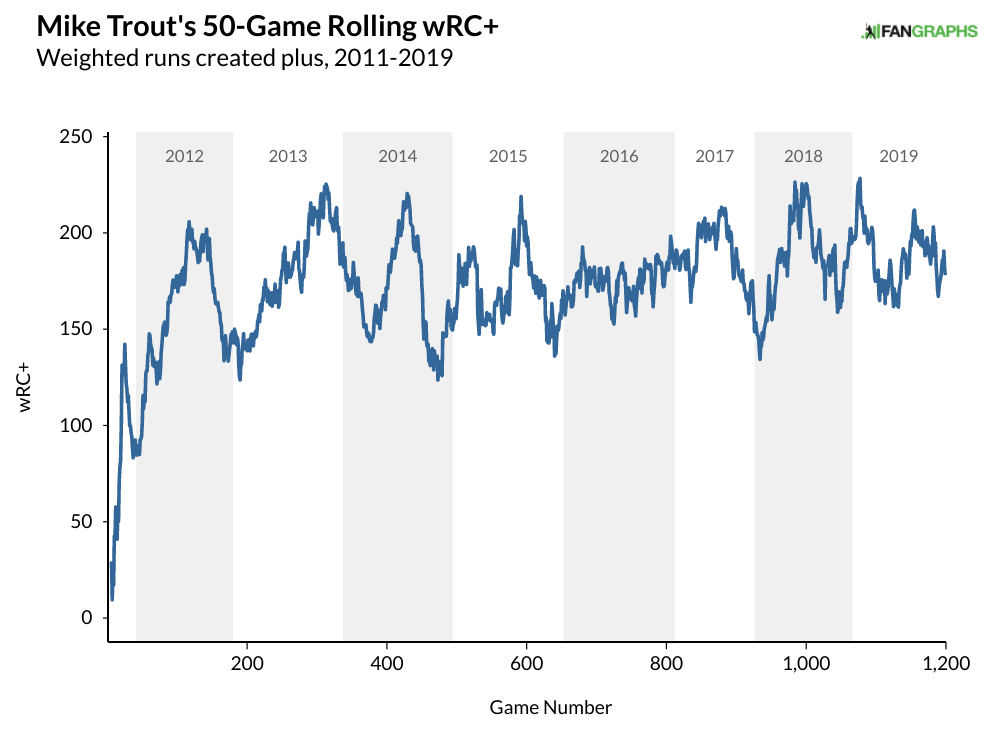
In 50 games, Mike Trout does what above average ballplayers do over the course of the entire season. To provide some context for Trout’s prowess, here’s a graph showing Trout’s rolling 50-game wRC+ average over the course of his career:

Remember that rough stretch Trout had near the end of 2014, where for a period of 50 games, his wRC+ was only 124? What struggles he must have been having. Or near the beginning of the 2018 season, when his rough patch carried over from 2017 and his wRC+ was a measly 134 over his previous 50 games? During his eight-plus years in the majors, Trout has spent more time with a 50-game rolling wRC+ above 200 than he has below 150. Read the rest of this entry »