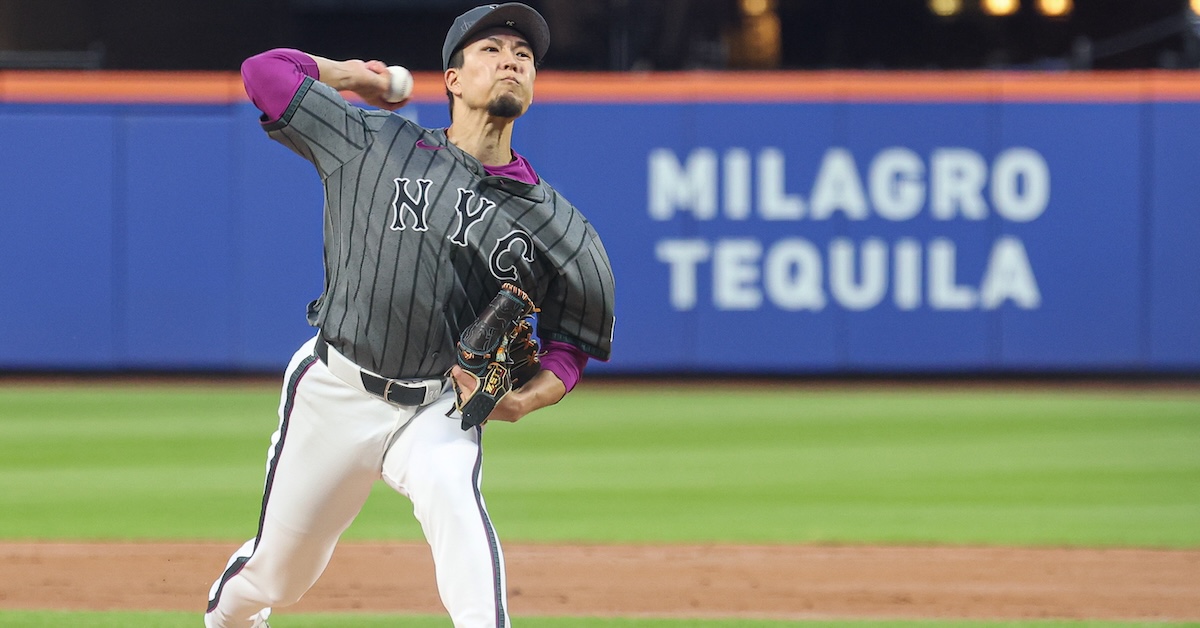
Welcome to another edition of Five Things I Liked (Or Didn’t Like) This Week. I got a chance to see many of my favorite baseball happenings this week: catchers making tough plays, exciting pitching matchups, and stars of the game at their absolute best. We also have plenty of goofy but delightful coincidences, just as Five Things patron saint Zach Lowe intended. A quick programming note: I’ll be on vacation, a nice restorative pre-deadline trip, for the next week and change. Enjoy baseball in the meantime – it’s a wonderful time of year for it.
1. Athletic Catchers
It’s amazing how much baseball knowledge your brain absorbs without actively thinking about it. For example, when you see an outfielder throw the ball home to cut down a runner trying to score on a single, you’ll immediately anticipate that the batter who hit that single might try to advance to second base. You might not even realize you’re thinking this. It’s just the natural timing of the sport. Long throw, cutoff man missed — how in the world is the catcher going to attempt a tag and then find a way to get the ball down to second base? It just doesn’t happen.
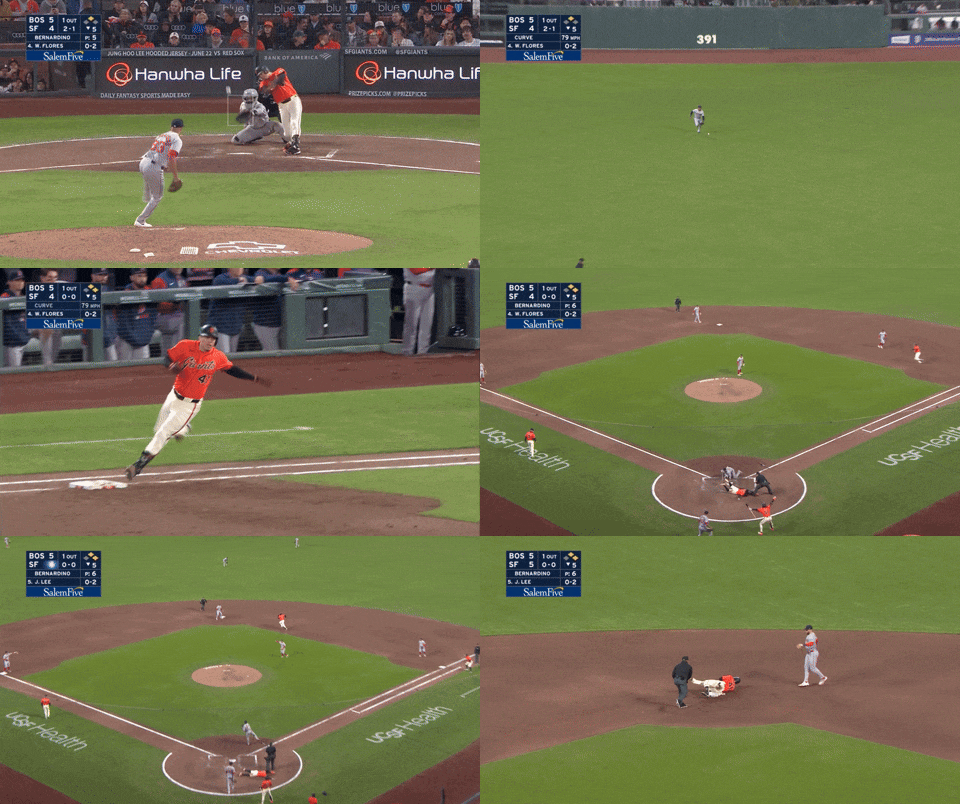
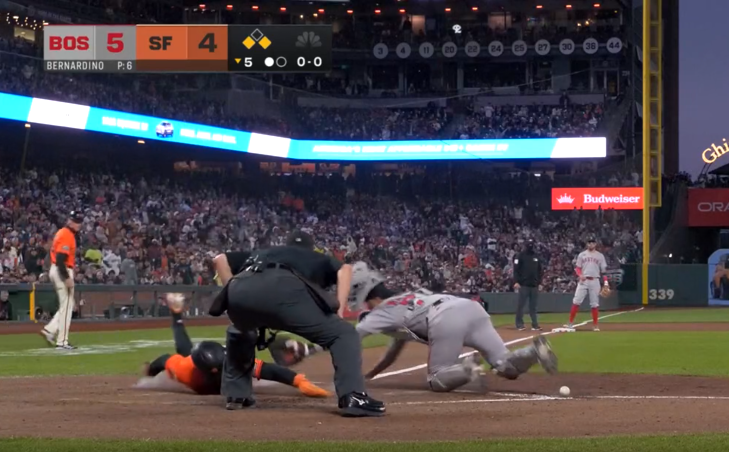
Or, well, it’s not supposed to happen. But Carlos Narváez doesn’t care what heuristics are stored in your brain:
What a weird play. The Red Sox correctly played to prevent the runner from scoring, and that let Wilmer Flores round first and get a great look at the play at the plate to see if he should advance. Right around this point, Narváez seemed to have no shot at throwing out Flores:
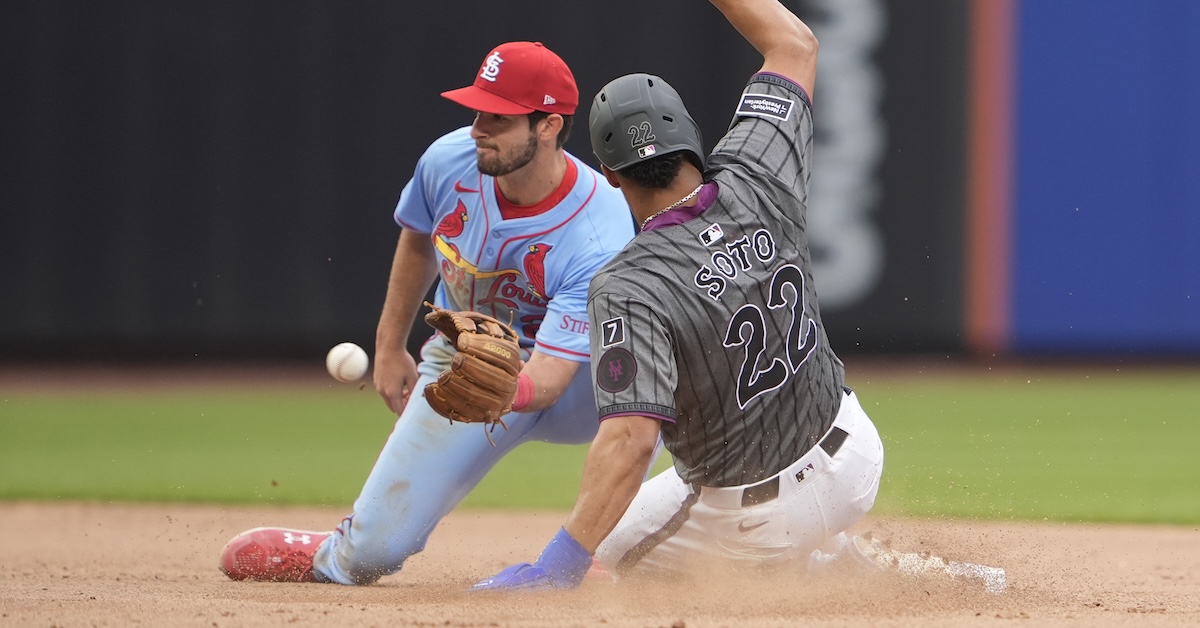
The Mets are not the fastest team in baseball. Wait, let’s be more specific. With an average sprint speed of 26.9 feet per second, the Mets are the second-slowest team in baseball. When their baserunning makes the news, it’s rarely for a good reason. Maybe they’re costing themselves hits and extra bases by failing to hustle out of the box, or maybe they’re running the bases in the wrong direction altogether. Either way, you could be forgiven for thinking that baserunning is costing the Mets runs after seeing something like this:
In fact, the Mets have been the 10th-best baserunning team in baseball according to our baserunning metrics, seventh best according to Statcast, and 11th best according to Baseball Prospectus. What makes this contrast even more fun is that in addition to being slow, they haven’t been amazing at taking the extra base either. BP ranks them 15th on that front, while Statcast has them all the way down at 26th. They go for the extra base as often as you expect them to, but they succeed at a below-average rate. For all the sabermetric angst about how being a valuable baserunner is more than simply piling up stolen bases, the Mets are, in fact, accruing all their baserunning value by stealing bases. But they’re still not stealing all that many bases.
The Mets’ 72 stolen base attempts are tied for the 17th most in baseball, and their 62 steals put them in a three-way tie for 11th. I’m sure you see where I’m going here. All this value is coming from efficiency; the Mets are converting 86.1% of their stolen base attempts — the highest rate in baseball this season, and the eighth highest ever recorded. That’s right: The second-slowest team in the league is running the eighth-highest stole base rate of all time.
Best Stolen Base Success Rates Ever
Season
Team
SB
CS
SB%
2020
Athletics
26
3
89.7
2023
Mets
118
15
88.7
2007
Phillies
138
19
87.9
2013
Red Sox
123
19
86.6
2021
Guardians
109
17
86.5
2023
Diamondbacks
166
26
86.5
2019
Diamondbacks
88
14
86.3
2025
Mets
62
10
86.1
2025
Cubs
96
16
85.7
2024
Dodgers
136
23
85.5
I don’t mean to be too dramatic here. I know the Mets are on an all-time top-10 list, but that’s to be expected. The league recently introduced rules that made basestealing much easier. They’re only one spot above the Cubs, who have been way more prolific on the bases, and fully half the teams in the top 10 are from the past three seasons. Still, I want to note a couple things about this list. The Cubs are the sixth-fastest team in baseball this year. Pete Crow-Armstrong, a top-15 player in terms of average sprint speed, has stolen more than a quarter of their bases. It’s not shocking that they’re up there. Further, the Mets appear on this list twice. In 2023, they were safe 88.7% of the time, the second-highest mark ever. The 2024 Mets rank 27th. Over the past three seasons, the Mets lead baseball with an 85.9% success rate, 2.5 points above the Phillies in second place. There really is something going on in Queens, and clearly, it’s not particularly dependent on speed.
Just to be sure about that last part, I ran some numbers. Like all teams, the Mets have their faster baserunners doing more stealing than their slower baserunners. I considered the possibility that they’re just only letting their faster players try to steal, but that’s not it. If you prorate team speed by the stolen base attempts of each player, their sprint speed moves up to 27.7 feet per second, which moves them from 29th all the way up to 25th. The Mets are just great at stealing bases.
I would really love to believe all of this is related to the team’s baserunning mantra, “Let’s Boogie,” coined by first base coach and run game coordinator Antoan Richardson. The Mets have been singing his praises over the past two seasons, but that is not particularly surprising. Light coaching hagiography is a staple of spring training coverage. Still, in this case, I am at least slightly inclined to believe the hype. “He’s one of the best I’ve ever been around,” said Juan Sotoin April. “He’s really good at that – checking on pitchers, what they do and how we can jump at it, when we can be more relaxed. I’ve trusted him twice and got it twice. So I feel like he knows what he’s talking about.” Soto is on pace for a career-high of 18 steals despite being the third-slowest outfielder in baseball (minimum 10 competitive runs).
It’s not just that Soto has increased his stolen base total so dramatically. It’s what I saw when I watched all of his steals this season. I recommend you keep the sound on, but even if you don’t, it is very easy to see what’s happening here.
The common thread is Soto got enormous jumps. The catcher didn’t bother to throw the ball in half of these clips. The only time it seemed like there might actually be a play was when he ran on the Blue Jays battery of Yariel Rodríguez and Alejandro Kirk. Rodríguez grades out as above average at controlling the running game, and Kirk is one of the best catchers in the game at that particular skill. Soto is slow enough that he needed every bit of his big jump. There’s no universe in which he runs here unless he is certain he has something on Rodríguez.
The same thing goes for Francisco Lindor, who is currently on pace for 26 steals even though his sprint speed ranks slightly below the league average for the first time in his career.
Just like Soto, Lindor is getting enormous jumps. He has the pitcher’s timing down cold. Sometimes he takes off before the broadcast even cuts to the pitcher! The Mets are stealing bases in all the right spots, and you can see it in the numbers. Baseball Savant keeps detailed measurements of both primary and secondary leads, and most of the time, the Mets are among the most conservative teams in baseball. At just 11.2 feet, their primary leads rank 28th. Their secondary leads rank 17th, but when you combine them with the extremely short primary leads, by the time the pitcher has released the ball, they’ve traveled an average of 14.8 feet, the fourth-lowest mark in the game. But those are just the overall numbers.
Things are completely different when the Mets are stealing. They’re very nearly the most brazen team in the league. Both their primary and secondary leads rank second in baseball. They end up 25.9 feet off the bag by the time the pitcher releases the ball, trailing the first-place Padres by just under two inches. No team has a bigger gap between their average lead and their we’re-about-to-steal lead than the Mets. In fact, the difference is 11.1 inches, and no team is within even a foot of that mark.
Because the Mets aren’t getting picked off or caught stealing, we can see they’re making great decisions about when to steal. And because they’re getting huger leads and even huger jumps, we can see they’re extraordinarily confident in those decisions. To be clear, not every player on the team is getting monster jumps. Luisangel Acuña has elite speed, and he’s relied on it to go 11-for-12 in stolen base attempts even without enormous jumps. Still, the Mets really do seem to know when to go, and that comes down to coaching and preparation. Before you boogie, you’ve got to study.
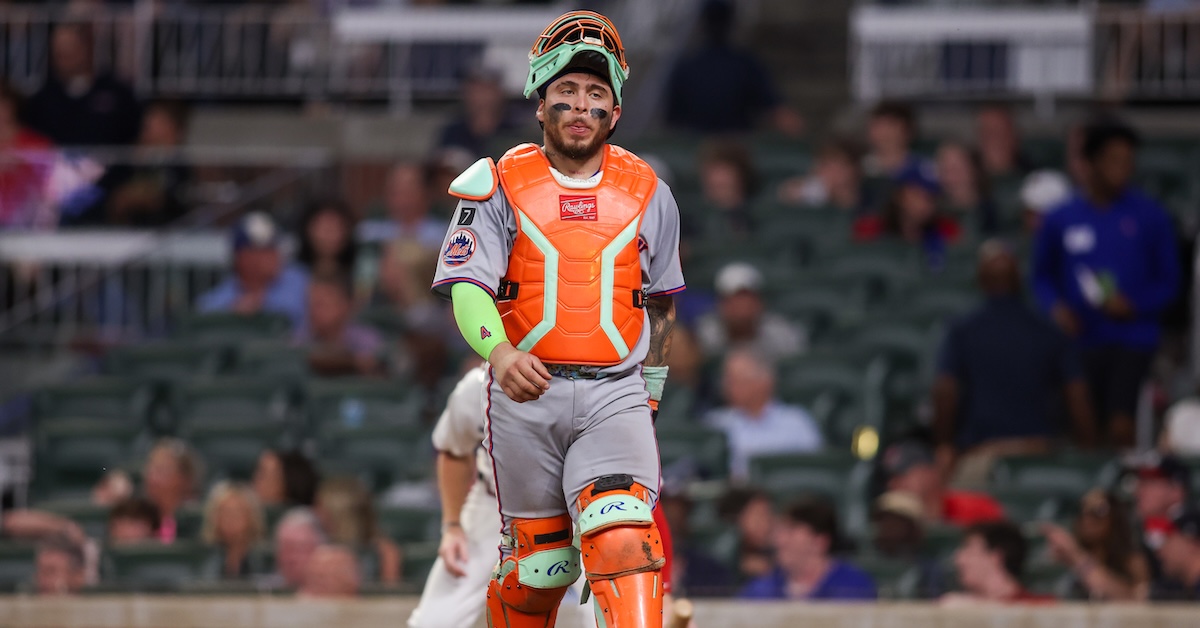
It’s looking like this isn’t the year for Francisco Alvarez after all. On Sunday, the day after they ended a seven-game losing streak, the Mets announced that they had optioned Alvarez to Triple-A Syracuse and called up Hayden Senger to take his place. The 23-year-old catcher already has a three-win season under his belt, and if not for a thumb injury that limited him to 100 games last season, he’d likely be a top-10 catcher in terms of WAR over the past two seasons. This season hasn’t gone to plan either, though, and Alvarez will now try to set things straight with a Syracuse Mets team that has dropped 12 of its last 14 games.
Alvarez fractured the hamate bone in his left hand on March 8, making this the second season in a row in which an injury to his catching hand has interfered with his chance to take the next step as an All-Star-level dual-threat backstop. Alvarez started a minor league rehab stint a very short 32 days later, batting .179 over 10 games at three levels. He returned to the Mets on April 25, and it’s hard to escape the conclusion that the team brought him back to soon. After missing a chunk of spring training and struggling during his rehab assignment, it perhaps shouldn’t be a surprise that he didn’t get off to a roaring start, but now that a skid has dropped them to one game behind the Phillies for the NL East lead, the Mets are no longer content to let him figure it out in Queens.
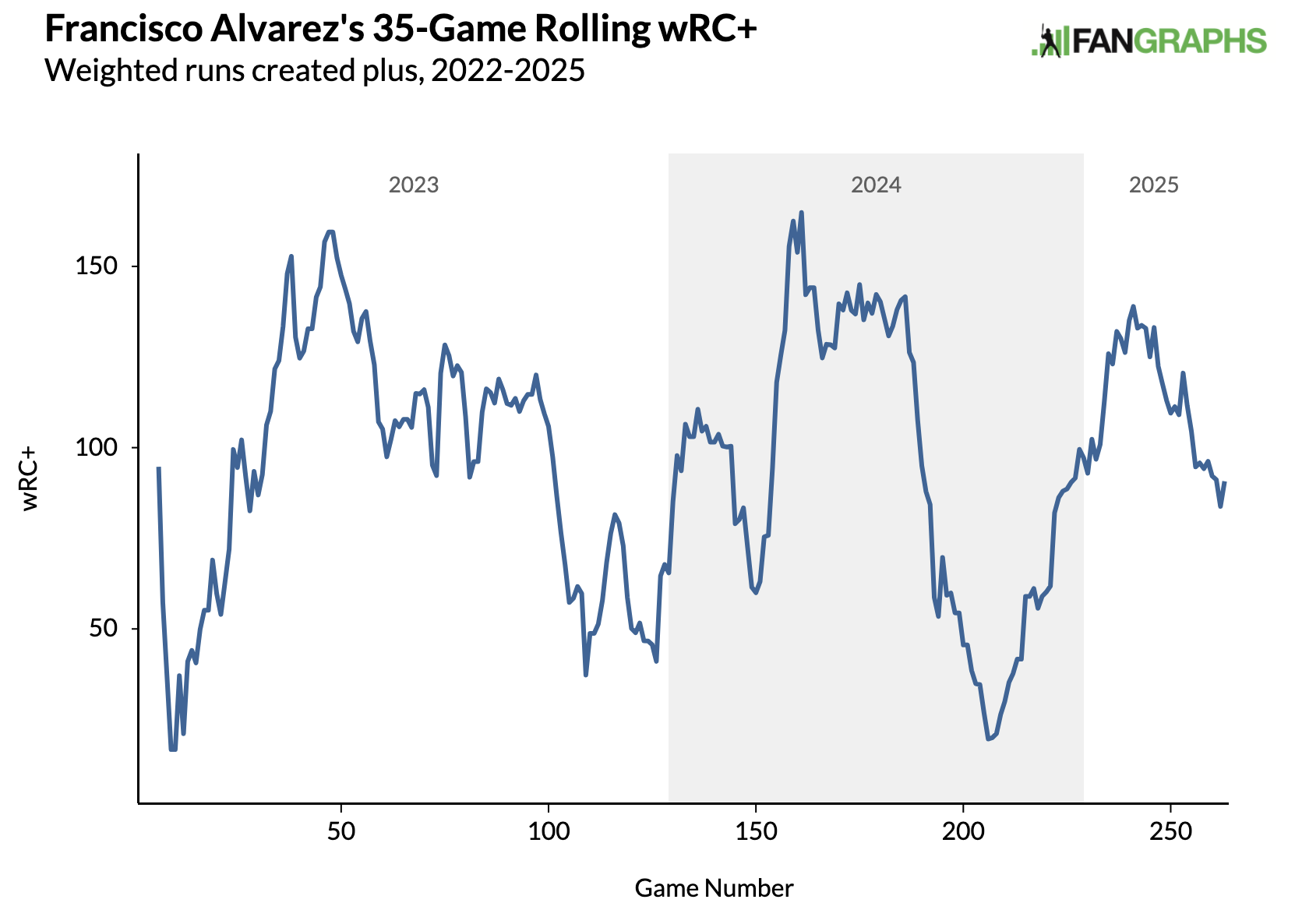
Let’s talk about the offense first. While it hasn’t been ideal, it hasn’t been disastrous either. Alvarez has gotten 138 plate appearances over 35 games, running a 91 wRC+. He put up a 97 wRC+ in 2023 and a 102 in 2024, so while this is the lowest mark of his career and a disappointment for a player who was expected to put it all together at the plate, it is by no means unprecedented. Alvarez had significantly worse 35-game stretches in each of his last two seasons:
Alvarez has been more aggressive of late, chasing and whiffing at career-high rates, and his 73% zone contact rate is among the worst in the league. However, because he’s increased his zone swing rate way more than his chase rate, SEAGER puts him in the 98th percentile, by far the best mark of his career. And because he’s seeing fewer strikes than he did in either of the past two seasons, Alvarez is running a career-high walk rate to go with his career-high strikeout rate. You could construct a real argument that the increased walk rate is worth the extra strikeouts, but the Mets clearly don’t see it that way. Manager Carlos Mendoza specifically cited plate discipline as Alvarez’s problem, telling reporters, “There were stretches where we felt, I felt like a couple of games where, OK, that’s what it’s supposed to look like. But then he’ll go a couple of games where he’s late with the fastball and then he chases, so just looking for consistency here.”
The other part of that argument has to do with the fact that Alvarez is crushing the baseball, though you wouldn’t know it from his career-low .098 ISO. We’re talking about a small sample, but he’s running career highs in hard-hit rate, as well as average, max, and 90th-percentile exit velocity. All that contact quality hasn’t turned into power largely because Alvarez hits the ball on the ground an awful lot; just 9% of his hard-hit balls have been in the air to the pull side, down from 29% in 2023 and 19% in 2024. The batted ball metrics are also shaping up in a weird way. Alvarez is running the highest BABIP of his career, but take a look at this:
Francisco Alvarez’s Hard-Hit Splits
Season
2023-2024
2025
Hard-Hit xwOBA
.612
.584
Hard-Hit wOBA
.660
.492
Difference
+.048
-.092
Not Hard-Hit xwOBA
.160
.220
Not Hard-Hit wOBA
.156
.260
Difference
-.004
+.042
SOURCE: Baseball Savant
Alvarez has gone from outperforming his wOBA when he hits the ball hard to underperforming it by quite a bit. But he’s also outperforming it when he doesn’t hit the ball hard. That’s not to say that all of this is the result of luck. Alvarez is running a career-low pull rate, and that drop-off is even more dramatic on balls in the air.
It’s not necessarily that Alvarez is struggling to catch up with pitches; he also went into the offseason determined to stop pulling the ball so much. “The primary focus for me has been to hit the ball the other way or up the middle, but there are going to be days where I am going to be pulling the baseball,” he said in April. “But probably 80 percent of the time my focus is more to the middle of the field to the opposite field.” It has worked, maybe too well. According to Statcast’s bat tracking metrics, his intercept point is 1.3 inches deeper than it was last season. At the moment of intercept, his bat went from being angled three degrees to the pull side to five degrees to the opposite field. In all, expected metrics like xwOBA think that Alvarez should be pretty much as good a hitter as he was last season, with the walks making up for the extra strikeouts and the contact quality making up for the less-than-ideal launch angles. However, DRC+, which gets deeper into the process, is much more skeptical:
Francisco Alvarez’s Expected/Deserved Stats
Season
xwOBA
xwOBAcon
DRC+
2023
.305
.370
97
2024
.289
.343
97
2025
.303
.369
85
Alvarez is an all-or-nothing power hitter, who is also groundball prone because he possess a flat swing; over the past three seasons, his 28 degree swing path tilt put him in just the 15th percentile. We’ve seen plenty of hitters make that work to varying degrees, but it’s not always the world’s most satisfying combination. He’s going to go through periods where he doesn’t make much contact, and he’s going to go through periods when he’s hitting the ball on the ground way, way too much. He’s been doing both this season, but it’s important to keep in mind that we’re talking about a small sample, just as we’re talking about a player coming off an injury and missing spring training.
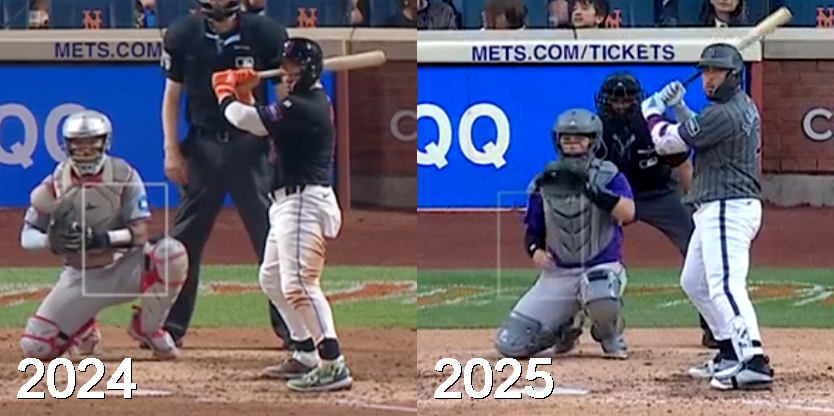
In addition to changing his approach, Alvarez has also changed his setup, going from a relatively stationary stance with his bat resting on his shoulder to a more fluid stance with his bat angled higher and his hands lower:
As Mendoza noted on Sunday, the hamate injury cost Alvarez the chance to get comfortable with these changes.
All that said, the bigger concern comes on the defensive end. “I feel like the receiving and the blocking is probably an area that we want to see some improvement,” said Mendoza. Over the past two seasons, Alvarez was one of the best framers in the game, with nine framing runs in 2023 and seven in 2024 according to Statcast. This season, he’s at -4. Baseball Savant breaks the edges of the strike zone into eight different sections. Alvarez grades out as below average in seven of them, and among the bottom 10 in the league in four of them. In previous seasons, he was excellent at the bottom of the plate, but this season, he ranks 38th out of 56 qualified catchers. That is a major issue that needs to be addressed. Even in his outstanding rookie season in 2023, Alvarez was a below-average hitter, with nearly all of his value coming from framing. Maybe he just needs more time to recover from an injury to the base of his catching hand, but that skill is what gave him his real star potential. Without it, he’s a different player.
Alvarez’s blocking has also been the subject of much criticism, as his four passed balls are tied for fifth-most in baseball. However, Baseball Prospectus sees him as an above-average blocker this season, and Statcast sees him as exactly average. The Statcast numbers show that this is likely a situation where the eye test isn’t treating him well. Alvarez has let 17 pitches get by him in 2025, but they’re not the ones you might expect:
Alvarez’s opportunities have been quite a bit tougher this season. He’s actually been better than average on pitches that Statcast grades as having medium difficulty, but he’s given those gains back on chances that grade out as easy. But moderately difficult blocks don’t stick out that much, so what we notice are all the passed balls on easy chances. Moreover, Alvarez is currently catching 41% of would-be basestealers, so he is making up some value with his arm.
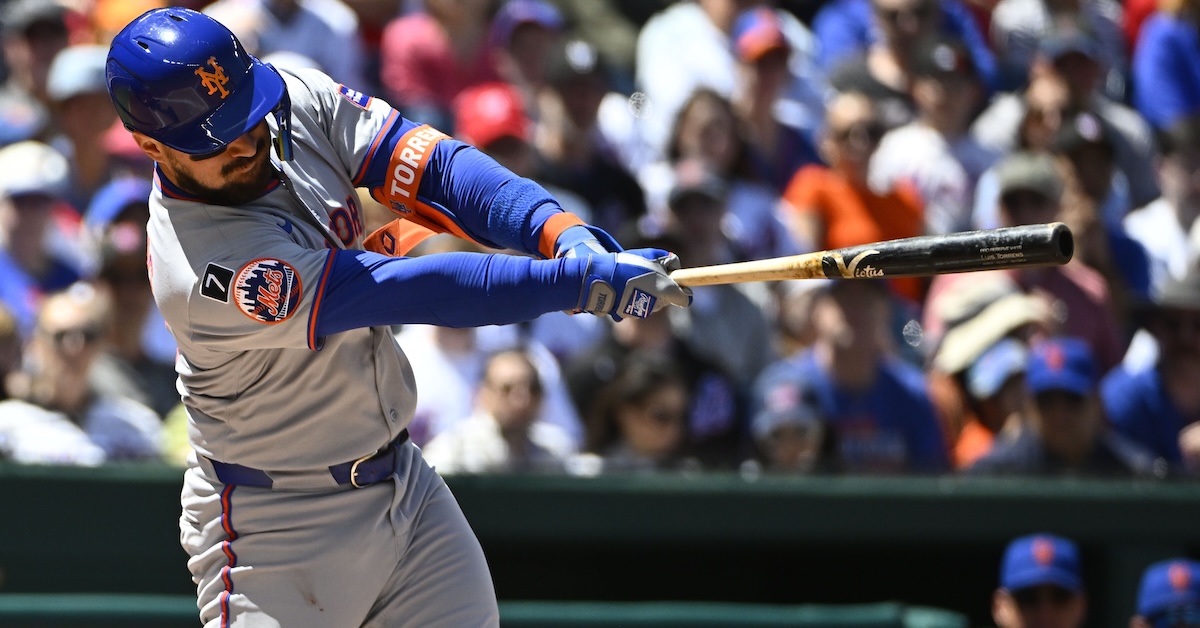
Now that we know all this, what does it say about the team’s decision to option Alvarez? It depends. If his issues merely stem from the injury and the lack of preparation time – if he’s going to figure it out eventually – then sending him down right now doesn’t make a ton of sense. He has already been ceding playing time to Luis Torrens. Torrens has been excellent at framing, which has allowed him to put up 0.7 WAR to Alvarez’s 0.5, even though his bat has been worse and his blocking actually has been bad. Senger is 28 and was running just a 59 wRC+ in Syracuse. In fact, he hasn’t put up an above-average offensive line in the minors since 2021. So swapping in Senger for even this reduced version of Alvarez will likely cost the Mets significantly in the short-term, and there’s always a risk that this kind of demotion could hurt a player’s confidence.
On the other hand, if the Mets really think that Alvarez could use a reset to work on his framing and figure out his approach, then it makes all the sense in the world to send him down right now. Mendoza is eager to get Alvarez more at-bats, but the Mets don’t think they can afford to while they’re battling for the division and Torrens is (slightly) outperforming him. It’s hard to say whether Alvarez’s struggles at the plate are the result of his new approach, residue from the injury, or simply bad luck over a short sample, but the Mets are clearly worried about his plate discipline. If they’re going to tinker with his swing, it’s probably better to do that in a lower-pressure environment. If it results in Alvarez having a great second half, it would be well worth the short-term downgrade.
To be clear, if Alvarez does bounce back at some point, there will be no way to really know the reason for it. Did the Mets help him figure something out? Did he just need some time to get back to his old self? Plenty of people will have an opinion, but we won’t know what would have happened if the team had just held to their current course. It seems safe to assume that Alvarez will get back to something like his old self at some point, and if that happens soon, it will make the Mets look very smart.
A week ago, as Sean Manaea and Frankie Montas continued their rehab assignments, reporters and fans wondered how the two hurlers — both of whom suffered injuries before the calendar flipped to March — would fit into a rotation that has been one of the majors’ best thus far. “Usually it plays itself out,” responded Mets manager Carlos Mendoza when asked about it. “We still are at least two weeks away from making those decisions and I’m hoping that by the time we get there it is going to be a difficult decision. That means everyone’s healthy. That means everybody continues to throw the ball well and we have some good problems.”
While the Mets still share the NL’s best record (45-28) thanks to the work of that rotation — which has been unusually durable since the start of the regular season — their decision regarding that pair has become more complicated. In rapid succession, both Kodai Senga and Tylor Megill have landed on the injured list, the former with a hamstring strain and the latter with an elbow sprain. Each is likely to miss at least a month, and so far, neither Manaea nor Montas has shown he’s ready.
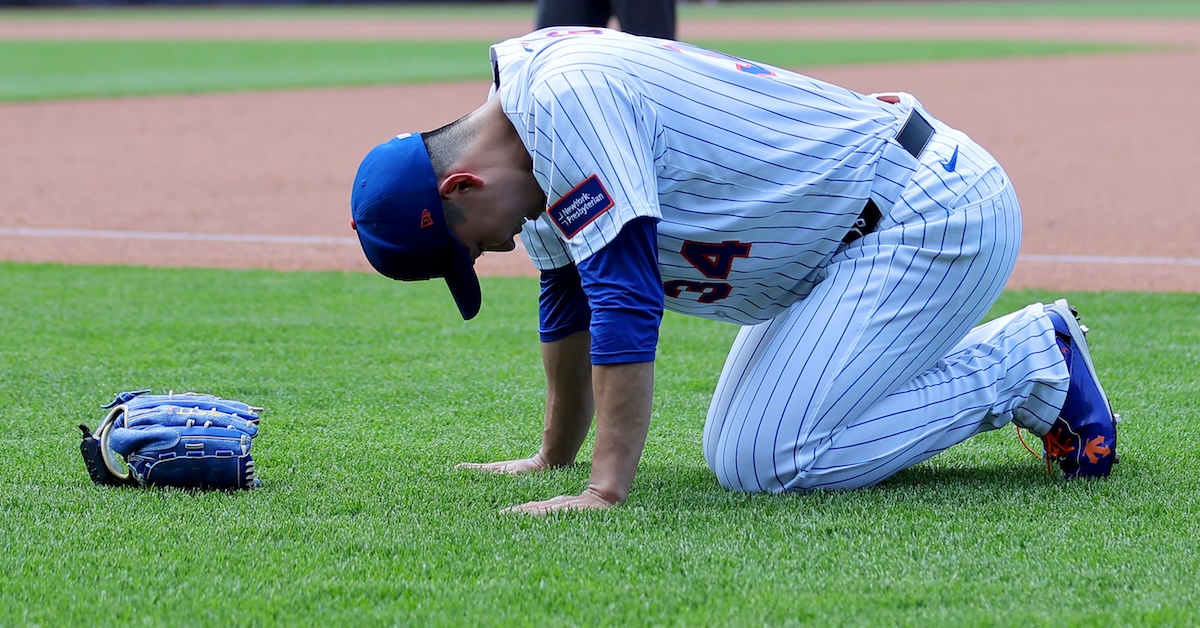
On Thursday at Citi Field, Senga absolutely carved up the Nationals, holding them to one hit — a first-inning single by James Wood — and one walk while striking out five. With one out in the sixth, he ran to cover first base after inducing CJ Abrams to hit a sharp grounder to Pete Alonso, whose throw to the pitcher was high. Senga leapt in the air to catch the ball, then extended his right leg far enough for his toe to touch the corner of the bag in time to beat Abrams. It was an impressive, acrobatic play, but the pitcher immediately grabbed his right hamstring upon landing, then tumbled to the ground.
In 2023, Mets left-hander David Peterson struck out 128 batters in 111 innings. Peterson’s strikeout rate that year, 26.0%, was 27th in the league out of 127 pitchers who threw 100 or more innings. He was tied with Zac Gallen, not far behind Luis Castillo, Gerrit Cole, and Zack Wheeler.
The next year, Peterson’s strikeout rate dropped by more than six points, to 19.8%, but he shaved three-quarters of a run off his FIP, and more than two runs off his ERA. This year, Peterson is striking out 21.5% of opponents, and after Wednesday night’s complete-game shutout of the Nationals, his ERA is 2.49, which is 14th among qualified starters.
But I thought striking batters out was good! How did Peterson turn into this unhittable monster while running a lower strikeout rate than Shane Baz? Read the rest of this entry »
Wendell Cruz, Jason Parkhurst, Gary A. Vasquez-Imagn Images
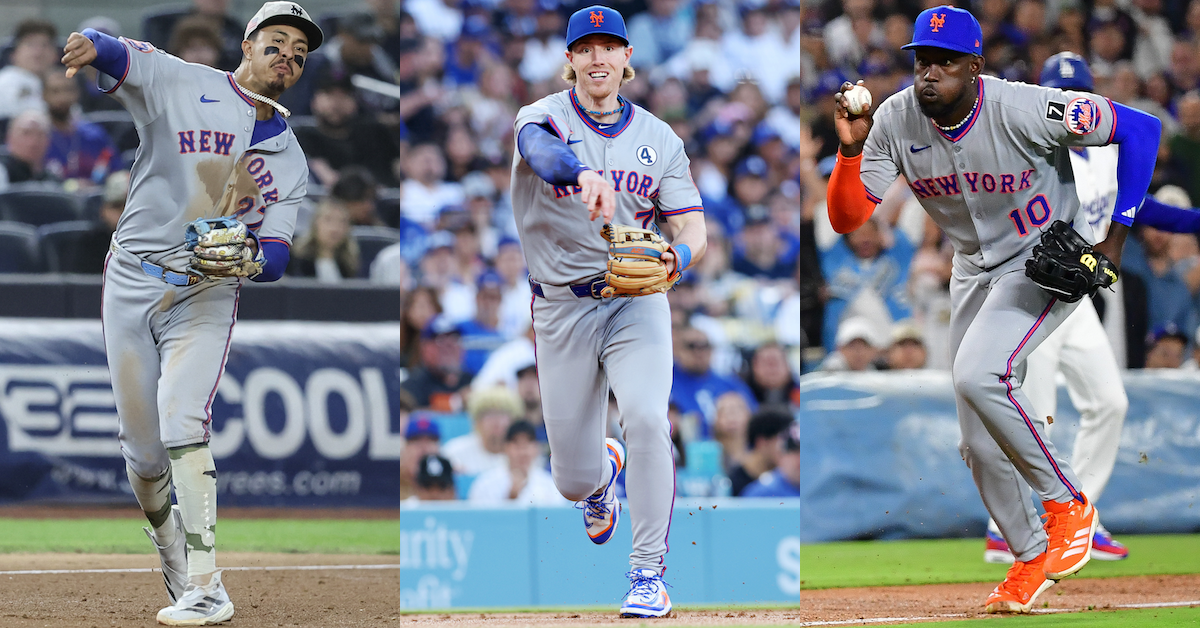
It’s been a frustrating season for Mark Vientos. After two years of trying to stick with the Mets, he broke out by hitting 27 homers in 111 games last season, and handled third base well enough to look as though he’d locked down a regular job. Yet this year, he’s regressed on both sides of the ball, and on Tuesday night in Los Angeles, he added injury to insult when he strained his right hamstring. The silver lining is that the 25-year-old slugger will get a chance for a reset once he’s healthy, and in his absence, the Mets have an opportunity to sort through their talented but still largely unproven assortment of young infielders.
Vientos’ injury occurred in the top of the 10th inning in Monday night’s opener of a four-game NLCS rematch between the Mets and Dodgers in Los Angeles; the series was an exciting one full of late-inning lead changes, with the two teams emerging with a split and three games decided by one run. Los Angeles had tied Monday’s game in the bottom of the ninth on a Shohei Ohtani sacrifice fly, and New York answered by scoring runs with back-to-back hits to start the 10th. With two outs and runners on the corners, Vientos had a chance to break the game open. He’d been hitting the ball hard lately but not getting great results, and when he smoked a 97-mph grounder to the right of shortstop Hyeseong Kim, it appeared to be more of the same. Kim reached the ball before it cleared the infield, but his throw to first base was an off-line one-hopper. It didn’t matter, as Vientos had fallen down before making it halfway down the line, because his right hamstring seized up.
On Tuesday, the Mets placed Vientos on the injured list and sent him back to New York to determine the severity of the injury. Manager Carlos Mendoza said on Wednesday that Vientos has a low-grade hamstring strain and is expected to receive treatment for 10-14 days before resuming baseball activities. To replace him on the roster, the Mets recalled 24-year-old Ronny Mauricio from Triple-A Syracuse. The former Top 100 prospect (no. 44 in 2022, and no. 90 in ’23, both as a 50-FV prospect) missed all of last season due to a right anterior cruciate ligament tear suffered during winter ball in February 2024. More on him below, but first, Vientos’ struggles are worth a closer look. Read the rest of this entry »
In early April, Davy Andrews penned an article that ran here at FanGraphs and began with the following: “You may have noticed that this is the Year of the Kick-Change.” My colleague went on to explain the pitch, which by now most people reading this are well familiar with. Our own coverage of the popular offering also includes an interview with Davis Martin and Matt Bowman from last September, and a feature from this spring on Hayden Birdsong, who throws a kick-change, and his teammate Landen Roupp, who does not. The pitch is thrown exclusively (at least to my knowledge) by supinators such as Martin, who explained that spiking his middle finger on a seam allows him to “kick the axis of the ball into that three o’clock axis [and] get that saucer-type spin to get the depth that a guy who could pronate a changeup would get to.”
Thinking about the pitch recently, a question came to mind: What would happen if a natural pronator tried to throw a kick-change?
In search of an answer, I queried three major league pitching coaches, as well as Tread Athletics’ Leif Strom, who in addition to having hands-on knowledge of the kick-change is credited with coining the term. Their responses varied. Moreover, they meandered a bit — but in a good way — as they offered insight into the science of throwing a baseball from a mound.
Here is what they had to say.
The following answers have been lightly edited for clarity.
———
Desi Druschel, New York Mets
“There are a couple of ways to look at the kick-change. Most people interpret it as, ‘the spike kicks the axis,’ but I’m not necessarily convinced. Another thought is that [the middle finger] is just out of the way, and the ring finger kind of swipes below it. You’re kicking the axis, for sure, but I don’t know if it’s always kicking it how people might think. That would be on the one where there is more supination. Read the rest of this entry »
If, like me, you’re a weird baseball transactions sicko, you probably first heard of Luis Torrens at the tail end of 2016. That’s when the Padres, in the midst of an A.J. Preller-led teardown, shocked baseball by taking three low-minors players in the Rule 5 Draft and putting them all on the major league roster for 2017. It was a bold, unheard of tactic. The three players – Allen Córdoba, Miguel Díaz, and Torrens – were clearly not ready for the majors. Torrens, the most advanced of the trio, was 21 and had around 200 plate appearances of full-season minor league ball under his belt, and he was still learning his new position of catcher.
That trio was famously overmatched in 2017. Torrens racked up -1.3 WAR in 139 plate appearances, Córdoba -1.0 WAR in 227 of his own, and Diaz -0.7 WAR in 41 2/3 innings pitched. The whole experiment was an embarrassment for the league, and no one has since tried similar chicanery. The Padres sent them down after the season, as soon as they were eligible to do so without having to return them to their previous organizations; Torrens and Córdoba spent all of 2018 in the minors, and both struggled in A Ball. Torrens did finally return to the majors as a backup in 2019, but Preller flipped him to Seattle a year later and he slid into journeyman status. From 2019 through 2023, he bounced around, rarely getting consistent playing time, ending up with 668 plate appearances, a 92 wRC+, and -0.4 WAR thanks to iffy defense.
I’ve used what San Diego did in this particular Rule 5 Draft as a cautionary tale when people ask me about the risks of rushing low-level minor leaguers to The Show. I firmly believe that this Rule 5 manipulation interrupted each of their career arcs – they just weren’t ready for the challenge, which is hardly unexpected given where they’d been playing. Each was a promising prospect, but in the six years after the Padres selected them, the amount of time you’d expect them to be under team control, they combined for -3.2 WAR. Read the rest of this entry »
Mikey Romero has hit a few speed bumps since the Boston Red Sox drafted him 24th overall in 2022 out of California’s Orange Lutheran High School. A back injury limited the 21-year-old multi-position infielder to just 34 games in 2023, and he then didn’t return to game action until last May. He also missed time in August after suffering a concussion.
When healthy, it’s been mostly smooth sailing for the former first-rounder. [Boston took Roman Anthony 16 picks later the same year]. Romero’s last-season ledger included 16 home runs and a 125 wRC+ over 362 plate appearances between High-A Greenville and Double-A Portland.
He’s off to a strong start in the current campaign. Back at the higher of those levels, Romero is swinging to the tune of a 134 wRC+ in 154 trips to the plate. Fully half of his 34 hits have gone for extra bases. The San Diego native’s smooth left-handed stroke has produced 10 doubles, a pair of triples, and five home runs.
As the season was getting underway, I asked the promising youngster how he’s grown as a hitter since joining the professional ranks. Read the rest of this entry »
A couple of weeks ago, Hannah Keyser of The Bandwagon asked Kodai Senga about his reverse splits when it comes to times through the order. His .347 wOBA allowed the first time through the lineup drops to .275 the second time through it, and then sinks to .205 the third time through. However, his total batters faced sits at just 90 for each of the first two times through the order and 48 for the third time through. That’s a small enough sample that it’s difficult to say how much of the credit goes to Senga and how much is naturally occurring variation.
Either way it doesn’t matter much to Senga, who cares more about process than results, “Quite honestly, I don’t feel like I’m very good at any point during the game this year,” he told Keyser through his interpreter. Harsh words for a pitcher with an ERA- of 37. He does acknowledge that he makes adjustments throughout the game to get a better feel for his pitches and tweaks his strategy based on how each pitch is looking in a given start, which offers some explanation for the improved outcomes as the game goes on. But according to Senga, all of his pitches feel off this year, as he remains in the process of re-establishing his mechanics following the shoulder and calf injuries that sidelined him for nearly all of last year.
Senga’s self-evaluation reminds us that folks performing at the elite level of their fields don’t get there by letting good enough be good enough, but rather by insisting that nothing is ever good enough. To the layperson, it’s baffling to hear that Senga feels he’s pitching worse, despite posting better results than in 2023, his first MLB season, and the last in which he was fully healthy. Add on that he somehow manages to gain effectiveness throughout his starts despite a certain level of displeasure with all of his pitches, and it couldn’t be any clearer that regardless of what you read in Us Weekly, the stars are not actually just like us. Read the rest of this entry »