For the 22nd consecutive season, the ZiPS projection system is unleashing a full set of prognostications. For more information on the ZiPS projections, please consult this year’s introduction, as well as MLB’s glossary entry. The team order is selected by lot, and the preantepenultimate team is the Baltimore Orioles.
Batters
Baltimore’s pitching looked to be a problem entering the 2025 season, but the lackluster offense turned what was a good team with a run prevention problem into a losing club. After ranking second in the American League in runs scored in 2024, the O’s dropped to 11th in 2025, and suffice it to say, the pitching didn’t bail them out. A 75-87 record looks bad in a comparatively mild way given some of the clunkers the team has crafted since 1997, but it was one of the biggest O’s letdowns in at least my memory (I’m from Baltimore). But like the Blue Jays going into 2025 or the Yankees going into 2024, people tend to underrate good teams coming off of crappy seasons, sometimes horribly. There’s this belief that the lousy year is some baseline expectation and you have to start counting wins added from that point, which is a very poor way to make projections.
Have the O’s done enough with the offense? If the projections here are accurate, probably. With so many underperformances, some righting of the ship was always going to happen anyway, but the O’s didn’t just wait for the magic of regression to do the job for them. I don’t think the end of the Pete Alonso contract will be pretty, but he’s a legitimate big bat in a way the franchise tried to pretend Ryan Mountcastle was for a long time. Taylor Ward isn’t great, but you know who Taylor Ward is. The O’s are now in a position where they don’t needCoby Mayo or Heston Kjerstad to get back on track, though it would of course be nice. Read the rest of this entry »
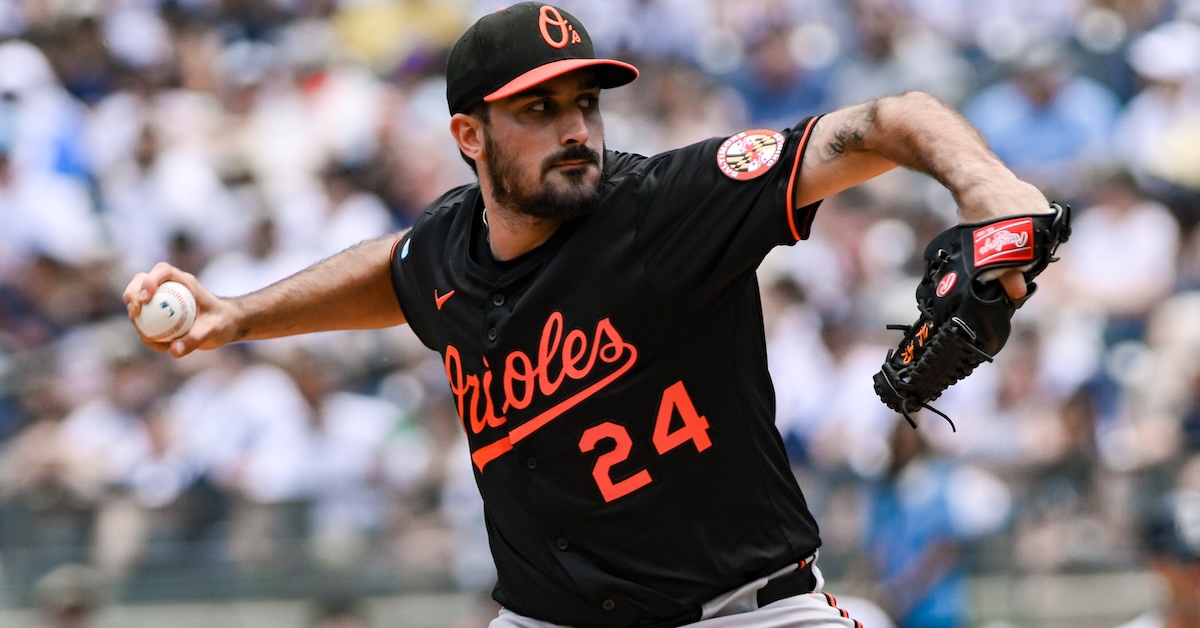
The Baltimore Orioles continued filling out their rotation last weekend, signing right-hander Zach Eflin to a one-year contract worth $10 million with a mutual option for the 2027 season. Traded to the Orioles from the Rays in 2024, Eflin struggled with injuries last year, throwing only 71 1/3 over 14 starts while putting up a 5.93 ERA and -0.3 WAR.
A first-round pick by the Padres out of a Florida high school in 2012, Eflin finally established himself as a solid mid-rotation starter with the Phillies at the end of the decade after being a part of trades for Matt Kemp and Jimmy Rollins. COVID and recurring patella issues in his right knee plagued him in 2021, resulting in season-ending surgery, and he missed another three months in 2022 with more problems with the same knee. Despite the setbacks, the Rays saw enough to sign him to a three-year, $40 million deal entering the 2023 season. Eflin experienced a minor back injury and tendinitis in his other knee, but that only cost him a handful of innings, and the result was his best and most durable campaign. He set career highs in starts (31), innings (177 2/3 innings), ERA (3.50), FIP (3.01), and WAR (4.9). While his numbers sagged a bit in 2024, Eflin was still a quality pitcher whose name bandied in trade rumors before the deadline. Read the rest of this entry »
The following article is part of Jay Jaffe’s ongoing look at the candidates on the BBWAA 2026 Hall of Fame ballot. For a detailed introduction to this year’s ballot, and other candidates in the series, use the tool above; an introduction to JAWS can be found here. For a tentative schedule and a chance to fill out a Hall of Fame ballot for our crowdsourcing project, see here. All WAR figures refer to the Baseball Reference version unless otherwise indicated.
The third and final multi-candidate pairing of this series is by far the heaviest, covering two candidates who have both been connected to multiple incidents of domestic violence. Read the rest of this entry »
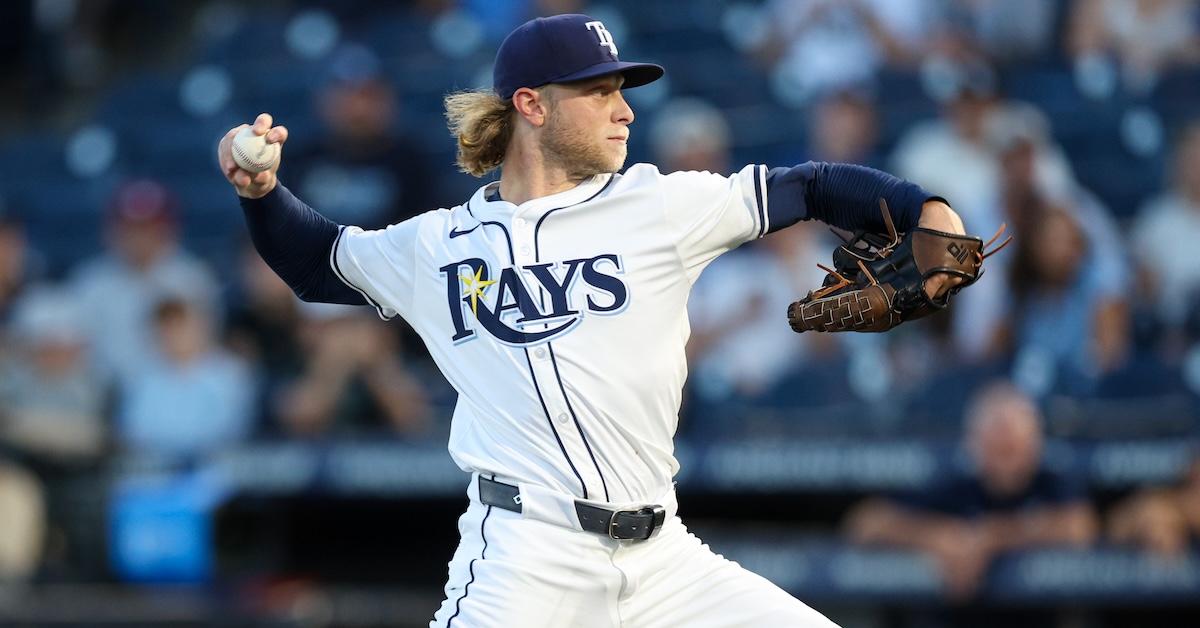
Orioles fans have had “Frontline Starter” on their Christmas list since the departure of Corbin Burnes, and though Friday’s acquisition of Shane Baz is perhaps the gift equivalent of asking for a Ferrari and getting an Acura, it adds a proven element to the middle of an Orioles rotation that still feels like it will be anchored by Kyle Bradish and Trevor Rogers.
To acquire the 26-year-old Baz, who is coming off a 2-WAR season, the Orioles had to part with a prospect potpourri made up of a pair of 2025 draftees (Coastal Carolina catcher Caden Bodine and high school outfielder Slater de Brun), a Competitive Balance Round A pick in next year’s draft, upper-level starting pitcher prospect Michael Forret, and speedy 22-year-old outfielder Austin Overn. It’s an enormous, high-volume return for one player and helps the roots of the Chris Archer trade tree anchor deeper into the game’s soil. I’ll talk more about each prospect, the comp pick, and the way this trade impacts both clubs’ farm systems later in the post. But let’s start with the most immediately consequential piece of the deal: Shane Baz.
Baz has been famous since his junior year of high school, when he emerged as one of the better pitching prospects in the 2017 draft. He was selected by Pittsburgh in the middle of the first round and traded as the Player to be Named in the Archer deal a little over a year later. The pandemic and persistent injuries (there were some near-misses as well) slowed Baz’s ascent through the minors and prevented him from working more than 81 innings in any single season until literally 2025. The Rays doggedly deployed him as a starter despite his injuries and early-career command woes, and they were rewarded with something of a breakout this year, as Baz ate 166.1 innings across 31 starts. He posted a 4.87 ERA, but hurricane damage to Tropicana Field meant that he pitched his home games in a minor league park with the hitter-friendly dimensions of Yankee Stadium; his xERA, which controls for defense, quality of contact, and the hitting environment, was 3.86. Read the rest of this entry »
The Baltimore Orioles will be different in 2026, and not just because of roster additions that already include Pete Alonso and Taylor Ward, with more almost certain to follow. They’ve hired a new manager (Craig Albernaz), replaced a few coaches, and done some reshuffling at the executive level. In a sport where remaining stagnant can be deleterious, the O’s are moving forward on the heels of a disappointing 2025 season.
A precipitous dip in the win column — 91 in 2024, just 75 last year — accentuated the need for changes, but that isn’t the only reason. According to Mike Elias, progress is an ongoing endeavor.
“We’re constantly evolving, having to respond to other teams’ getting better in areas,” Baltimore’s president of baseball operations told me during last month’s GM Meetings. “We make changes every year. We’re actually undergoing quite an overhaul at the major league level right now with our staff. We’ve done some reformatting in the front office, although certainly not to the degree we did when we came in.”
Things changed markedly after Elias arrived in November 2018 and began rebuilding the organization. Analytics — an area in which the Orioles had been well behind the times —- was of course a major focus. But while giant strides have been made, there is no finish line to reach. Moreover, an old Satchel Paige adage applies: “Don’t look back. Something might be gaining on you.” Read the rest of this entry »
ORLANDO — Congratulations, everybody. We made it. It’s now Thursday, and the Winter Meetings have officially concluded. It’s time to reflect on the state of effort in Major League Baseball, and I am pleased to report that it is strong. At this time last year, we had seen 22 We Trieds (though a few more would be added retroactively due to a rule clarification). As of now, we’re sitting at 24, so let’s take a moment to congratulate all the agents, the anonymous sources, and the reporters who took us this far. As always, I invite you to peruse this vast bounty on the official We Tried Tracker.
Before we break down the last couple days, I should start with an important update on the most recent entry of this series. When news broke that the Giants asked for Tatsuya Imai’s medicals even though they didn’t plan on pursuing him, I gave it an intentionally cumbersome moniker: We’re Not Even Going To Try, So Don’t Bother Getting Your Hopes Up. This was a classic defense mechanism. I went with the big, long name to deflect from the fact that I couldn’t come up with a clever, pithy one. But the right name came to me this week. In the future, such a move will be known as a Pre-Tried. I have spoken.
Since that last update, Bob Nightengale took a new angle on this exercise, packaging the news that the Reds “were hoping to sign” Devin Williams with the news that they had actually re-signed Emilio Pagán. It’s a brilliant maneuver. You sign a lesser player while also announcing that you were also thinking even bigger. We Trieds are all about partial credit, but here are the Reds, breaking out the razzle dazzle and running an end-around in a bid for double credit!
This strategy is also something of a double-edged sword, though. Some fans might give the Reds the double credit they want, but it’s also easy to take the information in the other direction. The Reds held onto a good reliever, Reds fans! Let’s celebrate! Oh, also, they only got him because they tried and failed to get an even better reliever? Do you still want to celebrate? Try pulling that move with a child. Take them to an ice cream shop and get them a kid’s cone. Once they’ve given it a big lick and smiled their adorable little smile, lean over and say, “You know, I was hoping to get you a giant ice cream sundae, but you’ll have to settle for this little one because the New York Mets ordered it first.” Read the rest of this entry »
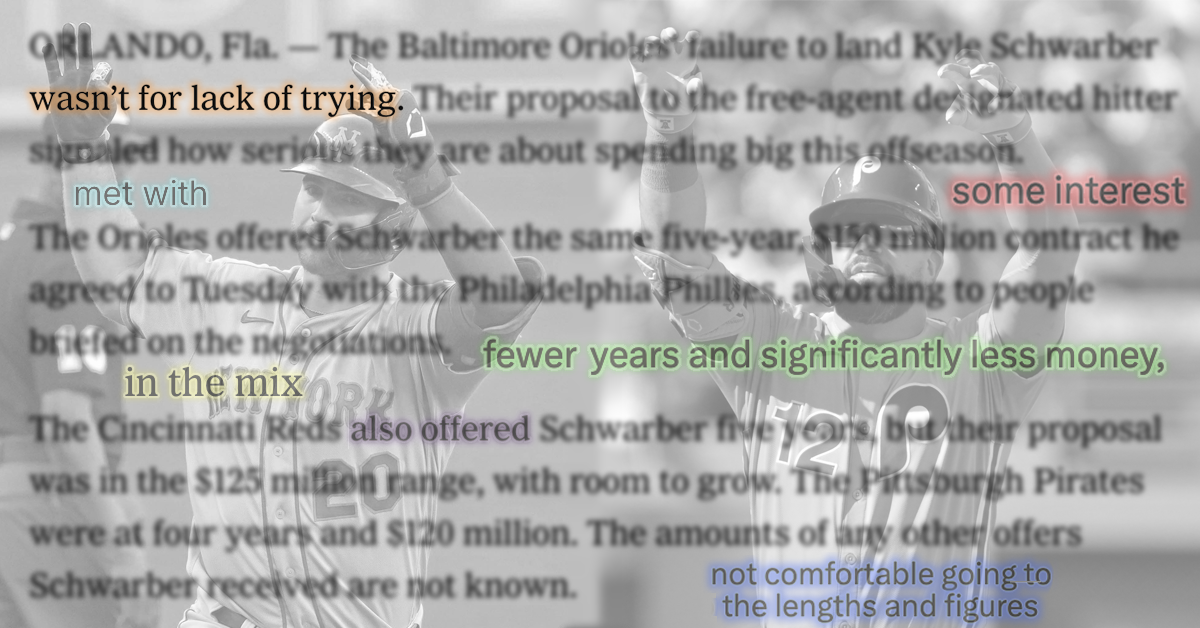
After a somnambulant first day of the Winter Meetings, one of the buzzier rumors involved free agent first baseman Pete Alonso getting in his car, driving up I-4 from his home in Tampa to Orlando, and pitching himself in person to the Red Sox and Orioles.
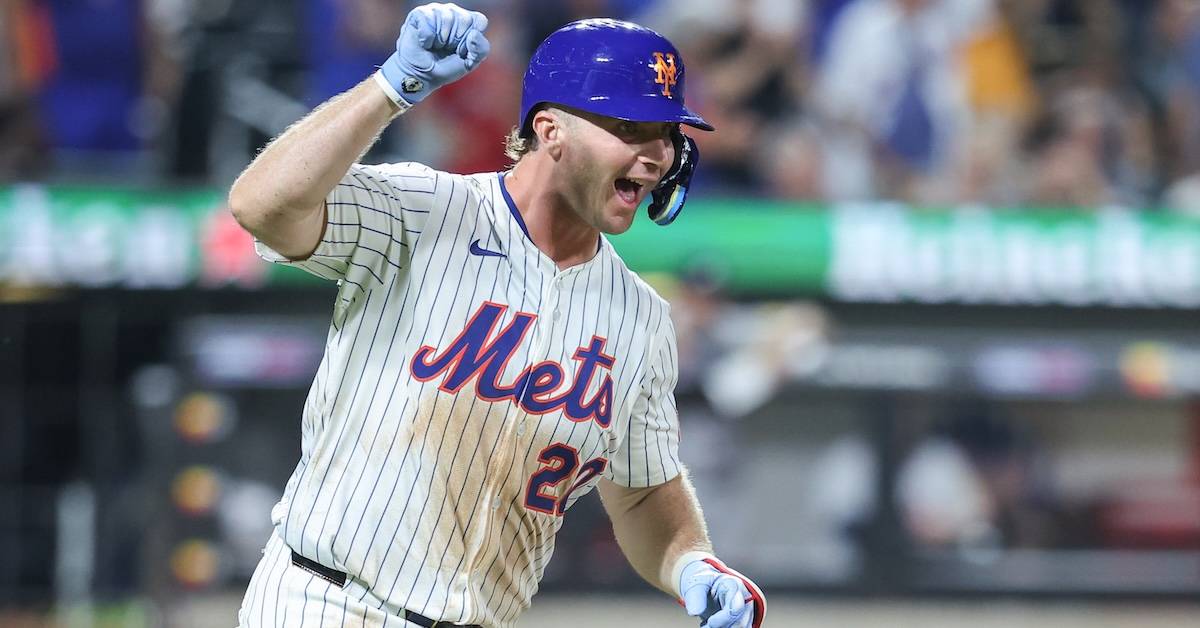
Apparently, those meetings went well. The drive from New York to Baltimore mostly takes place on expensive toll roads, but Alonso now has an extra $155 million to put on his EZ Pass account. Big Pete, the Polar Bear, the face of the Mets’ franchise, is bound for Baltimore on a five-year contract. Read the rest of this entry »
Many were surprised when Zach McKinstry outpolled Kansas City’s Maikel Garcia and New York’s Ben Rice to win this year’s American League Silver Slugger Award at the utility position. That’s understandable — McKinstry’s numbers weren’t as good as those put up by his co-finalists — but the honor was nonetheless deserved. For one thing, he was a true utility player. Not only did McKinstry start 20 or more games for Detroit at each of third base (69), shortstop (27), and right field (20), he was stationed everywhere besides center field and catcher. Conversely, Garcia started just 21 games at positions other than third base, while Rice’s only action came as a catcher and a first baseman.
And it’s not as though the Tiger didn’t have solid numbers of his own. Over 511 plate appearances, McKinstry slashed .259/.333/.438 with a 114 wRC+. Moreover, he logged 23 doubles, 11 triples, 12 home runs, and 19 stolen bases. Amid little fanfare, the 30-year-old erstwhile Central Michigan University Chippewa was one of the more valuable players on a team that went on to play October baseball.
By most accounts, McKinstry is an overachiever. Exactly one thousand players were chosen before him in the 2016 draft, and he ranked as just the 28th-best prospect in the Los Angeles Dodgers organization when he made his MLB debut in 2020. When the Tigers subsequently traded for him in March 2023 — he was by then a Chicago Cub — he had appeared in 121 big-league games to the tune of a 79 wRC+ and 0.8 WAR. Read the rest of this entry »
Rest in peace, starting pitcher Ryan Helsley (November 23, 2025 — November 29, 2025.) Last Sunday, a trio of staffers at The Athleticreported that the Tigers, among other teams, were interested in converting Helsley into a starter. Even by the open-minded modern standards of reliever-to-starter conversions, this seemed like a stretch. As Michael Baumann noted when he pondered the possibility, Helsley’s arsenal, comprised almost exclusively of four-seamers and sliders, is about as limited as it gets, and his extreme over-the-top arm angle leaves little room for projection.
On Saturday afternoon, Helsley’s illustrious starting career came to a close. ESPN’s Jeff Passan reported that the Orioles and Helsley had agreed on a two-year, $28 million pact, with an opt-out after the first year. According to Passan, Baltimore expects Helsley to handle the closer job.
Given the Orioles’ competitive ambitions and their considerable payroll space, they were all but a lock to spend a little cash on a backend reliever. President of baseball operations Mike Elias said as much earlier in the offseason, telling reporters that they were working to acquire an “experienced ninth-inning guy.” Following a season in which their bullpen delivered a 4.57 ERA, their top internal options to handle the late innings were Keegan Akin and Kade Strowd — fine pitchers, but not the leverage arms of a team with division-winning aspirations. After swinging a trade for setup man Andrew Kittredge in early November, Baltimore landed its “experienced ninth-inning guy” in Helsley.
Whether he’s up for the task is a reasonable question. After three straight dominant seasons with the Cardinals — book-ended by All-Star selections — Helsley had himself a nightmarish 2025, particularly after St. Louis traded him to the Mets at the deadline; he had a 7.20 ERA and a 5.19 FIP with New York after posting a 3.00 ERA and a 3.55 FIP before the trade. His 89-mph bullet slider was as effective as ever, racking up a 41.6% whiff rate and staying off barrels, but the fastball got rocked. In an interview with The Athletic’s Katie Woo a few days prior to his signing, he gave his theory for why his season went off the rails.
“I felt great, and the Mets’ models showed I was actually having the best stuff of my career, so it didn’t make sense for me to struggle as bad as I did,” Helsley told The Athletic. “But I was being really predictable in certain counts. It was almost a double-confirmation for hitters. They see it with their eyes, and they also had a stat behind it saying I’m more likely to throw this pitch in a certain count. It just gave them that much more comfort in the box, and more conviction.”
When hitters put his fastball in play, they slugged .667. And they had no issues putting it in play. His 17.8% four-seam whiff rate ranked in the 26th percentile of all pitchers with at least 300 fastballs thrown, surrounded by names like Jake Irvin, Miles Mikolas and Bailey Ober. That’s not ideal company.
Assuming his slider is fine, the merit of the Helsley deal boils down to whether his triple-digit fastball is still a good pitch. The way I see it, there are three possible explanations for its poor performance in 2025. The first is that Helsley was tipping with some sort of visual cue. Helsley told Woo that he believed his hand position “as he was becoming set” revealed whether the pitch would be a fastball or a slider.
“It was pretty obvious,” Helsley told The Athletic. “I’m not the greatest at (spotting pitch tipping), and even I could see it (on film with) the majority of the pitches.”
For whatever it’s worth, it didn’t look that obvious to me. For those on the public side, pitch-tipping analysis often looks like paranoid pattern-matching, like Charlie Day’s Pepe Silvia red string board. There’s little from the center field cameras, at least, that makes it clear. Here’s Helsley’s setup on a fastball that Harrison Bader launched 109 mph to the pull side:
And here is the previous pitch, a slider. Do you see any difference in the setup? To me, there’s no there there.
Here they are right next to each other:
(Helsley changed his setup after this game for the rest of the season, bringing his hands down and holding the ball closer to his body. The results weren’t much better; as Helsley himself said in that interview, it’s hard to make an in-season adjustment.)
While the physical tipping evidence is ambiguous, the count-level predictability is pretty clear-cut. In a broad sense, Helsley maintained a roughly 50/50 usage of his slider and fastball, occasionally tossing in a curveball as a wrinkle. But looking at the overall usage patterns belies the predictability of his pitch selection.
In 0-0 counts, Helsley opted for the heater 57% of the time. In deep hitter counts (2-0, 3-1, and 3-0), that leapt to 75%. Heavy fastball usage in these contexts is somewhat excusable, but Helsley’s full count approach underlined his reliance on the heater in tight spots. Of the 50 pitches thrown in 3-2 counts, 37 (74%) were four-seamers. (Perhaps another reason Bader smashed that 3-2 heater into the stratosphere.)
A similar story could be told with the slider. Heavy slider use in two-strike counts is to be expected, but even in 1-1 counts, Helsley threw it 72 times in 99 opportunities. For a pitcher with essentially two pitches, this type of predictability is lethal, no matter the nastiness of the stuff.
If Helsley’s ineffectiveness comes down to pitch-tipping and count issues, the Orioles have good reason to be confident in a bounce back. But if his stuff is starting to decline, they may have a problem on their hands.
Is there evidence this is the case? If you squint, maybe. Helsley broke out in 2022 with a superhuman 39.3% strikeout rate while tag-teaming the closer role with Giovanny Gallegos. The breakout was fueled by a massive velocity jump — from 2021 to 2022, Helsley’s fastball gained over two ticks, jumping to an average of 99.6 mph. In 2025, that dropped all the way down to… 99.3 mph.
The case for Helsley’s fastball losing its juice, then, would need to be about something other than velocity decline. Here, there is a bit more to latch onto. In that 2022 season, Helsley’s average arm angle on his four-seamer was around 52 degrees. By 2025, that had climbed all the way to 62 degrees with no concurrent improvement to the pitch’s vertical movement.
A fastball’s effectiveness can be largely explained by its vertical movement relative to its release point; more movement from a lower release or lower arm angle makes it tougher for a hitter to pick up. Because the excellent induced vertical break (18 inches) on Helsley’s fastball now comes from a more “vertical” arm angle, it doesn’t have the same deceptive qualities. Once near the top of the scale in terms of Alex Chamberlain’s dynamic dead zone measurements, his fastball has declined to merely “very good.” If Helsley needs to keep hiking his arm angle up each year to maintain the same level of induced vertical break, that could start to look like a concern.
As it stands, this seems to be more of a minor concern than a red flag. The stuff models on FanGraphs — Stuff+ and PitchingBot — both still consider Helsley’s fastball to be a well above-average pitch, even if they agree that the quality has declined slightly from 2022 or 2023. He’s sitting 99 mph, after all — even with poor shape, a four-seamer with that velocity should still play.
Overall, I’m inclined to say that both sides found a good deal here. The reliever market is the first of any position group to take shape in this early offseason, with both Phil Maton and Raisel Iglesias inking deals prior to Helsley. Iglesias is older, but received $16 million for a single year’s work; Maton, a solid middle reliever, got two years and $14.5 million. If this is the range for the second-tier relievers, and if the three top guys — Edwin Díaz, Devin Williams, and Robert Suarez — are in line for a good chunk more, Helsley’s signing starts to look pretty reasonable for the Orioles, especially because he is only one year removed from being in that elite group. For Helsley, it’s another shot at ninth-inning duty, with a chance to hit the market again next offseason, assuming all goes well.
From 2022-2024, Helsley ranked fourth among all relievers in FIP. His stuff is essentially the same as it was during that run. Assuming he sorts out the tipping issues and gets a little less predictable in certain count contexts, the Orioles just signed a high-end closer at an eminently reasonable price – even if it only proves to be for one year.
The following article is part of Jay Jaffe’s ongoing look at the candidates on the BBWAA 2026 Hall of Fame ballot. For a detailed introduction to this year’s ballot, and other candidates in the series, use the tool above; an introduction to JAWS can be found here. For a tentative schedule and a chance to fill out a Hall of Fame ballot for our crowdsourcing project, see here. All WAR figures refer to the Baseball Reference version unless otherwise indicated.
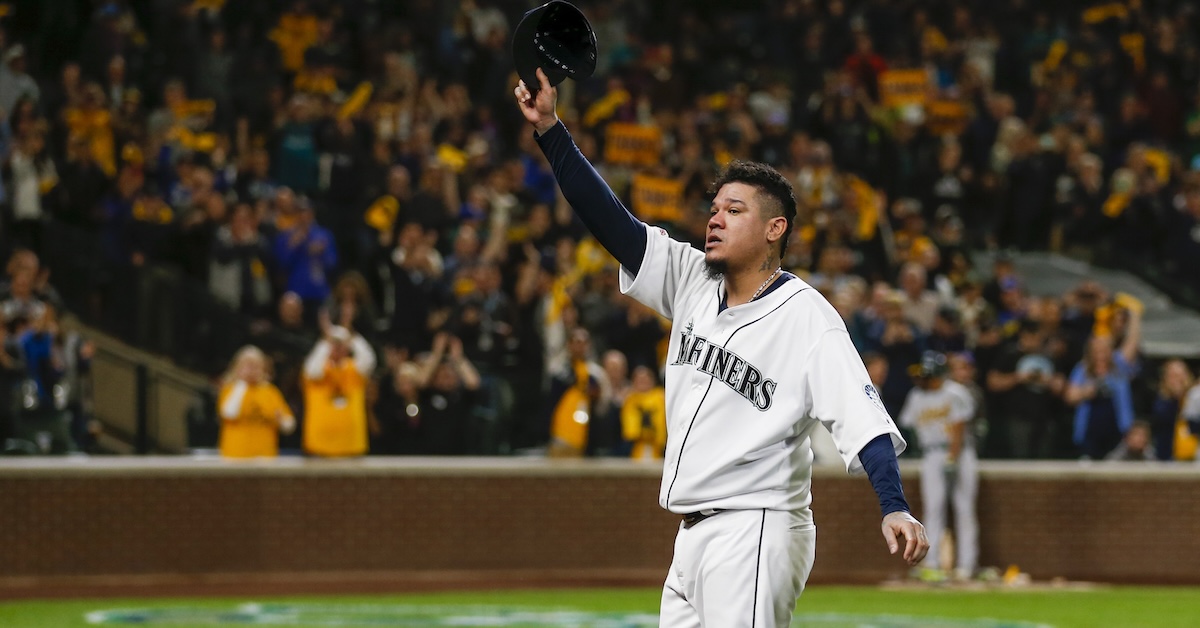
Before he’d ever thrown a major league pitch, cracked a prospect list, or reached legal adult status, Félix Hernández had a nickname: King Felix, crowned by U.S.S. Mariner blogger Jason Michael Barker on July 17, 2003, when he was overpowering much older hitters as a 17-year-old in the Low-A Northwest League. Still a teen when he reached the majors, he quickly came to represent the hopes and dreams of a franchise that had fallen short of a World Series despite four playoffs appearances from 1995–2001; parted with superstars Randy Johnson, Ken Griffey Jr., and Alex Rodriguez along the way; and capped that run with a record-setting 116 wins but a premature exit in the ALCS.
Though slow to embrace the royal moniker, Hernández grew into it. His dazzling combination of an electrifying, darting sinker, a knee-buckling curve, and a signature hard changeup propelled him to a Cy Young Award, two ERA titles, six All-Star appearances, and a perfect game. From 2009–14, he was the best pitcher in the American League by ERA, FIP, strikeouts, and WAR, parlaying that into a contract that made him the game’s highest-paid pitcher. Unfortunately, a heavy workload — more innings than any pitcher 23 or younger since Dwight Gooden two decades earlier — sapped the sizzle from his fastball, with injuries and a cavalier approach to conditioning taking their toll as well. The Mariners struggled to surround him with a quality roster while cycling through managers and pitching coaches every couple of years. The team didn’t reach the playoffs once during Hernández’s career, finishing above .500 just five times, with a pair of second-place showings in the AL West as good as it got. Read the rest of this entry »