
2025 Trade Value: Nos. 1-10
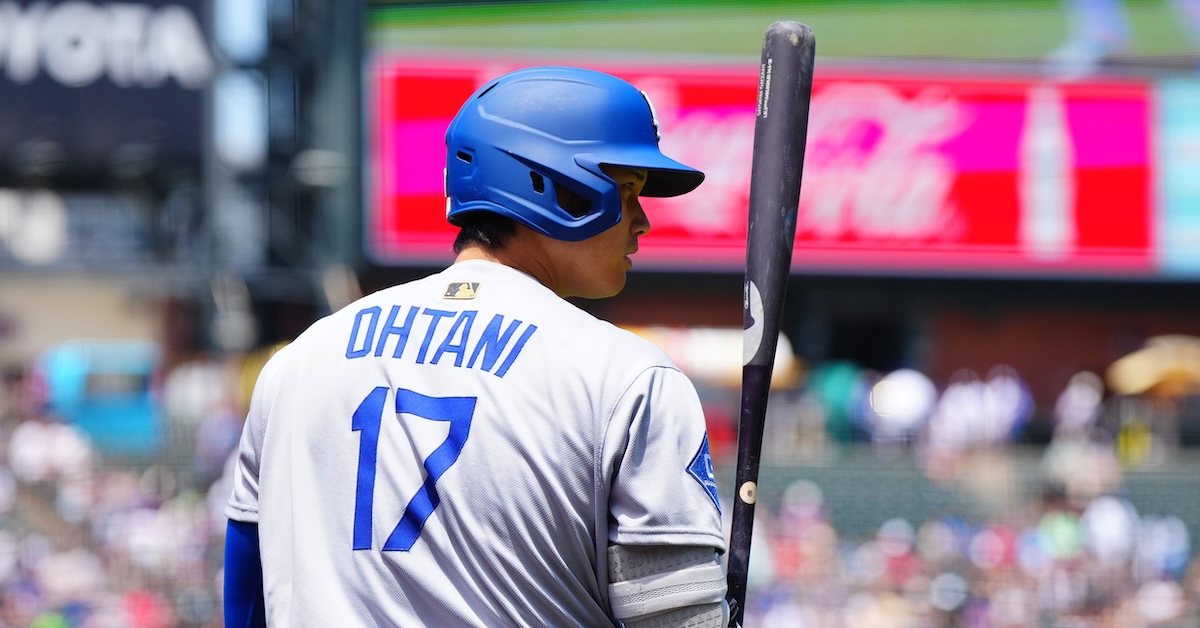
As is tradition at FanGraphs, we’re using the lead-up to the trade deadline to take stock of the top 50 players in baseball by trade value. For a more detailed introduction to this year’s exercise, as well as a look at the players who fell just short of the top 50, be sure to read the Introduction and Honorable Mentions piece, which can be found in the widget above.
For those of you who have been reading the Trade Value Series the last few seasons, the format should look familiar. For every player, you’ll see a table with the player’s projected five-year WAR from 2026-2030, courtesy of Dan Szymborski’s ZiPS projections. The table will also include the player’s guaranteed money, if any, the year through which their team has contractual control of them, last year’s rank (if applicable), and then projections, contract status, and age for each individual season through 2030 (assuming the player is under contract or team control for those seasons). Last year’s rank includes a link to the relevant 2024 post. Thanks are due to Sean Dolinar for his technical wizardry. At the bottom of the page, there is a grid showing all of the players who have been ranked up to this point.
A note on the rankings: As we reach the top of the list, the tiers matter more and more. There are clear gaps in value. Don’t get too hung up on what number a player is, because who they’re grouped with is a more important indicator. There are three distinct tiers in today’s group of 10 players, and I think they have clearly different valuations; I’d prefer everyone in a given tier over everyone below it, but I’m far less certain within each group. There’s one exception here: the second- and third-ranked guys absolutely belong at the top of their tier. I’ll note places where I disagreed meaningfully with people I spoke with in calibrating this list, and I’ll also note players whose value was the subject of disagreement among my contacts. As I mentioned in the Introduction and Honorable Mentions piece, I’ll indicate tier breaks between players where appropriate, both in their capsules and bolded in the table at the end of the piece.
With that out of the way, let’s get to the final batch of players.
| Five-Year WAR | 21.8 |
| Guaranteed Dollars | $17.0M |
| Team Control Through | 2028 |
| Previous Rank | #11 |
| Year | Age | Projected WAR | Contract Status |
|---|---|---|---|
| 2026 | 28 | 4.9 | $17.0M |
| 2027 | 29 | 4.7 | $17.0M |
| 2028 | 30 | 4.5 | $17.0M |
Acuña starts a tier of three players I’m calling Top Producers. These guys are racking up runs in great heaping piles in the major leagues right now. If you’re making up a list of potential MVP candidates for 2026, these three guys should probably all be near the top of your list (there are others, too, but don’t worry, there’s still some list left).
One big change I’ve made to my Trade Value process over the years is devaluing defensive contributions. Teams have gotten really good at finding defensive gems in the minors. Defense also peaks early, so it tends to peak with low, team-controlled salaries. Unless you’re the Brewers, you can’t field a team of nine center fielders, but “just be like the Brewers” is impossible — they’re the best at what they do. The Red Sox are playing Ceddanne Rafaela, who I think is one of the five best outfield defenders on the planet, at second base! Clearly, you can’t treat one win’s worth of defense the same way you treat one win’s worth of offense.
Ronald Acuña Jr. can rack up value from anywhere, on any team. His defense isn’t the draw, preposterous throwing arm notwithstanding. He’s just one of the best hitters around, and he’s doing it again this year. He has a pristine sense of when to swing, with top-tier chase rates but above-average aggression in the zone. He has S-tier bat speed and makes the most of it by getting the ball in the air. He’s 27, with a career 144 wRC+ and a history of improving as he goes. How many hitters would you expect to put up better batting numbers in 2026? Not a ton! Since the start of 2020, the only five guys ahead of him are Aaron Judge, Juan Soto, Yordan Alvarez, Shohei Ohtani, and Mike Trout. The only guys with better rest-of-season projections are Judge, Soto, and Ohtani (Alvarez is one point of wRC+ behind Acuña).
And have I mentioned that you can have Acuña for cheap? His early-career extension with the Braves is nearing its end, but he’s still under contract for three years at $17 million per (the last two are team options with big buyouts, but c’mon, you’re picking those up). That’s peanuts. Even the White Sox, Pirates, A’s, and Marlins could afford it. The only bummer about the contract is that it only runs three more seasons; I’d sign up for another decade or more at that rate if I could.
The other consideration with Acuña is injury, of course. He’s torn both ACLs, and he missed significant time recovering each time. The first time, he came back and simply wasn’t himself for a year. He seems more adept at adjusting this time; he’s stealing less often this year but is still maintaining good baserunning value, and he seems as explosive as ever – that .281 ISO doesn’t lie. But he’s only hit the 600-PA mark twice in his eight-year career, so clearly some adjustment is necessary.
In the end, that adjustment for me was pushing Acuña to the bottom of this tier. I couldn’t get him out of my personal top 10, though. He’s going to hit too much, for too low of a price, to be lower than this. I’d be happy with two seasons of peak Acuña and an injury season, and he’s both healthy and devastatingly locked in right now.
| Five-Year WAR | 24.1 |
| Guaranteed Dollars | $100.3M |
| Team Control Through | 2030 |
| Previous Rank | HM |
| Year | Age | Projected WAR | Contract Status |
|---|---|---|---|
| 2026 | 29 | 5.7 | $12.7M |
| 2027 | 30 | 5.3 | $13.7M |
| 2028 | 31 | 4.8 | $24.7M |
| 2029 | 32 | 4.4 | $24.7M |
| 2030 | 33 | 3.9 | $24.7M |
All that stuff I said about lowering catchers in my ranking process based on the difficulty of their position and volatility of their defensive numbers? That’s why Raleigh is ninth on this list instead of in the top five. He has everything else working for him. In the last calendar year, he went from incrementally improving his value to launching it into orbit. First, he finished 2024 strong with an excellent second half. Then he signed a team-friendly extension that will keep him around through 2030 (or even 2031) at a $20 million AAV. Then he turned into the catching version of Babe Ruth, won the Home Run Derby, and currently leads the majors in home runs. Pretty nice little year!
My crosscheckers, both internal and external, were all over the place here. Does he belong outside the top 10 because I won’t rank any catchers in the top 10? I don’t think that, but someone I talked to did. Could he be a top five player? It’s certainly plausible. He’s eighth among position players in WAR since his full-time debut in 2022. He’s cheap, and signed for a long time. He’s only 28. Sure, he’s outperforming his batted ball quality this year, but, well, duh. He has 39 homers in July! You could shade his production down a lot and still be amazed at his year.
The risk with Raleigh’s offensive game has always been that he wouldn’t make enough contact to keep his strikeout rate reasonable, but he’s made big strides there every year. In 2025, he’s chasing less than ever while still swinging more at strikes. That’s helped him post his highest contact rate and lowest swinging strike rate without reining in his tremendous power. Now that teams are pitching around him more frequently, he’s taking plenty of walks and striking out at a career-low rate. Realistically, you have to regress your projections for Cal by a lot because he posted a 112 wRC+ across 1,760 plate appearances before this season, but he’s clearly a different hitter now. The projection systems peg him for around a 135 mark the rest of the way, which sounds good to me, or maybe even a little low.
That’s a lower offensive level than the rest of the titans of the game you’ll find in the top 10, but Raleigh plays catcher! He plays catcher quite well, in fact; he won his first Gold Glove last year, and he’s been a plus receiver, plus thrower, and adequate blocker throughout his career. That defensive value is at a local low, but like I said, I discount catcher defensive value pretty heavily anyway. I don’t think he’s due for a defensive year quite as good as 2024 again, or an offensive year quite as good as 2025, but that’s just how career years work.
I ended up putting Raleigh in the middle of this group because I wouldn’t feel good having him at the top or bottom. He’s great right now. He’s around for a long time (and maybe even longer — he has a playing time-related vesting option in his deal and he plays a ton of games for his position) at a good rate. If he posted his same WAR in an outfield corner, to where it was all bat and no glove, I’d push him even higher. But in the end, this felt right. Particularly the part where he’s exactly one spot behind…
| Five-Year WAR | 25.3 |
| Guaranteed Dollars | $240.0M |
| Team Control Through | 2031 |
| Previous Rank | #19 |
| Year | Age | Projected WAR | Contract Status |
|---|---|---|---|
| 2026 | 34 | 7.8 | $40.0M |
| 2027 | 35 | 6.3 | $40.0M |
| 2028 | 36 | 5.1 | $40.0M |
| 2029 | 37 | 3.8 | $40.0M |
| 2030 | 38 | 2.4 | $40.0M |
What Aaron Judge is doing right now is just silly. I can’t wrap my mind around the enormity of his excellence. To paraphrase Shelley: look on Judge’s Works, ye Pitchers, and despair. Over the last four years – more than 2,300 plate appearances – Judge is hitting .312/.437/.682, good for a 205 wRC+. I’d say this is storybook stuff, but even in my storybooks, none of the hitters were slugging almost .700.
Here’s another way of contextualizing how silly this is: Judge’s contract probably still has positive surplus value even if you count WAR linearly, and there’s clear evidence that teams value stars far more than that. Three years into what was a record-setting deal when he signed it as a 30-year old, Judge has already churned out a ludicrous amount of excess value for the Yankees. He’s so far ahead of the rest of the league offensively that it looks like a dad being cajoled into joining his kids’ tee-ball game. His size makes that comparison even work visually.
Not every team could trade for Judge (none can in reality, of course, because the Yankees will never trade him). But oh my goodness, how they’d all want to. Our puny mortal minds have a quantitative/qualitative problem: After we perceive that someone is a great hitter, our brain puts them into the same bucket as all the other great hitters. But during this four-year run, Judge has been about as far ahead of the second-best hitter, Ohtani, as Ohtani has been ahead of the 24th-best hitter, Willson Contreras. Judge isn’t just souped-up Bryce Harper – he’s as far ahead of Harper as Harper is ahead of Ke’Bryan Hayes. He’s not a great hitter, he’s the greatest hitter in baseball by a huge margin.
The end of this contract might hurt. Judge just looks like a guy who will get hurt a lot, à la Yordan Alvarez. He missed a chunk of time early in his career, and his 2023 was interrupted by a freak injury (it was a five-win season anyway, good lord). But I don’t care. I thought about putting him even higher on the list. How are we even supposed to know what the decline phase looks like for a demigod? This might have been my easiest player evaluation — he’s the best hitter, it’s not close — while still being a very difficult trade value decision. But in the end, it’s just too much production, too rare of a skill set, to have Judge lower than this. I even considered placing him second before chickening out and going with the normal array of cost-controlled young standouts. Speaking of which…
| Five-Year WAR | 24.2 |
| Guaranteed Dollars | – |
| Team Control Through | 2028 |
| Previous Rank | #1 |
| Year | Age | Projected WAR | Contract Status |
|---|---|---|---|
| 2026 | 25 | 4.8 | Arb 1 |
| 2027 | 26 | 5.1 | Arb 2 |
| 2028 | 27 | 4.9 | Arb 3 |
Last year’s top dog is having a blah 2025 so far. He missed the start of the season with an intercostal strain, returned rusty, and has a measly 122 wRC+ deep into July. His defensive metrics are down across the board. Here’s the good news, though: He’s probably going to post a five-ish win season in a down year, he’s back to his career offensive averages since the start of May, and I was never into Henderson for his elite defense. Think of him as a Corey Seager or (in the extreme upside case) Cal Ripken Jr. type; guys this large and strapping usually aren’t spectacular defenders, but they make up for it by hitting a ton. Just being able to handle shortstop, so that you can play them there instead of the usual assortment of noodle-batted defensive whizzes, is a big deal.
Henderson falls short in the team control area relative to the rest of his tier, Best of the Best. He’s around for three more seasons after this one, and 2026 will be his first bite at the arbitration apple. Oh no! Just three years of a 24-year-old with an 8-WAR season in the rear view mirror? The horror! Seriously, though, the top of this list is stacked, and the years matter. I’d much rather have three years of Henderson than five years of a guy I’m hoping will break out – but look at the guys above him and I think you’ll come to the same conclusions I did.
This used to be the natural progression of top trade values. They’d hit that mark at the sweet spot of production and team control, then decay down the list as they convert that sweet, sweet team control into even sweeter on-field value. As you’ll see later today, that era is over, but Henderson is an example of what I’d consider the way things used to be. I’ve had a different no. 1 player in each year I’ve done the exercise. One year of performance or contract certainty is often the difference between being the best or just very nearly the best. You can’t knock Henderson for continuing to put up good numbers as he approaches a life-changing payday – unless you’re compiling a trade value list, that is.
One residual concern I haven’t had time to bring up until now: Should you treat the Orioles as serially correlated? Every one of their blonde-locked band of elite young hitters has seen their performance and perceived value decline over the past year. Could this be a team thing? Could it all snap back in unison in 2026? My conclusion, after spending far too much time thinking about it, is that I have to treat player forecasts as independent and independently distributed. I can’t tell you with absolute certainty that this is right. Anyone who would tell you with absolute certainty is just lying, of course: It’s unknowable. This thought exercise didn’t affect my valuation of Henderson. I’m just letting you know in the interest of full transparency into my thought process.
| Five-Year WAR | 25.9 |
| Guaranteed Dollars | – |
| Team Control Through | 2029 |
| Previous Rank | #4 |
| Year | Age | Projected WAR | Contract Status |
|---|---|---|---|
| 2026 | 24 | 5.1 | Pre-Arb |
| 2027 | 25 | 5.3 | Arb 1 |
| 2028 | 26 | 5.3 | Arb 2 |
| 2029 | 27 | 5.2 | Arb 3 |
It’s at least possible that Elly De La Cruz is already better than Gunnar Henderson and will never be worse than him again. The WAR column on his FanGraphs page is hiding some spectacular changes to his game. His strikeout rate? Down seven percentage points. His walk rate? Up. He’s getting on base a ton, slugging a ton, displaying good strike zone judgment, and running the bases like he’s the best athlete in baseball (he might be). His batted ball quality is unchanged from last year even before considering the massively improved non-contact results. He turned 23 in January. A 5-WAR followup to his 6.5-WAR 2024 campaign seems all but certain.
Ah, yes, that 6.5-WAR season. Here’s the thing: It was powered by an outlier defensive metric result. Statcast’s OAA had De La Cruz 11 runs above average defensively, and it has him three runs below average this year. Other defensive systems liked him less than OAA last year, and they mostly like him more this year than they did last year. Advanced defensive metrics are noisy – even if you like them, they move around a ton and the best guess at someone’s true value is probably some kind of weighted average across multiple years. Smooth those out, and we’re talking about a 5.5-WAR season last year and him being on track for 6-6.5 WAR this year.
Likewise, De La Cruz’s total offensive production hasn’t improved a ton, but my certainty that he has the capability to continue to improve has gone way up. His plate discipline changes are all excellent. His xwOBA is a lot higher than it was last year. He’s still scalding the ball. I think last year’s top-line numbers flattered his skill, while this year’s underestimate it. I love betting on guys who are both spectacular athletes and spectacularly capable of improving; De La Cruz’s track record fits that criteria to a tee.
ZiPS is picking up on the same things I am; it has him down for the fourth-most WAR over the next five years. He won’t hit arbitration until 2027, or possibly 2026; he’s right on the cusp of earning a bonus year of arbitration via Super 2. He won’t be a free agent until after the 2029 season. Maybe there’s even a little bit of contract extension equity here, though you don’t need to count on it to get to this valuation. The only reason I have De La Cruz lower in the rankings than last year is that some of the supernova outcomes in his distribution are gone – he’s not putting up a 160 wRC+ this year, for example. But that was never particularly likely, and I’ve loved what I’ve seen in 2025. Come join the Elly Bandwagon; we’re picking up steam.
| Five-Year WAR | 25.6 |
| Guaranteed Dollars | – |
| Team Control Through | 2030 |
| Previous Rank | #35 |
| Year | Age | Projected WAR | Contract Status |
|---|---|---|---|
| 2026 | 23 | 4.7 | Pre-Arb |
| 2027 | 24 | 5.1 | Pre-Arb |
| 2028 | 25 | 5.3 | Arb 1 |
| 2029 | 26 | 5.1 | Arb 2 |
| 2030 | 27 | 5.4 | Arb 3 |
My other freak-athlete-playing-baseball crush has gone Super Saiyan in the last year. Just like Elly De La Cruz, James Wood has a body type shared by almost no one else in baseball. He’s 6-foot-7 and gigantic, almost like a lefty Aaron Judge. Long-levered undersells it; he looks like a 3-and-D wing who got lost on the way to Capital One Arena and figured he’d try baseball for a day. He turns that size into 80-grade power, hitting home runs to corners of the ballpark that were heretofore unreachable.
None of that is new; Wood tore through the minors after joining the Nats in the Juan Soto trade and was comfortably above water – a 120 wRC+ over 336 PA – in his rookie year. But he’s hit another gear in 2025. He has an approach I love: wait for strikes, try not to swing too much, and try to absolutely demolish the ball when you do swing. He hits too many grounders, and might for a long time, but he’s improved on that front already. By spitting on balls in the dirt, he forces pitchers to come to him, and even though he’s always going to have some swing-and-miss in his game, that’s a bad deal for them. When Wood hits the ball, it just goes. Another way of putting this is that he has a 145 wRC+, with peripherals that suggest he’s getting a little bit unlucky, as a 22-year-old. He’s even improving on defense, and he might be great in the field at maturity; he’s huge and sneaky fast.
Believe it or not, I might be down on Wood relative to industry consensus. I don’t quite know how that happened – I’ve been so in on Wood from the jump that he’s been on this list for three seasons now, meaningfully longer than he’s been a major leaguer. But this combination of skill and youth – he won’t hit free agency until 2031 – makes people go appropriately starry-eyed. Maybe I should have been even higher here. I do love to bet on the guys who might put up 8-WAR seasons, the ones with the chance to break baseball for a season or two. Wood is obviously that.
The reason Wood isn’t higher is that he doesn’t actually have much, if any, team control edge on the rest of the top five. Yes, he’s cheap, but all of these guys are wild bargains. He’s not even that much younger than the rest of the group. There are just some great baseball players these days. I love James Wood, and I think he could end up being even better than I have him ranked here – but man, I love the last four guys even more.
| Five-Year WAR | 22.5 |
| Guaranteed Dollars | $95.1M |
| Team Control Through | 2031 |
| Previous Rank | #15 |
| Year | Age | Projected WAR | Contract Status |
|---|---|---|---|
| 2026 | 25 | 4.6 | $10.6M |
| 2027 | 26 | 4.5 | $12.6M |
| 2028 | 27 | 4.6 | $14.6M |
| 2029 | 28 | 4.5 | $28.6M |
| 2030 | 29 | 4.4 | $28.6M |
This time last year, Carroll was having a junior slump. After a shoulder injury scare in July of 2023, he started 2024 slow and had a 79 wRC+ at the All-Star Break. Ew! Then he hit .258/.351/.568 in the second half, turning in a 4.3-WAR season in a down year, and he’s hitting the cover off the ball again so far in 2025 while also turning in his customary best-in-baseball baserunning and great corner outfield defense. He’s been surprisingly durable for someone who always appears to be swinging so hard that his arms might pinwheel off of his body like a Looney Tunes cartoon. He has a faster average swing speed than Elly De La Cruz, for crying out loud.
Thanks to an early-career extension, you can get Carroll for the next five years at less than $20 million per season on average, with an option for a sixth. His salary doesn’t even crest $20 million until 2029; every team would be happy to slot him in and figure out the future when we get there. I like that most of his value comes from what he does on offense; the Diamondbacks could probably juice Carroll’s WAR even further by putting him in center, but I think that true top-end value is driven by offense, as I keep mentioning, and Carroll is a premium hitter. Would I expect him to out-hit James Wood? Ehhhhh… it’s close. But I have a lot more certainty that he’ll be an All-Star bat, and seriously, he’s that good as a baserunner. He’s already racked up more than three wins of baserunning value in his first three seasons.
There are exactly two blemishes in Carroll’s résumé for me. First, I don’t think he’s as likely to win an MVP as the rest of the people in this tier. It’s not that it would be impossible, it’s just that the guys I’m comparing him to are the very best players in baseball, and they’ve all had peak seasons that are a little higher than Carroll’s peak. Second, even though he hasn’t missed much time in the majors, you can’t ignore the injury risk. He missed almost the entire 2021 minor league season. His shoulder woes have clearly slowed him down at points of his big league career. ZiPS has baked some of that into its estimates, and I did as well. Would your team trade for Corbin Carroll? Of course they wouldn’t, because he’s not on the market. But if they could? Oh, they definitely would. The only downside is that they probably couldn’t afford him. This guy is one of the best of the best.
| Five-Year WAR | 21.1 |
| Guaranteed Dollars | – |
| Team Control Through | 2029 |
| Previous Rank | #3 |
| Year | Age | Projected WAR | Contract Status |
|---|---|---|---|
| 2026 | 24 | 4.5 | Pre-Arb |
| 2027 | 25 | 4.3 | Arb 1 |
| 2028 | 26 | 4.3 | Arb 2 |
| 2029 | 27 | 4.1 | Arb 3 |
I don’t think Paul Skenes is the best pitcher in baseball right this instant, but it’s close. He and Tarik Skubal are my top two contenders for the title, and while I’d give Skubal the edge today, it wouldn’t be by a ton. Skenes does absolutely everything you can ask for. He misses bats. He has elite command. He throws 100. He’s durable. He has a career 1.94 ERA. Is that something you might be interested in?
Looking through Skenes’s statistics is delightful. The ones that would go on a baseball card are all ludicrous. They might not even be the best ones, though. The process stats are all hilariously good. He invents new pitches on the fly. He’s striking out fewer guys this year than last, but it looks like it might be on purpose, a ploy to pitch deeper into games. He’d threaten 200 innings this year if the Pirates didn’t limit him, which to be fair it sounds like they might do. He’s 23. Goodness gracious.
Skenes is going to be around for a long time, too. He won’t hit free agency until after the 2029 season. Also, I’m not saying he’d accept just any contract extension, but you have to bake in some “thank God I’m not on the Pirates anymore” equity. Offer him a bag to play on a competitive team, and maybe you can get a Garrett Crochet style of deal done (for more money, obviously).
It’s been a long time since we’ve seen a pitcher this good this young. Picking nits almost seems pointless. The price for Skenes, and the rest of the top three, is beyond what anyone in baseball can muster up in return. It might take trading the farm — literally. Another way to think of this trio is that I have the best pitching trade value, the best hitting trade value, and then one guy who you can’t even do the math on because he transcends baseball. I put the pitcher third, because pitchers are inherently riskier than batters. I’m probably never going to change my thinking on that. It doesn’t matter much – all of these guys are so dang good and so dang valuable – but it’s worth pointing out. Skenes is an absolute monster. I couldn’t ask for anything more. He’s the no. 3 trade value in all of baseball.
| Five-Year WAR | 28.5 |
| Guaranteed Dollars | $278.4M |
| Team Control Through | 2030 |
| Previous Rank | #2 |
| Year | Age | Projected WAR | Contract Status |
|---|---|---|---|
| 2026 | 26 | 6.0 | $13.7M |
| 2027 | 27 | 6.0 | $19.7M |
| 2028 | 28 | 5.7 | $30.7M |
| 2029 | 29 | 5.5 | $35.7M |
| 2030 | 30 | 5.2 | $35.7M |
You know a guy is good when we’re talking about a disappointing season while he tracks for a seven-win campaign. I think we’ve all just gotten spoiled by Witt’s 2024 season, when he ripped off 10.5 WAR. If he meets his Depth Charts projections the rest of the way, he’ll end up with 7.2 WAR. If he keeps playing at exactly his season-to-date pace, he’ll end up with 7.3 WAR. Either of those would be top-30 single season marks in the Statcast era, among the top shortstop performances of the 21st century. And this is a down year.
I’m going to mostly gloss over the performance part of Witt’s blurb. It’s pretty easy to see why he’s so good. He hits the snot out of the ball. He rarely strikes out. He has eye-popping bat speed and consistently puts it to good use by elevating the ball. He’s a menace on the basepaths. He’s becoming one of the best shortstop defenders in baseball. His two-way excellence reminds me of peak Francisco Lindor, though he gets there in a different way, with booming power instead of phenomenal bat control. He debuted in 2022 and has never so much as hit the IL. Want top-end performance? No one this side of Aaron Judge and Barry Bonds has had a better season in the 21st century. Want durability? Witt’s got it.
Want team control? Okay, here it gets a little complicated. What’s not up for debate is that Witt will be around through 2030 for an average of $27 million a year. Clearly smaller-market teams could afford that deal – take, for instance, the Royals. After that, he has opt outs before each of the next four seasons, when he’d be making $35 million per year. If he doesn’t opt out, then the team gets their own three-year, $89 million option at the end of the deal. That’s complex, but think of it this way: It’s five years and $138 million on the low end, and 12 years and $367 million on the high end, but more likely the former than the latter. No one knows how the economics of baseball will evolve, but it’s going to be awfully tempting to hit the free agent market if Witt makes it to 2030 playing even close to his current form.
Honestly, that’s so far out that I don’t care overly much about which path is most likely. If you got Witt right now and wanted to make the team control longer, I bet that you and he could come to an agreement. After all, he signed this deal, and what, he’s going to say no if you offer him even more money and years to change it up a little? The reason he’s this high on the list isn’t the vagaries of his contract, though. It’s the outrageous ceiling combined with the ridiculous floor. It’s the fact that he’s 25 and doing it all for a third straight year, with five more years to come for sure. I actually got everyone I talked to in alignment with my choice for no. 1, but Witt was by far the most popular pick for no. 2. He’s the total package, and even the payroll-constrained teams could get involved. It’s hard to say you can’t afford him when the Royals managed to give him this deal.
| Five-Year WAR | 30.0 |
| Guaranteed Dollars | $560.0M |
| Team Control Through | 2033 |
| Previous Rank | #7 |
| Year | Age | Projected WAR | Contract Status |
|---|---|---|---|
| 2026 | 31 | 7.9 | $70.0M |
| 2027 | 32 | 7.4 | $70.0M |
| 2028 | 33 | 6.2 | $70.0M |
| 2029 | 34 | 5.0 | $70.0M |
| 2030 | 35 | 3.5 | $70.0M |
Who else? As with Bobby Witt Jr. and Paul Skenes, I’m mostly going to gloss over Ohtani’s on-field bona fides. You know them already. Aaron Judge might be the best player in baseball today, but Ohtani isn’t far behind, and he’s two years younger and also pitches. Calling him a unicorn doesn’t do him justice. If instead of trade value we just had a list of which player you’d most want on your team for the next five years, with on-field production the only consideration, I’d take Ohtani first overall.
Now, do you have to pay him $70 million ($46 million in NPV after deferrals) a year? You sure do. But here’s the good news – you’ll easily make way more than that back in advertising. The LA Times estimated the Dodgers’ annual marginal Ohtani-related revenue around $100 million. That’s not quite the same as Shohei Ohtani paying you $56 million a year to play baseball, but it’s not all that different. Forget him being a big contract; he’s actually the best bargain in baseball.
Could you rack up those same $100 million revenues in every market? Of course you couldn’t. I’m not going to pick on any team by naming names, but Ohtani’s hypothetical list of trade suitors would be short. The teams that are in a good position to cash in on him, though, would go bananas. He’s probably increased the value of the Dodgers franchise by hundreds of millions, if not billions, of dollars, and that’s net of the fact that they have to pay him.
Japan has the fourth-largest GDP in the world, and employing Ohtani cuts you into that market better than anything else you could ever dream of doing. Their economy is roughly the size of California. Imagine if employing Judge (a native of Linden, CA) meant that all of that state’s baseball enthusiasts became Yankees fans overnight, and that all of California’s biggest companies knocked each other over in a rush to sign gaudy marketing deals to be the official tire, the official search engine, the official submarine builder of the boys in pinstripes — heck, just to get their name on a billboard in left field. That’s not how the market works for any other player. But the Dodgers are monetizing Ohtani’s stardom more or less in that manner at the moment. You don’t think the Giants, Mets, Yankees, and even Mariners would get rich marketing to Japan with Ohtani on their team? Dream on.
Let’s be very conservative and say that Ohtani is playing for free net of the increased revenue. I think that undersells his off-field impact, but maybe the Los Angeles of it all is more central to his appeal than I think. If any of the best players in the league were available for no salary, they’d surely be the top trade value in baseball. Corey Seager’s production might decline – but who cares if you aren’t paying him? Like Garrett Crochet? You’d like him a lot more if he didn’t cost anything. You could get meaningfully worse in terms of expected production and still have best-in-baseball trade value.
But, uh, Ohtani is maybe the best player in baseball. He has the highest five-year ZiPS forecast. He’s a three-time MVP and the betting favorite for this year’s award. He hits and pitches! He just had a 50/50 season, the first in history. He threw the hardest fastball of his career this year. Ohtani is singular, a player unlike any other, both on and off the field. With a year of seeing the synergy between Ohtani and the Dodgers play out, I can’t imagine anyone else topping this list for a very long time. If you look at the whole picture and disagree, I don’t know what to tell you. This is as good as it gets.
| Rank | Prev | Name | Team | Pos | 2026 | 2027 | 2028 | 2029 | 2030 |
|---|---|---|---|---|---|---|---|---|---|
| Shohei Ohtani | |||||||||
| 1 | 7 | Shohei Ohtani | LAD | SP/DH | 7.9 $70.0M |
7.4 $70.0M |
6.2 $70.0M |
5.0 $70.0M |
3.5 $70.0M |
| Best of the Best | |||||||||
| 2 | 2 | Bobby Witt Jr. | KCR | SS | 6.0 $13.7M |
6.0 $19.7M |
5.7 $30.7M |
5.5 $35.7M |
5.2 $35.7M |
| 3 | 3 | Paul Skenes | PIT | SP | 4.5 Pre-Arb |
4.3 Arb 1 |
4.3 Arb 2 |
4.1 Arb 3 |
|
| 4 | 15 | Corbin Carroll | ARI | OF | 4.6 $10.6M |
4.5 $12.6M |
4.6 $14.6M |
4.5 $28.6M |
4.4 $28.6M |
| 5 | 35 | James Wood | WSN | OF | 4.7 Pre-Arb |
5.1 Pre-Arb |
5.3 Arb 1 |
5.1 Arb 2 |
5.4 Arb 3 |
| 6 | 4 | Elly De La Cruz | CIN | SS | 5.1 Pre-Arb |
5.3 Arb 1 |
5.3 Arb 2 |
5.2 Arb 3 |
|
| 7 | 1 | Gunnar Henderson | BAL | SS | 4.8 Arb 1 |
5.1 Arb 2 |
4.9 Arb 3 |
||
| Top Producers | |||||||||
| 8 | 19 | Aaron Judge | NYY | OF | 7.8 $40.0M |
6.3 $40.0M |
5.1 $40.0M |
3.8 $40.0M |
2.4 $40.0M |
| 9 | HM | Cal Raleigh | SEA | C | 5.7 $12.7M |
5.3 $13.7M |
4.8 $24.7M |
4.4 $24.7M |
3.9 $24.7M |
| 10 | 11 | Ronald Acuña Jr. | ATL | OF | 4.9 $17.0M |
4.7 $17.0M |
4.5 $17.0M |
||
| Young Superstars | |||||||||
| 11 | 14 | Jackson Merrill | SDP | CF | 3.4 $2.1M |
3.8 $7.1M |
3.8 $9.1M |
3.9 $11.1M |
3.8 $21.1M |
| 12 | 5 | Julio Rodríguez | SEA | CF | 5.2 $20.2M |
5.0 $20.2M |
4.9 $20.2M |
4.8 $20.2M |
4.6 $30.0M |
| 13 | – | Pete Crow-Armstrong | CHC | CF | 5.0 Pre-Arb |
5.6 Arb 1 |
5.6 Arb 2 |
5.6 Arb 3 |
5.6 Arb 4 |
| Tarik Skubal | |||||||||
| 14 | 24 | Tarik Skubal | DET | SP | 5.6 Arb 3 |
||||
| Great Players I’d Take Tarik Skubal Over | |||||||||
| 15 | 6 | Fernando Tatis Jr. | SDP | OF | 4.7 $20.7M |
4.7 $25.7M |
4.4 $25.7M |
4.2 $36.7M |
3.8 $36.7M |
| 16 | 16 | Logan Webb | SFG | SP | 4.8 $23.0M |
4.4 $23.0M |
4.0 $24.0M |
||
| 17 | HM | Garrett Crochet | BOS | SP | 4.6 $24.8M |
4.4 $28.8M |
4.2 $28.8M |
3.8 $28.8M |
3.5 $28.8M |
| 18 | 10 | Will Smith | LAD | C | 3.9 $16.0M |
3.3 $16.0M |
2.8 $12.5M |
2.2 $12.5M |
1.7 $12.5M |
| 19 | 17 | José Ramírez | CLE | 3B | 4.5 $21.0M |
3.6 $23.0M |
2.7 $25.0M |
||
| 20 | 13 | Riley Greene | DET | OF | 4.1 Arb 1 |
4.2 Arb 2 |
4.1 Arb 3 |
||
| Controllable Aces | |||||||||
| 21 | HM | Cristopher Sánchez | PHI | SP | 3.6 $3.5M |
3.3 $6.5M |
3.0 $9.5M |
2.6 $14.0M |
2.2 $15.0M |
| 22 | HM | Hunter Brown | HOU | SP | 3.9 Arb 1 |
3.7 Arb 2 |
3.6 Arb 3 |
||
| 23 | 22 | George Kirby | SEA | SP | 2.6 Arb 2 |
2.5 Arb 3 |
2.4 Arb 4 |
||
| Franchise Players With Question Marks | |||||||||
| 24 | 25 | Jackson Chourio | MIL | OF | 3.1 $7.3M |
3.2 $8.3M |
3.4 $9.3M |
3.5 $15.3M |
3.5 $16.3M |
| 25 | HM | Junior Caminero | TBR | 3B | 2.9 Pre-Arb |
3.5 Pre-Arb |
4.1 Arb 1 |
4.4 Arb 2 |
4.5 Arb 3 |
| 26 | HM | Eury Pérez | MIA | SP | 1.8 Pre-Arb |
2.1 Arb 1 |
2.3 Arb 2 |
2.3 Arb 3 |
|
| 27 | HM | Spencer Strider | ATL | SP | 2.6 $20.0M |
2.5 $22.0M |
2.4 $22.0M |
2.2 $22.0M |
|
| 28 | 8 | Yordan Alvarez | HOU | DH | 3.5 $26.8M |
3.2 $26.8M |
2.9 $26.8M |
||
| Begrudgingly Ahead of Ketel Marte | |||||||||
| 29 | 48 | Hunter Greene | CIN | SP | 3.1 $8.3M |
3.0 $15.3M |
3.0 $16.3M |
2.9 $21.0M |
|
| 30 | – | Alejandro Kirk | TOR | C | 4.1 $8.7M |
3.9 $12.3M |
3.7 $12.3M |
3.3 $12.3M |
2.9 $12.3M |
| Ketel Marte | |||||||||
| 31 | 43 | Ketel Marte | ARI | 2B | 4.3 $15.0M |
3.7 $12.0M |
2.8 $20.0M |
2.0 $22.0M |
1.5 $22.0M |
| Nice Catchers, Gimme Marte | |||||||||
| 32 | 9 | Adley Rutschman | BAL | C | 3.9 Arb 2 |
3.9 Arb 3 |
|||
| 33 | 27 | William Contreras | MIL | C | 4.5 $12.0M |
4.0 Arb 3 |
|||
| Nice Pitchers, Gimme Marte | |||||||||
| 34 | HM | Bryan Woo | SEA | SP | 2.9 Pre-Arb |
2.9 Arb 1 |
2.8 Arb 2 |
2.6 Arb 3 |
|
| 35 | – | Jacob Misiorowski | MIL | SP | 2.1 Pre-Arb |
2.4 Pre-Arb |
2.5 Pre-Arb |
2.5 Arb 1 |
2.5 Arb 2 |
| 36 | 23 | Logan Gilbert | SEA | SP | 2.8 Arb 3 |
2.5 Arb 4 |
|||
| 37 | HM | Yoshinobu Yamamoto | LAD | SP | 3.5 $16.2M |
3.4 $30.2M |
3.3 $30.2M |
3.1 $30.2M |
2.8 $33.2M |
| Superstars on Fair Deals | |||||||||
| 38 | HM | Zack Wheeler | PHI | SP | 4.3 $42.0M |
3.4 $42.0M |
|||
| 39 | 44 | Francisco Lindor | NYM | SS | 5.4 $34.1M |
4.4 $34.1M |
3.7 $34.1M |
2.6 $34.1M |
1.9 $34.1M |
| 40 | 42 | Corey Seager | TEX | SS | 4.0 $31.5M |
3.3 $31.5M |
2.6 $31.5M |
2.1 $31.5M |
1.4 $31.5M |
| 41 | HM | Byron Buxton | MIN | CF | 3.2 $15.1M |
2.7 $15.1M |
2.1 $15.1M |
||
| Industry Darlings | |||||||||
| 42 | HM | Roman Anthony | BOS | OF | 3.4 Pre-Arb |
3.9 Pre-Arb |
4.2 Pre-Arb |
4.2 Arb 1 |
4.3 Arb 2 |
| 43 | 40 | Zach Neto | LAA | SS | 3.2 Arb 1 |
3.7 Arb 2 |
3.8 Arb 3 |
3.8 Arb 4 |
|
| 44 | 36 | Wyatt Langford | TEX | OF | 3.4 Pre-Arb |
3.8 Arb 1 |
3.9 Arb 2 |
4.0 Arb 3 |
|
| Solid Infielders | |||||||||
| 45 | 31 | Masyn Winn | STL | SS | 3.1 Pre-Arb |
3.4 Arb 1 |
3.5 Arb 2 |
3.5 Arb 3 |
|
| 46 | 29 | Jordan Westburg | BAL | 2B/3B | 3.1 Pre-Arb |
3.0 Arb 1 |
2.8 Arb 2 |
2.6 Arb 3 |
|
| 47 | 32 | CJ Abrams | WSN | SS | 3.3 Arb 1 |
3.5 Arb 2 |
3.5 Arb 3 |
||
| High Volatility | |||||||||
| 48 | – | Jacob Wilson | ATH | SS | 3.0 Pre-Arb |
3.2 Pre-Arb |
3.2 Arb 1 |
3.2 Arb 2 |
3.0 Arb 3 |
| 49 | – | Drake Baldwin | ATL | C | 2.1 Pre-Arb |
2.2 Pre-Arb |
2.3 Arb 1 |
2.4 Arb 2 |
2.0 Arb 3 |
| 50 | HM | Ceddanne Rafaela | BOS | CF | 3.3 $2.3M |
3.3 $3.8M |
3.7 $5.8M |
3.4 $7.8M |
3.4 $10.8M |
Ben is a writer at FanGraphs. He can be found on Bluesky @benclemens.
Seems silly to all of a sudden bring up Ohtani’s off the field value and ignore everyone else’s throughout the entire list. Ohanti certainly leads the league in that department but the employers of any of the top 10 are coming out way on top if you look at “net” cost.
I hate Ohtani’s discount contract as much as the next guy, but come on.
If you add up the other 49 guys on this list, or heck, every other single player in baseball together, do you think it adds up to Ohtani’s off-field value?
I doubt it.
Bobby Witt Jr. is freaking awesome. I doubt many people outside of KC are buying Royals merchandise because of him.
I agree but that calculation should be used for the rest of the list as well and there was no indication that it was.
Did off the field value move Yamamoto up? Did it move Jacob Wilson down?
I think the point is that for no other player in baseball does it move the needle enough to even merit consideration.
Which, the more I think on it, isn’t ENTIRELY fair. No, Aaron Judge isn’t converting entire nations to Yankee fandom, but he definitely sells tickets. People buy Judge jerseys. They buy Soto and Lindor jerseys. Look at the Mets attendence this year compared to last year. Shouldn’t Soto get some, or even a lot of credit for that?
You’re actually converting me a little bit here. No, the other guys aren’t as valuable as Ohtani in this department, but it actually isn’t fair to credit Ohtani for this, and pretend that a large part of Aaron Judge’s value, or Juan Soto’s value, or Paul Skenes’ value, isn’t recaptured in off-field value.
Exactly, I don’t understand bringing it up at all unless you have some kind of figures showing exactly how the other guys stack up
So not the same ballpark, but you brought up Skenes’ value. Paul Skenes value should be studied. Pirate’s attendance is bad at home. The last Paul Skenes home starts averaged 19.xK. The day after, Mitch Keller, was at 17k, and the day prior was 15k and 12k (the 12k was a delay). So the bad Pirates team gets at least 2k more fans a game clustered to Skenes, and maybe upwards of 4k fans a game for him on a lost cause Pirates team.
At 4-5k fans, $30-50 bucks a ticket, that is $120k-$250k per home start, with 30-35 starts a year, half of them home, the Pirates $2-~4m in increased ticket sales just from Skenes home starts. (I couldn’t get a real average ticket price quickly as google put it at like $69 for Pirates which I KNOW is wrong)
Does that pale in comparison to Ohtani? yes. But I wonder if we have the data to see who is the most ‘must see’ show in the majors driving baseball economics, from increased foot traffic to increased ticket prices. Someone with more motivation and talents could find out.
30-50 a start doesn’t include concessions
This sounds like a fascinating offseason study project
There’s a cap to it. Not sure if you’ve seen any of Skenes with his LSU NIL gymnast girlfriend (not worth your time if you havent) but he’s a complete charisma void
It really is all on-field value. Skenes is a Show on the field but he’s not gonna become like a Peyton Manning off it
And…Ohtani isnt really all that different (aside from, you know, the Babe Ruth stuff) but because he’s foreign there’s a mystique to him and he brings a country
Makes no sense to not mention it at all. I’d be absolutely shocked if judges off-field value difference didn’t move him up to #2.
Despite that Ohtani’s marketing value is head and shoulders above everyone else, your point is still valid.
I’d be surprised if Judge didn’t have significantly more off-field value than all non-ohtani members of the list and it’s not even mentioned in his blurb?
Yes, I do. And easily. Ohtani has far and away the best “off-field value,” but let’s not be ridiculous.
Also, much like the Forbes lists of team values, I just don’t believe any of these reported numbers. I’m not saying they are necessarily wrong, I’m just saying the LA Times or any other outlet doesn’t have the actual factual information to know this, so it is what we in the business call a “guess.”
Ohtani is great and I do think there are 5-6 teams that would gladly trade their very best prospect for him, but I think the establishment superstars that are under 26 instead of over 30 and don’t cost a mint would fetch more in return.
He is a special case though and it does really seem like he is an apple to other oranges, so to me I’d admit that it really is impossible to say. But if I’m the Braves, I’d trade Baldwin, Schwellenbach, and the top five guys in the minors for Corbin Carroll, Paul Skenes, and probably a few other guys. I would not do that for Ohtani. With his financial hit, you would likely not be able to build a winning team around him. I think that goes for most teams.
I actually think you’re underrating how dollars and cents driven the Braves are, as a team owned and operated by grown adults who got their jobs by being at least somewhat competent.
The yearly outlay is only $2 million, after all.
No. It’s $2 million to Ohtani plus $44 million deposited into untouchable investment, the proceeds of which all go to Ohtani in a decade. the $70 million salary figure is bullshit, but Ohtani is legitimately costing his team $46 million per year before you start trying to estimate the extra revenue he brings the team back.
Except that team valuations are entirely vibes-based. The Dodgers feel like they’re worth whatever number Forbes or somebody else assigns them, so that’s what they’re worth. If they were sell tomorrow, they’d probably sell above that valuation, precisely because the hype around the Dodgers increasing value is intense, and a buyer would want in at as low a price point as they could get.
There’s no science to this, no metric that we can just plug in. Teams are worth what people will pay for them.
Precisely, and they have very frequently sold almost immediately after Forbes said they were worth a completely different (usually lower) amount.
Case in point, the Rays just sold for $450MM more than their Forbes valuation, and they don’t even have a ballpark.
There’s only 30 MLB franchises and they rarely hit the market. Always take the over.
The Braves actually did consider breaking their Team Salary Structure, which is a pretty core part of their identity, to go after Ohtani that offseason (he wasnt interested)
I think you’re wrong! They arent doing that for Corbin Carroll
Well, we do know that Ohtani makes more than 13 times what the next biggest endorsement earner in MLB, Aaron Judge, makes. Overall, he is no less than the second highest endorsement earner among athletes in the entire world. No other baseball player cracks the top 100. Judge actually makes less in endorsements than NBA guys like Bradley Beal and Devin Booker.
We also know that Ohtani has more than a dozen reporters whose only job is to follow and report on his activities. Not the Dodgers or even other Japanese players. Just Shohei. No other player in MLB has even a single reporter dedicated to following them.
Also, last year’s Dodgers playoff games drew over 12 million viewers in Japan — double the viewers in the US. As great a player as he is, I don’t think it was Freddie Freeman that caused that.
Ohtani moves the needle in a way baseball has never seen before.
Sort of what syndergaardennomes said. Ohtani has more value in off field then likely every other player in the MLB combined.
I think this is a defensible #1 choice, but your response is part of why I wouldn’t be in such a rush to put Ohtani at #1. I have zero doubt he is the single best revenue generating player in baseball. But it’s hard to bring this in without knowing how much other revenue other players bring in. This is totally hypothetical, but what if James Wood brings in $60M a year? He does not, it is hypothetical, but how do you know? Can we do this calculation for other players too? And how much value is due to just plain contribution to winning?
Like I said, this is a defensible choice. He is definitely in my Top 5 of this list, and I think I would put him at #3 (behind the other two guys at the top). But I wouldn’t be in a rush to stick him at #1 without knowing how other players stack up.
One way to know is that you can walk around Washington, DC and it is not absolutely blanketed with pictures of James Wood selling soda, sunglasses, motorboat insurance, pet food, etc.
Ask anyone who has walked around Tokyo recently how many times they saw Shohei’s face plastered on a 40 foot tall advertisement and they’ll probably say they stopped counting after a while.
But that isn’t the same thing, that’s endorsement money for Ohtani.
It is a strong indication that it moves the needle for the Dodgers, but to that degree?
For all we know, advertisers are just paying for wins and the Dodgers won the world series last year.
I think we really need a set of comparison points using the same methodology to know how big this is.
The problem is you’re not considering things like Ohtani making the Dodgers the first choice for most players coming out of Japan. They are paying Roki Sasaki a rookie salary and have him under team control for six years because he wanted to play with Ohtani. Yamamoto signed with the Dodgers because he wanted to play with Ohtani. The next big Japanese prospect will definitely take that into consideration. They’ve essentially been gifted a generational leg up into Japan and Japanese baseball; they won’t get them all, but they’ll get enough to make it worth whatever they pay Ohtani.
Again, there’s no hard and fast science here.
I’m not even talking about that, which I don’t think we can easily predict happening.
The fact is, they came up with the $100M figure for Ohtani, right? That sure seems like a hard and fast number. What does it look like for other players? I am sure it is less. I am sure it is a lot less. But knowing how much less is also going to tell us a whole lot of how much to trust that $100M number, as well as being able to quantify how much more it is adding.
I think it’s pretty safe to assume that, all other things being equal, every Japanese player coming to the U.S. wants to play with Ohtani until proven otherwise.
Good point. Except I was just in Tokyo. Every person I met watches Dodger games now. That’s millions of new eyeballs watching Dodger broadcasts. You don’t think that helps the Dodgers increase their own advertising rates?
They ARE the same thing. If a player is personally bringing in revenue to a franchise, it’s because they have a massive personal brand. It therefore stands to reason that other companies would want to get a piece of that player too, right? It’d be stupid of them not to seize the opportunity.
I don’t know how to explain this any other way, since you explain perfectly well how they are not the same thing in your reply but are hypothesized to be cause by the same thing. If X causes both Y and Z, that does not mean Y and Z are the same thing.
This is before we even go into how much of this is attributable directly to Ohtani, which is also something I wonder about and think it would be useful to have some context for that huge number with zero explanation of how it is calculated.
Yeah, the “we can’t know” argument is preposterous. Nobody else in MLB moves the needle the way Ohtani does. The only reason some people here can’t see it is that they literally can’t see it, because they’re either not in Japan or haven’t been paying attention to the insane Dodgerification of Japanese society and culture.
But all of that and all of the dollars Ohtani makes selling shoes and cologne does not confer to the Dodgers. Even all of the Ohtani jerseys largely are split 1/30 to each team. Almost none of those Ohtani jerseys walking around Tokyo were bought in the Dodgers team store. They were bought online.
Japanese companies buy signage in Dodger Stadium, on Dodger broadcasts, and on the Japanese broadcast of Dodgers games. That’s where the Dodgers make most of their money off Ohtani, not jersey sales.
I’ve seen Japanese signage behind home plate at a Royals game when they were playing the Dodgers. It’s insane.
This is also speaks to how poor of a job US baseball teams do promoting their players. It’s like they’re afraid that if they promote them they’re going to want more money, rather than if they promote them they’ll sell more tickets, merchandise, and TV rights.
Ohtani is Tiger Woods. There really isnt anyone after him and the void doesnt get filled. Who was the last guy that really made a difference like that in baseball? It was like McGwire/Sosa.
I guess what criteria are you looking at.
Bonds, Jeter, and Ichiro all had pretty significant impacts in a 1 of 1 kind of way.
No they didnt. Bonds was exactly who I was thinking of as an otherworldly player who did nothing for you outside the game
Jeter was important to the Yankees as a Yankee. Would not have that value outside that role. Judge is comparable there, I think.
Ichiro was a pretty big deal in baseball and I do think helped Seattle’s appeal out of their market. It wasnt near the same as Ohtani.
Well, it’d be pretty easy to tell if the Nat’s revenue jumped inexplicably from the previous year. Wood would also be besieged with endorsement deals from a wide range of international companies and soon become one of the top earners in the world ($50+ mil a year).
I think Ohtani is correctly rated at #1, and teams would trade anything for him, because they have the money angle in mind.
But I agree that Judge should be #2 for the same reasons. I think they’re the only two players who move the off-field revenue to that degree.
I don’t think Judge has anything even remotely close to the economic impact that Ohtani has. Ohtani is bringing in a massive new market. Judge certainly enhances the market he’s in but the number of new fans he’s bringing in is dwarfed by Ohtani.
Ohtani is in an entirely different ballpark economically from 2-50 and it’s perfectly reasonable to only bring it up in his blurb.
Is he? How do you know? There seems to be data here on how much revenue Ohtani generates but none on anyone else. Are you just assuming that and putting a player #1 based on that assumption? How does that make sense?
The big difference between Ohtani and Judge (and really Ohtani and every other player) from an off the field perspective is that Ohtani’s value is primarily tied to his nationality while Judge’s is primarily tied to his team.
When Ohtani signed with the Dodgers, it opened up access to a 100M+ person market. That’s an enormous increase in market size for any team and no other player in MLB brings anywhere near that kind of access. World Series viewership in Japan alone last year was over 12M viewers per game, which was close to the total viewership in the US (15.8M). And there are plenty of other viewership stats that show Ohtani on the Dodgers led to huge increases in engagement from the Japanese market.
For Judge, there’s nowhere else he could go where he would be equally valuable off the field. If Judge ended up going to the Giants, how many new fans would he realistically have brought to that market? Yankee fans aren’t suddenly buying Giants merch. Maybe more people in the Giants existing market engage with the team or they net some new fans from elsewhere as a result but we’re not talking millions of people like we are with Ohtani.
Judge’s off field value likely isn’t all that different from a Juan Soto or any other superstar in a large market. And it’s driven far more by their market than by the player himself.
Ohtani himself is a brand, Judge isn’t. The gap between the two in off field value is not even close.
“Seems silly to all of a sudden bring up Ohtani’s off the field value and ignore everyone else’s throughout the entire list.”
One word: negligible
-2025 Endorsements-
Ohtani: $100M
Harper: $10M
Judge: $7M
Soto: $7M
Trout: $4M
Seager: $3M
Cole: $2M
Altuve: $2M
Alonso: $2M
Snell: $750K
Correa: $500K
deGrom: $300K
Stanton: $250K
Wheeler: $200K
Rendon: $100K
Thats crazy, the dodgers get Ohtanis endorsement money?
This gives a clear sense of value scale, you know it, and your bad faith no data engagement just makes you sound silly.
Came here just to see BROD’s victory celebration
Rendon still making that list. Isn’t there some sort of character clause?
Who the heck is still endorsing Rendon?
the knee replacement surgeons of Anaheim. “Been injured in an accident ? they got me on the field again.”
Now I’m hoping for this
I don’t know that I would want it addressed in every other player’s blurb, but I think it would make sense to have a couple of comparisons mentioned in Ohtani’s blurb. Like how does his marketability compare to Yamamoto’s or Judge’s.
I went to Japan earlier this year, I saw at least 5 Ohtani ads every hour just walking around. I saw 0 for Yamamoto. Every other good player makes fans by winning you games but in general people who are already fans of your team support them. Ohtani gets you a whole market. He’s unique.
I’m sure you’re right but I would like to see the actual data so we know how much more he generates than others.
You’re asking for data that probably doesn’t exist. There is absolutely an element of faith here. But that’s what valuations are. You guys are trying to calculate this like fWAR, but it doesn’t work that way.
I went to Japan earlier this year as well and was surprised to see Yankees caps heavily outweighed Dodgers caps there.
That said, I don’t think that represented any team affiliation bent or player loyalty – it’s more a fashion statement. Which suggests caution to me when trying to parse these value considerations.
In the current context the values captured by the team are the relevant one. And while that like all other revenue figures remain private it seems pretty clear to me that Ohtani (perhaps enhanced by the presence of Yamamoto & Sasaki) is an outlier driver here.
My eldest daughter went to Japan this past Spring Break. She’s into Anime, Cosplay & Shoegaze. She’s rad. She also could probably recognize zero professional athletes outside of maybe LeBron and Tom Brady… Until Japan. Ohtani’s like early ’90s MJ over there.
Shoegaze for the win! That’s good parenting.
It’s like, why do people focus on Wilt Chamberlain’s 100 points when York Larese scored 9.
The other thing here is that MLB teams would figure to be business savvy. If Ohtani was able to bring in SO much revenue why did no one best the 10/700 offer. Seems like the kind of thing that is not to hard to forecast.
Why would you expect a cartel of feckless nepo-babies to be “business savvy,” haha?
Yeah I’m gonna say I think the Dodgers were one of the most aware of that potential
Ohtani set his market. Credible reports suggest he named the price he wanted and at least one other team (the Giants) matched it.
He pretty clearly dictated the terms of his free agency and wasn’t motivated solely by squeezing out every last dollar. I don’t know the guy, but it also seems pretty clear he was set on joining the Dodgers, a world class organization that wouldn’t even require him to move.
It’s error to treat him the same as your garden variety all star-level Boras client who holds out for every last marginal $1m.
Several claims to this effect in the thread. Very puzzling to me that commenters believe they know internal details of complex contract negotiations. I think at least four teams would’ve easily bested the Dodgers’ offer if given the chance (especially given that the “$700M” needs to be enclosed in quotation marks) but I wouldn’t claim to know that.
Rumor is the giants did beat that offer
I dunno man, maybe the same reason the Angels paid Anthony Rendon $245 million for (so far) 0.78 fWAR/season? They’re not always very smart.
Because Ohtani is singular, as Ben took pains to point out above. You can’t simply just plug another player into Ohtani’s team, deal and market and expect a similar value. You can’t expect value even on the same planet as Ohtani’s. It’s like talking about the fact that somebody is driving around in a tank and you’re complaining that nobody wants to talk about the pepper spray you’re carrying around in your pocket.
Just look at what baseball’s #2 in endorsement money, Aaron Judge made in 2024: $7 million. That’s less than 1/10th of what Ohtani made. The top 50 players collectively probably don’t have the marketing power of Shohei Ohtani. He’s probably the only player in the history of the game that brings in more money than he costs.
It’s a rough hot take when you forget about Babe Ruth.
You can’t have devalued defense that much if Julio Rodriguez is 12th on this list, no?
Julio heard everyone complaining about his trade value last night and hit his 15th home run, lol. Gonna be really funny if he goes on his customary late summer hot streak and winds up right at his career 126 wRC+ again. Oh no! My 24 year old elite defensive center fielder is only as good at hitting as Randy Arozarena!
(More seriously: I think Ben was clear in the Gunnar blurb, re: Cal Ripken, that being a great hitter who can play a key defensive position is super valuable because it lets other players play elsewhere, and actually being elite at that spot defensively is the part that’s a bit devalued.)
I mean he’s running a .731 OPS after finishing with a .734 OPS last year, though he may have just scarred me for life after drafting him in fantasy last year.
More seriously, yeah that was my real question, I suppose – as in, are we devaluing defense while still valuing the ability to competently play a premium defensive position?
He’s also underperforming his xWOBA by about 30 points after more or less hitting it spot on his first 2 years. And this is real life, not fantasy, where T Mobile makes that .731 OPS more impressive.
He underperformed it by 23 points, and is actually only underperforming it by 14 this year, not 30. Regardless, certain players consistently underperform their expected stats (Ke’Bryan Hayes and Ryan Mountcastle to name two), and while once is coincidence, twice is quite possibly a pattern.
His year-to-year wRC+(148, 129, 116, 110) is also on a such a steep decline that he’s threatening to devolve into a below average offensive player sometime in the next year or two if the trend continues to hold.
As for your other comment, I took him in a points league, so steals don’t matter. Getting a .689 OPS for the first five months of the season from my 2nd round pick unfortunately did matter quite a bit, though.
Julio read your post and it made him so mad he decided to:
#1, hit two home runs in one game off José Soriano, who leads MLB SP in GB%, and who had allowed only 5 HR in the entire season to date
#2, thereby raise his wRC+ to 115, pulling it up to match last year’s, in the span of 3 at bats. Suddenly the decline looks a mite less steep.
I just feel like you might want to wait until the end of the season before declaring him dead.
Crazy how the number changes when you post a day later and he had a good game.
Me too
Sorry your fantasy team had to suffer through a 20/20 season from a guy who had a down year.
I think he could’ve been clearer about Ripken in the Gunnar blurb–what you’re saying makes sense, but my reaction was “You can’t possibly be saying that Cal Ripken wasn’t a spectacular defender.”
…in fact Ripken never ended a season with a higher career wRC+ than Corey Seager’s right now. His peak was 134 after 3 1/2 seasons, exactly where Gunnar is now. He got a lot of extra WAR through huge defensive numbers and through literally never missing a game.
Bro got games canceled rather than missing
Cal Ripken doesn’t miss games. Games miss him.
The defense and positional consideration still seem overvalued to me. I’m also just not convinced that finding great shortstops is such a rarity anymore. Clearly lower levels are prioritizing churning out dudes that do it all. I think Soto getting traded twice for hefty packages to “smart” teams shows that offense is top dog by a massive margin
Offense is top dog and yet being a great shortstop is still rare. Consider that Rafaela is one of the best centerfielders in baseball, yet was apocalyptically terrible at shortstop for the Red Sox.
Is it rare?
In no particular order
Bobby
Gunnar
Lindor
Abrams
Wilson
Mookie (?)
Elly
Abrams
Bichette
Seager
Trea
Perdomo
Neto
Wynn
Adames
Half the teams have good to great shortstops
“Great shortstop”=/=“Great player who plays shortstop,” from the context of jdb’s comment:
Letting an extra 10-15 singles through just ain’t moving the needle for me , and I don’t think it’s moving the needle for most GMs. Gimme the better hitter every single time
Oh, I agree completely!
Solely talking about the context of JDB’s comment.
I’m sure Ohtani at one is going to be controversial, but I suppose the argument is pretty convincing. That said, I think I’d still prefer Wood, Carroll, Witt, and Skenes over him (probably in that order, though this listing talked me into how good Carroll’s contract is and he may be the overall best).
I kept ending up with Witt, Wood, Skenes, Ohtani, Judge in the trade value tool and I feel good about that
Awesome series, Ben. Not only is the content excellent, but I also get the added bonus of enjoying how mad people get at you for not ranking their favorite team’s player high enough 🙂
This is not how I would order the top 10, but I don’t think I disagree with any of what is written here?
The only things I would change, and these are minor:
I would flip Raleigh and Judge because Raleigh is quite a bit cheaper, unless we are redoing this list for off field star power like with Ohtani.
I would probably move EDLC behind Judge and Raleigh too, because I think they are clearly better now and I think EDLC is probably “who he is” right now in the future, which is super valuable but I don’t think he is likely to surpass them. Raleigh and Judge will likely decline earlier so I understand it the other way around but that is a trade off I would be willing to make.
I might slot Cristopher Sanchez ahead of EDLC and Acuna, maybe Crochet or Webb too, but Ben is clearly down on pitchers so I understand why they’re not here even if it’s not my choice. I get it.
I would slide Ohtani back to #3 because the contract structure is weird and I am concerned about durability, but even then I understand the logic of him being at #1.
I think I actually…mostly agree with this?
The weird contract structure is a *massive boon* for smart ownership groups – $2m yearly outlay for massive sponsorship returns…which they can then invest to more than account for his deferred payments.
Of course, the list of “Smart ownership groups” is a fairly short one!
Are you Witt and Skenes 1 and 2 or Witt and Wood?
Witt, Skenes, Ohtani in that order for me. Wood and Carroll after in some order (you could flip them easily enough), then probably Raleigh and Judge. Then probably Gunnar. That’s not very different at all.
After that is where my list starts to diverge a bit but having EDLC and Acuña in the top 10 makes a lot of sense if Ben is devaluing pitchers.
I think Wood has the best chance of dethroning Witt next year for me but not yet.
I can get behind all of this
I don’t think EDLC is anywhere near a finished product.
His bat control is terrible. He can improve his swing decisions so I suppose he could still get better there, but I don’t see how he’s going to adjust his swings to hit more homers or improve his contact rate dramatically.
But when you have the best power-speed combination in baseball since Eric Davis, you’re still pretty valuable.
Thanks for responding. Regarding your bat control comment…I think he’s still a work in progress with his hand positioning and bat path to the ball…from both sides. I’ve seen progress this year compared to last trying to shorten up but he’s still not there yet and it’s not completely natural.
I think the last two months of this year and especially next year will tell the tale (as compared to a guy like Julio who I have very little hope for improving in that aspect).
I’m fully onboard with Ohtani’s contract being a bargain, but why didn’t he get more when he signed it not that long ago? Even at the time it seemed low to me.
I am pretty sure he got that deal *when he had a torn UCL*.
He also basically decided he was going to the Dodgers, I would not be surprised at all if the Blue Jays or some other team offered more money.
AAV’s move incrementally, so there is always a cap on a players pay until someone gets just a little bit more each time.
Highest AAV record:
Soto: $51M (2024)
Ohtani: $46M (2023)
Scherzer: $43.3M (2021)
Cole: $36M (Dec 2019)
Trout: $35M (March 2019)
Greinke: $34.4M (2015)
Cabrera: $31M (March 2014)
Kershaw: $30.7M (Jan 2014)
A-Rod: $27.5M (2000)
Outside of really Soto and Scherzer, there weren’t any major jumps for the highest paid player and in fact, for 14 years A-Rod held the record at what is now a fairly affordable $27.5M (Willy Adames makes almost that!).
A-Rod’s $27.5m deal came in 2007, after he opted out of the Rangers deal he signed in 2001.
But yeah.
Ah yeah good catch. He’s listed back-to-back here and I just read it wrong.
$25.2M in 2000, $27.5M in 2007.
So it only lasted 7 years, which still, is a long time, and he did it twice.
https://en.wikipedia.org/wiki/List_of_highest-paid_Major_League_Baseball_players
Because Ohtani’s objective was not solely about maximizing his salary, but rather some combination of money and chances of making/winning the postseason.
Ohtani offered $700M/10 year deferred contract to the four finalists (Angels, Blue Jays, Dodgers, and Giants) and the Angels was the only team who refused.
With at least three teams willing to pay you a certain amount, Ohtani surely knew that he could have received more, but he simply chose not to and gave the Dodgers a “bargain.”
Of course, all of this is very unique and it was viable for Ohtani partly because he is the only MLB player who makes much more money off the field. (estimated $40M in 2023, $65M in 2024, $100M in 2025)
For reference, non-Ohtani off-field earnings for MLB players record is 2025 Bryce Harper at $10M.
If Ohtani is traded to Kansas City, does that massive off-the-field value continue unabated?
We don’t know what sort of revenue the Angels were getting from Ohtani but I am pretty sure it is not that, or anywhere close to it.
And if the Angels weren’t getting anywhere close to that then that means there’s a huge premium for the franchise stature. They’re in the same market! But the Angels are a mid tier team in terms of name recognition and the Dodgers are in the Top 3 or 4 even before they signed Ohtani.
Forget the Royals, I’m not at all confident he would be #1 on this list for the Mets or Blue Jays. Probably he would be for the Yankees and Cubs? If they could get ownership to agree? Remember, not every owner is as attuned to these possibilities as the Dodgers.
I’m fairly certain that Mets ownership is pretty attuned to the possibilities Ohtani would bring.
Wilpons sold a few years ago.
Hasn’t the past year and a half shown that the Angels didn’t properly take advantage of the economic benefits of a player as unique as Ohtani?
No team would be able to match what the Dodgers have done with him but given the specifics of Ohtani’s situation and Japan’s obsession with him, any team should be able to turn the most talented player in the world into an unprecedented economic windfall.
I think perhaps this off-field value, to the team, not the player, is overblown. Let’s not forget that this is the team that won the World Series. It is loaded with MVPs. The Dodgers would be selling lots of tickets and merch with or without Ohtani and remember that they only get 1/30 of almost all of the merch sold due to Ohtani.
That’s the thing, I’m not even just talking about merch (where he is still number 1 by a landslide, though the gap is closer here).
He brings Japanese sponsors that nobody else does. To the team. Estimates from January of $70m. You can discount that heavily and he’s still in a league of his own. I feel pretty strongly that people are overlooking the uniqueness of his situation
I don’t think we really know the answer to this. But per Forbes the Dodgers had a franchise valuation of $4.8 Billion in the 2022 season, and the Angels were at $2.7 Billion (with Ohtani). So they do have way, way more cache than the Angels ever did.
Let’s say that’s a proxy for how much Ohtani’s star power gets amplified. Let’s say the Angels amplify it by 2.7x, and the the Dodgers amplify it by 4.8x. That suggest that the Angels–if they had the appropriate marketing geniuses–would get about $56.5M in Ohtani-related revenue. That’s a lot, but that statement “that’s not quite the same as Shohei Ohtani paying you $56M a year to play baseball, but it’s not all that different” probably doesn’t hold for most teams. It would be more like $10M a year for the Blue Jays, Angels, Braves, Mets, Phillies, etc.
But he’s also the second best player in baseball.
And his present cost is only $2m/year.
I think Toronto might be able to swing it (it’s a gigantic market comparable to a Chicago) and I think Boston and the Yankees (probably also the Mets) could do it. Seattle probably as well.
The LA Times article linked claimed that LAA got a 10-20mm revenue boost from signing Ohtani which seems reasonable. But I think that $100mm figure is a bit overstated as people have pointed out but the revenue he generates is incomparable with any other player.
But looking at the raw change in average attendance from 2022 and 2023 compared to 2024 I see ~ 1.1k jump in attendance. Assuming those marginal attendees paid the Dodgers median ticket price of $175 comes out to ~15mm. Then when accounting for all the new Japanese sponsorships which was reported to be ~$70mm you can get close to the $100mm figure.
I still take issue with this because the Dodgers also signed Yamamoto, Teoscar, traded for Glasnow and extended him so to assume that 100% of the new attendance and the new sponsors are directly attributable to Shohei is dubious at best. Obviously he’s the primary reason for the Japanese deals since he’s a much larger of a public figure in Japan than Yamamoto but I think it’s wrong to totally ignore Yamamoto signing weeks after Shohei. If Shohei’s traded do these sponsors actually switch to another market? My guess is some do but some don’t but it’s impossible to tell.
But if we’re going to give him credit for the revenue he generates we should also account for any additional costs he brings. So I don’t think we should ignore his salary’s contribution to the luxury tax. Since the Dodgers are over the luxury tax threshold for the third consecutive year and they exceed the fourth surcharge threshold (301mm) the Dodgers owed ~138mm in 2025. If you split it proportionally per AAV then you can attribute ~17mm of that marginal tax for Shohei (you could argue that he’s responsible for more given his contract was conditional on using extra capital to pursue expensive FA but that’s too messy).
It’s hard to ignore this massive revenue stream but I’m not a huge fan of that being a major determinant in this ranking. I’d prefer to treat him as a player with x projected WAR and a luxury cap hit of $46mm per year (which is close to the aggregate capital required every year between his salary and the escrowed funds for his deferred compensation) and use that to compare to the rest of the player universe. Is that based on reality? No but for the purity of the rankings procedure I’d prefer it that way.
Ultimately Ohtani is a straight up cheat code in every way and the Dodgers are taking full advantage of it.
Yeah the Angels only making $10-20M in the same market makes me think that there is a major Dodgers premium. I don’t doubt that the Angels could have made more, and that other teams could have made more. But if the Phillies traded for Ohtani I don’t think they can reach anywhere close to that. $50M a year in extra bonus money is nice for a player you are paying $46M but it’s not the crazy addition of $100M.
And that’s if we take the numbers at face value, which I make no judgments about except that I think we need to judge other players by the same methods to figure out how big that really is.
Isn’t it possible he’d have even more off-field value in KC? Remember, this is off-field value to the team. Not his own value in things like endorsements.
Right now, if you swapped Witt and Ohtani, the Dodgers would still be an elite team in an elite market with multiple high profile Japanese players to also appeal to that market. There would be an impact. But they’d still be the Dodgers, with Betts, Yamamoto, and 95+ wins every year plus the national exposure that comes from that.
Meanwhile, KC would suddenly have by far the most marketable player in baseball, a hook into a new market overseas, national media exposure, and a selling point for free agents.
The Angels were bad for 6 years but still got constant national exposure thanks to him.
No. The numbers being thrown around with the Dodgers are five to ten times higher than the same financial benefit reported for the Angels. If the Dodgers numbers are true, which I doubt, then Ohtani’s additional revenue is dramatically higher for the Dodgers than it would be for any other team.
I mean, maybe not Kansas City, but probably like Texas or Chicago? The Houston Rockets made a ton of money off of China thanks to Yao that even lasted after he was gone (until their GM got in his feels about Taiwan) and Portland already seems to be getting a boost from a mid-first draft pick
Josh Naylor enters the list at #416
Guardians made the right choice to trade Naylor when they did. I’d much rather have Cecconi + the 2nd round choice they used to draft Will Hynes than what the Diamondbacks received.
To be fair to Arizona, it’s
Cecconi & draft pick
for
.6 season of Naylor & SEA package
The Guardians season might look different if they still had Naylor, considering their paltry offense
I mean, the only thing I didn’t mention in my comment was the WAR produced by Naylor. But I’m not sure how much that matters. Arizona acquired Naylor as a one-year rental to accomplish a specific mission. And….well…mission not accomplished. Which is why they traded him.
As for Naylor helping the Guardians…sure, he’s been better than his replacement (Santana) by 0.8 WAR. Not sure that would move the needle much (plus they wouldn’t have Cecconi’s contributions this year).
It’s hard for me to see Ohtani at the top when at least third of the teams in the league couldn’t afford him
Yes but for the teams that could afford him, it would be one hell of an auction.
Just as Soto and Ohtani did not need every team bidding on them to get their huge contracts, they wouldn’t need every team bidding for them to bring back a massive haul.
2/3 of the league is 20 teams. Imagine a 20 team bidding war on Ohtani?
We just had one. Every other team in baseball decided they couldn’t top his current contract
Pretty sure that wasn’t it
“Who is the most valuable player?”
The player who makes the most value.
“Okay but like, he wouldn’t ever sign with KC so he should be lower”
*launches self into space, never to see the stupid inhabitants of this planet again*
There is no way that Ohtani brings back more value in a trade than Witt. 20+ teams can afford Witt, and 20+ teams cannot afford Ohtani. That should matter, right?
They could all afford him. Every single team. Don’t confuse “not spending money” with “not having money”.
The Pirates are reportedly one of the most profitable teams in baseball despite pleading poverty everytime someone needs an extension.
Not disagreeing with it at all but seeing so much of Ohtani’s value boiled down to his star power takes a little of the fun out of this exercise.
It definitely seems out of place with the tone of this series. Like 49 entries were written by one author and Ohtani’s by someone else
Ohtani himself is out of place with the rest of the league. He is a singular star in terms of stature and public notoriety. It makes sense for his piece to seem out of place, because in effect, he is as well.
He’s the only guy whose fame and opportunities provided are atypical for a guy at his place on the list. It’s a notable thing that differentiates him from, say, Evan Longoria, who was #1 on this list for years. He’s the only guy on the list who is an outlier in that area.
Ohtani’s placement and the justification for it are appropriate for a player value series, but not a trade value series.
Struggling to find the distinction here? Unless you think LAD is singularly capable of utilizing Ohtani’s value. But all it would take is at least two other franchises (say NYY and NYM) to get into a bidding war that would set his trade value astronomically high. Similar to the bidding war for Soto as a free agent.
Player value is that player’s worth to the team that they are currently on. Trade value is that player’s hypothetical worth if they were traded to some other team.
That is very obviously the case. The additional revenue Ohtani brought to the Angels was reported to be $10 to $20 million per season. The additional revenue Ohtani brings to the Dodgers is reported to be $100 million. I have no way of verifying either total, but the massive difference between them makes it clear that the additional revenue is not intrinsic to Ohtani himself. Him being on the Dodgers is particularly beneficial in a way that he wouldn’t be on any other team.
I think it’s higher with LAD than anywhere else but another major market club (NYY, NYM, CHC, TOR, etc) would surely do better than one based in Anaheim, right? Idk, just speculating. Maybe you’re right and it is a singular Dodgers thing that a globally massive brand like the Yankees couldn’t come close to replicating.
Los Angeles has the largest Japanese population by far of any city in the continental United States (Honolulu is highest overall) at 170k. New York only has 37k and is three additional time zones away.
Why does Woods’ WAR projection go up and down for a few years?
James Wood is notoriously aligned with politics. They are predicting a new president
Using Ohtani’s marketing value to justify putting him at #1 is not only a dubious last-minute justification when no one else’s marketing value was previously mentioned, I am also pretty confident that it’s wrong.
I question the Times’ conclusion that Ohtani actually generates $100 million in additional revenue per season for the Dodgers, but even if we assume that number to be true, it clearly wasn’t anything even remotely close to that level when he played for the Angels. The value you’re using to justify putting Ohtani at #1 would not realistically apply to any other teams if he were to be traded, and therefore it should not be a factor in this assessment of trade value. If the Royals traded Witt for Ohtani, Shohei would only be generating a fraction of the marketing value for the Royals that he did for the Dodgers.
Clemens does address that concern by evaluating him as if his marketing value only cancels out his salary. I do think he’s wrong to handwave away a decline in playing ability, as it would certainly impact that marketing value too. But in the broadest terms, you have a player who generates massive value beyond his playing ability AND is an incredible contributor on the field.
I agree that there should be some context about what type of marketing revenue other players bring to their teams.
No, as that does not address the fact that his marketing value is massively amplified by being on the Dodgers. Since this is a hypothetical exercise where his value is estimated on some team other than the Dodgers, his specific marketing value to them is not relevant. This is a trade value series, after all, not a player value series.
I mostly agree. The only thing I disagree with is that the appropriate comparison is probably teams that could take something like that level of advantage (even if it’s not the full level) and are willing to.
Which is probably only a couple of teams, since it is whatever set of owners of the Yankees, Red Sox, Cubs, and Giants have decided to actually permanently set themselves above the luxury tax to bring that revenue in.
And if we’ve learned anything over the past several years, the number of teams willing to permanently break the luxury tax is something like two – the Dodgers and Mets.
I just think that Ben (and others) are underestimating how penny wise and pound foolish MLB owners can be. The Red Sox and Cubs should be willing to get themselves permanently over the luxury tax for someone like Ohtani, but I don’t think they would. At least not if it involves trading half your farm as well.
I think what a lot of commenters seem to not be aware of is how many actual Japanese (and to some extent, local Asian diaspora) make trips to LA to see the Dodgers and these people buy a ton of merch
In that sense, the teams who should be going to the mat here (and didnt) are Seattle, SF, San Diego, maybe Las Vegas once theyre actually in Las Vegas and not crying poor anymore
As an example, I work with a Chinese guy whose college aged daughter and her friend group took a trip to LA to go to Disneyland and do some other things for a week
These girls arent sports fans. Theyre music/entertainment types. I live on the East Coast. His daughter attends Emory
They went to a Dodgers game
But did this happen with the Angels?
I don’t think this happened with the Angels.
I don’t think this is just a geography thing, I think this is his star power being amplified by one of the Top 3 (maybe 4, probably not) brands in MLB.
Merch money is shared amongst all teams equally. The revenue this column references comes from corporate sponsorships. I just have a hard time believing that Ohtani brought exactly the same increase to the Dodgers as he makes himself. I think that number comes from looking at the 2023 to 2024 increase and attributing all of that to Ohtani.
Bro…the country of Japan logs in to watch Dodger games now. Do some basic math. It’s not hard.
Did they do that for the Angels? That’s the trade value—what he was worth to a non-Dodgers team, not for the Dodgers. I bet it’s still high, but not like this.
Bro … the Dodgers don’t get any more of that money than every other team in baseball. It’s split evenly, regardless of what team those international fans are watching.
The additional revenue this column is talking about comes solely from corporate sponsorships, and I think they have grossly overestimated how much of that is attributable to Ohtani. Yes, the Japanese sponsorships would be, but those don’t even come close to the reported figure of $100 million annually.
“The LA Times estimated the Dodgers’ annual marginal Ohtani-related revenue around $100 million. ”
Scott Boras and A. J. Pierzynski both said it’s around $150-200 million.
https://m.youtube.com/watch?v=xM9FwiRNFOA&t=7799s
I know people have said that, but it’s hard to reconcile that number with say the Angels or Mets choosing not to pay him $70M/year without deferrals, figuring on $50M of marginal revenue (half the Dodgers impact) and $40M of on field performance and being an absolute steal.
Who says that Ohtani ever wanted to play for the Mets, though?
Hell, the deferrals were *his idea*.
Yeah, we dont know what the numbers would have gone to with the Mets if they chose to seriously bid because he made it pretty clear to them he wasnt going there.
They did take Yamamoto’s bidding from 200 to 325 before Yamamoto had to tell them to stop
Probably the Dodgers brand amplifies his off-field value. Especially with a championship.
Also the Angels know if they offered $70M the Dodgers would counter with $90M.
But the real off-field value is the long term growth of the franchise valuation. Converting millions of children all over the world into lifelong fans doesn’t bring much revenue now… but in the future…
Remember when he came over here in 2017 and signed with Angels for the major league minimum salary, rather than a potentially lucrative contract that would have been available to him as a free agent had he waited two more years?
https://www.nytimes.com/athletic/5124923/2023/12/09/steve-cohen-ohtani-signing-dodgers/
“The agent never reached out to me personally,” Cohen told The Athletic, “and I think that’s pretty telling.”
Indeed, if a star’s representation — especially in the case of Ohtani — never talks with a team’s ownership, that’s a surefire indication that things never went beyond a preliminary stage, at most. Thus, reading between the lines, Ohtani probably never had much interest in playing for New York.
If the money is your top priority, then you would definitely try to involve the two NY teams in the bidding (see Yamamoto, Soto).
That is an odd pair of sources that I would distrust for entirely different reasons.
Surprised Boras didn’t say it was a gazillion
It’s pretty amazing that Judge and Ohtani were recently free agents, available to the highest bidder (more or less), signed massive deals, and are still huge bargains.
Not disagreeing with the rankings, more that I don’t think Soto is going to be joining them on this list ever (I think his trade value is negative and decreasing). I guess there’s a chance Kyle Tucker becomes a 35 HR/year hitter and 7-8-win player and is then projected to massively outperform his contract. Same for about any recent or near future free agent. The tops of these lists are almost all players under their initial 6-7 years of team control making league minimum or arbitration salaries or an extension that replaces said seasons.
Mets attendence has jumped over 10K per home game this season. If we’re giving credit to Ohtani for off-field value, then Soto should be getting credit for a big part of that attendence jump, which is not at all insignificant revenue created.Ditto someone like Paul Skenes on dates he starts for the Pirates.
Every single player provides the type of revenue that Skenes and Soto generate, though. It’s the reason they’re paid the money they are.
As much as we pretend otherwise, baseball teams aren’t in the business of winning games, they’re in the business of making money. The salary they pay for talent correlates to winning games but it’s not the reason they pay it.
Every (normal) player’s value is set by how much revenue they drive, and generally it’s set by in-market revenue streams like you mentioned: attendance, tv ratings, merchandise, etc.
Ohtani is singular in that he provides a completely different revenue stream out-of-market that doesn’t map on to what any other player provides. No other player is prompting foreign companies to significantly outbid local companies to be the official sponsor of their team.
The Mets also made the NLCS last year, which is always going to result in attendance bump the following year.
That’s not a knock on Soto as much as it is about the impossibility of being able to reliably quantify how much revenue an individual player brings in, which is why I don’t like its inclusion in Ohtani’s blurb
It is all wrapped together. I believe Cohen made comments last year about being aware attendance is tied to prior season performance more than anything (the Mets attendance is notoriously quite poor, actually) but signing Soto is an indication that the team actually gives a **** and is going to keep trying to win so I’m sure it’s played a part in the boost, as has having Lindor and Alonso etc on a competitive team
There’s a diminishing return to it, of course. If they gave Kyle Tucker $500M this offseason I dont think thats going to add as it would the first time when you get Soto
Judge and Ohtani being ranked this highly while Soto isn’t on the list at all feels off to me precisely because all three were recent free agents and all three are performing at roughly the same level that they had established before signing those deals.
This whole court is out of order!
I don’t know if that’s true though – yes Judge was coming off his 11 WAR MVP season, but that was also a pretty major anomaly at that point. If you tried to guess his “true talent” at the time he signed the deal you might’ve said 8 WAR, while today you’d say 10-11 WAR. He also likely took some discount. It was reported the Padres were offering $400m.
And Ohtani was something like a 6-WAR position player with a torn UCL. His future was a lot less certain before he had a 9 WAR season as a DH (and recovered from his TJ). He also took a discount.
I agree that Soto’s outlook hasn’t changed, but he seemed to get every dollar he could so I don’t think he has positive trade value. If no team besides the Mets and maybe the Yankees were willing to give him that deal in December, why would they trade prospects to give it to him now?
this isn’t an actual trade value column, though
the entire top 10 is littered with “of course no one would trade him, this team can’t afford him” caveats
Yeah, I think the fact that Judge is just simply a 200 wRC+ player over almost 4 full seasons was not something we could have assumed after 2022.
I dunno. Soto has a .449 xWOBA (2nd, between Judge and Ohtani). He’s underperforming it by 71 points and still has a 149 wRC+. And he’s 26. I think the mega-rich teams would still take that contract, and trade value for the privelige.
Soto has underperformed his xWOBA every year of his career pretty much. He’s an insanely good hitter but not as good as the xstats think he is
You are technically correct, but prior to this season, Soto has 0.404 wOBA and 0.418 xwOBA for a 0.014 gap.
This year, he has .378 wOBA and .449 xwOBA for a 0.071 gap.
Pretty big difference.
The Red Sox split Rafaela’s time last year almost equally between CF and SS. This year he’s played 808 innings in CF and 30 at 2B. The obvious conclusion is that this team has observed how valuable he is in CF and taken steps to play him there far more often.
Further, if teams are getting better at finding defensive gems, shouldn’t that be reflected in replacement level/the average against which other players are judged? I’d like to see the data behind this decision.
Yup — I found that comment extremely weird.
The Red Sox had opportunities to move him to the infield when they were flush with OF options and had infield needs, and (mostly) didn’t, because of the massive defensive difference that switch would create. They clearly understand and value his CF defense.
It doesn’t seem to me that Rafaela should be blamed for the Red Sox’s terrible decisions.
I agree. I think that the point that Clemens was trying to make was that this was an example of how teams don’t really value defense that much. But Rafaela’s usage shows the opposite.
OMG they are going to play Rafaela even more at second base. I cannot emphasize how bad of an idea this is! Here’s a partial list of better ideas:
1) Play David Hamilton
2) Call up Blaze Jordan, move Romy Gonzalez to second base
3) Bring back Kristian Campbell, have him play either second or first base and move Romy Gonzalez to second base
4) Call up Nick Sogard (a true emergency move if there ever was one)
5) Trade for Isiah Kiner-Falefa (current fWAR: 0.5)
6) Trade for Thairo Estrada (current fWAR: 0.0)
7) Trade for Luis Rengifo (current fWAR: -0.6)
How are the Red Sox so bad at this?!
Yeah it’s bad. My hope is that it’s just for a couple days until they clear up the of a bit.
I think the shift to valuing top end talent more even if on short-term contracts or long high-cost ones makes a lot of sense and it has generally been applied across the board. I think there are two glaring exceptions: Soto and Wheeler. Soto had multiple bidders somewhat near what the Mets gave him, is a top 5–10 player for the foreseeable future, and has some marketing value. The contract might technically be under water but I would expect you could get better prospects for him from a big payroll club then someone like Neto, maybe even someone like Kirk. Wheeler seems way too low. If I were a top World Series contender, I would rather have 3 post seasons with Wheeler than 2 with Skubal. For what it is worth, I had Soto 38 and Wheeler 21.
You don’t have to pay Ohtani $70M a year. You have to pay him like $2m now and then put $43M in an escrow account within 2 years. At no point, will $70M of cash leave the dodgers bank account and transfer to Ohtani as a single year of salary.
Ben, I love your writing, but suddenly bringing up off-field value isn’t what this series feels like it should be about
Additionally, it feels bizarre to add this to Ohtani’s value while simultaneously saying stuff like that Roman Anthony’s value should be discounted because he wouldn’t be a target for lots of teams cause he’s young. This just feels weird
“Not every team could trade for Judge (none can in reality, of course, because the Yankees will never trade him).”
Shouldn’t this corollary be in just about every blurb?
One of my thoughts reading through these lists regarding pitchers: Where have you gone, Mark Buehrle?! What would a solid #2/3 starter be worth for taking the ball every 5 days, going 6+ innings, and doing it through his mid-30’s? I know, this guy no longer exists, but it doesn’t feel that long ago, and at the time we didn’t feel like he was super-valuable. There were better if slightly less durable and long-lasting guys who made more all-star games and got more CY votes. But if Buehrle could bring the same schtick (let’s assume the same results) of high volume durability to today, what would it be worth?
That’s a good question. I can’t even begin to answer which is what makes this exercise so fun. I think for 5 years of buehrle’s prime you would have to give up a lot, but hindsight benefits us regarding durability.
My version of this is prime andrelton Simmons. Where does he end up with like 4 cost controlled prime years? Lots of (the vast majority) of readers seem to think defense is something teams will make sacrifices for, and Ben and others are clearly believe in shortstop supremacy. I just don’t think that would ever bear itself out in reality. Like, prime andrelton would be HM on my list
The Braves dumping prime Andrelton Simmons for not that much (and then not getting burned for it) is my go to on not overvaluing defense
Buehrle was not a #2-3 starter and neither is the guy you’re describing.
Yep – Buehrle was a dyed in the wool #2, with a couple career years.
(I’m quite comfortable giving Mark Buehrle the credit for his run prevention, even though he did play in front of Gold Glover Mark Buehrle)
I remember the year he made that absurd play on opening day and the ros they had to have a Buerhle meter. Still probably the most absurd play a pitcher has ever made
I do find the fWAR FOREVER folks funny.
Mostly because we’ve known for a decade that pitcher BABIP stabilizes at a 1000 BIP sample size…but also because the core concept of FIP involves two assumptions:
1) There’s no difference between the stretch and the windup.
2) Pitchers cannot impact on the outcomes of balls in play.
I think you think you described Logan Webb. Or maybe a lesser version would be Jose Berrios
Yeah, that guy is Logan Webb
He was great, but Webb is a lot better
There’s not anyone analogous to Buehrle in today’s game.
Jose Quintana is probably the closest equivalent but we haven’t seen that version of him in several years.
I’m glad that you did this, as the market very clearly does not value defense as much as defensive WAR suggests that they should, but doesn’t that mean that we should change the defensive WAR calculation?
It seems to me like the market value of defense is pretty strongly correlated with the offensive ability of the player. Great defender with a 90 wRC+? Not that valuable despite the defense. Great defender who’s also an impact offensive player, I think you get full credit for the defense.
The Carl Crawford/Jason Heyward mistakes still loom for the guys who are average offensive players and get credit for defense that probably isnt going to last as they age, but maybe this is an admission that idea is changing
A lot of this is already accounted for because defensive stats are heavily regressed in the player projections. But only if you’re using the projections and not what they are doing right now.
I also think OAA is a bit aggressive on assigning value and demerits compared to UZR and while OAA is clearly better I do tend to shade down on the calculations by a small amount, like maybe 10%? 20%?
Good observation that defense is essentially freely available. Which would suggest that there’s also a problem with aggregate WAR values
Defensive WAR is determined by comparing players to the average at their positions, right? If defense has gotten better, WAR should reflect this.
The issue is that fWAR doesn’t base positional adjustments on teams’ current behavior, but rather on an approximation of their behavior 20 years ago.
I’m less concerned with teams’ behavior than with the actual value produced. If I have a great SS and I play him at SS he generates a lot of value. Whether or not that is popular behavior doesn’t really enter into that.
Hm?
Team behavior tells us how much offense the league is willing to sacrifice for average defense at each position…aka the core concept of positional adjustments.
FanGraphs treats this as settled science, based on 20 year old napkin math.
I disagree, because of the empirical evidence to the contrary.
I was under the impression that the positional adjustment is based on the average offensive contribution at any given position, versus the league average, and represents essentially how much more valuable a SS who hits at a league average level is versus his SS peers than a 1B who hits at a league average level versus his 1B peers…
I was also pretty sure it is recalculated every year, similar to park adjustments…
Are you sure the positional adjustments have just been set since the fWAR formula was first developed? I admit I’m too lazy to look it up myself at the moment, but I think there is a WAR calculation explainer on the site.
Nevermind. Curiosity got the best of me and I looked it up. Appears you are correct.
rWAR does recalculate positional adjustments each year, in fairness!
With the ohtani logic, then Messi’s probably worth more than half of mls players combined
Surely more than half haha
And would you or MLS owners disagree with that?
I don’t think it’s hyperbole to say that Messi is worth more than every other MLS player combined
I would say that he is likely worth multiples of the mls combined.
I took the 5 year ZIPS projections and the estimated salaries (used Baseball Reference, so the Arb years could be a little bit low). Got the top 10 cheapest $million per WAR. I think most teams would lean this way.
Top 10
Roman Anthony 0.46
James Wood 0.62
Elly De La Cruz 0.71
Jacob Misiorowski 0.77
Junior Caminero 0.82
Pete Crow-Armstrong 0.82
Paul Skenes 0.87
Gunnar Henderson 0.94
Wyatt Langford 0.99
Jacob Wilson 1.02
Bottom 10
Fernando Tatis Jr. 6.67
Garrett Crochet 6.83
Shohei Ohtani 7.68
Aaron Judge 7.87
Yordan Alvarez 8.38
Yoshinobu Yamamoto 8.70
Spencer Strider 8.87
Francisco Lindor 9.47
Zack Wheeler 10.91
Corey Seager 11.75
I think lean is the right word. A good starting point but one that needs a fair bit of refining.
That method assumes WAR is linear and that all ZiPS projections are equal.
“Most teams” don’t set the market though. 25+ franchises being unwilling/unable to pay Juan Soto didn’t prevent him from getting a $765M contract.
Wouldn’t be a Trade Value Series without a Kebryan Hayes reference!
I’m just gonna finish out my banging on the “shortstops are overvalued” drum:
6 SS taken in the first 10 picks of this draft
14 in the first round
This is the new orthodoxy. All of these FO understand the arguments about why a SS is incredibly important and needs to be well rounded. The market, and the way people play the game, is adjusting. For that reason, I don’t think that the general tendency to put SS higher because of “scarcity” is correct. I think young, absolute mashers like wood, Kurtz, etc are way more scarce than a slightly above league average, good defensive shortstop.
I’m just a guy, but I’m never, ever trading James wood for elly. And probably never trading him for Gunnar (although this is closer). And I really don’t think it’s a given that the A’s would trade Kurtz for elly. I don’t think I would
I agree with your “Kurtz is underrated” point. ZIPS looks to be very low on him, and maybe some other feedback was ho-hum. But I personally had him in my top 25. Even if he levels off and isn’t that great, he’s still just so low risk cost-wise.
But what would being “not that great” look like for him. Just really hard to imagine him becoming Chris Carter, as someone commented the other day. So Adam Dunn? A very imperfect masher? Guys like that don’t grow on trees. The guy is 22! He was dreadful his first 20 games or so, its hard to overstate how insane the tear he’s on is
He was in my top 10.
They draft a lot of SS who end not being SS. At lower levels, that’s where the best athletes tend to play.
I mean yeah, obviously, but it’s still a record number nonetheless. Which is the whole point. Colleges, high schools, helicopters dads – everyone knows to shoehorn these kids into being a SS, cause clearly it pays. Just look at how few elite 1b there are now
But that’s not new at the amateur level. Any kid getting drafted high out of HS is almost assuredly the best athlete in that school’s history, so of course he’s going to be the best option to play SS even if he projected as a 1B in pro ball
Miggy came up at SS. Thome came up at SS. Harper was SS catcher pitcher. Judge was a SS/pitcher when he was first drafted out of hs. Pujols was a ss. The levels of better those guys are than everyone else is why.
Pujols playing shortstop is a phenomenal bit of trivia I did not know and really helps underscore how everyone was a shortstop back then.
It seems like the default is that if you are a top prospect and throw right handed you’re a shortstop or a catcher, and if you throw left handed you’re a center fielder. The cases I can think of where this doesn’t work is (1) they’re a 2-way player so they’re playing first base instead, or (2) you’re atone of those “fake schools” in Florida or North Carolina or Texas where kids go to just to play sports, because everyone is crazy talented athletically. I guess this year Brady Ebel got shoved off of shortstop by Billy Carlson…
I’m sure this is changing w transfers. If everyone is transferring probably going to be more rh other positions because all the guys going high are already on x position. But everyone is a ss at some point if they are right handed and make the mlb.
The thing is, a lot of those “SS who end up not being SS” are still playing a good bit of SS in the majors these days!
Wilmer ****ing Flores, who is currently a DH, stood at SS for 3 seasons and the metrics didnt even hate him there!
The draft thing is probably more because you can move a young SS to conceivably every non-catcher position, but you’re drafting a RF then you’re only going to get a RF
Hell sometimes they can even move them to catcher
Teams have always drafted a ton of shortstops high up because that’s where the best baseball players tend to play as amateurs.
I was actually dreading the “well actually Juan Soto is undervalued” but I’m breathing relief.
Next year. 🙂
When I’m thinking about trade value I can’t ignore the economics of the situation and how many teams would be eliminated by a players contract. I also do agree completely with Ben that I’d value star players with elite power numbers over just max surplus value guys in establishing value.
There is only 1 player on the list who has put up a superstar level season (for me that’s 8+ WAR), and is on a contract that basically every team could afford, and that’s Acuna. Yes, he’s coming off the second ACL injury, but he’s currently hitting right in line with the 9 WAR MVP season. He’s the only one of the proven MVP tier players who if you put them on the market right this second every team could afford to bid on. Teams like the Rays or the Guardians could legitimately afford to (and probably would try) to be in on Acuna just as hard if not harder than the largest of the large market teams because you simply can not get proven MVP level producers at his price point. He’d drive a legitimate bidding war from all across baseball that the other MVP tier guys just wouldn’t.
But all 29 teams would be baking the multiple ACL tears into their valuation, whereas the 3-5 of the 7-10 teams going for Ohtani would be focusing on the NPV of his contract relative to the sponsorship money.
I should have been clear I’m excluding Ohtani because any calculation on him has to factor in things that are completely unrelated to play on the field.
If you put for example both Judge and Acuna on the market the Judge market is going to be limited a ton by the contract, minimum 20 and probably more like 25 teams just couldn’t even consider him because of it. Then just as teams would bake in Acuna’s ACL tears they would have to bake in Judge’s age and the risk of decline there. You have to bake in injury risk on anyone you trade for. The big risk on Acuna’s ACL tears weren’t that they made him massively more likely to get injured in the future but that there was a real risk they might just make him a completely lesser player afterwards. That absolutely does not appear to be the case, and going forward there’s no more risk to him doing that again than there is to it happening to anyone else.
This is not me arguing that Acuna is the better player than Judge, just that I believe if you put 2 MVP level players on the market the one who’s less than 1/2 the cost and 6 years younger (that does matter when you factor in the cost of Judge’s deal) I think Acuna would garner a bigger trade package. If Judge were also 27 even on his current deal though I think he’d get more as there would be very minimal age related downside risk.
Perfectly fair!
I do think the fact that Judge is 30-50% better at baseball and under team control for a longer period would play a factor, though…along with the fact that the best predictor of future injuries is past injuries!
Yeah I don’t think Acuna was going to be bad at hitting because of his second injury. It’s that he’s not going to 40-70 again.
If they were the same age regardless of the additional cost I think Judge would get more in a trade because I agree he’s the better player. From what I’ve read regarding ACL injuries the odds of you retearing an ACL is essentially the same as tearing it the first time, but what does increase is the chances of tearing the other ACL after the first tear. Well Acuna has already gone through that and torn both of them and by all accounts has recovered just fine. Obviously you can’t ignore blowing out each of your ACL’s, but he’s got no other injury history at all. Which do I think is more likely, Judge starting to have greatly increased age related injury risk or Acuna tearing his ACL again? Probably Judge starting to get hurt because older players generally get hurt more.
It doesn’t appear to be the case, yet. Freaks of nature like Adrian Peterson can come back and be like whatever (seriously he was sprinting like a month later) but ACL even w repair in pro athletes often deteriorate over time. It’s like all injuries, but ACL injuries at his age is sorta who knows.
My concern w him is the bat. Not in that he won’t mash, he will. There is literally nothing that can predict what he is gonna do. He has a career 22.4% k. This year it’s 27.9. He had a career year where all of a sudden he became the best contact hitter, too. 11.4% k. You have to discard that season. His next career best is 23.6%. He’s running a .415 babip this year. He’s literally a different hitter every single season. Even his spray chart is different. That isn’t to say his placement is wrong, I agree with it. But you can’t take that random 8 war season (surprising number of players in the Braves had career years that year) as gospel.
Great contract, great value. But his bat changes annually. His defense is horrible and going to get worse. I know it’s crazy w a 73 stolen base season, but bad base runner. All basically betting on the bat. The bat is good enough, but if you think he’s more 160 than 130 I think you are wrong
I think he could be closer to 160 WRC+ than 130 till he reaches decline. He has a career 144 WRC+ and of his parts of 8 seasons in the league only in his age 21 season was he healthy and posted below 130 (and that was 125). His age 22 and 23 seasons he posted 158 and 157, unfortunately the first was the Covid shortened year and the second was when he first tore his ACL. Then he came back too soon and had a bad season of 115 but then posted a 171 in his MVP season. Tore his ACL again, and now in the comeback where he actually took the correct amount of time has a 187.
ZIPS the next 2 seasons have him projected at 149 and 148, so while not 160 close to that than 130.
I guess we just have to see. His babip rn is absurd. Love Acuna and hope you are right
If you trade for Ohtani, aren’t you still on the hook for all his deferrals? You pay him $68M a year for 10 years after the contract is up. He’s only in year 1, but I think this will become very important in the future. Trade him after year 5, and you’re on the hook for 5 years/$2M per year for $10M total, and then $680M after that. The value/year is going to start dropping very quickly.
Of course not! Dodgers have to put money in escrow every year. It’s complicated (there’s a formula in the contract) but it’s effectively $47m year for whoever owns his contract.
I’ll add for people worrying about only counting Ohtani’s extra $ and not others, remember that’s OUS/Japan cash we’re talking about, where he probably accounts for 95% of the MLB, so know one else even counts. If you consider traditionally US/CAN advertising/merch, he probably is worth even more, as are other stars to a lessor extent, but that’s on a much smaller scale
That makes sense, I stand corrected!
Isnt Ohtani’s deal void if Andrew Friedman leaves the Dodgers? Does that not also apply to a trade? I assumed for the point of this exercise we’re waiving all that
I did not know that was even possible under the CBA, but more power to him for getting it.
whether or not off field value should be included in here is a separate question (although considering this is the trade value list not the what is your on-field value list I think it should be), but there are some really bizarre comments in here about ohtani’s off the field value, from just stating that the real value is much lower (based on what exactly? vibes?), to comparing to that of other players (the value of the second most valuable player here is absolutely dwarfed by anyone doing a serious estimate).
From rational assessment. Ohtani clearly wasn’t worth $100 million in additional revenue when he was with the Angels. And if he is worth that to the Dodgers, then why isn’t his contract substantially larger? If he actually brought in that much money annually then his contract should have been paid without deferrals.
Remember, the Dodgers’ don’t get a disproportionate share of Ohtani’s merchandise sales. All teams get an equal share of anything not sold at a team’s stadium. Ohtani is only making $100 million himself via endorsements, so the idea that the Dodgers are making the same amount from corporate sponsorships when those corporations could just pay the player directly doesn’t make much sense to me.
All of the complaints about mentioning off-field value only for Ohtani are very strange to me. Atypical situations should be treated atypically.
Ohtani is the only guy on the list whose off-field value is an outlier compared to the expected value for a guy at that spot on the list. Evan Longoria was the #1 guy for years. He did not provide the off-field value that Ohtani does. Trout was the #1 guy. The inability of MLB and the Angels to market him was so notable that it was a national story for years.
Bobby Witt Jr. is the #2 guy, and he’s probably about as valuable off-field as you’d expect a typical #2 guy on this list to be. That’s why it doesn’t really need to be mentioned for him. Logan Gilbert is the #36 guy who is probably about as valuable as you’d expect the #36 guy to be. For Ohtani, it’s an outlier that impacts his value in a way that it doesn’t for any other player.
Carroll was my #1 in the trade value game, but I’m comfortable with Ohtani going #1 for the reasons you listed. His ability to generate revenue is truly off the charts for a baseball player. Nobody moves the needle even a little bit outside of their home region, but Shohei is the most famous person in Japan, that contract is an absolute bargain
I like the idea that went into the Top 10 this year which was, give me the absolute best players in the game as long as there isnt a massive asterisk of concern (say, Betts’ offensive numbers this year).
I had Ohtani as my #3 in the Elo-exercise, and if I had him there, I can see why you’d move him to #1. A question I kept asking myself with him and Judge was, “if I’m taking a guy over them, he NEEDS to have Freak Potential” the likes of Skenes or EDLC or Wood. The only non-freak who I’d sometimes think about was Gunnar, although I think had him lose most of the Ohtani/Judge matchups and just win all the rest…which in Elo put him at #2
Judge lost a fair bit of them just because of the age. But he’s Aaron freaking Judge, he has a LOT of room to fall
The one name that doesnt fit for me is Corbin Carroll. I had him down there with PCA and Merrill around 10ish. I think there’s a fair argument you take him first of that group but he’s down there with me. Maybe I am undervaluing him a bit as he has Trea Turner baserunning value (pretty freakish) but he doesnt get the Trea Turner batting average/BABIP boost (which matters a lot more)
Then why was Soto off the list entirely?
Think that’s a fair question and you could argue to have him on towards the back of the list
He really is quite onerously expensive for a long time, though. Zack Wheeler making 42M for a few seasons while youre trying to win a WS is a different thing than that
Actually just checked…remembered wrong. Witt was 2 (duh), Gunnar 3, Ohtani 4 (even though I’d reverse that)
Carroll was 9
Next year I’d love to see my full trade value list from the game, not just the top 10!
Also, Elly having a better 5 year WAR than Gunnar really shocked me!
The Blue Jays would trade Kirk for Anthony.
The Red Sox wouldn’t trade Anthony for Kirk.
There’s a lot of those.
I actually don’t see many others where I would confidently say it was true, but if you have examples I’m sure people would be interested.
It is silly to have any free agent contract or market value extension near the top of this list absent a massive change in performance after signing. The player was available for only money and signed at or near the top offer. Why would teams give up anything to take on those contracts?
There is reason to think that Ohtani’s contract was not available to most teams and that he was not available for only money and he may not have signed at or near the top offer.
He wanted to play on the west coast, and he demonstrably doesn’t care much about money. I suspect that if the Mets or Yankees or Red Sox had offered twice as much, he’d have ignored them.
By the same token, Ohtani would not be available to most teams (really, any other team) with his NTC. I know this is all a hypothetical exercise, but if we pump his trade value for acquiring teams because he wasn’t available during FA, shouldn’t we consider the reverse in a trade scenario?
Really, really struggling to understand the logic used to leave Soto off the list and square that with placing Ohtani #1. In my opinion they’re either both on (and near the top), or both off.
Their contracts are similar AAV after accounting for the deferral math, they have virtually identical 3Yr WAR projections as hitters (per ZiPS), and Ohtani’s decline should come sooner than Soto’s given their age difference.
I get that Ohtani also provides (some) value as a pitcher…I get that he puts butts in seats…and yet…
The total remaining commitment to Ohtani is about 53% of the total remaining commitment to Soto. If Soto’s deal were cut in half, he’d be a top-5 trade asset.
The guy trolling about ohtani being “the most team-friendly deal in baseball” on the intro article and getting downvoted to oblivion wound up at least somewhat aligned with ben clemens. Lol, maybe that’s ben’s burner
I certainly agree with Ben that it is correct to lessen the value of defense. Hitters get paid and defenders don’t. I don’t think it is a reach to say that Juan Soto and Vlad Guerrero, Jr., both of whom have extreme negative metrics on the defensive side, are universally seen as poor defenders. That obviously didn’t enter into their contract negotiations in even the most miniscule way. In contrast, I always look at the Platinum Glove winner from 2023 who has also taken home at least a Gold Glove in every season he has been a regular, Andres Gimenez. Gimenez is the best defensive 2nd baseman I have seen and his 2022 season was simply sensational. The Guardians rewarded him with a 7 year deal worth $106.5 million. His bat has evaporated since but it is ludicrous to think he would ever have commanded contracts anywhere near the contracts Soto and Guerrero received. In a similar vein, just yesterday another superb defender retired, Nick Ahmed. He carried a sausage bat but if he had reversed his skills he would have been a star player and would have commanded a much larger salary.
The problem is that it’s much easier to hide a bad glove than a bad bat. While a guy who can hit will always play even if he’s a butcher in the field, the DH has taken a bite out of defensive/roster versatility that reduces my enjoyment of the game and squeezes defensive specialists off of rosters. But the fans want what the fans want. It also doesn’t help that general defensive peaks coincide with early-mid 20s, when players’ earning power is at its lowest.
Nick Kurtz would like a word ….
Came back here to say this…if youre going to overreact to one game, that’s probably the one to do it. It’s moved me from “probably belongs on the list, fine with waiting to see more” to “Yeah, he needs to be there”
lol ffs was looking for the comment. 183wrc damn near 700 slug (686)
I touched on this in the HM column but Kurtz is being tremendously undervalued. He breaks projection systems because he only had 150 minor league plate appearances and is in MLB absolutely mashing less than a year out of college. It’s unprecedented. Cam Smith came up with only 134 PAs and is doing a damn good job holding his own given his lack of experience. But Kurtz is a monster. I simply don’t care about his K rate right now given his age and lack of professional experience.
And that’s before even taking into consideration looking at swing metrics which I’m guessing are going to but him in the 90th percentile.
I know things have maybe solidified rapidly in the last month but no Kurtz not being on this list is already looking to be wild. He’s already a top ten hitter in the game.
Why do the projections think Skenes is going to peak at Age 24?
James Wood has not been discussed in these comments anywhere enough!
Is he too high? Or too low? Discussion in the comments is usually centered around players where there’s not consensus. Everyone thinks Wood is one of the most valuable trade assets and he was ranked accordingly so there isn’t going to be a lot of discussion.
Elly should be #2 or 3 at worst.
And Nick Kurtz needed to be on the list. For the value I’d take over every 1B in MLB. Vlad is more established but he’s getting 50m and Devers is getting 30m.
There was a comment on the personal ELO trade value rankings post that swayed me to devalue Witt’s contract more. Essentially, because of the opt outs, Royals would absorb all the downside at $300 million plus. I guess Ben and most calculators will have the outcome that Witt goes late (but not end) career Albert Pujols be a relatively low probability so the expected value of that final portion is low. However, plenty of teams I imagine may be scared of taking a $200 million bet that Witt opt outs or is close enough to the value in the latter half of the contract where it’s not a big overpay but he also doesn’t opt out
The “catching version of Babe Ruth” is Josh Gibson.
I feel like we are taking for granted that Ohtani in any big market area = Japan flipping their fandom in unison. For example, he used to play in almost the exact same market for a worse team alongside the other best player of the last century and Japan was hardly in Angel-mania the way they are with the Dodgers now.
One could have put Ohtani on top purely based on baseball performance, but I thought researching and expounding on how much revenue he brings in was very smart. I enjoyed reading the rationale! I understand criticisms regarding not doing that for everyone, but I have a hard time believing that anyone else comes close. Maybe I’m wrong, and that’s fine.
The interesting thing about baseball trade value lists is that it’s an uncapped league. In a capped league, if Player A is only a little better than Player B, but he’s making a lot more money, then you’d have to rank Player B ahead of A. In baseball, it’s debatable, and if that extra win or two gets you into the playoffs or a bye, then I’d rather have Player A. To pick a real world example, I would’ve ranked Judge second. I don’t care how much more money he’s making than the pre-arb/arb guys ahead of him. I wouldn’t trade him for the aforementioned players because I’d rather just have the extra wins.
Ohtani at #1 in trade value is absurd. For a surplus value piece, I agree 100%, and I think it would be a good contrast to the trade value piece by highlighting guys who, due to their age/contracts/franchise status, are essentially immovable but still provide ridiculous ROI. The market has shown time and time and time again that teams value young, cost-controlled talent (ideally at a premium) more than any other metric. The more teams you can entice into bidding because the contract terms are disgustingly team-friendly, the better the hypothetical return. Is this because teams are cheap? Yeah, but also because acquiring teams must fit his $46M AAV into their contract obligations, including the decline years. How does this affect their CBT navigation? Or the pending CBA talks? Yes, every team in the league can afford Ohtani, but no other team has access to LA’s population, proximity, and demographic benefits. New York has the LA population beat handily, but I imagine the New York teams have a more balanced share of the population than LAD vs. LAA. No other area comes close. Seattle, San Francisco, and San Diego combined don’t have the population of the LA metro. Ohtani and the Dodgers were a match made in heaven from a business perspective. If the Angels in the same market (broadly speaking here) were making 5-10x less than the Dodgers in revenue off Ohtani, what would KC, Milwaukee, TB, Miami, etc. be making off of him? Was this purely the Angels’ incompetence? This isn’t even considering his full NTC in a hypothetical trade scenario! Obviously, Ohtani breaks the game in more ways than one, but to assume his marketing value is absolute rather than a function of his team is a bridge too far for me.
I always enjoy the pieces, Ben. Thanks for the fun read.