
Envelope Please: The 2025 Crowdsourced Trade Value Results
Two weeks ago, we launched our new crowdsourced trade value tool, which aggregated responses to simple “Which of these two players do you prefer?” questions to create a composite trade value ranking across our readership. With your help, we logged nearly 900,000 matchups – 897,035, to be precise. Now that the Trade Value Series is in the books, it’s time to see how the broader FanGraphs audience lined everyone up. Today, I’ll walk you through how to access and interpret your results, which can be found here, and share a few interesting tidbits about the places where the crowd and I agreed or differed.
Let’s start with the exercise itself. We sampled up to 500 results from each user’s set of submissions and threw them all into one big group of matchups. We ordered those matchups randomly, then used Elo ratings to turn the matchups into an ordered list. Then we redid the random ordering a total of 100 times and averaged the results, which got rid of Elo’s bias towards more recent matchups. That created a list of the crowd’s aggregate preferences. When you open the above link, the first thing you’ll see is your own results in full. I, for example, came pretty close to matching my official list:
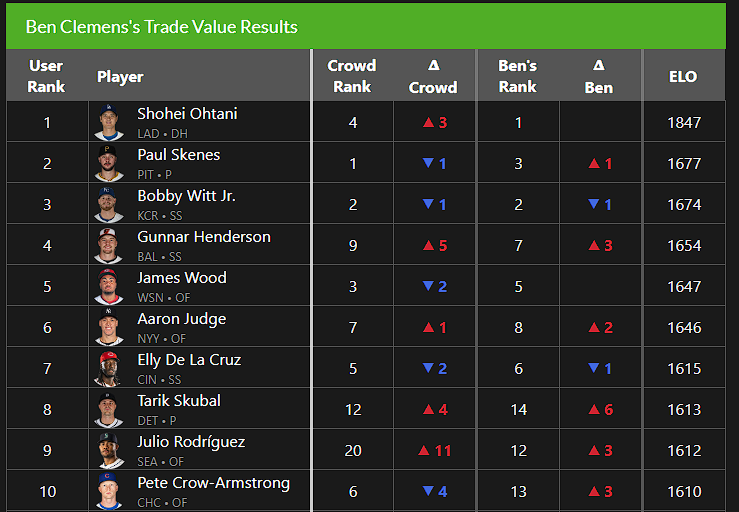
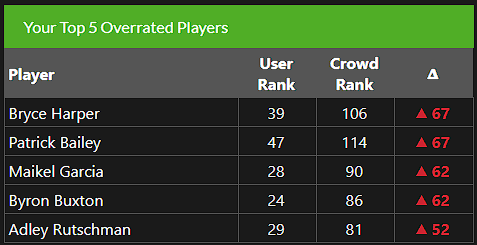
The page will show you how your list (naturally, mine is called “Ben Clemens’s Trade Value Results,” but yours will have your username) compares to both the crowd’s aggregate list and my official one. You’ll also be able to see the players you liked most and least relative to the crowd. Because of the way we designed this tool, the list can get a little bit weird in the middle (we give you fewer of those matchups), so don’t be alarmed if, say, Maikel Garcia ends up in your top 30:
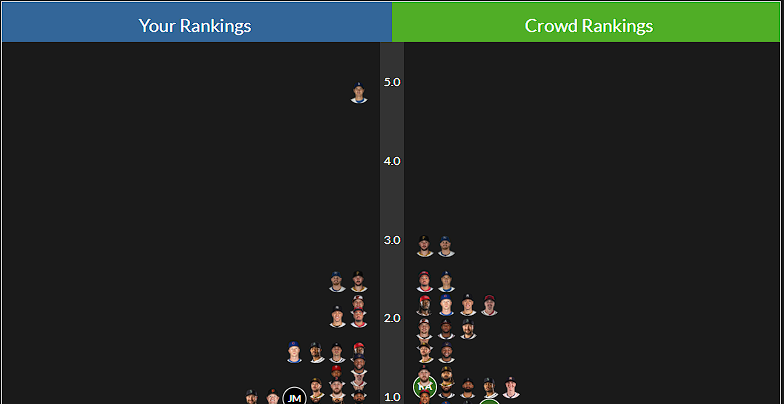
If you liked the tier system that I’ve used over the last two years of the Trade Value Series, you’re in luck. The “Graphs” option turns your rankings into z-scores and then uses those to make tiers. If you hover over a player’s face on that tool, you can see their Elo score based on the matchups you picked, as well as their numerical ranking. They’ll also be highlighted in the crowdsourced tiers over on the right so that you can compare your work to that of the group. These work based exclusively on those z-scores; everyone with a similar score gets grouped together. If, like me, you were much higher on one player than the rest of the group, you can see that clearly in the tiering:
Finally, you can look at the full crowdsourced results and a full breakdown of how my list compared to the crowdsourced list in the tabs on the right. As I noted above, the individual lists might get a little bit funky in the middle, but the aggregate crowdsourced list is a big enough sample that the effect goes away. One thing I absolutely loved seeing is that my rankings and the crowdsourced rankings agreed on nine of the top 10 (I had Cal Raleigh, while you all had Pete Crow-Armstrong).
Now let’s take a peek at a few interesting tidbits to emerge from this exercise, starting with a list of the players who I was highest on relative to the crowd:
| Player | Position | My Rank | Crowd’s Rank | Difference |
|---|---|---|---|---|
| Logan Webb | SP | 16 | 27 | 11 |
| Will Smith | C | 18 | 46 | 28 |
| George Kirby | SP | 23 | 43 | 20 |
| Eury Pérez | SP | 26 | 39 | 13 |
| Spencer Strider | SP | 27 | 42 | 15 |
| Yordan Alvarez | DH | 28 | 64 | 36 |
| Alejandro Kirk | C | 29 | 52 | 23 |
| Adley Rutschman | C | 32 | 81 | 49 |
| William Contreras | C | 33 | 76 | 43 |
| Zack Wheeler | SP | 38 | 53 | 15 |
| Corey Seager | SS | 40 | 112 | 72 |
| Byron Buxton | CF | 41 | 86 | 45 |
| Jordan Westburg | 2B | 46 | 105 | 59 |
Boy, you guys sure do hate catchers! I wanted to come up with some broad generalizations here, and that’s the one that stands out. Will Smith barely being among the top 50 trade values in baseball only makes sense to me if you just don’t value catchers much at all, but that is definitely logically consistent with the rest of the crowd’s rankings. I thought my ranking of Raleigh – ninth – was already low, and he’s the only catcher where we’re even close (11th in the crowd’s rankings). I wrote at length about how I’ve tried to change my valuation of catchers, but clearly the crowd is far lower on anyone wearing the tools of ignorance. Likewise, if a player has been hurt recently, the crowd wasn’t into it. I think that’s quite reasonable. It shows different preferences, but that seems fine. Pushing Spencer Strider, Eury Pérez, and Yordan Alvarez out of the top 30 and towards the bottom of the top 50 because they’re currently either hurt or returning from injury makes sense, even if I chose differently.
After that, I think you’ll see some general disagreement on stars signed to big-money contracts. Corey Seager? Hugely unpopular with the crowd. The same was true of Zack Wheeler, which really surprised me, and Byron Buxton, whose contract and injury status are incredibly difficult to parse. Then there are just a few more stragglers: two pitchers who are command over stuff and play on the West Coast in Logan Webb and George Kirby, and then a strong disavowal of cheap team control in Jordan Westburg at 105th for the crowd. I’m higher on Westburg than industry consensus, but I think it’s fair to say that the crowd is far lower. After all, I showed this list to a bunch of folks in front offices, and they didn’t tell me that Westburg should fall out of the top 100.
And the plot thickens when we look to the list of players where I was lower than the crowd:
| Player | Position | My Rank | Crowd’s Rank | Difference |
|---|---|---|---|---|
| Pete Crow-Armstrong | CF | 13 | 6 | -7 |
| Jackson Chourio | OF | 24 | 14 | -10 |
| Junior Caminero | 3B | 25 | 18 | -7 |
| Bryan Woo | SP | 34 | 25 | -9 |
| Jacob Misiorowski | SP | 35 | 26 | -9 |
| Roman Anthony | OF | 42 | 17 | -25 |
| Zach Neto | SS | 43 | 36 | -7 |
| Wyatt Langford | OF | 44 | 28 | -16 |
| CJ Abrams | SS | 47 | 29 | -18 |
| Jacob Wilson | SS | 48 | 30 | -18 |
| Ceddanne Rafaela | CF | 50 | 33 | -17 |
If I had to generalize here, I’d say that the crowd is into the unknown more than I am. Roman Anthony in the top 20, Wyatt Langford and Jacob Wilson in the top 30; those are aggressive valuations for young players with short track records. I wrote extensively about how I think about the valuation for these guys in each of their blurbs, but the crowd clearly disagrees. There’s also a fair amount of defense and chase rate devaluation visible on my part here: plenty of shortstops and plus outfielders were more popular with our readers than they were with me. Looking at this list tells me that the crowd likes potential more than I do, which isn’t that surprising. Potential is really fun! One of the toughest parts of this exercise for me is reconciling the fact that the point of baseball is to win games with the unshakable feeling that the new is always better. The simplest explanation I can offer for this list of differences is that we dealt with that fact, well, differently. That said, “much higher on Jacob Wilson and much lower on Jordan Westburg” is a tough position to square, and I think it largely comes down to Wilson being the newer, shinier, more batting average-y option.
Finally, here are the crowd’s highest-ranked players who didn’t make my top 50:
| Player | Position | My Rank | Crowd’s Rank |
|---|---|---|---|
| Juan Soto | OF | NR | 24 |
| Spencer Schwellenbach | SP | NR | 34 |
| MacKenzie Gore | SP | NR | 35 |
| Jeremy Peña | SS | NR | 37 |
| Jackson Holliday | 2B | NR | 38 |
| Nick Kurtz | 1B | NR | 40 |
| Andy Pages | CF | NR | 47 |
| Cole Ragans | SP | NR | 48 |
| Cam Smith | OF | NR | 49 |
Most of my “just missed” cohort is on there; MacKenzie Gore, Jeremy Peña, Jackson Holliday, Nick Kurtz, Cam Smith, and Andy Pages all would have been in my top 60 if I ranked that deep. Likewise, all of these players other than Juan Soto are in the back half of the crowd’s top 50, where relative valuations are compressed. Gore at 35th is different than my ranking (51st), but not by a ton. If I had ended up with any of these players in my final rankings, it wouldn’t have felt weird; in fact, the crowd’s list looks pretty good to me. I will admit to a little confusion about some of the inclusions on this particular list, though. Soto is a great player on a big deal; having him 24th and then Seager outside the top 100 strikes me as odd. Likewise, Spencer Schwellenbach and Cole Ragans are each on the 60-day IL right now. I’m open to the idea that you could put them on the list despite those injuries, but I’m having trouble coming up with a throughline that simultaneously pushes those guys up the list and the Strider/Pérez/Alvarez group down. I’m not saying it’s impossible or anything, just that the aggregate preferences of the crowd can make for some weird groupings.
I also bet that if we did this exercise again today, Kurtz would finish a lot higher. Most of the voting in these things happens in the first few days. Kurtz had a 138 wRC+ at the All-Star break, which is when the tool debuted; by the time voting closed last Friday, an eight-game, 472 wRC+ stretch had his season line up to a 184 wRC+. I’d estimate his time-adjusted placement in the mid-20s, but it’s hard to say for sure. Those darn players, continuing to play while we try to rank them!
That’s basically it. You’ve done the hard work of ranking all these players; now you can play around with the results to your heart’s content. I even have a little bonus piece of data: the five closest matchups between top-ranked players. We directed our algorithm to set up more matchups between players who were at the very top of individual lists so that we’d have more data about who each user preferred among the best players in baseball, which means more of those matchups. Even with all that extra volume, however, these choices split right down the middle:
| Matchups | Player 1% | Player 1 | Player 2 | Player 2 % |
|---|---|---|---|---|
| 1,075 | 50.5% | Shohei Ohtani | Bobby Witt Jr. | 49.5% |
| 465 | 49.2% | Corbin Carroll | Elly De La Cruz | 50.8% |
| 220 | 49.1% | Tarik Skubal | Jackson Chourio | 50.9% |
| 499 | 51.5% | Aaron Judge | James Wood | 48.5% |
| 355 | 48.5% | Ronald Acuña Jr. | Gunnar Henderson | 51.5% |
| 637 | 48.0% | Pete Crow-Armstrong | James Wood | 52.0% |
| 312 | 47.8% | Tarik Skubal | Gunnar Henderson | 52.2% |
| 518 | 47.7% | Elly De La Cruz | Pete Crow-Armstrong | 52.3% |
| 248 | 52.4% | Tarik Skubal | Jackson Merrill | 47.6% |
| 453 | 47.5% | Corbin Carroll | Pete Crow-Armstrong | 52.5% |
Thanks again for your help in making this new tool useful – we couldn’t have done it without all of you. And of course, I’d like to offer one more round of thanks to Keaton Arneson and Sean Dolinar for designing and developing the crowdsourced tool and the results page. I hope you enjoyed stepping into my shoes for a week.
Ben is a writer at FanGraphs. He can be found on Bluesky @benclemens.
What an awesome idea and tool to play around with…thanks Ben!
People do know Joe Ryan is alive, right?
Joe Ryan has been the most underrated pitcher in MLB basically since he debuted.
Most of the “most underrated” players eventually wind up fairly rated, but Ryan is going to make it to free agency and get a $150M+ deal before people start paying attention to him.
If this doesn’t show coastal bias, I don’t know what does.
Ryan might not have been in the set of players being ranked. He’d have been somewhere between #30-40 on my list.
Yeah, I think he wasn’t included.
I think there are a few things working against Ryan in people’s minds.
-Age is one. He’s 29 with 2 years of team control left. It’s pretty clear the crowd group has a youth/potential/team control preference.
-Until this year he never had a flashy ERA. And before last year he wasn’t much more than an above average starter.
-He plays for the Twins and lacks media exposure as a result. It takes highlight worthy skills (i.e. Buxton) or playoff appearances to get national exposure in smaller markets. Ryan had a nice velo bump last year but fans aren’t going out of their way to check out the guy with a 94 MPH average fastball and the Twins late season collapse did no favors either.
He also has one of the most forgettable names. You completely forget Joe Ryan’s name five seconds after he introduces himself.
I did 700 matchups and I don’t remember him being in many of them at all.
Soto ranked above Seager by the crowd strikes you as odd? Soto is 6 years younger and Seager is never on the field…
I do not understand why Soto would have positive trade value, and I’ll die on this hill until someone can explain why he does. Soto was given this contract last offseason, and other teams had the opportunity to beat it and did not. He therefore did not have positive trade value upon signing that deal, or else someone else would have beaten it.
That means that either:
(a) The outlook for Soto over the length of his remaining contract is significantly different than before, or
(b) The market has changed.
Regarding (a), I don’t see how Soto’s outlook has changed. He’s on pace for under 5 WAR this season. Now, some of that is that he’s underperformed his peripherals, but he’s also been meaningfully worse defensively. Regardless, I don’t think anyone is feeling substantially different about him as a player than pre-season (which is to say, he’s still one of the handful of best hitters in baseball). However, the years of his contract where he’s in his 20s are clearly the most valuable, and you’re now down most of one of those.
Regarding (b), I don’t see a reason to believe there’s a meaningful change either. We know Soto also received offers from the Yankees, Red Sox, Blue Jays, and Dodgers. The Dodgers’ offer was substantially lower. The Red Sox probably are less interested in another outfielder at this point. The Blue Jays locked up Vlad, which I would guess would prohibit them from taking on that contract. I don’t see why the Yankees’ situation would have changed significantly.
All in all, I just don’t think there’s any reason to think teams that wouldn’t do that contract in the winter would suddenly pay up additional capital to acquire Soto. At best maybe you could convince me that the Yankees would take on the contract for free.
Yea I have to agree. Soto got that contract coming off a 181 wRC+ and 8 fWAR contract year. Now he’s back just under his career batting line. It doesn’t make sense to think Soto, at his current level of compensation and production, would warrant anything more than a nominal return in a trade.
The only argument is really that the Mets wouldn’t trade the superstar they just signed unless the return was a superstar or a highly coveted young player because the optics of such a move would be horrendous and the team is competing now.
He’s probably in the same territory as Rafael Devers–pretty close to neutral, but if I had to pick he is slightly underwater.
I’m perfectly okay with Devers’ contract at 30m AAV for the next 8 years. He ended up at 29 in my rankings. I expect him to maintain his 133ish WRC+ for the next five or 6 years as I do think he’ll be a guy that walks more as he ages. I also think he’ll be a plus defender at 1B given an offseason to prep as he’s got soft hands and good footwork.
If the Pirates were serious about contending during the time they have Skenes under contract they should have been all over brining him into the fold.
My problem with this statement is that it assumes facts not in evidence. We have reporting about offers but we don’t know what other teams offered, and secondly, a free agent is under no obligation to take the “best” offer.
Not sure if either one or both apply to Soto, but that line of logic is fatally flawed, IMO.
Sure, fair enough, but absent evidence to the contrary I don’t see any reason to believe Soto turned down a higher offer elsewhere that was not reported. Your line of reasoning certainly makes sense for the Ohtani deal, where it doesn’t seem he sought his max possible contact.
Having watched it unfold from afar, it really did seem like he went to the highest bidder. It’s just the simplest explanation.
You never know all the facts but that one seemed likely enough to me.
If the Mets put Soto on waivers he would clear. I’d bet any amount of money I have.
Reportedly the other four finalists this offseason were NYY at 760m, LAD at 600m, BOS at 700m, and TOR at 700m. After signing Vlad Toronto would likely be out. The other three finalists would likely strongly consider claiming him though depending on when he was placed on waivers.
This is a great way to state it. Even if say the Yankees and Dodgers would claim him and I don’t think they would, that 27 would pass suggests no trade value.
Well, the positive trade value comes from the fact that he’s one of the small handful of best hitters in MLB, and not everything is a contract-efficiency calculation.
The cost may be borderline insane, but he WILL improve your team.
That’s real value. Not top-10, but not nothing.
But they could have had him on this contract while trading absolutely nothing a mere 6 months ago, and my argument is that nothing substantial has changed in that time. Unless you are saying that something substantially has changed and another team would want that contract now, your argument makes no logical sense.
Like it’s not about surplus value here. It’s just about willingness to pay the contract, which it sure looks like no one else would do.
Nah. It’s a theoretical exercise, and a stateless one at that.
The fact that Soto chose the Mets doesn’t mean his other suitors are no longer interested in his services.
We all know that WAR value isn’t linear. Juan Soto has the ability to pack more WAR into a single roster slot than almost anyone else. To a degree, that makes comparisons moot. We can debate the relative cost of guys like Chris Paddack and Mitch Keller, while comparing them with other mid-rotation SPs and pronounce VALUE as if it’s meaningful. But Juan Soto (and Judge, and Ohtani, etc…) live outside of those arguments.
A competent front office is always going to look for players who are better and cheaper. That’s the heart of the trade value question. But so long as MLB has no real salary cap and every team’s payroll is constrained only by their billionaire owner’s personal need to win a World Series, guys who aren’t cheaper but ARE better will have positive value.
But who’s interested in that contract now? The Yankees? The Dodgers? They already told us it was too much.
This is a theoretical exercise, not a concrete implementation.
There do exist a small number of teams in MLB who at least theoretically have room for Juan Soto’s contract on their long-term payroll, and would be interested in having one of the very best bats in Major League baseball.
Contract decisions made 6 months ago, and actual payrolls at this very moment. today, are secondary considerations at best
The Yankees would take him back. I feel fairly confident of that.
The Blue Jays probably would.
I don’t think the Dodgers would.
But those teams were in on him. Why didn’t they just make him a bigger offer?
Following that logic to its conclusion literally EVERY recently signed free agent has no trade value, because no one was willing to exceed the signing team’s offer.
…and yet
I think the point here is that plenty of other last-offseason FAs have had material changes to their outlook, and/or their realistic suitors have had material changes to their need. Neither applies to Soto, except perhaps he should be slightly shaded downward because 2/3 of a prime-age season is now gone and he’s played at “merely” great rather than obscene levels.
If you think he signed at the highest possible market value, then the trade value of his contract is by definition zero at that point. Not every free agent does. But in a bidding war involving the top spending teams, it’s realistic to think that happened here, yeah. The alternative is that the team who wants to trade for him now is being irrational.
Okay that’s possible too.
Edit: plenty of reasons other than irrationally could exist: a team just needs Soto more now than they did six months ago; Soto’s performance is better than expected; a team has had a sudden windfall of cash. … I just don’t think those things happened.
It’s (mostly) blind bidding; the player, at any time, can choose one and go with it, and they may not give you an opportunity to up the offer. With Soto, it was pretty clear he had a squishy deadline, but definitely wasn’t intent on dragging it out.
“underperformed his peripherals” is a bit of an understatement. He’s got the second largest underperformance by xWOBA in the league, .001 behind Vaughn.
Putting up a top 10 wRC+ while underperforming more than everybody else in the world is good, actually
For some reason this is something that stuck out to me very quickly about the crowdsource list: people love Bo Naylor. He’s immune to the catcher debuff. He nearly made the top 50. He’s way ahead of Adley Rutschman, despite also not being that good for two years. He’s way ahead of Austin Wells and Ivan Herrera, despite them being better players with the same contract situation.
As I type this comment, I realize David Fry is also ahead of all of these players. Cut it out, Guardians fans!
My bottom 5 trade values:
120) Michael Harris II
121) Andres Gimenez
122) Manny Machado
123) Jose Altuve
124) Vlad Jr
My biggest “real” disagreement with the crowd is Zack Wheeler, who I had at 22. I think I would put him around 25-27 if I did it manually though. There are obviously others that are more quantitatively but I think are smaller areas of disagreement. For example I had Jaren Duran at 47 and the difference between 47 and 99 seems less stark than between 22-27 and 53.
My 5 lowest:
124- Michael Harris II
123- Roki Sasaki
122- Chase Meidroth
121- Luis Castillo
120- Dansby Swanson (that seems odd to me, but, it’s what it says)
119- Machado
Gimenez is 117, Vlad is 108, Altuve is 92
Biggest difference vs the Crowd- Sal Frelick who somehow ended up 14th. Colt Keith was also in the top 20 (his contract is insanely cheap & I’m a Detroit fan). Mookie Betts is another I had way higher (that’s my bias showing because he’s a favorite). Lindor is the guy I had way lower.
I think I did like 512 rankings, & wonder if the Frelick # is due to that. That’s waayy higher than I would rank him if I just did an ordinal list.
“Finally, you can look at the full crowdsourced results and a full breakdown of how my list compared to the crowdsourced list in the tabs on the right”
Am I missing something or is this not available on mobile? I don’t see any tabs on the right.
It was fun to mess around with, but looking at my list is kind of frustrating because it doesn’t represent even a first-order list after 302 attempts when I closed the tab. Apparently I had James Wood 27th. In my scant recollection he just didn’t come up very much, whereas certain other players like Mookie were ubiquitous. At least my top 10 had 5/10 and all in the top 20 of the crowdsource results, so I guess not so crazy off.
I did 407 matchups, and AJ Smith-Shawver is still my number 16. I don’t like him, but I ranked him ahead of people whose contracts struck me as being underwater and ahead of very low value non-pitchers who are in arbitration.
I do not think he’d be in my top 50 in a full listing.
I had Raleigh at 2, Kirk at 11, and 3 more catchers in my top 50, so I don’t think I was too low on catchers.
Could the crowd being more into the unknown than you also be the crowd being into lots of cheap (or unknown arb payout) control? Those things almost inevitably go together.
I think maybe by “into” Clemens meant they were willing to accept the unknown more than him, or more confident in things he feels are unknown to a large degree?
Surplus value ain’t linear
I think a lot of the differences you see come from small market fan vs large market fan perspectives. As a brewers fan, it was impossible for me not to look at this exercise as if I wasnt the GM of a small market team. I’m going to more highly favor controlled talent than the locked in high priced vets. It’s baked in to my thought process that the price controlled player like Langford, Wilson, and Rafaela are more valuable to me because those cheaper prices for those handful
of years will allow me to spend a little bit in FA elsewhere and come with less financial risk. Would love Seager or Wheeler on my roster, but that’s too much risk to put all the eggs in that basket.
Yelich and Braun are recent examples. They’ve been fine, and have not been too much underwater (compared to some other big contracts out there), but overall they’ve been a disappoint and will shape the way Brewers spend money in the future and value folks on the trade or free agent markets.
I tried to take the mindset of a mid-tier payroll GM, say $150M-$170M, to allow the ability to dip a toe into the giant contract sandbox while still emphasizing a roster largely built around cheaply controlled talent. That was easy enough to get my head around. But there were two realities I found difficult to square when ranking players in a vacuum:
1) Is my team a serious WS contender the next 2-3 years? Give me Zach Wheeler and Tarik Skubal. Am I a fringe playoff team or rebuilding? Give me Eury Perez and Jacob Miz.
2) Same question but amplified for this exercise being done midseason. Where is my team at right now? The difference between getting 1 vs 2 or 2 vs 3 postseasons out of a presently healthy ace is more stark than for position players.
Joe Ryan and MacKenzie Gore are good examples of players whose value takes a big hit for me come November. Yes, they are under arb control for 2026 and 2027, but at the rate pitchers blow out their arms, there’s decent risk you could pay a lot and fail to get one even one postseason run in return. But acquiring now in July? When you know your team is a contender? And you only need the health to hold up for 3 months? That’s equation-flipping info.
I tried approaching it from the perspective of some of the large markets but not the very largest markets–Phillies, Braves, or Rangers. Theoretically you could have any of these guys on your roster (except Soto), and you can pay the luxury tax without worrying. But it’s also very valuable to have strong producers signed to cheap contracts, because eventually your owner is going to cut you off and so you need to manage it well.
Based on that, I ranked Wheeler very high but Seager probably would be an HM for me.
So what I learned from this exercise is 1) I need to do more than 400 matchups to get a more representative list, and 2) there were some things I ended up ignoring that probably should’ve gone into consideration when I did these matchups. Great idea though, and very thought-provoking! I’d definitely do this again.
Did users get a random subset of the 145 players in the set? There are several players I don’t recall ranking.
Seems like it was 124/145, which I’m slightly disappointed in. Some of the dudes that weren’t in my “set” are more interesting than some of the ones that were. Also, it makes the “crowd” overrating towards the end meaningless since there’s 20+ spots below the furthest I can push anyone down (Chase Mediroth).
Probably would have prevented answering the same matchup multiple times. I was amused when I had two guys as the matchup and the same matchup, but switched was next.
Also, the crowdsource results don’t have a #72. It jumps from 71 to 73.
Sorry, 70 to 71. Also, #55 is missing.
I will take Ben’s ranking on Pete Crow-Armstrong (13), Logan Webb (16), Junior Caminero (25), Spencer Strider (27), Bryan Woo (35) Byron Buxton (41), CJ Abrams (47), and Jacob Wilson (48).
I’d have Abrams and Wilson and maybe Buxton as HMs but there are probably 20 players who are all about the same for me spanning 41-60, so whatever.
I’ll take The Crowd’s Ranking on Jackson Chourio (14), Cedanne Rafaela (33), Eury Perez (39), Kirby (43), and Yordan Alvarez (64, but IMO he’s unrankable).
I’m higher than Ben and The Crowd on Raleigh, Cristopher Sanchez, and Wheeler. And Joe Ryan! And probably Lawrence Butler too.
I’m lower than both Ben and The Crowd on Misiorowski and Neto.
I think I am right in the middle of both Ben and the crowd on basically all the other catchers as well as Corey Seager, Jordan Westburg, Wyatt Langford, and Roman Anthony.
Not surprised the crowd leaned into who’s hot now.
Ben and I agree that Paul Skenes is 3rd. The crowd and I agree that Gunnar Henderson is 9th and Michael Busch is 87th.
I also definitely had a few results that I don’t even close to agree with, and I also think after reading all the lists and a ton of the comments last week I’d surely change a lot if I did this again now.
Amazing project Ben! However, I feel you started blending ‘value the player currently has’ and ‘actual trade value’ towards the middle of the list.
You mention the disconnect between the crowd on Wheeler and Seager, but Wheeler is an aging star who already plans to retire in 2 years and Seager is on the wrong side of 30 with a massive contract. Given this, you still rank them above Roman Anthony, Jacob Wilson etc. There is no world where the Red Sox would give up Anthony for Wheeler 1:1 and I don’t think you would either.
Awesome tool and being able to access our full results is an unexpected surprise.
I ended up way higher than consensus on Soto as he ended up at 12?!?!? on my ranking after 700 matchups. If I was doing a manual adjustment I’d drop him at least 15 to 20 spots. However, assuming the next CBA doesn’t institute a hard salary cap or something similar I think he opts out after 2029. I’ll gladly take Soto for his age 27 to 30 season even at the price of 50m.
Well, he’s ~$61m for those years as the contract is front loaded so he can get paid and then possibly opt out. The best case scenario with Soto is paying him -$265m for the next 4.33 years and then he becomes a free agent. That’s what happens if things go well. Is a 31-year-old Soto going to turn down the remaining 10/$440m? Again, if things go really well he probably does.
There is of course a substantial possibility that things don’t end up going so well.
Thank you for writing the series and making this really awesome tool!
I’m fascinated by all of these results because I’ve never seen a crowdsourced result without team specific bias.
That said, I think fans are undervaluing star power from both a productivity and marketing perspective. If as a fan you were hoping your team would sign Soto last offseason it’s not just because you needed some specific $/WAR influx, but because you wanted a star player.
That said, having Bo Naylor 26 spots higher than Bryce Harper is a mind boggling statement. He was literally just traded for a super light return. From a ‘trade deadline” perspective he’s worse than Harper, at the same position, in the same year. So the implication there must be that Harpers contract has negative value, that you’d need to acquire a prospect just to take the contract off your hands. Maybe I’m biased, but can you imagine any team not signing Harper to 6/152 in the offseason? Every team would be able to sell enough jerseys on the front end and then market all the career milestones in the back end to make that a slam dunk decision.
This was awesome
The matchup tool was very interesting. Thank you for doing it full disclosure i only made a couple of dozen matchups before determining that I would be at it all day unless I put it down lol.
I think where the crowd differered was not ‘unknowns’ but about valuing cost controlled talent higher
Love this. But I think the conclusion is people are irrational and probably don’t use a model similar to actual teams.
I bet if you dug in you could find hundreds of examples where a person prefers A to B and B to C but also C to A. If teams would take the remaining 14+ years of Soto’s contract why didn’t they offer more 6 months ago? It’s not like he’s putting up another 8 WAR season and making us re-assess his value.
I think that deal is a huge overpay — many may not — but it’s nearly impossible to genuinely believe the deal looks better with 2/3 of a “cheap” year gone.
I feel like a genius for putting Nick Kurtz into my top five completely without planning it.
Westburg (too high) vs Wilson (too low) makes sense to me. Westburg is already 26 and has a .307 OBP with OK defense, and it’s not like he had some prospect pedigree or upside either. I don’t quite get the love. He’s on pace for around 2 WAR.
Wilson is not a superstar either, but he’s 3 years younger, cheaper now and in the near future, and is having a much better season than Westburg (double his WAR). Now some of that batting average may be unsustainable, but even so, he’s walking more than Westburg as well, with similar defense. Even looking at Eric’s prospect reports, Westburg had a 40 future hit tool and Wilson had a 70! So Wilson has more scouting pedigree as well.
You mention people liking “newer”. I think that position makes all the sense in the world – younger players are always more valuable than older ones. So it’s not just being bored or whatever with Westburg, it’s the very real valuation of 3 years younger, more theoretical upside/pedigree, and that much further from a big payday.
You have those guys right next to each other, I’d venture the industry has Wilson quite a bit higher at this moment due to those factors (younger, cheaper, better prospect, better current season).
Want to make a few notes here. You can always shade someone down on a counting stat when they miss time with an injury. Westburg is on a 3.6 fWAR / 600 PA pace this year, and last year it was 3.9 fWAR / 600 PA. Perhaps we can start throwing the injury-prone label on him, but he has a track record of well-above-average performance and way more power than Wilson. I’d also note that Westburg’s wOBA and xwWOBA are basically bang-on, while Wilson has been “over-performing” by 40 points so far this year per that metric. Finally, FG’s “Def” metric seems to actually prefer Westburg’s glove work this year to Wilson’s.
Following baseball as a hobby I value prospects and the low-cost guy in my system because it would be such a cool win. Think of the potential!
If I were doing this for work? Give me the player I know is consistently good, even if it costs more. Dreaming on potential gets me fired.
And this seems to align with the crowdsource vs. Ben vs. the league.
The crowd putting PCA over Carroll, Judge, and Gunnar is *wild*.
Carroll is only one year older, actually under control for longer (at an unreasonably cheap price), and they have the same wRC+ this year. If you actually traded for PCA the first thing you would do is *beg* him to sign Carroll’s contract. I get the defensive angle and I like PCA too but the crowd seems to not be valuing Carroll ‘s years long track record of performance at all.
And I’m pretty sure, if Cashman traded Judge for PCA, he would get banned from the state of New York.
I went against the crowd and comparatively love catchers. Raleigh was 5th. Patrick Bailey ranked. I have several catchers in the top 50. But I seriously think we undervalue catcher defense. But I have watched some terrible catchers over the years butcher pitching stats. Ruiz does this nightly. All while living through Y Molina’s entire career. I thought he took a good run off the Cardinals era most years. If not more. Feel free to disagree. I am also slightly Nats biased. Wood first. I’m very elite defender biased. Those don’t surprise me. I’ve got PCA 2nd but he wowed me when the cubs played the Nats. I also ranked other top defensive CF higher than the crowd. Had several in my like better than the crowd list. Im higher on Kwan and Wynn. I’m more down on power hitters who don’t field. And I’m more down on Judge because of the contract. He was not even in my top 10. I really don’t believe anyone would pay more than the Yankees do for judge. So he would reject any trade. Those limit his trade value some. I’m sure many would disagree on Judge.