Of all the novelties we’re going to see this postseason, this series is one of the weirdest. The Phillies and Marlins have never met in the postseason before. In fact, they’d never made the playoffs in the same season before; apart from a stretch from 2003 to ’09 when it seemed like they only ever played each other, the two franchises had never even finished above .500 in the same season before.
The playoffs start on Tuesday, and we are going to cover every single game, from the Wild Card round to the World Series. But those games are played by humans, and those humans have to find a way to avoid murdering each other over the course of a very long season. Inventing goofy celebrations is a good way to inject some fun into the proceedings. This article and its American League counterpart, which will run tomorrow, will break down how each playoff team celebrates when a player reaches base or the team notches a victory. (I’m going to skip the home run celebrations becausethey’vealreadybeencoveredverythoroughly, and because they’re sure to get plenty of camera time as October unfolds.) The point of this article is to help you enjoy the smaller celebrations that might otherwise go unnoticed.
One important note: This is necessarily an incomplete list. I spent a lot of time looking, but I wasn’t able to track down the origin of every single celebration. When you search for information about a team’s celebration, you have to wade through an ocean of articles about the night they clinched a playoff berth. The declining functionality of Twitter (now known as X) also made it harder to find relevant information by searching for old tweets (now known as florps). When I couldn’t find the truth about a celebration’s backstory, I either gave it my best guess or invented the most entertaining backstory I could think of. If you happen to know the real story behind a particular celebration, or if you’d like to share your own absurd conjectures, please post them in the comments. Read the rest of this entry »
The Minnesota Twins and a short first round playoff series: Name a more iconic duo. The Twins have been quietly excellent this year, compiling the seventh-best run differential in baseball. To be sure, some of that is because they have the good fortune of facing fellow AL Central clubs, but a lot of it is because their team is full of good pitchers. They’ll meet the Toronto Blue Jays in a Wild Card clash. You’ve probably watched and heard a lot about the Blue Jays this year, and I’ll get to them, but let’s start with the thing you probably most need to hear: The Twins are good, not just the token AL Central representative, and they got a lot better when you probably weren’t paying attention.
The Minnesota rotation might be short on name recognition relative to some other playoff squads, but Pablo López and Sonny Gray are each top 10 pitchers by WAR this year. Joe Ryan, Kenta Maeda, and Bailey Ober are both above average as well – Ryan will likely draw the third start, but the other two will surely be available to relieve him if necessary. They’re one of those classic playoff tropes, the team you hate to face because so much of their value is concentrated in good pitching. López has gone six or more innings while allowing one or fewer runs 11 times this year; Gray has done it nine times himself. It’s easy to imagine the Jays coming into Minneapolis and leaving with very few runs to show for their trip. Read the rest of this entry »
Primary Purpose
The Cleveland Guardians are sourcing applicants for potential future Minor League Hitting Coach openings in the Player Development Department. Though the team does not have any current openings, we are looking to get to know potential candidates throughout the calendar year in order to (1) begin to vet potential candidates at times more conducive to their schedules; and (2) enable us to move forward more quickly through the hiring process if and when relevant openings do develop. The ideal candidate will possess a passion for player and personal growth, experience integrating multiple information sources to create and implement development plans, and a thorough understanding of skill acquisition principles. Excellent applicants will demonstrate curiosity, creativity, and a drive to learn new concepts to problem solve. First and foremost, we are looking for great people!
We are committed to creating an equitable interview process that recognizes the unique identities of all applicants and allows candidates to bring their best selves forward. If you are more comfortable with submitting your materials (i.e., resume, other documents) in Spanish, please feel free to do so.
If you meet some of the qualifications above, we encourage you to apply or to reach out for more information. We know that people from historically marginalized groups – including people of color, women, people from working class backgrounds, and people who identify as LGBTQ – may feel less likely to apply, even though they are qualified, unless they meet every requirement for a job. Therefore, we encourage you to reach out if you have questions about the role or your qualifications. We are happy to help you feel ready to apply!
Essential Responsibilities and Duties
Integrate objective information into a detailed and comprehensive player development plan.
Create effective training environments based off individual player plans.
Collaborate with Physical domains to effectively plan, implement, and monitor a holistic player development plan.
Utilize internal tools, resources, and analytics to assess and adjust player plans.
Communicate development plans and progress with players and Player Development staff and Front Office throughout the year.
Assist field staff with normal daily operations when necessary.
Requirements
Minimum of two years related experience and/or training required. Previous experience with a Major or Minor League Baseball organization or collegiate baseball program is a plus.
Candidate is willing to potentially work at our development complex in Arizona year-round.
Ability to effectively communicate with a wide range of people and backgrounds.
Reads, speaks, comprehends, and communicates English proficiently in all communications.
Interest in personal and professional development with a desire to be involved in internal continuing education opportunities.
Proficiency in Microsoft Office including Teams, Word, Excel, PowerPoint, Office, and Outlook.
Preferred Experience
Fluency in Spanish is a plus but not required.
Proficiency in SQL is a plus but not required.
Experience working with Trackman, Edgertronic cameras, biomechanics data, and workload monitoring data.
Strength & conditioning experience is a plus but not required.
Standard Requirements
Represents the Cleveland Guardians in a positive fashion to all business partners and the general public.
Ability to develop and maintain successful working relationship with members of the Front Office.
Ability to act according to the organizational values and service excellence at all times.
Ability to work with multicultural populations and have a commitment to fairness and equality.
Ability to work in a diverse and changing environment.
Back in August, my colleague Ben Clemens crafted an article titled Wait, Zack Littell is a Starter Now?! It was an apt headline. Not only had the 27-year-old right-hander been DFA’d by the Red Sox a few months earlier — Boston having been his third organization in as many years, and his sixth overall — he’d logged a 4.08 ERA over 145 big-league appearances, all but four out of the bullpen, with just three saves. As Clemens pointed out, Littell “wasn’t even a dominant reliever.”
Of course, this was the Tampa Bay Rays who’d moved him into their rotation. Much for that reason, Clemens qualified his skepticism by saying, “What else can we do but wait and see the results?”
The results have remained largely positive. Littell has a not-so-great 6.75 ERA in 14 appearances out of the bullpen this year, but in the same number of outings as a starter his ERA is 3.41. Moreover, he’s consistently gone five-plus innings. As Rays beat writer Marc Topkin told me for an article that ran here at FanGraphs on Friday. the under-the-radar righty “has basically saved the starting rotation.”
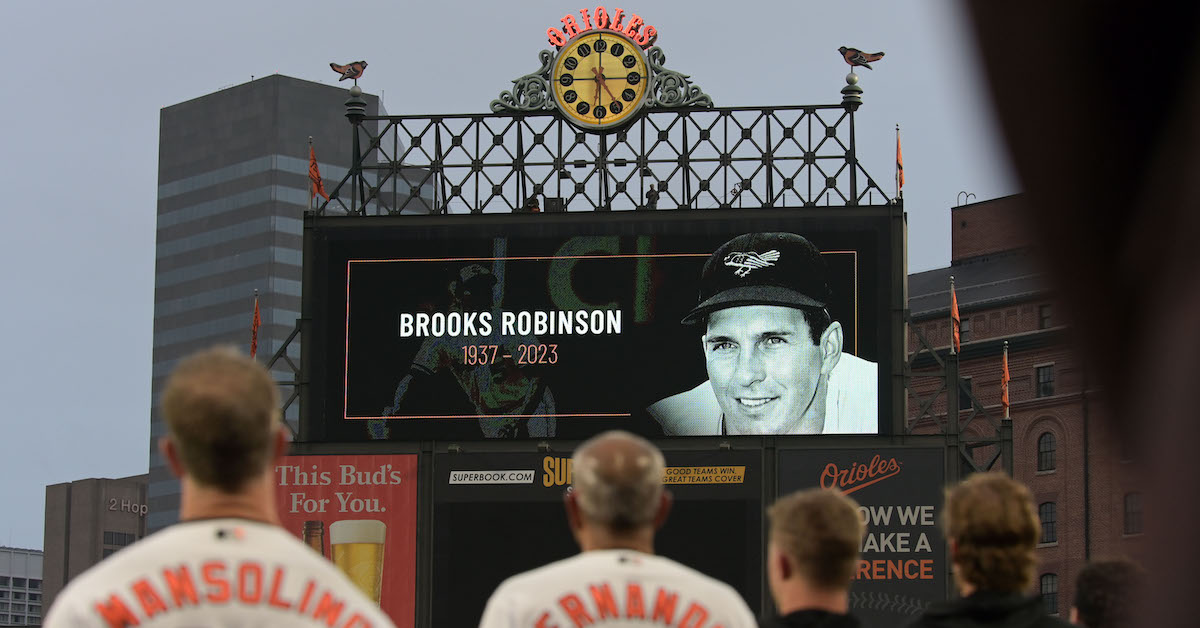
Variously known as the “The Human Vacuum Cleaner,” “Mr. Hoover,” or “Mr. Impossible,” Brooks Robinson set the standard for defensive wizardry at third base, winning a record 16 consecutive Gold Gloves thanks to his combination of ambidexterity, supernaturally quick reflexes, and acrobatic skill. He was an 18-time All-Star, a regular season, All-Star Game, and World Series MVP, and a first-ballot Hall of Famer. More than that, he was “Mr. Oriole” for his 23 seasons spent with Baltimore, a foundational piece for four pennant winners and two champions, and a beloved icon within the community and throughout the game. In 1966, Sports Illustrated’s William Leggett wrote that Robinson “ranked second only to crab cakes in Baltimore.” He may have surpassed them since.
Robinson died on Tuesday at the age of 86. According to his agent, the cause was coronary disease. On the broadcast of the Orioles’ game on Tuesday night, longtime teammate and fellow Hall of Famer Jim Palmer fought back tears to pay tribute. “We all know he’s a great player, he won 16 Gold Gloves, but we also know how special a person he was,” said Palmer, who like Robinson debuted with the Orioles as a teenager, spent his entire career with the team, and was elected to the Hall of Fame in his first year of eligibility. “I think as a young player you make a decision early in your life, ‘Okay, who do I want to emulate? Who do I want to be like?’ Brooks was that guy.” Read the rest of this entry »
While most of the baseball world was focused on the playoff race, the Nationals got an early start to their offseason on Wednesday, avoiding arbitration with veteran utility man Ildemaro Vargas. The terms of the contract have not yet been announced, but it’s safe to presume the journeyman will earn a raise over his $975,000 salary from the current season. He set a new career high in plate appearances this year, playing in 84 games at five different positions. What’s more, the 2023 campaign marked the first of his career in which he wasn’t optioned, traded, or designated for assignment; apart from a three-week stint on the injured list and a few rehab games at Triple-A, he spent the entire season on Washington’s big league roster.
I’ll be honest: when the Nationals first broke the news about Vargas, I didn’t think it warranted a full write-up. Still, I wanted to do my due diligence, so I began my typical process of cursory player research. First, I checked his FanGraphs page. A 77 wRC+ and -0.1 WAR? Sure, sounds about right. Next, I went to Baseball Savant. 16th-percentile xwOBA? Yeah, that tracks. Then, I looked on Baseball Prospectus. A 144 DRC+ and 2.0 WARP? Okay, nothing out of the… wait, what?
After refreshing the page a couple dozen times and checking to make sure there isn’t a second Ildemaro Vargas out there, I realized this guy might be just a little more interesting than I initially thought. DRC+ is only one metric, and like any metric, it’s vulnerable to small sample size trickery. Be that as it may, I can’t ignore the fact that DRC+ ranks Vargas as the fourth-best hitter in the National League; it goes Ronald Acuña Jr., Mookie Betts, Juan Soto, and Vargas. He’s ahead of names like Matt Olson, Luis Arraez, and Freddie Freeman. Small sample size or no, this is a player who deserves our attention: Read the rest of this entry »
“Let’s Talk About Underrated 2023 Orioles” was the subtitle of my Sunday Notes column on September 10, with the opening section having featured a combination of Baltimore broadcasters and scribes opining on that very topic. Today, we’ll head south and talk about underrated Tampa Bay Rays — arguably an even more subjective exercise. Few teams in any sport have enjoyed as much success while getting contributions from as many players who largely fly under the radar from a national perspective.
The six people quoted below — four Tampa Bay broadcasters and a pair of the team’s beat writers — offered their perspectives on Wednesday when the Rays played the Red Sox at Fenway Park.
———
Brian Anderson, Rays broadcaster:
“The guy who had the big game tonight: Josh Lowe. Coming into the season, it was Vidal Bruján, Jonathan Aranda, Luke Raley, and Josh Lowe — those four guys for two spots — and it was a battle right to the end of spring training. Raley and Lowe got them. Not only did [Lowe] fight for a roster spot and get it, he turned it into .290 with 20 home runs, and he’s 32-for-35 in stolen bases. He’s third on the team in runs driven in. He plays a good outfield. I mean, he’s gone through the roof for a guy who, until the end of camp, didn’t know if he was going to make the team or not. To be able to do what he did… I don’t think anyone saw him putting together the kind of year he’s put together.” Read the rest of this entry »
There’s a week at the end of every season when Triple-A welcomes some of baseball’s top prospects for a brief stint at the minor leagues’ highest level before they hang up their cleats for the year (or in many cases, head to the Arizona Fall League). Expanded rosters at the big league level leave a slew of freshly vacated Triple-A roster spots. Meanwhile, the Low-, High-, and Double-A seasons end when there’s still a week left on the Triple-A schedule, creating a sizable pool of lower-level up-and-comers. These prospects, especially the younger ones, are looking to prove themselves capable of standing up to competition beyond what their developmental schedule might otherwise deem appropriate. It’s also a big reason why so many of the following year’s prospect list write-ups include some version of the phrase “He notched a few innings at Triple-A at the end of last season.”
One such prospect this year is Ricky Tiedemann, the young lefty hurler who sits atop the Blue Jays prospect list and currently ranks 18th on our overall Top 100. If that résumé sounds oddly familiar, you may be picking up echos of recent big league debutant Kyle Harrison, who tops the Giants list and is stacked just spot above Tiedemann on our Top 100. The similarities don’t end there, though. Both Harrison and Tiedemann were drafted as teenagers, and both boast a tremendous punchout ability that belies their years, posting strikeout rates above 40% at various points in their young pro careers.
Before I continue, a caveat: Due to a combination of mid-season arm soreness and a short leash when it came to his pitch count, Tiedemann only threw 44 innings in 2023. That’s important to keep in mind, especially considering that Harrison’s lowest innings total in a pro season is more than double that. Tiedemann still has to demonstrate that he’s capable of maintaining his prowess over the type of innings load that Harrison has endured. With that established, let’s dig into how the two young southpaws resemble one another, and more importantly, what sets Tiedemann apart, at least for now. Read the rest of this entry »
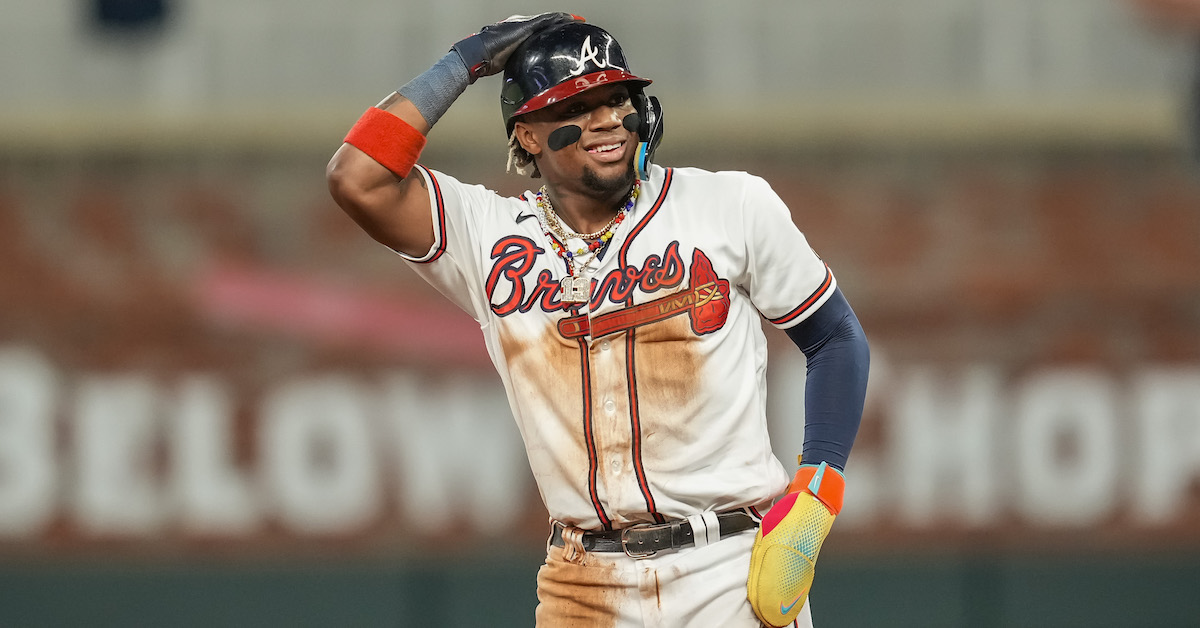
It’s one thing to join a club, but it’s another thing to start your own club entirely. That goes doubly so when the requirements to enter your club are harder to obtain than a liquor license in 1928. Ronald Acuña Jr. had already earned his 40–40 membership last Friday. That was the hot club in town back in 1988 when Jose Canseco started it up, but with five members now, it’s not quite as exclusive as it once was. So Acuña started up his 40–70 club, and he gets the prime parking space. And still not quite 26, there’s more time to start up some new clubs.
I tend to have mixed feelings about these clubs in baseball. They’re undeniably cool, in the way we’re all attracted to round numbers, and the key clubs and milestones give us an underpinning to compare accomplishments across baseball history. There’s something satisfying about experiencing the game in a similar fashion to someone 30 or 50 or 75 years ago as a shared cultural event, and these number-based chases are a big part of that. On the other hand, they also tend to be somewhat arbitrary in their construction and focus on a different direction than the one I’m interested in: what numbers mean rather than what they are.
When I’m not thinking about how fun something like a 40–70 club is or a 50–50 club would be, I can’t help but ask myself, “Hey, wouldn’t the 46–68 club have been a lot more meaningful than 40–70?” And the HR–SB club, unlike hitting 400 homers, has the added baggage of comparing two very different things with very different values. At least the Triple Crown isn’t a bad model of offense if you don’t have OBP and SLG; homers, batting average, and RBI cover most offensive contributions, even if the weighting is rather inaccurate.
The 40–70 club isn’t something I’d give extra credit for in an MVP vote; Acuña’s homers and stolen bases are already part of his statistical record. But thankfully, I’m not an MVP voter this year, so trying to separate Acuña and Mookie Betts is a problem I’m relieved to not have to unwind. My colleague Jay Jaffe made an excellent case for why he might break the tie in Betts’ favor. I’ll give a counterpoint in Acuña’s favor, but it has little to do with club membership and more about defense. While there’s some additional value to Betts’ flexibility, at the same time, there’s simply far more uncertainty around defensive numbers than offensive ones.
But if you’re not tired already of the MVP arguments, I guarantee you’ll be exhausted with it nearly two months from now when the award is announced. So let’s talk about something more fun, like the chance that Acuña can manage to top himself in the future with more than a full healthy season back under his belt. Read the rest of this entry »