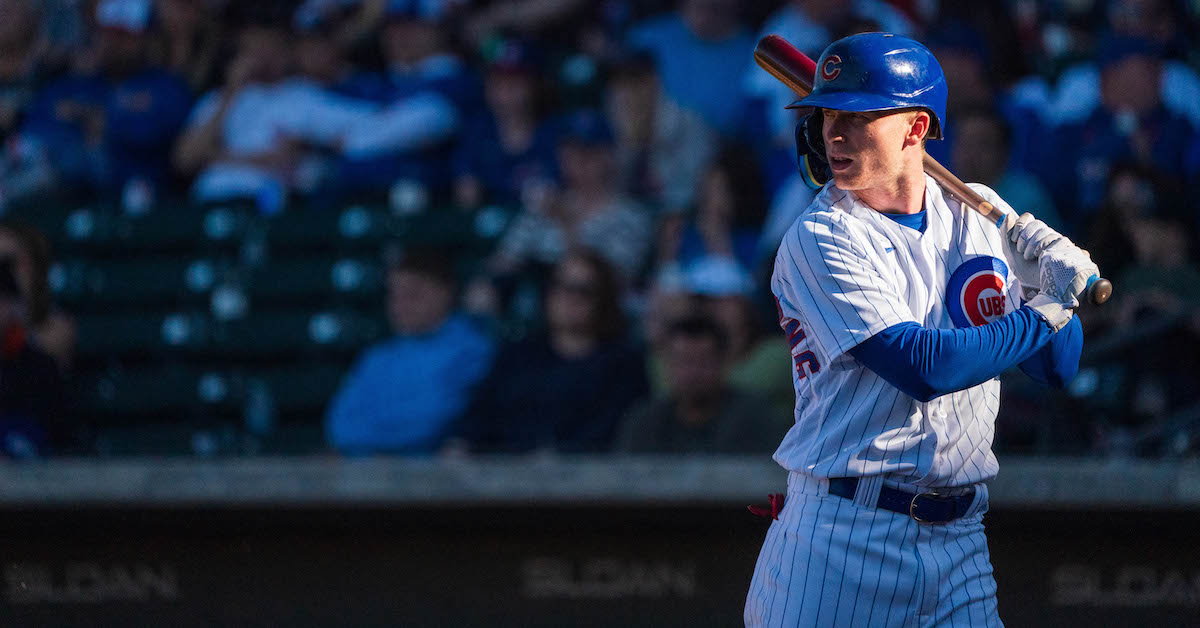
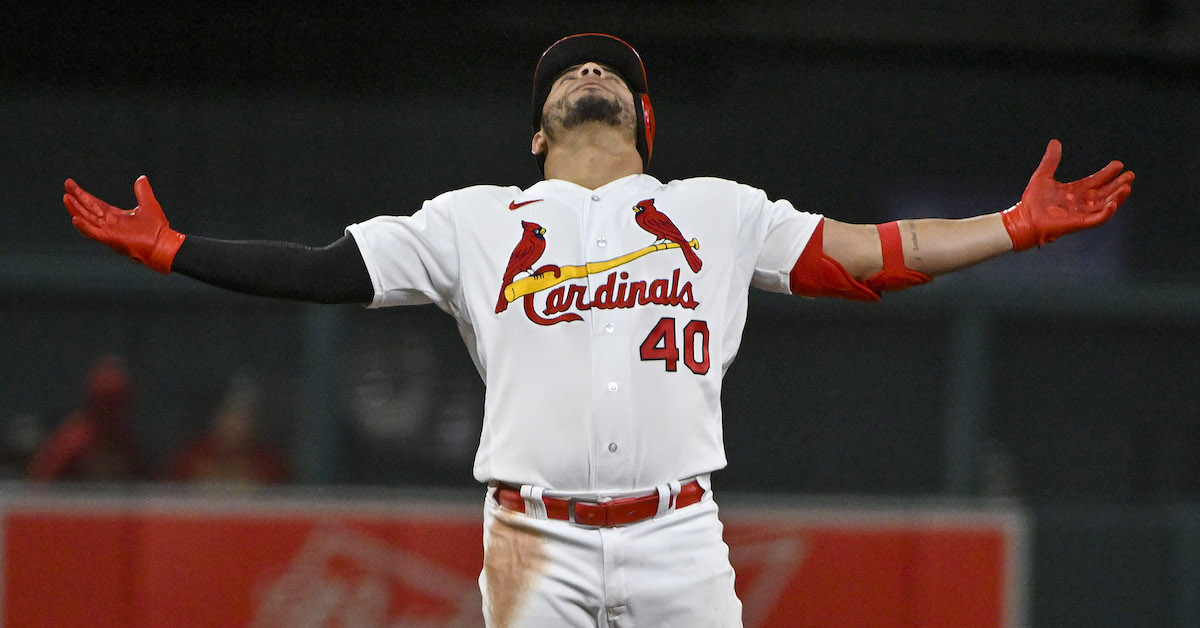
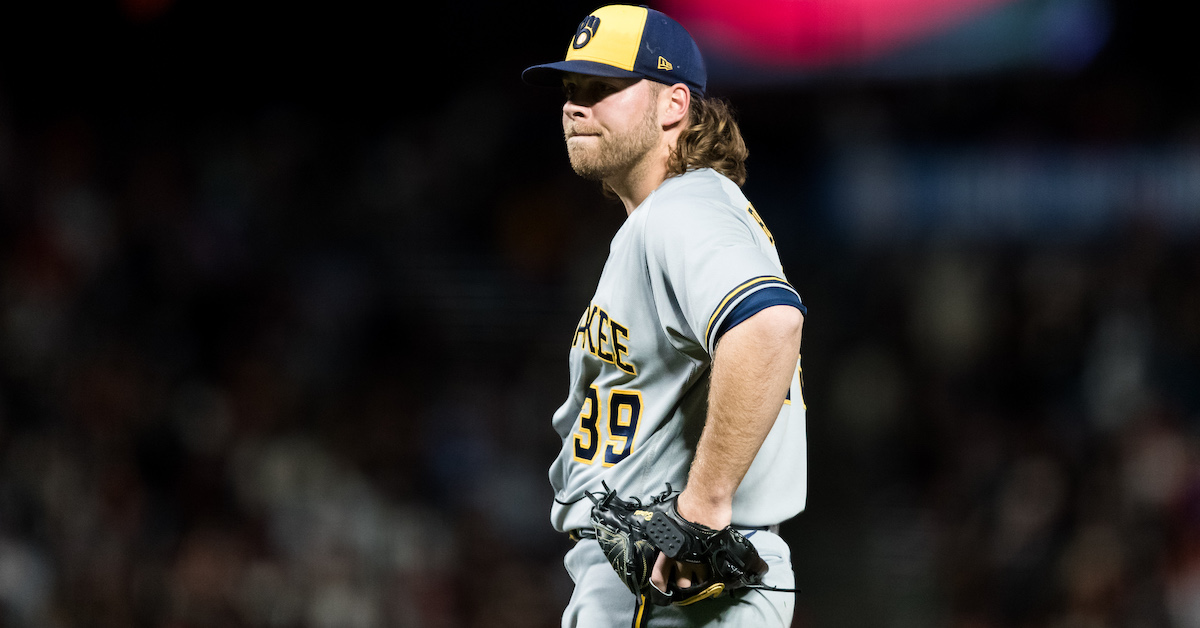
An increase in stolen bases wasn’t the primary aim of MLB’s offseason rule changes, but it was expected to be a happy side effect of new timing rules and bigger bases. Baseball fans will argue about just about anything, but stolen bases enjoy near-universal popularity. They’re exciting to watch, and they reward athleticism and initiative. The only drawback: They’re risky. And the new rules would mitigate that risk.
Over the first weekend of the season, the Orioles brought forth a new golden age of basestealing in the span of two days. In 10 attempts, they stole 10 bases off the Red Sox, and they did so without coming particularly close to getting thrown out.
“We just knew we needed to do a better job with the run game after that series,” Red Sox catcher Connor Wong says. “You can’t let guys run all over you and get into scoring position all the time.” Read the rest of this entry »
Last year, as you might have heard, the Guardians cracked the code. I say “you might have heard,” but let’s be honest: you heard. You couldn’t walk five feet without someone telling you that contact was in, that this team of genius mavericks had turned baseball on its ear by finding players who don’t fit the modern-day ideal. What dummies, those other teams! All you have to do is not strike out, and then baseball is easy. Why didn’t anyone else try this plan before?
Good news! The Guardians have continued their no-strikeout ways this year; they’re fourth in baseball in strikeout rate (lower is better), striking out only 20.3% of the time. But bad news! They stink. Their offense is hitting an aggregate .224/.301/.330, good for a 75 wRC+, the worst mark in baseball. The Athletics are in the middle of recreating the plot of Major League, and the Guardians are comfortably worse than them offensively. The Nationals traded everyone who wasn’t nailed down, then traded the nails they had left over, and the Guardians are comfortably worse than them offensively. They’re comfortably worse than everyone offensively; the Tigers are in 29th place, and they’re six points of wRC+ better. Only the Tigers and Marlins, who combine awful offense with awful baserunning, have scored fewer runs.
What gives? To some extent, this is about overhype. The Guardians had the lowest strikeout rate in baseball last year, but it’s not like they lit the world on fire offensively. They produced a 99 wRC+, which is below average (that’s how it works), and scored 698 runs, 15th in baseball. That’s despite playing a lot of games against the Royals, White Sox, and Tigers, who were all bad pitching teams. They did that with Andrés Giménez putting up a 140 wRC+ and Oscar Gonzalez coming out of nowhere to hit .296/.327/.461 over nearly 400 plate appearances. To put it mildly, those two haven’t backed up their performances this year. Read the rest of this entry »
Below is an evaluation of the prospects in the Chicago Cubs farm system who readers should consider “imminent big leaguers,” players who might reasonably be expected to play in the majors at some point this year. This includes all prospects on the 40-man roster as well as those who have already established themselves in the upper levels of the minors but aren’t yet rostered. We tend to be more inclusive with pitchers and players at premium positions since their timelines are usually the ones accelerated by injuries and scarcity. Any Top 100 prospects, regardless of their ETA, are also included on this list. Reports, tool grades, and scouting information for all of the prospects below can also be found on The Board.
This is not a top-to-bottom evaluation of the Cubs farm system. We like to include what’s happening in minor league and extended spring training in our reports as much as possible, since scouting high concentrations of players in Arizona and Florida allows us to incorporate real-time, first-person information into the org lists. However, this approach has led to some situations where outdated analysis (or no analysis at all) was all that existed for players who had already debuted in the majors. Skimming the imminent big leaguers off the top of a farm system will allow this time-sensitive information to make its way onto the site more quickly, better preparing readers for the upcoming season, helping fantasy players as they draft, and building site literature on relevant prospects to facilitate transaction analysis in the event that trades or injuries foist these players into major league roles. There will still be a Cubs prospect list that includes Alexis Hernandez, Cade Horton, and all of the other prospects in the system who appear to be at least another season away. As such, today’s list includes no ordinal rankings. Readers are instead encouraged to focus on the players’ Future Value (FV) grades. Read the rest of this entry »
Jonathan India started his career with a bang. In 2021, the Cincinnati second baseman put up a 120 wRC+ and 3.0 WAR over 150 games, good enough to snag National League Rookie of the Year honors. Last year, a hamstring injury limited him to just 103 games, and he struggled to a 95 wRC+ at the plate. He looked like a natural bounce back candidate coming into the 2023 season, and here he is bouncing back. After a big day on Sunday, India’s .306/.397/.460 slash line consists of three career-best figures. His underlying metrics are also better than ever in a host of categories.
Jonathan India – Year-Over-Year Stats
Season
Chase%
Whiff%
BB%
K%
GB/FB
Exit Velocity
HardHit%
wRC+
2021
25
22.8
11.3%
22.3%
1.32
87.6
38.1%
120
2022
27.9
21
7.2%
21.8%
1.14
85.1
28.8%
95
2023
22.1
14.3
11.6%
14.4%
1.19
90.2
43.8%
130
Let’s start with plate discipline. India is chasing less than ever, whiffing less than ever, walking more, and striking out way less. Those developments are all — and please excuse the inside baseball jargon here — very good. His chase rate has either improved or held steady against every pitch type except for sinkers, which have been something of an Achilles’ heel this year. He’s hitting them harder, but 71% of the sinkers he’s put in play have been groundballs, up from 54% in previous years.
India is reaching base more and hitting the ball much harder. After the previous paragraph, you might assume that his increased exit velocity has come from hitting more pitches in the zone, but the difference is smaller than you might think: 87% of his balls in play came on pitches in the zone, as opposed to 84% in 2021. Further, a close look at his batting line reveals something interesting: Although he’s hitting the ball harder and his BABIP is at a career high, his production on balls in play is still a ways off from where it was in 2021.
Jonathan India – Balls in Play
Season
BABIP
wOBA
xwOBA
2021
.326
.413
.395
2022
.305
.357
.339
2023
.343
.390
.366
Again, this is not necessarily a bad thing; walking more and striking out less has so far made this a worthwhile tradeoff. But it’s worth exploring why India’s newfound exit velocity hasn’t translated into as much power as we might expect. He’s currently running a .153 ISO, closer to the mark he put up last year than the .190 he posted in 2021. His barrel rate is likewise between his 2021 and ’22 figures, and his HR/FB is at a career low. Read the rest of this entry »
The Cardinals snapped their eight-game losing streak on Sunday thanks to Paul Goldschmidt’s three-homer day, but not before finding new ways to embarrass themselves this weekend. Saturday’s loss dropped them to 10–24, their worst record through 34 games since 1907. On top of that, that same day the team declared that Willson Contreras, the marquee free-agent catcher signed in December to replace the retired Yadier Molina, would no longer be the primary backstop but would instead spend his time as a designated hitter and corner outfielder, drastically reducing his value. A day later, St. Louis backtracked, announcing that Contreras will DH but have a path to returning to catching duties.
What in the world?
This is jaw-dropping, panicky stuff coming from what was supposed to be a well-run organization. The Cardinals entered the season having reached the playoffs in four straight years and won at least 90 games in each of the last three full seasons; twice in those four years they took home division titles, including last year, when they went 93–69. But more than 20% into this season, they own the National League’s worst record at 11–24, three games worse than the Rockies (14–21), the NL’s next-worst team, and only three games ahead of the godforsaken A’s (8–27) for the majors’ worst record. Read the rest of this entry »
The 2023 season represents a golden opportunity for the Brewers. Their long-time tormenters, the Cardinals, can’t get out of their own way. The Cubs aren’t quite ready for prime time yet. The Pirates are an awesome story, but they’re light on impact players; this feels more like a feel-good warmup for the future than their year to shine. But the Brewers have problems of their own: their vaunted starting pitching has let them down to start the year.
You might assume I’m talking about the shaky back of the rotation; after all, the Brewers have been built around Corbin Burnes, Brandon Woodruff, and Freddy Peralta for years now. But Wade Miley is holding up his end of the bargain, and even Colin Rea and Eric Lauer have turned in mid-4s ERAs — hardly a disaster. Instead, the problems have come at the very top: Woodruff is out indefinitely with a shoulder injury, and Burnes simply doesn’t look like himself this year.
Over the past three seasons, Burnes had established himself as one of the best pitchers in baseball. He has outrageous strikeout stuff; his 33.4% strikeout rate over those three years was 0.1 percentage points off of the best mark in baseball for a qualified starter. He mastered his command in the past two seasons, turning in back-to-back years of excellent walk rates. He even added durability, topping 200 innings in 2022, the first time in his career he’d even exceeded 170.
What’s gone wrong this year? A little bit of everything, to be honest. He’s walking more batters. His strikeouts have gone missing in action. His velocity is down across the board, as are his swinging-strike and chase rates. He’s giving up more contact than ever before, and “ever before” encompasses the 2019 season, when he ran up an 8.82 ERA and 6.09 FIP and got sent to the bullpen. In sum, he’s pitched to a 3.86 ERA and 4.34 FIP this year, quite the letdown after his last three years produced a 2.62 ERA and 2.40 FIP. Read the rest of this entry »
Josh Winckowski has been an invaluable piece in the Boston bullpen this season. Pitching in multiple relief roles — he’s entered games in the each of innings five through nine — the 24-year-old right-hander has a 1.57 ERA to go with a 2-0 record and one save. Acquired by the Red Sox from the New York Mets in February 2021 as part of a three-team, seven-player trade that featured Andrew Benintendi, Winckowski has tossed 23 frames over a baker’s-dozen outings.
He’d primarily been a starter prior to this season. All but six of Winckowski’s 90 minor-league appearances came as a starter, as did all but one of the 15 he made last year in his first taste of MLB action. That he’s thriving as a former 15th-round pick whose repertoire lacks power is also part of his story.
“I went through every level of the minor leagues and had to prove myself at all of them,” said Winckowski, whom the Toronto Blue Jays drafted out of Estero (FLA) High School in 2016 and subsequently swapped to the Mets in the January 2021 Steven Matz deal. “Somewhere in the middle there was a pitch-to-contact-and-miss-barrels.’ That’s the sweet spot for me. Quick outs — two or three pitches for outs — is definitely my game. It’s where I’m at my best.”
Winckowski does have the ability to strike batters out. While his K/9 is a modest 7.04 — last year it was just 5.6 — he fanned 9.2 batters per nine in Triple-A. Moreover, he’s not a soft-tosser. But while his sinker averages 95.1 mph, reaching back for more juice isn’t how his punch-outs come about. Read the rest of this entry »
Department: Baseball Operations Status: Full-Time Location: Los Angeles, CA Pay Rate: $120,000 – $150,000/year* Reports to: Director, Quantitative Analysis
*Compensation rates vary based on job-related factors, including experience, job skills, education, and training.
The Los Angeles Dodgers are looking for quantitative baseball researchers to turn data into actionable insights through use of mathematical and statistical models. Senior Analysts are expected to innovate on our core data products, identify future areas of innovation in predictive modeling, identify and implement best practices in developing and deploying code, and provide data-backed opinions to coaches and front office decision-makers on decisions regarding on-field strategy, player development, and player evaluation.
Essential Duties & Responsibilities:
Own the development and deployment of our most complex and highest impact predictive models
Identify, research, and implement opportunities for new models, data sources, and areas of baseball research
Contribute to high level planning and prioritization of projects within the QA group
Build internal tooling to make you and your peers more efficient
Understand the needs of users and evaluate the day-to-day impact of analytics products
Perform ad hoc data analyses to answer urgent questions from front office leadership and other groups within baseball operations
Advise executives and coaches on player evaluation, player development, and on-field strategy
Make public appearances to student and professional groups to aid departmental recruiting efforts
Provide mentorship to junior analysts, interns, and various members of the Dodgers organization not coming from a technical background.
Basic Requirements/Qualifications:
Passionate about winning championships
5+ years of experience building and evaluating predictive models in industry
Expertise in model deployment and tools for automating data science workflows
Experience maintaining a well-organized, well-documented code repository
Experience mentoring early-career data scientists
Nice to Haves:
Experience using data to advise decision-making in some domain
Experience with Bayesian Statistics
Experience with spatial statistics
Experience with analysis of time series data
Experience with machine learning, particularly problems involving computer vision
Experience maintaining and monitoring machine learning models in production
Department: Baseball Operations Status: Full-Time Location: Los Angeles, CA Pay Rate: $90,000 – $110,000/year* Reports to: Director, Quantitative Analysis
*Compensation rates vary based on job-related factors, including experience, job skills, education, and training.
The Los Angeles Dodgers are looking for quantitative baseball researchers to turn data into actionable insights through use of mathematical and statistical models. Analysts are expected to build and evaluate models, follow best practices in developing and deploying code, and provide data-backed opinions to coaches and front office decision-makers on decisions regarding on-field strategy, player development, and player evaluation.
Essential Duties & Responsibilities:
Maintain and make improvements to our core predictive models
Contribute features to internal tooling
Understand the needs of users and evaluate the day-to-day impact of analytics products
Perform ad hoc data analyses to answer urgent questions from front office leadership and other groups within baseball operations
Advise executives and coaches on player evaluation, player development, and on-field strategy
Make public appearances to student and professional groups to aid departmental recruiting efforts
Provide mentorship to junior analysts, interns, and various members of the Dodgers organization not coming from a technical background.
Basic Requirements/Qualifications:
Passionate about winning championships
2+ years of experience building and evaluating predictive models in industry or equivalent experience in academia
Experience maintaining a well-organized, well-documented code repository
Nice to Haves:
Experience using data to advise decision-making in some domain
Experience with model deployment and tools for automating data science workflows
Experience mentoring early-career data scientists
Experience with Bayesian Statistics
Experience with spatial statistics
Experience with analysis of time series data
Experience with machine learning, particularly problems involving computer vision
Experience maintaining and monitoring machine learning models in production
Department: Baseball Operations Status: Full-Time Location: Los Angeles, CA Pay Rate: $75,000 – $85,000/year* Reports to: Director, Quantitative Analysis
*Compensation rates vary based on job-related factors, including experience, job skills, education, and training.
The Los Angeles Dodgers are looking for quantitative baseball researchers to turn data into actionable insights through use of mathematical and statistical models. Analysts are expected to build and evaluate models, follow best practices in developing and deploying code, and provide data-backed opinions to coaches and front office decision-makers on decisions regarding on-field strategy, player development, and player evaluation.
Essential Duties & Responsibilities:
Assist more senior analysts in building, evaluating, deploying, and maintaining statistical and machine learning models of baseball data
Understand the needs of users and evaluate the day-to-day impact of analytics products
Perform ad hoc data analyses to answer urgent questions from front office leadership and other groups within baseball operations
Advise executives and coaches on player evaluation, player development, and on-field strategy
Continue to build your own data science skills and those of your colleagues
Basic Requirements/Qualifications:
Passionate about winning championships
Demonstrated experience building and evaluating predictive models. Candidates providing evidence such as a personal GitHub page will be given highest consideration.
Nice to Haves:
Experience using data to advise decision-making in some domain
Experience with model deployment and tools for automating data science workflows
Experience maintaining a well-organized, well-documented code repository
Experience with Bayesian statistics
Experience with spatial statistics
Experience with analysis of time series data
Experience with machine learning, particularly problems involving computer vision
Experience maintaining and monitoring machine learning models in production
When it comes to stealing bases, the Central division leaders couldn’t be more different. The Pirates rank first in baseball with 44 steals in 53 attempts; the Twins rank last with six steals in 11. But for the past ten games, these two teams have been taking a similar approach. Since the end of April, both have been ramping up their efforts, stealing far more often than they did over the first few weeks of the season. To be fair, that means something completely different for either club: for Pittsburgh, it means stealing at a rate we haven’t seen in years; for Minnesota, it means simply stealing at all. In both cases, it warrants a closer look.
In 2022, the Twins ranked last in baseball with 38 steals and 55 stolen base attempts. Their team leaders in stolen bases, Byron Buxton and Nick Gordon, had just six steals apiece. The Rangers, who led the league in steals, ran more than three times as often as the Twins:
Stolen Base Attempts (2022)
Team
Stolen Base Attempts
MLB Rank
Texas Rangers
169
1st
Miami Marlins
151
2nd
Chicago Cubs
148
3rd
Colorado Rockies
65
29th
Minnesota Twins
55
30th
Part of the problem was the lineup Minnesota was working with. Of its top five players by plate appearances, the fastest runner was Carlos Correa, who had a sprint speed in the 44th percentile and hasn’t been a stolen base threat since his age-21 season. Luis Arraez, Gio Urshela, Jose Miranda, and Gary Sánchez were the only other Twins with more than 450 PA, and none of those guys is winning a footrace, to put it kindly.
Even the fastest players in Minnesota were hesitant to run, however. Buxton was only on pace to add another four or five steals had he remained healthy; a player with his skills could have easily stolen 25–30 bags, at least. Presumably, he was staying put out of an abundance of caution for his physical safety, yet if that were the only explanation, it’s odd he was running as often as he did. He stole enough bases to put himself in harm’s way, but he wasn’t running enough to maximize his value on the basepaths. Other Twins who stole less than you’d expect included Gordon, Jorge Polanco, and Max Kepler. All three had above-average sprint speeds and above-average OBPs, but they attempted significantly fewer steals than in 2021. In other words, speed wasn’t the only problem. By all appearances, the Twins were discouraging their players from taking extra bases. Read the rest of this entry »
Sean Murphy does not get cheated when he swings. No matter the count, he is going to put up his A swing in hopes of barreling up the baseball. His profile is one of my favorites to watch. Although this type of hitter can be more prone to strikeouts than most, Murphy has managed to maintain a respectable strikeout rate in the last few seasons due to solid bat-to-ball skills and above-average plate discipline. Add solid raw strength on top of that, and you have yourself a career 116 wRC+ hitter. But this year, he has blown that mark away with a 182 wRC+ through 119 plate appearances. That’s an incredible jump that warrants some investigative work.
If I were a hitter looking to improve, I would focus on two things. The first is tweaking my mechanics to make myself less prone to exploitation. In other words, I’d make sure my bat path could cover different heights and depths of the zone so that I can be adjustable to different speeds and locations. The other approach would be to learn with what pitches and in which zones I’m already good at making flush contact and adjust my swing decisions to cater to those tendencies better. These two things are often intertwined, but depending on where a hitter is at in their career, they may focus on one more than the other or have an equal split.
For Murphy, it seems the focus has been more on matching his swing decisions to his strengths, and that has worked very well thus far. Below is a table with his swing rates by pitch type in the last few seasons:
Murphy Swing Decisions By Pitch Type
Year
Pitch
Swing%
Chase%
2021
Fastballs
45.4
25.5
2022
Fastballs
48.2
27.5
2023
Fastballs
36.9
15.7
2021
Offspeed
59.5
42.9
2022
Offspeed
49.4
29.5
2023
Offspeed
51.9
28.6
2021
Breaking
47.8
30.5
2022
Breaking
50.9
31.8
2023
Breaking
46.7
26.8
SOURCE: Baseball Savant
This year, Murphy is swinging at fewer fastballs and breaking balls than he typically has, leading to an overall Swing% decrease. In 2021 and ’22, he swung at fastballs and breaking balls 47.6% and 49.3% of the time, respectively. This year, that number is down to 43.0%, the lowest since his best offensive year in the shortened 2020 season, where his Swing% was 41.3%.
The bulk of that change comes from not chasing as often. Murphy’s chase rate on fastballs and breakers have both seen notable drops. For somebody who had a chase contact rate of 61.1% in 2022, this is a big improvement. Most hitters aren’t good at finding the barrel outside of the zone, and Murphy is no different. If you chase less frequently, you take away opportunities for more whiffs and barrel suppression.
As a hitter, if you get better at targeting locations where you know you have more room for error in terms of getting your barrel to the ball, then you can move your batted ball profile towards its optimal form. And that is exactly what Murphy has seen happen so far this season. For the first time since his cup of coffee debut in 2019, he is pulling half of his batted balls (50.7%). In the previous two full seasons, he pulled the ball 39.7–41.5% of the time. Pulling the ball isn’t always the right prescription for every hitter; for some, it risks too much top spin that can drag down your batted balls in the air, or it can mean not making contact when your bat path is in an upward trajectory (rolling over). But Murphy’s best contact has always come when he pulls the ball. Below is a table of all of Murphy’s batted balls greater than or equal to 95 mph and between an 8–32 degree launch angle; the former is Statcast’s definition of hard hit, and the latter is its definition of the sweet spot:
Murphy Hard Hit and Sweet Spot By Direction
Year
Direction
Percentage
2021
Pull
47.4
2022
Pull
38.7
2023
Pull
50.0
2021
Straight
38.6
2022
Straight
45.2
2023
Straight
37.5
2021
Oppo
14.0
2022
Oppo
16.1
2023
Oppo
12.5
SOURCE: Baseball Savant
The most ideal way to display this data would be bucketing by spray angle, rather than using Statcast’s directional definitions, but that data is not publicly available. If this were separated by spray angle, it’d be easier to see that batted balls to the left side of the field are most ideal for Murphy. Either way, the percentages clearly show that he doesn’t have the kind of opposite field power that would justify trying to make that a main part of his game. His best chances of hitting the ball hard in the air is by hitting it to the left side. The following spray chart shows you what this group of batted balls looks like on the field. (The venue chosen for the dimensions is Truist Park.)
If you couldn’t see it on the table, you can definitely see it here: Murphy’s home run power is from the pull side gap to the left field foul pole. Unfortunately for him, this wasn’t ideal for a right-handed hitter in Oakland. According to Statcast’s park factors, Oakland Coliseum has been the third-least hitter-friendly park for right-handed hitters in the last three seasons in terms of wOBACON, whereas Truist ranks seventh. And while home/road splits analysis doesn’t always tell the entire story of a hitter, Murphy’s 106 wRC+ at Oakland compared to 126 elsewhere during his tenure there is notable. Perhaps he feels more comfortable with this approach in his new home, but no matter what, it’s clear this is something that should be a permanent change.
Typically, this is the point in a piece where I introduce mechanical changes as a complement to the swing decision and batted ball analysis. But when I was watching Murphy’s tapes from this year and last year, he didn’t look all that different. See for yourself: The first three swings are from his final month in Oakland last year, and the other three are from his first month in Atlanta, all on fastballs in the heart of the plate:
2022 Swing 1
2022 Swing 2
2022 Swing 3
2023 Swing 1
2023 Swing 2
2023 Swing 3
The setup and finish are both very similar, the leg kick hasn’t undergone any significant changes, and the stride direction is almost identical. All I can say is that things look smoother and more connected. There might be slightly different timing mechanisms going on with the leg kick that has led to a more connected swing between the upper and lower body, but again, there haven’t ben any significant changes. That tells me that the change in swing decision is the leading factor in this early hot streak.
As hitters get older, they often better understand who they are and what their swing can do. There are multiple variables at play with Murphy, but it seems as if he has gotten to the point where he understands the exact approach he needs to have to be the best version of himself. We’ve seen this happen with hitters in Atlanta before, and he is most likely another example. Will pitchers adjust to his changed approach? Probably; that’s just life in the big leagues. But from his perspective, it can take years to get to this point where you know your recipe for success. Even when he sees his inevitable regression from his exorbitant .340 ISO, he will still know what his blueprint is to optimize his profile, and that is huge for himself and his team.