Archive for Teams

The Demystification of the Dinger

We live in an era of home runs. You know that. It’s been discussed ad nauseam on your favorite team’s broadcast, on your Twitter feed, and by your favorite baseball writers. We’re going to talk about it some more now.

The cause for this spike is manifold. Players are swinging up and for the fences, as you may have heard. They’re better-conditioned and better-fed. We understand the science and kinetics of hitting better than ever. The ball is quite possibly juiced. It’s a perfect storm of dingeritis that’s led to a fascinating new world where it’s not just guys like Aaron Judge and Paul Goldschmidt who are in scoring position the very second they step into the box. Well over 100 batters have hit at least 10 home runs, and we’re not out of June yet. The list grows to more than 240 batters if you include those who have hit at least 5, which means they’ve got a fair shot of getting to double digits before the season is out.

So yeah, we’re going coo-coo for Cocoa Puffs here. Which leads to an interesting question: if this continues, if the ball really is juiced and if players are going to keep chasing fly balls when they’re in the box, if anyone can hit the ball out, doesn’t that make a home run less special? Doesn’t that make a home run less valuable? Doesn’t it alter projections for amateurs and prospects?

There’s two important lines of thought there, so we’ll tackle the inside-baseball stuff first. If you’re running a baseball team, you’re probably no longer getting worked up over a free agent with 20-homer power because of his power alone. Why dish out a two- or three-year deal for a veteran when there are kids in your minor-league system who can replicate that kind of power on the cheap? Power was one of the last remaining calling cards of free agents. Defense and speed can decrease with time, but veterans could get paid for their bats. Rookies and journeymen like Yonder Alonso are suddenly tapping into previously unrecognized reservoirs of power with wild success. Not everyone has a Cody Bellinger sitting around at Triple-A, but given the way the ball is flying around and the way hitters are structuring their swings, you may be able to scrounge up 15 bombs for a league-minimum salary.

We already saw some of this over the winter when players like Chris Carter had a hard time finding work. Power is coming even easier now. It’s becoming less of a defining tool. If everyone can hit 15-20 bombs, it then becomes a question of what else a player can do for you, and for how much. Can you field well? Can you play multiple positions? Do you walk a lot? Can you do all that for cheap?

There’s more to this than team-building and the squeezing out of veterans, too. There’s a fan’s side to this too, and it’s probably more important. We’re now witnessing home runs more often than ever. Mark McGwire, Barry Bonds and Sammy Sosa aren’t running around out there anymore. The word “anabolic” isn’t in the papers all that often anymore. This is more dramatic than the steroid era. Maybe we’ll one day call this the “uppercut era,” the “juiced-ball era,” or the “three-true-outcomes era.” But this is clearly a different animal. Balls that have never really gone out before are going out. Is there a saturation point?

Read the rest of this entry »


Joe Maddon on Leadership and Straight Talk

The Charlie Rose Show is a personal favorite of this author. There’s little shouting, little over-the-top debate, few hot takes. Some of our greatest minds, innovators, and performers have gathered at Rose’s iconic oak table over the years.

I’ve always been curious about the studio environment because it’s so different. There’s no loud, elaborate set. The studio is the antithesis of an ESPN or cable-news backdrop, lacking similar bells and whistles, lacking gigantic flat-screens. I personally know of few people who have entered the studio as a guest but I was able to approach one recently in Pittsburgh: Chicago Cubs manager Joe Maddon.

Read the rest of this entry »


What the Rays Can (and Can’t) Learn from Local Minor-League Attendance

This is Michael Lortz’ fourth piece as part of his June residency at FanGraphs. Lortz covers the Tampa Bay baseball market for the appropriately named Tampa Bay Baseball Market and has previously published work in the Community pages, as well. You can find him on Twitter, as well. Read the work of all our residents here.

There’s been a lot of circumstantial and empirical evidence showing winning baseball games has an effect on the amount of tickets purchased in subsequent games. In 2008, Michael Davis of the Department of Economics at the University of Missouri-Rolla (now Missouri S&T) concluded that team success leads to greater attendance. However, Davis’s study had a huge flaw. He limited his study to “only the ten major league baseball teams that have played in the same city for over 100 years. This list includes five National League teams: the Chicago Cubs, Cincinnati Reds, Philadelphia Phillies, Pittsburgh Pirates and St. Louis Cardinals; and five American League teams: the Boston Red Sox, Chicago White Sox, Cleveland Indians, Detroit Tigers and New York Yankees.”

For the sake of determining whether wins matter, that’s way too small of a sample size. Davis might have had enough data points, but his data points were not representative of the wide array of situations with which franchises must contend.

In 2012, Dan Lependorf wrote a post for The Hardball Times concerning the relationship between wins, attendance, and payroll. Whereas Davis went deep in time for a few teams, Lependorf analyzed every team from 2000 to 2011. Lependorf concluded that the relationship between wins and attendance produced an R-squared of .27. There was an even stronger correlation to attendance and wins the previous season (R-squared = .3). Attendance in a season featured an even stronger relationship to attendance level in the previous season (R-squared = .8).

Every sports team in every city will draw at least one fan. In Major League Baseball, we can also guarantee that every team will win at least one game. We can also guarantee a top level of attendance depending on the maximum capacity of the stadium. For the Rays, that would be 40,135 times 81 — or 3,250,935. And, of course, the most wins the Rays can have in the regular season is 162.

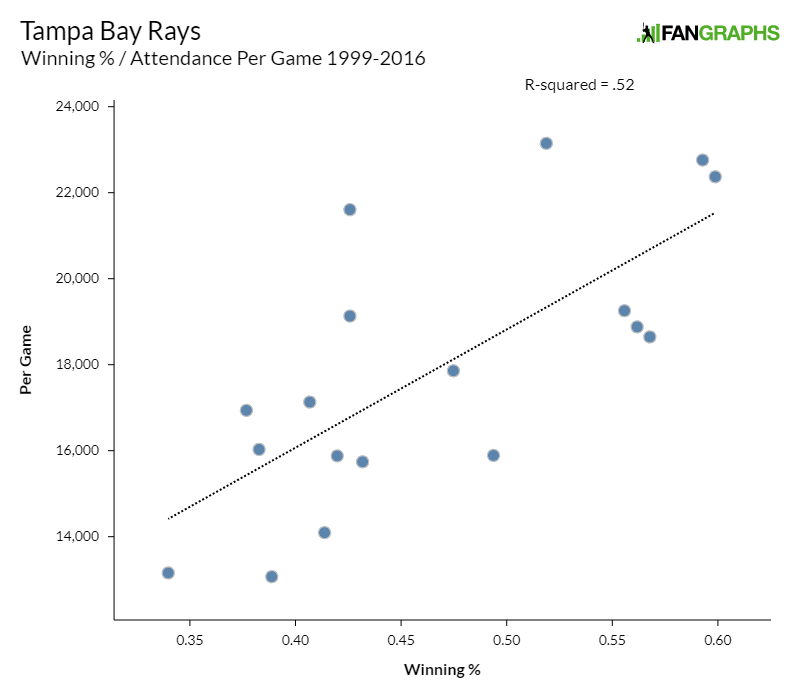
Since 1999 (excluding their inaugural season), the Rays have averaged 1.4 million fans and 75 wins per season. They’ve had eight seasons over 75 wins and nine seasons over 1.4 million fans. Since 1999, the correlation between the Rays’ winning percentage and attendance per game produces an R-squared value of .52.

That is almost double the correlation Davis found for teams. So despite the claims that wins don’t matter to attendance in Tampa Bay, they do. To a point.

Read the rest of this entry »


The Pirates Should Sell, Softly

In the coming days and weeks, you will read quite a bit about which teams should buy and which should sell, at FanGraphs and elsewhere. As the midpoint of the season approaches, the Pirates once again reside on the bubble. They’re a team once again with a slim but mathematically possible path to the postseason — a 2.9% chance, according to FanGraphs projections — a team that most expect to sell prior to the deadline.

Dave placed the Pirates in his sellers bucket earlier this week in his examination of the forming market, also noting that Andrew McCutchen had rebuilt some trade value due to his recent improvement — possibly a result, that improvement, of McCutchen having finally identified a swing flaw. After a lengthy down period, which included his baffling age-29 decline last season and an even worse start to the 2017 season, McCutchen more resembles his former self. The Pirates tried to move him last winter without success. If teams believe his current run is a result of tangible change, that could make him more appealing.

Retaining a resurgent McCutchen for 2018 might be Pittsburgh’s best plan. (Photo: Keith Allison)

Jon Morosi of FoxSports reports that the Pirates will listen on Gerrit Cole

Executives from other Major League teams said this week they expect the Pirates will listen to offers for Cole ahead of the July 31 non-waiver Trade Deadline, and that the A’s will do the same with Sonny Gray. …. For both the Pirates and A’s, a crucial part of the Trade Deadline calculus must be the opportunity to capitalize on an apparent shortage of No. 1 — and even No. 2 — starters available on this year’s trade market.

So what should the Pirates do?

They should sell, probably, but in a particular sort of way. In fact, they might have created a model to follow last deadline.

Read the rest of this entry »


Charlie Blackmon Hit a Silly Home Run

So far, the Diamondbacks have been a major surprise, and although every surprise is, by definition, surprising, there are degrees. What makes the Diamondbacks all the more surprising is that they are where they are without Shelby Miller. A Miller bounceback was supposed to be key to their hopes, but then he got hurt, which should’ve been trouble. Enter Zack Godley. Godley has plugged the hole, and then some.

Relative to last season, Godley’s been one of the more improved starting pitchers in the major leagues. While he has several elements going on at any one time, his main trick is a dynamite curveball that he’s fallen in love with. By run values, it’s been baseball’s second-best curveball, behind Corey Kluber and above Lance McCullers. Godley’s curve is something special, and it causes one’s discipline to deteriorate. It’s not an easy pitch to lay off.

Godley, on Thursday, got a start in Colorado. He faced Charlie Blackmon to lead off the bottom of the first, and Godley got Blackmon to a two-strike count. A couple curves couldn’t finish him off. Nor could a couple non-curves. Godley’s seventh pitch came in a 2-and-2 count, and at last he threw the pitch that he wanted. The curve caught the plate, but it plummeted below the zone. It was labeled for the dirt, but too sharp to spit on. It was the swing-and-miss curve to make Blackmon go away.

Read the rest of this entry »


Max Scherzer Is Mastering the Near Miss

One frequent topic of debate this season is whether Max Scherzer has overtaken Clayton Kershaw as the majors’ best pitcher.

Scherzer, for example, has recorded the majors’ second-largest strikeout- and walk-rate differential (29.1 points), behind only Chris Sale (30.5 K-BB%), while Kershaw ranks a somewhat distant third (24.6) by that measure. Scherzer (3.1) trails only Sale (4.6) in the FIP-based version WAR and leads all pitchers by the sort calculated with runs allowed. Scherzer also leads both Kershaw and Sale in Bill James’ starting pitcher rankings, something akin to world rankings in golf and tennis.

Depending on what metrics or qualities one cares to cite, the identity of Best Pitcher is open to debate. What’s not debatable is that, over the past three years or so, Scherzer has been the pitcher most likely to do something incredible in any given outing.

Read the rest of this entry »


Daily Prospect Notes: 6/22

Daily notes on prospects from lead prospect analyst Eric Longenhagen. Read previous installments here.

Jacob Scavuzzo, OF, Los Angeles NL (Profile)
Level: Double-A  Age: 23   Org Rank: HM   Top 100: NR
Line: 3-for-5, 3 HR
Notes
Scavuzzo has above-average raw power, but he often expands the zone; has a stubborn, pull-only approach to contact; and has long levers. That’s a potent swing-and-miss cocktail, but hitters with Scavuzzo’s body type sometimes put it together a bit later than their peers. He’s 23.

Read the rest of this entry »


The Rockies’ Road to Success on the Road

Earlier this week, Travis Sawchik took note of some steps that Colorado Rockies pitchers have taken this year to better succeed in the context of the team’s challenging home park. Jeff Sullivan added to the conversation the next day, observing that the Rockies have been fantastic on the road this season. To continue the investigation of Colorado’s strong campaign, I’ve attempted here to understand what factors have contributed to the Rockies’ road record — which stands at 25-13 entering today, the second-best mark in the majors. My conclusion? A good bullpen, the club’s first decent defense in quite some time, and some luck.

The Rockies have one of the best records in the majors this year. Examining merely the raw numbers, one might conclude that the club’s offense, which ranks fourth in runs per game, is largely to thank for that. That would be a bad conclusion to reach, however. For the Rockies, in their stadium, fourth is actually quite bad. After adjusting for park, the team’s offensive is 15% worse than league average, fifth worst in the majors. One might argue that the park adjustment penalizes hitters too much for Coors Field. Perhaps that’s the case. Even so, the Rockies have recorded a below-average offensive mark away from Coors, as well. Their offense, by most measures, just hasn’t been that great.

There are also suggestions that the club is perhaps getting a bit lucky. While the Rockies have compiled a 47-27 record overall, Pythagorean win percentage (which estimates a club’s record based on runs scored and allowed) has them at 43-31, while BaseRuns (which strips out sequencing) has them at 40-34. That could go a long way in explaining the Rockies road record: just chalk it up to luck and be done.

We can’t actually do that, though, because most of that luck has come at home for the Rockies. In 36 home games, Colorado has outscored their opponents by just 19 runs; on the road, that margin is 46 runs. At least in terms of runs scored and prevented, the Rockies have earned their road success.

Read the rest of this entry »


The Astros’ Grand Fastball Experiment

No team’s batters have ever seen fewer four-seam fastballs than the Houston Astros this year. Few teams’ pitchers, meanwhile, have thrown fewer four-seam fastballs than the Houston Astros this year. This all has something to do with changes in baseball, yes, and also with the personnel on this current team. But there’s also a wrinkle to the thing that tells us a little more about why these trends are happening, and why the Astros are at the forefront in both cases.

Read the rest of this entry »


Twins Prospect Zack Granite on His Success at Triple-A

Zack Granite is hitting the ball as hard as anyone in Triple-A. Not in terms of power — the 24-year-old Minnesota Twins prospect is a slasher, not a basher — but the line drives have been coming fast and furious. Granite leads the International League in batting average by a whopping 30 points. Jump-starting the Rochester Red Wings’ offense out of the lead-off spot, the left-handed-hitting outfielder is slashing .349/.404/.494.

When Eric Longenhagen profiled Granite in his Twins top-prospect list, he wrote that “his ability to play center field well, run, and put the bat on the ball, points toward a near-certain big-league role of some kind.” When (and if) that comes to fruition is yet to be determined, but the 2013 14th-round pick out of Seton Hall University is making a case for it to happen soon. Since June 2, Granite is 37 for 75, with nine doubles, three triples, a home run, and 11 walks.

Granite talked about his game — and tossed a few playful jabs in the direction of one of his teammates — when Rochester visited Pawtucket over the weekend.

———

Granite on an adjustment that’s helped fuel his surge: “I’ve moved a little closer to the plate. I think that has kind of helped me see pitches better. A lot of pitches away that were strikes, I was taking. That’s my game — going the other way — so I was kind of getting away from my game. I also just feel really good at the plate right now, which is obviously helping a lot.

“Opposite field is my security blanket, but I’m getting better at pulling the ball. I worked on that a lot last year with my manager, Doug [Mientkiewicz]. I’d always been ‘stick to left, stick to left,’ and he helped me learn how to pull the ball — how to attack it the right way. That’s another repertoire, another factor, to my game now.”

Read the rest of this entry »

