NEW YORK — For one brief moment, all had been forgiven. The unreasonable hope, the unbearable burden, the unfulfilled potential — it all had led to this point, when the local kid and lifelong Yankee fan finally made good.
Anthony Volpe stepped into the box in the bottom of the sixth inning with a runner on first, two out, and the Yankees down by two and facing elimination in Game 3 of the American League Division Series. After taking a Griffin Jax sweeper in the dirt for a ball, the one-time second coming of Derek Jeter, who’d stalled and backtracked and flamed out in frustrating fashion, turned on a sinker running in on his hands and lifted a high-arching fly ball to left field that just cleared the wall for a game-tying home run. As he made his way around the bases, all the emotions of the last four years came pouring out of him.
But just after he crossed the plate, the six umpires came together and called for a crew chief review. Reality set in as the replay repeated on the jumbotron in center field, showing different angles of the same disappointing event. Several minutes of deliberation made it official: The home run was overturned. A fan in the first row had reached over the wall with both hands and touched the ball before it rolled up his arms and into his lap.
Volpe was awarded second base, as the umpires determined that the ball would not have been caught even if the fan hadn’t interfered with it. They also concluded that George Lombard Jr., who began the play on first and was running on contact with two outs, would’ve scored on the play. That run turned out to be the final one of the game for either team, as the Rays held on to beat the Yankees, 4-3, and complete the sweep. Read the rest of this entry »
Do you ever stop and think about how baseball would be different if the ball smelled delicious? Imagine that Major League Baseball, in its never-ending quest to abase itself for sponsorship dollars, forges an innovative partnership with Willy Wonka. In exchange for the title of Official Chocolate of Major League Baseball and the right to outfit the umpires in his trademark violet velvet coats, the eccentric chocolatier uses his quasi-supernatural confectionary gifts to impart one of several dozen mouthwatering aromas to each and every baseball used in a game. This baseball smells like warm chocolate chip cookies, the next one like toasted marshmallows, and the one after that like snozzberries. You get the idea.
Now imagine you’re pitching in the World Series. The umpire reaches into the pouch that dangles from their belt (but awkwardly, because they first have to flap the side of their knee-length velvet coat out of the way), grabs a new pill, and fires it out to you. Millions of eyes are on you. The game is on the line. The season is on the line. You’d still raise the ball up to your face for a whiff before you got settled on the mound, right? You’d have to. Would you really be able to go without smelling the ball? You know it smells amazing, but you don’t know how. If you didn’t sniff the ball, wouldn’t the curiosity about its scent be so distracting as to have a deleterious effect on your ability to pitch? Could you really say you’re putting your all into each pitch if you’re not acquainting yourself as fully as possible with the one and only tool of your trade?
I imagine that sniffing the ball would be something of a flex for infielders. Those who gloved a grounder with time to spare would earn the right to take a healthy waft before firing it over to first. I further conjecture that throwing the ball around the horn after a strikeout would take longer because the outfielders would insist on being included too. More importantly, I imagine that the error rate might tick down just the slightest bit. I’m not saying that major league fielders lack motivation to hold onto the ball as things stand right now, but I hardly think it would hurt to supply them with an additional reason to give it their all. Letting a ball go right through your legs feels terrible, but it probably feels just a little bit worse when you know that along with hurting your team, you’ve fumbled away a transportive sensorial experience. Maybe that would push you to take that extra round of infield practice, to lock in on every single pitch, to lay out for that ball. Anyway, that’s what I was thinking about in the shower this morning as I reflected on the fact that last night, in the biggest game of the season, the New York Yankees played as if the ball smelled like a butt. Read the rest of this entry »
The Tampa Bay Rays won the most games in the American League this year while running the AL’s second-lowest payroll. That’s a feat of team-building, first and foremost, but it also speaks to how well their players dodged leaks. On offense, they had the lowest strikeout and whiff rates in the majors; their pitchers had the league’s lowest walk rate and just 18 blown saves. You can’t make mistakes if you’re the Rays.
That’s a well-worn cliché, but here’s a novel spin on it: You can’t make mistakes if you’re the Yankees either. Presumptive AL Cy Young winner Cam Schlittler did some terrific work in his first career playoff road start, and no one’s going to remember it, because the other eight guys in gray pajamas played like the ball was covered in dish soap in Game 2.
The Yankees committed three errors in the bottom of the first inning, and another in the fifth. The Rays scored five runs across those two half-innings, and there’s your final score: Rays 5, Yankees 2. Read the rest of this entry »
Cam Schlittler threw the Red Sox a curveball in Game 1 of the AL Wild Card Series. Well, actually, he threw them a lot of curveballs — 32, to be exact.
In the Yankees’ resounding 9-0 win over their archrivals last week at Yankee Stadium, the 25-year-old flamethrower went 6 1/3 scoreless innings, giving up just two hits and one walk while striking out 10 and throwing a career-high 117 pitches. Except for the pitch count, his final line reflects the same dominance we’ve seen repeatedly throughout a 2026 season in which Schlittler went 14-6 with a 1.95 ERA, a 2.56 FIP, and 6.2 WAR across 193 2/3 innings. The difference this time was how he got there, and it poses a new challenge for opposing batters when he starts against the Rays in Game 2 of the ALDS on Monday night at Tropicana Field.
Schlittler turned to the curveball early and often, utterly baffling a Boston lineup that was geared up for his signature three-fastball repertoire. Instead, they got a heavy dose of the hook and couldn’t handle it. In Game 1, he threw his curveball 27.4% of the time. The Red Sox swung at 16 of the 32 curves they saw from Schlittler, whiffing on eight of them, fouling off six, and putting two in play; the first of those two fair balls was a softly hit lineout to shortstop in the fifth inning, while the second came when Wilyer Abreu lined the right-hander’s last pitch of the game to right field for a single. Four of Schlittler’s 10 strikeout pitches were curveballs, all during his first time through the order. Read the rest of this entry »
Generally picked to win the AL East before the 2026 season, the New York Yankees spent the final four months of the season looking up at the Tampa Bay Rays in the standings. If the Bombers were hoping to avenge their second-place finish in their Division Series matchup with their AL East foe, they got off to a poor start on Saturday evening, losing 1-0 in a game that felt more lopsided than the one-run margin would suggest. Taking a no-hitter into the eighth inning, Drew Rasmussen dominated the Yankees, with his bid for history only spoiled by an Austin Wells two-out double that the New York catcher unsuccessfully tried to stretch into a triple. Bryan Baker quickly dispatched the Yankees in the ninth to give the Rays a 1-0 series lead to match the final score.
In a game without much in the way of offense, Rasmussen was the biggest story. Unfazed by a New York lineup that consisted almost entirely of lefties — not entirely surprising as Rasmussen has shown no platoon differential over his major league career — he freely mixed his four pitches, with the Yankees not having an answer for any of them. Rasmussen struck out 10 batters over eight innings and still cruised enough that, if the Rays’ cushion had been larger, he may very well have been sent out for the complete game in the ninth.
As playoff starts go, Rasmussen’s stands out not just as a pretty darn good start, but one that was good enough to rank with the best in recent history. Bill James’ Game Score is useful for this kind of thing, and Rasmussen’s Game Score of 88 is tied for the 15th-best playoff start of the Wild Card era (1995-present). Among games of the last decade, only Blake Snell’s 2025 NLCS Game 1 start ranks higher. Snell’s performance featured a final line that was nearly identical to Rasmussen’s (8 IP, 1 H, 0 ER, 10 K, but no walks).
It certainly wasn’t passivity that caused the Yankees to fail against Rasmussen. It’s well known that the Yankees are a low-contact team, with the fourth-lowest contact rate in baseball in 2026, and ahead of only the White Sox among playoff clubs. But they also weren’t as selective as usual with their swings against Rasmussen, chasing 37% of his out-of-zone pitches, including 69% of the changeups. For the game, the Yankees had a 43.1% whiff rate, their second-worst number in 2026, and the 24th worst out of the 3,082 games they’ve played since the start of the 2008 season.
There were, of course, a few productive moments in a night of offensive woes. George Lombard Jr. hit a couple of scorchers where they could be easily caught by outfielders, and I’d argue that both could very well have been home runs if his swing had connected with the ball a whisper of an instant earlier. Jazz Chisholm Jr. worked a nine-pitch walk, though it turned out to be moot; the Yankees left him at first and the additional pitches had no noticeable impact on Rasmussen, who never seemed to tire. He was throwing as hard in the eighth as he was in the first. Behind the plate, Wells nailed two ABS challenges in the first inning, including a strike three on the teensiest edge of the strike zone to Chandler Simpson that ended the first with the Rays stranding two runners.
Meanwhile, the Yankees’ excellent pitching staff was about as good as advertised. Gerrit Cole pitched well in his first postseason start since 2024; he just didn’t quite match Rasmussen’s dominance. His game plan was a heavy dose of fastballs and knuckle-curves, and after the first inning, the Rays weren’t particularly successful at stringing hits together. Cole’s lone blemish came with one out in the third inning, when Jonathan Aranda barreled up a thigh-high changeup on the outside edge of the plate for a home run.
As the night went, it was almost fitting that New York’s sole bit of offense, a Wells double, was also arguably the team’s worst moment. In the eighth, with two out, Wells rocketed a Rasmussen sinker down and in and right in his wheelhouse into the right field corner, the hardest hit of the night at 107.8 mph. The hit not only broke Rasmussen’s no-hitter; it also broke the hearts of Yankee fans, as Wells decided that with two outs, he was going to try and leg out the triple. Suffice it to say, the guy who looks like a no-nonsense police captain on a 1970s TV show did not successfully channel Rickey Henderson. Any reasonable relay would’ve nailed Wells at third, and the one from right fielder Victor Mesa Jr. to shortstop Taylor Walls to third baseman Junior Caminero proved to be more than reasonable.
Baker came out in the ninth, whiffed pinch-hitter Giancarlo Stanton in his first plate appearance since April, froze Ben Rice on a changeup, and got Cody Bellinger to ground out to end the game. Part of me wonders whether Rays manager Kevin Cash was secretly relieved that Rasmussen’s no-hitter was broken up, as letting a pitcher try to finish a no-hitter in a 1-0 game is a whole lot scarier than in an 8-0 laugher.
It may not be remembered in light of Rasmussen’s performance, but after Mesa’s single in the fourth inning, Cole and three relievers (Ryan Weathers, Paul Blackburn, Brent Headrick) held the Rays hitless for the rest of the game, preventing any inconvenient insurance runs from scoring. Those insurance runs were not needed.
If there’s any silver lining, it’s that this was the game in the best-of-five series that ZiPS projected the Yankees to have the lowest probability of winning. I believe Cole is a future Hall of Famer, but at this point of his career, I think he’s no better than the fourth-best starting pitcher in the New York rotation. Losing any game in a short series is bad, of course, but it’s less impactful on the Yankees’ chances of advancing than if the Rays had spoiled a Cam Schlittler start. It would be dangerous to count the Yankees out, but the Rays simply looked like the better team in the opening battle.
Kirby Lee, Denis Poroy, Vincent Carchietta and Brad Penner-Imagn Images
In basketball, the biggest offensive threat is usually guarded by the other team’s best defender. A football team’s most dynamic wide receiver has to worry about lining up across from an All-Pro cornerback. But in this sick and twisted sport, sometimes good-on-good instead becomes good-on-whoever-we-have-available. For the 2026 crop of Division Series, there is no shortage of micro matchups — both because the soft underbelly of every roster typically gets exposed in the postseason, and because every organization’s horde of spreadsheet nerds will be combing through information looking for advantages — that may or may not seal a team’s fate.
San Diego Padres vs. Milwaukee Brewers: Run Game vs. Run Game
The Padres and Brewers series will feature a lot of things: two cities that love beer, a blinding amount of yellow arm sleeves and rally towels, and a bunch of basepath thievery.
Both of these teams finished top five in total stolen bases this year, each employing a crew of bandits that will surely look to continue their heist. The Padres were one of just five major league teams to have multiple players swipe at least 25 bags, as Fernando Tatis Jr. and Jackson Merrill took 38 and 27, respectively. Xander Bogaerts, who was not much of a basestealer until arriving in San Diego in 2023, has also joined the party. His 22 steals in 2026 — during his age-33 season, impressively — marked a new single-season best, topping the previous career high of 20 he set in 2025. And while neither received enough playing time to put up those kinds of numbers, speedy outfielders Samad Taylor and Jase Bowen both have elite sprint speed and solid base-stealing acumen. Read the rest of this entry »
Welcome to the strong side of the bracket. This ain’t no Guardians-White Sox. They may not have been sanctified by the Bishop of Rome, but we’ve got a matchup between the Rays and the Yankees, the two best teams in the American League. Or, at least, the teams with the two best records. The Rays won 98 games, which gave them the best record in the American League by a whopping five-game margin. With 93 wins, the Yankees were the only team within 11 wins of the Rays! But according to both their BaseRuns and Pythagorean records, the Rays played above their heads and the Yankees are the better team.
The Rays won the season series, 7-6, but four of those 13 games took place very recently. In the penultimate series of the regular season, the Yankees took three of four from the Rays in the Bronx. Somehow, this is just the second time the Rays and Yankees have ever faced off in the playoffs. Tampa Bay beat New York, 3-2, in the 2020 ALDS. Gerrit Cole went 1-0 in two starts in the series, and Giancarlo Stanton batted .316 with four home runs. Aaron Judge knocked two homers of his own, but batted just .143. Yankees reliever Ryan Yarbrough pitched pretty well too, but he did so for the Rays. Anyway, that was six years ago in a season that just barely happened. So much for history.
In years past, we’ve hashed out and rehashed the great debate: Would you rather have a bye and risk the rust, or would you rather come off a series win, triumphant but unrested? This conversation has always been at least a little bit silly because it’s always better to take the bye; no one has ever lost a bye. Still, this year, it’s different. The Rays will be coming off five full days of rest. They could be rusty. But the Yankees won’t be tired. They got three days off before the Wild Card series, and they finished stomping a mudhole in the Red Sox on Wednesday night, giving them two full days off to recover. The entire bullpen is rested. Presumptive (read: 100% certain) AL Cy Young Cam Schlittler won’t pitch Game 1, but he’ll be on regular rest for Game 2 and a potential series-deciding Game 5. The offense that everyone was worried about just put up back-to-back nine-spots. Momentum may be a construct, but you’d still rather have it on your side, right? Read the rest of this entry »
Albert Cesare/The Enquirer / USA TODAY NETWORK via Imagn Images and Eric Hartline-Imagn Images
Credit the Phillies for trying. When I highlighted the worst defenses among contending teams in early July, they were the poster boys, scoring worse than any team besides the decidedly non-contending Rockies in the multi-metric methodology I’ve used for the past four seasons. But when the August 3 trade deadline arrived, president of baseball operations Dave Dombrowski took a step to improve that shoddy defense, acquiring second baseman Luis Arraez from the Giants and setting off a game of musical chairs that sent incumbent second baseman Bryson Stott to third base, third baseman Alec Bohm to first, and first baseman Bryce Harper to right field. The defense at those spots mostly improved, but last Thursday, with the Phillies in the midst of what would become a 2-6 skid that nearly cost them a Wild Card berth, Arraez sprained his left ankle while trying to avoid a tag at first base. On Monday, interim manager Don Mattinglyannounced that the 29-year-old infielder will be left off the roster for the team’s Wild Card Series against the Braves.
How Mattingly will proceed with his lineup is unclear. In the three games Arraez missed — including Sunday’s playoff berth-clinching win over the Rays — Edmundo Sosa started at third base twice while Stott returned to second, while in the other game, Bohm and Harper moved back to their original positions as well; they lost that one 12-1.
Below I’ll take a closer look at the metrics underlying the Phillies’ defensive configurations, but long story short, they rate as the playoff team with the worst defense, as they did last year and in 2023. Read the rest of this entry »
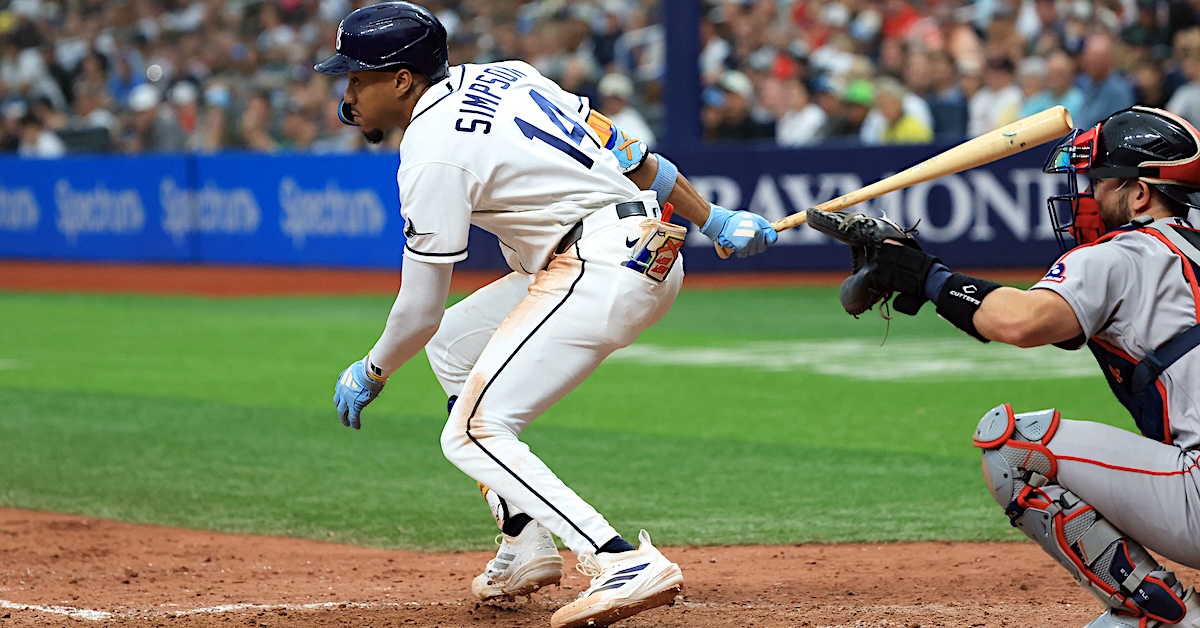
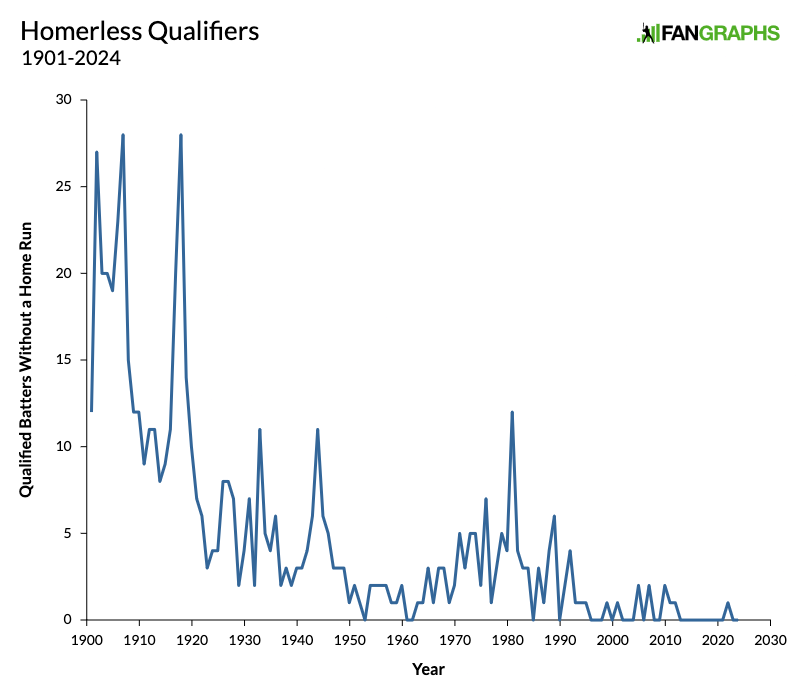
Well, I jumped the gun by a year. Last year, I got excited that the Homerless Qualifier Club might be reopening. Nick Allen was playing every day for the Braves, and Nick Allen’s approach to impacting the baseball is sort of like Atticus Finch’s approach to parenting: It’s composed almost entirely of occasional, gentle nudges in the right direction. If Allen could just get enough plate appearances, I figured, he’d qualify for the batting title without a single home run to his name, making him just the second new member since 2012. The problem was that Allen didn’t just lack punch; he couldn’t get on base at all. The Braves batted him last and pinch-hit for him every chance they got, then gave his spot to waiver wire pickup Ha-Seong Kim. Allen never homered, but he ended up 86 plate appearances short of qualifying. This year is different. This year it’s in the bag. Chandler Simpson has already qualified for the batting title, and he is about to finish the season without a single home run.
As was the case for Allen, the reason that the Homerless Qualifier Club has been closed for business for so long is that it’s really hard for a regular baseball player to be playable without any power whatsoever. Allen’s a defensive specialist whose game has never been built around the home run ball, but he still needs some base level of power to keep his offense from sinking the entire profile. Think of your favorite contact hitter – Luis Arraez, Steven Kwan, Nico Hoerner – these guys are much better at avoiding strikeouts than Allen, and they still hit the ball hard enough to rack up a bunch of doubles and at least a handful of home runs a year. Meager though it is, if that power production were to disappear, their offense would simply be too much of a deficit to overcome. They’d stop getting enough plate appearances to qualify for the batting title. That’s why the pipeline has dried up.
This season, Allen has just 161 plate appearances with the Astros, but he’s betrayed us to the tune of a whopping three home runs. Stretch that over 500 plate appearances and he’s nearly in double digits. My point is that although these are extreme examples of contact hitters, they still have plenty in common with the rest of the league. They are still looking to drive the ball, at the very least, over the infield. Simpson may as well be playing a different sport. Read the rest of this entry »
The Yankees had to make do without Aaron Judge for all of June, July and August due to a stress fracture in his right first rib. With the days on the calendar dwindling and the AL East title still in play — which is no longer the case after the Rays clinched on Tuesday night — Judge bypassed a rehab assignment, but once he returned, he played in just seven games before landing back on the injured list due to a right calf strain. Both the slugger and the team took great pains to avoid discussing the injury’s specificity and timeline for recovery until Tuesday, when manager Aaron Boonerevealed that Judge has a “moderate grade” strain, received a platelet-poor plasma injection, and isn’t expected to be available for the team’s Wild Card Series rematch against the Red Sox.
While deadline acquisition Heliot Ramos has heated up after a very slow start to his pinstriped career, the Yankees’ right field situation is one of the more glaring potential trouble spots among American League contenders. As the playoffs approach, teams no longer have a chance to upgrade from outside their organizations and instead must make do with the talent on hand. What follows here is a look at the most vulnerable teams at each position — something of a companion to my annual pre-deadline Replacement Level Killers series, with a focus on the teams that still have a chance to make the playoffs. For the AL, that means the Rays, Yankees, and Red Sox — all of whom have clinched spots — plus the Guardians, White Sox, Rangers, and Astros, who are battling for the other two division titles and the third Wild Card spot. I’ve taken the Blue Jays out of consideration, as their Playoff Odds now start with a zero in front of the decimal. While full-season performances play a significant part here, I’m more concerned with who’s worst now, with injuries and adjustments in mind. Each position has a headliner (or two, if it’s a job share), but at several positions, I’ve noted other teams with concerns. A companion National League piece will follow. Read the rest of this entry »