Archive for Rays

Yandy Díaz and the Groundball Revolution

If you’ve followed FanGraphs the past few years, you know the Yandy Díaz story by now. As an Indians prospect, his contact and on-base abilities marked him as a potential major league contributor, but his physique hinted at more: Díaz excelled despite a plethora of groundballs, and he also had elite bat speed and exit velocity numbers at times. If he could just aim up a little more, the thinking went, he could be the next launch angle success story.

When the Rays acquired him in a trade before the 2019 season, it wasn’t hard to connect the dots. The Rays acquired an already-usable player with a fixable flaw? We’ve certainly heard that story before. Indeed, Díaz spent 2019 putting balls in the air at a rate he’d never approached before. His fly ball rate spiked, his groundball rate dropped, and he hit double-digit homers for the first time in his professional career.

All of those balls in the air made Díaz a different hitter, but they didn’t change the core of his approach at the plate: wait patiently for a pitch he liked, then try to hit the snot out of it. As FanGraphs alum Sung Min Kim detailed, he mostly accomplished it without a swing change; he simply focused on finding pitches to drive rather than spraying grounders.

The evidence was there if you wanted to look for it. His air pull rate, the percentage of line drives, pop ups, and fly balls that he sent to left field, jumped significantly. At the same time, he started hitting fewer grounders; his GB/FB ratio dipped to heretofore unseen lows:

Elevate and Celebrate
Year GB/FB Air Pull%
2017 3.13 9.8%
2018 2.29 9.5%
2019 1.59 18.9%

Read the rest of this entry »


That Name Again Is Brandon Lowe

Through Monday night, major league baseball teams have played 415 games, the same number of games they had played on April 28 of last year. Back then, Cody Bellinger, Christian Yelich and Mike Trout were the top three players by WAR. Also in the top 10 were Matt Chapman, Marcus Semien, Pete Alonso, Anthony Rendon, Javier Báez, and Paul DeJong, who all went on to have good-to-great seasons. Elvis Andrus, on the other hand, put up 1.5 WAR through most of April and was replacement-level the rest of the way. Moving one month forward, a stretch equivalent to half of this season, Pete Alonso was replacement-level in May. Marcus Semien put up an 80 wRC+. All of which serves as a good reminder that in this shortened season, it’s best not to make too much of one month’s worth of performance when looking forward. That said, though, let’s take a look at the current WAR Leaderboard for position players:

2020 Position Player WAR Leaderboard
Name Team PA OBP SLG wRC+ WAR
Mike Yastrzemski Giants 133 .429 .645 184 2.2
Fernando Tatis Jr. Padres 134 .396 .678 183 2.1
Mookie Betts Dodgers 122 .369 .664 174 1.8
Anthony Rendon Angels 117 .453 .558 179 1.8
Brandon Lowe Rays 118 .398 .676 190 1.8
Kyle Lewis Mariners 125 .456 .585 190 1.7
Nelson Cruz Twins 119 .429 .699 198 1.7
Trent Grisham Padres 131 .369 .514 140 1.4
Bryce Harper Phillies 96 .453 .667 191 1.4
Ian Happ Cubs 108 .411 .575 161 1.4
Through August 24

Over the last month, Ben Clemens has written about Mike Yastrzemski, Mookie Betts, and Ian Happ; Jay Jaffe has added his own piece on Betts. Fernando Tatis Jr. has been featured in posts from Jaffe and Dan Szymborski, and ranked very highly in our Trade Value Series. Jake Mailhot has written up Kyle Lewis and Trent Grisham. While Anthony Rendon, Nelson Cruz, and Bryce Harper have all been great and perhaps deserve articles of their own, their greatness isn’t too far removed from our general expectations for them. That just leaves Brandon Lowe, whose start definitely merits attention. Read the rest of this entry »


Jalen Beeks, Now With More Whiffs

During this shortened season, pitching depth has become a crucial separator for contending teams. With injuries taking a greater toll on pitching staffs and hurlers still ramping up after an abbreviated summer tune-up, many teams have had to scrounge to fill all those vacancies. The Tampa Bay Rays entered the season with one of the deepest pitching staffs in baseball. They led the majors in league- and park-adjusted FIP last year, using 33 different pitchers throughout the season, and the bulk of the staff returned in 2020.

That depth will be tested after a rash of injuries decimated the Rays’ rotation. Both Charlie Morton and Yonny Chirinos were placed on the Injured List this week, Andrew Kittredge left his start yesterday after facing just two batters, and Brendan McKay was shut down from throwing at the Rays alternate training site yesterday. To make matters worse both Blake Snell and Tyler Glasnow have been slow to ramp up to full strength after getting a late start to pre-season activities — Snell had lingering issues with his elbow and Glasnow tested positive for COVID-19. The current rotation depth chart for Tampa has Snell and Glasnow at the top, Ryan Yarbrough next, and a bunch of question marks after that.

Two possible candidates to step into the rotation are Trevor Richards and Jalen Beeks. Both are intriguing — Richards possesses a killer changeup but has struggled to maximize his entire repertoire. Meanwhile, Beeks has made some real improvements to his approach that gives him considerable upside if he were to join the rotation.

Beeks was acquired by the Rays from the Red Sox in mid-2018 when Boston traded him straight-up for Nathan Eovaldi. He had just made his major league debut in Boston earlier that year but struggled to make an impact during his first two seasons in the bigs. He’s posted a 4.49 FIP across more than 150 innings during 2018 and 2019. Most of those innings came as a bulk reliever used after an opener. His strikeout rate during that time was a lackluster 19.1% and his 9.3% walk rate was a bit above league average. Read the rest of this entry »


Ji-Man Choi Pulled a Surprising Switcheroo

The downtime produced by shelter-in-place orders and other restrictions during the coronavirus pandemic has inspired many people to take up new hobbies or polish previously dormant skills. The Jaffe-Span household, for example, has created a windowsill garden with herbs and vegetables, and every person on social media can name a friend or five who has tracked their recent forays into breadmaking. Ji-Man Choi apparently used his time to rediscover the advantages of switch-hitting. On Sunday, in the first major league game in which he batted right-handed, the Rays’ 29-year-old first baseman clubbed a home run off Blue Jays lefty Anthony Kay.

It wasn’t a cheapie, either. Choi hit a 429-foot shot that came off the bat at 109.9 mph — the second hardest-hit homer of his five-season career:

The South Korea native, who began his stateside professional career in the Mariners’ organization in 2010, and who does throw right-handed despite regularly batting left-handed, isn’t a complete newcomer to switch-hitting. In 2015, after breaking his right fibula during spring training, he spent time learning to switch-hit under the tutelage of Mariners Triple-A hitting coach Howard Johnson, who spent 14 seasons switch-hitting in the majors, primarily with the Mets and Tigers. Upon returning to action in August, first with the team’s Arizona League affiliate and then with the Triple-A Tacoma Rainiers, Choi went 6-for-14 with a double and a walk while batting righty against left-handed pitchers, and 0-for-2 with two walks while batting righty against righties.

“I did it, and it worked well, so I kept doing it” Choi told MLB.com’s Alden Gonzalez (through an interpreter) the following spring. Gonzalez noted at the time that Choi’s leg kick was more pronounced from the right side of the plate. “But I don’t worry about the form,” Choi said, “I just concentrate on hitting the ball. See the ball, hit the ball.”

That conversation took place in the context of Choi having joined the Angels via the Rule 5 draft. Less than three weeks later, however, the team asked him to abandon switch-hitting, with manager Mike Scioscia saying that the Angels felt Choi’s left-handed swing was better, and that they planned to use him more in that capacity. Read the rest of this entry »


Brandon Guyer Looks Back

Brandon Guyer announced his retirement last week, ending a career that was undeniably unique. A platoon outfielder for the Tampa Bay Rays and the Cleveland Indians from 2011-2018, the 34-year-old University of Virginia product has the highest hit by pitch rate in big-league history. All told, Guyer was plunked 85 times in just 1,487 plate appearances.

Getting drilled wasn’t his lone skill. A creditable defender with a reliable right-handed bat, Guyer slashed .274/.376/.449 against lefties, and his consummate-gamer personae made him an asset in the clubhouse. Overall, he logged a .727 OPS with 32 home runs (the first of which his wife heard on the radio in a stadium parking lot). A fifth-round pick by the Chicago Cubs in 2007, Guyer went on to have some especially-memorable moments with Cleveland in the 2016 World Series.

———

David Laurila: How would you describe your career?

Brandon Guyer: “First of all, I feel very fortunate to have played seven seasons in the big leagues. When I was thinking about retirement, that brought me back to where it all started, Little League and then the whole journey. If someone would have told me what would happen with my baseball career, I wouldn’t have believed them. All of the ups and downs, the injuries… obviously, my goal would have been 20 seasons and being an All-Star every year, but I’m proud of the career I had. My main goal all along was to make the absolute most of my potential, and I did everything in my power to do that. I left it all on the field.”

Laurila: How do you think most fans will remember you?

Guyer: “Probably as la piñata. And I don’t know if they will, but I hope fans remember me as a guy that played hard, played the game the right way, and carried himself the right way off the field. Those are all things I prided myself on.”

Laurila: When I asked you about it four years ago, you told me there wasn’t an art to getting hit by pitches. Now that you’re no longer playing, is your answer any different? Read the rest of this entry »


Effectively Wild Episode 1561: Season Preview Series: Rays and Marlins

EWFI
Ben Lindbergh and Meg Rowley banter about baseball dreams and a holiday weekend in MLB marred by testing delays, canceled practices, concerned players, and other impediments to a safe and smooth season, then pick up where they left off four months ago in their season preview series by previewing the 2020 Tampa Bay Rays (16:05) with The Athletic’s Josh Tolentino and the 2020 Miami Marlins (57:10) with the Miami Herald’s Jordan McPherson.

Audio intro: Warren Zevon, "Disorder in the House"
Audio interstitial 1: Superchunk, "Florida’s on Fire"
Audio interstitial 2: Modest Mouse, "Florida"
Audio outro: Mac DeMarco, "Dreams From Yesterday"

Link to Jay Jaffe’s summary of MLB’s testing mess
Link to story on Chaim Bloom’s cardigan
Link to Yandy Díaz workout
Link to story on Jonathan Erlichman
Link to Josh’s Rays return-to-play guide
Link to Josh on the Rays’ farm system
Link to FanGraphs’ Rays prospect rankings
Link to Jordan on the Marlins’ furloughs
Link to Jordan on the Marlins’ COVID-19 concerns
Link to Jordan on Marlins roster decisions
Link to FanGraphs’ Marlins prospect rankings
Link to Roster Resource Team Info Tracker

 iTunes Feed (Please rate and review us!)
 Sponsor Us on Patreon
 Facebook Group
 Effectively Wild Wiki
 Twitter Account
 Get Our Merch!
 Email Us: podcast@fangraphs.com


Analyzing the Prospect Player Pool: AL East

Many species of shark, most commonly lemon sharks, give birth in shallow, nutrient-rich mangroves teeming with small sea life that can easily sustain their offspring while also insulating them from the predators typically found in deeper, open waters. Most young sharks spend years feasting in these hazy, sandy green mangroves until they’ve grown, then head out to sea. Some leave the safety of the roots and reeds early and enter the blue black depths at greater risk of a grisly fate. Many of them won’t make it. The ones that do will likely become the strongest of all the adult sharks.

Now that teams have announced their 60-player pools for the upcoming season, we can see how they’ve balanced rostering players who can help them compete this season with prospects for whom they’d like to ensure playing time, while avoiding prospects whose service time clocks they don’t want to risk winding. Below, I have analysis of the prospects in the player pools for the AL East clubs. I’ll be covering every division in the coming days, with some divisions requiring their own piece and others combined where appropriate.

Two of our site tools go hand-in-hand with this piece. The first is The Board, which is where you’ll want to go for scouting reports on all of these players (click the little clipboard), as this piece focuses on pathways to playing time and potential roles and strategic deployment rather than on scouting. Perhaps the more relevant visual aid are Jason Martinez’s RosterResource pages, which outline the player pools that have been dictated by all 30 teams in a depth chart format, and also include columns that indicate where the prospects in the pools rank within each club’s farm system.

A couple roster mechanics to keep in mind as you read: Teams are allowed a 60-player pool. They don’t have to roster 60 guys from the start; not doing so allows them to scoop up released or DFA’d players without cutting someone. Within those 60 players still exists the usual 40-man roster rules from which teams will field an active roster of 30 players, a number that will shrink to the usual 26 as the season moves along. Big league clubs are allowed a three-man taxi squad that can travel with the team but isn’t part of the active roster; that squad must include a catcher (this is clearly to mitigate the risk of some injury/COVID/travel-related catastrophe). Players not invited to big league camp, or who aren’t on the active roster (40-man players and beyond) when the season begins, will train at an alternate location, typically a nearby minor league affiliate. Lastly, only players in the 60-man pool (including prospects) may be traded during the season. Read the rest of this entry »


Sunday Notes: Jim Deshaies Can Deal With the Remote; He’ll Miss the Camaraderie

Jim Deshaies will be experiencing a first this summer. Along with his TV partner, Len Kasper — this assuming the season goes off as planned — Deshaies will be calling road games remotely. The Cubs duo won’t be alone. Per reports, broadcasters across both leagues are slated to do the same.

Deshaies hopes to be in Wrigley Field for the entire 60-game schedule. Rather than broadcasting away-action from a studio, the pitcher-turned-analyst envisions doing so, alongside Kasper, from the friendly confines of their home booth. He doesn’t see safety being an issue. As Deshaies put it, “Up there we’re in a wide open, well-ventilated space, and there wouldn’t be anyone else around. Plus, it would give us a little more of a ballpark atmosphere.”

Regardless of where they’re perched, things won’t be business as usual.

“It’s going to be kind of surreal, and weird,” said Deshaies, who is heading into his eighth season in Chicago after 16 in Houston. “I’ve never done [games remotely], but our tech people, producers, and directors are all really good. One thing they’ll need to make sure of is that we have monitors, and camera shots that will give us a live view. We’ll want to be able to see who is walking into the on-deck circle, who is warming up in the bullpen, and things like that.”

The nuts and bolts of the broadcasts will in some ways be the same. Read the rest of this entry »


The Biggest Losers in a Seasonless Season

While we can hope there’s a 2020 season that provides both quality baseball and sufficient safety protocols for players, team personnel, and those who work in the game’s orbit, a lot of things have to come together to make such a season happen. A number of COVID-19-related health concerns and continued issues between labor and ownership could cause the season to stall before it ever starts.

In a very real sense, if this happens, everybody loses. But in a baseball sense, the consequences of a lost 2020 season won’t weigh equally on every team. While we maintain the fiction that every team enters the season with a real chance to win the World Series, our story’s ending is more like that of one of those German fairy tales; even if Ron Gardenhire is unlikely to be eaten by a wolf, the Detroit Tigers were always long shots to go 70-92.

Teams had different ideas about what they wanted to accomplish in 2020, and for some teams, this season was more crucial for their long-term goals — in one way or another — than it was for others.

Cincinnati Reds

Many analysts, myself included, have bemoaned the lack of ambition many teams have displayed the last few offseasons, with winning clubs seemingly most concerned with not paying luxury tax penalties or spinning tales of financial hardship too fanciful even for the Brothers Grimm. Read the rest of this entry »


Matt Bowman, Chaz Roe, and Justus Sheffield on Crafting Their Cutters and Sliders

Pitchers learn and develop different pitches, and they do so at varying stages of their lives. It might be a curveball in high school, a cutter in college, or a changeup in A-ball. Sometimes the addition or refinement is a natural progression — graduating from Pitching 101 to advanced course work — and often it’s a matter of necessity. In order to get hitters out as the quality of competition improves, a pitcher needs to optimize his repertoire.

In this installment of the series, we’ll hear from three pitchers — Matt Bowman, Chaz Roe, and Justus Sheffield — on how they learned and developed their sliders and cutters.

———

Matt Bowman, Cincinnati Reds

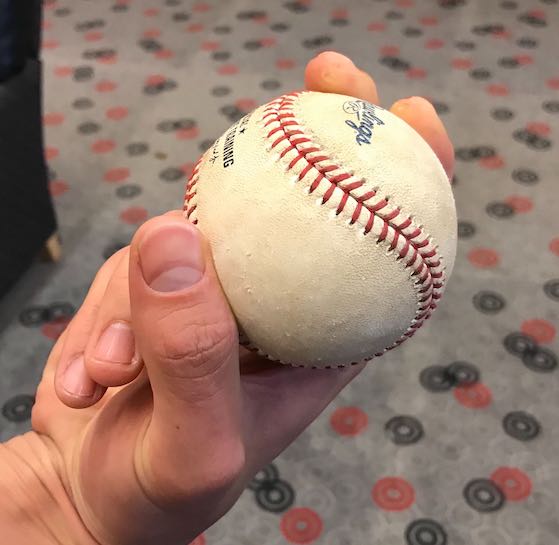
“With the unfortunate news of Roy Halladay [in November 2017] came the story of Mariano Rivera teaching him the cutter. I watched the interviews they did about how they threw it, and what their cues are. Halladay had that ball where he drew the outline of where his fingers should be. I literally gripped it the same way.

Matt Bowman’s cutter grip.

Read the rest of this entry »