Archive for Rays

Sunday Notes: Astros Reliever AJ Blubaugh Used To Throw a Submarine Knuckleball

AJ Blubaugh has given a boost to the Astros bullpen since debuting in late April of last season. Over 29 big-league appearances (including three as a starter), the 25-year-old right-hander has logged a 3.22 ERA over 58-and-two-thirds innings while being credited with five wins, against three losses, and three saves. Drafted in the seventh round by Houston out of the University of Wisconsin-Milwaukee in 2022, he ranked third among the system’s prospects with a 45 FV when he reached The Show.

His backstory is atypical, in part because of a pitch he hasn’t thrown since his days as an Ohio prep. Moreover, the Mansfield native now has a delivery that is both conventional and consistent. That wasn’t always the case.

“When I was in high school and started to get into pitching, I threw from three different slots,” Blubaugh explained. “An over-the-top arm slot, a sidearm arm slot, and a submarine arm slot. I would differentiate that every single pitch. One pitch would be a curveball from over the top, then I’d drop to sidearm and throw a slider. Then I’d throw a fastball from submarine. I was just a funky junk-ball thrower. I threw a knuckleball a bunch, probably from the time I was 10 years old to the time I graduated. It was probably my main pitch.”

Remarkably, his butterfly wasn’t simply delivered from down under; it came from each of his arm angles. Read the rest of this entry »


Yandy Díaz Might Be Baseball’s Most Underappreciated Hitter

Pablo Robles-Imagn Images

Yandy Díaz was in the news last week when he recorded his 1,000 career hit, making him the 20th Cuban-born MLB player to reach that milestone. The plaudits he received were well deserved, and they were also relatively uncommon. Playing in a lower-profile market, the Tampa Bay Rays stalwart flies under the national radar. Be honest. Outside of when he captured the American League batting title with a .330 average in 2023, when was the last time you paid more than a modicum of attention to the player who is arguably the top hitter in Rays franchise history?

You’re excused if you weren’t aware of just how good Díaz’s numbers are. Now in his eighth season with Tampa Bay after parts of two in Cleveland, he boasts a 133 wRC+ with the Rays, the highest in team annals among hitters with at least 1,000 plate appearances. Over 3,627 plate appearances with his current club, the 34-year-old corner infielder/DH has a .291/.373/.447 slash line and 104 home runs.

Díaz was admirably humble when asked about his milestone the following day.

“I never thought I’d get to 500, let alone 1,000,” he told reporters. “When I signed with Cleveland, I honestly never really thought I was going to get to the major league team. I thought, yeah, I was going to be a professional, but maybe I was going to get cut — specifically because it’s a different style of play over in Cuba. I thank God that I made the team and have been able to do it for so long.”

I asked the Sagua la Grande native how much he’s changed — and how much he really hasn’t changed — since coming stateside to play professionally in 2013. Read the rest of this entry »


Sunday Notes: Kai-Wei Teng’s Sweeper Takes a Sharp 90-Degree Left Turn

Kai-Wei Teng had a limited repertoire when he signed with the Minnesota Twins out of Taiwan in 2017. The right-hander from Taichung possessed just a fastball and a curveball. A lot has changed since that time. Now 27 years old and pitching for the Houston Astros, Teng attacks hitters with a five-pitch mix that includes a sweeper that is not only hard to hit, it is no fun to be on the receiving end of in catch-play.

“It’s insanely good,” Spencer Arrighetti told me last weekend at Fenway Park. “I throw a sweeper. Lance [McCullers] throws a sweeper. We have a couple of other guys who toy around with it. But Teng’s is incredible. Truly. I played catch with him, and it looks like a fastball for 48 feet, then takes a 90-degree left turn. Not all sweepers are created equal. Some of them are a little loopier and bigger, but his is 85 mph. I mean, it’s gross. It really is a great pitch.”

The numbers back that up. Teng has relied on his most-used offering 36.3% of the time this season to the tune of a .118 BAA, a .118 SLG, and a 27.9% whiff rate. His other numbers are impressive, as well. Over 14 appearances, Teng has a 2.35 ERA, a 3.83 FIP, and a 24.7% strikeout rate over 23 innings.

I asked Teng for the story behind his best weapon. Read the rest of this entry »


FanGraphs Weekly Mailbag: May 2, 2026

Stan Szeto-Imagn Images

I don’t pay too much attention to the standings in April. I look at them, of course, but that’s more a matter of routine than a desire to learn something substantial. It’s hard for teams to pull ahead of the pack this early in the season, and I’d rather not read too much into the fact that, say, the banged-up Blue Jays are a few games below .500, or that none of the five teams in the NL Central has a losing record. It takes time for these things to sort themselves out.

And yet, upon checking the standings Friday morning, I found myself pondering the significance of what I saw: specifically, that only three teams in the American League had a winning record. After a dizzying 20 minutes of digging, I lifted my head from my laptop in a daze, wondering how the heck I ended up staring at Baseball Reference’s playoff odds for the 14-18 White Sox. I think seeing the number 16.1% is what snapped me out of my stupor. (For what it’s worth, our Playoff Odds gave the South Siders a 2.2% chance to make the postseason, double their odds on Opening Day.) Anyway, about those three AL clubs above .500, the Yankees (20-11) were expected to be one of the best teams in baseball, so their place atop the standings wasn’t surprising, but the strong starts of the Rays (18-12) and Athletics (17-14) caught me a bit off guard. I thought Tampa Bay was destined for last place when the season began, and our Playoff Odds agreed, projecting the team to finish with 79.7 wins and giving it a 28.9% shot to reach the postseason. Entering May, the Rays have only added about two wins to their median projection (81.9), but they now have a 45.6% chance of making the playoffs. Meanwhile, I believed the A’s would be better this year, but better meant maybe a third-place finish in the AL West and an outside shot to snag the final AL Wild Card spot. Still, I figured they were more likely still a year or two away from true contention. Our preseason Playoff Odds tabbed them for 78 wins and a 21.4% shot at the playoffs. Now, they’re up to a projected 81.3 wins and 43.1% odds. I still don’t think either team will play postseason baseball this year; according to both their Pythagorean and BaseRuns records, the Rays have played more like a .500 team than one that’s on pace to win 97 games, while the A’s simply don’t have enough pitching. Remember, it’s only the start of May. There’s so much more baseball still to be played.

OK, that’s enough about the Rays and A’s in this week’s mailbag. Today, we’ll be answering your questions about how good Shohei Ohtani would be at basketball, whether James Wood is one of the best lefty batters ever at hitting the ball the other way, which batter has the most hits against a pitcher without recording an out, and what would happen if ZiPS forgot about 2020. But before we get to all of that, I’d like to remind you that this mailbag is exclusive to FanGraphs Members. If you aren’t yet a Member and would like to keep reading, you can sign up for a Membership here. It’s the best way to both experience the site and support our staff, and it comes with a bunch of other great benefits. Also, if you’d like to ask a question for an upcoming mailbag, send me an email at mailbag@fangraphs.com. Read the rest of this entry »


Five Things I Liked (Or Didn’t Like) This Week, May 1

Junfu Han-USA TODAY NETWORK via Imagn Images

Welcome to another edition of Five Things I Liked (Or Didn’t Like) In Baseball This Week. This column isn’t running every week this year, which means the title is more of a suggestion than a rule. There are some plays from last week, some plays from this week, and future editions will probably break that convention even a little more. I can’t imagine that’s all that big of a deal. After all, “I Liked” is a bigger part of why I enjoy writing this series than “This Week.” So sit back, relax, and check out some of the most delightful baseball happenings of the second half of April. And of course, thanks again to Zach Lowe of The Ringer, the progenitor of the “X Things I Liked This Week” format and my inspiration for this column.

1. Inevitability
If you tune into a baseball broadcast with a runner on third base and less than two outs, you’re liable to hear a discussion of an “undefendable play.” That play is some variation on a safety squeeze: The batter bunts, the runner gets down the line as far as he can safely and waits to see where the bunt is headed before committing, and the defense has very little hope of making a tag play in time. Batters have attempted 24 of these bunts in 2026, and defenders have only retired the lead runner four times. Safety squeezes were equally hard to stop in 2025, this hilarious double play notwithstanding. But maybe they’re even better than those success rates would imply. Maybe there’s some kind of supernatural force that makes safety squeezes work. How else do you explain this nonsense?

Taylor Walls is the most prolific safety squeeze bunter in baseball, and he tried it in extras against the Pirates last week:

Read the rest of this entry »


The Reset Button’s Been Hit on the AL East

John Jones-Imagn Images

For most of the first two weeks of the 2026 season, just about everything was coming up Yankees. In what was supposed to be a highly competitive division, the Yankees burst out of the gate with eight wins in their first 10 games. None of those victories came against pushover teams, and they were also convincing wins, with the lineup scoring more than twice the team’s runs allowed. Just as importantly, the teams expected to rival the Yankees all got off to mediocre (or worse) starts. The Bronx Bombers had a 3 1/2 game cushion in the AL East, about as large as one can reasonably hold in a tough division after 10 games. Then, things happened.

After the games of April 7, ZiPS had the Yankees with a projected two-game edge in the East, and a 35% chance of winning the division. While these numbers didn’t suggest dominance or anything remotely resembling a guarantee, that was a four-game swing from the preseason projected standings (New York was initially two games back of Boston) and a solid bump from their 20% odds to win the division.

While none of the games were one-sided affairs, the Yankees proceeded to drop five in a row against the Athletics and Rays, only winning on Monday in the ninth inning against the Angels after a Jordan Romano meltdown. Had they lost, it would have left the Yankees without a share of first place for the first time this season. Read the rest of this entry »


Counting Pitchers on My Fingers

Jeff Curry and David Butler II-Imagn Images

Starting rotations have five slots.

Yes, every once in a while a team will pretend to have four or six slots, but that team must inevitably confront the truth: Starting rotations have five slots. It’s a matter of policy, preference, and just plain practicality, Mariners general manager Justin Hollander said last year in an interview with Lookout Landing.

“The unfortunate thing about the roster rules is you only get 26 spots, and you only get 13 pitchers. And when you add a sixth starter, you take away a reliever. When you add a sixth starter, sometimes your starters pitch every six days, sometimes they pitch every eight or nine days. Starting pitchers are fussy. They don’t like that. They like to stay on a regular schedule. They like to know when they’re pitching.”

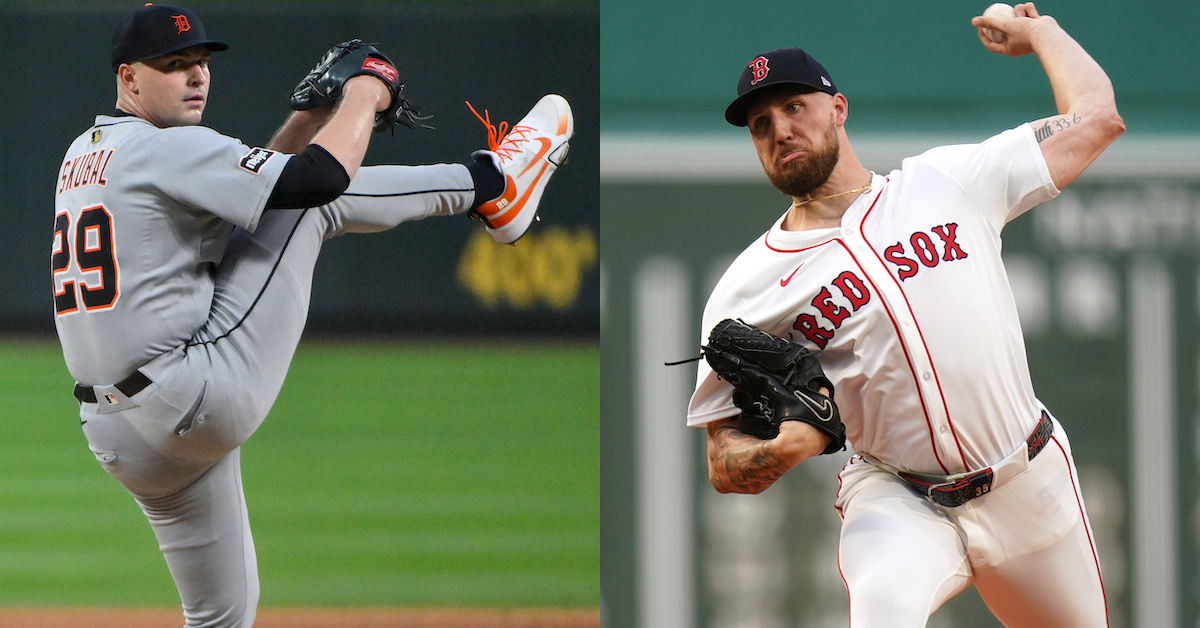
I’ve been thinking about the fixed-nature of rotations lately after reading this discussion between Eno Saris and Jen McCaffrey in The Athletic. They compare the rotations in Detroit and Boston by assigning each pitcher a label (one, two, three, four, five), sizing them up horizontally and vertically, and confronting the trade-offs in quality and depth. This reflects how many of us compare rotations in the abstract, and I wanted to see if this could be applied more broadly. Read the rest of this entry »


When Chases and Whiffs Don’t Lead to Outs

John Froschauer-Imagn Images

A pitcher goes to the mound hoping to record outs without allowing runs. Unfortunately, a lot goes on between the ball leaving the pitcher’s hand and the scoreboard changing. You can’t just toe the rubber, chuck the ball, and say, “God’s will be done,” as you stare glassy-eyed into the distance like Martin Sheen as Robert E. Lee in Gettysburg.

I mean, you could, but you wouldn’t like the results.

A modern pitcher goes to the mound with a plan to influence events much further up the causal chain. Every pitcher is special in his own way, but every plan boils down to this: By changing speed, movement, or location, trick the hitter into swinging somewhere other than where the ball will be. Read the rest of this entry »


Effectively Wild Episode 2443: Season Preview Series: Blue Jays and Rays

EWFI
Ben Lindbergh and Meg Rowley banter about a video of Brandon Marsh’s hair-wetting, the Phillies’ latest therapy, the Red Sox “home whites” non-disparagement saga, a former team exec’s proposals to promote competitive balance, and the best candidates among MLB players to pit against each other in a “Who ya got?” debate, then preview the 2026 Toronto Blue Jays (55:43) with The Athletic’s Mitch Bannon, and the 2026 Tampa Bay Rays (1:42:53) with MLB.com’s Adam Berry.

Audio intro: The Spaghettis, “Effectively Wild Theme”
Audio interstitial 1: Jonathan Crymes, “Effectively Wild Theme”
Audio interstitial 2: Ian H., “Effectively Wild Theme”
Audio outro: Nate Emerson, “Effectively Wild Theme”

Link to Steele tweet
Link to Marsh video
Link to Jake on Marsh’s hair routine
Link to Baumann on Crawford
Link to hyperbaric oxygen therapy article 1
Link to hyperbaric oxygen therapy article 2
Link to Mayo Clinic on hyperbaric oxygen therapy
Link to research on efficacy
Link to Red Sox jersey change
Link to story on changing statements
Link to side-by-side statements
Link to @RedSox reply
Link to Ball on competitive balance
Link to Moneyball scene
Link to BP on competitive balance
Link to Ben on Machado vs. Arenado
Link to Ben on Correa vs. Seager
Link to Baumann on Conforto vs. Judge
Link to Machado vs. Arenado, rest of 2015
Link to Machado vs. Arenado, 2016 on
Link to Correa vs. Seager, 2018 on
Link to Conforto vs. Judge, start of 2017
Link to Conforto vs. Judge, rest of 2017
Link to Conforto vs. Judge, 2018 on
Link to team payrolls page
Link to Blue Jays offseason tracker
Link to Blue Jays depth chart
Link to 2025 team FRV
Link to team SP projections
Link to Rogers Centre renovations
Link to “Toronto” pronunciation
Link to Return of the Jedi scene
Link to bagged milk
Link to Happ on bagged milk
Link to Sloan’s website
Link to Mitch’s author archive
Link to Mitch’s podcast
Link to Rays offseason tracker
Link to Rays depth chart
Link to Dolinar data 1
Link to Dolinar data 2
Link to three-team-trades stat
Link to Statcast park factors
Link to team WAR projections
Link to Shane scene
Link to ballpark renderings
Link to trial delay
Link to Adam’s author archive
Link to spring training Opening Day

 Sponsor Us on Patreon
 Give a Gift Subscription
 Email Us: podcast@fangraphs.com
 Effectively Wild Subreddit
 Effectively Wild Wiki
 Apple Podcasts Feed 
 Spotify Feed
 YouTube Playlist
 Facebook Group
 Bluesky Account
 Twitter Account
 Get Our Merch!

2:28:37

Sunday Notes: No Two-Way About It, Cubs Prospect Cole Mathis Comes From a Small Town

Cole Mathis is a small-town kid from the South hoping to make it big on Chicago’s North Side. His upside is evident — Mathis possesses projectable tools, including plus raw power — but there are question marks, as well. Drafted 54th overall in 2024 by the Cubs out of the College of Charleston, the 22-year-old corner infielder will enter the 2026 campaign with a smattering of experience above the amateur level. He had Tommy John surgery following his junior season, then was limited to just 194 plate appearances last year (128 with Low-A Myrtle Beach and 66 in the Arizona Fall League) due to a right elbow sprain. The degree to which he’ll have success against professional pitchers as he climbs the minor-league ladder is uncertain.

His future position is also in question. While he was drafted as a third baseman, Mathis was primarily a first baseman in college… when he wasn’t pitching. Prior to going under the knife, Mathis was a two-way player who showed plenty of promise on the mound thanks to a fastball that reached the mid-90s. Over 100 collegiate frames, he fashioned a 3.60 ERA with 90 strikeouts and just 30 walks.

When I caught up to him in the AFL, I asked Mathis if he still thinks about standing atop a clump of dirt sixty feet, six inches away from home plate. I also wanted to hear his thoughts on a what-if:

Had his elbow been healthy, might he have been drafted and developed as a pitcher?

“I mean, yeah, for sure,” Mathis responded to the first question. “It’s something I could fall back on, but hopefully I won’t have to resort to pitching again. At the time of the draft, my hitting skills were farther above where my pitching was, and the Cubs and I saw eye to eye with that, so it’s what we wanted to do moving forward.

“I don’t know,” he said to the second. “I mean, I got to pitch two strong years in college (he was solely a position player in his final collegiate season due to the damaged UCL) and don’t really know what would have happened that junior year. But yeah, I think we made the right decision.”

How well he develops as a hitter — particularly if he ends up at first base rather than at the hot corner — will help determine if it was the right choice. Moreover, his ability to elevate will go a long way toward his reaching, or failing to reach, his ceiling. Mathis understands that.

“We’ve definitely been working on getting the ball in the air a little more,” he told me. “A little bit of it is bat path, but the majority of it is pitch selection, getting pitches that I can drive. I have a flatter swing, so while I’ve had some success on balls down in the zone, pitches up in the zone play more to my swing.”

Mathis went on to say that while he used to have “kind of the same swing, no matter the pitcher,” he has come to realize that adjustability is a necessity against higher-quality hurlers. There is a mental component to it as well as a mechanical.

“I’ve kind of had to change my approach,” said Mathis. “Not so much change my swing, but rather change the thought process behind it. You can’t just have the same approach and swing over and over again. Pitchers watch film as much as we do, so they’re out there playing their pitches off our swings.”

Where he grew up plays into how he approaches the game of baseball itself.

“I come from a small town — it’s called called Cataula — and our county only has one high school [Harris County High School in Hamilton, GA],” Mathis explained. “I don’t know the total population of my hometown, but everybody knows everybody. Knowing that I have a whole town of support behind me, a whole county of support, means a lot. When I go out there, I’m not just playing for me, but for also for them. I’m representing my town.”

———

RANDOM HITTER-PITCHER MATCHUPS

Jason Giambi went 23 for 37 against Darren Oliver.

Al Oliver went 11 for 19 against Vern Ruhle.

Bob Oliver went 11 for 21 against Diego Segui.

Joe Oliver went 8 for 15 against Rheal Cormier.

Ollie Brown went 15 for 30 against Jerry Reuss.

———

Jackson Baumeister had a lot of promise when he was drafted 63rd overall by the Baltimore Orioles out of Florida State University in 2023. What he didn’t have was an understanding of pitching analytics. I learned as much when I talked to the 22-year-old right-hander during the Arizona Fall League season, where he was making up for innings lost due to a shoulder ailment.

“In high school, even in college, I had no idea what pitch metrics were,” admitted Baumeister, whom the Tampa Bay Rays acquired from their A.L. East rivals in July 2024 as part of the Zach Eflin deal. “We were a little behind the curve in college when it came to TrackMan, Rapsodo, and stuff like that. I was completely raw coming into pro ball. When I got drafted, it was basically, ‘Hey, I don’t know any of the words or numbers you’re saying to me.’ I basically had to do this whole little master class of pitch metrics.”

Baumeister’s lessons began in Baltimore’s introductory draft meetings, and from there he continued to pick up knowledge, including in bullpen sessions where he would learn about the readings he saw on the iPad. Before long, he “understood what those numbers meant, and what the Orioles were telling me about things like what the sweet spot was for all of my pitches.”

When he signed, Baumeister’s bread and butter pitches were his fastball and curveball, the latter of which has been supplanted by a slider as his primary secondary offering. And while his mid-90s heater remains his best pitch, the way he utilizes it is far different.

“In college, my coaches preached throwing the low-and-away fastball,” explained the erstwhile FSU hurler. “For a guy like me who rides the ball pretty well and gets a lot of induced vertical break, that wasn’t ideal. Getting into pro ball, it became ‘Throw your fastball at the top of the zone.’ I also have a pretty low release, so by locating the ball at the top of the zone, I get a lot of swing-and-misses.

“My release height is lower than six feet,” continued Baumeister. “I get down into the 5-5, 5-6 range, and then I’m around 17 or 18 [inches] of vertical break on average with my fastball. Velo-wise, I think I averaged 95 [mph] this past year, but I can reach back to 97-98 on a good day. It’s my best pitch, no doubt.”

Backing off on his curveball usage and throwing more sliders was a Rays directive. His current organization also altered the shape of his slider. Whereas he used to throw a sweepier version, he now throws more of a gyro. Along with the four-seamer, gyro, and lesser-used curveball, the righty also has a changeup in his arsenal. That has also undergone a tweak. Last season he began working on a kick-change to replace what had been a more traditional two-seam circle.

———

A quiz:

Ichiro Suzuki has the most singles since the turn of the century (2000), while Albert Pujols is tops in both doubles and home runs. Which player has the most triples? (A hint: he had 517 stolen bases and 145 home runs.)

The answer can be found below.

———

NEWS NOTES

The upcoming SABR Analytics Conversation, which will take place in Phoenix from February 27-March 1, will include a seven-person Arizona Diamondbacks front office panel. More information can be found here.

SABR’s John McMurray recently conducted an oral history interview with Greg Maddux. The transcript and video recording can be found here.

Roy Face, a right-hander who played for the Pittsburgh Pirates from 1953-1968, and then briefly for the Detroit Tigers and Montreal Expos, died earlier this week at age 97. A standout on Pittsburgh’s 1960 World Series championship club, Face is the franchise’s all-time leader in pitching appearances (802), relief wins (94), and saves (188). As mentioned here in Sunday Notes two weeks ago, his 18 relief wins in 1959 are an MLB record.

Gary Blaylock, who pitched for the St. Louis Cardinals and New Yankees in 1959, died earlier this month at age 94. The Clarkton, Missouri native appeared in 41 games and went 4-6 with a 4.80 ERA. He was the pitching coach for the Kansas City Royals when they captured the World Series in 1985.

———

The answer to the quiz is José Reyes, with 131 triples. If you guessed Carl Crawford, he had 123 triples, as well as 480 stolen bases and 136 home runs.

———

Mike Daly was featured here at FanGraphs on Wednesday, the subject at hand being the current state of San Diego’s prospect pipeline. Left on the cutting-room floor from my conversation with the club’s assistant director of player development was what he learned from his year as a minor-league manager. Daly was at the helm of the High-A Fort Wayne TinCaps in 2024.

“I learned a lot,” said Daly, whose résumé also includes extensive scouting experience. “First and foremost, it gives you a greater appreciation, and empathy, for what players and the staff go through from spring training all the way to the end. And the season is long. You understand that from a front office perspective, but until you’ve lived it, you don’t truly understand it.”

Daly went on to mention the speed of the game, and how managers frequently need to make decisions on short notice. Experiencing that firsthand reinforced the importance of pre-game planning and talking through various scenarios prior to the team’s taking the field. He also received a reminder that patience is a virtue when it comes to development.

“In the past, I was sometimes guilty of coming into an affiliate for a week and maybe trying to expedite, or push, some action with the staff regarding certain development of players,” Daly admitted. “What you learn from being in that dugout for a full season is that the process of development really does take time. It certainly made me better in terms of asking questions.”

Writing the reports that are sent to the front office after a game is a markedly different experience from being on the receiving end.

“Yes,” acknowledged Daly. “When you’re writing that manager report, especially after a tough loss… let’s just say it’s a lot different sitting in the dugout than it is sitting behind the plate [as a scout] or in the office. Until you walk in those shoes… again, you understand, but you don’t truly understand. I’m very thankful to have had an opportunity to do it.”

———

A random obscure former player snapshot:

Ice Box Chamberlain had a fascinating career. Born in Warsaw, New York in 1867, the right-hander went on to pitch for six major league teams across the 1886-1896 seasons, registering a record of 157-120. His best year was 1889, when he went 32-15 while throwing 421-and-two-thirds innings for the American Association’s St. Louis Browns.

Chamberlain — his given name was Elton —had some especially notable games. Twice he pitched both right- and left-handed in the same contest, making him, along with Larry Corcoran and Tony Mullane, one of three pre-1900 hurlers to toe the rubber in ambidextrous fashion. On May 30, 1894, Chamberlain not only went the distance for the Cincinnati Reds in a 20-11 loss to the Boston Beaneaters, he was taken deep four times by Bobby Lowe. In doing so, Lowe became the first player in big-league history to hit four home runs in the same game.

———

LINKS YOU’LL LIKE

MassLive’s Christopher Smith wrote about Kyle Boddy and how the Boston Red Sox have been implementing Driveline philosophies.

CBS Sports’s Dayn Perry weighed in on Chaim Bloom’s rebuild in St. Louis, and where the Cardinals go from here.

Cy Young was born in a town of roughly 400 people in Ohio’s Tuscarawas County, and his 35-acre boyhood farm is now up for sale. Joey Morona has the story at Cleveland.com.

What would MLB look like with a salary cap? Evan Drellich delved into that question at The Athletic.

The Athletic’s Katie Woo wrote about how “The Harvard of umpire schools” is closing as changing times favor tech over tradition.

———

RANDOM FACTS AND STATS

Ollie Bejma played for the St. Louis Browns from 1934-1936, and for the Chicago White Sox in 1939, logging 202 hits and a .245 batting average. Humble as those numbers are, they didn’t dissuade legendary cartoonist (and big-time baseball fan) Charles Schultz from featuring him in a February 21, 1974 Peanuts comic strip. Asked who played shortstop for the pennant-winning St. Paul Saints in 1938, Woodstock replied to Snoopy that it was Ollie Bejma.

Blaine Durbin played in 32 games and logged 14 hits in 51 at-bats while suiting up for three teams across the 1907-1909 seasons. His first two seasons were spent with the Chicago Cubs, who won the World Series in each of those years. The last of Durbin’s seasons was split between the Cincinnati Reds and Pittsburgh Pirates, the latter of which won the World Series.

J.D. Martinez had 6,865 PAs, 1,741 hits, and 3,172 total bases.
Nick Castellanos has 6,950 PAs, 1,742 hits, and 2,977 total bases.

Mike Piazza had 7,745 PAs, a .308 BA, and 779 extra base hits.
Magglio Ordonez had 7,745 PAs, a .309 BA, and 741 extra base hits.

The St. Louis Cardinals signed Leon Durham as a free agent on today’s date in 1989. The erstwhile Chicago Cubs slugger — he had 135 home runs and a 125 wRC+ for the Northsiders from 1981-1987 — proceeded to record just one hit in 18 at-bats with the Cardinals. Suspended for failing a drug test, Durham never again played in the majors.

The New York Yankees signed Jeff Reardon as a free agent on today’s date in 1994. The righty reliever, who recorded 367 saves while playing for seven teams across 16 seasons, went on to appear in 11 games for the Yankees, earning a win and two saves in what proved to be his final hurrah. Reardon is the only pitcher in MLB history to allow exactly 1,000 hits in his career.

Players born on today’s date include Larry Yount, who appeared in one MLB game… yet never actually appeared in an MLB game. A right-hander, the older brother of Hall of Famer Robin Yount took the mound for the Houston Astros on September 15, 1971, but was injured while warming up and never delivered a pitch to a batter. Because he had been announced, Yount’s name is in the record books with one official appearance.

Also born on today’s date was Carlton Molesworth, a left-hander who logged a 14.63 ERA while appearing in four games for the Washington Senators in 1895. A teenager when he took the mound in the majors, Molesworth subsequently played 17 seasons in the minors as an outfielder, suiting up for teams including the Binghamton Bingos, Schenectady Electricians, and Shamokin Coal Heavers.

Slicker Parks had a humble MLB career. Appearing in 10 games for the Detroit Tigers in 1921, the right-hander from Dallas Township, Michigan went 3-2 with a 5.68 ERA over 25-and-a-third frames. He fared far better down on the farm. In 1926, Parks went 19-14 with the International League’s Jersey City Skeeters.