The best team in baseball will be without its biggest star for a few weeks.
The Braves placed Ronald Acuña Jr. on the injured list Sunday with a strained left hamstring. Acuña exited Saturday’s game after pulling up in considerable pain while running out a groundout. Manager Walt Weisstold reporters that imaging revealed a Grade 1 strain, the least severe grade. According to MLB.com, Weiss said:
“It’s not going to be just a couple days. It’s gonna be more than that, so we need to put him on the IL, and hopefully it’ll be sooner than later. No idea with these soft tissue injuries how long they’re gonna take, but I think the silver lining is that the MRI showed it wasn’t too serious.”
While many players return from Grade 1 hamstring strains in just a couple weeks, or even following the 10-day minimum, this is an injury that can linger and delay a return.
This is, obviously, less than ideal for the Braves. Acuña is their best player and was projected in the preseason as the ninth-best position player in baseball with 5.4 WAR, according to our Depth Charts. Though his performance hasn’t been spectacular thus far, with a 111 wRC+ in 152 plate appearances, his .381 xwOBA and 12.2% barrel rate — along with strong strikeout and walk rates — suggest he hasn’t missed a beat this year, coming off his bounce-back 2025 season.
Of course, last year was a comeback campaign because Acuña missed most 2024 (and the early part of 2025) after tearing his ACL. He also missed chunks of 2021 and 2022 with a torn ACL in his other knee. In 2018, he missed about a month with a mild ACL sprain. That means Acuña’s hamstring strain is his fourth lower body injury requiring IL time in his career. Read the rest of this entry »
“Throw the bums out!” is a rich American tradition. While most used in the context of the messiness of that whole democracy thing, it’s also applicable to sports. When you’re a fan, especially a passionate one, and things are going horribly wrong for your favorite team, there’s a real sense of wanting the perpetrators of these crimes against excellence to be figuratively carted out in tumbrels and to meet their makers like Danton or Robespierre. And heads do roll in baseball when things are going badly, because someone has to take responsibility for a team’s crapitude, and it’s not going to be the team’s owner. Most often, it’s someone public-facing, as fans will not be appeased by the firing of some relatively anonymous staffer in operations. Since general managers and team presidents get first priority to hold the axe (but not always), and individual coaches don’t usually have wide-enough authority to take responsibility for the whole team, that leaves managers as the common sin eaters.
The moment of catharsis happens, and lo and behold, teams play a lot better, vindicating the demise of the ex-manager. It certainly feels that way, and it’s not the craziest idea in the world to think that there’s something to it. While you would expect teams in the midst of a spate of sucking to be underplaying their talent level rather than overplaying it, when you drive by an accident with a car that’s been unfortunately integrated into a telephone pole, it’s also quite likely that the driver had something to do with it.
Two managers have already been fired this season, after their large-payroll teams with championship aspirations got off to awful starts. Surprisingly, Alex Cora was first to go, as Red Sox chief baseball officer Craig Breslow canned not just Cora, but also anyone on the coaching staff considered to be one of Cora’s guys, on Saturday night after the team started the season 10-17. Then, on Tuesday, the Phillies fired Rob Thomson after they began the year 9-19, a woeful start that included a 10-game losing streak. Four years ago, Thomson became one of the most successful midseason replacement managers ever, as he steered a sinking Phillies ship back from a 22-29 start all the way to the World Series. Mets manager Carlos Mendoza can’t be comfortable about his job security right now, despite the team’s insistence that his job is safe. Read the rest of this entry »
They say that no news is good news. Google tells me that saying is attributed to James Howell, a 16th-century writer and politician, but I disagree. I attribute it to Sully and Murph, the two imaginary Red Sox fans whose lens I like to interpret Boston sports news through. I mean, COME ON. Last week, Sonny Gray hit the IL with a hamstring injury. Over the weekend, the Sox fired manager Alex Cora of his duties, along with a significant portion of his coaching staff. While the echoes of that momentous decision were still reverberating through the city, there’s now this: Boston placed staff ace Garrett Crochet on the 15-day IL with shoulder inflammation. Woof. The Sox can’t catch a break.
Crochet’s IL placement follows a frustrating start to his season. Through six starts, he’s had three spectacular outings and three clunkers. His last time out, he put together one of his best starts of the year: six innings, seven strikeouts, and no earned runs against the Orioles. But toward the end of that outing, his velocity dipped sharply. Despite sitting 95-96 mph in the early innings, he was down in the 91-93 range by the end of his start.
Crochet told Christopher Smith of MassLive that he felt some fatigue in his shoulder during that start, and that he doesn’t think this is a serious injury. “Was able to grind through (the fatigue) there at the end. It just makes more sense to get ahead of it now so I’m not playing catch-up the rest of the season,” he said. Read the rest of this entry »
Though spring training concluded several weeks ago, it’s still spring on the solar calendar, and this year, spring cleaning in Boston involved the Red Sox clearing out some dirty laundry. On Saturday night, ESPN reported the firings of manager Alex Cora, bench coach Ramón Vázquez, third base and outfield coach Kyle Hudson, hitting coach Peter Fatse, assistant hitting coach Dillon Lawson, and major league hitting strategist Joe Cronin. Further, game planning and run prevention coach Jason Varitek has been offered a different role within the organization.
The Red Sox began the season projected to win 85 games, with 60.8% odds to make the playoffs. Of the 25 writers who contributed to the FanGraphs 2026 Staff Predictions, 21 picked the Red Sox to make the postseason and nine had them winning the division, which tied Boston with Toronto as the most popular pick to take the AL East. Heading into Sunday’s games, the Red Sox had a projected win total of 80, and their odds of making the playoffs were down to 31.4%. Their drop of 29.4 percentage points in playoff odds was the largest in the AL, while in the NL, the Mets and Phillies saw their playoff odds decline by 41.0 points and 33.0 points, respectively.
At just 27 games into the season, Boston’s dismissal of Cora is the earliest manager firing since 2018, when the Reds firedBryan Price after the club started the year 3-15. Cincinnati entered the season looking to complete the transition from rebuilding to contention, but instead finished in last place in the NL Central with a 67-95 record. The Reds simultaneously cut ties with pitching coach Mack Jenkins, which is representative of a common pattern with coaching changes. When a team’s struggle is particularly acute on one side of the ball, the coach leading that effort is often held accountable along with the manager. But rarely does an organization remove seven members of its major league coaching staff in one fell swoop. Boston’s overhaul was so dramatic, the team had to bring in what appears to be a party bus to transport the deposed coaches away from the team hotel. Read the rest of this entry »
Led by American League Cy Young runner-up Garrett Crochet, free agent signee Ranger Suarez, and trade acquisition Sonny Gray, the Red Sox were projected to have the majors’ top rotation in our preseason Positional Power Rankings. Four weeks in, the unit has been one of the majors’ worst, with Crochet getting pummeled and Gray underperforming before landing on the injured list earlier this week with a right hamstring strain. The bullpen has been shaky, the offense weak, and after losing the first two games of a three-game series against the Yankees at Fenway Park, the Red Sox now sit 9-15, last in the AL East.
Through 24 games, this is the Red Sox’s worst start since 2020, when they went 6-18 en route to a 24-36 record and a last-place finish. In terms of full-season futility, in 2019 the Red Sox — defending champions at the time — started 9-15 before rallying to finish at 84-78, third in the division but outside the playoff picture. After winning 89 games last season and making their first postseason appearance since 2021, this year was supposed to be different, but since Opening Day, the team’s seasonal win projection has fallen from 85 to 80.5, the fourth-largest drop in the majors ahead of only the Mets (-7.1), Phillies (-5.7) and Royals (-4.5). Only those three teams have larger drops in their Playoff Odds:
Red Sox Change in Playoff Odds
Date
W
L
W%
GB
Win Div
Clinch Bye
Clinch WC
Make Playoffs
Win WS
March 25
0
0
—
0
22.5%
19.2%
38.2%
60.8%
4.9%
April 22
9
15
.375
6
6.5%
5.2%
28.7%
35.3%
2.4%
Change
-16.0%
-14.0%
-9.5%
-25.5%
-2.5%
The driver of Boston’s success was supposed to be the rotation, headed by Crochet. After making his first All-Star team with the White Sox in 2024, he emerged as a true ace last year, leading the majors in both innings (205.1) and strikeouts (255) while ranking second in the AL in strikeout rate (31.3%), xERA (2.88), FIP (2.89), and WAR (5.8) — behind Cy Young winner Tarik Skubal in all of those categories — and third in ERA (2.59). Read the rest of this entry »
For most of the first two weeks of the 2026 season, just about everything was coming up Yankees. In what was supposed to be a highly competitive division, the Yankees burst out of the gate with eight wins in their first 10 games. None of those victories came against pushover teams, and they were also convincing wins, with the lineup scoring more than twice the team’s runs allowed. Just as importantly, the teams expected to rival the Yankees all got off to mediocre (or worse) starts. The Bronx Bombers had a 3 1/2 game cushion in the AL East, about as large as one can reasonably hold in a tough division after 10 games. Then, things happened.
After the games of April 7, ZiPS had the Yankees with a projected two-game edge in the East, and a 35% chance of winning the division. While these numbers didn’t suggest dominance or anything remotely resembling a guarantee, that was a four-game swing from the preseason projected standings (New York was initially two games back of Boston) and a solid bump from their 20% odds to win the division.
While none of the games were one-sided affairs, the Yankees proceeded to drop five in a row against the Athletics and Rays, only winning on Monday in the ninth inning against the Angels after a Jordan Romano meltdown. Had they lost, it would have left the Yankees without a share of first place for the first time this season. Read the rest of this entry »
Jacob Misiorowski has a fastball that consistently reaches triple digits, and he augments it with an effective curveball-slider combination. Usage-wise, the 24-year-old Milwaukee Brewers right-hander is throwing his high-octane heater at a 62.3% clip, while his breaking-ball percentages are 16.6 and 17.3 respectively. Given the lethality of those pitches — his xBA is a paltry .168, and his K-rate an MLB-best 41.8% — he has little need for a changeup…
… but there is one in his arsenal. From time to time, he will even show it to a batter. Of the 289 pitches Misiorowski has delivered so far this season, 11 (3.8%) have been changeups. The story behind his only-sporadically-used weapon?
“I’ve had a changeup my whole career,” Misiorowski told me prior to throwing three of them in a 101-pitch start at Fenway Park on Tuesday. “That was one of the first pitches I truly learned. But then as I started throwing harder, I began going away from it, and it obviously got worse and worse the less I threw it. By the time I got drafted [63rd overall in 2022], I basically didn’t have a changeup any more. I had to relearn it, re-figure it out. So, yeah, it’s always been there, but it hasn’t always been there.”
Misiorowski went on to tell me the grip was originally a more conventional four-seam circle, but that he now has his pointer and middle fingers together, and his thumb underneath. He also said that he likes the amount of horizontal he gets on it, which is generally around 18 inches and has been up to 20. When I told him that the movement profile sounds a little like a two-seam sinker, he agreed that it does.
A few more things Misiorowski told me about the pitch are unfortunately lost, due to glitches I’ve recently encountered on my iPhone’s recording app (I mentioned this teeth-gnashing, hopefully-resolved-soon, issue in Monday’s piece on Padres’ broadcaster Mark Grant.) Fortunately, I was able to grab a few minutes with Brewers pitching coach Chris Hook, who made up for the missing words with his own perspective.
Going into yesterday, Mason Miller had thrown 37 pitches on the season, 19 of them fastballs averaging 101 mph, while another 17 were sliders that elicited a 60.0% whiff rate. There was also one changeup. Delivered to Luis Arraez on a 1-1 count, the ninth-inning offering was wide outside and taken for a ball.
Why did the San Diego Padres closer throw his seldom-used changeup to the three-time batting champ on Wednesday night? Low leverage was certainly a factor; the Friars had scored four times in the bottom of the eighth to turn a 3-1 lead into a far safer 7-1 advantage. It nonetheless represented an outlier for the 27-year-old flamethrower. Over the previous two seasons, only 2.3% of his pitches were changeups.
I asked him about it when the Padres visited Fenway Park on Friday,
“A changeup is a good pitch, but I’m not going to feel comfortable with it if I’m not throwing it,” Miller told me. “I’m picking my spots. There are certain guys it matches up well against. [Arraez] is a guy who isn’t going to swing and miss, so I’m not going to be hunting a strikeout. If I can get softer contact on it… any time you have a guy who isn’t fast and he puts it on the ground, that’s an opportunity for an out.”
Arraez didn’t kill any worms in his matchup with Miller, instead lining a 2-1 fastball to right field for a single. Not that it mattered. The righty proceeded to fan the next three batters, one on a 101.5-mph heater, and two on nasty sliders. While those pitches were pristine, the execution on his lone changeup was another story. Read the rest of this entry »
Yes, every once in a while a team will pretend to have four or six slots, but that team must inevitably confront the truth: Starting rotations have five slots. It’s a matter of policy, preference, and just plain practicality, Mariners general manager Justin Hollander said last year in an interview with Lookout Landing.
“The unfortunate thing about the roster rules is you only get 26 spots, and you only get 13 pitchers. And when you add a sixth starter, you take away a reliever. When you add a sixth starter, sometimes your starters pitch every six days, sometimes they pitch every eight or nine days. Starting pitchers are fussy. They don’t like that. They like to stay on a regular schedule. They like to know when they’re pitching.”
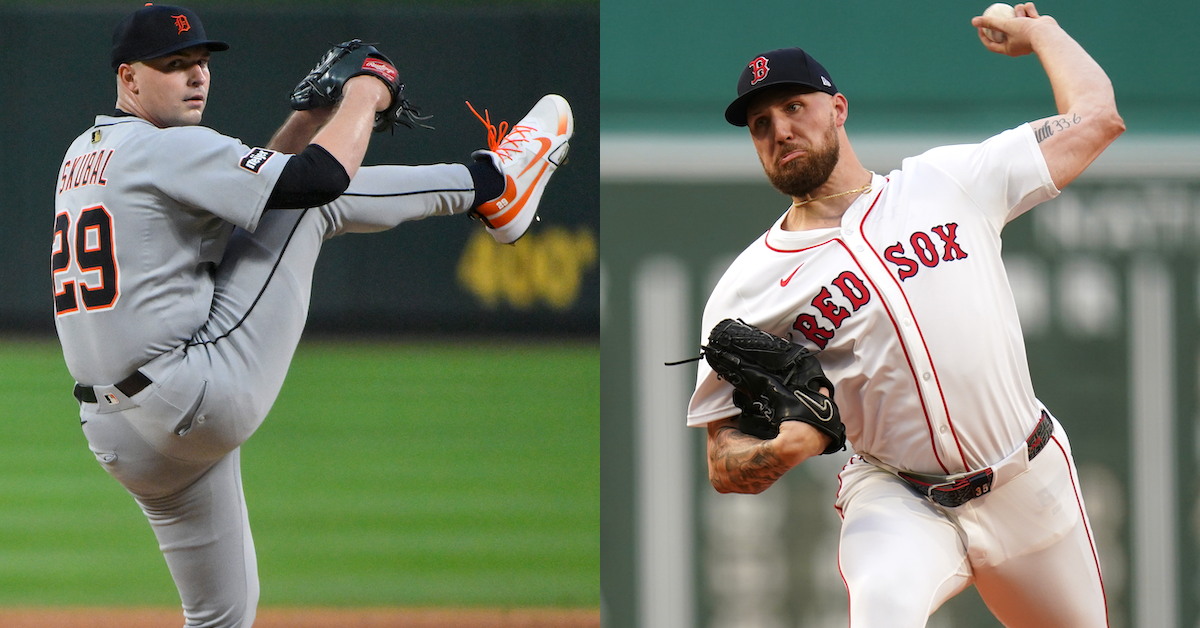
I’ve been thinking about the fixed-nature of rotations lately after reading this discussion between Eno Saris and Jen McCaffrey in The Athletic. They compare the rotations in Detroit and Boston by assigning each pitcher a label (one, two, three, four, five), sizing them up horizontally and vertically, and confronting the trade-offs in quality and depth. This reflects how many of us compare rotations in the abstract, and I wanted to see if this could be applied more broadly. Read the rest of this entry »
The hardest-hit ball of the World Baseball Classic semifinal between the United States and the Dominican Republic only traveled 191 feet. Vladimir Guerrero Jr.’s fourth-inning double left the bat at 116.1 mph, but it was just the 23rd-longest batted ball of the game, a few feet behind a Ketel Marte popout that was hit more than 40 mph softer. None of this was necessarily shocking. After the play, John Smoltz revealed even he was aware that sabermetric types wish Guerrero would find a way to lift the ball more often and turn some of his scorched groundouts into extra-base hits and extra-base hits into home runs.
This decade, 26% of balls hit 116 mph or harder have gone for home runs, and the lowest launch angle among those home runs was 15 degrees. Guerrero hit his double at just five degrees, and over the past five years, he ranks fourth in baseball with 28 non-homers of at least 116 mph. Five degrees is not the optimal launch angle if your goal is to do damage, but hitting a ball that low and that hard can have other benefits.
One benefit is that the ball can really slow down on its way to the wall. When you hit a screaming line drive or a high fly ball to the wall, it maintains much of its velocity and bounces off hard. When you hit a low liner or a grounder, all that contact with the outfield grass slows it down. Hard as it was hit, this ball didn’t have all that much velocity left, and the padding on the wall absorbed much of the remainder. It rolled back across the warning track and likely would have stopped entirely as soon as it encountered the grass. The outfielder has to wait back, wary of a hard carom bouncing past them, so when the ball dies like that, they need extra time to go get it, giving you more time to coast into second or stretch for third.
A weak carom also carries aesthetic benefits. When a ball is moving that slowly, you can’t field it normally. Below a certain velocity threshold, gloves are more hindrance than help. If you’re picking up a stationary baseball, or one moving at anything below a brisk walk, say 5 mph, it’s harder to pick the ball up off the ground with a glove than it is with your bare hand. Stiff leather fingers aren’t as sensitive or as flexible as real fingers, and the ball doesn’t have enough momentum to roll up into the pocket. Since you have to get the ball to your throwing hand anyway, you’re better off cutting out the middle man and barehanding the ball. It happens every day, but usually it happens for infielders who are dealing with bunts or squibbers. They charge hard, then scoop up the ball and throw it in one motion. It’s a thing of beauty, but it works quite differently in the outfield.
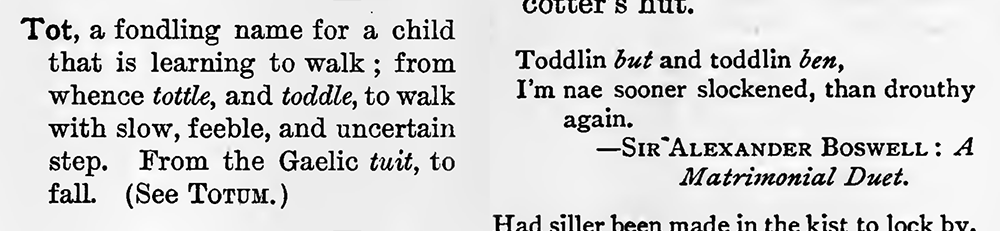
How much have you thought about the word toddler? As you can deduce, it means one who toddles, walking “with short tottering steps in the manner of a young child,” according to Merriam-Webster. The word first appeared in the early 16th century. There were tots, and the way they got around became tottering and tottling, which then became toddling. Finally, a good 300 years later, those tots who toddled became known as toddlers. (Who knows, they may have even enjoyed the occasional hot toddy. It was a different time.)
A Dictionary of Lowland Scotch, Charles Mackay, LL.D., 1888
Of course, toddling isn’t the only hallmark of a toddler. Our balance, motor skills, and proprioception evolve (and then devolve) over time, so we end up moving very differently at each stage of life. For example, when adults bend over to pick something up off the ground, they bend at the waist, but they also tend to put one foot in front of the other and go into a slight lunge to bring their torso closer to ground level. Toddlers have a different approach, getting into a deep crouch and reaching for the item while it’s still way out in front of them. They tuck their chests against their knees and they have to stick their elbows out to make room. Because they’re not yet champions of spatial awareness, they don’t often nail the location of their squat, which is the reason they often end up reaching way out or way across their bodies.
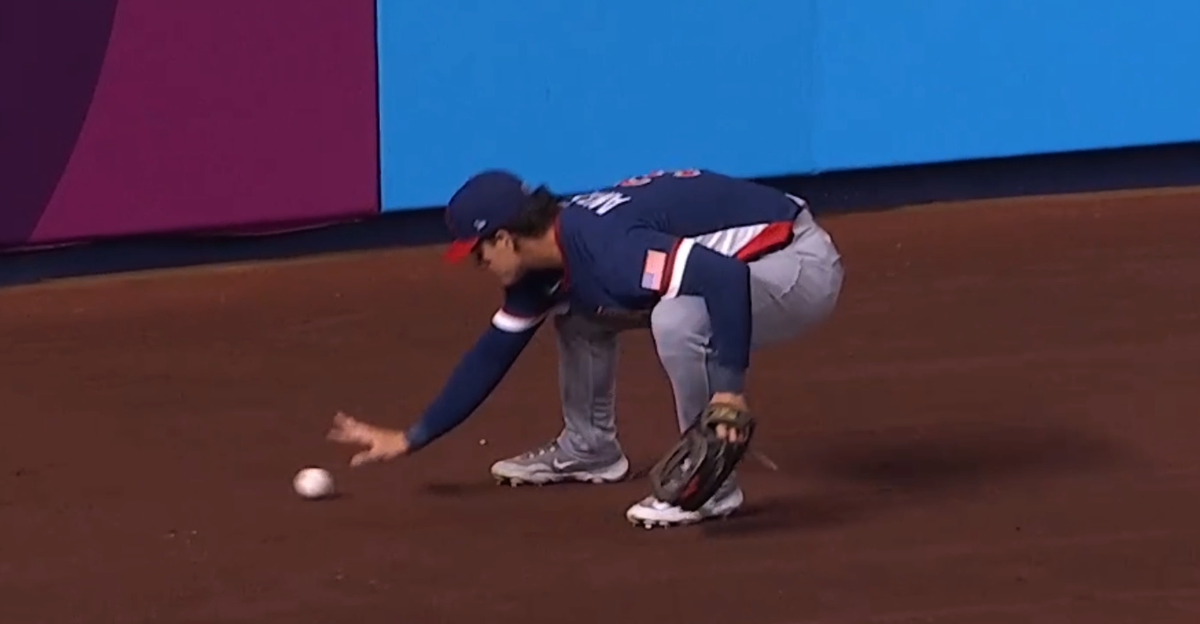
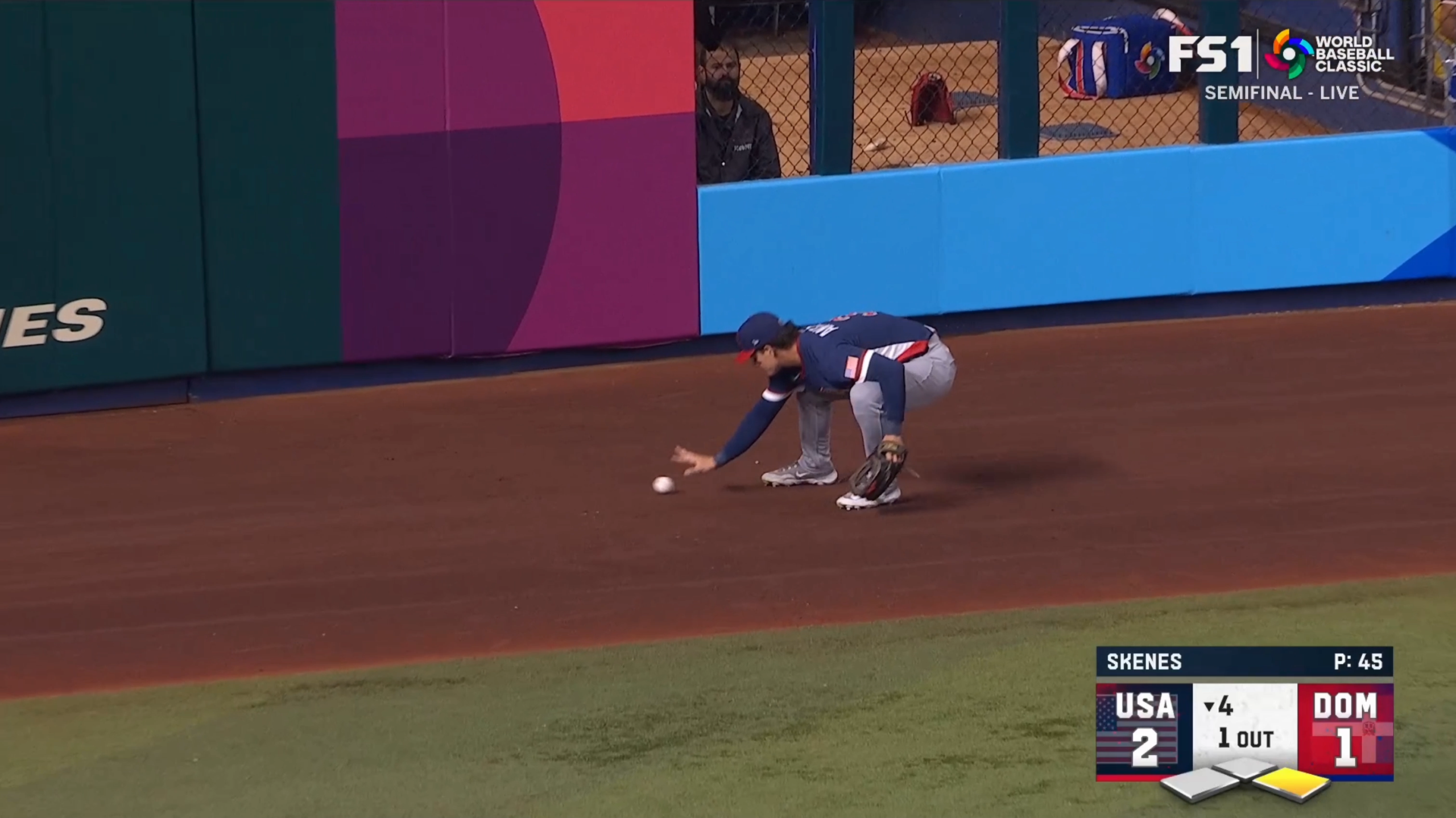
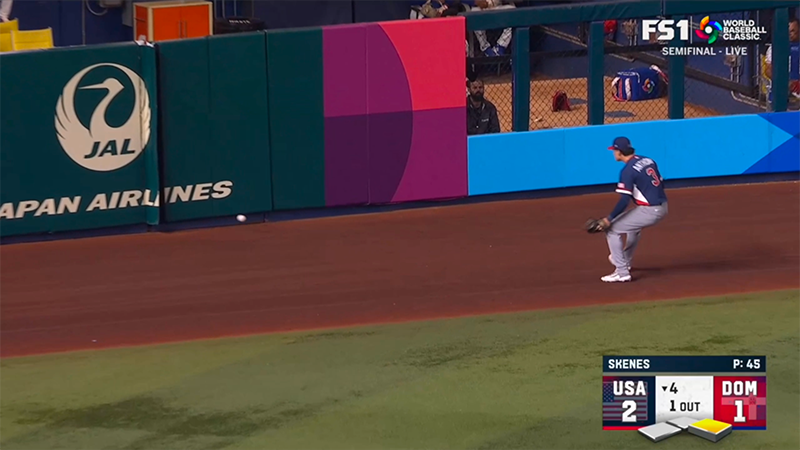
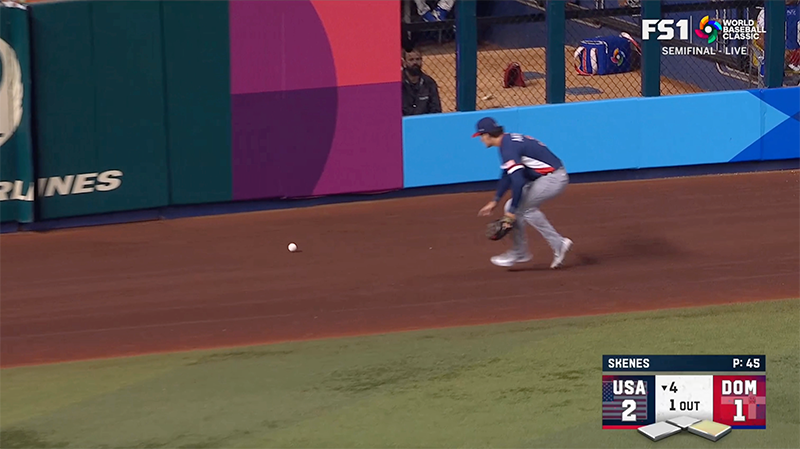
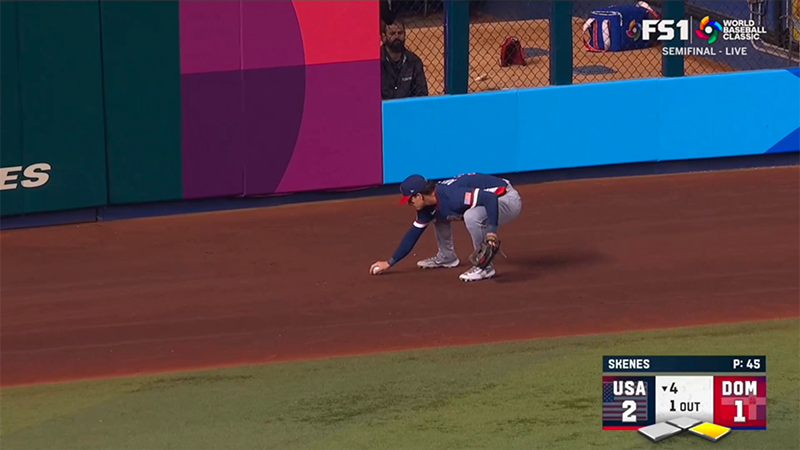
I bring all this up because when Roman Anthony, playing left field for the United States at the time of Guerrero’s blistering low-launch-angle double, loped out to the warning track to field the ball, I couldn’t help but notice that he didn’t exactly look like the Greek god, top-prospect-in-baseball, uber-athlete we’ve come to expect. He looked, uh, different.
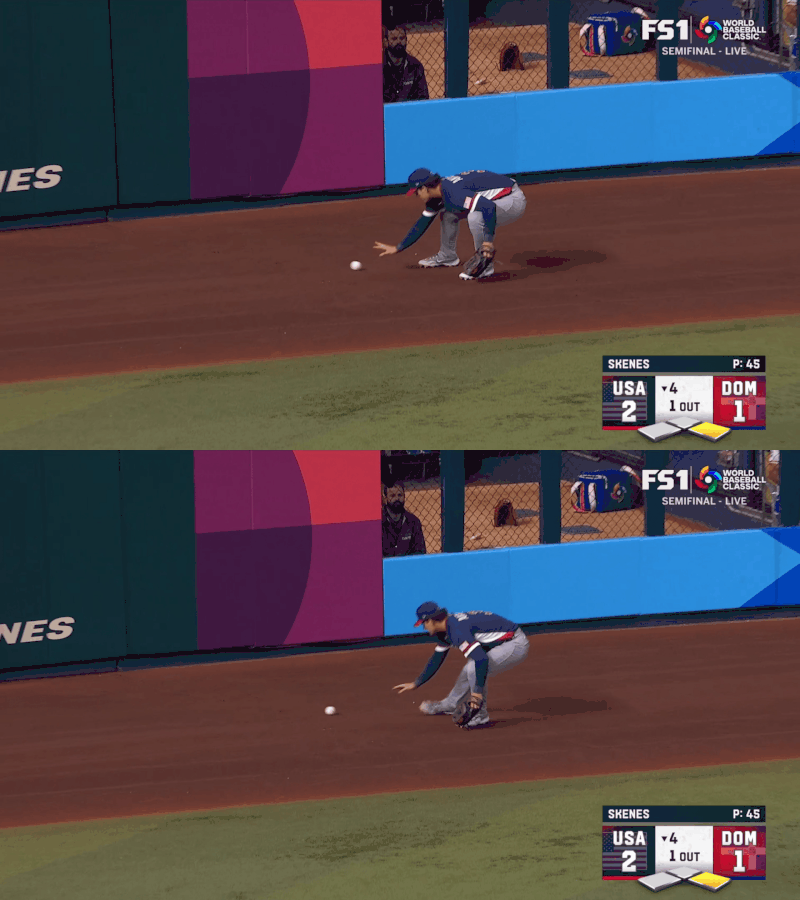
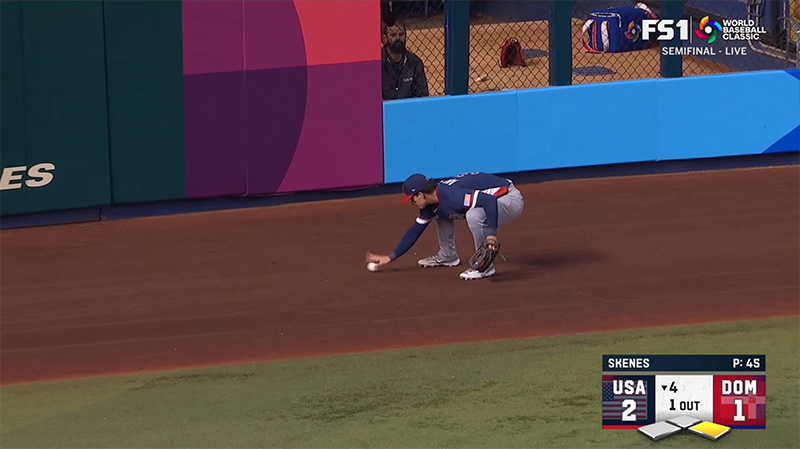
Anthony looked either like a toddler playing with a toy dump truck or a grown man doing a pretty convincing impression of an anteater. I’m going to be honest with you. I went through a bunch of pictures of my nieces and nephews, and it didn’t take long to find a photo of a niece in the exact same pose. She’s two years old, and she’s not wearing a shirt or pants because she was just playing in the sprinklers. She’s crouched down to pick up a worm from the garden. She looks exactly like Anthony in the picture above, and I wish I could show you the two side-by-side in the Miami outfield, which I absolutely mocked up in Photoshop. Alas, I cannot do that to my niece, who is no longer two years old.
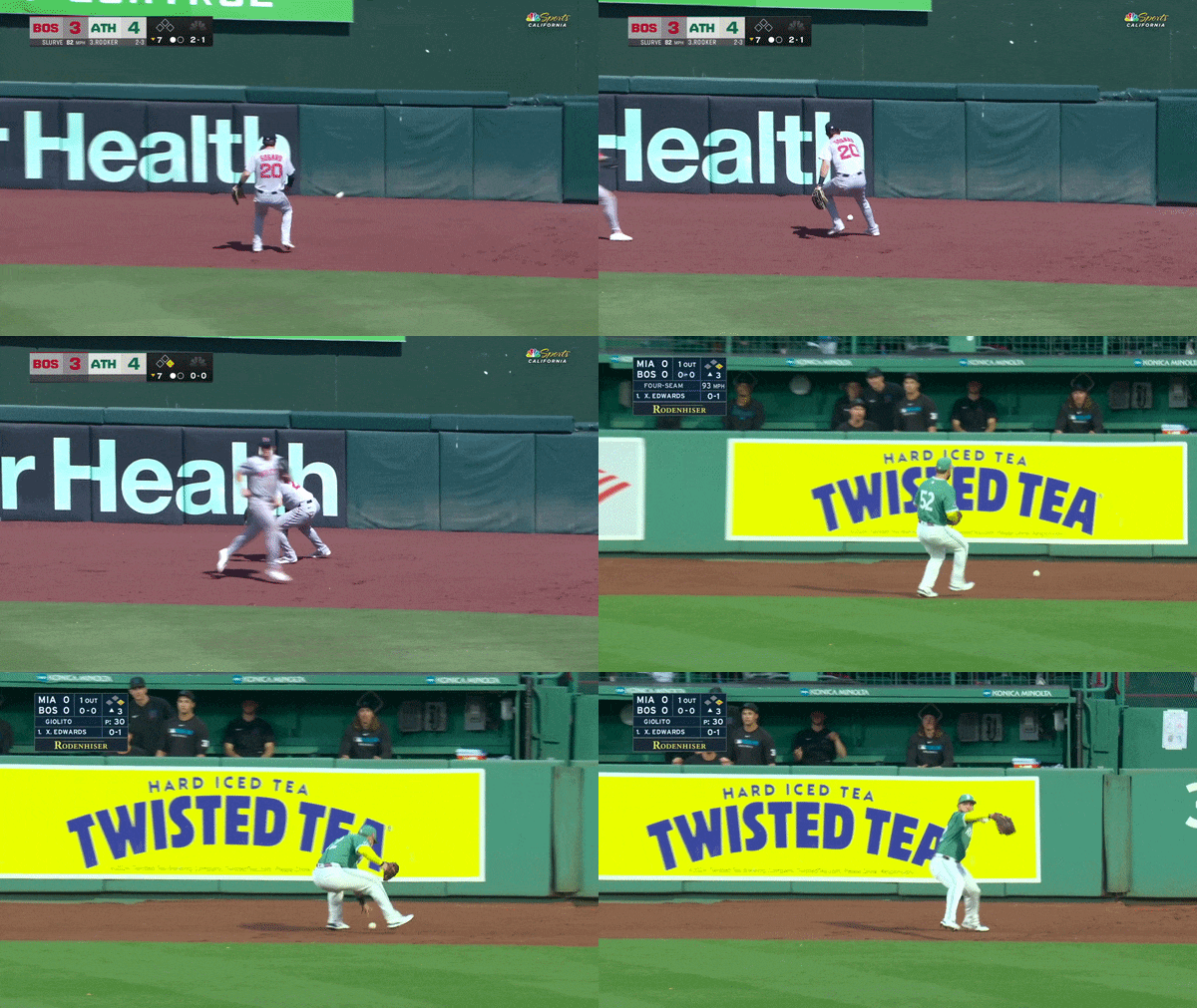
How did Anthony get into this position? For starters, in the outfield, you’re no longer scooping the ball up gracefully and firing it on the move. The weak carom is the only situation where you have to barehand the ball, and you’re always moving away from the infield to get it, which means you’re running, stopping to pick up the ball, then reversing your momentum to throw it into the infield. It’s a halting, graceless maneuver at the best of times. But other outfielders seem to manage it. Here are Anthony’s Red Sox teammates, Nick Sogard and Wilyer Abreu, making similar plays.
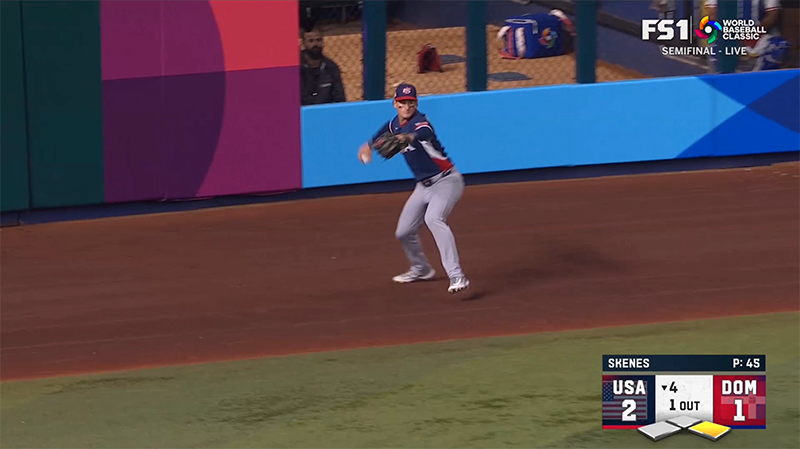
They chop their steps and time things so that the ball arrives between their feet rather than way out in front of them. They get low to field the ball, but their chests aren’t tucked tightly against their knees. They still look like athletes. To be fair, they’re also benefitting from a more flattering angle, but let’s break down the video of Anthony on Guerrero’s double frame by frame just to make sure we understand the progression.
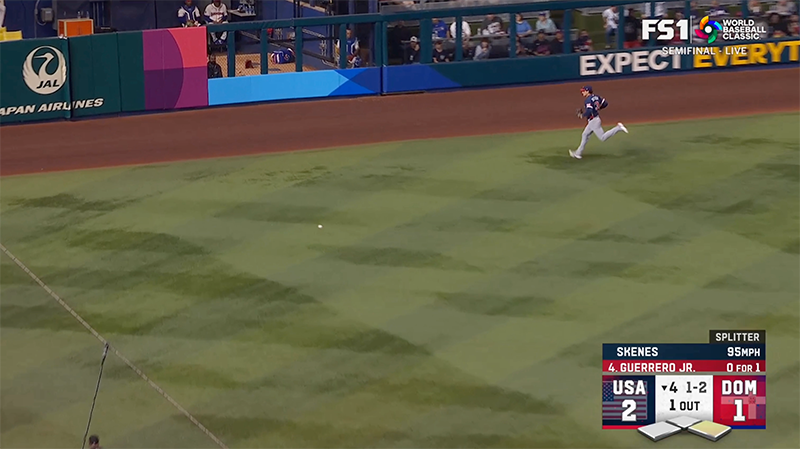
Here’s Anthony running after the ball with his trademark long, graceful strides. He’s a 6-foot-3 miracle with a 55 current value on his run tool.
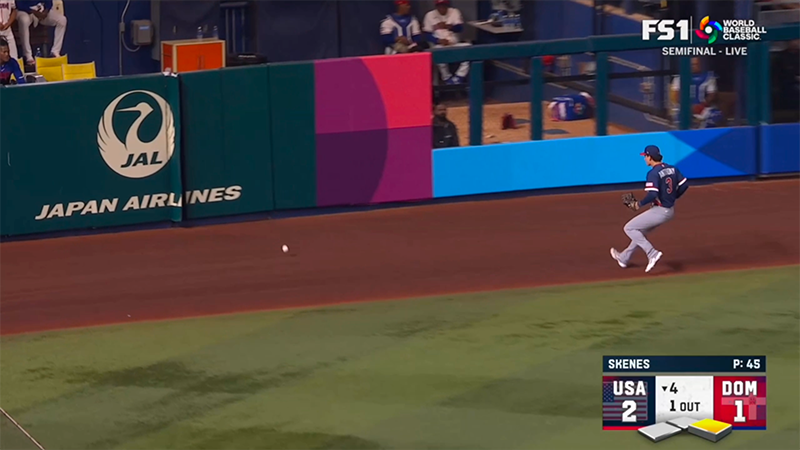
Next, here he is putting on the brakes. He may be slowing down, but the picture is still alive with movement as he powers down into a hover.
And here Anthony is, settling into a defensive crouch as he awaits the carom off the wall. He’s low, he’s alert, he’s ready for anything. Wherever this ball decides to bounce, he’s about pounce.
Um, so this is Anthony scuttling like a crab. He’s scuttling like a crab now. The ball didn’t so much bounce off the wall as it did die on the wall, and Anthony just kind of stayed in the crouch and started – sorry, scuttling is really the only word I can think of that applies here – toward it.
So this is the difference between a professional athlete and a toddler. When the right leg is still extended, planted in the ground for maximum leverage, the foot digging into the dirt at an angle, Anthony is a force to be reckoned with. Once the right leg is bent, he’s completely flat-footed, knees to his chest, left elbow stuck way out to the side so he can wrap his arm around his leg; he’s everyone’s nephew, powerless to stop himself from befriending a worm.
This is the frame that really takes it over the toddler top. For some reason, Anthony doesn’t grab the slow-moving ball with his fingers. He reaches out with his hand angled back. It looks like he doesn’t know what to do, so he’s just going to slap the baseball. He lets it get deep into his palm and grabs it with his whole hand. Professional baseball players do not grip the baseball that way. They have enormous hands and get a four-seam grip, holding the ball with their fingertips. There’s air between the ball and their palm. When Anthony finally picks up the ball, he holds it the way you might cradle a melon.
After that, sadly, Anthony returned to his usual status as a fearsome baseball warrior blessed with grace and agility.
Anthony has a long career ahead of him, and he will awe us with many astounding feats of power and dexterity. For now, though, let’s make sure we treasure this memory of him as an adorable toddler before he hits the terrible twos.